
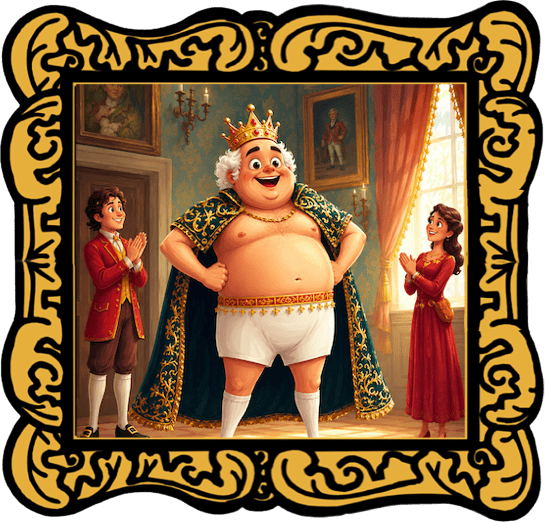

The Emperor’s New Clothes is a classic Hans Christian Andersen fairy tale about pride, fear and the danger of pretending something is true just because everyone else says it is. This retelling keeps the heart of Andersen’s famous version while using clear, child-friendly language. Below, you can read the full story, then explore the summary, moral, meaning, vocabulary, discussion questions and classroom activities.
- Independent Reading Age: 8-11
- Reading Level: Upper Elementary (Grades 3-5)
- Reading Time: 9-10 minutes
- Author / Source: Hans Christian Andersen, based on an older tale
- Story Type: Literary fairy tale
- Region / Origin: Denmark
- Main Characters: The emperor, two swindlers, minister, courtiers, child
- Moral / Themes: Truth, vanity, pride, honesty, appearances, fear of judgment
The Story of The Emperor’s New Clothes
A Fashion-Obsessed Emperor
Long ago, in a grand and prosperous kingdom, there lived an emperor who cared about just one thing—his clothes. Not his people. Not his army. Not even the theatre or the arts. What he loved most was fashion.
This emperor owned more outfits than anyone else in the land. He had clothes for every hour of the day. While most kings were said to be “in council,” people would say of this ruler, “The emperor is in his dressing room.”

His palace buzzed with tailors, dressmakers, and fabric merchants. He spent all his gold on silk, lace, velvet, and fine embroidery. The emperor’s obsession was no secret—his subjects spoke of little else.
Two Strangers Arrive

One day, two strangers arrived in the capital. They called themselves weavers and claimed to be able to create the most beautiful fabric ever seen.
But that wasn’t all.
They said their cloth had magical properties: it would be invisible to anyone who was foolish or unfit for their job.
As soon as word reached the emperor, he was delighted. “If I wear clothes made of this special cloth,” he thought, “I’ll be able to tell who in my court is clever and capable—and who is not. What a wonderful idea!”
So the emperor ordered a large sum of gold to be paid to the weavers and told them to begin at once.
The Work Begins – Or Seems To

The two men were given a grand room in the palace. They set up looms and pretended to work. Day after day, they moved their hands and clicked their looms, but there was nothing actually being woven. No thread. No fabric. Nothing at all.
Still, they demanded the finest silk and the purest gold thread. These, they said, were needed to make the magical cloth. But instead of weaving, they stuffed all the valuable materials into their bags and continued to pretend.
Everyone in the city was curious. Everyone had heard about the enchanted fabric. And everyone secretly worried whether they would be able to see the cloth.
The Emperor Sends His Minister

The emperor was eager to see the progress, but he hesitated. What if he couldn’t see the cloth? That would mean he was either foolish or unworthy of his throne. Best to be cautious, he thought—so he sent his most loyal minister to check on the weavers.
The minister was wise and respected. Surely he could judge whether the cloth was as marvellous as claimed.
When the minister arrived, he saw the weavers hard at work. But there was nothing on the looms.His eyes widened. “I can’t see anything!” he thought. “Does that mean I’m a fool? That I don’t deserve my position? I mustn’t let anyone know.”
So he lied.
The weavers smiled and gestured to the empty looms.
“Isn’t the pattern stunning?” one said.
“The colours are so vibrant,” said the other. “Don’t you agree?”
The poor minister squinted and nodded. “Oh yes, it’s absolutely beautiful. Such craftsmanship!”
He listened carefully as they described the “colours” and “design,” memorising every detail so he could report back to the emperor without suspicion.
Another Visit, Another Lie

The emperor was pleased with the minister’s report, but he wanted to be sure. So he sent another official—a trusted advisor known for his intelligence and honesty.
But just like the minister, the advisor saw nothing on the loom. He too feared being labelled a fool or unfit for his post.
So he lied.
“Amazing!” he said. “So light, so elegant. A true masterpiece.”
The Lie Spreads
Soon, news of the emperor’s magical clothes spread through the entire city. Everyone talked about the fabric—its shine, its elegance, its enchantment.
No one admitted they couldn’t see it.
Everyone lied.
The Emperor Sees for Himself
Eventually, the emperor decided it was time to view the clothes himself. He brought with him his two trusted officials and a group of courtiers.
The weavers bowed deeply. “Your Majesty, behold your new garments!”
They pointed to the empty looms, describing every imagined detail.
The emperor blinked. He saw nothing.
“Am I truly unfit to rule?” he thought. “Is that what this means?” Fear gripped his heart.
But he couldn’t admit he didn’t see anything. He straightened his back, forced a smile—and lied.

“Exquisite. The colours are delightful. The pattern is simply perfect.”
The courtiers all nodded enthusiastically. “Yes, yes! Quite splendid!”
Everyone was determined not to be the first to admit the truth.
The emperor turned to the weavers. “I shall wear this outfit in the grand parade,” he declared. “Let it be finished in time.”
Final Preparations
The night before the parade, the two weavers lit candles and pretended to work through the night. They moved their scissors through the air, cutting imaginary fabric. They stitched invisible thread and held up garments that weren’t there.
In the morning, they announced, “The clothes are ready.”
The emperor arrived with his courtiers.
The weavers helped him “dress,” pretending to fasten buttons and smooth down fabric.

“It’s as light as air,” they said. “You’ll feel as if you’re wearing nothing at all.”
“How elegant!” said the courtiers. “How regal!”
“Would Your Majesty like to see yourself in the mirror?”
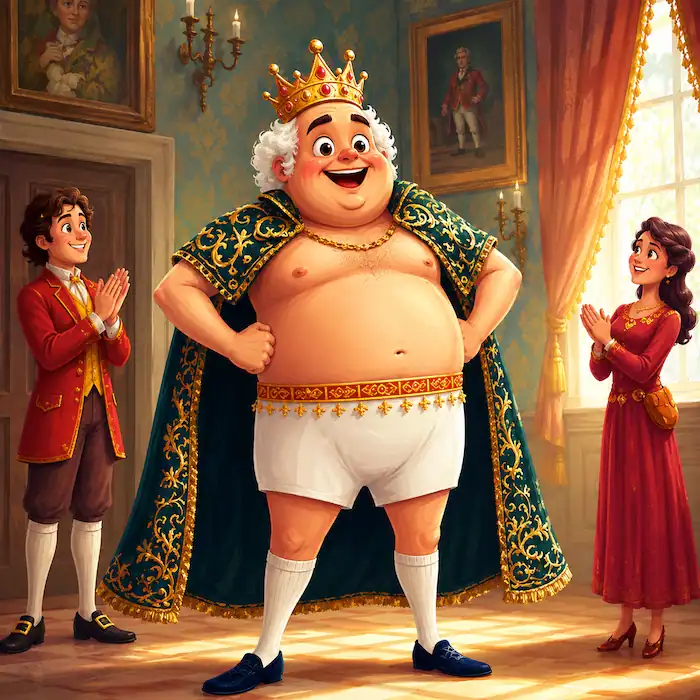
The emperor turned slowly and looked. Nothing.
But he nodded and smiled. “Very fine. Extremely well-made.”
The royal procession was ready to begin.
The Parade Begins
Outside, the streets were lined with people. Flags fluttered. Drums beat. Trumpets sounded.
The emperor stepped out under a golden canopy. Everyone cheered and clapped.They had all heard that only the wise could see the clothes. So no one wanted to admit they saw nothing.

So they lied.
“Such beautiful fabric!” someone shouted.
“The embroidery is flawless!” cried another.
People strained to admire what wasn’t there, terrified that others might discover they were fools.
The emperor marched proudly through the streets, head held high. Behind him, chamberlains held up his “train,” their hands grasping empty air.
A Child Speaks

Suddenly, a small voice broke the silence.
“But he’s not wearing any clothes!” said a child.
Gasps spread through the crowd.
“Hush!” said the mother. “Don’t say such things!”
But others began whispering. “The child is right! He’s got nothing on!”
Louder and louder, the truth spread.
“The emperor has no clothes!”
The emperor heard it.
He blushed. He knew deep down that the crowd was right—and the tailors had tricked him out of a fortune.

But he couldn’t admit it. He had come too far.
“I must finish the parade,” he thought. “There’s no turning back now.”
So he stood taller than before and walked on proudly as his chamberlains held up the invisible train of his invisible clothes.

The Emperor’s New Clothes Summary
The Emperor’s New Clothes is a fairy tale about a ruler who cares too much about fashion and appearance. Two swindlers trick him by claiming they can make magical clothes that only wise and worthy people can see. Afraid of looking foolish, the emperor, his officials and the crowd all pretend to admire clothes that do not exist. In the end, a child speaks the truth and says plainly that the emperor is wearing nothing at all.
What Is the Moral of The Emperor’s New Clothes?
The moral of The Emperor’s New Clothes is that people should tell the truth even when others stay silent.
The story also warns against:
- Vanity
- Pride
- Fear of embarrassment
- Following the crowd
- Pretending to believe something just to fit in
The child is the only one brave enough to say what everyone else can already see. That is why the story still works so well: it shows how easy it is for people to ignore the truth when they are afraid of being judged.
More Hans Christian Andersen Stories
If you enjoyed The Emperor’s New Clothes, you may also like these other Hans Christian Andersen tales:
The Princess and the Pea – a classic story about judgment, appearances and a very unusual test
The Ugly Duckling – a tale about rejection, identity and discovering your true worth
The Little Mermaid – a moving fairy tale about longing, sacrifice and change
The Little Match Girl – a short, powerful story about hardship, hope and compassion
Thumbelina – the story of a tiny girl on a strange journey to find where she belongs
The Red Shoes – a darker tale about vanity and consequences
The Tinderbox – a magical adventure involving a soldier, a witch and three enormous dogs
The Emperor and the Nightingale – a story about pride, beauty and what is truly valuable
Stories With Similar Themes
Looking for more stories about truth, pride, foolishness and seeing past appearances? Try these next:
The Gingerbread Man – a comic tale about overconfidence and consequences
The Three Little Pigs – a story where foolish choices lead to trouble
The Vain Little Mouse – a folktale about vanity, flattery and the danger of judging by charm and appearances
Vocabulary Spotlight
Prosperous – Rich or successful.
Obsession – Something a person thinks about all the time.
Courtiers – People who attend a king or emperor at court.
Invisible – Unable to be seen.
Exquisite – Very beautiful and finely made.
Regal – Suitable for a king, queen or ruler.
Swindlers – People who cheat others out of money by tricking them.
Satire – A story that uses humor or exaggeration to expose foolish behavior.
Teacher’s Note
The Emperor’s New Clothes works particularly well in upper elementary because children this age can usually grasp both the simple plot and the deeper social message.
At one level, it is a funny story about a vain ruler being tricked. At another, it opens up useful discussion about:
- honesty
- peer pressure
- fear of standing out
- the difference between truth and performance
- why people sometimes go along with things they know are wrong
It is also a strong text for introducing satire in an age-appropriate way. Children do not need a formal literary lecture on satire. They just need help noticing that the story is laughing at foolish pride and at the crowd’s behavior.
This story also works well alongside classroom conversations about leadership, integrity and speaking up.
Parent and Teacher Discussion Questions
Why do the two swindlers succeed so easily?
Why does the minister pretend to see the cloth?
Why does the emperor lie when he sees nothing?
Why does the crowd join in, even when the truth is obvious?
Why is it important that a child speaks the truth, not an adult?
What does the story say about pride?
What does it say about fear of embarrassment?
Have you ever seen people agree with something just because others were agreeing too?
Was the emperor only foolish, or was he also weak?
Is the child brave, honest or both?
How would the story change if one official had spoken up earlier?
Why do you think this story has lasted for so long?
Classroom Activities for The Emperor’s New Clothes
1. Truth and Pressure Chart
Ask children to make a two-column chart.
Column 1: What characters really think
Column 2: What they actually say
This helps children see the gap between truth and public performance.
2. Freeze Frame Drama
In small groups, children create still scenes from key moments:
- the minister at the loom
- the emperor in the mirror
- the parade crowd
- the child speaking out
Then ask each group what each character is feeling in that moment.
3. Write the Missing Thought Bubbles
Give children scenes from the story and ask them to write what each character is secretly thinking.
Examples:
- the minister
- the emperor
- a courtier
- a person in the crowd
- the child’s mother
This is a strong comprehension and empathy task.
4. Satire Made Simple
Ask:
What is the story making fun of?
Children can sort answers into:
- pride
- pretending
- following the crowd
- power
- fear of looking foolish
This gives them an accessible way into satire without overcomplicating it.
5. Newspaper Report
Have children write a newspaper article with a headline such as:
EMPEROR PARADED IN NO CLOTHES
or
CHILD EXPOSES ROYAL FASHION FRAUD
They should include:
- who
- what
- where
- when
- why
- quotes from witnesses
This works well for cross-curricular writing.
6. Design the “Invisible” Outfit
Let children draw and label the imaginary outfit the swindlers claim to have made. Then ask them to write the sales pitch the swindlers might have used to flatter the emperor.
This is useful for inference and persuasive writing.
7. Debate: Who Is Most to Blame?
Set up a short class debate. Possible answers:
- the swindlers
- the emperor
- the officials
- the crowd
Children must justify their view with evidence from the story.
8. Compare the Child and the Adults
Create a comparison table:
- what they see
- what they fear
- what they say
- why they say it
This is a simple but effective critical thinking activity.
9. Hot Seating
One child takes the role of:
- the emperor
- the minister
- one of the swindlers
- the child
The class asks questions in role.
Examples:
- “Why didn’t you tell the truth?”
- “Did you know you were being foolish?”
- “Did you feel ashamed?”
10. Modern Link Task
Ask children to think of a modern situation where people might pretend something is good, true or impressive because everyone else says it is.
Keep this broad and age-appropriate. The goal is not cynicism. The goal is learning to think independently.
Writing Prompts
- Write a diary entry from the emperor after the parade.
- Write a letter from the minister explaining why he stayed silent.
- Write a sequel in which the emperor finally admits the truth.
- Imagine one brave official spoke up earlier. Rewrite that scene.
- Write a speech from the child explaining why honesty matters.
History of The Emperor’s New Clothes
Hans Christian Andersen published The Emperor’s New Clothes in 1837, and his version is the one most readers know today. Although it is often grouped with older traditional tales, Andersen’s version is a literary fairy tale, meaning it was written by a named author rather than passed down anonymously for generations.
The story was not entirely original in plot. Andersen is generally understood to have based it on an older Spanish tale from Count Lucanor, written by Don Juan Manuel in the 14th century. In that earlier version, the trick is different: the false cloth is said to be invisible to people of illegitimate birth.
Andersen changed that idea. In The Emperor’s New Clothes, the clothes are said to be invisible to anyone who is foolish or unfit for office. That change makes the story feel sharper and more modern, because it turns the tale into a warning about vanity, fear, status and the danger of pretending to believe something just to protect your reputation.
That is one reason the story has lasted. It is funny on the surface, but underneath it is really about pride, social pressure and the courage it takes to say what is plainly true.
This famous idea has lasted so well that people still use the phrase “the emperor has no clothes” when they want to point out that something widely praised is actually false, weak or empty.
Frequently Asked Questions About The Emperor’s New Clothes
-
What is The Emperor’s New Clothes about?
The Emperor’s New Clothes is about a vain ruler who is tricked by two swindlers into believing he is wearing magical clothes. Because everyone is afraid of looking foolish, they pretend to admire clothes that do not exist until a child tells the truth.
-
What is the moral of The Emperor’s New Clothes?
The moral is that people should speak the truth even when others are afraid to do so. The story also warns against vanity, pride and following the crowd.
-
What does The Emperor’s New Clothes mean?
The story means that pride and social pressure can stop people from admitting what is obvious. It also shows how fear of looking foolish can keep people from speaking honestly.
-
Who wrote The Emperor’s New Clothes?
The Emperor’s New Clothes was written by Hans Christian Andersen and published in 1837.
-
Is The Emperor’s New Clothes a fairy tale?
Yes. It is usually classified as a literary fairy tale because the best-known version was written by Hans Christian Andersen rather than passed down anonymously as a traditional folk tale.
-
Was The Emperor’s New Clothes based on an older tale?
Yes. Andersen’s story is generally linked to an older Spanish tale in Count Lucanor by Don Juan Manuel, written around 1335.
-
What was different in the older tale?
In the older Spanish version, the false cloth is said to be invisible to people of illegitimate birth. Andersen changed that idea so the clothes are invisible to anyone who is foolish or unfit for office.
-
Why can’t the adults tell the truth?
The adults are afraid of being judged. They worry that if they admit they cannot see the clothes, others will think they are foolish or unfit for their positions.
-
Why is the child important in The Emperor’s New Clothes?
The child is important because the child says what everyone else is too afraid to say. That breaks the spell of social pressure and exposes the lie.
-
Why is The Emperor’s New Clothes still famous?
The story is still famous because its lesson still feels true. People still pretend to agree with things out of fear, pride or pressure from others.
-
Why is The Emperor’s New Clothes still famous?
The story is still famous because its lesson still feels true. People still pretend to agree with things out of fear, pride or pressure from others.