


The Story of The Tinderbox
A soldier came marching down the road with steady steps.
One, two. One, two.
His boots were dusty from long travels. His knapsack hung across his back, and his sword knocked against his side as he walked. He had been away at war and now he was heading home, though he did not have much more than the clothes he wore.
The road ran past fields, then through a patch of crooked woodland where the branches crossed overhead like bony fingers. As the soldier went by a huge old tree, someone stepped out from behind it.
She was an old witch. Her tangled gray hair hung in wild strands, and her black dress looked ragged and worn. Worst of all was her long nose and the greedy grin that spread across her face as she peered out from the hollow tree.
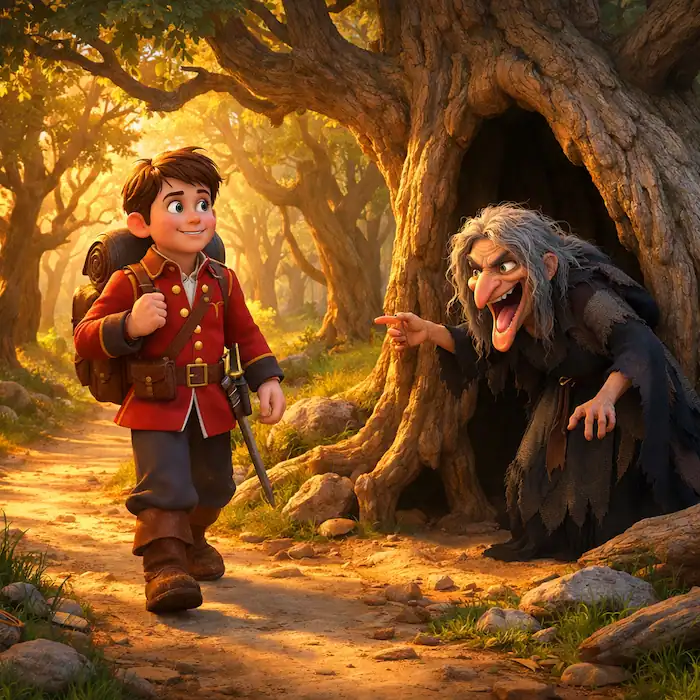
“Good evening, soldier,” she croaked. “That is a fine sword, and what a fine knapsack. You look every inch a soldier. Would you like more money than you could ever spend?”
The soldier stopped and looked at her carefully.
“That sounds generous,” he said. “Too generous. What would I have to do?”
The witch pointed a bent finger at the tree. “See that trunk? It is hollow inside, all the way down to the roots. Climb in, I will tie a rope around your waist, and you can lower yourself into the hollow beneath the tree.”
“And what is under there?” asked the soldier.
“A great underground hall,” said the witch. “It is bright as day, because hundreds of lamps burn there all the time. In that hall are three doors. Behind each door is a room. In each room sits a chest full of money.”
The soldier raised an eyebrow. “That sounds easy.”
The witch gave a dry laugh. “Not entirely. In the first room, the dog has eyes as big as teacups. In the second, the dog has eyes as big as cartwheels. In the third, the dog has eyes as big as the great round tower in the city. Each dog sits on top of a chest.”
The soldier blinked. “That is a very odd thing to say.”
“It is also true,” said the witch. “Still, do not be afraid. I will lend you my blue checked apron. Spread it on the floor, lift the dog onto it, and the beast will not harm you. Then open the chest and take what you like. The first chest holds copper coins. The second holds silver. The third holds gold.”
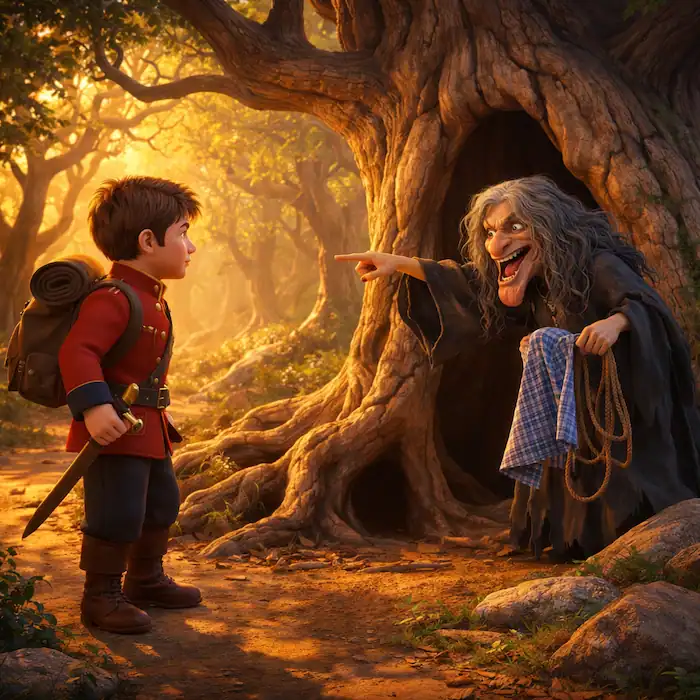
The Rooms of Copper, Silver and Gold
The witch tied the rope firmly around him and handed him the blue checked apron. Then the soldier climbed the tree, found the dark opening and lowered himself down into the hollow trunk.
Down, down, down he went.
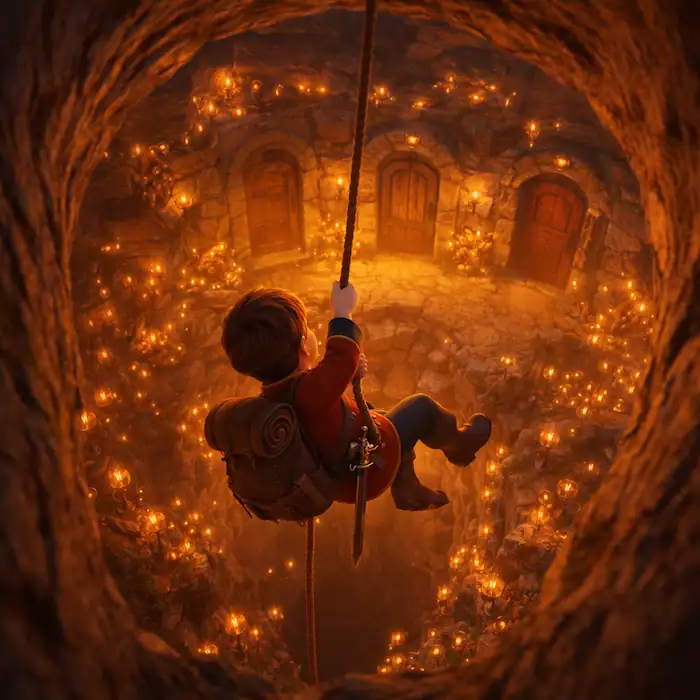
At last his boots touched the ground.
The witch had spoken true. He stood in a broad stone hall lit by rows of lamps that flickered against the walls. Three doors stood ahead of him, each with a key already waiting in the lock.
He opened the first door.
There, in the middle of the room, sat a chest. On top of it crouched a dog with enormous round eyes, each one as wide as a teacup. The creature stared so hard that the soldier nearly laughed.
“You are a queer fellow,” he said.
He spread the witch’s apron, lifted the dog onto it and opened the chest. Inside were heaps of copper coins that shone in the lamplight.
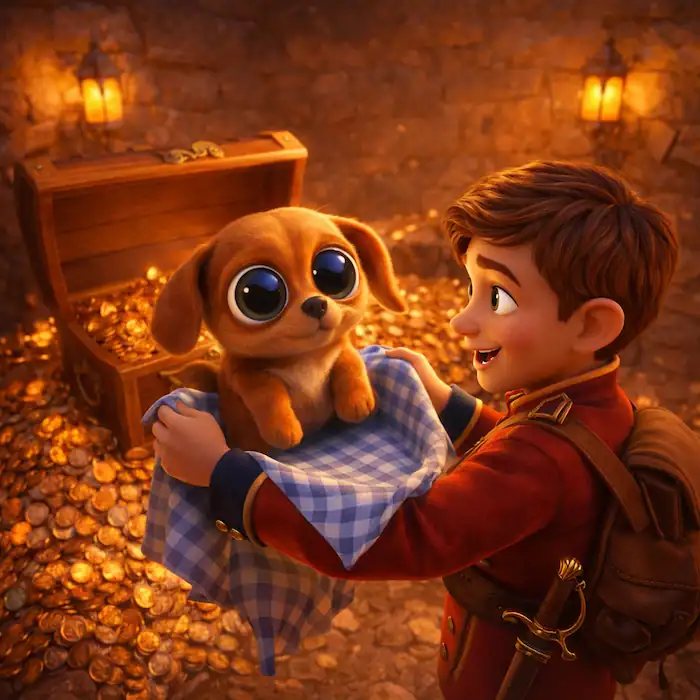
He filled both pockets, though not for long.
“If I can do this once,” he muttered, “I can do better next door.”
So he shut the chest, set the dog back in place and tried the second room.
In the second room the dog’s eyes were larger still, huge and round as wheels. They rolled as the soldier came in.
“Now that is a stare,” said the soldier.
Again, he placed the dog on the apron. Again the beast did nothing.

Then the soldier opened the second chest, and when he saw the silver inside he tipped out all his copper and stuffed his pockets and knapsack with silver instead. Still he was not satisfied.
He went to the third room.
At first he nearly stepped back. The dog on the last chest was the strangest creature he had ever seen. Its eyes were so large they seemed almost too heavy for its head. They turned slowly toward him, bright and round and shining in the dim room like great lanterns.But the soldier had already grown bold.
“Well,” he said, “you are the biggest of the lot.”
He set down the apron, lifted the dog and opened the chest. Gold.Not a handful of gold. Not a purse. A mountain of it. Coins lay stacked and piled and spilling against the sides of the chest.The soldier gave a low whistle.
He dropped the silver at once and filled his pockets with gold. Then his boots. Then his knapsack. Then his cap. By the time he was done, he could hardly bend or breathe, but he was grinning from ear to ear.
Then, just as he reached the door, he stopped.
“The tinderbox,” he said aloud. He found it tucked away in a corner, old and plain and blackened with soot. It did not look special at all. Still, he shoved it into his pocket and returned to the hall.
“Pull me up!” he shouted.
The Witch Asks for Her Price
The rope tightened and up he rose through the hollow tree until he saw daylight again.
The witch leaned over him eagerly.
“Have you got it?” she asked. “Have you brought me the tinderbox?”
The soldier dragged himself out onto the road, his boots and pockets heavy with gold.
“Yes,” he said. “I have it. Now tell me why you want it.”
“That does not concern you,” snapped the witch. “Give it here.”
The soldier narrowed his eyes. “You promised me riches, and I have them. But you want that shabby old box more than all the money below. I mean to know why.”
The witch stamped her foot. “Hand it over.”
“No.”
The witch hissed through her teeth and reached for him.
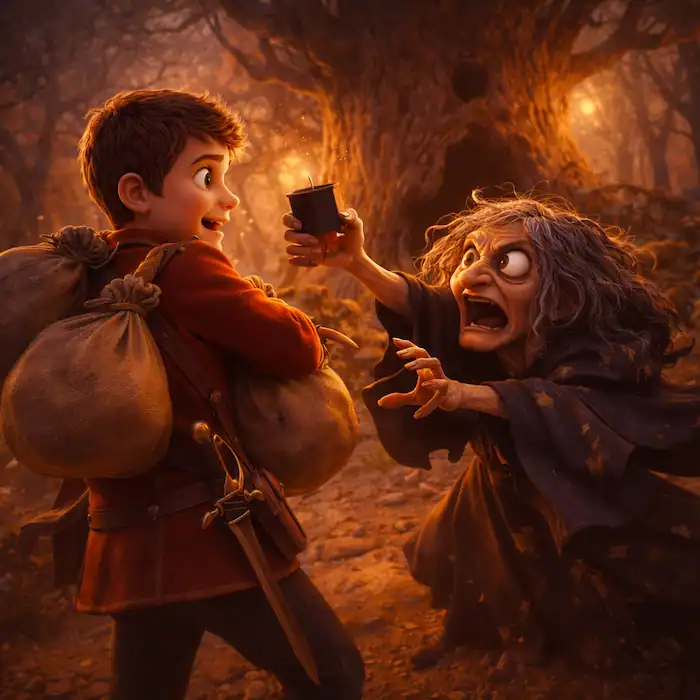
The soldier drew his sword. The quarrel flared quickly and fiercely, and in the end the soldier struck the witch down on the roadside.
For a moment, the world went still.
Then he took a breath, tied up his gold in the blue checked apron, tucked the tinderbox deeper into his pocket and walked on toward the city.
He did not look back.
A Fine Life in the City
The city was grander than any he had seen before. Its streets were busy from morning till night. Carriages rattled over stone roads. Market stalls overflowed with bread, ribbons, fruit and roasted meat. Church bells rang above crowded rooftops, and sunlight flashed from windows high overhead.
The soldier rented handsome rooms at the best inn. He ordered excellent dinners and warm baths. He bought polished boots, velvet coats and shirts with bright buttons. In only a few days he no longer looked like a dusty traveler. He looked like a wealthy gentleman.
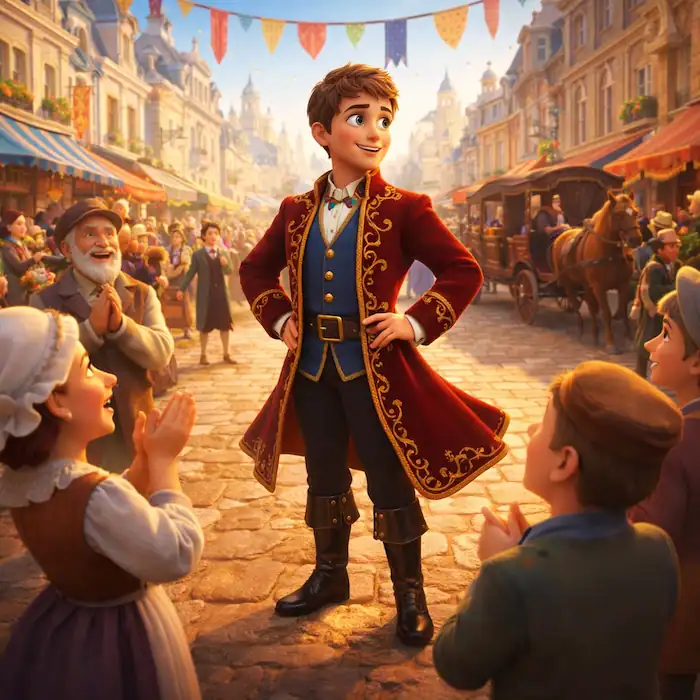
Because people admired fine clothes almost as much as they admired money, he soon had many new companions.
They invited him to dinners and gardens and the theater. They laughed at his stories and praised his generous ways. He gave coins to beggars, tipped servants well and spent freely because he had never before known what it was like to have enough.
One evening, while dining with cheerful townsfolk, he heard talk of the royal family.
“The King has only one daughter,” said a merchant’s wife. “They say she is the loveliest princess in the land.”
“But no one sees her,” said another. “She is kept inside a great copper castle, behind walls and towers.”
“Why?” asked the soldier.
“Because a prophecy said she would one day marry a common soldier. The King and Queen dislike that very much.”
The soldier smiled into his cup. “And so they have locked her away?”
“As if walls could stop fate,” said the woman.
That thought stayed with him.
From Riches to Rags
For a time he lived merrily. He enjoyed the city. He bought gifts, treated his new friends and rode in carriages through the royal gardens. Yet gold runs out quickly when it pours from an open hand.
At last his purse grew thin.
Then it was empty.
One by one he sold his fine things. He left the inn and rented a poor little attic room under the roof of a narrow house. The stairs were steep and the walls were bare. Wind slipped through the cracks in the window frame, and at night the room was so dark he could not even see his own hand.
His grand friends stopped calling.
The soldier sat alone on a broken chair and gave a humorless laugh.
“So that is friendship,” he said.
That evening he searched his old things and found the black tinderbox.
“I may as well use it,” he muttered. “At least I can light a scrap of candle.”
He struck the flint.
At once the door flew open.
In bounded the dog with eyes as big as teacups.
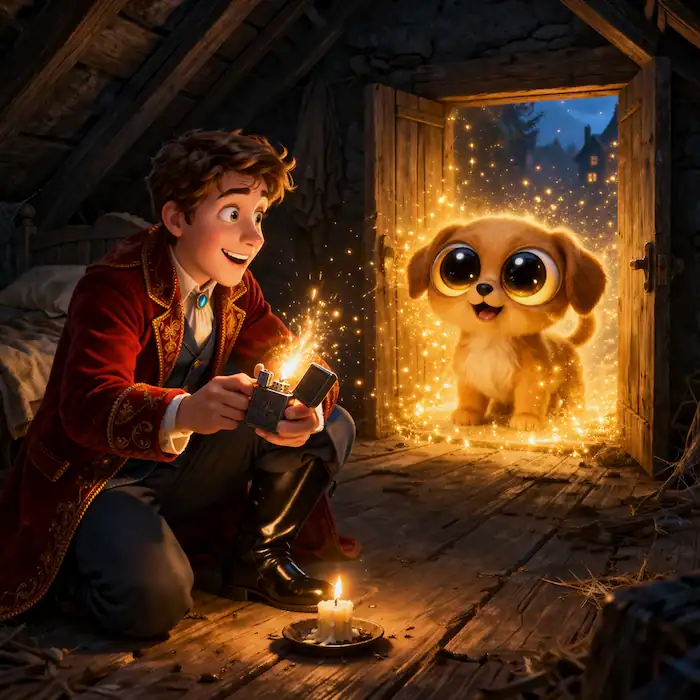
It sat before him and said, in a deep voice, “What does my master command?”
The soldier nearly dropped the box. “What?”
The dog blinked. “Your command.”
The soldier stared, then grinned slowly. “Bring me money.”
In a flash the dog was gone. In another flash it was back with a bag of copper coins in its mouth.
The soldier leaped to his feet. He struck the tinderbox twice. The dog with cartwheel-sized eyes appeared. When he struck it three times, the great gold-guarding dog stood in the room, nearly filling it.
The soldier laughed aloud. He had not merely found a tinderbox. He had found power. Within days he was rich again.
The Princess in the Night
One night, long after the city bells had struck twelve, he sat by candlelight and took out the tinderbox.
“They say she is beautiful,” he murmured. “Let me see for myself.”
He struck it once.
The dog with teacup eyes appeared.
“Bring me the princess,” said the soldier.
Without a sound the dog vanished.
A moment later it returned carrying the sleeping princess gently on its back.

The soldier caught his breath. She wore a soft white gown. Her hair lay like dark silk across her shoulders, and even asleep she looked calm and proud and bright, as if moonlight had taken the shape of a girl.
The soldier forgot his worn past, forgot the dark tree and the witch and the gold. He only looked at her. Then, moved by wonder and foolish boldness, he kissed her lightly.
“Take her back,” he whispered.
By morning the princess woke in her copper castle and told the King and Queen about the strangest dream. She had ridden through the night on a dog’s back, she said, and a soldier had kissed her.
The Queen set down her cup very slowly.
“That is no dream,” she said.
The next night an old court lady was ordered to watch beside the princess’s bed. Yet when the dog came again, it moved so swiftly that it scooped up the princess and slipped away before the old lady could do more than gasp. She chased them as far as she could and saw them vanish into a certain street. Quickly she marked one door with chalk and hurried home.
But the dog noticed. On the way back it took a bit of chalk and marked every door on the street, and the next street too.
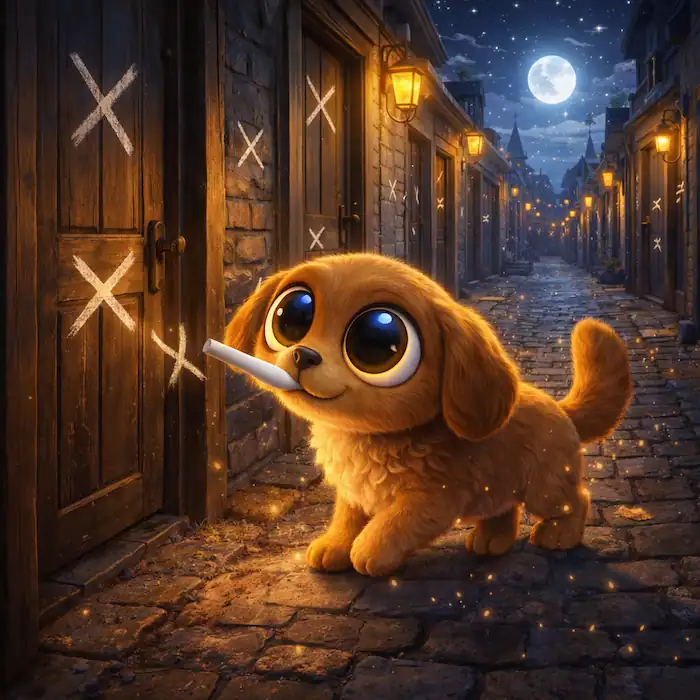
So when the King, Queen and half the court came searching in the morning, they found crosses everywhere and learned nothing at all.
Flour on the Castle Floor
The Queen was cleverer than that.
The following evening she sewed a little silk bag, filled it with flour and tied it to the princess’s back. Then she pricked a tiny hole in the cloth.
Again the dog came.
Again it carried the sleeping princess through the dark city and up to the soldier’s room.
This time, however, a pale trail of flour drifted behind them over stones and along walls and up to the very house where the soldier lived.
In the morning the King and Queen followed it straight to his door.
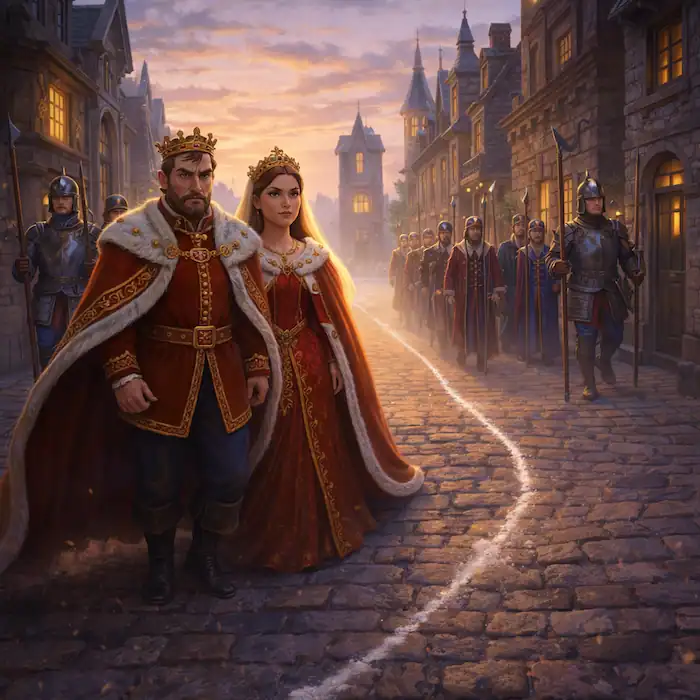
Guards seized the soldier, dragged him away and threw him into prison.
In his shock he forgot all about the tinderbox, which he had left behind in his room.
The Gallows Beyond the Gate
Prison was cold, and the night seemed longer there than anywhere else in the world. By dawn the soldier knew his sentence. He would be hanged outside the town that very day.
He stood at the narrow window, gripping the bars, while crowds hurried past to watch.
Among them ran a shoemaker’s boy in an apron and loose slippers. He ran so fast that one slipper flew off and struck the wall beneath the prison window.
“Boy!” called the soldier. “Come here!”
The boy looked up.
“If you fetch the tinderbox from my room,” said the soldier, “I will give you four silver coins.”
The boy’s eyes widened. He nodded and raced away.
Hours later, as the soldier was led to the gallows, the boy slipped through the crowd and pressed the tinderbox into his hand.
The soldier closed his fingers around it and breathed again.
Outside the city, the gallows stood on a wide open field. Soldiers formed a ring around it. People packed the ground shoulder to shoulder. The King and Queen sat on raised seats beside the judges and councilors, dressed in silks and furs as if they had come to a feast instead of an execution.
The soldier climbed the ladder.
Then he turned and said, “It is the custom to grant a condemned man one last wish. I ask only to smoke a pipe before I die.”
The King, wanting to appear fair before the crowd, gave a stiff nod.
The soldier took out the tinderbox.
Once.
Twice.
Three times.
The air cracked like thunder.
There stood the three dogs.
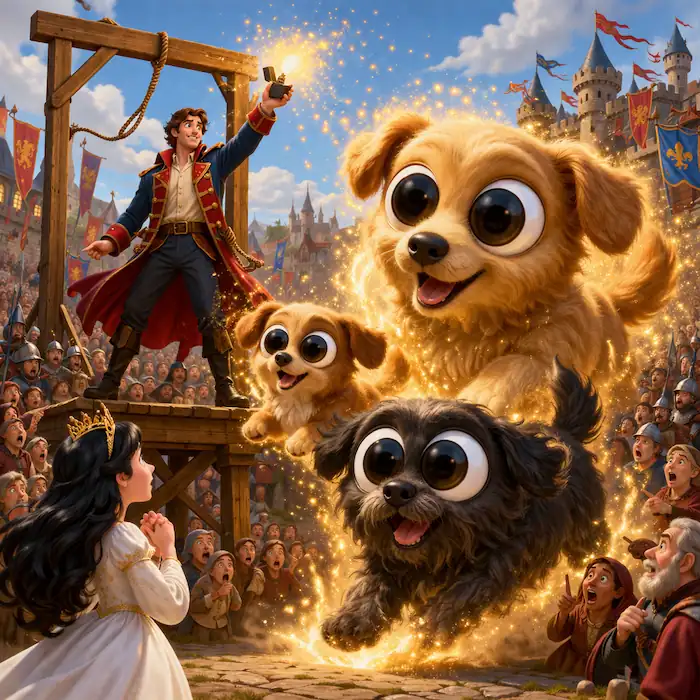
The first leaped toward the judges. The second bounded at the councilors. The third, with the giant eyes, sprang before the King and Queen. In an instant the whole field burst into chaos. Wigs flew. Hats tumbled. The proud and powerful were tossed aside like dolls. People screamed, then scattered, then turned to stare.
No one had ever seen such a thing.
The dogs did not stop until the royal party had been thrown into a frightened, helpless heap, unable to command anyone again.
Then all at once the shouting changed.
“The soldier!” cried someone.
“Let him be king!” shouted another.
“And let him marry the princess!”
The soldiers lowered their weapons. The crowd roared its agreement.
Soon the princess was brought from the copper castle. She looked at the soldier, and though their strange meetings had begun like a dream, she did not turn away. The old prophecy had found its road after all.
So the soldier became king, and the princess became his queen.
As for the three dogs, they sat proudly at the wedding feast with their great eyes shining brighter than the candles. Musicians played for days. Bells rang through the city. Tables groaned with bread, cakes and roasted meats, and everyone talked for years afterward about the wedding where three magical dogs dined among lords and ladies.
And in the middle of it all, on the high table near the king’s hand, lay the old black tinderbox.
Plain to look at, yet powerful enough to change a life.
