

The Story of Thumbelina
A Tiny Wish
Long ago, in a small house with flower pots on the windowsill, lived a woman with a very big wish. She had food on the table, a warm fire in the grate and a neat little home, yet she often sat by the window and sighed.
“If only I had a child,” she whispered, “even a tiny one. Then I would be truly happy.”
One day she walked to the edge of town to visit a wise old woman. Some people called her a witch, others called her a healer, but everyone believed she knew strange and secret things.
The wise woman listened, then nodded.
“I know what your heart longs for,” she said. “Take this barleycorn. It is not the sort that grows in the farmers’ fields or feeds the hens. Plant it in a flower pot, treat it kindly and see what grows.”

The woman thanked her and hurried home.
At once she filled a pot with soil, pressed the barleycorn into the middle and watered it gently.
She set the pot on her sunny windowsill and checked it every morning, her heart full of hope that something wonderful would grow. Soon, a green shoot sprang up. It grew into a tall plant with one large bud shaped like a tulip. Its petals were red and gold, but they stayed tightly closed.
“What a lovely flower,” she whispered. She loved it at once and bent to kiss the smooth bud.
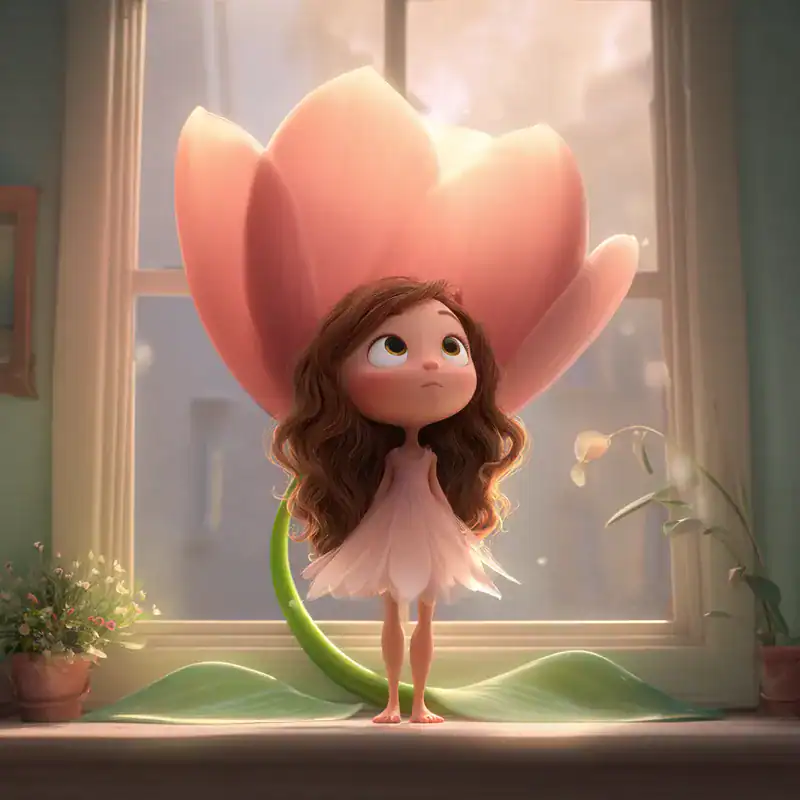
The moment her lips touched the petals, the bud gave a soft crack and opened. Inside there was a girl no bigger than the woman’s thumb. Her hair shone like fine silk, her eyes were bright as morning dew and she wore a dress made of petals.
“Oh,” breathed the woman, “you are the child I always wished for.”
Because the little girl was no taller than a thumb, the woman named her Thumbelina.
A Tiny Girl in a Wide World
The woman loved Thumbelina dearly. She gave her a polished walnut shell for a cradle, lined it with violet petals and tucked her in under a rose leaf each night.
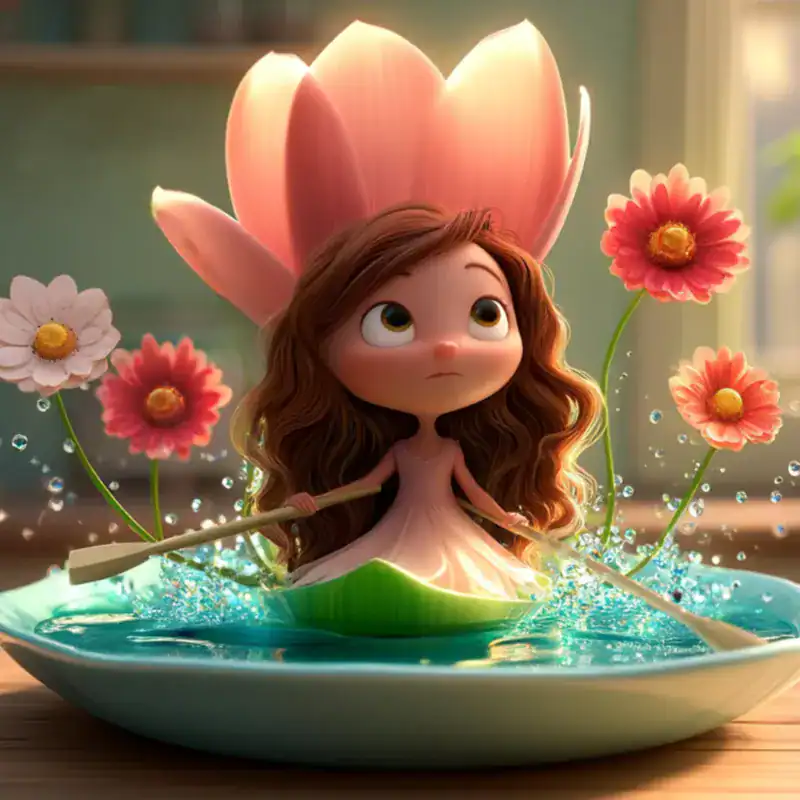
During the day Thumbelina played on the kitchen table. The woman placed a shallow plate of water there and set a wreath of flowers around the edge. On the water floated a broad tulip leaf. Thumbelina used it as a boat and rowed from one side of the plate to the other.
She sang as she sailed. Her voice sounded light and sweet, almost like a bird’s song. Anyone who heard it would have said they had never heard such delicate singing in all their life.
For a while everything was peaceful.
Then, one dark night, while the woman slept, something cold and wet crept in through a crack in the window. A large toad hopped onto the table. Her eyes gleamed when she saw the walnut shell cradle with the tiny girl sleeping under her rose-leaf quilt.
“What a perfect wife she will be for my son,” croaked the toad. “He is a fine young toad, though some say he is ugly. This girl will suit him nicely.”
Without asking anyone, the toad reached up, took the walnut shell in her clammy paws, hopped back through the broken pane and bounded away into the night.
The Stream and the Toad
Outside the garden fence, a wide stream flowed. Near the bank the mud was thick and soft, covered with rushes and water-lilies. This marshy place, damp and gloomy, was where the toad and her son lived.
“My boy,” she called, when she reached her home, “I have found a bride for you.”
Out of the mud popped the son, even uglier than his mother, with bulging eyes and a crooked mouth.
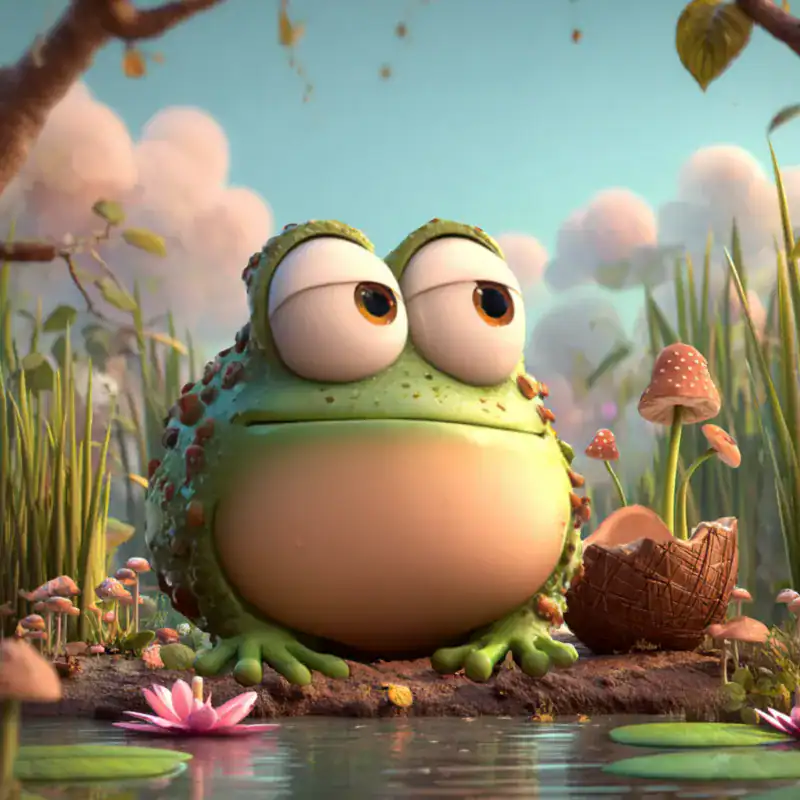
“Croak, croak,” was all he could manage when he saw Thumbelina sleeping.
“Do not shout,” hissed his mother. “You will wake her and she might hop away. She is as light as thistledown.”
Then she had an idea. “We will place her on one of the great water-lily leaves in the middle of the stream,” she said. “That will be like a little island. While she stays there, we can prepare a fine muddy home under the bank for the wedding.”
She carried the Thumbelina out to the stream and chose the biggest lily leaf far from the shore. She set Thumbelina down in the middle, then swam back with her son to decorate their house with yellow buds and rushes.
Morning came. Thumbelina stirred and sat up. At once her heart began to pound. Water glittered all around her. Tall reeds swayed over the stream and she could see no dry land.
“How will I ever get home?” she whispered as tears filled her eyes.

While she wept, the old toad and her son poked their heads above the water near the leaf.
“Here is your husband,” croaked the toad. “You will live with us in the mud where it is very cosy. We are getting your room ready.”
“Croak, croak, croak,” said the son and rolled his large eyes at her.
Thumbelina shivered with fear. She did not want to live in the dark mud. She did not want to marry a toad. Yet she was trapped on the floating leaf.
The River Creatures to the Rescue
Under the water small fish had watched everything. They had seen the toad steal the little girl and they did not like it at all. Thumbelina looked as delicate as a flower petal and they wanted to help her.
They gathered together around the green stalk that held the lily leaf where they nibbled and nibbled until the stalk snapped.

At once the leaf drifted free and began to float away, carried by the streams current.
Thumbelina felt the leaf move. She looked back and saw the muddy bank sliding away. She heard the old toad croaking angrily as the leaf sailed out of reach.
“Good-bye, muddy bank,” she said softly and wiped her eyes. “Thank you, little fish, whoever you are.”
Birds in the bushes along the stream saw the leaf with the tiny girl on it and called, “What a pretty little maid.” The warm sun shone on her face and the water sparkled like melted gold. For a while Thumbelina’s fear faded.
Soon a small white butterfly fluttered past. It circled her leaf once, twice, then settled on the edge, fanning its wings.
“You can travel with me if you like,” said Thumbelina. “I will tie my sash to you and to the leaf and you can pull me along.”
She loosened the ribbon around her waist, tied one end gently around the butterfly and fastened the other to the stem of the leaf. As the butterfly flew, the leaf skimmed faster over the water. Thumbelina laughed with delight.
Just then a shadow swept across the stream. A big beetle buzzed down from a nearby tree. Before Thumbelina could duck, the beetle caught her around the waist with his sharp legs and carried her high into the air.
Her ribbon snapped. Below, the leaf and the butterfly drifted on without her.
The Beetle Tree
The beetle landed on a broad green leaf high in a tree.
“What a curious creature you are,” he said, peering at Thumbelina. “You are not a beetle, but you are quite pretty.”
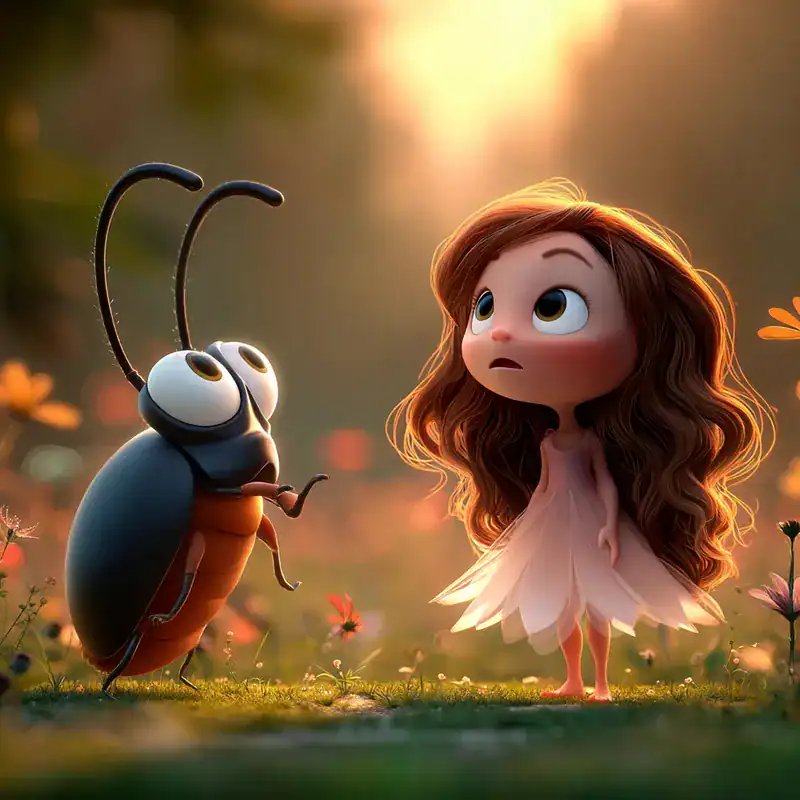
He gave her sweet nectar from a flower to drink and placed her carefully on the leaf. However, the other beetles soon came to look. The lady beetles polished their feelers, glanced at Thumbelina and sniffed.
“She has only two legs,” one said. “How odd.”
“She has no feelers at all,” said another. “Her waist is far too thin.”
“She looks like those great clumsy humans,” added a third. “How ugly she is.”
The beetle who had carried Thumbelina began to feel embarrassed. At first he had thought she was beautiful, yet he did not want the others to laugh at him.
“Perhaps you are not so pretty after all,” he muttered. “You would be happier elsewhere.”
He lifted Thumbelina, flew down out of the tree and set her gently on a daisy in a meadow. Then he buzzed away.
Thumbelina stood alone on the white petals and tears pricked her eyes again.
“They say I am ugly,” she sighed, “but I cannot change how I look. Still, I must try to be brave.”
Summer Alone, Winter at the Door
The long summer days passed. Thumbelina did not see the toad, the beetles or her dear butterfly again. Instead she made a life for herself in the fields.
She wove a hammock from grass and hung it under a broad dock leaf to keep off the rain. She sipped dew from the leaves each morning and ate nectar she found in open flowers. Birds sang above her and crickets chirped below. Although she sometimes felt lonely, the world around her was full of music.
However, summer never lasts forever.
Soon the leaves turned yellow, the air grew sharper and the birds flew away toward warmer lands. The flowers withered and Thumbelina’s dock leaf curled up and dried.
When the first snowflakes fell, Thumbelina gasped. Each flake felt as heavy to her as a shovel of snow would feel to us. She had no coat, no boots, nothing but her thin dress and her courage.

She wrapped herself in a dead leaf and tried to keep warm, yet the cold crept in and she trembled so much she could hardly walk.
Near the edge of the field she saw a low bank where dry stalks of corn stubble stuck out of the frozen ground. To her they were as tall as trees. Between them she noticed a small hole, almost like a tunnel entrance.
She knocked politely and called in a tiny voice, “Is anyone there? Please, may I come in? I am very cold and I have had nothing to eat for two days.”
Mrs Fieldmouse and Mr Mole
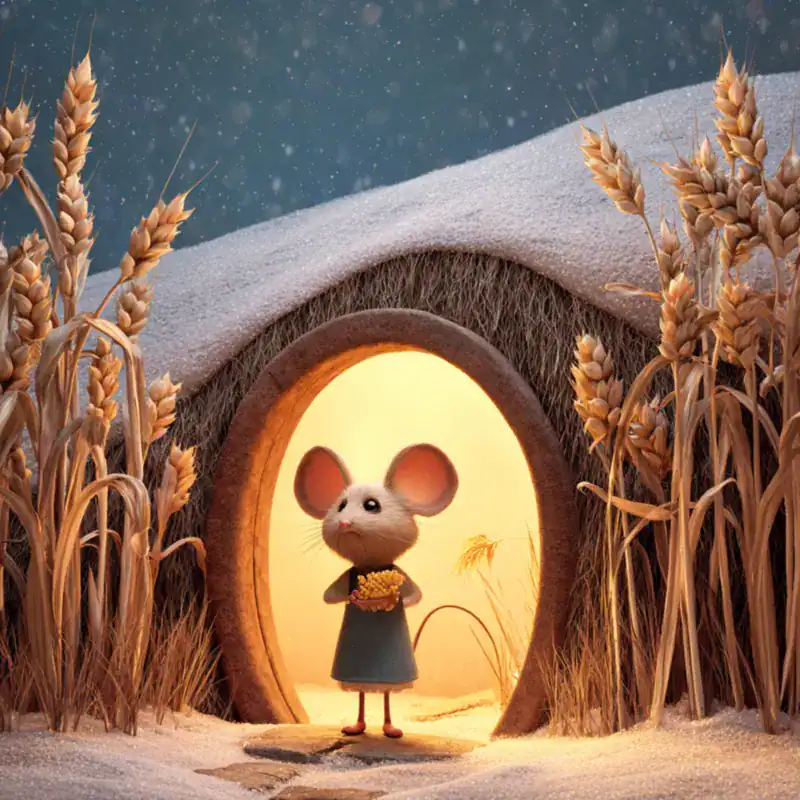
A whiskered nose appeared. It belonged to a field mouse with kind eyes.
“Oh my,” said the mouse, “you look half frozen. Come inside at once.”
The mouse’s home was snug and warm. The walls were lined with stored grain and seeds. A tiny lamp burned near a tidy bed.
“Sit by the fire,” said the mouse. “My name is Mrs Fieldmouse. You may share my dinner, little one. In return you can keep my rooms tidy and tell me stories. I love a good story.”
Thumbelina agreed with joy. She swept the tiny floor, folded Mrs Fieldmouse’s blankets and each evening, sat by the lamp telling tales of sunshine, flowers and singing birds. The mouse listened with her paws tucked under her chin and smiled.
“One more thing,” Mrs Fieldmouse said one day. “My neighbour visits often. He is very rich and very clever. His house is twenty times larger than mine. He wears a fine black velvet coat. If only you could marry him, you would be well provided for. He cannot see, but that hardly matters.”
Thumbelina’s heart sank. “Who is he?” she asked.
“He is Mr Mole,” said Mrs Fieldmouse. “Such a sensible, serious gentleman.”
Soon Mr Mole paid a visit. He wore a sleek black coat and spoke in a deep careful voice. He praised Mrs Fieldmouse’s store of grain and her solid tunnels. He did not praise anything bright or green, because he had never seen the sky, the sun or a flower. In fact he called them all foolish nonsense.
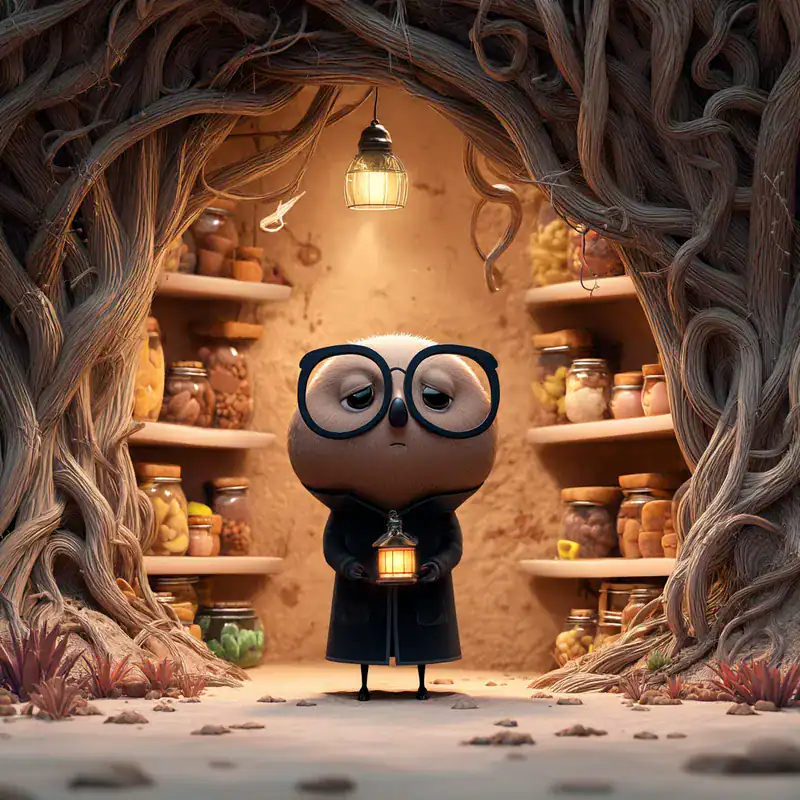
Thumbelina sang for them. She sang songs about birds and meadows and home. Mr Mole tilted his head to listen and grew very quiet. Her clear small voice touched his cautious heart and he began to think, “This little girl would make an excellent wife.”
He said nothing right away because he liked to think for a long time before he spoke. Still, he invited Mrs Fieldmouse and Thumbelina to walk along a new tunnel he had dug between their homes.
“There is a dead bird lying in the passage,” he warned. “It died at the start of winter. Do not be alarmed when you see it.”
The Swallow in the Dark
Mr Mole took a piece of glowing touchwood to light the way and marched ahead. Thumbelina and Mrs Fieldmouse followed.
Soon they came to a place where the roof of the tunnel was very thin. Here Mr Mole pushed up with his broad back until a crack opened and a faint grey light slipped down. In that pale light Thumbelina saw a swallow lying on the earth with its wings folded close and its eyes shut.
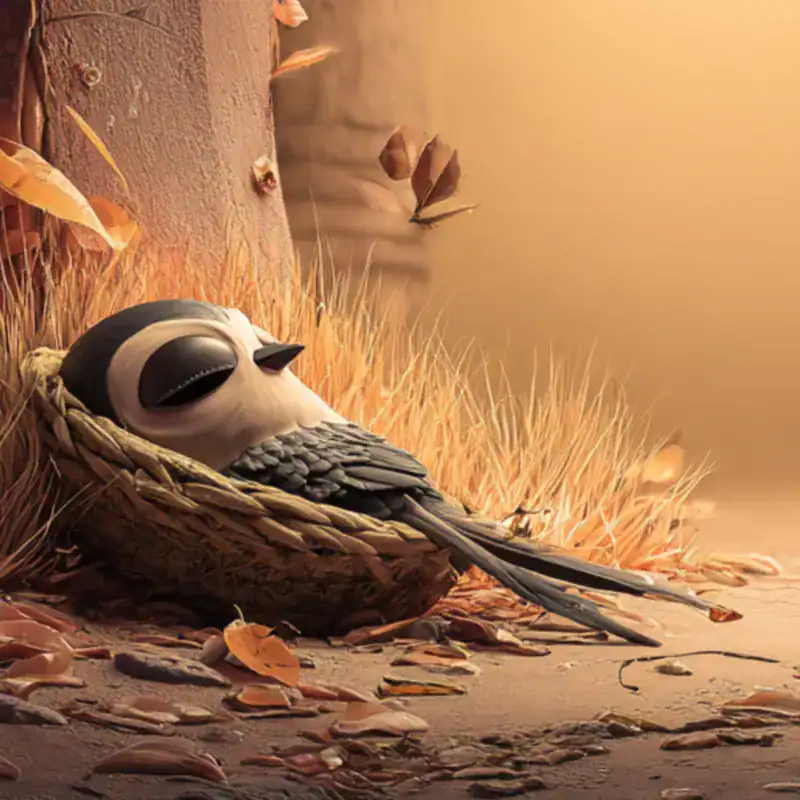
In summer the swallows had flown over her head and filled the air with song. Now one lay silent and still.
“It is good that it is dead,” said Mr Mole. “Silly creatures, those birds. They have nothing but their twit-twit and then they freeze in winter.”
“Yes,” agreed Mrs Fieldmouse, “they think they are so grand, but see how they end.”
Thumbelina said nothing. When the others walked on, she stayed behind a moment. She parted the swallow’s feathers, smoothed its head and kissed it softly.
“Perhaps you sang to me by the stream,” she whispered. “Thank you for your songs, dear swallow.”
Then she followed Mrs Fieldmouse and Mr Mole back home.
That night Thumbelina could not sleep. The thought of the silent swallow in the cold tunnel would not leave her. At last she slipped quietly out of bed, plaited a small blanket from dried grass and carried it along the tunnel. She spread it over the bird and tucked soft, light fluff she had found in Mrs Fieldmouse’s storeroom around its body.
“I wish I could do more,” she murmured. “Sleep well, dear bird.”
She laid her head against the swallow’s chest and suddenly jerked back in fright. Something gave a faint thump under her cheek.
“The heart is still beating,” she gasped. “It is not dead, only weak and cold.”
At once she tucked the grass blanket closer and pulled her own little green leaf shawl over the swallow’s head. Then she ran home, fetched more fluff and carried it back until the bird lay snug and warm.
Every day, when Mrs Fieldmouse and Mr Mole thought she was busy sweeping, Thumbelina crept back to the tunnel with a cup of water in a folded leaf and a few crumbs of grain. Slowly the swallow’s strength returned. Soon its eyes opened and it saw the tiny girl and the dim glow of her touchwood.
“Thank you,” it whispered. “You have saved my life.”
“You must stay still until the spring,” said Thumbelina. “Outside it is freezing and the snow lies deep.”
The swallow told her how it had torn its wing on a thorn bush and fallen behind the others when they flew south. It had grown weak in the cold air, fallen to the ground and remembered nothing more.
All winter the swallow remained in the tunnel, and Thumbelina kept it secret. Mr Mole and Mrs Fieldmouse did not like birds and would never have allowed it in their house.
A Wedding Thumbelina Does Not Want
At last spring came. Warmth crept back through the soil and green shoots pushed up. One day the swallow said, “Open the crack to the sky. I am strong enough to fly again. Come with me, dear Thumbelina. Sit on my back and I will carry you out into the wide world, to green forests and open fields.”
Thumbelina thought of kind Mrs Fieldmouse and shook her head.
“I cannot simply run away,” she said. “She would be sad. Besides, she has arranged for me to marry Mr Mole.”
The swallow looked worried.
“You do not love this mole,” it said gently.
“No,” Thumbelina admitted. “He does not care for the sun or the flowers. Still, I feel I must stay for now.”
The swallow spread its wings.
“Then farewell, brave little friend,” it said. “If you change your mind, call for me.”

With a rush of air the bird squeezed up through the crack into the bright blue sky and flew away.
Thumbelina watched the small shape grow smaller and smaller until it vanished. She felt very alone.
The days grew warmer. Up in the field the corn sprouted and grew tall, so that almost no light reached Mrs Fieldmouse’s doorway. Thumbelina longed for fresh air, yet she could only catch thin strips of blue when the wind parted the stalks.
Mrs Fieldmouse, however, bustled about happily.
“Everything is settled,” she said. “You will marry Mr Mole at the end of summer. You should be grateful. His house is full of food. His black velvet coat is as fine as any queen’s cloak. You will never go hungry or cold.”
Thumbelina felt her chest tighten.
“I do not want to live underground forever,” she said softly. “I love the sun and the open air.”
“Nonsense,” snapped Mrs Fieldmouse. “You are very ungrateful. If you complain again, I will bite you with my sharp teeth.”
So Thumbelina said nothing more. She spun thread for her wedding clothes and four spiders came to help weave the cloth. Every evening Mr Mole visited, praised the darkness and spoke about the fine furniture he was making for his future wife.
At last autumn returned. The corn was cut and only the dry stubble stood in the field. The wedding day drew near.
Flight to the Warm Countries
On the morning she was to go and live in Mr Mole’s home forever, Thumbelina walked up to the field entrance one last time. The air felt cool, yet the sky shone bright.
“Farewell, dear sun,” she said. “Farewell, blue sky.”

She reached up to hug a small red flower still blooming bravely among the stubble.
“If you see the swallow, please give him my love,” she whispered.
At that very moment she heard a familiar sound.
“Twit-twit!”
She looked up. The swallow was flying overhead. When he saw her, he swooped down at once.
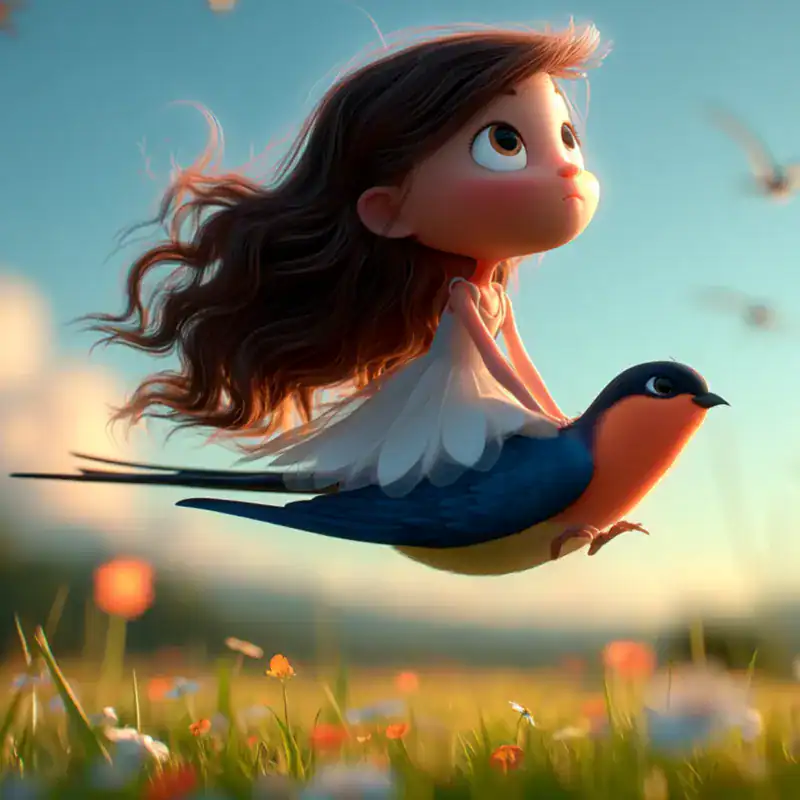
“You look so pale,” he said. “Why are you crying?”
“I must marry Mr Mole,” Thumbelina replied. “I am going to live deep underground where the sun never shines. I feel as if my heart will break.”
“Come with me,” said the swallow firmly. “Winter is coming and I am flying to the warm countries. Tie yourself to my back with your sash. We will leave this field and that gloomy mole far behind. You saved my life. Now let me save yours.”
Thumbelina’s heart leaped. She looked back once at Mrs Fieldmouse’s door, then at the clear sky.
“I will come,” she said.
She untied her sash, fastened one end around her waist and the other to the swallow’s strongest feather. Then she climbed onto his back, put her feet on his wings and held tight.
The swallow rose into the air. They flew higher and higher until the fields and woods became tiny patterns below. Snow already lay on the mountain tops, but Thumbelina nestled among the warm feathers and only peeped out to see forests, lakes and towns passing beneath them.
Queen of the Flowers
After a long journey the air grew soft and warm. The sky turned a deeper, clearer blue. Below them Thumbelina saw green hedges heavy with grapes and gardens full of oranges and lemons. The scent of myrtle and mint floated up. Bright butterflies rested on every bank and children ran along sunlit paths.
“This is the warm country,” said the swallow. “It is always summer here.”
He flew on until they reached a shining white palace beside a blue lake. Marble columns rose in front, wrapped in trailing vines. On the highest part of the building several swallows had built nests.
“This is my home,” he said, “but you need a place of your own. Look down there, among the flowers.”
Beside the fallen remains of a marble pillar a cluster of large white blossoms grew. The swallow flew down and set Thumbelina gently on one broad petal.
In the centre of that flower stood a tiny man, no taller than she was herself. On his head he wore a golden crown.
He was the prince of the flower-folk.
The sight of the great bird had frightened him at first, yet when he saw Thumbelina his eyes shone with wonder.
“You are the loveliest girl I have ever seen,” he said. “What is your name?”
“My friends call me Thumbelina,” she answered, a little shyly.
“That name does not suit you,” he said. “It sounds rough and clumsy and you are so delicate. We will call you Maia, like the flowers of spring.”
He took off his golden crown and gently placed it on her head.
“Will you be my wife?” he asked. “If you say yes, you will be queen of all the flowers in this garden. Each one holds a little person like me. We will dance among the petals and live in the sunlight. You will never again have to live underground.”
Thumbelina looked at the prince, at his kind eyes and gentle smile. She thought of the toad and her dull son, of the beetles who had called her ugly and of Mr Mole who hated the sun. Then she looked up at the swallow who had carried her so far.
“Yes,” she said softly. “I will stay here and be your queen.”
At once tiny lords and ladies stepped out of every flower around them. They brought small sparkling gifts: a ring made from a necklace bead, a crown as golden as honey and a cloak as colourful as butterfly’s wings.
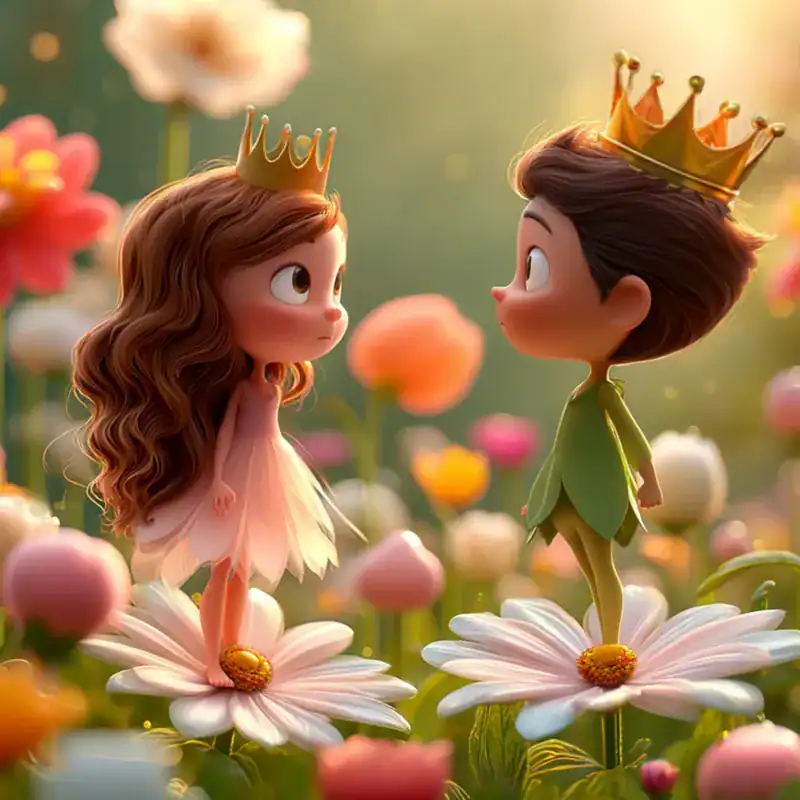
High above them, the swallow sang from his nest. His song was full of joy and just a little sadness, because he loved Thumbelina dearly and knew they would no longer travel together.
“Good-bye, little Maia,” he sang. “You were once alone and unhappy, but now you have found your place in the sun.”
When autumn came again in the north, the swallow flew back to that colder land. He nested above the window of a writer who loved stories. There he sang about the tiny girl, her dangers, her courage, her kindness and her happy life as queen of the flowers.
And that is how we know the story of Thumbelina, the tiny girl who stayed kind and brave, chose her own path and finally found a home where she could grow and shine.