
The Red Shoes Story
A Pair of Shoes Made from Scraps
Karen lived in a small village where summers were dusty and winters were sharp with frost. She was a sweet child but very poor. In warm months she went barefoot. In cold months she wore heavy wooden clogs that rubbed her feet raw.

When Karen’s mother died, the neighbors did what they could. Old Dame Shoemaker, who mended shoes for a few coins, sewed Karen a pair from red cloth scraps. They were lumpy and awkward, yet they were the only shoes Karen had.

So on the day of the funeral Karen followed the straw-covered coffin in those red shoes. She did not mean to stand out. She only meant to walk.

The Lady in the Carriage
A grand old carriage arrived at the churchyard gate. Inside sat an elderly woman with a harsh face. She watched Karen standing alone and her face softened.
She spoke to the pastor. “Here is the child. Give her to me. I will raise her!”
Karen climbed into the carriage with a startled hope. In her mind the red shoes had brought the miracle, as if they were a charm. The old lady did not see them that way at all.

At home the lady frowned at the red shoes. “Those will not do,” she said and threw them into the fire. Karen swallowed her sadness because the house was warm and meals came every day.

The old lady taught Karen to read and sew and to keep herself tidy. She could not see well, yet she could hear everything and she expected obedience.
A Princess in the Parade
One spring the queen traveled through the land with her little daughter. People gathered to watch the royal parade and Karen went too. The princess rode side saddle on a white horse, calm and shining in her bright dress and red shoes.

Karen stared at the princess’s shoes.
They were red leather, smooth and shining, far finer than Dame Shoemaker’s clumsy cloth pair. Karen felt a sharp wishing inside her, like a candle being lit.
After that day she noticed red wherever she went. She told herself it was only because red looked cheerful. Still the wish grew.
The Shoemaker’s Glass Cases
When Karen was old enough to be confirmed, the old lady bought her a new dress and promised her new black church shoes. They went to a city shoemaker with bright windows and glass cases filled with elegant shoes.
The old lady leaned close to see, yet her eyes were weak. Karen’s eyes were not.
In the center case stood a pair of red shoes made of shiny leather. They looked just like the princess’s. Karen’s breath caught.
The shoemaker said, “They were made for a noble child, but they did not fit. Try them.”
The old lady touched the leather. “They shine. Are they patent?”
“Yes, they shine,” said Karen. She did not say, “They are red.” The shoes fit perfectly. The old lady paid, still unaware of the color.

Red Shoes on Gray Stones
On confirmation day Karen stepped into the church and felt every gaze drop to her feet. The red shoes flashed against the gray stones. Shame should have risen in her, yet instead she felt important.

The pastor spoke about faith and promises. The organ filled the church. Karen tried to listen, but her thoughts kept sliding back to the bright shoes. When she knelt, she stared at them. When she stood, she felt them glow.
She forgot her hymn. She forgot her prayer.
Afterward the old lady heard the truth from the villagers and her voice turned cold. “Never again,” she said. “Black shoes to church, always.”
Karen nodded, yet in her room she opened the closet where the red shoes waited and she could not stop looking.
The Soldier’s Tap
The next Sunday Karen held the black shoes in one hand and the red shoes in the other. She chose the red.
The sun shone and dust rose along the path as Karen and the old lady walked toward church. At the church door stood an old soldier with a crutch and a very long beard with a reddish tint. He bowed low and asked the old lady if he might dust her shoes. She gave him a coin and walked on.
Karen lifted her foot a little. The soldier’s eyes gleamed. “What beautiful dancing shoes,” he said. “Hold tight when you dance.”
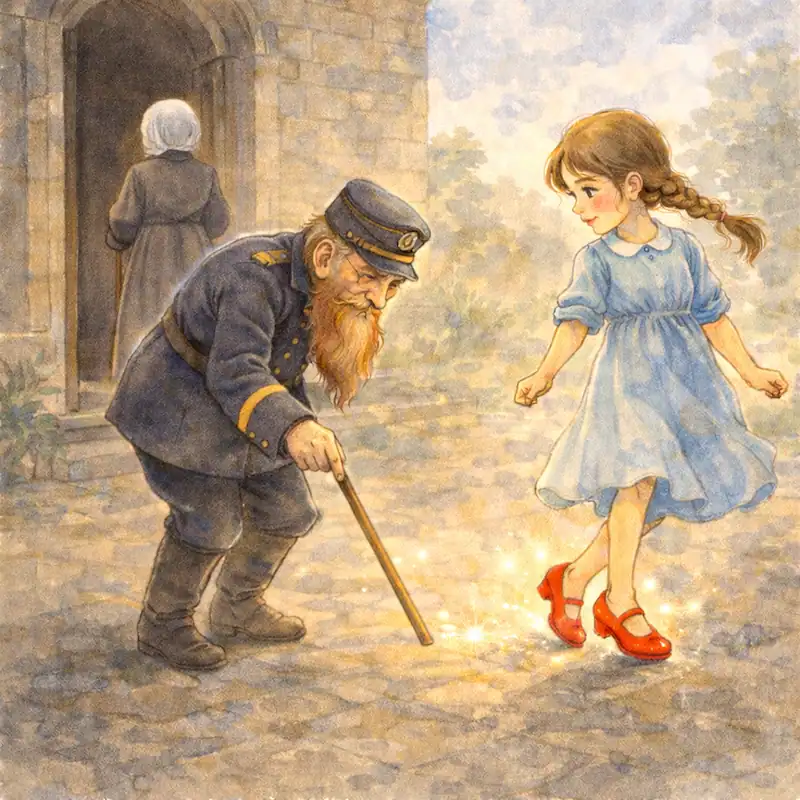
He tapped the sole with his stick.
Karen laughed in a small uneasy way. “I am not going to dance,” she said.
Still, when church ended and Karen stepped outside, her feet began to move. One step turned into two. Two steps turned into a turn. She grabbed the fence, but her legs kept going as if someone else were pulling the strings.
The coachman ran and caught her and lifted her into the carriage. Even then her feet danced and kicked until the old lady cried out in pain. Only when Karen tore the shoes off did her legs fall quiet.
The old lady locked the shoes away. Even so Karen’s mind stayed locked on them.
The Key and the Invitation
Soon the old lady grew sick. The doctor said she might not recover. Karen cared for her, yet her eyes kept drifting to the closet key.
Then an invitation arrived for a grand ball in the city. Karen’s heart raced. She looked at the old lady’s pale face and told herself she deserved one evening of joy.
With the key in her hand she took the shoes and put them on.
At the ball the music swelled and the floor shone with lantern light. Karen danced and people praised her quick steps. For a moment she felt like the princess in the parade.
Then she tried to stop.
Her feet refused.
She tried to turn one way and the shoes turned another. She tried to leave the hall and the shoes carried her down the steps, into the street and out through the city gate.
Soon the music faded behind her as the red shoes drove her into the dark woods.
The Wood That Would Not End
Branches scratched her arms. Roots tripped her. Still the shoes drove her on. Moonlight slipped between the trees and Karen saw a face ahead.
It was the old soldier with the red beard, sitting as if he had been waiting.
“Look,” he said calmly, “what beautiful dancing shoes.”
Karen sobbed and bent to pull them off, but the shoes clung tight. She tugged at her stockings, yet the leather would not let go. Rain fell, then sun returned, but the dancing never stopped.

She danced through day and night until her feet bled and her thoughts grew thin with fear.
At last she danced past the churchyard and toward the open church door because she wanted help, any help at all.
The Angel in the Doorway
An angel stood in the doorway, tall and bright in white. In his hand was a shining sword.
“Dance,” said the angel. “Dance in your red shoes until pride has left you.”
“Mercy,” Karen cried, but the shoes spun her away before she could hear more.
The Coffin on the Morning Road
One morning Karen danced past a door she knew. A hymn sounded inside. Men carried out a coffin covered with flowers.
Karen understood at once. The old lady had died while Karen was dancing at the grand ball instead of staying to care for her.
A cold loneliness filled her. She wanted to fall to her knees, yet the shoes would not allow it. They forced her onward like a cruel joke.
The Parson’s Door in the Night
By evening the shoes carried Karen back toward the village. Her breathing came in sharp little gasps. Her legs shook, but they would not stop.
A warm light glowed from the parsonage window. Karen’s feet turned that way as if the light pulled them. She reached the steps and tapped the doorframe with trembling fingers.
The clergyman’s wife opened the door and froze when she saw Karen spinning on the stone step, pale and wild-eyed.
“Child,” she said softly, “what has happened?”
“I can’t stop,” Karen cried. “I put them on again. It seemed harmless, but my feet won’t listen to me.”
The clergyman hurried in with a lantern. He took one look at the red shoes and then at Karen’s face.
“Karen,” he said, steady and calm, “these shoes have become more important to you than kindness and truth. That is why they are holding you.”
Karen’s throat tightened. “I was proud,” she whispered. “I wanted everyone to look at me, and I forgot everything else.”
“Then choose what matters more,” the clergyman said. “Not with fancy promises, but with a true heart.”
Karen wanted to nod, yet her feet kept turning.
The clergyman’s wife pulled a sturdy chair into the doorway.
The Still Chair and the Quiet Choice
“Look at the chair,” she told Karen. “Look at one still thing.”
Karen fixed her eyes on the chair. She tried to think about nothing else. At first her mind kept darting back to the shine of the shoes. Then she forced it away.
She thought of the old lady’s quiet house. Then she remembered the prayers she had forgotten. Next came her mother’s funeral, the straw-covered coffin, and how small she had felt.
Tears slid down her cheeks and fell onto the bright leather.
The shoes still tugged and tugged, but Karen’s steps grew smaller. The fast turns became slow turns. The slow turns became tiny shuffles.
At last, with one final stubborn twitch, the shoes stopped.
Karen swayed. The clergyman’s wife caught her and guided her into the chair.
Karen covered her face and cried, not loud and angry, but quiet and sorry. When she could breathe again, the clergyman said, “Now take them off.”
Karen bent down and unbuckled the straps. This time the shoes did not cling. They slipped away as easily as any ordinary shoes.
The clergyman’s wife carried them to a cupboard and shut the door. “They will not rule you again,” she said.
Karen stared at her bare feet. They were sore, but they were hers.
Wooden Shoes and a Humble Promise
In the morning the clergyman walked Karen home. Karen wore plain wooden shoes borrowed from the parsonage, clumsy and heavy, yet safe. Every step felt like a choice.
Karen went to the parsonage again that same day.
“Please,” she said, “take me into service. I will work hard, and I only want a home with good people, so I can learn to do what is right.”
The clergyman’s wife studied her face. She saw fear there, but she also saw change.
“You may stay,” she said.
Karen swept and mended and carried water carefully. She listened at night when the clergyman read from the Bible. When the children talked about fine clothes and grand things, Karen only smiled and shook her head.
The Church Comes Near
One Sunday the family asked if she wanted to go to church with them. Karen hesitated. Her feet still ached from the days of forced dancing and fear rose in her like a shadow.
“I will stay,” she said softly.
After they left she sat in her small room with her prayer book. The wind carried the sound of the organ through the window. Karen closed her eyes.
“God,” she said, “help me keep my heart steady.”
A clear light filled the room. The angel appeared again, yet the sword was gone. In his hand was a green branch covered in roses.

He touched the low ceiling and it seemed to lift. He touched the wall and it widened, as if the room were opening like a flower. Karen found herself seeing the church, hearing the choir and feeling the warm sun through the glass.
It was as if she had been brought into the church, or as if the church had come to her.
Karen’s heart filled with a quiet peace that did not need praise. She breathed out a long grateful sigh and the last hard knot of pride loosened.
In that gentle light her soul felt free at last and no one asked after the red shoes.