

The Story
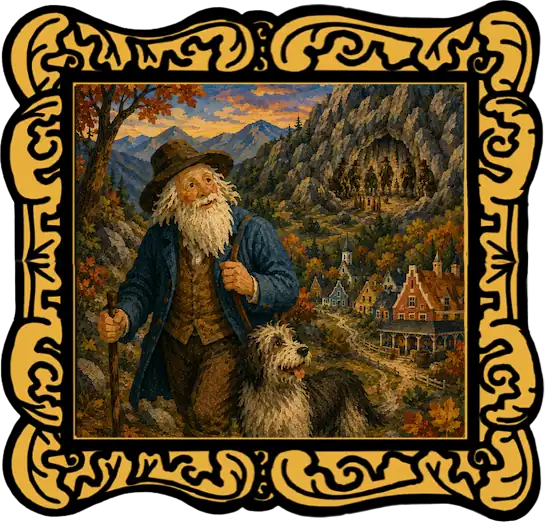
Long ago, when the Hudson River shone silver below the Catskill Mountains, there was a little Dutch village where everyone knew Rip Van Winkle. The houses had steep roofs, tidy gardens and curls of smoke rising from their chimneys. Behind them, the mountains climbed into mist and pine trees. In the morning, they looked blue. At sunset, they glowed purple and gold. When thunder rolled across their peaks, children would stop playing and look up, wondering what strange thing might be happening there.
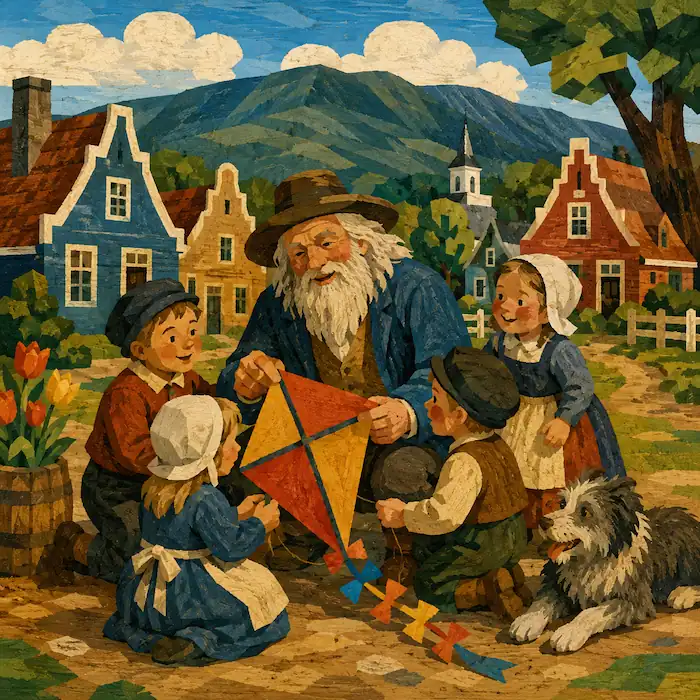
Rip Van Winkle lived in that village with his wife, his children and his faithful dog, Wolf. Everyone liked Rip because he was gentle, funny and always ready to help someone else. If a child’s kite tore, Rip would tie the string with careful fingers and say, “There now. This one will fly higher than a hawk.”
If a neighbor’s gate stuck, Rip would fetch his tools and make it swing again. If someone lost a goat, Rip would search the lanes and fields until he found it nibbling leaves where it should not.
But at home, things were different. Rip’s own fence leaned sideways, weeds climbed through his corn and rain slipped through the roof in thin, cold drops. Tools lay where Rip had dropped them days before. The little farm looked sadder every season, and Dame Van Winkle, his wife, grew more tired with every broken hinge, empty woodpile and unfinished chore.
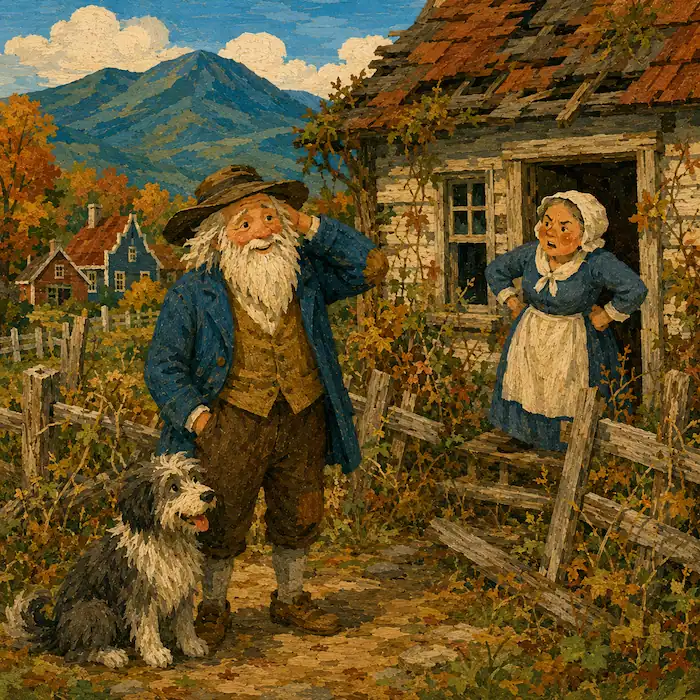
“Rip Van Winkle,” she called one morning from the doorway, “will you mend our fence today?” Rip looked at the fence, then looked at the sky, then scratched his head as if the answer might be hiding under his cap. “I meant to do it yesterday,” he said. Dame Van Winkle sighed. “You meant to do it last spring.”
Rip did not like being scolded. No one does. But somewhere inside him, he knew she was not wrong. Dame Van Winkle did not scold because she enjoyed scolding. She was tired of patching, carrying, cooking, counting, worrying and watching Rip’s good nature wander down every road except the one that led back to his own chores.
Rip was kind, but he was dreamy. He was helpful, but he was not steady. He could fix another person’s gate while his own hung open in the wind. If Dame Van Winkle asked him to weed the field, he remembered a neighbor who might need firewood stacked. If she asked him to repair the roof, he suddenly wondered whether the fish were biting in the river. If she asked him to milk the cow, he picked up his old musket, whistled for Wolf and wandered toward the mountain path.
“Come along, Wolf,” Rip would say. “The mountains will not scold us.” Wolf barked once, as if he agreed, and the two of them would disappear among the trees.
The Path Into the Mountains
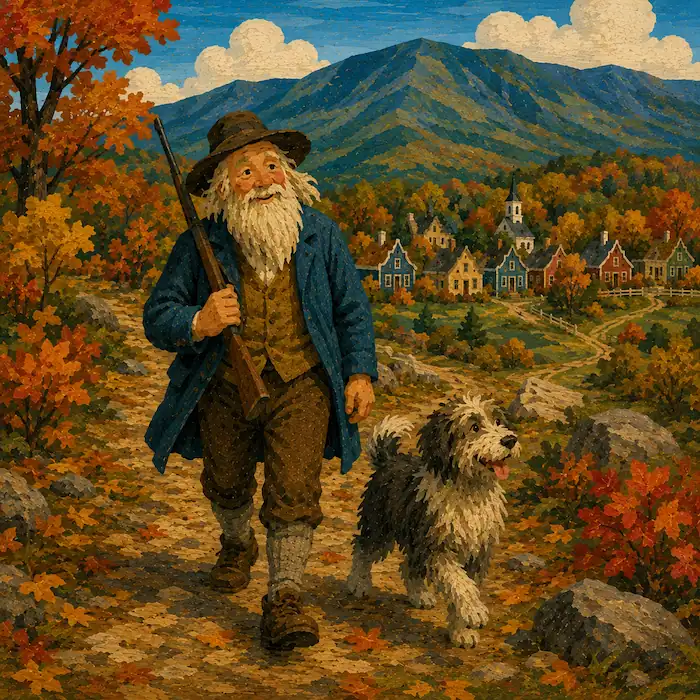
One golden autumn afternoon, Dame Van Winkle sent Rip to mend a broken gate. Rip carried his tools to the gate and studied the split wood, the rusty hinge and the crooked post. Then his eyes drifted past the village to the Catskill Mountains, where the leaves were red, orange and yellow, and the air seemed to shimmer with the smell of pine needles and sun-warmed earth.
“I’ll walk first,” Rip murmured. “A clear head makes quick hands.” Wolf wagged his tail, which was all the encouragement Rip needed. He picked up his old musket and started up the hillside.
The path twisted through birch trees and hemlocks. A stream chattered over stones, squirrels flicked their tails and vanished into branches, and the village grew smaller with every step. Higher and higher Rip climbed until the roofs below looked like little brown shells and the Hudson River gleamed far away like a ribbon of light. At last, he sat on a mossy rock and looked down at the world he had left behind.
For a while, Rip felt wonderfully peaceful. The village smoke rose in thin blue lines, the mountains breathed cool air around him and Wolf rested his chin on his paws. Then Rip remembered the broken gate, the waiting tools and Dame Van Winkle in the doorway. “Oh dear,” he said softly. “She will have words for me.”
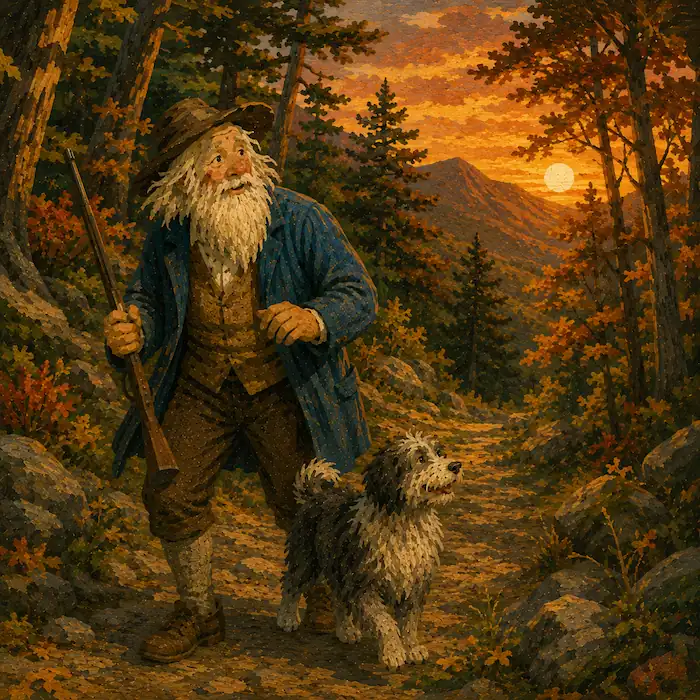
Wolf lifted his head. From somewhere among the rocks, a voice called, “Rip Van Winkle!”
“Who’s there?” he called. The woods answered with silence, but a moment later the voice came again, deeper and stranger than before. “Rip Van Winkle!”
A tall, broad man stepped from between two dark trees. He wore old-fashioned Dutch clothes with silver buttons, wide breeches and a high pointed hat. His beard curled over his chest, and his face was serious and still, as if it had been carved from weathered wood. Across his shoulder rested a heavy wooden keg.
The stranger did not smile. He pointed to the keg, then pointed up the mountain. Rip understood well enough. “You need help?” he asked, and when the stranger nodded, Rip’s kind heart stirred at once. “Well, I cannot leave a man struggling under a load.”
Rip took one end of the keg and the stranger took the other. Together, they climbed a narrow track between tall rocks. The path grew colder as they went, and the trees stood closer, their branches knitting together overhead. Wolf followed, but he kept low to the ground and looked over his shoulder more than once.
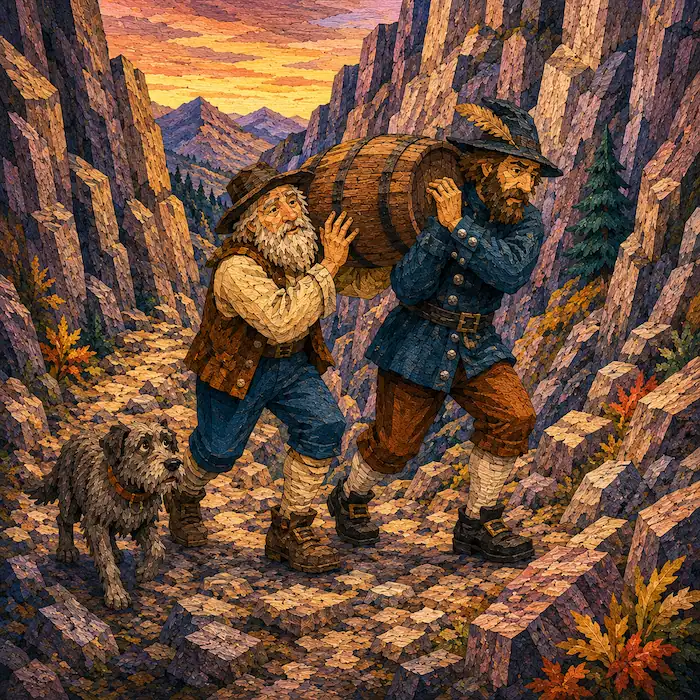
Soon they reached a hollow ringed by high stone walls. There, in the fading light, Rip saw a company of strange Dutchmen.
The Men Who Played Ninepins
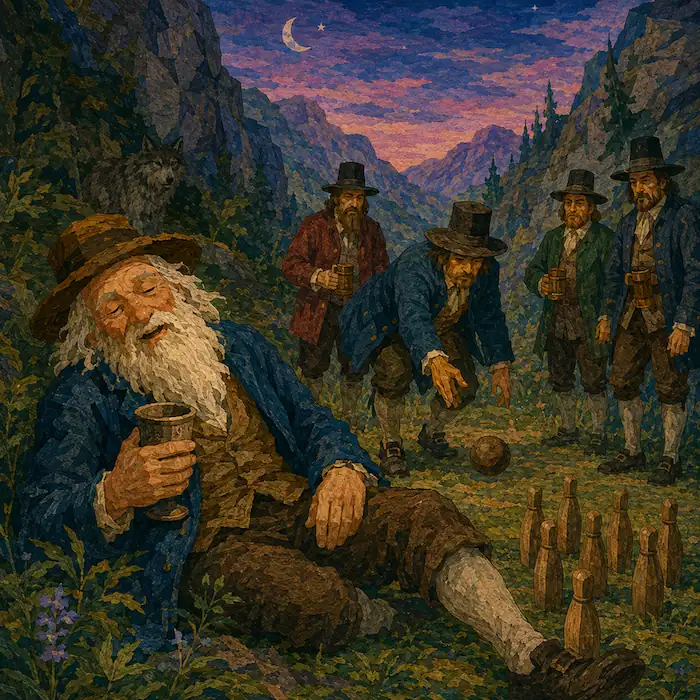
The Dutchmen wore old Dutch coats, buckled shoes, broad belts and high-crowned hats. Some had long beards, some had round cheeks and some had sharp noses, but all of them looked solemn. Not one laughed. Not one spoke. They were playing ninepins on the grass as if they had been playing there for a hundred years and meant to play for a hundred more.
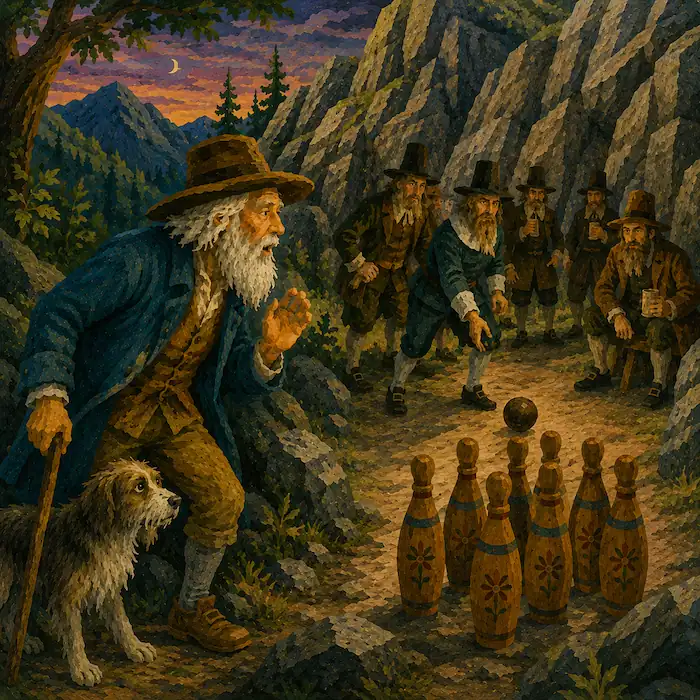
A wooden ball rolled across the ground and struck the pins with a crash. The sound leaped around the cliffs like thunder, though the sky above was clear. Rip looked up, expecting storm clouds, but only a pale evening sky looked back at him. Another ball rolled, another crash shook the hollow, and Wolf tucked his tail beneath him.
The Dutchmen turned their eyes toward Rip. Their faces did not change. One pointed to the keg, and another pushed a cup into Rip’s hand. Rip filled cup after cup with the strange mountain drink while the Dutchmen drank in silence, then returned to their game. The wooden ball rolled again, and again the cliffs answered with a deep booming sound.
Rip felt curious and uneasy at the same time. “What a strange party,” he whispered to Wolf, but Wolf did not answer. He crouched in the grass, watching every movement.
After a while, one of the men pointed to the keg and nodded toward Rip. Rip hesitated. The Dutchmen only stared, so Rip held his cup beneath the wooden spout and poured himself a drink and took a careful sip.
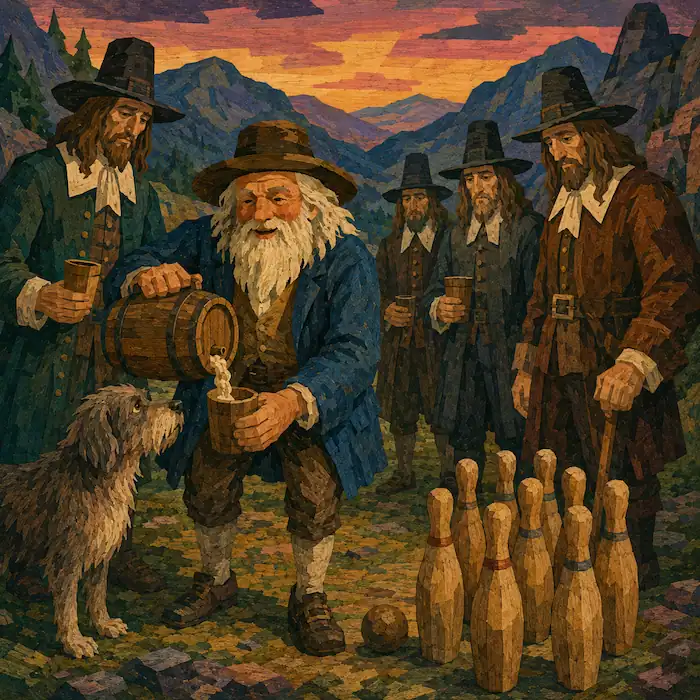
The drink tasted sweet, sharp and warm, like autumn apples and mountain wind mixed together.
He took another sip, then another. Soon the hollow softened at the edges, the ninepins rolled in a faraway rumble and the serious faces of the Dutchmen seemed to float in the twilight. Rip’s eyelids grew heavy. Beside him, Wolf curled up on the grass and closed his eyes. “I’ll rest just a moment,” he murmured, sinking onto the grass. The last thing he heard was the wooden ball rolling across the hollow with a sound like thunder under the earth.
Then Rip Van Winkle fell into a deep, deep sleep.
Morning in a Changed Wood
When Rip opened his eyes, sunlight poured through the leaves and birds sang above him. A beetle crawled over a blade of grass beside his hand. Rip sat up with a groan, feeling his back ache, his knees creak and his shoulders pull as if he had slept on stones for a week.
“Well,” he muttered, “that was a powerful nap.” Then something brushed his chest. Rip looked down and saw a long gray beard hanging over his coat. He grabbed it with both hands. At first, he almost laughed, but then he touched it again and felt a cold shiver pass through him. This was not one night’s growth. It was years and years of gray.
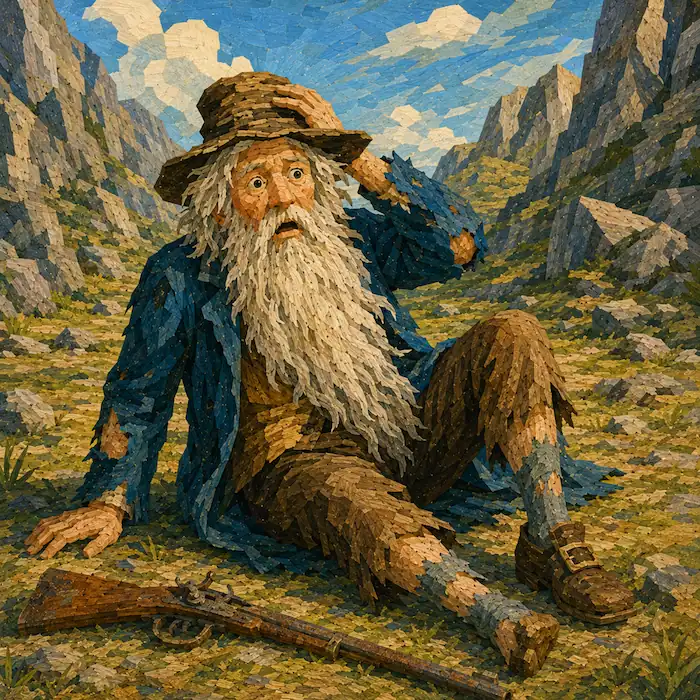
“Wolf!” he shouted. No bark answered. Rip turned in a circle, but the strange players had vanished. The keg had vanished, the ninepins had vanished and even the narrow path between the rocks seemed hidden by weeds and tangled vines. He called again for Wolf until his voice grew hoarse, but only the birds replied.
Rip reached for his musket and found it changed too. The musket’s barrel was rusty, its wooden stock was cracked and its lock was stiff and brown with age. He stood slowly, staring at the ruined gun, his tattered clothes and his thin worn shoes. A cold worry crept through him. “What has happened here?” he whispered.
Then another thought struck him. The gate. Dame Van Winkle. For once, he did not feel annoyed by the thought of her scolding. He felt afraid. He imagined her standing in the doorway, arms folded, sharp-eyed and waiting, and he began the long walk down the mountain.
The Village That Was Not the Same
The path seemed different. Trees had fallen where Rip remembered open ground, bushes crowded the track and the stream had carved a deeper bed through the stones. Once or twice, he stopped and looked around, certain he had taken the wrong way. Yet the mountains were the same mountains, and the river still shone far below, so Rip kept walking.
At last, he reached the lower slopes and saw the village. It was there, but it was not the village he knew. New houses stood where fields had been, the road was wider and strange signs hung above shops. People hurried about in clothes Rip had never seen before, while children ran after him, pointing at his beard and his old rusty gun.
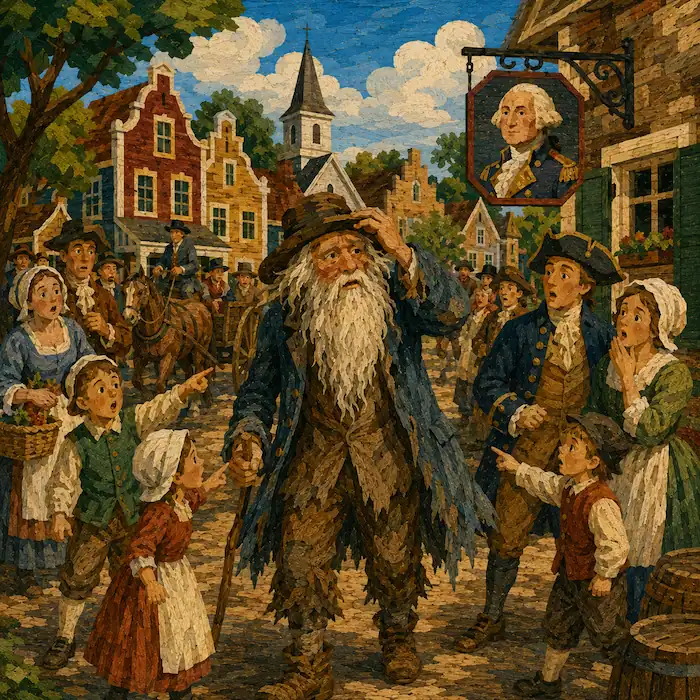
Rip searched their faces, but he did not know any of them. He walked faster through the larger, louder village, past men talking in excited voices about elections, liberty, rights and the new nation. When he reached the inn where he had once sat beneath a great tree, he stopped in confusion. The tree was still there, broader and older than before, but the old sign of King George was gone. In its place hung a sign with a stern-faced man in a blue coat.
“King George has grown a different face,” Rip murmured. A crowd gathered around him, and one sharp-eyed man asked who he was voting for. Another demanded to know which side he was on. Rip stepped back, bewildered by their questions, and said, “I am a loyal subject of the King.”
The crowd gasped. Some people laughed, but others frowned. “King?” cried a man. “There is no king here. This is the United States of America.”
Rip clutched his rusty musket. “The United what?” he asked. A murmur spread through the crowd, but Rip no longer cared about their questions. He wanted only one thing. He wanted home.
The House with the Broken Door
Rip found his house at last, or what was left of it. The roof sagged, the windows gaped like empty eyes and grass grew high around the doorstep. The gate he had once meant to mend hung broken and gray. The door leaned from one hinge, and when Rip pushed it open, dust stirred in the dim room.
“Dame Van Winkle?” he called. No answer came. A cracked chair lay on its side, the hearth was cold and a spiderweb trembled in the corner. Rip remembered his wife moving through the room with quick steps. He remembered her tired hands, her sharp voice and the way she had called his name from the doorway. “She was trying to hold us together,” he said softly, “and I kept wandering away.”
Outside, the village children peered through the door while older villagers whispered among themselves. Rip came out again, pale and shaken. “Does no one know Rip Van Winkle?” he asked.
An old woman pushed through the crowd and studied him closely. “There was a Rip Van Winkle,” she said slowly. “He went into the mountains twenty years ago and never came back.”
“Twenty years?” Rip whispered. The words seemed too large to fit in the air.
Then another woman hurried forward with a baby in her arms. She stopped when she saw Rip’s face. Her own face changed as she looked at his eyes, at the shape of his smile and at the old sadness waking there. The baby’s blanket slipped from her shoulder. “Father?” she whispered.
Rip stared at her. “Little Judith?” Tears filled her eyes. “I am grown now,” she said. “I have a child of my own.” Rip reached out one trembling hand, and Judith took it. For a moment, neither of them spoke. Then she led him to a bench beneath the great tree, and Rip Van Winkle sat down in the village he had left behind twenty years before.
Twenty Years Gone
Bit by bit, Rip learned what had happened while he slept. The colonies had fought a war against Britain, the King’s rule had ended and a new country had been born. The village had changed with it. Old friends had died or moved away, his children had grown, Wolf was gone and Dame Van Winkle had died some years before.
Rip lowered his head. “I slept through all of it,” he said. Judith sat beside him and answered gently, “You did, Father.”
“Your mother must have worried,” Rip said. Judith looked toward the broken house. “She did. She was angry too, but she kept us going.” Rip looked at his hands, rougher and older than he remembered, and thought of every chore he had left for another day. He thought of the broken gate, the leaking roof, the leaning fence and the family waiting while he wandered into the hills.
“I always thought there would be more time,” he said. Judith squeezed his hand. “There is still some time,” she told him, and those words comforted Rip more than all the speeches in the village.
All that day, people asked him questions. Where had he been? What had he seen? Had he truly met strange Dutchmen in the mountains? Rip told them about the hollow, the silent players, the wooden keg and the thunderous game of ninepins. Some believed him, some shook their heads, but no one could explain his gray beard, his rusted gun or the twenty missing years.
The Story Beneath the Tree
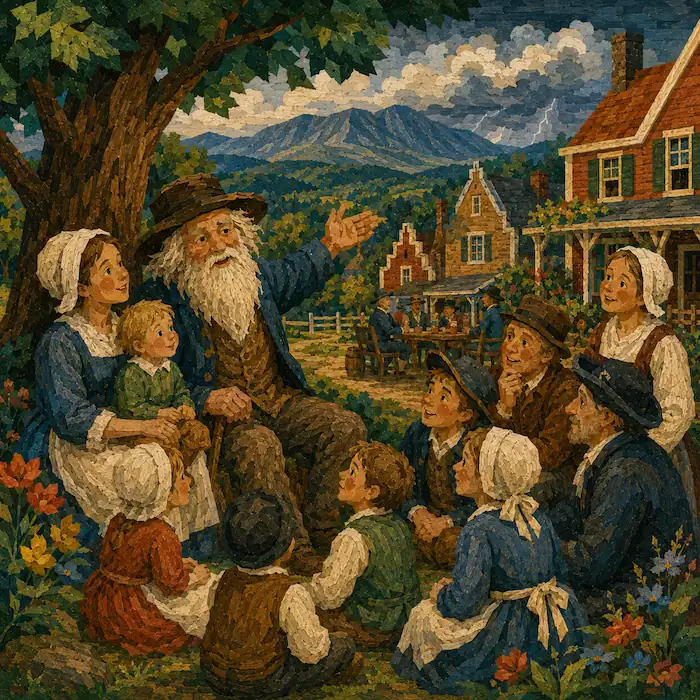
In time, Rip settled into the changed village. He lived with Judith and helped care for her children. He carried water, mended little things around the house and told stories by the fire when evenings grew cold. He was still Rip. He still liked a quiet bench, a long tale and the sound of birds in the trees, but when a latch was loose or a child needed help, he did not always wander away.
One morning, Judith found him repairing a small broken hinge. “That can wait, Father,” she said with a smile. Rip shook his head and kept working. “That is what I used to say.”
As the years passed, travelers came to hear his tale. Children gathered close whenever thunder rolled over the Catskill Mountains. Rip would lift one finger and tell them to listen, because somewhere high in the mountains the Dutchmen might be rolling their ninepins again. The children shivered happily, especially when the thunder answered from the peaks.
“Were you afraid?” asked his grandson one evening. Rip nodded. “At first.” His granddaughter leaned against his knee. “Did you know you would sleep so long?” Rip shook his head. “No, and if I had known, I would have run all the way home.”
The children wanted to know why. Rip looked toward the mountains, where mist curled between the peaks, and thought of birthdays, harvests, hugs, old friends, his children’s growing years and the birth of a new country. “Because twenty years is a high price for one lazy afternoon,” he said.
So when one child wished aloud that he could sleep for twenty years too, Rip smiled sadly and patted his shoulder. “A nap is pleasant,” he said, “but better to wake for your own life.”
Thunder Over the Catskill Mountains
Rip grew older in the village that had once seemed strange to him. Some people called his story a wonder, some called it a warning and some said he had dreamed the whole thing beneath a tree. Rip did not argue. He knew what he had seen, he knew what he had lost and he also knew what he still had.
On warm evenings, he sat with Judith’s family and watched the Catskill Mountains turn purple in the fading light. The children played near his feet, smoke rose from the village chimneys and somewhere along the lane a gate clicked shut. Then thunder rolled across the peaks, deep and round as a wooden ball striking pins in a hidden hollow.
“The ninepins,” whispered his granddaughter. Rip smiled. “Perhaps.”
He looked at the fields, the homes, the busy road and the bright faces around him. At last, Rip Van Winkle felt awake in every way that mattered. When the storm rumbled again, he did not wish to climb after it. He stayed where he belonged, beside the people who loved him, grateful for the work of the day and the time he had left.
