

The Little Red Hen Story

The Little Red Hen is a classic fable for children aged 6–12 about work, fairness and sharing. This child-friendly version retells the traditional story in clear language, with a gentle lesson about helping before expecting a reward.

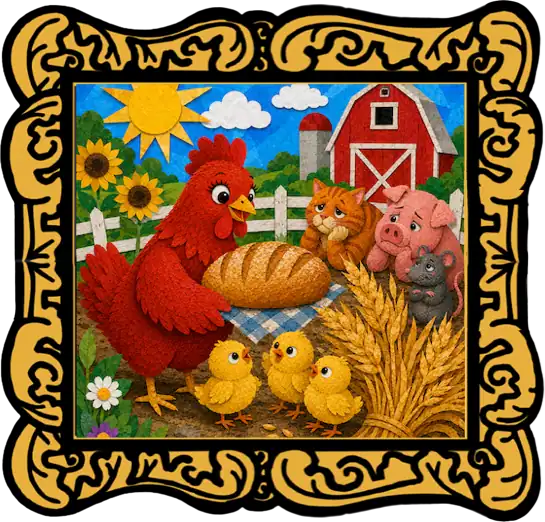
The Little Red Hen audio cover showing the red hen, chicks and barnyard animals in a gold frame
0:00 / 0:00
The Little Red Hen
Kooky Kids World Cloud Logo showing where the audio read aloud file is.

About This Retelling

This child-friendly retelling keeps the main shape and meaning of the traditional Little Red Hen story while using clear language for young readers. Like many folk tales and fables, the story has been retold in different ways across books, classrooms and families, so this version should be read as one fresh retelling rather than the only version.

The Little Red Hen Story

The Little Red Hen Finds a Seed

In a sunny barnyard lived a small red hen.

Every morning she woke before the rooster crowed. Then she stepped from her straw nest and gathered her chicks.

“Come along, little ones. The day will not scratch itself clean!”

Her chicks tumbled after her like yellow puffballs. They peeped and hopped as they followed their mother across the yard.

The Little Red Hen worked from sunup until dusk. She scratched the ground for worms, carried straw to mend her nest and taught her chicks where to find beetles under stones.
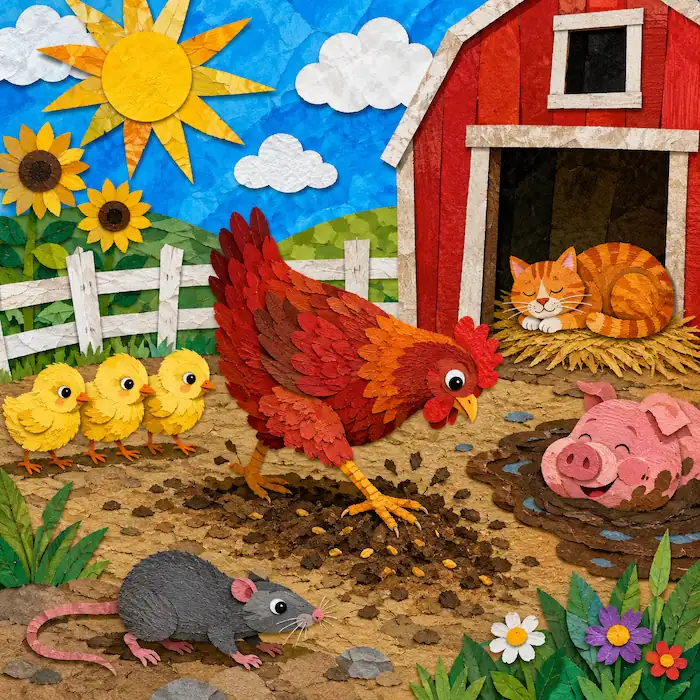
The Little Red Hen in a sunny barnyard with her chicks, a cat, a pig and a rat

Nearby, the farm cat lay in a warm patch of sunlight by the barn door.

“Lovely day for a nap,” purred the cat.

The pig rolled in the cool mud beside his sty.

“Lovely day for doing nothing,” grunted the pig.

The rat crept along the fence, sniffing for dropped grain. He liked work, but only when someone else had already finished it.

“Lovely day for a snack,” squeaked the rat.

One morning, while the Little Red Hen scratched near the old wooden gate, her claw struck something small and hard.
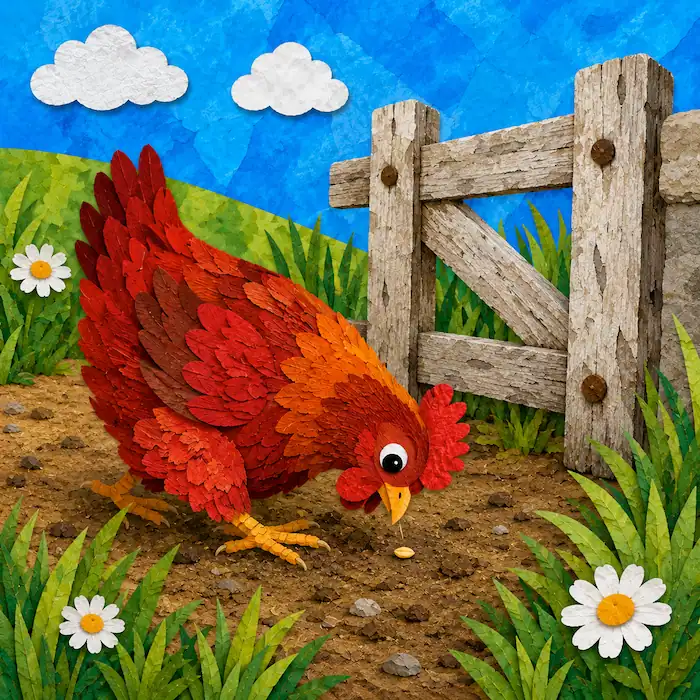
The Little Red Hen finding a small wheat seed near an old wooden gate

Tap!

“What have we here?” she said.

It was not a stone. It was long and golden brown, with a tiny point at one end. She turned it over with her beak.

“A wheat seed,” she said at last. “If someone plants it, it can grow into wheat. If someone cuts the wheat, it can go to the mill. If someone grinds it, it can become flour. And if someone bakes the flour, it can become bread.”

At the word bread, all the animals lifted their heads.

“Bread?” said the cat.

“Bread?” said the pig.

“Bread?” squeaked the rat.

“Yes,” said the Little Red Hen.

“But first, the seed must be planted.”
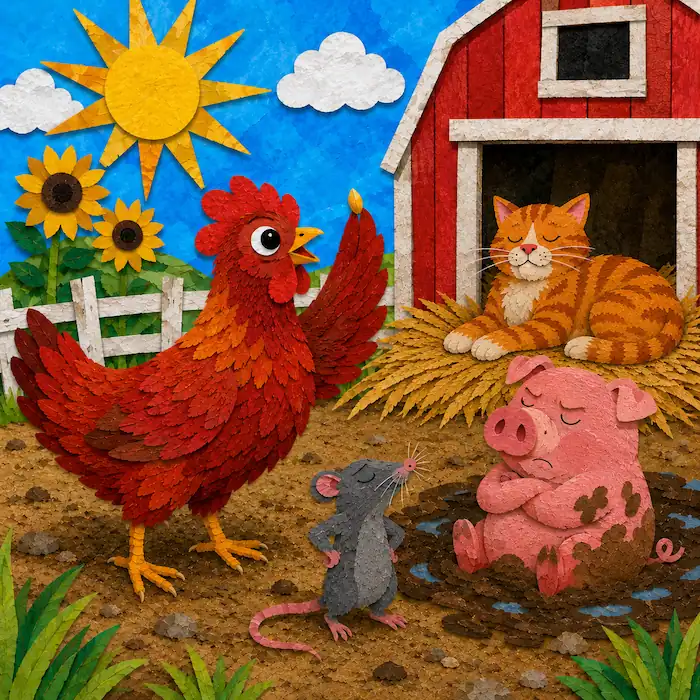
The Little Red Hen asking the cat, pig and rat to help plant the wheat seed

Not I, Said the Others

The Little Red Hen carried the seed to a soft patch of earth near the fence.

Then she called across the barnyard, “Who will help me plant this wheat seed?”

The cat opened one green eye.

“Not I,” said the cat. “I have just found the warmest spot in the yard.”

The pig flopped onto his other side.

“Not I,” said the pig. “Planting sounds dusty.”

The rat twitched his whiskers.

“Not I,” said the rat. “I am checking the fence for crumbs.”

The Little Red Hen looked at them one by one.

“Very well,” she said, “then I will plant it myself.”

And she did.

She dug a small hole with her claw. She dropped in the seeds, one by one and covered them with earth and patted the soil smooth. After that, she fetched water from a puddle and sprinkled it over the ground.
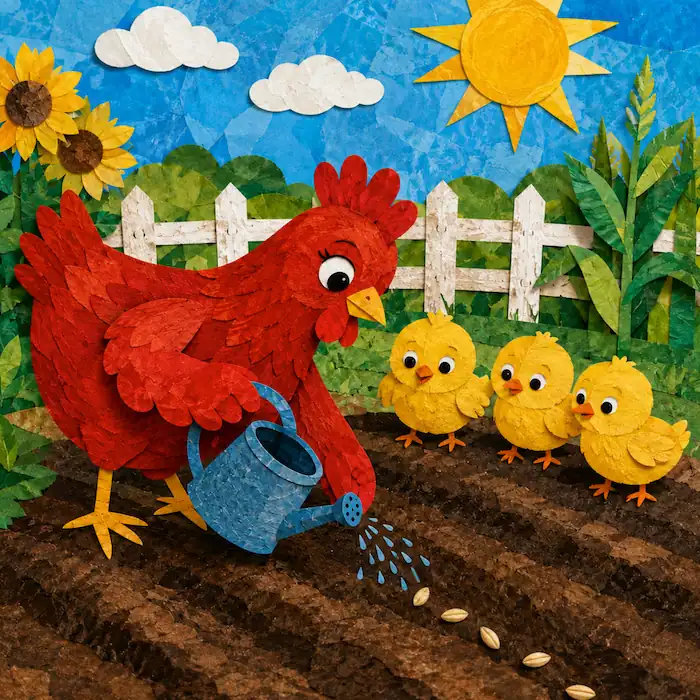
The Little Red Hen planting and watering wheat seeds while three chicks watch

Days passed. Then weeks passed. The chicks grew taller, the sun grew hotter and the seed sprouted a thin green shoot.

The Little Red Hen continued to work from sunup to sundown. She scratched for worms, mended the nest, taught and fed her chicks and still found time to care for the seed. The Little Red Hen watered it when the weather stayed dry, pulled away weeds and guarded it when the chicks wanted to peck at the leaves.

The cat watched from the barn door.

“That plant seems like a lot of trouble,” she said with a yawn.

“Most useful things are trouble at first,” said the Little Red Hen.

The pig snorted. “Wake me when it turns into bread.”

The rat laughed quietly. He did not want anyone to ask him to help.

The Wheat Grows Tall

By late summer, the wheat had grown tall and golden. Its head bent under the weight of ripe grain. When the wind blew, the stalk swayed like a tiny flag.
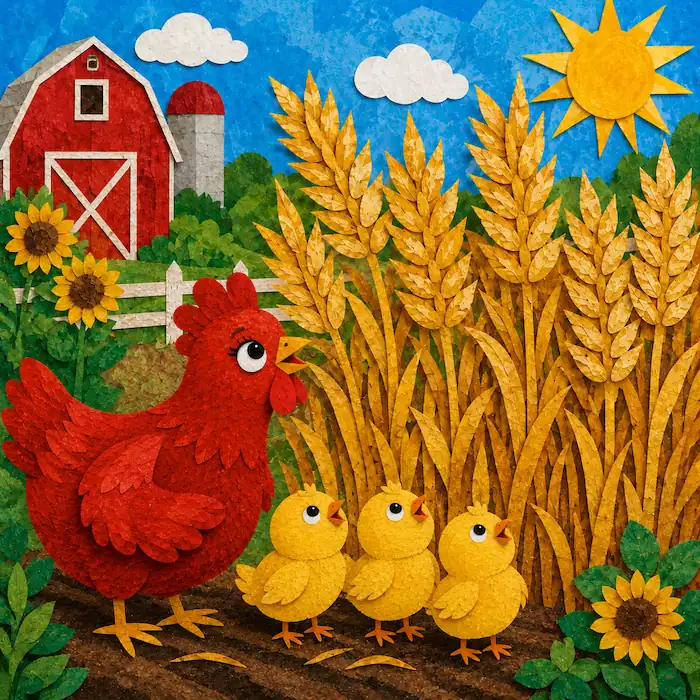
The Little Red Hen and her chicks admiring tall golden wheat in the barnyard

The Little Red Hen stood before it with pride.

“Look, chicks. The seed has become wheat.”

The chicks danced around her feet.

“Can we eat it now?” asked the boldest chick.

“Not yet,” said their mother.

“First, someone must cut it.”

Across the yard, the cat licked her paws. The pig nosed through his trough. The rat sat on an overturned pail and pretended not to listen.

“Who will help me cut the wheat?” called the Little Red Hen.
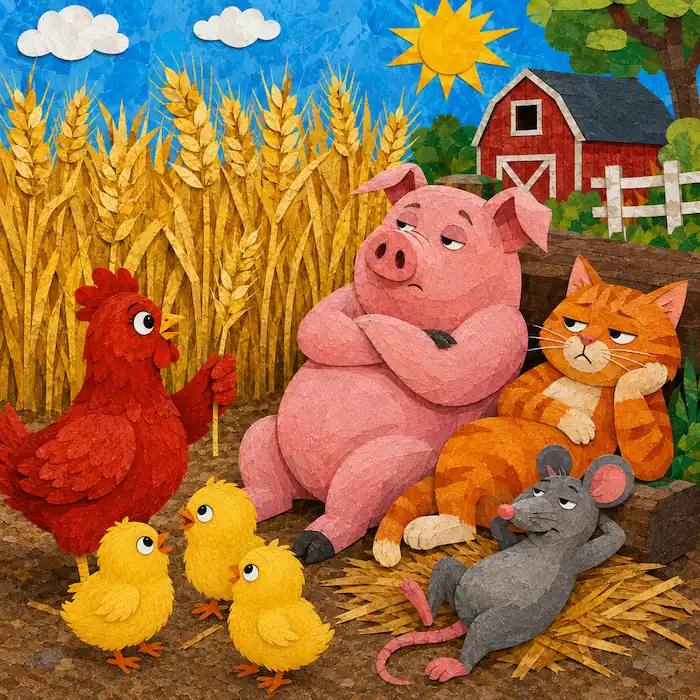
The Little Red Hen holding wheat while the cat, pig and rat refuse to help

“Not I,” said the cat. “My claws are for climbing, not cutting.”

“Not I,” said the pig. “The sun is too bright.”

“Not I,” said the rat. “I might get straw in my whiskers.”

“Very well then,” said the Little Red Hen. “I will cut it myself.”

And she did.

She fetched a small sickle from the tool shed. Snip by snip, she cut the wheat stalk and laid it on the ground.
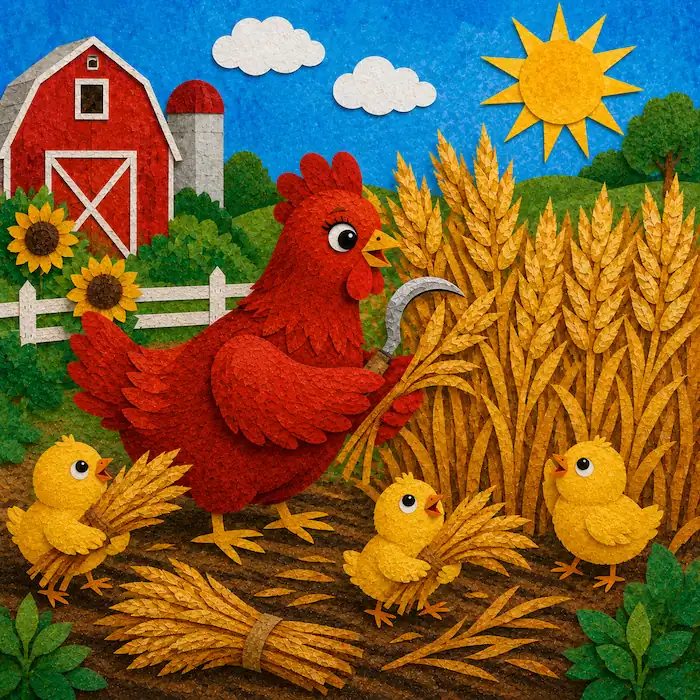
The Little Red Hen harvesting golden wheat with a sickle while her chicks help

Her chicks helped in their own small way. One held a straw straight. Another dragged a leaf aside.

“Well done,” said the Little Red Hen. “Helping means doing what you can.”
The cat pretended she had not heard.

A Heavy Little Bundle

Once the wheat lay cut, the Little Red Hen tied it into a bundle with twine. The bundle looked small to the pig, the cat and the rat. To the Little Red Hen, it felt heavy.

Still, she dragged it across the yard.

“Who will help me thresh the wheat?” she called.

The cat sat up. “What does thresh mean?”

“It means to loosen the grain from the stalk,” said the Little Red Hen.

“That sounds noisy. Not I,” said the cat.

“That sounds tiring. Not I,” said the pig.

“That sounds like work. Not I,” said the rat.

The Little Red Hen looked disappointed at the other barnyard animals.

“Very well then,” said the Little Red Hen. “I will thresh it myself.”

And she did.

The Little Red Hen harvesting golden wheat with a sickle while her chicks help

She beat the wheat gently against a clean board until the grains fell free. Then she tossed the grain into a shallow pan and let the breeze blow away the chaff.

The work made her wings ache. Dust tickled her beak. Still, when the grain sat clean and bright in the pan, she smiled. It was not bread yet, but it was closer than before.

The Road to the Mill

The next morning, the Little Red Hen poured the wheat grain into a small sack. She tied the top with string and tugged it toward the gate.

“Who will help me take this wheat to the mill?” she called.

The mill stood beyond the meadow, past the pond and over the little hill. Its great wheel turned whenever the stream ran strong.

“Not I,” said the cat. “My paws are too soft for dusty paths.”

“Not I,” said the pig. “Hills disagree with me.”

“Not I,” said the rat. “I have important business under the hayrack.”

“What business?” asked the Little Red Hen.

“Private business,” said the rat.

“Very well then,” said the Little Red Hen. “I will take it myself.”

And she did.
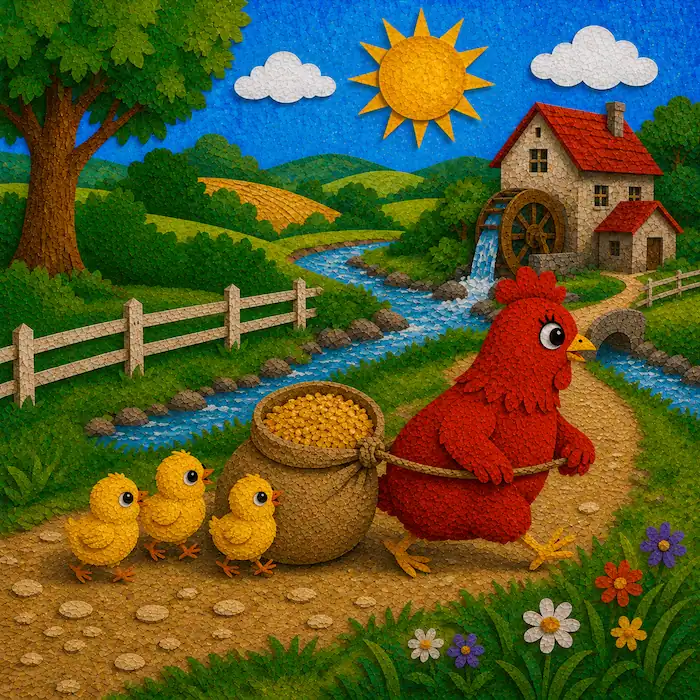
The Little Red Hen dragging a sack of grain toward the mill with her chicks behind her

She pulled the sack with her beak, pushed it with her chest and sometimes rolled it with both feet. The chicks followed behind, peeping encouragement.

“Come on, Mother!”

“You can do it!”

One chick pushed the sack with both feet. Another picked up the string when it slipped. They were small helpers, but they were helpers all the same.

At last they reached the mill. The miller was a kind old man with flour on his sleeves and a smile in his eyes.

“Well, well,” he said. “A hen with wheat. That is not something I see every day.”

“I planted it, cut it, threshed it and brought it here,” said the Little Red Hen. “Can you grind it into flour?”

“I can,” said the miller. “You have earned fine flour from fine work.”
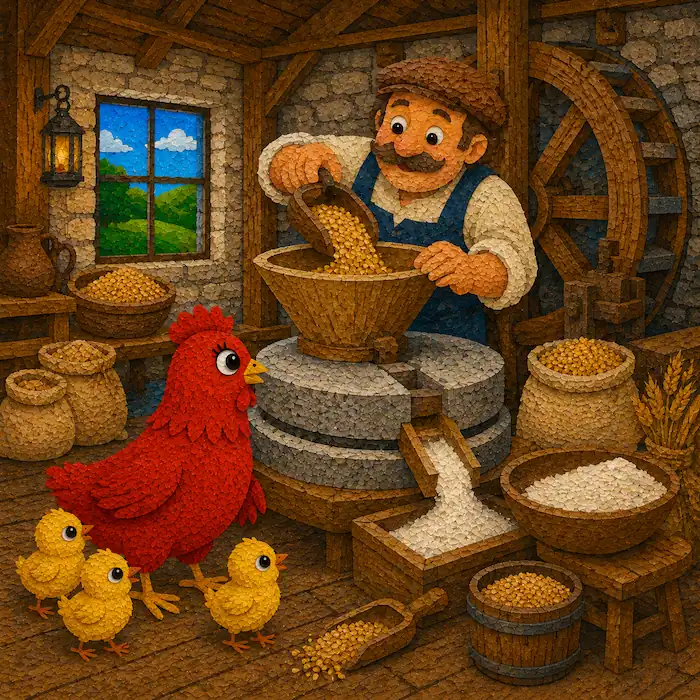
The Little Red Hen watching a miller grind wheat into flour inside a rustic mill

The great stones rumbled. The wheel turned. Soon the wheat became soft white flour.
The Little Red Hen thanked the miller. Then she carried the flour home.

Flour on the Table

When she reached the barnyard, the smell of flour drifted from the sack. The cat, the pig and the rat came closer at once.

“What is that?” asked the cat.

“Flour,” said the Little Red Hen.

“Will it be bread soon?” asked the pig.

“It can be,” said the Little Red Hen. “But first, someone must make the dough.”

She set the flour on a clean wooden table near the kitchen door. She brought out a bowl, a spoon, a little salt, water and yeast.

Then she called, “Who will help me make the bread?”

“Not I,” said the cat. “Flour gets on fur.”

“Not I,” said the pig. “That yeast smells strange.”

“Not I,” said the rat. “I only help with tasting.”

The Little Red Hen’s eyes flashed.

“Tasting is not helping,” she said. “No one tastes until the bread is made.”

The rat hopped down.

“Then not I.”

“Very well,” said the Little Red Hen. “I will make it myself.”
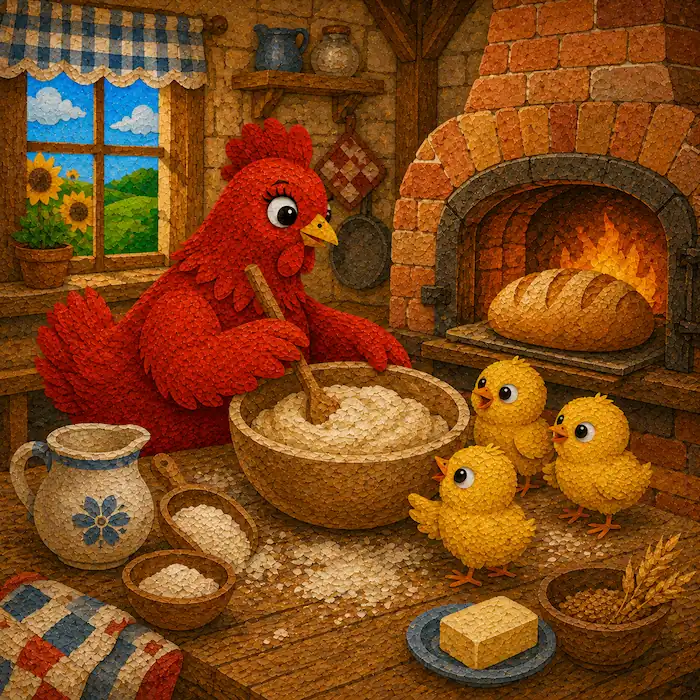
The Little Red Hen stirring dough in a cozy kitchen while her chicks watch

And she did.

She mixed the flour with water. She stirred until the dough grew thick. Then she kneaded it with her little feet, pressing, folding and turning.

“Press and fold,” she told the chicks. “Good bread needs patience.”

The chicks copied her in the dust with their tiny feet.

The cat watched from the windowsill.

“You are making a terrible mess,” she said.

“I am making bread,” said the Little Red Hen.

The Warm Smell of Bread

The dough rose in the bowl like a soft round pillow. The Little Red Hen shaped it into a loaf and placed it in a baking pan in the warm oven.

First came a small smell, warm and yeasty. Then came a rich smell, golden and sweet. Finally the whole barnyard filled with the wonderful scent of fresh bread.

The cat leaped down from the windowsill.

“That smells delicious,” she purred.

The pig hurried from his sty so fast that mud splashed behind him.

“That smells perfect,” he grunted.

The rat scampered along the wall.

“That smells like supper,” he squeaked.

The Little Red Hen opened the oven door and pulled out the loaf. It was brown on top, crisp at the edges and soft in the middle. Her chicks cheered.

“Bread! Bread! Bread!”

The Little Red Hen set the loaf on the table to cool. Steam curled from the crust.

Then, because she believed in asking fairly, she called across the yard one last time.

“Who will help me eat this bread?”

The cat sprang forward.

“I will!”

The pig pushed his snout close to the table.

“I will!”

The rat climbed onto a stool.

“I will!”

The Little Red Hen stood very still.

“No, you won’t,” she said. “I will eat it myself.”

A Fair Slice

The cat’s ears drooped.

“Not even a corner?”

“Not today,” said the Little Red Hen.

The pig shuffled his feet.

“Not even a crumb?”

“Not today,” said the Little Red Hen.

The rat twitched his nose.

“What if I promise to help next time?”

“Next time,” said the Little Red Hen, “you may show me.”

Then she sliced the bread, gave a warm piece to each chick and took a slice for herself. The crust crackled. The soft middle tasted sweet and warm.
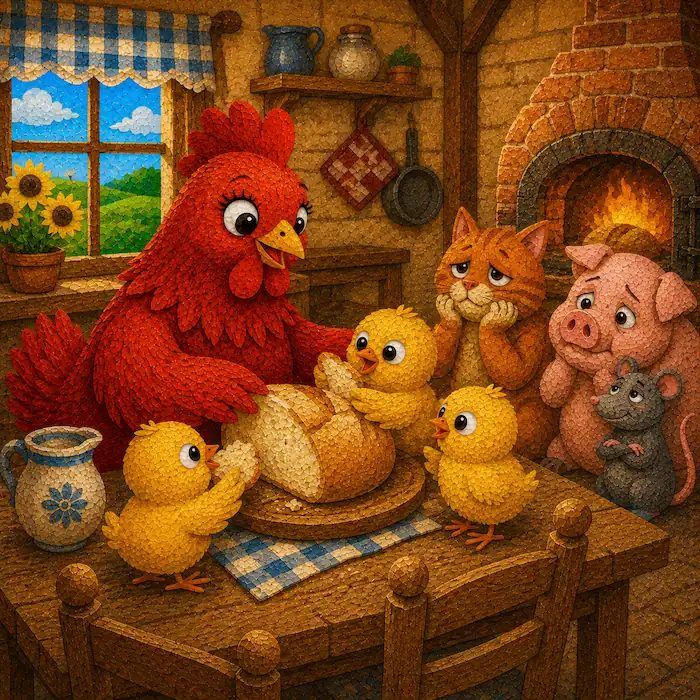
The Little Red Hen sharing fresh bread with her chicks while the cat, pig and rat look disappointed

The cat, the pig and the rat watched in silence. They had never noticed how much work came before a meal. They had only noticed the meal.

The cat looked at her clean paws. The pig looked at the mud on his belly. The rat looked at the empty place where his slice might have been.

After a while, the pig spoke.

“I suppose planting is not so dusty if friends do it together.”

The cat flicked her tail.

“And flour might brush out of fur.”

The rat swallowed hard.

“I could check the road to the mill for pebbles.”

The Little Red Hen looked at them kindly, but she did not hand over the bread.

“We shall see,” she said.

Moral

The moral of The Little Red Hen is that those who share the work should share the reward.

Short Summary of The Little Red Hen

The Little Red Hen finds a wheat seed and asks the cat, pig and rat to help her plant it, cut the wheat, thresh the grain, take it to the mill and bake the bread. Each animal refuses until the warm loaf is ready to eat. When they all want a slice, the Little Red Hen reminds them that rewards are fairer when everyone has helped.

Main Characters in The Little Red Hen

The Little Red Hen: A hardworking hen who takes care of her chicks and does every job needed to turn wheat into bread.

The Chicks: The hen’s young children, who watch, learn and help in small ways.

The Cat: A lazy barnyard animal who prefers comfort to work.

The Pig: A muddy, sleepy animal who avoids every task but wants the reward at the end.

The Rat: A sneaky, snack-loving animal who only wants to help when eating begins.

The Miller: A kind man at the mill who grinds the hen’s wheat into flour.

Vocabulary from the Story

Fable: A short story, often with animals, that teaches a lesson.

Barnyard: The area around a barn where farm animals live and move about.

Wheat: A tall grain plant that can be ground into flour.

Seed: The small part of a plant that can grow into a new plant.

Thresh: To loosen grain from the stalk after wheat has been cut.

Chaff: The dry outer bits of the wheat that are separated from the grain.

Mill: A place where grain is ground into flour.

Dough: A soft mixture made from flour and liquid, used to make bread.

Discussion Questions

  1. What does the Little Red Hen find near the gate?
  2. Why does she ask the cat, pig and rat for help?
  3. How do the other animals behave when work needs to be done?
  4. Why do the cat, pig and rat suddenly want to help when the bread is ready?
  5. Do you think the Little Red Hen is fair when she refuses to share the bread? Why?
  6. What small jobs do the chicks do to help their mother?
  7. Which character changes the most by the end of the story?
  8. What could the cat, pig and rat do differently next time?

Classroom Activities for Children

Story sequencing cards:

Give children cards showing the seed, planting, growing wheat, cutting, threshing, going to the mill, making dough and eating bread. Ask them to place the cards in order and retell the story aloud.

Act out “Who will help me?”:

Children take the roles of the hen, chicks, cat, pig and rat. Each group acts out one scene, using voice, gesture and expression to show helpfulness, laziness, disappointment and understanding.

Seed-to-bread movement trail:

Place signs around the room: Seed, Plant, Grow, Cut, Thresh, Mill, Dough, Bread. Children move from sign to sign and create an action for each stage, such as planting, watering, cutting, carrying and stirring.

Fine motor wheat craft:

Children cut strips of yellow paper to make wheat stalks, glue them into a bundle and add small paper grains. This supports cutting, arranging and careful hand control.

Outdoor seed hunt:

Take children outside to look for seeds, grasses, leaves or plants. Discuss how plants grow and what they need, linking back to the Little Red Hen caring for her wheat.

Bread-making observation:

If practical, show children flour, water and dough. They can watch how dry flour changes when liquid is added, then talk about the many steps behind everyday food.

Feelings freeze-frame:

Ask children to freeze like the Little Red Hen when no one helps, the lazy animals when asked to work and the chicks when the bread is ready. Then discuss each feeling.

Fairness circle:

Ask: “What is fair sharing?” Children can give examples from home, school, playtime or group work.

Teachers’ Notes

Best curriculum fit:
Reading comprehension, traditional stories, fables, moral stories, sequencing, speaking and listening, drama, PSHE / social-emotional learning and early food education.

Key learning themes:
Responsibility, fairness, work, consequences, helping, teamwork, patience and gratitude.

Before reading:
Ask children: “Have you ever worked hard on something and then someone else wanted the reward?”

During reading:
Pause each time the Little Red Hen asks for help. Ask children to predict whether the animals will help this time.

After reading:
Discuss whether the Little Red Hen was unkind or fair. This is a good way to explore moral reasoning without turning the story into a lecture.

Cross-curricular links:
Art: Make paper-collage wheat, bread or barnyard animals.
Drama: Act out the repeated “Not I” scenes with different voices.
Nature study: Look at seeds, grain and plant growth.
PSHE: Talk about helping, fairness and group responsibility.
Writing: Write a new ending where the animals help next time.

Teacher tip:
Some children may feel sorry for the cat, pig and rat at the end. Use this as a useful discussion point: the story is not about being mean, but about learning that choices have consequences.

Why This Version Works for Children

This version keeps the traditional story’s main events while making the language clear for children aged 6–12. It keeps the important lesson about hard work and fairness, but the ending stays gentle and reflective rather than harsh.

The repeated “Who will help me?” pattern also supports early readers, read-aloud sessions and classroom participation.

What Parents and Teachers May Want to Know

The Little Red Hen is a moral story with a firm but child-safe ending. The hen does not share the bread with the animals who refused to help, which can lead to a useful conversation about fairness, effort and responsibility.

Younger children may need help understanding that the Little Red Hen is not refusing out of cruelty. She is showing the other animals that rewards feel fairer when everyone has helped.

Story Background

The Little Red Hen is a traditional folk tale and classic fable about work, food and fairness. In many familiar versions, the hen finds wheat, asks other animals to help with each stage of making bread and receives the same answer each time: “Not I.”

Public domain versions often describe it as an old English folk tale, including Florence White Williams’s The Little Red Hen: An Old English Folk Tale, released on Project Gutenberg. Project Gutenberg lists the title as public domain in the USA and describes it as an old English folk tale retold and illustrated by Florence White Williams.

Like many traditional stories, details can vary. Some versions use different animals, shorter wording or a sharper ending, but the core lesson usually stays the same: if you want to share the reward, you should help with the work.

Further Reading for Adults and Teachers

For adults and teachers who want to compare this retelling with a public domain version, Project Gutenberg has The Little Red Hen by Florence White Williams. It is listed as The Little Red Hen: An Old English Folk Tale and marked as public domain in the USA.

Frequently Asked Questions About The Little Red Hen

  • What is The Little Red Hen about?

    The Little Red Hen is a traditional folk tale and classic fable about a hardworking hen who finds wheat seeds and turns them into bread. The cat, pig and rat refuse to help with planting, cutting, threshing, carrying or baking, but they all want to eat the bread when it is ready.

  • What is the moral of The Little Red Hen?

    The moral of The Little Red Hen is that people should help with the work if they want to share the reward. The story teaches children about hard work, fairness, responsibility and the consequences of refusing to help.

  • Is The Little Red Hen a fable, folk tale or fairy tale?

    The Little Red Hen is usually described as a traditional folk tale and classic fable. It is a fable because animal characters teach a clear moral lesson, but it is not really a fairy tale because it has no magic, royalty or enchanted objects.

  • What age group is The Little Red Hen suitable for?

    This version of The Little Red Hen is written for children aged 6–12. Younger children can enjoy it as a read-aloud story, while older children can use it for reading comprehension, character discussion and classroom activities.

  • What character traits does The Little Red Hen teach?

    The Little Red Hen teaches responsibility, perseverance, initiative and fairness. The hen works hard and keeps going, while the other animals learn that laziness and empty promises do not earn a reward.

  • What is the repeated phrase in The Little Red Hen?

    The most famous repeated phrase in The Little Red Hen is “Who will help me?” The other animals answer “Not I,” until the bread is ready and they suddenly want to join in.

  • How can teachers use The Little Red Hen for ESL, EFL or TEFL lessons?

    Teachers can use The Little Red Hen to practise simple action verbs such as plant, cut, carry, grind, mix and bake. The repeated dialogue also works well for pronunciation practice, role play, sequencing and beginner English speaking activities.

  • What are the best classroom activities for The Little Red Hen?

    Good classroom activities for The Little Red Hen include story sequencing cards, role play, bread-making discussions, seed-to-bread movement games and paper-collage wheat crafts. These activities help children understand the plot, practise speaking and explore the story’s lesson about helping.

Copyright Notice

© Kooky Kids World. This original retelling, illustrations, audio narration and supporting educational content are protected by copyright. The underlying folk tale is traditional and may exist in many public domain or oral storytelling versions.