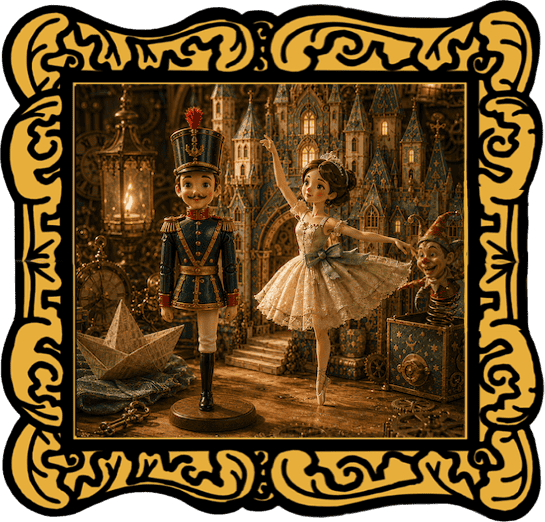

The Steadfast Tin Soldier is a classic literary fairy tale by Danish author Hans Christian Andersen for children aged 6-12. This Kooky Kids World retelling follows one brave toy soldier through danger, darkness and fire, showing how courage can stay steady even when everything around him changes.
This version includes a sad but gentle ending. Younger children may benefit from an adult listening along with them and talking afterward about courage, loyalty, loss and what remains in the heart.
A brave tin soldier and a paper ballerina in a classic Andersen fairy tale for children.
- Independent Reading Age: 8 to 11 years
- Read-Aloud Age: 6 to 12 years
- Reading Level: Upper Elementary (US Grades 3-5)
- Reading Time: 15 minutes
- Author / Source: Originally written by Hans Christian Andersen and re-written by Kooky Kids World
- Story Type: Danish literary fairy tale / authored fairy tale / classic fairy tale
- Region / Origin: Denmark
- Main Characters: The one-legged tin soldier, the paper ballerina, the birthday boy, the boy's mother, the goblin in the jack-in-the-box, two boys in the street, the rat, the fish, the cook or maid and the paper palace
- Moral / Themes: Courage, loyalty, steadiness, love, danger, resilience
- Child-Suitability Note: This uploaded Kooky Kids World version includes danger, fire and a sad ending, but it presents them gently for children aged 6-12.
About This Retelling
This child-friendly retelling keeps the main shape and emotional meaning of Hans Christian Andersen’s literary fairy tale while using clear language for young readers. The story is not a traditional folk tale. It is an authored literary fairy tale by Hans Christian Andersen, first published in 1838.
This Kooky Kids World version focuses on the tin soldier’s steadiness, the ballerina’s quiet presence, the goblin’s threat, the dangerous journey through the gutter and canal, the return home and the final image of the tiny tin heart beside the ballerina’s spangle.
The Steadfast Tin Soldier Story
The Soldier with One Leg
On the morning of his birthday, a boy woke to find a long wooden box at the foot of his bed, tied with red string and looking far too important to ignore.
He sat up at once. “Is that for me?”
His mother smiled from the doorway. “Open it.”
The boy pulled the string loose, lifted the lid and stared. Inside stood twenty-five tin soldiers, shoulder to shoulder, as neat as a little army. They wore blue coats, red collars and shiny black hats, with their muskets resting against their shoulders and their faces set in such serious little expressions that the boy laughed with delight.
“Soldiers!” he cried. “Twenty-five of them!”
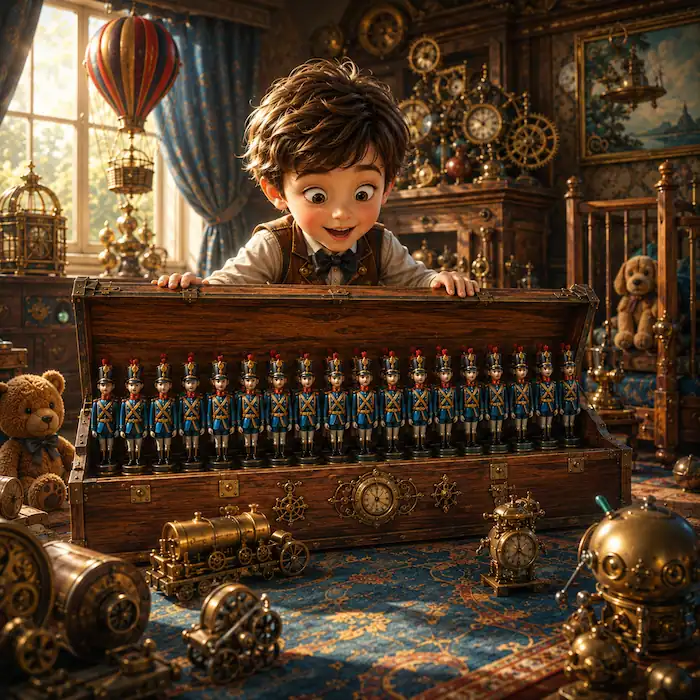
He carried the box to the nursery table and set them out in rows, one soldier, two soldiers, three soldiers, all the way to twenty-five. They had all been made from the same old tin spoon, melted down and poured into soldier molds, but the last soldier was different.
When he had been cast, there had not been enough tin left for a second leg. So he stood on one leg only, straight and steady, with his musket held as proudly as any soldier in the row.
The boy picked him up and turned him in the light. “This one is the best. He can stand with only one leg.”
Then he placed him at the front.
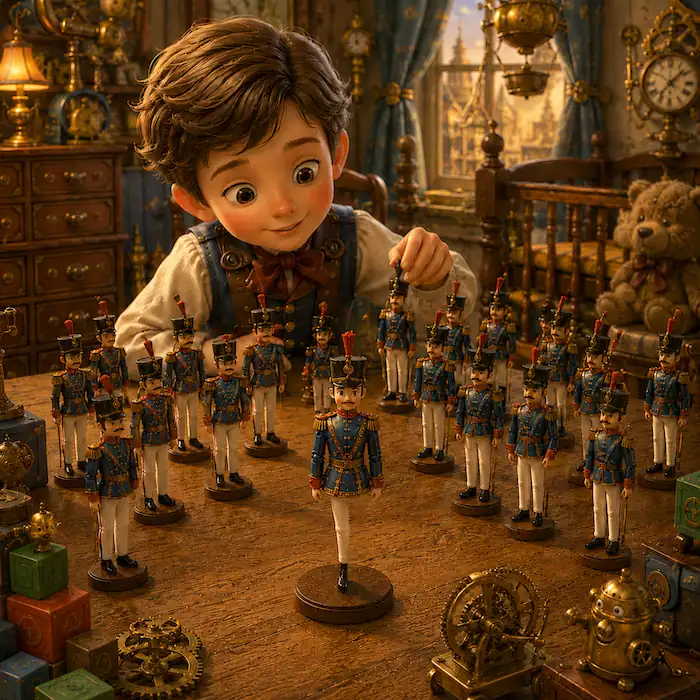
The tin soldier could not answer because toys do not speak when people are watching, but he stood taller than ever, with his one boot firm on the table and his painted eyes fixed ahead.
The Ballerina by the Palace
By afternoon, the nursery table had become a whole little world. The boy built a castle from blocks, set out paper trees and placed a small mirror on the table to make a lake. Last of all, he unfolded a paper palace with golden doors and tall painted windows. In front of the palace stood a paper ballerina.
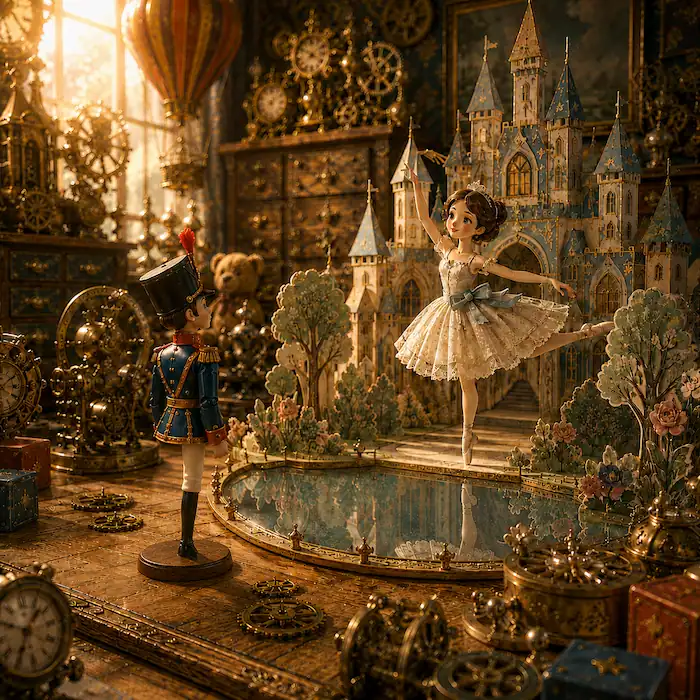
A pale blue sash circled her waist and a bright spangle glittered at the front. One arm reached upward while one leg stretched behind her so high that, from where the soldier stood, he could not see it at all.
“She has only one leg too,” thought the soldier, and for the first time that day, he felt less alone.
He wanted to march across the table, bow to her and ask if it was difficult to stand so still. He wanted to tell her that he understood. But no order had been given and a soldier does not leave his place just because his heart tells him to.
So he stayed at attention and watched her.
Evening came. The boy played until supper, then until bedtime, then a little longer after he had been told twice to put his toys away. At last, the nursery grew quiet, the fire burned low and moonlight crept across the floorboards.
At midnight, the nursery changed and all the toys woke up.
The wooden horse rocked, the clockwork mouse twitched and the blocks rolled softly against one another. Then the lid of a black box jerked open.
Pop!
A jack-in-the-box sprang into the moonlight with a pointed cap, a sharp little chin and a smile that looked friendly only if you were standing very far away.
The Goblin’s Threat
The jack-in-the-box was not just a toy. A small goblin lived inside him and he liked everyone in the nursery to know it.
He bounced once, then twice, until his spring squeaked. “Tin soldier,” he snapped, “stop looking at the ballerina.”
The soldier did not move.
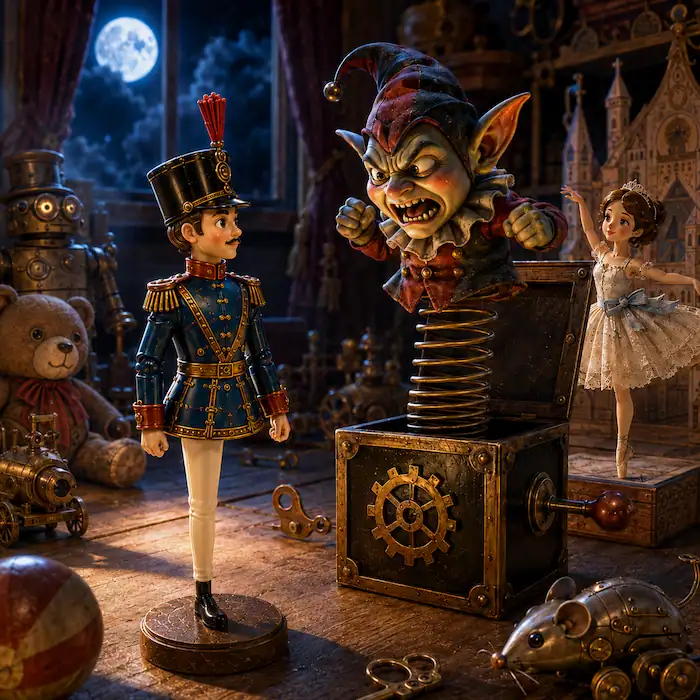
The goblin’s eyes narrowed. “Did you hear me? She belongs by the palace. You belong with the other soldiers. Face front.”
The tin soldier kept his gaze steady. He had not spoken to the ballerina or moved a single step. Looking at her was the only thing he had done for himself all day and he would not give that up because a goblin told him to.
The ballerina stood silent in her doorway, her spangle flashing once in the moonlight.
The goblin sank lower into his box. “Very well,” he hissed. “Stand proud tonight. Tomorrow will be different.”
The lid snapped shut so sharply that the nearest blocks gave a little jump.
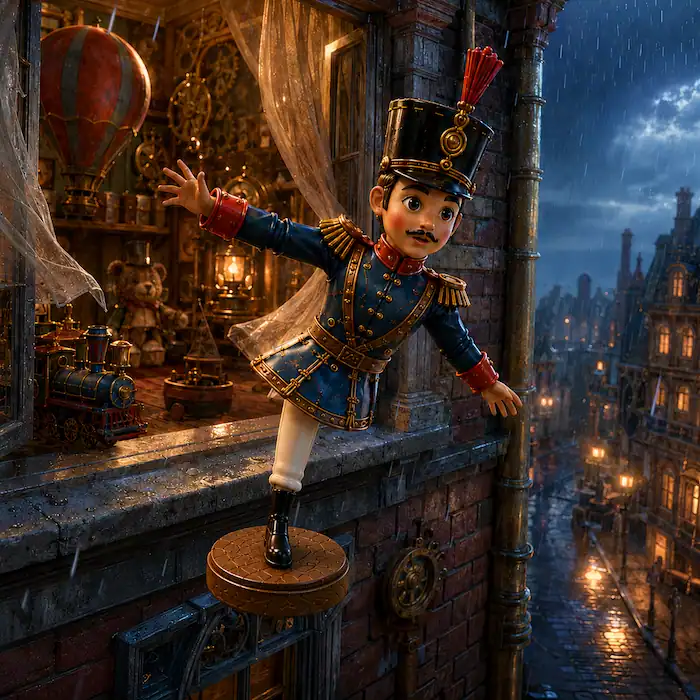
The next morning, after breakfast, the boy returned to the nursery and built a fort near the window. He placed the one-legged soldier on the sill as a lookout while rain tapped the glass outside, cartwheels hissed along the wet street and water ran in the gutter below.
Suddenly the window flew open.
Perhaps the latch had not caught, perhaps the wind shoved it, or perhaps the goblin had waited all night for his chance.
The tin soldier tipped forward and, for one sharp second, saw the street far below.
Then he fell.
Into the Street
Down he dropped past the brick wall, past the window ledge and past the startled face of a cat on the next sill. He struck the pavement hard, but he did not break. His bayonet jammed between two stones, leaving him stuck upside down with his one leg pointing straight into the rain.
The boy and the maid rushed outside.
“He fell here!” cried the boy. “I know he did!”
They searched beside the steps, under the windowsill and along the gutter, but neither of them saw the little soldier wedged between the stones.
“We must go in,” said the maid. “You are getting soaked.”
The boy looked once more, then the door closed behind them and the soldier was alone.
Water rushed around his shoulders and mud spattered his coat each time a cart passed. It was a miserable place to be stranded, but the soldier did not complain. He had no voice for it and no time for it either.
Before long, two boys came running through the rain. One held a folded newspaper boat and the other stopped when he spotted the soldier.
“Look! A soldier!”
They pulled him from the crack.
“He needs a ship,” said the first boy.
Before the tin soldier could even feel the air on his coat, they set him inside the paper boat and launched it into the gutter.
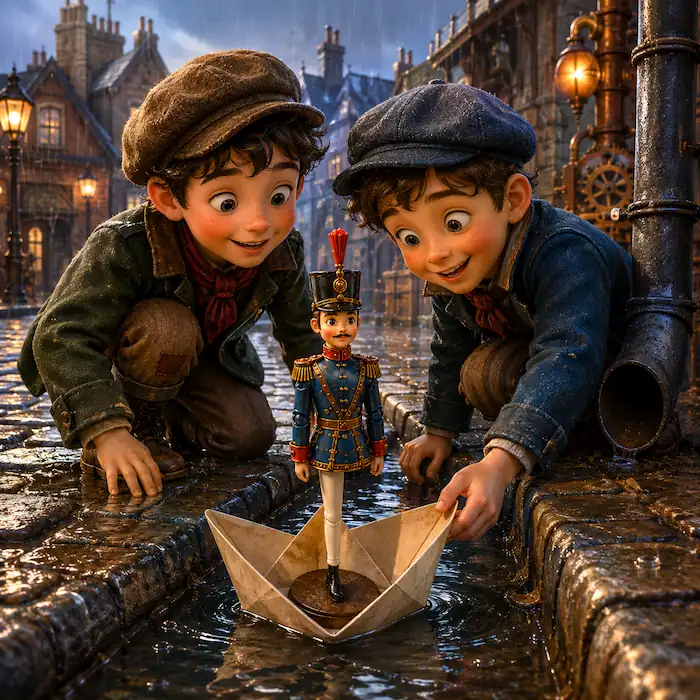
“Good voyage!” laughed the boys as the water grabbed the boat and carried it away.
The Wild Gutter Ride
The paper boat shot down the street like a runaway carriage, spinning past twigs, straw, orange peel and clumps of mud. Dirty water slapped the sides, rain hammered the paper and the little boat bumped against stones so hard that it lurched sideways and almost tipped over.
The tin soldier stood rigidly in the middle. He could not steer, jump out or call for help. He could only balance on his one leg and hope the thin paper beneath him held.
The gutter narrowed and the water began to roar. Ahead, beneath the road, a black drain opened like a mouth. The boat plunged in and daylight vanished.
Inside the drain, the world smelled of wet brick, mud and old leaves. Water dripped from the roof while the paper boat rushed deeper into the dark.
Then something moved.
A rat stepped onto a slick stone ledge. His whiskers twitched and his teeth shone.
“Stop!” squeaked the rat. “Who goes there?”
The tin soldier stared ahead.
“Where is your pass?” demanded the rat. “Where is your toll? No one sails through my drain without paying!”
The soldier had no pass, no coin and no wish to argue with a rat in a drain, so he kept silent.
The rat raced along the ledge beside him. “Stop him! Stop him! He has not paid!”
But the current was too strong. The boat swept past, the rat’s angry squeaks faded behind him and the tunnel suddenly dropped into a deeper roar.
The Canal
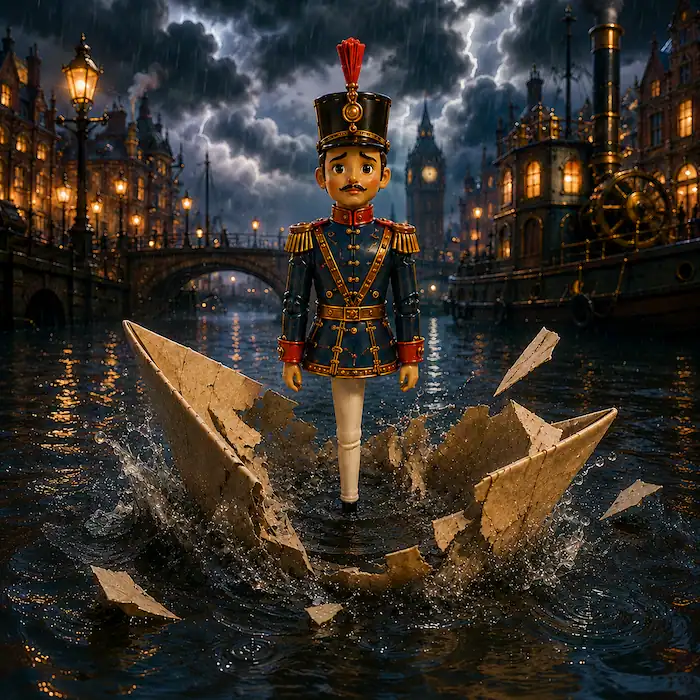
The paper boat burst out of the drain and dropped into a canal swollen by rain. For a moment, it bobbed in open water, then a wave slapped the boat and cold water spilled over the side.
The paper became soggy. The bow sagged first, then the stern dipped, and although the boat still carried him, it barely carried him at all.
The tin soldier thought of the ballerina standing by her palace with her arm raised and, as far as he could see, only one leg. She had not trembled and she had not fallen, so he would not fall either.
The water level in the little boat began to rise. First it reached his boot, then his calf, then the hem of his coat. Then, with a wet rip, the paper tore open.
For the first time, the soldier felt something close to fear. The water was cold, the sky was dark and no one knew where he was. Still, he held himself straight.
The paper boat broke apart beneath him and down he sank. Water closed over his hat, the canal turned black and before he could sink to the bottom, a huge fish swept out of the gloom, opened its mouth and swallowed him whole.

In the Belly of the Fish
Inside the fish, there was no light at all.
The soldier could hear dull, heavy sounds from outside, but they came as if through walls. The fish twisted and the soldier slid one way, then the other, yet he kept his musket close and his body stiff.
He had fallen out of a window, sailed a gutter, escaped a rat and sunk in a canal. Now he was shut inside a fish, which was not how he had imagined a soldier’s life.
In the dark, he thought again of the ballerina. He pictured her white dress, her blue sash and the spangle that shone at her waist. The thought did not make the darkness go away, but it gave him something to face it with.
So he waited.
Later that day, a fisherman caught the fish and took it to market. A cook bought it and by the strangest turn of luck, that same fish was carried into the boy’s house for supper.
In the kitchen, the maid laid it on the table and cut it open.
Out slid the tin soldier, wet, silent and still standing as straight as ever.
The maid cried out and nearly dropped her knife. “Mercy! The little soldier!”
She wiped him clean with a cloth and ran upstairs.
Back on the Table
The boy shouted when he saw him. “My soldier! He came back!”
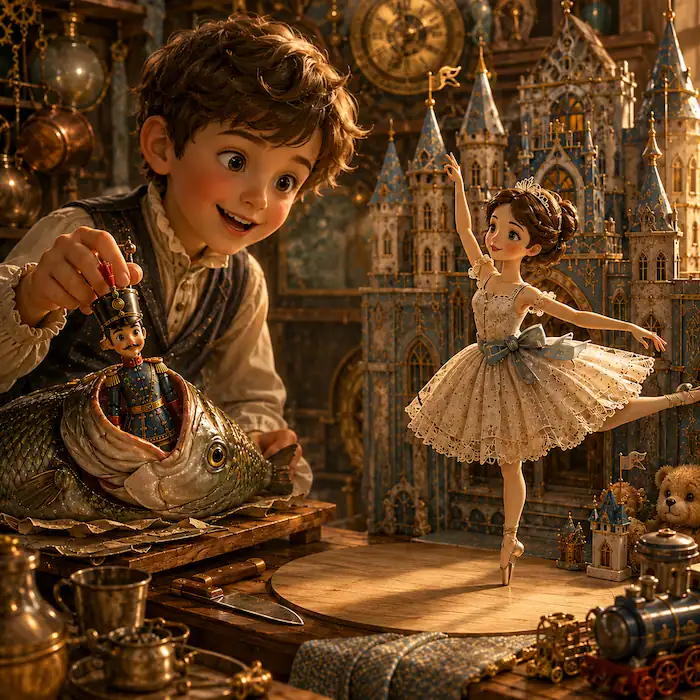
He placed the tin soldier on the nursery table, right where the adventure had begun. The blocks were still there, the mirror lake still shone and the paper palace stood at the far end with its golden doors.
And there was the ballerina.
She had not moved. Her dress was still white, her blue sash was still tied neatly at her waist and the spangle still glittered.
The tin soldier stood facing her and, for the first time since the window, the world felt still. He had been rained on, chased, drowned and swallowed. He had been carried through places no toy soldier was meant to see, yet he had returned to the one place he wanted to be.
If tin could smile, he would have smiled then.
The other soldiers stared from their row, spotless and untouched. Not one of them had traveled farther than the edge of the table. The one-legged soldier said nothing, but he stood a little taller.
In the shadows, the jack-in-the-box watched and his lid trembled.
The Fire
That evening, a fire burned in the nursery hearth, snapping and crackling behind the grate. The paper palace glowed, the ballerina’s spangle flashed and the soldiers’ buttons shone like sparks.
The boy picked up the tin soldier and held him for a long moment. Perhaps he wondered how a toy could fall from a window, vanish down a gutter and return inside a fish. Perhaps he meant only to look at him more closely. Or perhaps the goblin in the jack-in-the-box whispered from the dark.
Suddenly, the boy threw the tin soldier into the fire.
The soldier landed among the burning wood and flames rose around him at once. Heat struck his coat, his paint darkened and his tin body softened, but still he stood upright on his one leg.
Through the fire, he saw the ballerina.
Then the door opened and a gust of air swept through the nursery. It lifted her from the paper palace and carried her across the room, her skirt fluttering wildly while her arms stayed curved in their graceful pose.
For one bright second, she seemed to dance in the wind.
Then she flew into the hearth and landed beside the soldier. Her white dress flared, the spangle on her sash shone once, bright as a spark, then turned black.
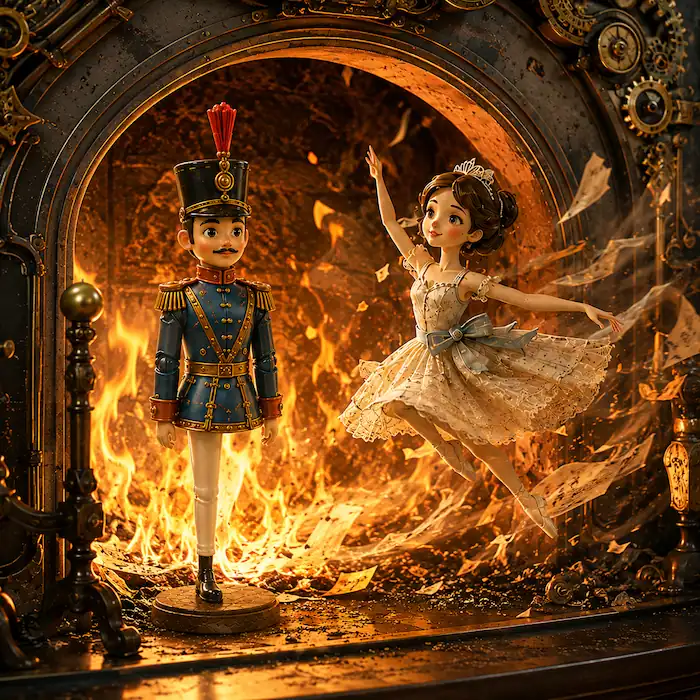
The fire was fiercer than the rain, darker than the drain and hotter than any danger he had known, but the ballerina was beside him and he did not turn away. He stood fast until the flames took him.
The Heart in the Ashes
By morning, the fire had gone out and the nursery was pale and quiet. Sunlight pushed through the curtains and lay across the floor in long golden bars. The toys stood where they had been left and the jack-in-the-box did not open.
The maid came in with a brush and pan to clean the hearth. She swept up the gray ash, the black cinders and the last curled scraps of paper, then stopped when something small gleamed among the ashes.
She picked it up carefully between finger and thumb.
It was a tiny heart made of tin.
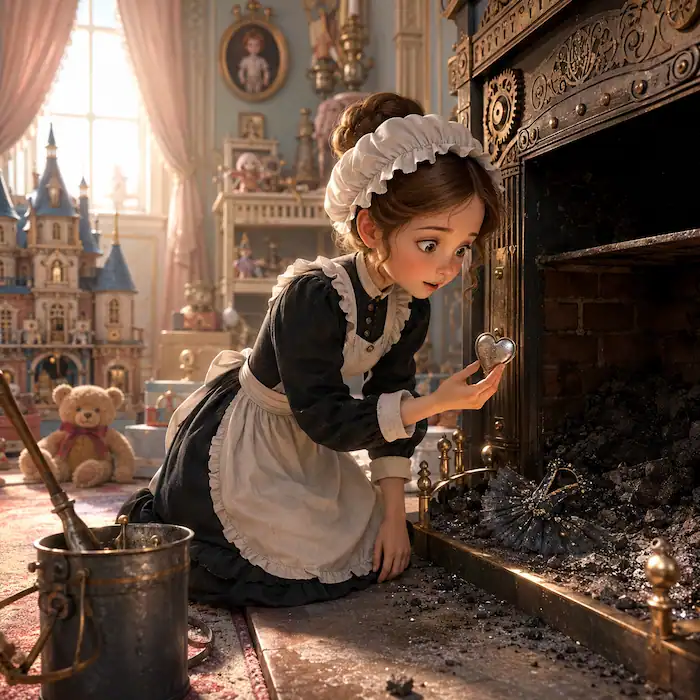
Beside it lay the ballerina’s spangle. It had burned as black as coal, but it still rested close to the little heart.
The maid placed them on the mantel.
When the boy saw them, he did not laugh or clap his hands. He only stood and looked. The tin soldier was gone and the ballerina was gone, yet something of them remained, small enough to fit in a child’s palm and strong enough to silence the whole room.
The morning sun touched the mantel and, for a moment, the tiny heart gleamed.
Moral and Themes
Moral: True courage means staying steady, loyal and kind even when fear, loss or danger tries to change who you are.
Story-specific themes:
- Courage: The tin soldier stays upright through the fall, rain, drain, canal, fish and fire.
- Loyalty: He keeps thinking of the ballerina and returns his gaze to her when he comes home.
- Steadiness: His one leg becomes a sign of strength rather than weakness.
- Loneliness and belonging: The soldier feels less alone when he sees the ballerina appear to stand on one leg too.
- Danger and resilience: The gutter, rat, canal and fish turn a small toy journey into a major adventure.
- Sadness and remembrance: The ending is sad, but the tiny heart and spangle show that something meaningful remains.
Short Summary of The Steadfast Tin Soldier
The Steadfast Tin Soldier tells the story of a boy who receives twenty-five tin soldiers for his birthday. One soldier has only one leg, but he stands proudly and feels a special connection with a paper ballerina near a palace. After a goblin threatens him, the soldier falls from a window, travels through rain, a gutter, a dark drain, a canal and the belly of a fish before returning home. The ending is sad, but the tiny tin heart beside the ballerina’s spangle gives children a gentle image of courage, loyalty and love that remains.
More Stories Like The Steadfast Tin Soldier
Enjoyed The Steadfast Tin Soldier? Here are more stories with courage, kindness, imagination, sacrifice and classic fairy tale themes.
- Fairy Tales for Kids: Kooky Kids World’s wider fairy tale collection.
- The Ugly Duckling: A Hans Christian Andersen story about loneliness, change and finding where you belong.
- The Little Mermaid: A Hans Christian Andersen fairy tale about longing, sacrifice and love.
- The Little Match Girl: A Hans Christian Andersen story with sadness and a gentle adult-support note for younger readers.
- The Emperor’s New Clothes: A Hans Christian Andersen fairy tale about honesty, pride and speaking the truth.
- The Princess and the Pea: A classic fairy tale with a royal setting and a memorable test.
- The Tinderbox: A Hans Christian Andersen fairy tale with magic, choices and adventure.
Main Characters in The Steadfast Tin Soldier
The tin soldier: A one-legged toy soldier who stands steady through danger, darkness and fire.
The paper ballerina: A delicate paper dancer near the palace. The soldier thinks she has only one leg too, which helps him feel less alone.
The birthday boy: The child who receives the tin soldiers, plays with them and later throws the soldier into the fire.
The boy’s mother: The adult who gives the boy the wooden box of soldiers.
The goblin in the jack-in-the-box: A sharp, threatening toy figure who tells the soldier to stop looking at the ballerina.
The two boys in the street: Children who place the soldier in a newspaper boat and send him into the gutter.
The rat: A drain-dwelling creature who demands a pass or toll as the soldier rushes past.
The fish: The fish that swallows the soldier before being caught and brought back to the boy’s house.
The cook or maid: The household helper who finds the soldier inside the fish and later discovers the tiny heart in the ashes.
Vocabulary from the Story
Steadfast: Firm, loyal and brave, even when something is frightening or difficult.
Ballerina: A female ballet dancer. In this story, the ballerina is a paper toy.
Spangle: A small shiny decoration, like a sequin.
Jack-in-the-box: A toy with a figure that springs up when the lid opens.
Gutter: A channel that carries rainwater along a street or roof.
Drain: A pipe or tunnel that carries water away.
Canal: A man-made waterway or channel.
Cinder: A small piece of partly burned wood, coal or ash.
Discussion Questions
- Why does the boy think the one-legged soldier is special?
- Why does the tin soldier feel less alone when he sees the ballerina?
- Why does the goblin tell the soldier to stop looking at the ballerina?
- How does the gutter ride make a small toy adventure feel dangerous?
- What helps the tin soldier stay steady in the canal and inside the fish?
- Why is the ending sad?
- What does the tiny tin heart suggest about the soldier?
- What does this retelling teach about courage, loyalty and staying true to yourself?
Classroom Activities for Children
Draw the nursery table: Ask children to draw the soldiers, castle blocks, mirror lake, paper palace, ballerina and jack-in-the-box. Encourage them to place each item where it appears in the story.
Story sequencing cards: Give children cards for the birthday box, the ballerina, the goblin’s threat, the fall, the gutter ride, the rat, the canal, the fish, the return home, the fire and the tin heart. Ask them to place the cards in order and retell the story.
Steadfast statue movement game: Children stand like toy soldiers, then freeze in poses for rain, wind, darkness, fear, hope and courage. Keep movements slow, safe and controlled.
Paper boat water test: Children fold newspaper or scrap-paper boats and test them in a tray of water. Discuss what helps a boat float, what makes paper soggy and how the story turns a small boat into a big adventure.
Tin heart craft: Children cut or draw a small heart and decorate it with words from the story, such as steady, brave, loyal, kind, hope and courage.
Soundscape retelling: In groups, children create gentle sounds for rain, cartwheels, rushing water, the drain, the fish market, crackling fire and the quiet morning after the fire. One child narrates while the others add sound effects.
Feelings map: Place feeling words around the room, such as proud, lonely, brave, frightened, hopeful, sad and quiet. Read key moments and ask children to stand near the feeling the tin soldier might have.
Outdoor water-path observation: If suitable, look outside after rain or use a safe water tray. Children observe how water carries leaves or paper pieces and connect this to the soldier’s journey through the gutter.
Writing activity: Ask children to write a diary entry from the tin soldier’s point of view after he returns from the fish, or a short note from the ballerina to the soldier.
Gentle ending circle: Invite children to share what they found sad, brave or beautiful in the ending. Make clear that stories can help us talk safely about difficult feelings.
Teachers’ Notes
Best curriculum fit: Reading comprehension, classic fairy tales, authored literary fairy tales, character study, vocabulary, speaking and listening, drama, art, design, simple science, writing and social-emotional learning.
Key learning themes: Courage, loyalty, resilience, loneliness, love, danger, imagination, sadness, empathy and staying true to yourself.
Before listening or reading: Ask children what it means to be brave. Can bravery mean standing steady rather than fighting?
During the story: Pause when the soldier sees the ballerina and thinks she has only one leg too. Ask children why that moment matters to him.
Second pause point: Pause when the paper boat enters the dark drain. Ask children how the writer makes a tiny toy’s journey feel large and dangerous.
After the story: Discuss the tin heart and the ballerina’s spangle. Ask what remains at the end and why that image is quieter than a happy ending.
Cross-curricular links:
- Art: Draw the toy room, ballerina, paper palace or heart in the ashes.
- Design and technology: Fold and test paper boats.
- Science: Explore floating, sinking, water flow and absorbent paper.
- Drama: Create freeze frames for the goblin’s threat, the gutter ride, the fish scene and the final hearth scene.
- PSHE / social-emotional learning: Talk about courage, loneliness, loyalty, sadness and how children can handle difficult endings.
- Writing: Write a diary entry, alternative ending, character letter or scene description from the tin soldier’s point of view.
Teacher tip: This uploaded version includes a sad ending, fire and the loss of two toy characters. It is suitable for children aged 6-12 when handled gently, but younger or sensitive children may need reassurance and space to talk.
Why This Version Works for Children
This Kooky Kids World retelling keeps Andersen’s core story while using clear, concrete language for children aged 6-12. It gives the tin soldier a strong emotional thread: he feels less alone when he sees the ballerina, stays steady through danger and leaves behind a tiny heart that helps children understand the ending symbolically.
The story does not make the fire scene graphic. It keeps the sadness, but frames the final image as quiet, meaningful and emotionally discussable for children, parents and teachers.
What Parents and Teachers May Want to Know
The Steadfast Tin Soldier has a sad ending. The tin soldier and the ballerina are both lost in the fire, but the story ends with a tiny tin heart and the ballerina’s spangle, giving children a gentle symbol of what remains.
Adults may want to explain that older fairy tales often use sadness to help children think about courage, loyalty, love and loss. This version is best shared with time for questions afterward.
Story Background
The Steadfast Tin Soldier was written by Danish author Hans Christian Andersen and was first published in 1838 under the Danish title Den standhaftige Tinsoldat.
It is a literary fairy tale, not a traditional folk tale. That means it was written by a known author rather than passed down through oral tradition in many anonymous versions.
The uploaded Kooky Kids World retelling follows Andersen’s core pattern: a one-legged tin soldier, a paper ballerina, a threatening goblin, a fall from a window, a gutter journey, a rat, a canal, a fish, a return home and a sad final scene in the fire.
Further Reading for Adults and Teachers
For adults and teachers who want to compare a public domain English text, see Project Gutenberg’s Hans Andersen’s Fairy Tales.
Frequently Asked Questions About The Steadfast Tin Soldier
-
What is The Steadfast Tin Soldier about?
The Steadfast Tin Soldier is about a one-legged toy soldier who stands bravely, loves a paper ballerina and survives a dangerous journey through rain, a drain, a canal and a fish. In this Kooky Kids World retelling, he returns home before the story ends sadly but gently with a tiny tin heart in the ashes.
-
Who wrote The Steadfast Tin Soldier?
The original story was written by Danish author Hans Christian Andersen. It was first published in 1838.
-
Is The Steadfast Tin Soldier a folk tale or a fairy tale?
The Steadfast Tin Soldier is a literary fairy tale. It is not a traditional folk tale because it was written by a known author, Hans Christian Andersen.
-
What is the moral of The Steadfast Tin Soldier?
The moral is that true courage means staying steady, loyal and kind even when fear, loss or danger tries to change who you are. The tin soldier cannot control what happens to him, but he keeps his courage and loyalty.
-
Why does the tin soldier have only one leg?
In this retelling, the soldiers are made from an old tin spoon and there is not enough tin left to give the last soldier a second leg. He still stands proudly, which helps show his strength and steadiness.
-
Why does the tin soldier feel connected to the ballerina?
The tin soldier thinks the ballerina has only one leg too because one of her legs is lifted so high that he cannot see it. This makes him feel less alone and gives him someone to think about during his dangerous journey.
-
Does The Steadfast Tin Soldier have a sad ending?
Yes. This uploaded Kooky Kids World version includes the classic sad ending with the fire, but it presents the moment gently. The final image of the tiny tin heart and the ballerina's spangle helps children talk about courage, love, sadness and remembrance.
-
What age is The Steadfast Tin Soldier suitable for?
This child-friendly retelling is suitable for children aged 6-12. Younger children may benefit from an adult listening along with them and talking about the ending afterward.
-
Can children listen along to The Steadfast Tin Soldier?
Children can listen along if the final Kooky Kids World page includes a working audio player. Do not use listen-along wording on the live page until the audio has been checked.
-
How can teachers use The Steadfast Tin Soldier in class?
Teachers can use the story for comprehension, sequencing, vocabulary, character study, art, drama, paper boat activities, floating and sinking science, writing prompts and social-emotional discussion about courage and sadness.
Copyright Notice
The original story by Hans Christian Andersen is in the public domain. This Kooky Kids World retelling, illustrations, audio narration and supporting educational content are © Kooky Kids World.