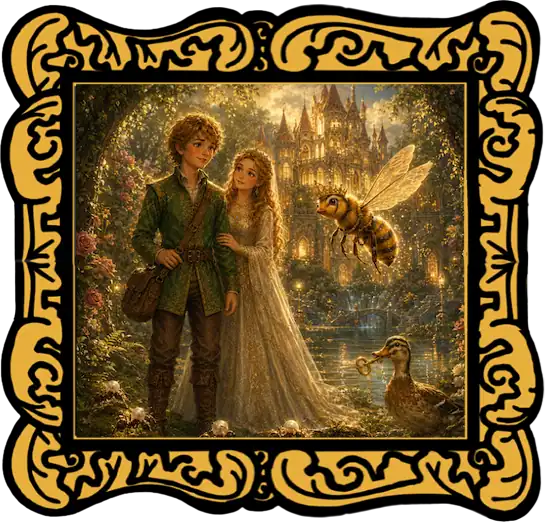

The Queen Bee: A Grimm Fairy Tale for Kids

The Queen Bee is a gentle Grimm fairy tale for children aged 6 to 12. It follows a young prince who protects tiny creatures when his older brothers would rather ignore or harm them.

This retelling keeps the main shape of the traditional story while using warm, clear language for young readers. It is a useful story for talking about kindness, patience, courage and respect for nature.

Listen Along

Read-aloud audio cover for The Queen Bee by the Brothers Grimm
0:00 / 0:00
The Queen Bee
Kooky Kids World Cloud Logo showing where the audio read aloud file is.

Story Details

  • Independent Reading Age: 8 to 12 years
  • Listen-Along Age: 6 to 12 years
  • Reading Level: Upper elementary, US Grades 3 to 5
  • Reading Time: About 10 to 15 minutes
  • Author / Source: Brothers Grimm fairy tale, public-domain source context, original Kooky Kids World retelling
  • Story Type: Fairy tale
  • Region / Origin: Germany / European fairy tale tradition
  • Main Characters: The youngest prince, his two brothers, ants, ducks, bees and three sleeping princesses
  • Moral / Themes: Kindness, patience, mercy, courage, gratitude, respect for small creatures and help returned

About This Retelling

The Queen Bee is a public-domain fairy tale collected by the Brothers Grimm. Different translations and retellings may include small changes in wording, pacing or detail.

This child-friendly retelling keeps the main shape and meaning of the Grimm fairy tale while using clear language for young readers. It should be read as one gentle introduction to the story, not as the only version.

The Queen Bee Story

The Youngest Prince

Once there were three princes who left their father’s castle to seek their fortune. The two older brothers were proud, restless and quick to laugh at anything gentle. The youngest brother was quieter. He watched carefully, listened kindly and did not think strength meant being cruel.
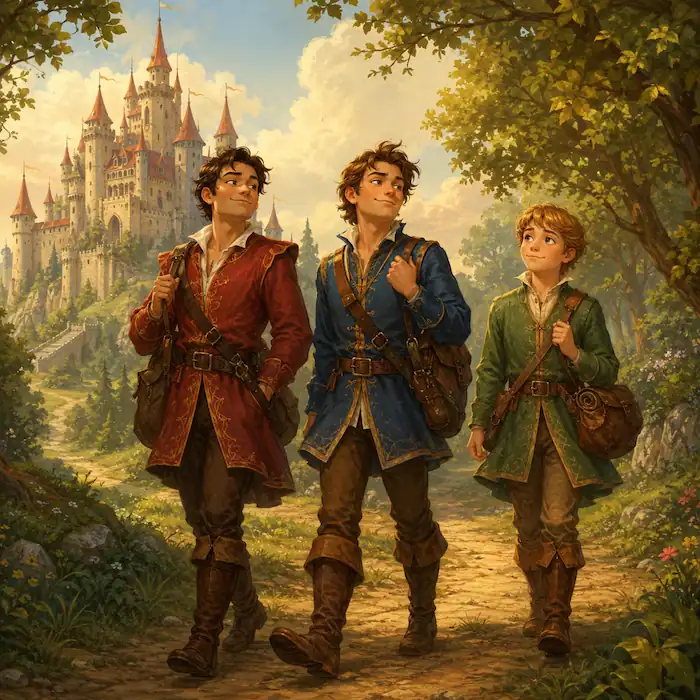
Three young princes leave their father’s castle and begin their journey in The Queen Bee Grimm fairy tale.

The brothers traveled through forests, fields and winding roads. Whenever they grew hungry, tired or bored, the two older princes wanted to take what they could from the world around them. The youngest prince often had to speak up for creatures that could not speak for themselves.

Kindness on the Forest Road

One day the brothers came to an anthill beside the path. Thousands of tiny ants hurried in and out, carrying crumbs, leaves and grains of sand. The two older princes laughed and wanted to stir up the anthill just to watch the ants scatter.
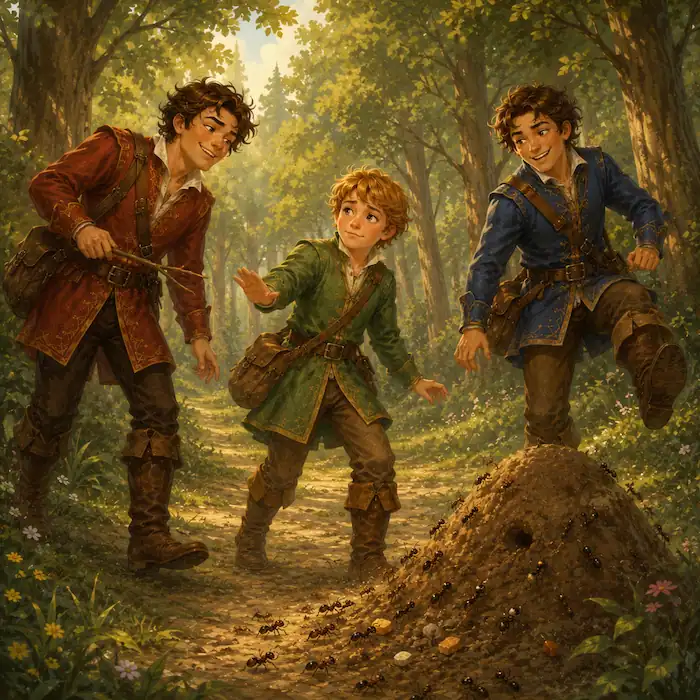
The youngest prince stops his older brothers from disturbing an anthill in the forest in The Queen Bee by the Brothers Grimm.

The youngest prince stepped in front of them. “Leave the little creatures in peace,” he said. “They are working hard and have done us no harm.” The older brothers shrugged and walked on, but the ants were safe.

Later the brothers came to a lake where ducks were swimming. The older princes wanted to catch them for sport. Again the youngest prince stopped them. “Let them live,” he said. “They are happy on the water and have not troubled us.”
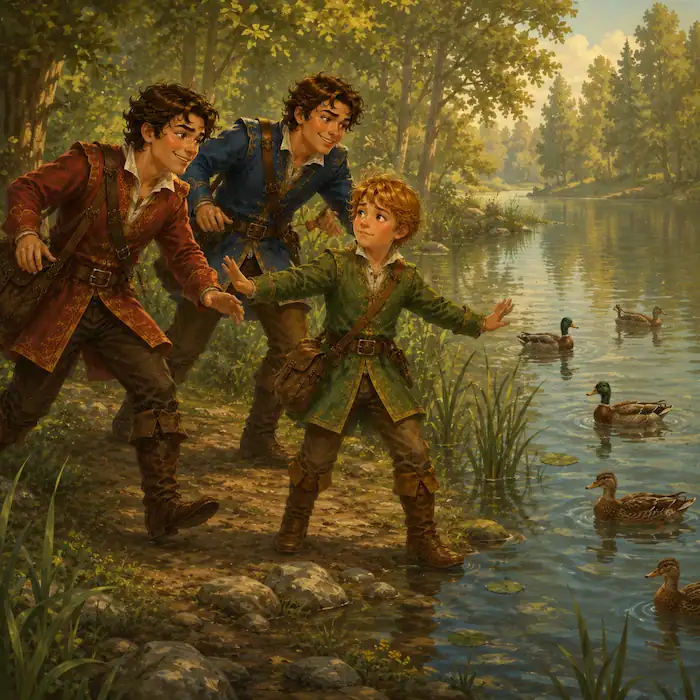
The youngest prince protects ducks on a forest lake from his older brothers in this Brothers Grimm fairy tale scene.

The Bees in the Hollow Tree

As evening came, the brothers found a hollow tree filled with bees. Golden honey glistened inside. The two older princes wanted to smoke out the bees and take the honey for themselves.

The youngest prince would not allow it. “The bees have worked for their honey,” he said. “We should not destroy their home.” The older princes grumbled, but they left the bees alone.

The youngest prince protects bees and their honey in a hollow tree while his older brothers hold smoking branches.

The youngest prince did not know it, but the ants, the ducks and the bees had all noticed his kindness. In a fairy tale, even the smallest kindness may return when it is needed most.

The Silent Castle
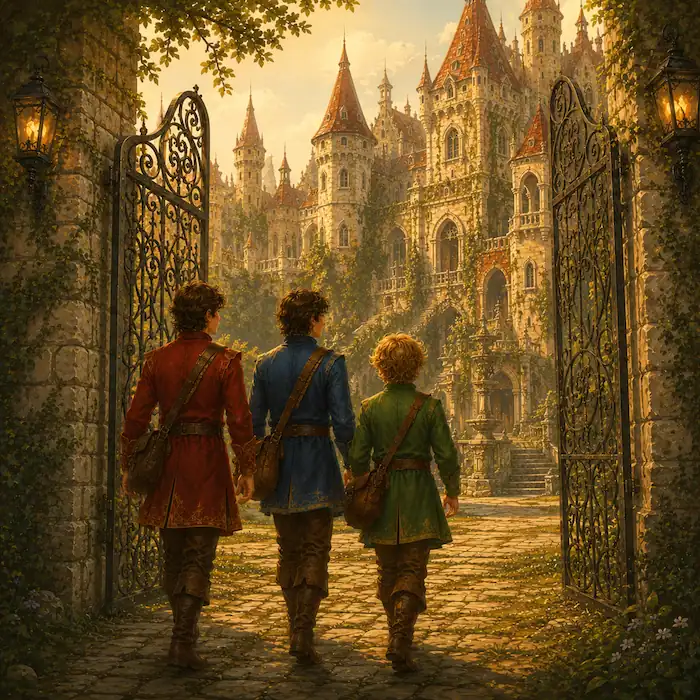
The three brothers enter the open gates of a silent enchanted castle in The Queen Bee Grimm fairy tale.

After many days, the brothers reached a strange castle. The gates stood open, but no guards called out. The courtyard was still. The halls were quiet. Inside, they found rooms filled with beautiful things, but no one moved or spoke.

At last they found an old gray man sitting at a table. He did not speak, but he showed them food and places to sleep. 

The next morning, he led the oldest prince to a stone tablet. On it were written three tasks. Whoever completed them would wake the castle. Whoever failed would be turned to stone.
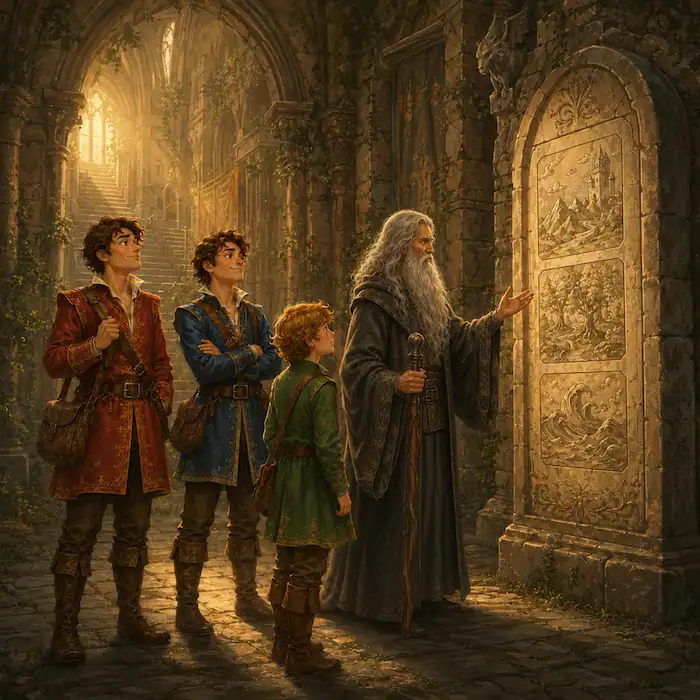
An old gray man shows the three princes a stone tablet with the tasks that can wake the enchanted castle.

The oldest prince tried first, but he failed the tasks and became stone. The second prince tried next, and he too failed. Then it was the youngest prince’s turn.
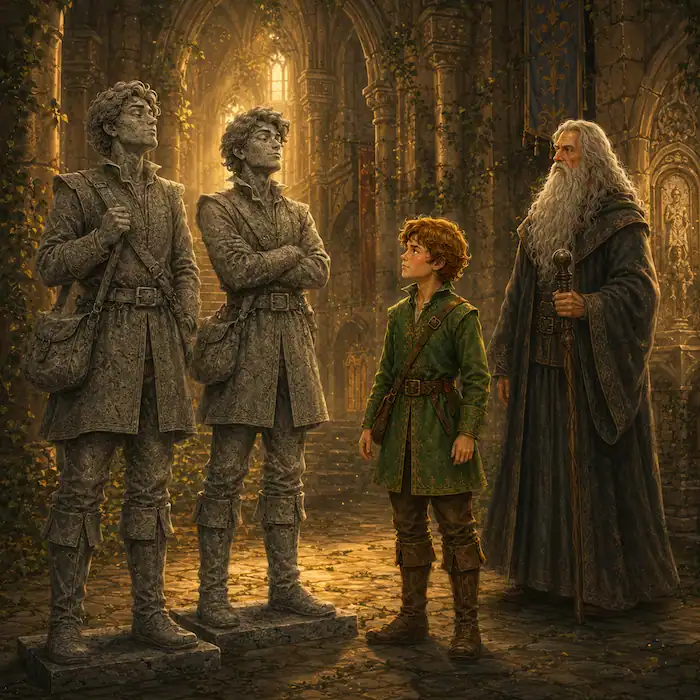
The youngest prince stands beside his two older brothers after they are turned to stone inside the enchanted castle.

The Ants and the Ducks

The first task was to find a thousand pearls scattered through the moss in the forest. The youngest prince searched carefully, but the pearls were tiny and hidden among leaves, roots and stones. He soon feared he would never find them all.

Then the ants he had protected came marching from the ground. They spread through the moss in long careful lines. One by one, they carried the pearls back until every last pearl was found.
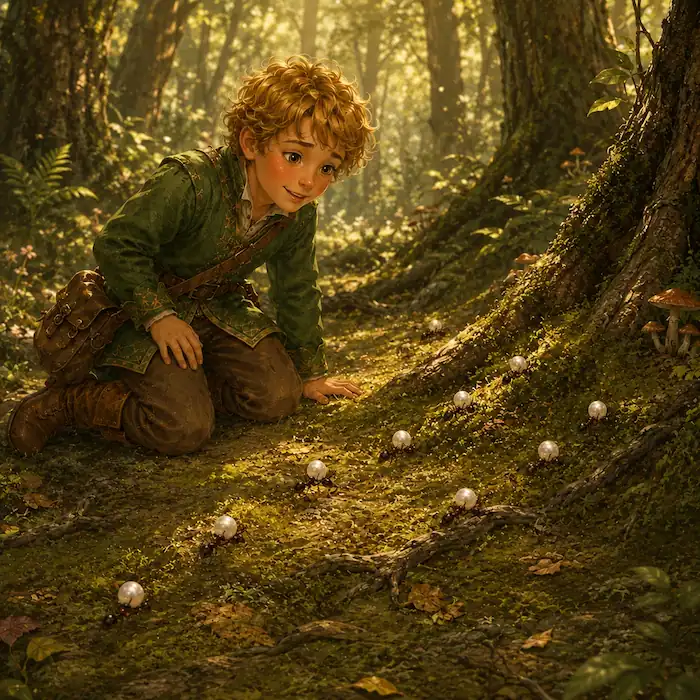
Ants help the youngest prince find a thousand pearls scattered through the moss in the forest.

The second task was to fetch a key from the bottom of the lake. The youngest prince stood by the water, wondering how he could reach it. Then the ducks he had saved swam toward him. They dipped beneath the surface, searched the dark water and brought the key up in their beaks.
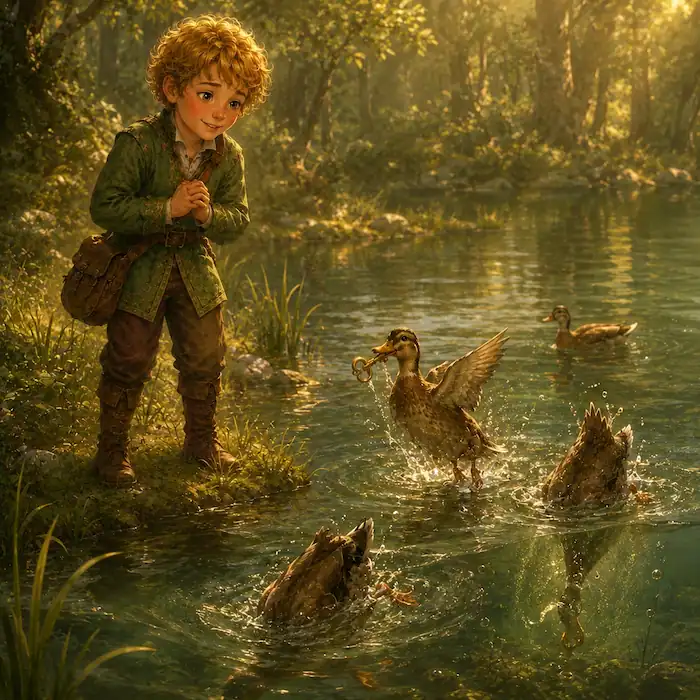
Ducks bring a golden key from the bottom of the lake to help the youngest prince complete the second task.

The Queen Bee’s Choice

The third task was the hardest. In a room of the castle lay three sleeping princesses. They looked so alike that no ordinary person could tell them apart. The youngest prince had to choose the youngest and dearest princess, or he would fail like his brothers.

He stood quietly, unsure what to do. Then the queen bee, whose home he had protected, flew into the room with her swarm. She hovered over each princess, then settled gently on the lips of the youngest one, who had tasted honey before she fell under the spell.
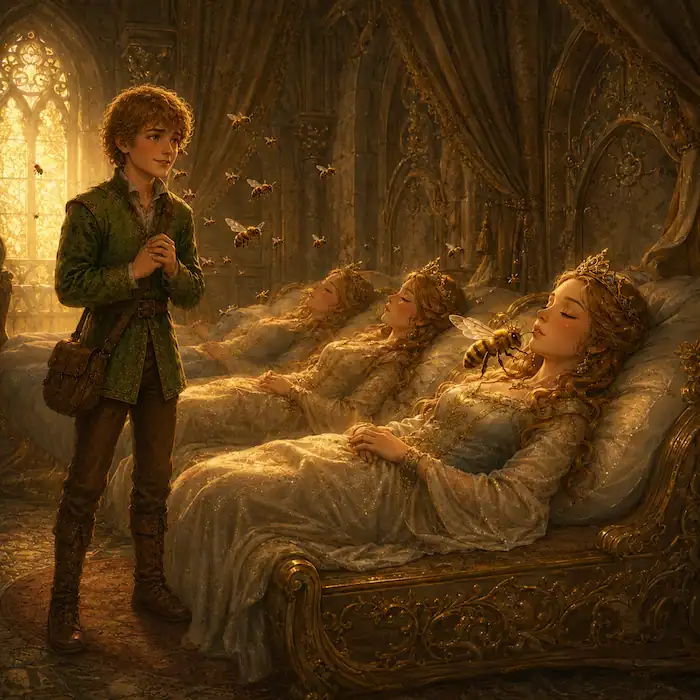
The queen bee settles on the lips of the youngest sleeping princess so the youngest prince can choose correctly.

The youngest prince understood. He chose the princess marked by the queen bee.

The Castle Wakes

At once the spell broke. The silent castle filled with sound. The stone figures became living people again, including the prince’s two brothers. Doors opened, voices returned and joy moved through every room.

The youngest prince had not won by force or by proud boasting. He had won because he had been kind when no reward was promised. The little creatures he saved became the helpers who saved him in return.
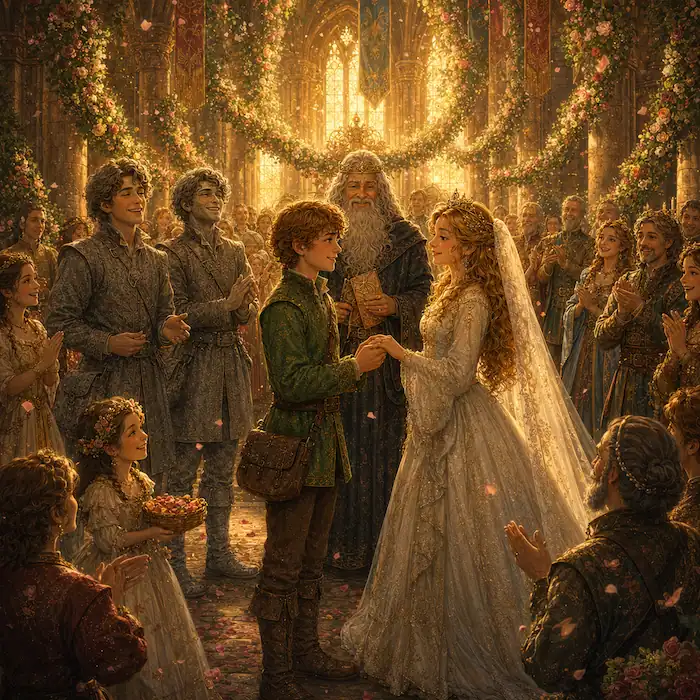
The youngest prince and princess marry as the enchanted castle wakes and his stone brothers return to life.

The youngest prince married the princess, and the castle lived happily again. From that day on, everyone remembered that small creatures can carry great wisdom, and gentle choices can be stronger than proud ones.

Moral

Moral: True kindness means caring for those who seem small or powerless, and that kindness can return when it is needed most.

Short Summary

The Queen Bee tells the story of a youngest prince who protects ants, ducks and bees while traveling with his careless older brothers. When the brothers reach an enchanted castle, the prince must complete three difficult tasks to wake everyone from the spell. The creatures he once saved return to help him at the turning point. The story ends by showing that kindness, patience and respect for small living things can be stronger than pride.

More Stories Like The Queen Bee

Enjoyed The Queen Bee? Here are more Kooky Kids World stories and collections about fairy tales, kindness, animal helpers and magical adventures.

Main Characters

  • The Youngest Prince: A kind and patient prince whose respect for small creatures helps him complete the tasks.
  • The Two Older Brothers: Proud princes who act carelessly and do not understand the value of mercy.
  • The Ants: Tiny helpers who repay the prince by finding the scattered pearls.
  • The Ducks: Lake birds who help by bringing the hidden key up from the water.
  • The Queen Bee: A wise little guide who shows the prince which princess to choose.
  • The Sleeping Princesses: Three enchanted princesses waiting for the spell over the castle to be broken.

Vocabulary Spotlight

  • Mercy: Kindness shown to someone or something that needs help.
  • Enchanted: Changed or held by magic.
  • Scattered: Spread in many different places.
  • Hollow: Empty inside, like part of an old tree.
  • Swarm: A large group of insects moving together.
  • Task: A job or challenge that must be completed.
  • Boasting: Talking too proudly about yourself.
  • Wisdom: Good sense and understanding.

Discussion Questions

  1. Why does the youngest prince stop his brothers from harming the ants, ducks and bees?
  2. How do the older brothers act differently from the youngest brother?
  3. Why do you think the small creatures choose to help the prince later?
  4. Which castle task seems the hardest, and why?
  5. What does the story suggest about kindness when no one is watching?
  6. How might the youngest prince feel when he sees his brothers turned to stone?
  7. What can this story teach us about respecting nature?

Classroom Activities for Children

  • Creative activity: Make a kindness shield or crown showing the ants, ducks and bees as helpers in the story.
  • Sequencing activity: Give children mixed-up story cards and ask them to place the events in order from the forest path to the waking castle.
  • Movement activity: Create a story movement map around the room. Children march like ants, glide like ducks, buzz carefully like bees and freeze like the silent castle.
  • Fine motor activity: Use beads, buttons or paper circles as “pearls” and let children sort, count or place them carefully into small containers.
  • Speaking and listening activity: In pairs, let one child be the prince and one be a creature explaining how they can help.
  • Drama activity: Build a short freeze-frame performance of the three tasks, then let the class guess which moment is being shown.
  • Emotional literacy activity: Match feelings such as worry, pride, gratitude and relief to different scenes. Ask children to explain what each character might be feeling.
  • Outdoor or nature-based activity: Go outside and quietly observe ants, birds or bees from a safe distance. Discuss how small creatures work together and why we should not disturb them.
  • Writing activity: Write a short thank-you note from the prince to one of the helper creatures, explaining how its help changed the ending.
  • Screen-free option: Draw a three-part comic showing one kind action, one difficult task and one helpful return.

Teachers’ Notes

  • Best curriculum fit: Reading comprehension, traditional tales, fairy tales, moral choices, speaking and listening, drama and PSHE or social-emotional learning.
  • Key learning themes: Kindness, consequences, patience, gratitude, respect for living things and the idea that small helpers can make a big difference.
  • Before reading: Ask children whether a very small animal could ever help a person. Invite predictions without judging the answers.
  • During reading: Pause after each rescued creature and ask children to remember it. This helps them notice the pattern when the tasks begin.
  • After reading: Discuss how the ending depends on earlier choices. Ask what might have happened if the prince had copied his brothers.
  • Cross-curricular links: Art through helper-creature designs, drama through freeze frames, nature study through careful observation, PSHE through empathy and writing through thank-you notes or scene retellings.
  • Teacher tip: Emphasize that the story rewards care and restraint, not just bravery. This makes it useful for classroom conversations about empathy and responsibility.

Why This Version Works for Children

This version is suitable for many children aged 6 to 12 because it keeps the main lesson of the Grimm fairy tale while using clear language and a steady story path. It avoids overly confusing or frightening detail and keeps the focus on kindness, courage and respect for nature.

The repeated pattern of kind act, difficult task and helpful return also makes the story easy to follow, retell and discuss.

What Parents and Teachers May Want to Know

This fairy tale includes mild danger, magic, enchantment and the threat of being turned to stone. These moments are presented calmly and are resolved through kindness and help from the natural world.

Some children may want to talk about why the older brothers behave carelessly and how the youngest prince chooses a better path. The story is child-friendly, but it still gives room for thoughtful discussion.

Story Background

The Queen Bee is a fairy tale collected by the Brothers Grimm. It belongs to a tradition of stories where kindness to animals or small creatures is later rewarded.

Versions and translations may vary, especially in wording and small details. Common themes include mercy, gratitude, enchantment, sibling contrast and respect for the natural world. This retelling does not claim to be an official or only version.

Further Reading for Adults and Teachers

Adults and teachers who want to compare this child-friendly retelling with a public-domain source can read Grimms’ Fairy Tales at Project Gutenberg.

Frequently Asked Questions About The Queen Bee

  • What is The Queen Bee about?

    The Queen Bee is about a young prince who protects ants, ducks and bees. Later, those small creatures help him complete three tasks and break the spell on a silent castle.

  • What is the moral of The Queen Bee?

    The moral is that kindness to small and powerless creatures matters. The story shows that gentle choices can return as help when they are needed most.

  • What age is The Queen Bee suitable for?

    This retelling is written for children aged 6 to 12. Younger children may enjoy listening along, while older children can read it independently and discuss the moral.

  • Is The Queen Bee a fairy tale?

    Yes. The Queen Bee is a fairy tale collected by the Brothers Grimm, with magic, three tasks, an enchanted castle and a moral lesson.

  • Where does The Queen Bee come from?

    The story is connected with the Brothers Grimm collection from Germany. Like many fairy tales, versions and translations may vary.

  • Why do the animals help the youngest prince?

    They help him because he protected them earlier when his brothers wanted to harm or disturb them. His kindness is returned at the moment he needs help.

  • What can children learn from The Queen Bee?

    Children can learn that kindness, patience and respect for living things are important. The story also helps them think about choices, consequences and gratitude.

  • How can teachers use The Queen Bee in class?

    Teachers can use the story for sequencing, comprehension, moral discussion, drama, vocabulary, nature observation and screen-free creative activities.

Copyright Notice

The original Brothers Grimm fairy tale is in the public domain. This child-friendly Kooky Kids World retelling, page text, educational notes, activities and presentation are original to Kooky Kids World and are protected by copyright.

© Kooky Kids World. Please do not copy, reproduce, republish, record, distribute or adapt this version or page content without permission.