

The Tale of Urashima Tarō: Japanese Folk Tale

The Tale of Urashima Tarō is a traditional Japanese folk tale for children aged 6–12, especially when read aloud with younger listeners. This version has been retold for young readers with clear language, audio support and a gentle focus on kindness, wonder, time, honesty and keeping promises.

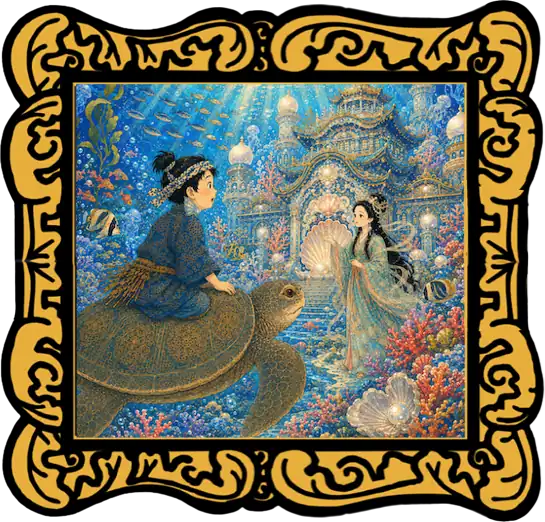
Audio cover for The Tale of Urashima Tarō with a gold frame, turtle, Otohime and undersea palace.
0:00 / 0:00
The Tale of Urashima Tarō
Kooky Kids World Cloud Logo showing where the audio read aloud file is.

About This Retelling

This child-friendly retelling keeps the main shape and meaning of the traditional Japanese folk tale while using clear language for young readers. Traditional stories can vary between regions, families, books and storytellers, so this version should be read as an introduction rather than the only version.

This page does not present an official version of the tale. It offers one gentle Kooky Kids World retelling for children, parents and teachers.

The Tale of Urashima Tarō Story

The Turtle in the Net

Urashima Tarō lived in a small fishing village beside the sea. Every morning, he carried his nets down to the shore and loaded up his boat ready for the day’s fishing.

“Good morning, sea,” he said, as if the waves could answer him.

Tarō was young, strong and kind. He lived with his mother in a wooden house in the village. She was a wise, kind woman who knew how to mend nets better than anyone else in the village.

“Take care today,” she told him each morning.

“I will, Mother,” Tarō always replied.
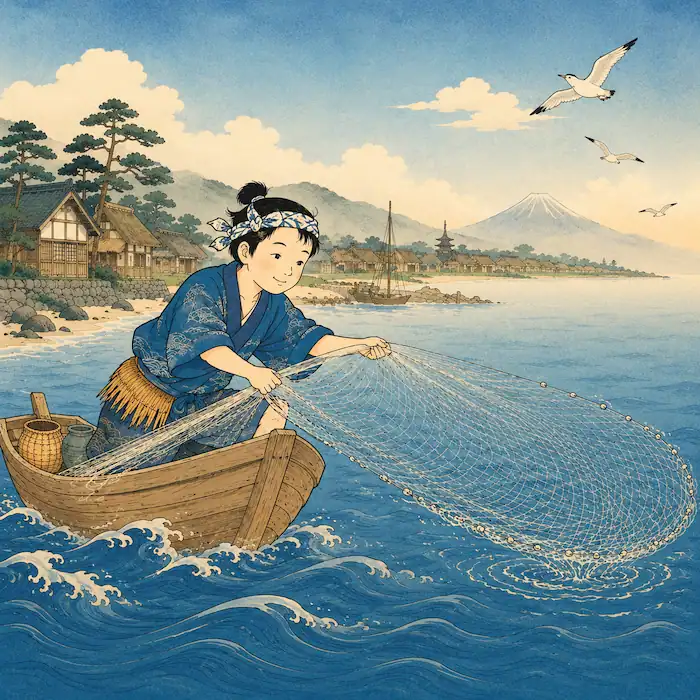
Urashima Tarō casts his fishing net near a Japanese seaside village in this Japanese folk tale.

One bright day, Tarō rowed farther from shore than usual. The water glistened like a thousand little mirrors. He cast his net like he did every day, then waited. After some time, he pulled the net onto the boat and inspected his catch.

Fish flashed silver in the net and seaweed tangled around the ropes. Then something caught Tarō’s eye.

“What is this?” he murmured.

Caught in the net was a small turtle. Its flippers twisted in the ropes and its dark eyes looked up at him as if asking for help.

Tarō’s face softened. “Poor little one. You do not belong in my net.”
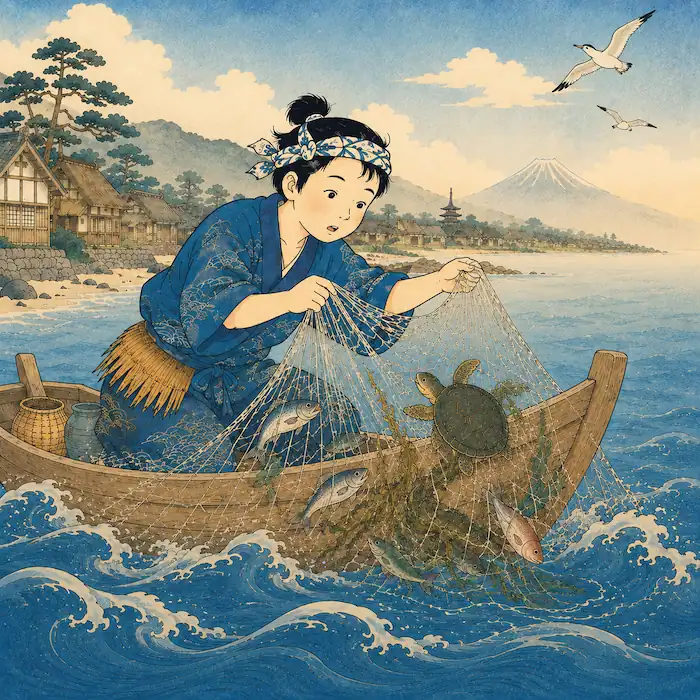
Urashima Tarō finds a small turtle tangled in his fishing net beside the shore.

Carefully, he loosened the cords. One loop slipped free. Then another, then another. At last, the turtle was free.

“There you are,” Tarō said. “Back to the sea with you.”

He gently lowered the turtle into the water. For a moment, it floated beside the boat, then it dipped its head, as if bowing, and vanished below the waves.
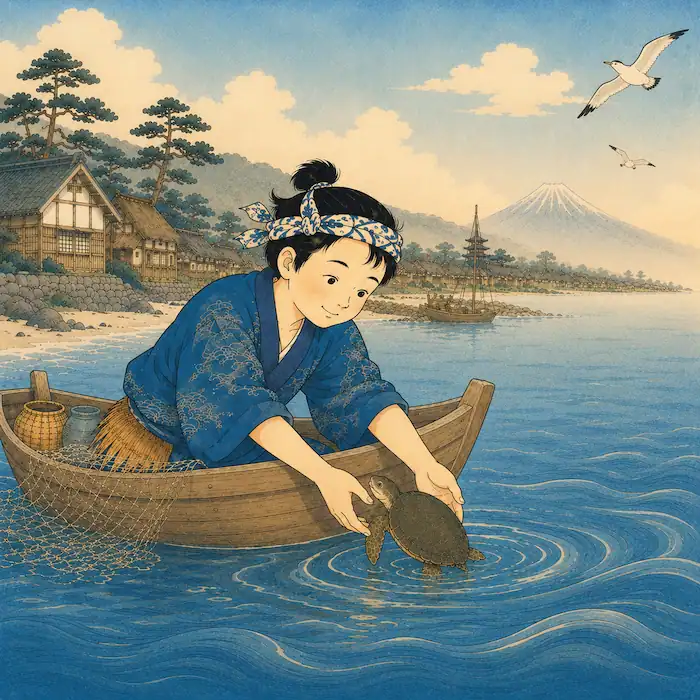
Urashima Tarō gently releases the small turtle back into the sea.

That evening, Tarō told his mother what had happened.

“You did right,” she said, smiling. “The sea remembers kindness.”

Tarō laughed. “Does it?”

His mother looked out toward the darkening water. “Sometimes.”

The Great Turtle’s Message

The next morning, mist lay over the sea. Tarō rowed out early, with his oars moving softly through the water.

He had just lowered his net when something huge rose beside the boat. Tarō froze.

A great turtle lifted its head from the sea. Its shell shone deep green and gold and its eyes looked older than the cliffs.
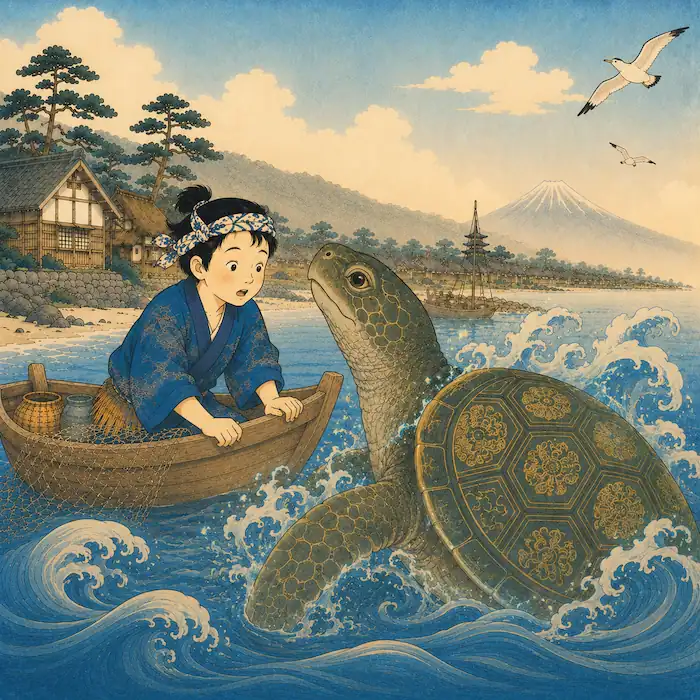
A huge magical turtle rises beside Urashima Tarō’s boat in the Japanese legend.

“Urashima Tarō,” said the turtle.

Tarō nearly dropped his oar. “You can speak?”

“Yes,” said the turtle. “Do not be afraid. I have come because of the little turtle you saved.”

“The little turtle?” Tarō leaned forward. “Is she safe?”

“She is safe because of you,” the great turtle replied. “She is no ordinary turtle. She is the daughter of Ryūjin, the Emperor of the Sea.”

Tarō stared at the rolling waves. “The Emperor of the Sea?”

“Yes. Ryūjin wishes to thank you in person at his palace beneath the ocean.”

Tarō looked back toward the shore. His village was only a soft line in the distance. “Beneath the ocean? But I cannot breathe underwater.”

The turtle smiled in a slow, wise way. “For today, you can.”

The great turtle lifted one flipper and suddenly a sparkle of sea-light swirled around Tarō. It tickled his neck, cooled his cheeks and fluttered beside his ears.
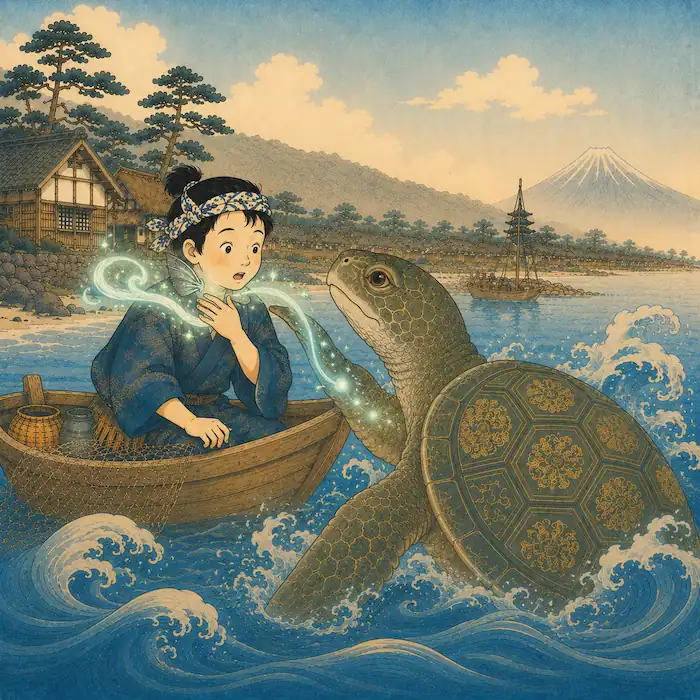
The great turtle gives Urashima Tarō magical gills so he can breathe underwater.

Tarō touched his throat. “What happened?”

“You have gills,” said the turtle. “Climb onto my back.”

Tarō hesitated only a moment before slipping carefully into the sea. He climbed onto the turtle’s back and tucked his hands into the turtle’s shell ridge.

“Hold tight,” said the turtle.

Then it dived down into the water.

The Road Beneath the Waves

Down they went, past silver fish and waving forests of kelp. Sunlight streamed through the water in long golden ropes. Tiny bubbles danced around Tarō’s face.

He took a breath. Water flowed past his new gills, cool and strange, yet he did not choke.
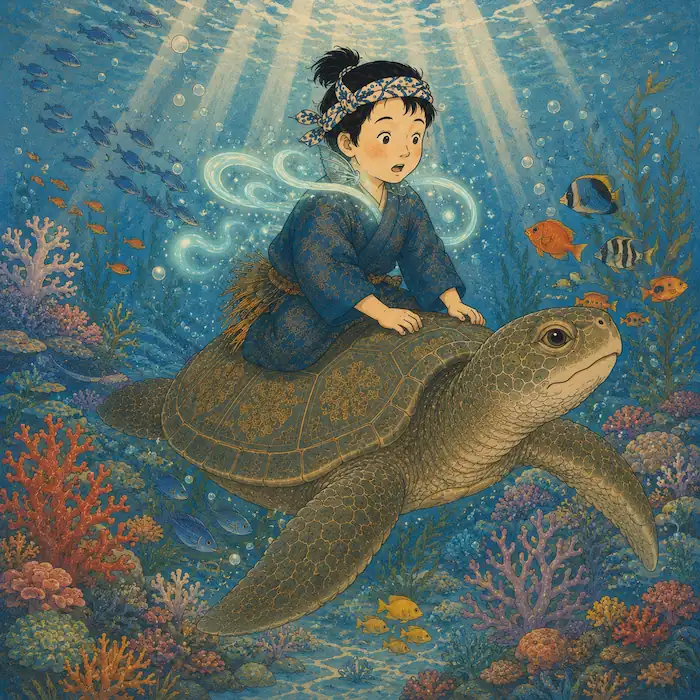
Urashima Tarō rides the great turtle through coral gardens under the sea.

“I can breathe!” he cried.

“Of course,” said the turtle. “Ryūjin’s magic does not do things by halves.”

They glided over coral gardens where red, pink and white branches grew like underwater trees. Bright fish darted between them and a school of tiny blue fish swirled into the shape of a fan, then quickly scattered.

Soon, the water grew crystal clear. Ahead stood a palace so magnificent that Tarō forgot to breathe for a moment.

Ryūgū-jō, the Palace of the Dragon God, rose from the ocean floor. Its roofs curved like waves. Pearly towers gleamed in the blue light. Doors of shell and jade stood open and lanterns glowed without flame.
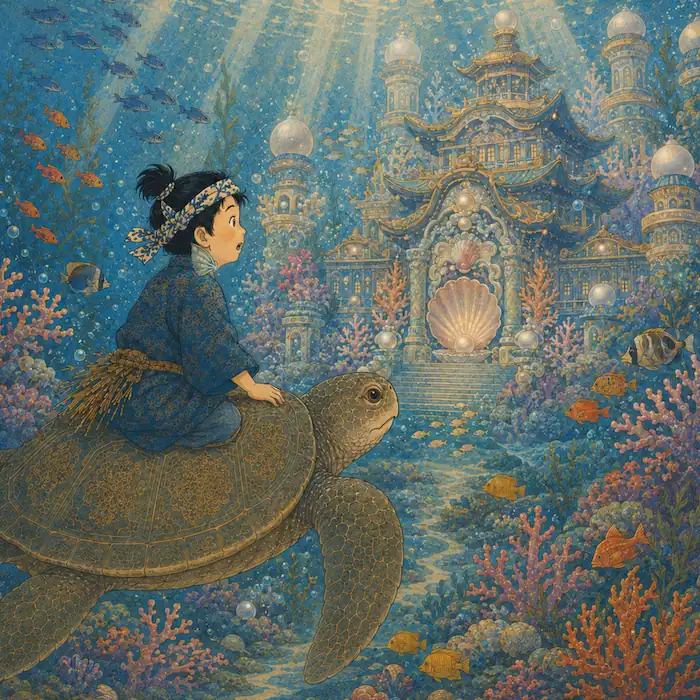
Urashima Tarō sees Ryūgū-jō, the Palace of the Dragon God, beneath the sea.

At the gate, fish in shining armor crossed their spears.

The great turtle spoke. “I bring Urashima Tarō, friend of the princess.”

The guards stepped aside and Tarō followed the turtle over polished floors that shimmered like moonlit water.

At the center of the palace sat Ryūjin, Emperor of the Sea.

He wore robes that moved like waves. His crown glittered with pearls, coral and jewels. His eyes were bright and deep, like the sea during a storm.
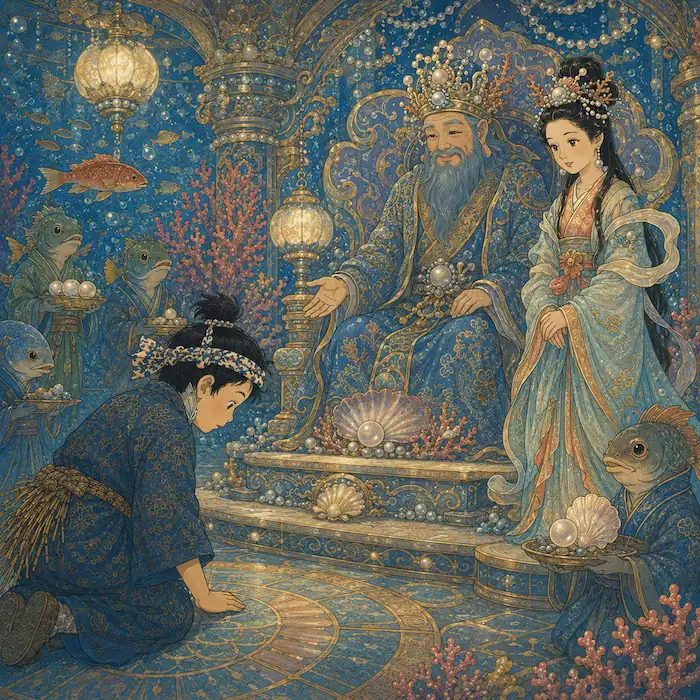
Urashima Tarō bows before Ryūjin and Princess Otohime in the underwater palace.Tarō bowed low. “Great Emperor,

I am only a fisherman.”

Ryūjin laughed kindly. “A fisherman who showed mercy to my daughter. For that, I am grateful.”

The Princess of the Sea

Beside the emperor stood a young woman in robes as pale as foam.

Tarō knew her eyes at once. “You are the little turtle,” he said softly.

The princess laughed. “Yesterday, yes. Today, I greet you as Otohime, daughter of Ryūjin.”

Tarō bowed again, suddenly shy. “Princess, I am glad you are safe.”

“And I am glad you were kind,” Otohime said. “Please stay as our guest.”

Servants brought trays of shining fruit, rice cakes shaped like shells and cups filled with sweet sea nectar. Music rose in the hall. Fish danced in bright circles. Octopuses beat tiny drums. Sea horses flicked their tails in time.

Tarō laughed until his cheeks hurt. Then Otohime led him through the palace.

“You must see the four windows,” she said.
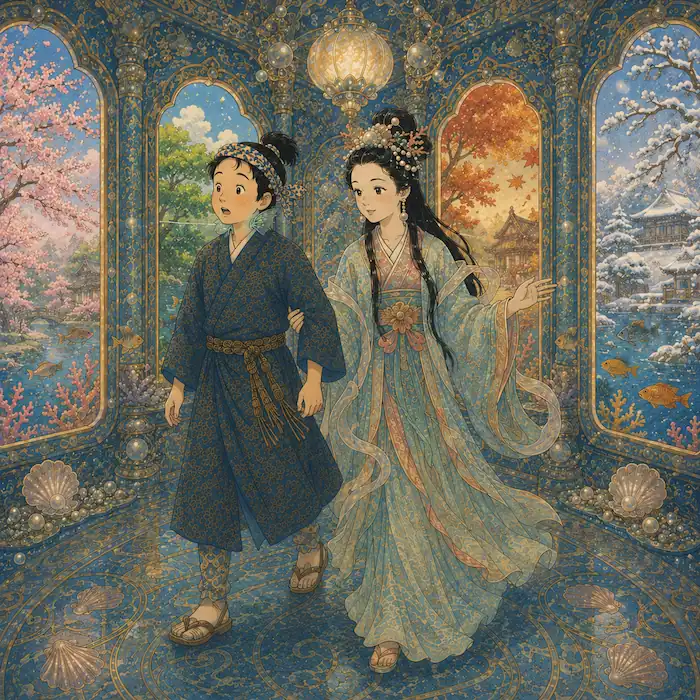
Princess Otohime shows Urashima Tarō the four seasons inside Ryūgū-jō.

They walked to the east side, where a huge window opened onto cherry trees blooming beneath a soft spring sky. Pink petals drifted through the air.

“How can there be cherry trees under the sea?” Tarō asked.

Otohime smiled. “Ryūgū-jō keeps many wonders.”

At the south window, summer fields glowed in golden sunlight. Cicadas sang and green leaves flashed in the breeze.

Behind the west window, red and orange maple leaves tumbled over a quiet path.

At the north window, snow fell over pine branches and rooftops.

Tarō pressed his hands to the window frame. “Spring, summer, autumn and winter. All at once.”

“Yes,” said Otohime. “Here, time moves differently.”

Tarō heard the words, yet the music and magic filled his mind. For three days, he feasted, laughed and listened to stories from the deep. He forgot the ache in his arms after rowing. He forgot the smell of drying nets. For a little while, he almost forgot the shore.

Three Days in Ryūgū-jō

On the third evening, Otohime and Tarō sat beside a garden of glowing coral.

“Are you happy here?” Otohime asked.

Tarō looked around at the palace, the soft blue light and the peaceful halls.

“Yes,” he said. “More happy than I can say.”

“Then stay longer.”

Her voice was gentle, but something in Tarō’s chest tightened. He pictured his mother waiting for him to come back.

“My mother is old,” he said. “She waits for me at home.”

Otohime lowered her eyes. “You love her very much.”

“I do. She will be worried. I have been gone for three days.”

The princess nodded. “Then you must go.”

Tarō felt sorry at once. “You have been so kind. I do not wish to seem ungrateful.”

“You are not ungrateful,” said Otohime. “Your mother must know you are safe.”

“Wait here while I fetch something,” Otohime said. Then she rose and left the garden.

When she returned, she carried a small shiny box. It was tied closed with a cord of blue silk.
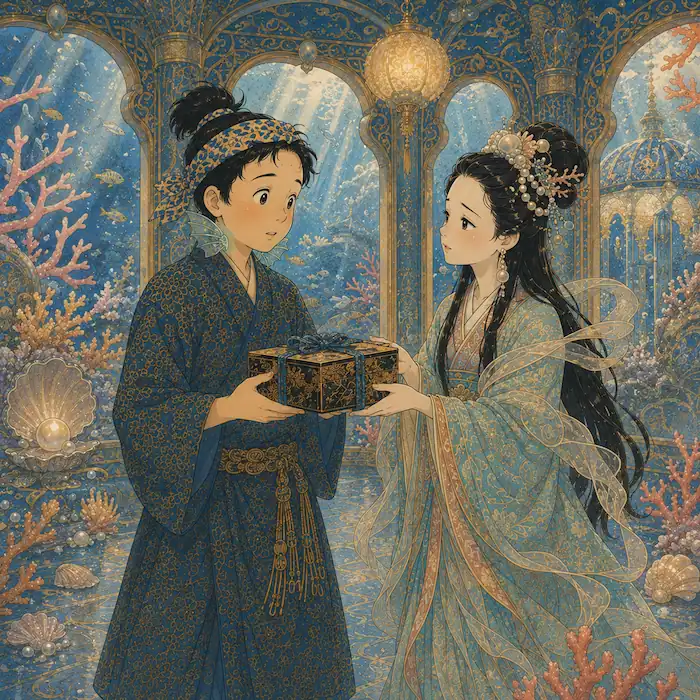
Princess Otohime gives Urashima Tarō the tamatebako box in the underwater palace.

“This is a tamatebako,” Otohime said. “Take it with you.”

Tarō accepted it with both hands.

“What is inside?”

Otohime’s face grew sad. “You must never open it.”

“Never?”

“Never. Keep it close and keep it closed. It will protect you from harm, but only while it stays shut.”

Tarō looked at the box.

“I promise,” he said.

Otohime smiled, though tears shone in her eyes. “Then farewell, Urashima Tarō.”

The great turtle waited at the palace gate. Tarō climbed onto its back. As he looked over his shoulder, he saw Otohime standing beneath the pearl towers, one hand lifted in a sad goodbye.

Then the turtle rose through the sea.

The Changed Shore

The journey upward seemed faster than the journey down and soon the great turtle broke through the waves near Tarō’s village.

“There is the shore,” said the turtle.

Tarō slid down onto the sand with the box tucked under his arm.

“Thank you,” he said.

“Remember your promise,” the turtle replied. Then it sank beneath the water.

Tarō turned toward the village, smiling. He could already hear his mother scolding him.

“Three days!” he imagined her saying. “Urashima Tarō, where have you been?”

But as he walked up from the beach, his smile faded.

The path was wrong. The pine tree near the rocks had vanished and the old well stood in a different place. New houses lined the lane and none of them looked familiar.

Tarō hurried toward his home and mother, but the house was gone. In its place stood a small garden and a house he had never seen.

Tarō’s heart began to pound. “Mother?” he called.

No one answered.

An old man came out of the house. “Can I help you, young fisherman?”

“This is my home,” Tarō said. “My mother lives here.”

The old man frowned. “I have lived here since I was a boy.”

Tarō shook his head. “That cannot be. I left three days ago.”

“Three days?” The old man looked at Tarō’s clothes, then at the box in his hands. “What is your name?”

“Urashima Tarō.”

The old man’s face changed. “Urashima Tarō? That is a name from an old tale.”

Tarō stepped closer. “What do you mean?”

“My grandfather told me about a fisherman by that name. He went out to sea and never came back.”

A woman carrying water stopped nearby. “Yes, I know that story. They said he vanished long, long ago.”

“How long?” Tarō whispered.

The old man swallowed. “Three hundred years, they say.”

The world seemed to tilt beneath Tarō’s feet.

The Box of Years

Tarō ran through the village. He searched every lane, every corner and every face, but nothing remained from his life. The boat sheds were different, the children spoke names he did not know and even the shape of the fields had changed.

At last, he stumbled back to the shore. The sea rolled in and out as if nothing had happened.

“Mother,” he whispered.

He sank onto the sand. His hands shook around the tamatebako. Three days in Ryūgū-jō had been three hundred years on land.

The princess had known.

“She gave this to protect me,” he said.
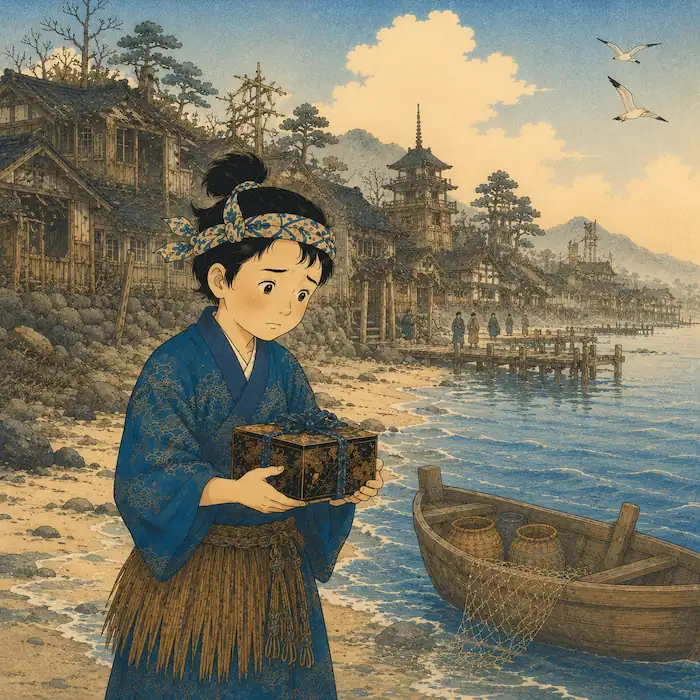
Urashima Tarō returns to shore holding the tamatebako and finds his village changed.

He stared at the blue silk cord. What kind of protection could sit inside a box? What had Otohime hidden from him? Perhaps it could bring back his mother.

Perhaps it could return his village. Perhaps it held the answer to everything he had lost.
Just then, the promise echoed in his mind.

You must never open it.

Tarō pressed the box against his chest. He thought about keeping his promise, but he was desperate to try anything that might help him see his mother again.
Slowly, Tarō untied the cord. The lid lifted.

A cloud of white smoke burst out. It curled around his face, slipped down his shoulders and wrapped around his whole body.
Tarō gasped.
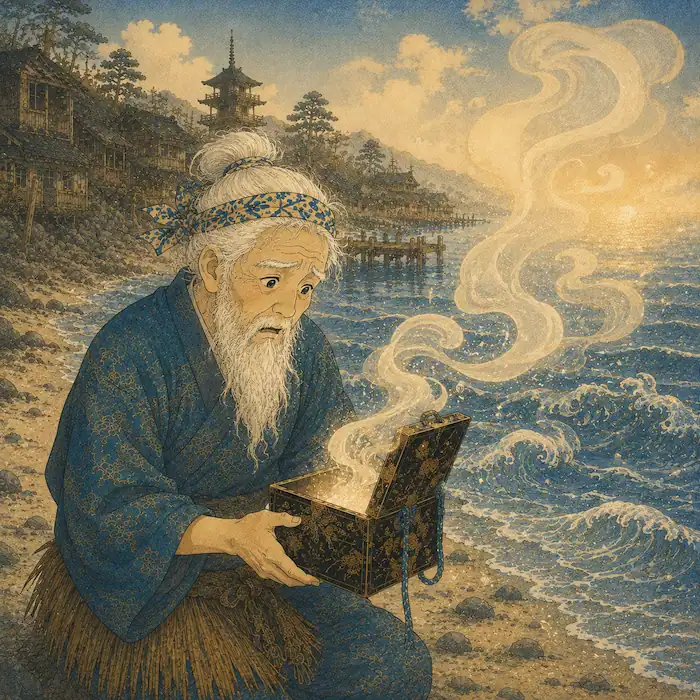
Urashima Tarō opens the tamatebako as white smoke turns him into an old man.

Suddenly, his fingers wrinkled, his back bent and his black hair turned white. A long white beard flowed down to his chest and the strength in his legs vanished like foam on sand. The box slipped from his hands.

Across the water came a voice, sad and sweet.

“Urashima Tarō,” called Otohime. “I told you not to open the box. Inside it was your old age.”

Tarō looked toward the sea with clouded eyes. The waves shone in the afternoon light. For a moment, he thought he saw the palace far below and the princess standing beneath pearl towers. Then the vision faded.

Tarō closed the empty box and held it in his lap.

He had been kind to a helpless creature and the sea had shown him wonders in return. But now Tarō understood something too late. A promise can protect us, but a hidden truth can still break the heart.

The sea whispered at his feet.

And far beneath the waves, in the Palace of the Dragon God, Otohime remembered the kind fisherman who saved a little turtle.

Moral

Kindness can lead to wonderful rewards, but promises, honesty and understanding must go together. Tarō is kind when he saves the turtle and loving when he wants to return to his mother, yet he suffers because he does not fully understand the truth about the box or the passing of time. The story teaches children that keeping your word matters, but so does telling the truth clearly when someone needs to understand what they are promising.

Short Summary of The Tale of Urashima Tarō

The Tale of Urashima Tarō tells the story of a kind Japanese fisherman who saves a turtle and is invited to Ryūgū-jō, the magical palace beneath the sea. After three wonderful days with Otohime, he returns home and discovers that three hundred years have passed on land. When he opens the tamatebako box, the old age kept inside it returns to him and he learns too late that promises and truth must go together.

Main Characters in The Tale of Urashima Tarō

Urashima Tarō: A kind young fisherman who saves a turtle and is invited to the magical palace beneath the sea.

Tarō’s mother: A wise and loving parent who helps show why Tarō longs to return home.

The small turtle: The helpless creature Tarō rescues from his net. In this retelling, she is later revealed as Otohime.

The great turtle: The magical messenger who carries Tarō beneath the sea to Ryūgū-jō.

Ryūjin: The Emperor of the Sea, who welcomes Tarō after his act of kindness.

Otohime: The sea princess who thanks Tarō, shows him the wonders of Ryūgū-jō and gives him the tamatebako.

The villagers: The people Tarō meets when he returns to land and learns how much time has passed.

Vocabulary from the Story

Fisherman: A person who catches fish for food or work.

Net: A woven tool used to catch fish.

Gills: Body parts that help fish and some sea creatures breathe underwater.

Kelp: A large brown seaweed that grows underwater.

Coral: A hard sea material made by tiny sea animals, often found in warm ocean places.

Ryūgū-jō: The magical Palace of the Dragon God beneath the sea in Japanese folklore.

Otohime: The sea princess in the story of Urashima Tarō.

Tamatebako: The mysterious box Otohime gives to Tarō and warns him not to open.

Discussion Questions

1. Why does Tarō free the turtle from his net?
2. What does Tarō’s kindness tell us about his character?
3. Why do you think Tarō accepts the invitation to visit the palace beneath the sea?
4. How does the story show that Ryūgū-jō is magical?
5. Why does Tarō decide to return home even though he is happy in the palace?
6. What makes the ending sad for Tarō?
7. Why does Tarō open the tamatebako even though he promised not to?
8. What could Otohime have explained more clearly before Tarō left?

Classroom Activities for Children

Draw the undersea palace: Ask children to draw Ryūgū-jō with shell doors, pearl towers, coral gardens and sea creatures. Encourage them to add details from the story rather than copying a generic castle.

Story sequencing cards: Give children cards for key events, such as saving the turtle, meeting the great turtle, visiting the palace, receiving the tamatebako, returning to the changed village and opening the box. Ask them to place the cards in order and retell the story aloud.

Underwater movement map: Place signs around the room for the boat, deep sea, palace gate, four windows, shore and village. Children move safely between each place and explain what happens there.

Turtle shell balance challenge: Children move slowly and carefully like a turtle carrying a shell. Use beanbags or paper “shells” for a gentle balance activity.

Tamatebako fine motor craft: Children fold a small paper box or decorate a simple card box. On the outside, they write “Keep your promise.” Inside, they place a word linked to the story, such as kindness, truth, time, family or trust.

Four seasons window art: Fold paper into four panels. Children draw spring, summer, autumn and winter, then explain how the windows help show that time works differently in the palace.

Soundscape retelling: In groups, children create gentle sounds for waves, oars, fish, palace music, turtle movement and the quiet changed shore. One child narrates while others add sound effects.

Feelings line: Place emotion words around the room, such as curious, joyful, worried, homesick, confused, sad and regretful. Read key moments and ask children to stand near the feeling Tarō might have.

Outdoor observation: If suitable, go outside and look for signs of time passing, such as weather, shadows, plants, leaves, birds or changes in the playground. Connect this to the story’s theme of time.

Promise and truth discussion circle: Ask children to talk about why promises matter and why people also need enough truth to understand what they are promising.

Writing activity: Ask children to write a short diary entry from Tarō’s point of view after he returns to the changed village. They can describe what he sees, how he feels and what questions he wants to ask. Older children can write a second diary entry from Otohime’s point of view, explaining why she gave Tarō the tamatebako and why she warned him not to open it.

Teachers’ Notes

Best curriculum fit: Reading comprehension, traditional stories, folk tales from around the world, moral stories, speaking and listening, drama and social-emotional learning.

Key learning themes: Kindness, gratitude, promises, honesty, family love, homesickness, curiosity, regret, wonder and the passing of time.

Before reading: Ask children if they have ever heard a story where time moves differently in a magical place.

During reading: Pause when Otohime gives Tarō the tamatebako and asks him never to open it. Ask children what they think might be inside and whether Tarō has enough information to understand the promise.

After reading: Discuss whether the story is only about breaking a promise or also about needing honesty and clear explanations.

Cross-curricular links:

Art: Draw Ryūgū-jō, the four seasons windows or the tamatebako.

Drama: Act out the meeting with the turtle, the palace welcome or Tarō returning to the changed village.

Nature study: Explore turtles, sea habitats, kelp, coral and how real ocean life differs from magical story settings.

PSHE / social-emotional learning: Talk about promises, honesty, sadness, regret and how children can ask for help when they feel confused.

Writing: Write a diary entry from Tarō’s point of view when he returns home or a letter from Otohime explaining the box.

Teacher tip: The ending is sad because Tarō loses his home, his mother and his own time. Younger children may need reassurance and space to talk about the difference between magical folk tale sadness and real life.

Why This Version Works for Children

This version keeps the traditional story’s main events while making the language clear for children aged 6–12. It keeps the important lesson about kindness, promises, time and truth but avoids graphic fear or harsh punishment that may not suit young readers.

The story also gives children a rich way to talk about mixed feelings. Tarō is kind and loving, yet he still faces a painful ending because he does not fully understand what has happened.

What Parents and Teachers May Want to Know

The Tale of Urashima Tarō has bittersweet and sad moments, but this retelling keeps them suitable for children aged 6–12. Younger children may need help understanding the passing of three hundred years, the loss of Tarō’s old life and why the box changes him.

The story works well as a read-aloud when adults leave time for questions about promises, honesty, family, curiosity and the way traditional stories sometimes teach through sadness.

Story Background

The Tale of Urashima Tarō is a traditional Japanese folk tale about a fisherman, a rescued turtle, a magical palace beneath the sea and a mysterious box called a tamatebako. Like many traditional stories, it has been told in different ways across books, regions and retellings.

Common versions usually include Tarō saving a turtle, traveling to Ryūgū-jō, spending time with Otohime and returning to find that far more time has passed on land than he expected. The story is often read as a tale about kindness, time, promises, curiosity, loss and the sadness of returning to a changed world.

This Kooky Kids World version uses culturally careful wording and avoids claiming to be the official or only version of the story.

Further Reading for Adults and Teachers

For adults and teachers who want to compare a public domain English version, see Lit2Go’s text of “The Story of Urashima Taro, the Fisher Lad” from Japanese Fairy Tales by Yei Theodora Ozaki.

This source can help teachers compare how older public domain retellings differ from a modern child-friendly version.

Frequently Asked Questions About The Tale of Urashima Tarō

  • What is The Tale of Urashima Tarō about?

    The Tale of Urashima Tarō is about a kind fisherman who saves a turtle and is taken to a magical palace beneath the sea. When he returns home, he discovers that hundreds of years have passed on land.

  • What is the moral of The Tale of Urashima Tarō?

    The story teaches that kindness matters, promises matter and truth matters too. Tarō is kind and tries to keep his word, but he suffers because he does not fully understand the truth about time or the box.

  • What age is The Tale of Urashima Tarō suitable for?

    This child-friendly retelling is suitable for children aged 6–12. The story has a sad ending, so younger children may benefit from an adult reading it aloud and talking through the feelings in the story.

  • Is The Tale of Urashima Tarō a fairy tale, folk tale, myth or legend?

    The Tale of Urashima Tarō is usually described as a traditional Japanese folk tale. It includes magical elements, such as a talking turtle, an undersea palace and time passing differently between worlds.

  • Where does The Tale of Urashima Tarō come from?

    The story comes from Japanese traditional storytelling. Versions can vary across retellings, so this Kooky Kids World version should be read as one child-friendly retelling rather than the official version.

  • Who is Otohime in The Tale of Urashima Tarō?

    Otohime is the sea princess and daughter of Ryūjin, the Emperor of the Sea. In this retelling, she is also the small turtle Tarō saves before he visits the palace beneath the sea.

  • Why does Urashima Tarō become old?

    Tarō becomes old because he opens the tamatebako after returning from Ryūgū-jō. The box held the old age that had not touched him while he was away from the world on land.

  • How can teachers use The Tale of Urashima Tarō in class?

    Teachers can use the story for comprehension, sequencing, discussion, drama, art, vocabulary work and social-emotional learning. It is especially useful for talking about kindness, promises, honesty, curiosity, sadness and how stories can teach through wonder.

Copyright Notice

© Kooky Kids World. This original retelling, illustrations, audio narration and supporting educational content are protected by copyright. The underlying folk tale is traditional and may exist in many public domain or oral storytelling versions.