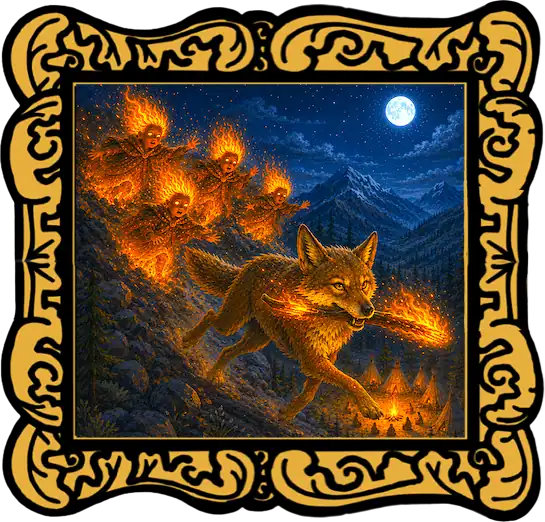

How Coyote Stole Fire: Native American Folktale

How Coyote Stole Fire is a Native American folktale for children about courage, cleverness and teamwork. In this trickster tale, Coyote and the animals work together to bring fire to the people, showing that the best ideas often succeed when everyone helps.

On this page, you can read the full story, explore the moral, learn useful vocabulary, answer discussion questions and try classroom activities linked to folklore, teamwork and storytelling.

How Coyote Stole Fire read-aloud audio cover showing Coyote running with fire from the Fire Beings
0:00 / 0:00
How Coyote Stole Fire
Kooky Kids World Cloud Logo showing where the audio read aloud file is.

The Story

Long ago, the people had no fire. They had no campfires to warm them, no coals for cooking and no flames to light the dark. When the sun went down, the world became cold very quickly.

Darkness spread across the land. The people pulled animal skins around their shoulders and huddled together, shivering until morning came.
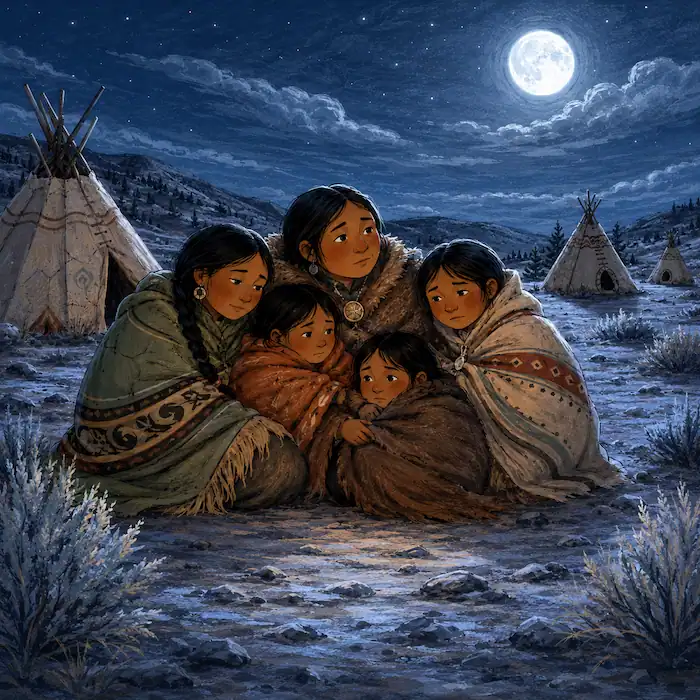
How Coyote Stole Fire scene showing people huddled in the cold before fire reaches their camp

In the daytime, they worked hard. They gathered roots, berries and seeds. They hunted when they could. They carried water and cared for their children. But when evening came, all their strength seemed to disappear into the cold.

A little child once asked, “Why does the night bite our hands?”

His grandmother wrapped him in her own blanket and said, “Because we have no fire, little one.”

“Where is the fire?” asked the child.

The grandmother looked toward the mountain, where a faint orange glow sometimes flickered against the clouds.

“Up there,” she whispered. “Far away.”

The Fire on the Mountain

High on a steep mountain lived the Fire Beings.

They were not people and they were not animals. Their eyes glowed like hot coals. Sparks danced around their feet. Their hair flickered like small flames.

In the middle of their camp burned the only fire in the world.
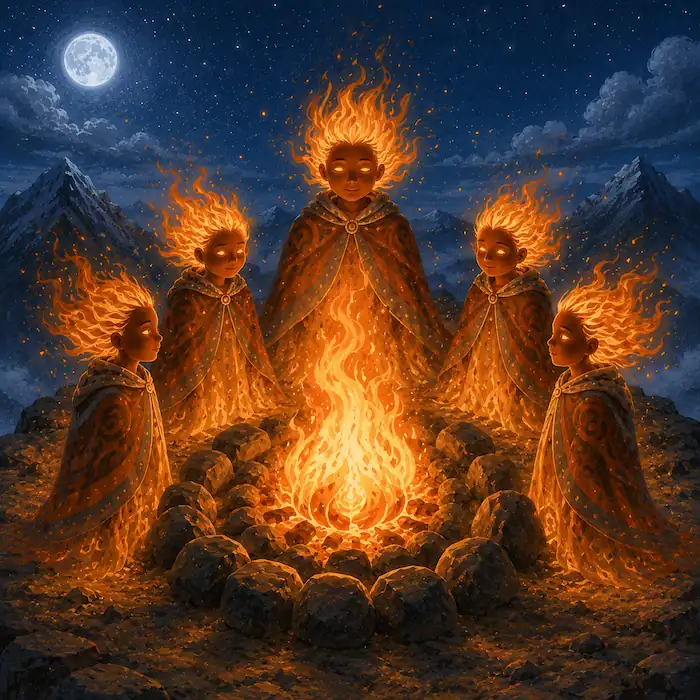
How Coyote Stole Fire scene with magical Fire Beings gathered around the guarded mountain fire

It leapt and crackled inside a ring of black stones. It warmed the Fire Beings. It lit their faces. It cooked their food and pushed the darkness away. Yet they guarded it as if the flames belonged to them alone.

“No one else may have it,” said the tallest Fire Being.

“No one may touch it,” said another.

“And no one may steal even one spark,” said a third.

So they watched the fire day and night. Some stood with burning sticks in their hands. Others sat on high rocks and stared down the mountain path. If any creature came near, they drove it away with smoke, sparks and fierce cries.

From the forest below, the animals watched.

Bear saw the people shiver. Deer saw the children curl up beside their elders. Fox saw hunters return hungry because they could not cook what they found. Rabbit saw babies cry in the cold.

At last, the animals gathered in a clearing beneath tall pines. Moonlight shone on their backs. Frost glittered on the grass.
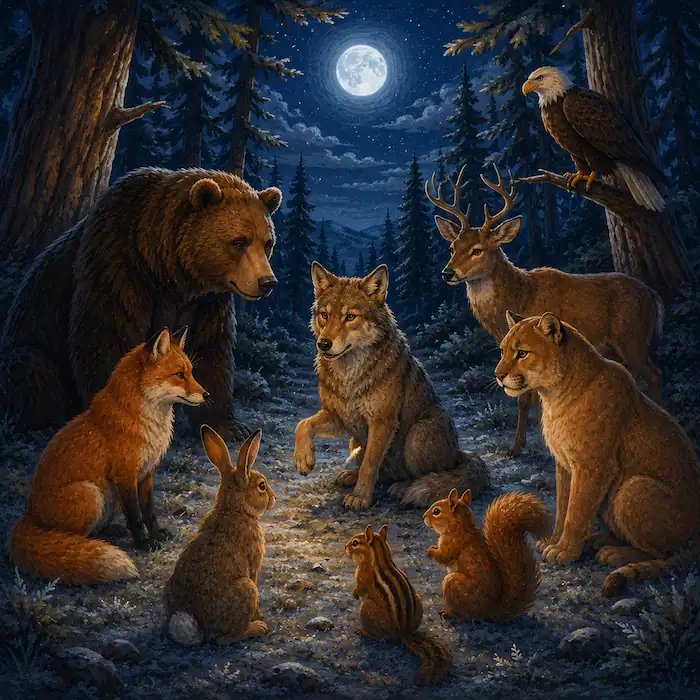
How Coyote Stole Fire animals gather in a moonlit forest clearing to plan how to help the people

Deer looked toward the dark camp below. “Listen,” she said. “The children are crying again.”

Rabbit rubbed his paws together. “If one mountain has warmth, why must everyone else freeze?”

Bear stamped one paw. “Then I will take it.”

Bear Tries First

Bear rolled his great shoulders, and mist puffed from his nose.

“I am strong enough to shake pinecones from the tallest tree,” he said. “The Fire Beings will move when they see me coming.”

Coyote lifted one ear. “Strength is useful,” he said. “But those Fire Beings watch very closely.”

Bear snorted. “Let them watch.”

Before anyone could stop him, he was already marching up the mountain.

He pushed through thorn bushes, climbed over rocks and soon reached the Fire Beings’ camp.

The flames flashed in his eyes.

“Give me fire!” Bear roared.

The Fire Beings leapt up at once.

“Go back!” they cried.
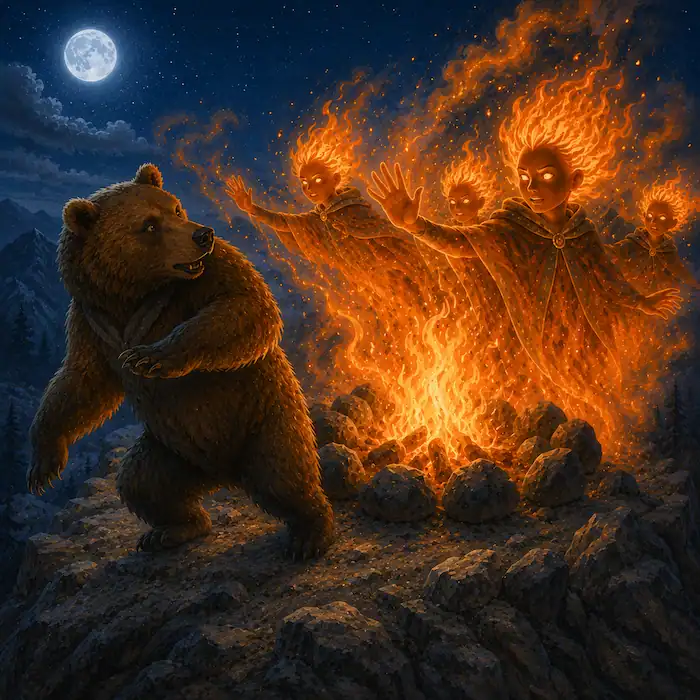
How Coyote Stole Fire scene of Bear trying to take fire while the Fire Beings drive him back

Bear lunged toward the flames, but the Fire Beings swung their burning sticks. Sparks flew. Smoke curled around Bear’s nose. One hot ember landed on his fur.

“Ow!” Bear barked.

He spun around and thundered back down the mountain.

When he returned to the clearing, his fur smelled smoky and his pride looked badly bruised.

“Well?” asked Fox.

Bear sat down with a heavy thump. No one laughed. Not even Fox. Bear was much too large to laugh at safely.

“They have no manners,” Bear muttered, patting the singed patch on his fur.

Coyote scratched behind one ear, which usually meant he was either thinking or pretending not to.

Deer Runs Like the Wind

Deer stepped lightly forward. “Bear made too much noise,” she said. “I will be gone before they know I was there.”

“Be careful,” said Rabbit.

Deer dipped her head and bounded toward the mountain.

She moved lightly over stones and slipped between bushes. Soon, she reached the ridge while the Fire Beings leaned close to their flames.

For one bright moment, Deer thought she might succeed.

She darted toward the fire.

But a Fire Being on the watch rock shouted, “There!”

At once, the others sprang up.
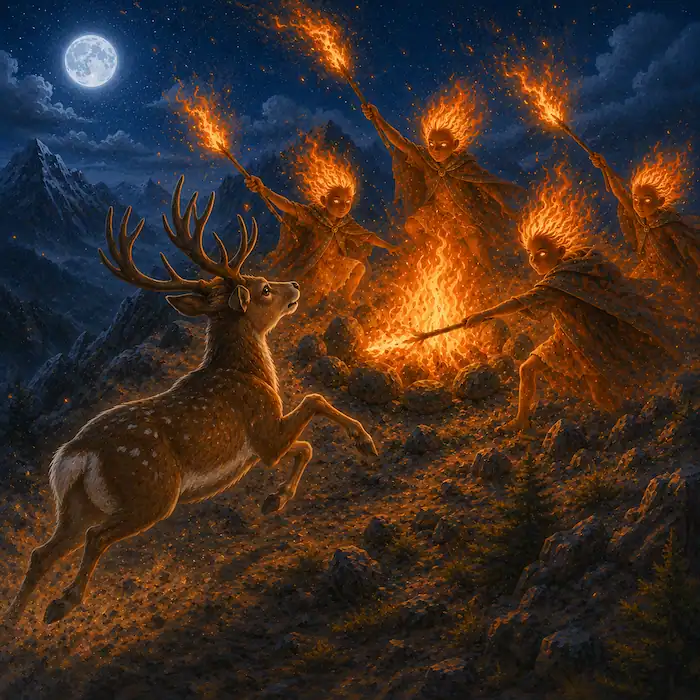
How Coyote Stole Fire illustration of Deer racing toward the fire as Fire Beings block her path

Deer twisted left. Flames blocked her path. She sprang right. Sparks snapped at her hooves. Then she leapt over a fallen branch and raced back down the mountain with the Fire Beings close behind.

At the clearing, she stumbled to a stop.

“Every path has eyes,” Deer gasped. “I turned once, and another one was already waiting.”

The animals murmured uneasily.

Fox flicked the smoky tip of his tail. “What you need,” he said, “is someone who knows how to be where he is not expected.”

Other Animals Try

Fox crept from the circle.

“Leave this to me,” Fox said. “Shadows and I are old friends.”

That night, Fox slipped up the mountain path and crouched near the Fire Beings’ camp. The fire crackled only a few steps away.

He stretched one paw forward.

Suddenly, a Fire Being sniffed the air.

“I smell fox fur,” it said.

Fox bolted. Sparks snapped behind him all the way down the mountain, and when he reached the clearing, one side of his tail was striped with soot.

This time, Bear did laugh. Fox sat down with great dignity and pretended not to hear him.

Eagle opened her wings. “They watch the path,” she said. “They forget the sky.”

She came from above, folding her wings and dropping toward the fire. But smoke stung her eyes, and a Fire Being threw sparks into the air.

Eagle beat her wings hard and flew away coughing. She landed heavily, ruffling her feathers.

“They watch the sky too,” she said.
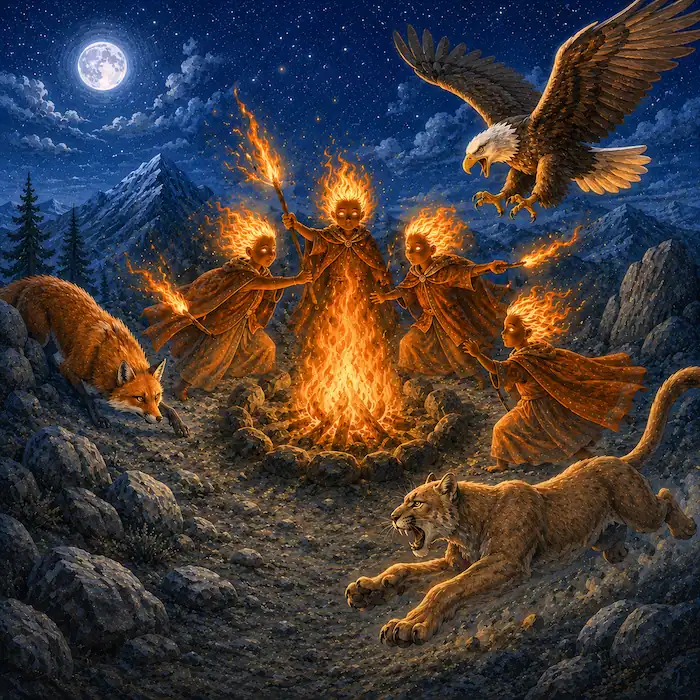
Native American folktale scene from How Coyote Stole Fire with animals failing to reach the flames

Mountain Lion rose without boasting. “I will try the rocks,” he said. “There are paths up there even smoke cannot follow.”
He bounded up the rocks in mighty leaps, but the Fire Beings stood ready and drove him back before he touched even one glowing coal.
He came back with ash on his whiskers and said only, “They were waiting.”
One by one, the animals tried. One by one, they failed.
The people still shivered in the darkness below.

Coyote Makes a Plan

For a long time, Coyote said nothing.

He watched the mountain. He watched the thin orange glow above it. He listened to Bear grumble, Deer catch her breath and Fox pretend his smoky tail did not hurt.

Then Coyote scratched behind one ear, which usually meant he was either thinking or pretending not to.

“I will go,” he said.

Bear blinked. “You?”

Fox gave a small laugh. “You are not stronger than Bear.”

“You are not faster than Deer,” said Rabbit.

“You cannot fly,” said Eagle.

Coyote smiled as if everyone had just paid him a compliment. “All true.”

“Then how will you get the fire?” asked Chipmunk.

“I will not fight the Fire Beings,” said Coyote. “I will not race them alone. I will make them look the wrong way.”
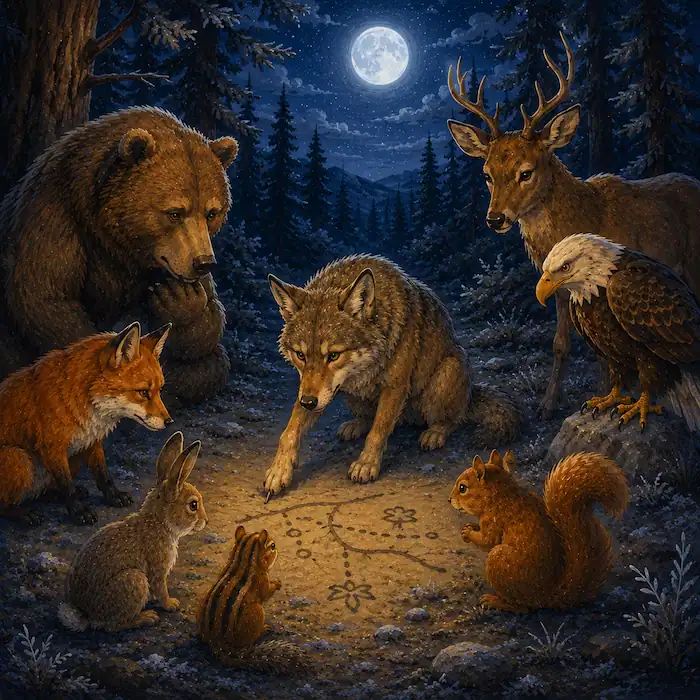
How Coyote Stole Fire illustration of Coyote drawing a clever plan while the animals listen

Rabbit’s ears stood straight up. Fox stopped licking the ash from his tail. Even Mountain Lion opened both eyes.
Coyote drew a line in the dirt with one claw. “The Fire Beings can chase one animal. They can chase two. But can they chase all of us?”
Rabbit’s eyes grew wide. “We could pass the fire from one to another.”
“Now your ears are working,” said Coyote.
Rabbit looked pleased, then worried. “That sounds dangerous.”
“It is,” said Coyote. “That is why we must do it properly.”
He pointed to the dark shapes of the hills. “Squirrel will wait by the first hill. Chipmunk near the rocks. Rabbit in the grass. Fox by the cedar trees. Deer by the stream. Bear will block the lower path. Mountain Lion will guard the narrow pass, and Eagle will carry the fire over the camp.”
Bear frowned. “And what will you do?”
Coyote’s grin grew sly. “I will make the first mistake for them.”
By sunrise, every animal was in place.

Coyote Visits the Fire Beings

Coyote walked up the mountain. He did not creep. He did not hide. Instead, he trotted along the path as if he had been invited for breakfast.

The Fire Beings saw him coming from far away.

“Stop there!” one shouted.

Coyote stopped so quickly that dust puffed around his paws. Then he sat, wagged his tail and looked as harmless as a sleepy pup.

“What do you want?” asked the tallest Fire Being.
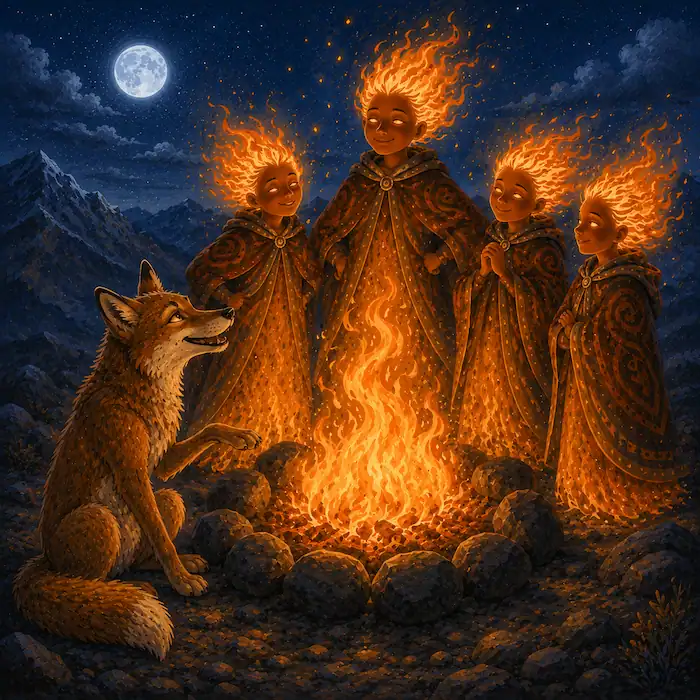
How Coyote Stole Fire scene where Coyote praises the Fire Beings and edges closer to the flames

Coyote widened his eyes at the flames, just enough for the Fire Beings to notice.

“I came to admire your fire,” said Coyote. “The animals speak of nothing else. They say no one could ever guard such a treasure as well as the Fire Beings. You are too quick, too watchful and too clever.”

The Fire Beings glanced at one another. Coyote padded a little closer. Then closer again.

The Burning Stick

The fire snapped.

A small burning stick rolled near the edge of the stone ring.

Coyote’s ears twitched.

Still, he kept talking.

“Of course,” he said, “I warned the others not to try. No one could fool the Fire Beings.”

“Clever too?” asked the tallest Fire Being.

“The cleverest,” said Coyote.

The Fire Beings puffed up with pride. Even their sparks seemed pleased.

For one tiny moment, every glowing eye turned toward Coyote’s smiling face instead of the fire.

That was the moment he needed.

Coyote sprang.

He snatched the burning stick in his teeth and bolted down the mountain.
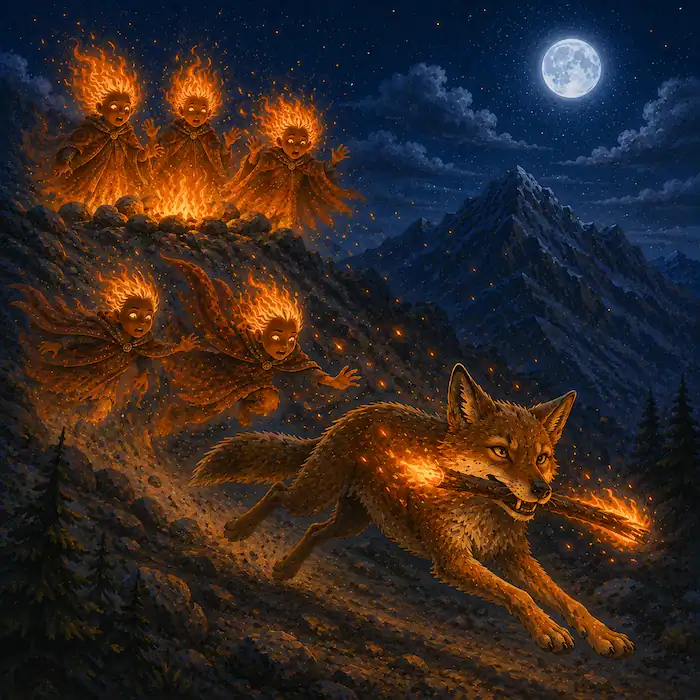
How Coyote Stole Fire illustration of Coyote running down the mountain with a burning stick

For one heartbeat, the Fire Beings stared.

Then the mountain erupted with shouting.

“Thief!”

“Stop him!”

“After him!”

Coyote raced over stones and through brush. The burning stick smoked in his mouth. Sparks flew past his whiskers. Heat warmed his nose.

Behind him, the Fire Beings thundered down the path.

Coyote ran faster. Still, they came closer. He could hear their crackling steps. He could feel their heat on his tail.

At the first hill, Squirrel waited with her paws ready.

“Now!” barked Coyote.

He tossed the burning stick.

Squirrel caught it and shot across the hill like a streak of brown lightning.

The Fire Runs Through the Forest

The Fire Beings swerved after Squirrel.

She leapt over roots. She dashed along a fallen tree. Her tail curled high as she ran.

“Hurry!” cried Coyote from behind.

“I am hurrying!” squeaked Squirrel.
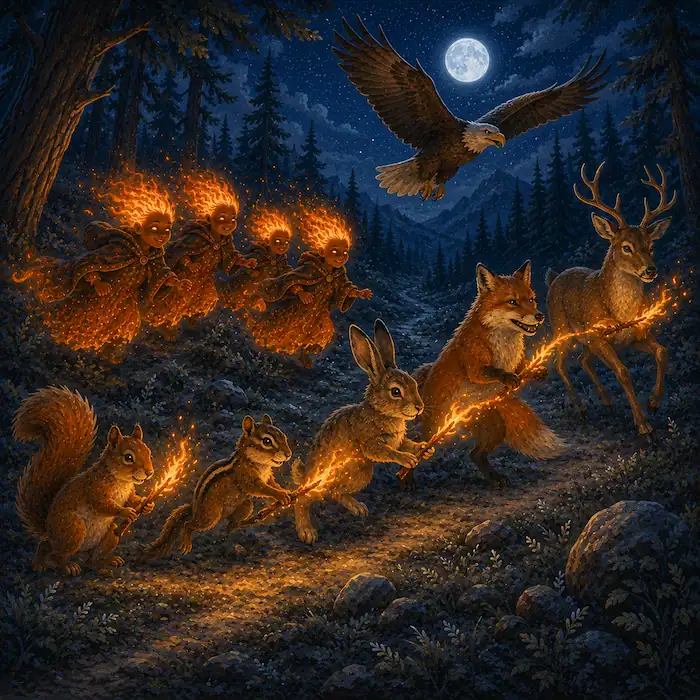
How Coyote Stole Fire scene of animals passing the burning stick through the forest as a team

Just as the Fire Beings reached for her, Squirrel threw the burning stick to Chipmunk.

Chipmunk caught it and darted between the rocks.

The Fire Beings stumbled among the narrow cracks.

Chipmunk zipped left. Then right. Then under a stone arch.

“Too slow!” he squeaked.

Before they could grab him, he tossed the fire to Rabbit.

Rabbit caught it in his mouth and bounded through the grass. His long ears streamed behind him. His feet thumped so fast that dust puffed up in little clouds.

The Fire Beings roared and followed.

Rabbit saw Fox by the cedar trees.

“Catch!” Rabbit called.

Fox snapped up the burning stick and ran into the shade. He twisted between tree trunks. He doubled back. He left the Fire Beings chasing shadows.

Then he flung the stick to Deer.

Deer caught it gently and ran for the stream. This time, she did not run alone. Eagle circled above her, calling directions.

“Left! They are coming from the rocks!”

Deer leapt left.

“Now right!”

Deer sprang right.

As the Fire Beings thundered closer, Bear stepped into the lower path and stamped both paws. Snow shook from the rocks.

The Fire Beings swerved around him, losing precious moments.

At the streambank, Deer saw them closing in. Mountain Lion sprang onto a rock above the narrow pass and gave a great roar.

The Fire Beings stopped for just a moment. That moment was enough.

Deer tossed the fire upward. This time, Eagle was ready. She swooped down, caught the burning stick in her talons and rose above the smoke before the Fire Beings could throw their sparks.

Fire Reaches the People

Eagle rose high above the Fire Beings.

They shouted and shook their burning sticks, but they could not reach her. She flew over the stream, over the trees and over the cold camps of the people below.

The people looked up in amazement.

“What is that light?” asked a child.

“It is a star falling!” cried another.

“No,” said the grandmother, rising slowly. “It is fire.”

Eagle dropped lower.

Coyote, panting and smoky, raced into the camp below her.

“Clear a place!” he called. “Bring dry grass! Bring twigs!”

The people hurried. They laid down dry grass, thin sticks and pieces of bark. Eagle dropped the burning stick into the pile.
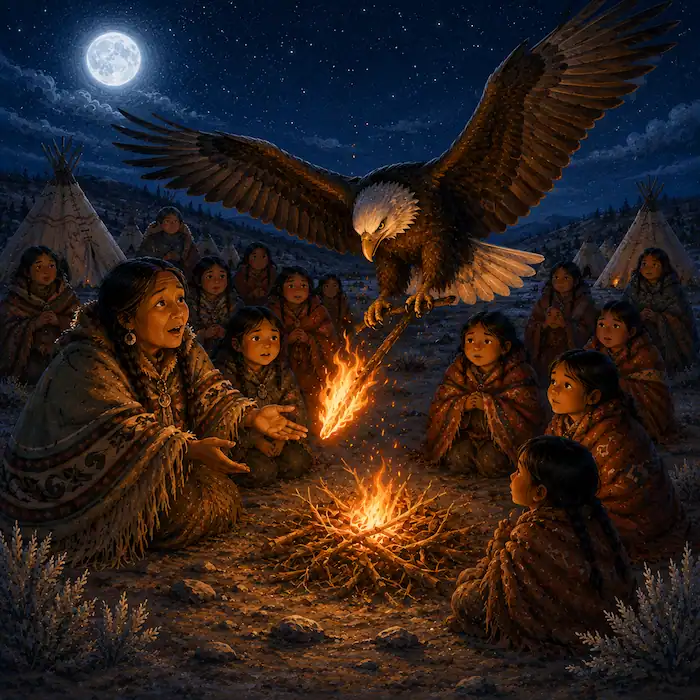
How Coyote Stole Fire illustration of Eagle bringing the burning stick to the waiting people

For a moment, nothing happened.

Then a small flame licked the grass.

The people held their breath.

The flame grew. It curled around the twigs. It brightened. It crackled. Warmth spread across the camp, gentle at first and then strong.

The children stretched out their hands. The elders smiled. Hunters brought food and learned how the heat changed it. Families sat close around the flames, warm for the first time after sunset.

The Gift Everyone Shared

The Fire Beings reached the edge of the camp and stopped.

Fire now burned in many places. People carried coals carefully from one family to another. Flames rose under cooking stones. Warmth spread through the camp.

The Fire Beings could not take it all back. Their fire no longer belonged to one mountain.
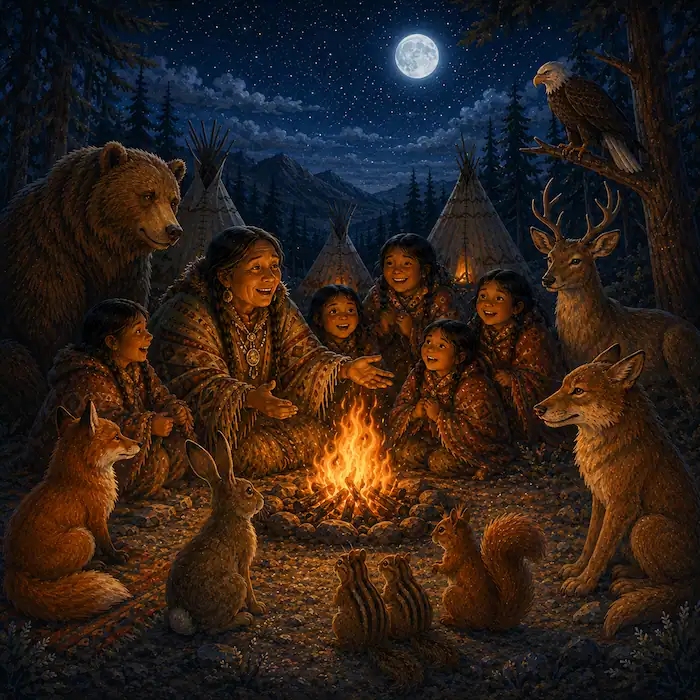
How Coyote Stole Fire ending with people and animals gathered around the first shared campfire

“Coyote stole from us!” cried the tallest Fire Being.

Coyote tilted his head. “You kept what others needed.”

The Fire Beings hissed and crackled, but they had no answer.

Bear stepped beside Coyote. Deer stood on his other side. Fox, Rabbit, Squirrel, Chipmunk, Eagle and Mountain Lion gathered too.

“No one animal brought the fire,” said Deer.

“We all did,” said Rabbit.
Coyote gave a small shrug. “I merely started the trouble.”

Fox laughed. “For once, your trouble was useful.”

From that day on, the people cooked their food, warmed their homes and carried light into the dark.

When children asked how fire first came to the people, the elders told of the cold nights, the guarded mountain and the animals who ran, leapt, flew and stood together.

They told of Coyote too, who was not the strongest or the fastest, but knew how to make a plan.

And that is how Coyote stole fire.

Moral of How Coyote Stole Fire

The moral of How Coyote Stole Fire is that cleverness is powerful, but it works best when people share it and work together for the good of everyone.

Coyote does not win because he is the strongest or the fastest. Instead, he watches, thinks carefully and asks the other animals to help. The story shows children that teamwork can solve problems that one person, or one animal, cannot solve alone.

Vocabulary Spotlight

Trickster – A trickster is a clever character who uses wit, tricks or unexpected ideas to solve problems. In many stories, tricksters can be helpful, mischievous or both.

Fire Beings – In this story, the Fire Beings are magical guardians who keep the only fire in the world. They are not ordinary humans or animals.

Ember – An ember is a small piece of glowing wood or coal from a fire. Embers can stay hot even when the flames are low.

Singed – Singed means lightly burned. Bear’s fur is singed when sparks from the Fire Beings touch him.

Guarded – Guarded means watched and protected carefully. The Fire Beings guarded the fire so no one else could take it.

Dignity – Dignity means calm self-respect. Fox sits with dignity after Bear laughs at his smoky tail.

Precious – Precious means very valuable or important. In the story, each moment matters when the animals pass the fire along.

Moral – A moral is the lesson a story teaches. The moral of this story is about teamwork, cleverness and helping others.

Teacher’s Note

How Coyote Stole Fire works well for upper elementary reading lessons because it combines action, repeated attempts, dialogue and a clear moral. It can support work on folktales, trickster tales, oral storytelling, character motivation, sequencing and theme.

This story should be taught with care. “Native American” is a broad term, and Coyote stories belong to many different Indigenous North American storytelling traditions. Coyote is widely known as an Indigenous North American trickster figure, with stories told across areas including California, the Southwest, the Plateau and the Plains.

When using this story in class, avoid presenting it as belonging to all Native peoples in the same way. A respectful teaching approach is to say that this is a child-friendly retelling inspired by traditional Coyote fire stories, not a replacement for Nation-specific versions told by Indigenous storytellers.

Parent and Teacher Discussion Questions for How Coyote Stole Fire

  1. Why do the people need fire at the start of the story?
  2. Why do Bear, Deer, Fox, Eagle and Mountain Lion fail when they try to take the fire?
  3. What does Coyote notice that the other animals do not?
  4. Is Coyote brave, clever or both? Explain your answer.
  5. Why does Coyote need the other animals to help him?
  6. Which animal has the most important role in the plan? Or do they all matter equally?
  7. Why are the Fire Beings angry when the fire reaches the people?
  8. Do you think Coyote was right to take the fire? Why or why not?
  9. What does the story teach about sharing things that others need?
  10. How would the story change if Coyote tried to take the fire alone?
  11. What is the main theme of How Coyote Stole Fire?
  12. What other stories do you know where someone brings light, fire or knowledge to people?

Classroom Activities for How Coyote Stole Fire

1. Story Sequencing: The Fire Journey

Best for: Grades 2–4
Skills: sequencing, comprehension, speaking and listening

Give students 10–12 event cards from the story. Ask them to put the events in order, beginning with the cold nights without fire and ending with fire reaching the people.

Suggested event cards:

  • The people shiver in the cold.
  • The Fire Beings guard the fire.
  • Bear tries to take the fire.
  • Deer runs toward the flames.
  • Fox, Eagle and Mountain Lion fail.
  • Coyote makes a plan.
  • Coyote praises the Fire Beings.
  • Coyote grabs the burning stick.
  • The animals pass the fire along.
  • Eagle carries the fire to the people.
  • The first campfire begins to burn.
  • The people learn to share fire.

Challenge: Ask students to choose the three most important events and explain why they matter.

2. Character Role Chart

Best for: Grades 3–5
Skills: character analysis, inference, evidence

Create a chart with these headings:

Character Role Chart

Bear

What he tries: Bear tries to take the fire by strength.

What this shows: He is brave, but too direct.

Evidence from the story: Bear marches straight up the mountain and demands the fire.

Deer

What she tries: Deer tries to use speed.

What this shows: She is fast and graceful, but the Fire Beings block every path.

Evidence from the story: Deer reaches the ridge quickly, but the Fire Beings are already watching.

Fox

What he tries: Fox tries to sneak through the shadows.

What this shows: He is clever, but not careful enough to fool the Fire Beings.

Evidence from the story: The Fire Beings smell fox fur before he can reach the fire.

Coyote

What he tries: Coyote makes a careful plan.

What this shows: He is observant, strategic and willing to work with others.

Evidence from the story: Coyote realizes the Fire Beings can chase one animal, but not all the animals working together.

Eagle

What she tries: Eagle carries the fire at the end.

What this shows: She helps complete the plan by using her strength in the sky.

Evidence from the story: Eagle flies above the Fire Beings and brings the burning stick to the people.

Extension: Ask students to decide whether Coyote is a hero, a trickster or both.

3. Teamwork Web

Best for: Grades 2–5
Skills: theme, collaboration, visual thinking

Write TEAMWORK in the center of the board. Around it, add each animal’s name. Students draw or write how each animal helps.

Prompt questions:

  • What could this animal do that the others could not?
  • Why did the plan need many animals?
  • What would have happened if one animal refused to help?

Class discussion: Connect the story to real-life teamwork, such as sports, group projects, family chores or classroom jobs.

4. Trickster Tale Detective

Best for: Grades 4–5
Skills: genre study, comparison, critical thinking

Explain that a trickster tale often includes:

  • a clever character
  • a problem that cannot be solved by strength alone
  • a trick, plan or unexpected idea
  • humor or mischief
  • a lesson about human behavior

Students find examples of each feature in How Coyote Stole Fire.

Extension: Compare Coyote with another trickster character, such as Raven, Anansi, Br’er Rabbit or Puss in Boots. Keep the comparison respectful and focused on story features.

5. Debate: Was Coyote Right?

Best for: Grades 4–6
Skills: debate, moral reasoning, evidence

Set up a class debate:

Statement: Coyote was right to steal the fire.

One side argues that Coyote helped the people survive. The other side argues that taking something still causes conflict, even when the reason seems good.

Students must use evidence from the story.

Helpful sentence starters:

  • “I think Coyote was right because…”
  • “The Fire Beings were wrong because…”
  • “Another way to look at this is…”
  • “The story shows…”

Teacher note: Keep the tone thoughtful. The aim is not to “win” but to explore moral complexity in a child-safe way.

6. Oral Storytelling Circle

Best for: Grades 2–5
Skills: speaking, memory, performance, oral tradition awareness

Students sit in a circle and retell the story one section at a time. Each student adds one event.

Rules:

  • Keep the events in order.
  • Use clear speaking voices.
  • Add expression for dialogue.
  • Do not mock cultural storytelling traditions.

Extension: Add sound effects using hands, voices or simple classroom objects: wind, footsteps, crackling fire, Eagle’s wings and Coyote running.

7. Compare Fire Myths Around the World

Best for: Grades 4–6
Skills: comparison, mythology, research

Use this story as a gentle introduction to “theft of fire” stories, a theme found in several world traditions. For example, Greek mythology includes Prometheus, who is known for stealing fire for humans. Other traditions also include stories about how fire came to people.

Students compare:

How Coyote Stole Fire

Who brings fire? Coyote and the animals.

Who receives it? The people.

What is the lesson? Clever teamwork can help everyone.

Prometheus

Who brings fire? Prometheus.

Who receives it? Humans.

What is the lesson? Knowledge and powerful gifts can come with risk and responsibility.

Another Fire Story

Who brings fire? Student choice.

Who receives it? Student choice.

What is the lesson? Student choice.

Classroom prompt: Ask students to compare the stories carefully. What is similar? What is different? What does each story teach about fire, knowledge and helping people?

Important: This is a comparison of story patterns, not a claim that the traditions are the same.

8. Create a Story Map

Best for: Grades 3–5
Skills: setting, plot, visual literacy

Students draw a story map showing:

  • the cold camp below
  • the mountain
  • the Fire Beings’ camp
  • the forest path
  • the first hill
  • the rocks
  • the grass
  • the cedar trees
  • the stream
  • the people’s camp

Then they draw arrows showing how the burning stick moves from Coyote to Squirrel, Chipmunk, Rabbit, Fox, Deer and Eagle.

Extension: Add labels explaining where the tension rises.

9. Write from Another Character’s View

Best for: Grades 4–6
Skills: creative writing, point of view, empathy

Ask students to rewrite one scene from another character’s point of view.

Options:

  • Bear returning with singed fur
  • Fox pretending not to hear Bear laugh
  • Deer racing toward the stream
  • Eagle carrying the fire
  • A child seeing fire for the first time
  • A Fire Being realizing the fire has been shared

Writing prompt:
“I saw the fire move from paw to paw, and I knew…”

10. Fire Safety Link

Best for: Grades 1–4
Skills: personal safety, practical learning

After reading the story, briefly discuss how real fire helps people but must be treated carefully.

Simple points:

  • Fire gives warmth and light.
  • Fire can cook food.
  • Fire can also burn and spread.
  • Children should never play with matches, lighters or campfires.
  • Adults should always supervise fire.


Optional activity: Students design a “Respect Fire” safety poster with one clear rule.

Fun Facts About Coyote Trickster Stories

  • Coyote appears in many Indigenous North American stories, especially in traditions from the West, Southwest, Plains and Plateau regions.
  • Trickster characters are not always simple heroes or villains. They often make mistakes, cause trouble, solve problems and teach lessons through action.
  • Coyote stories can vary widely between Nations, regions and storytellers. That is why it is more respectful to describe this page as “a retelling inspired by traditional Coyote fire stories” rather than claiming one single official version.
  • Many cultures around the world have stories about how humans first received fire, light or knowledge.
  • In this version, Coyote succeeds because he understands something important: the Fire Beings can chase one animal, but they cannot stop everyone working together.

History of How Coyote Stole Fire

How Coyote Stole Fire belongs to a wider group of traditional stories sometimes called “fire theft” myths or “origin of fire” stories. These stories explain how people first gained fire and why fire became part of human life.

Coyote is one of the best-known trickster figures in Indigenous North American storytelling. Britannica describes Coyote as a widely known Indigenous North American trickster whose stories are told in several regions, including California, the Southwest, the Plateau and the Plains.

However, it is important to be precise. There is not one single “Native American version” of Coyote. Coyote stories differ between Nations, places and storytellers. Some versions show Coyote as foolish, greedy or comic. Other stories show him as a culture hero who helps bring important gifts to the world.

This child-friendly version focuses on Coyote as a clever helper. It keeps the traditional trickster pattern, but presents the story in a way that is suitable for children, classroom discussion and read-aloud storytelling.

Learn more about  Coyote in Native American folklore and mythology.

Why We Retold This Story

We retold How Coyote Stole Fire because it is a strong example of a trickster tale that children can understand and discuss. The story has action, humor, danger, teamwork and a clear moral without becoming too frightening.

It also gives parents and teachers a useful way to talk about cleverness. Coyote is not the strongest animal. He does not win by fighting. Instead, he watches carefully, thinks ahead and trusts others to help. That makes the story especially useful for lessons on cooperation, problem-solving and moral choices.

Because this tale comes from Indigenous North American storytelling traditions, we have presented it with care. This is a respectful, child-friendly retelling, not a claim to represent every Native American tradition or every version of the story.

Frequently Asked Questions About How Coyote Stole Fire

  • What is How Coyote Stole Fire about?

    How Coyote Stole Fire is about Coyote and the animals working together to bring fire to the people. The Fire Beings guard the only fire in the world, so Coyote uses cleverness and teamwork instead of strength.

  • What is the moral of How Coyote Stole Fire?

    The moral is that cleverness works best when it helps others and is joined with teamwork. Coyote succeeds because he makes a plan and every animal plays a part.

  • What is the theme of How Coyote Stole Fire?

    The main themes are teamwork, sharing, courage and clever problem-solving. The story also explores whether something important, such as warmth and light, should belong to only a few.

  • Is How Coyote Stole Fire a Native American myth or folktale?

    It can be described as a Native American folktale, trickster tale or fire myth, depending on how it is being studied. Because Coyote stories vary across Indigenous North American traditions, it is best to avoid calling this one version the only official version.

  • Who are the Fire Beings in How Coyote Stole Fire?

    The Fire Beings are magical guardians who keep the only fire in the world on a mountain. They help create the conflict because they refuse to share fire with the people below.

  • Why does Coyote steal fire?

    Coyote steals fire because the people are cold, hungry and living in darkness. He sees that fire could help everyone, so he creates a plan with the animals.

  • Why is Coyote called a trickster?

    Coyote is called a trickster because he solves problems through wit, planning and mischief. In this story, his trick is not cruel. He uses it to distract the Fire Beings and help the people.

  • What is the setting of How Coyote Stole Fire?

    The story takes place in a cold landscape below a steep mountain where the Fire Beings guard the only fire. Important settings include the people’s camp, the mountain, the forest clearing, the stream and the path where the animals pass the burning stick.