
The Story
Bear’s Beautiful Tail
Long ago, when the world was still young, Bear had a tail that made the whole forest stare.
It was not the little round tail that bears have today. Oh no. Bear’s tail was long, thick and glossy as he walked between the pine trees. When he climbed over fallen logs, it swung proudly from side to side. When he stood beside the lake, it curled neatly around his paws.
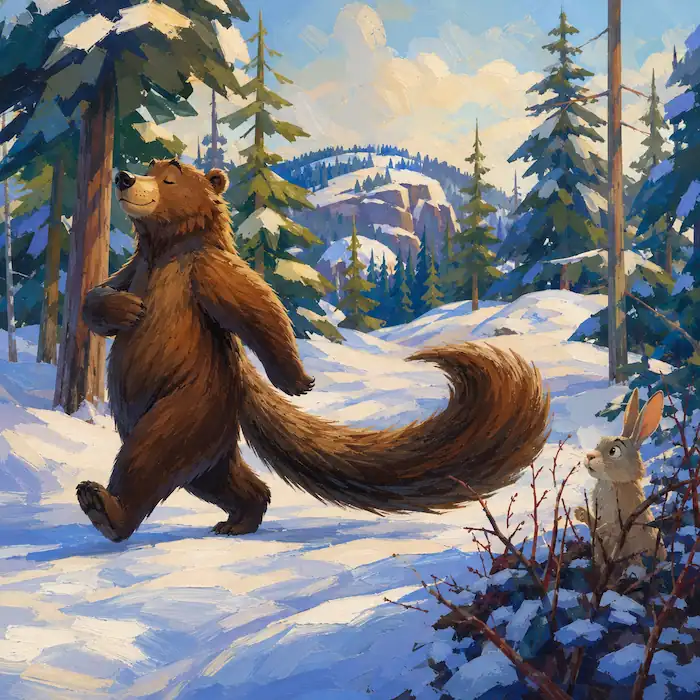
Bear loved that tail. Sometimes, he loved it so much that he forgot to notice anything else.
“Good morning, Rabbit,” Bear would say as he passed the bramble patch. “Have you seen how fine my tail looks in the snow?”
Rabbit would twitch his nose. “Good morning, Bear. Yes, it is very long.”
“Long and handsome,” Bear would add.
When Bear met Beaver near the icy shore, he would stop and shake himself until his tail swished like a brush.
“Useful tail, isn’t it?” Bear would say.
Beaver looked at Bear’s tail, then at his own flat tail. “Every tail has its use.”
Bear chuckled. “Mine is for being admired.”
So Bear went through the forest with his head high, his paws heavy and his long, glossy tail swaying behind him.
Now, Bear was not cruel. He did not mean to hurt anyone’s feelings. Still, he did like being noticed. He liked being praised even more. Because of that, he did not always listen as carefully as he should.
A Hungry Winter Morning
One winter morning, the forest woke under a thick white blanket.
Snow covered the roots of the trees. Ice shone on the branches. The wind slipped through the woods with a sharp little whistle.
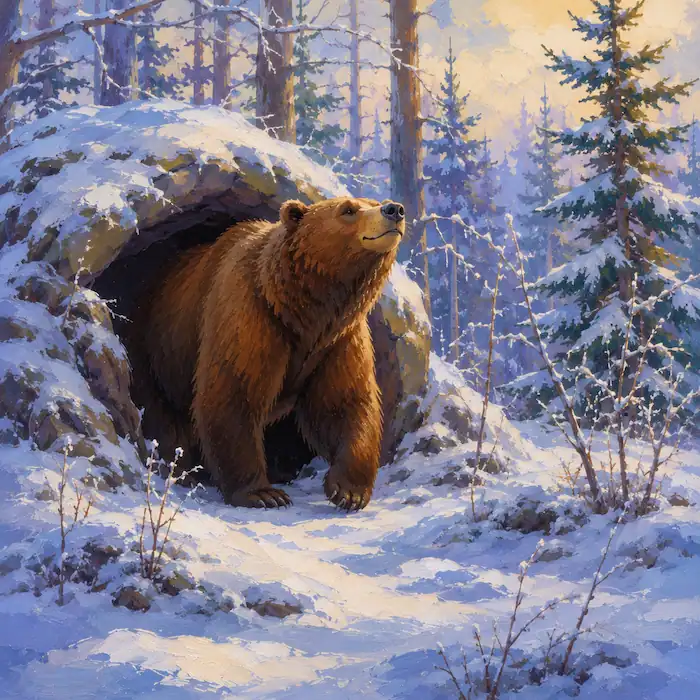
Bear pushed his nose out of his den and sniffed.
“Hmm,” he grumbled. “I am hungry.”
He had slept for a long time, but not long enough to forget food. His stomach gave a deep rumble.
So Bear stepped into the snow. His big paws sank into the soft drifts. Crunch, crunch, crunch went the frozen ground beneath him.
He searched under bushes. He scratched at tree bark. He sniffed near old logs. However, winter had hidden nearly everything.
The berries were gone. The bees were hidden in their hives, and their honey was out of reach. The insects slept deep in the earth. Even the squirrels kept quiet in their nests.
Bear’s stomach rumbled again.
“Be still,” Bear told it. “I am looking.”
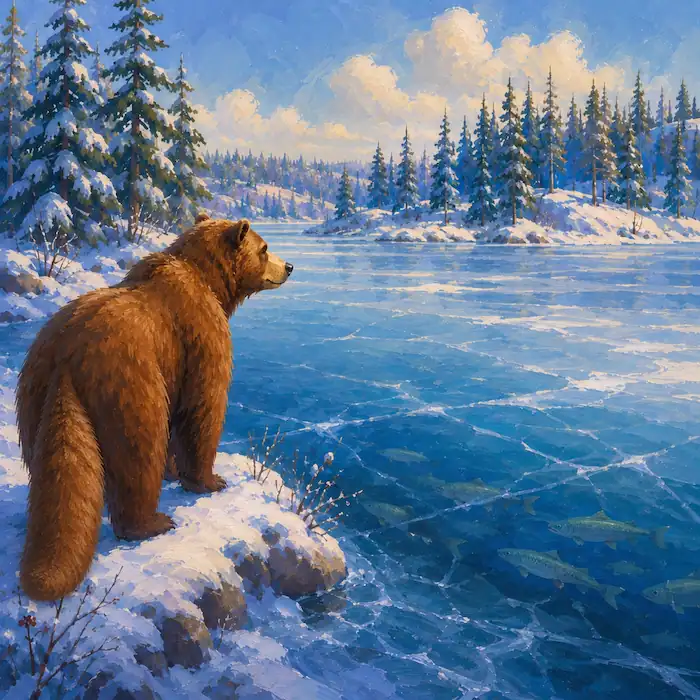
He walked farther and farther until he reached the edge of a wide lake. In summer, fish flashed there like silver leaves. In winter, the whole lake lay under a sheet of ice.
Bear stepped close and peered across it.
“Fish,” he muttered. “I would like fish.”
Just then, a red shape moved between the trees.
It was Fox.
Fox Smells a Trick
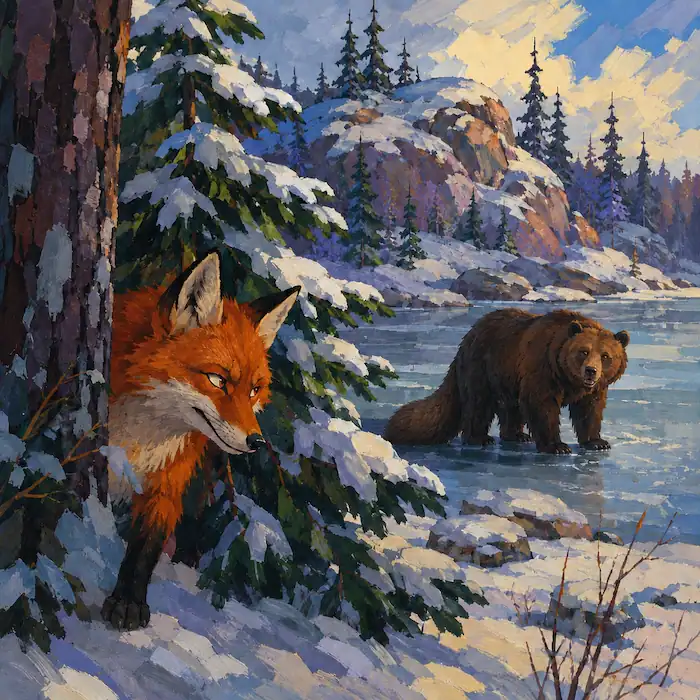
Fox trotted out from behind a spruce tree with his sharp nose in the air. His red coat looked bright against the snow, and his black paws moved lightly over the frozen ground.
Fox was clever, and every animal in the forest knew it. Some admired him. Others stepped carefully when he came near. Fox liked jokes, but he liked them best when someone else ended up looking foolish.
That morning, Fox had already eaten. His belly was full and his mood was playful. Then he saw Bear beside the frozen lake with his long tail dragging behind him.
Fox stopped. His eyes narrowed, and his mouth curled into a small smile.
“Good morning, Bear,” Fox called.
Bear turned. “Good morning, Fox.”
Fox looked Bear up and down. He looked at Bear’s hungry face. Then he looked at Bear’s long tail.
“What brings you out on such a cold day?” Fox asked.
“Food,” Bear said. “That is what brings me out. But the forest has hidden every bite.”
Fox nodded as if this were a serious problem.
“Yes,” he said. “Winter can be difficult. Still, a clever animal does not go hungry for long.”
Bear’s ears lifted. “Have you found food?”
Fox licked one paw and wiped his whiskers. “I have found a very easy way to catch fish.”
Bear’s eyes grew wide.
“Fish?” he said. “In this weather?”
“Of course,” said Fox. “Fish do not vanish just because the lake freezes. They swim under the ice.”
Bear looked at the hard white lake. “But how do you catch them?”
Fox flicked his tail. “Ah, that is the clever part.”
Bear leaned closer.
The Hole in the Ice
Fox led Bear to a small round hole in the ice. The dark water below looked cold enough to bite.
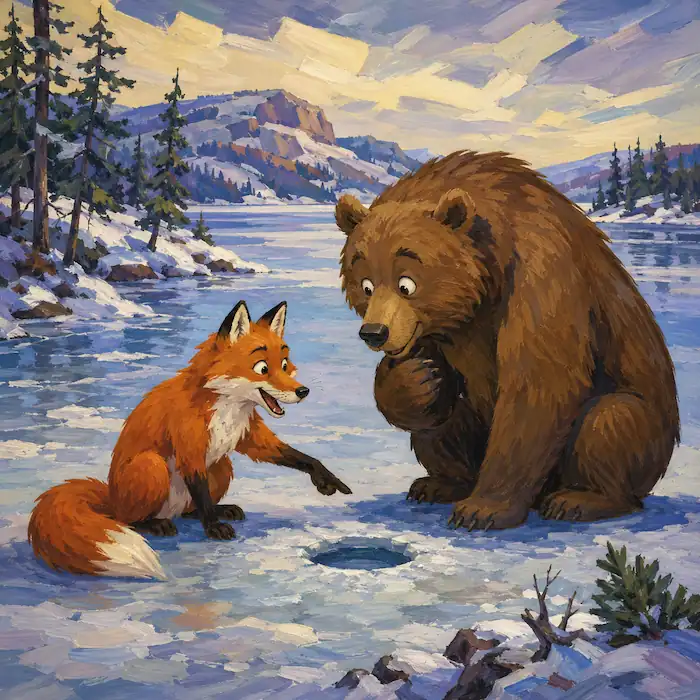
Bear bent down and sniffed. “I smell water.”
“And fish,” Fox said quickly.
Bear sniffed again. He was not sure he smelled fish. Still, he was hungry enough to believe almost anything.
Fox sat neatly beside the hole. “Listen carefully, Bear. This is an old fishing trick.”
Bear sat too, though the snow was cold beneath him.
“Put your tail into the water,” Fox said. “Then sit still. Very still. The fish will think your tail is a fine, fat worm. They will bite onto it. After a while, you pull your tail up and out come the fish.”
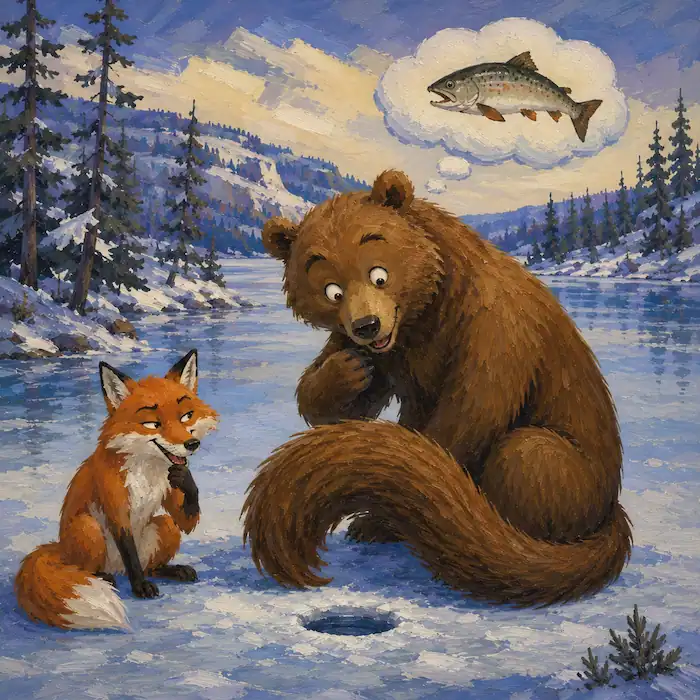
Bear turned his head and admired his own tail. It was certainly long. It was certainly thick. Perhaps fish would think it was something worth biting.
“How many fish?” Bear asked.
Fox shrugged. “That depends.”
“On what?”
“On how long you wait.”
Bear nodded slowly. “I can wait.”
“The longer you wait,” Fox said, “the more fish you will catch.”
Bear liked the sound of that. He pictured a pile of fish shining on the snow. One fish. Two fish. Ten fish. Maybe more.
His stomach rumbled so loudly that Fox had to hide a laugh with his paw.
“Does this really work?” Bear asked.
Fox opened his eyes wide. “Would I tell you if it did not?”
Many animals would have paused at that. They might have remembered that Fox enjoyed tricks. They might even have asked, “If this works so well, Fox, where are your fish?”
But Bear was hungry. He also liked an easy answer.
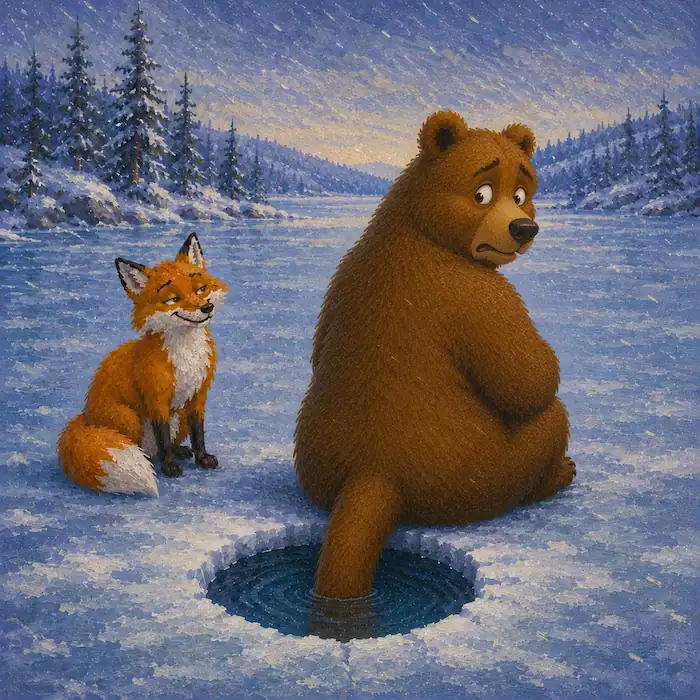
So he backed up to the hole, lowered his beautiful long tail into the freezing water and sat down.
Waiting for Fish
The cold struck Bear at once.
“Oof!” Bear gasped.
“Do not move,” Fox said.
Bear gritted his teeth. “I am not moving.”
The water pulled at his tail with icy fingers. Bear dug his paws into the snow and tried to think about fish instead of the cold creeping up his spine.
Fox stood nearby, watching.
“How long must I sit?” Bear asked.
“Until you feel a tug,” Fox said. “Then wait longer. One fish is good, but many fish are better.”
Bear nodded. “Many fish are better.”
The wind swept across the frozen lake. It ruffled Fox’s fur and dusted Bear’s ears with snow.
For a little while, Fox stayed where he was. He circled Bear once. Then he circled again. Bear kept his eyes on the far shore because he wanted to look patient and wise.
“Are the fish biting?” Fox asked.
“I think they are thinking about it,” Bear said.
Fox’s whiskers twitched.
A crow flew overhead and called, “Caw! Caw!”
Bear looked up. “Do you think Crow knows this fishing trick?”
“Perhaps,” said Fox. “But Crow has no tail for it.”
Bear felt proud again. Perhaps his tail was not only handsome. Perhaps it was useful too.
So he sat.
The cold crept into his back legs. Snow settled on his shoulders. His nose turned numb. Still, Bear did not move.
After a while, Fox stepped toward the trees.
“Where are you going?” Bear asked.
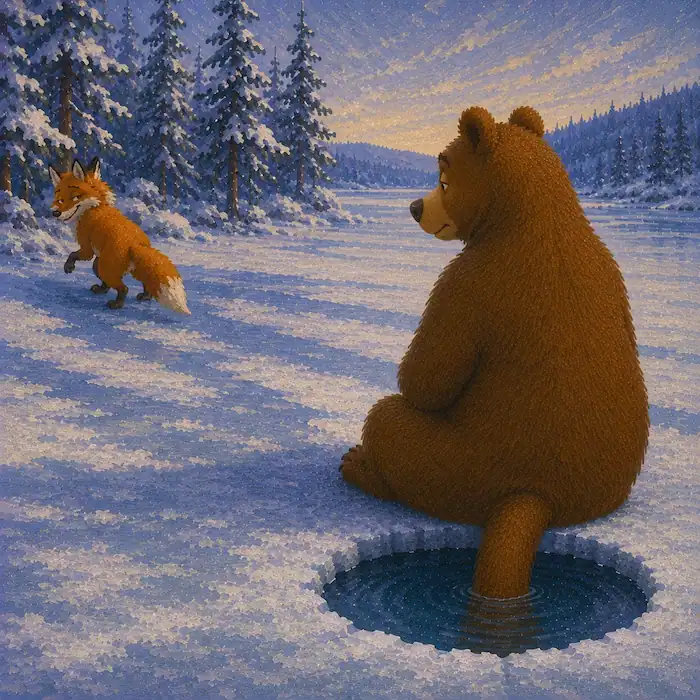
“To look for more fishing holes,” Fox said. “You stay there. Remember, the longer you wait, the more fish you catch.”
“I will wait,” Bear promised.
Fox slipped into the trees. As soon as he reached the shadows, he pressed both paws over his mouth to keep from laughing too loudly.
The Long Cold Afternoon
Bear waited through the morning.
At first, he imagined fish nibbling gently at his tail.
Then he imagined them biting harder.
After that, he imagined a whole crowd of fish under the ice, each one holding tight with its little fish mouth.
“This will be a wonderful meal,” Bear said.
The sun climbed higher, but it gave little warmth. The lake stayed hard and white. The pines stood still around the shore. Now and then, a branch dropped a soft puff of snow.
Bear shifted his front paws.
A sharp pain ran up his tail.
He stopped at once.
“Ah,” he said. “That must be the fish.”
He waited longer.
Soon his tail felt heavy. That pleased him.
“Many fish,” Bear whispered.
A squirrel poked its head out from a tree hole. “Bear, why are you sitting on the lake?”
“I am fishing,” Bear said proudly.
“With your tail?”
“Yes.”
Squirrel blinked. “Who told you to do that?”
“Fox.”
Squirrel’s eyes grew round. “Fox?”
Bear frowned. “Do not chatter at me. You will scare the fish.”
Squirrel pulled back into the tree hole. “Well,” he said softly, “I hope you know what you are doing.”
Bear did not answer.
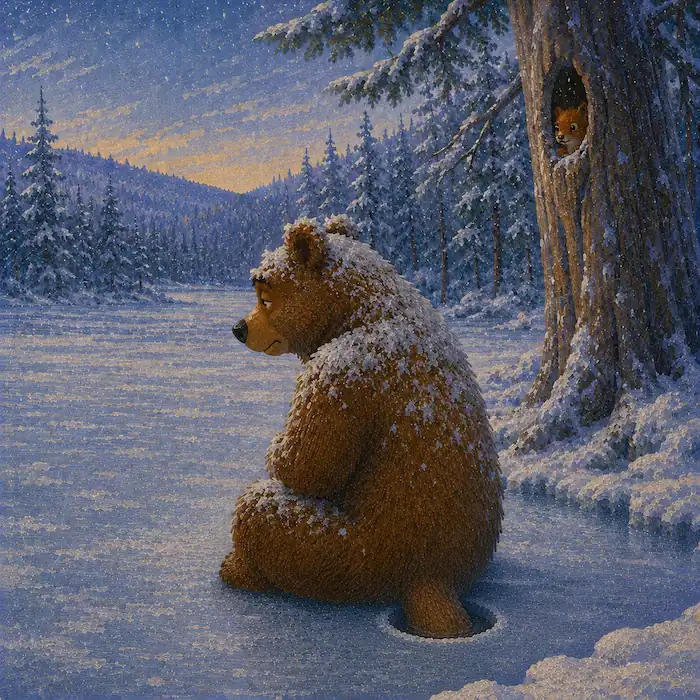
The day grew colder. Clouds covered the pale sun. Slowly, bit by bit, the little hole in the ice froze around Bear’s tail.
Bear did not see it happen. He only felt his tail grow stiffer and heavier.
“That must be a great number of fish,” he murmured.
Bear Pulls Hard
At last, Bear could wait no longer.
His belly ached with hunger. His paws trembled. Snow had gathered on his head like a little white cap.
“Enough,” Bear said. “I have caught plenty.”
He planted his front paws on the ice and leaned forward.
Nothing happened.
Bear blinked.
He pulled again.
His tail stayed where it was.
“Oh!” Bear said. “These must be very strong fish.”
He dug his claws into the ice and gave a harder pull.
Still nothing moved.
Under the ice, of course, there were no fish holding his tail. The lake had frozen tight around it.
Bear huffed. Steam puffed from his nose.
“I will not be beaten by fish,” he growled.
He rocked forward, then back. He pulled once. He pulled twice. The ice creaked, but his tail did not come free.
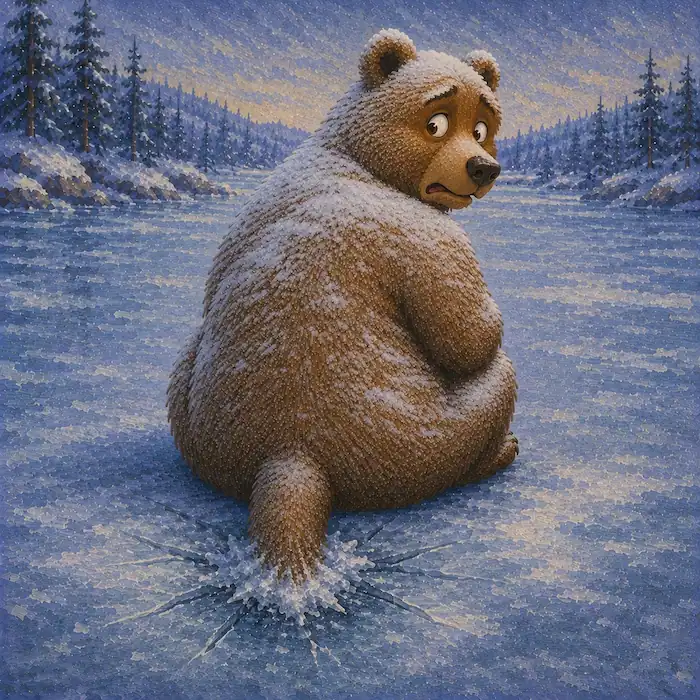
Bear’s eyes narrowed.
Now he felt angry.
He stood as high as he could, braced all four paws and tugged with every bit of strength in his great body.
Crack!
Bear shot forward and tumbled nose-first onto the ice.
For a moment, he lay there in a heap.
Then he scrambled up and spun around.
His long, handsome tail was gone. Only a short little stump remained.
Bear stared.
He turned in a circle, as if his tail might be hiding behind him. It was not. A piece of it stayed frozen in the ice behind the hole.
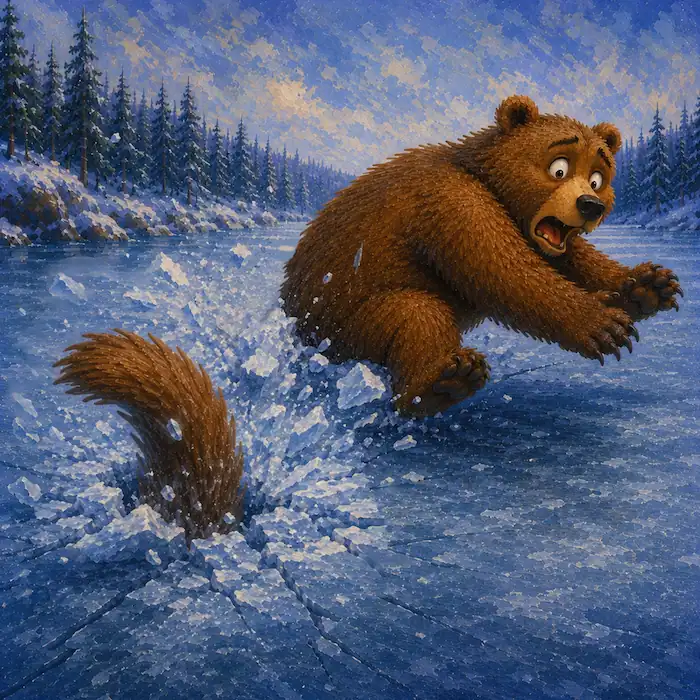
Bear’s mouth fell open.
“My tail,” he whispered.
Then, from the forest edge, he heard laughter.
Fox Runs Through the Trees
Fox stood between two pine trees, shaking with delight.
“Oh, Bear!” Fox laughed. “What a catch! I have never seen anyone fish so hard for ice.”
Bear’s face grew hot, even in the winter cold.
“You tricked me!” he roared.
Fox took one step backward. “I only told you to wait.”
“You told me fish would bite my tail!”
“And did you feel something heavy?” Fox asked.
Bear growled.
Fox laughed again, then turned and darted through the trees.
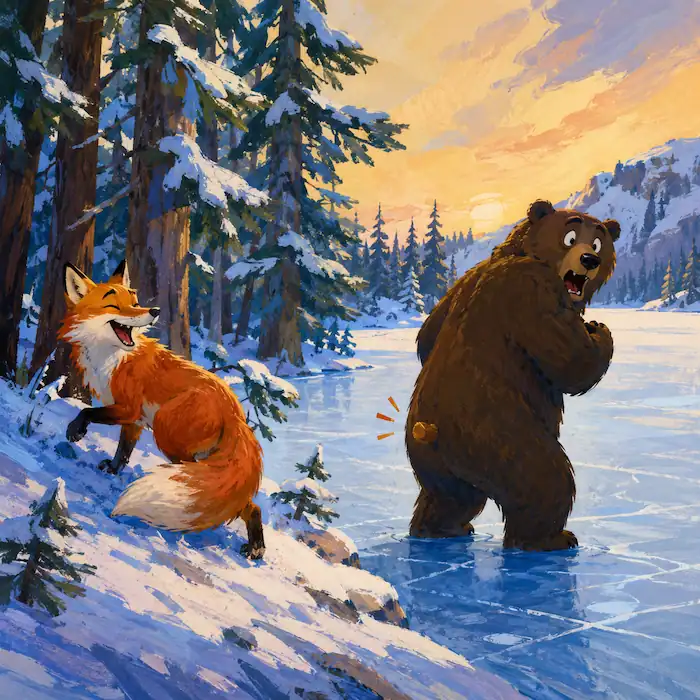
Bear charged after him.
The chase shook snow from the branches. Fox slipped between bushes and leaped over roots. Bear crashed behind him, breaking twigs and thumping through drifts.
“Come back!” Bear roared.
Fox did not come back.
He was much too quick. He zipped around a boulder, ducked under a fallen log and vanished into a tangle of spruce.
Bear stopped, panting. His paws ached. His tail, or what was left of it, stung in the cold air.
For a long while, he stood in the silent forest.
At last, the anger in his chest grew smaller. In its place came an uncomfortable thought.
Fox had played the trick, yes.
But Bear had believed him too quickly.
He had not asked questions. He had not wondered why Fox had no fish. He had not listened when Squirrel looked worried. He had wanted an easy meal so badly that he forgot to use his own good sense.
Bear sighed.
A Short Tail and a Long Memory
Bear walked back through the forest more slowly than before.
His grand tail no longer swept behind him. It did not brush the snow. It did not curl around his paws. It was gone.
Rabbit saw him first.
“Good afternoon, Bear,” Rabbit said. Then Rabbit noticed the short stump. His nose twitched.
“Oh,” said Rabbit.
Bear lowered his head. “Do not ask.”
Beaver looked up from the icy shore as Bear passed.
“Every tail has its use,” Beaver said gently.
Bear gave a tired nod. “And every animal needs wisdom.”
That evening, Bear returned to his den. He was still hungry. He was still cold. Yet he was a little wiser than he had been that morning.
From then on, Bear did not boast about his tail. He could not, because it was short. Instead, he listened more carefully when others spoke. If Fox came near with a clever idea, Bear narrowed his eyes and asked questions before believing a word.
As for Fox, he told the story often. He told it beside the lake. He told it under the pines. He told it until even Crow could repeat every word.
And that is how the tale spread through the woods.
That is why Bear has only a short tail today. He remembered that frozen lake for the rest of his life, and whenever Fox came near with a clever idea, Bear asked questions first.
After reading, ask your child or class: What should Bear have done before trusting Fox?