
The Ants & the Grasshopper: Aesop’s Fable

The Ants & the Grasshopper is a classic Aesop’s fable for children about work, play and planning ahead. This child-friendly retelling follows Jasper Grasshopper, who spends the summer making music while Mina and the ants gather food for winter.

Read the full story below, then explore the moral, vocabulary, discussion questions and classroom activities to help children understand the fable’s lesson.

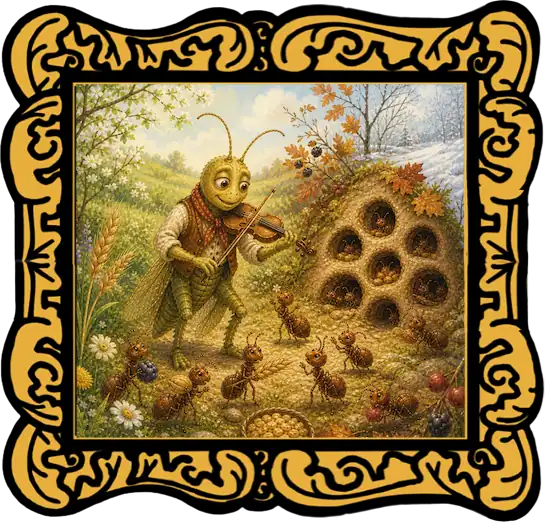
Read-aloud image for The Ants & the Grasshopper Aesop’s fable, showing Jasper Grasshopper playing his fiddle beside ants carrying food, surrounded by a gold frame.
0:00 / 0:00
The Ants & the Grasshopper
Kooky Kids World Cloud Logo showing where the audio read aloud file is.

The Story

The Ants & the Grasshopper is a classic fable for children aged 7–10 about work, play and planning ahead. In this retelling, a cheerful grasshopper spends his days making music while a family of ants prepares for winter.

Music in the Meadow

All summer, the meadow rang with music.

The grass grew tall and sweet. Buttercups shone in the grass. Bees dipped into clover blossoms and dragonflies flickered over the stream.

In the middle of the meadow sat Jasper Grasshopper, polishing his fiddle with a dock leaf. “Good morning!” he chirped. “What shall I play today?” He tucked the fiddle under his chin and began a bright tune.

Beside the old stone wall, a family of ants marched in a neat brown line. They carried seeds, crumbs, barley grains and tiny flakes of corn. Up the wall, down the crack, across the root and into the storeroom.
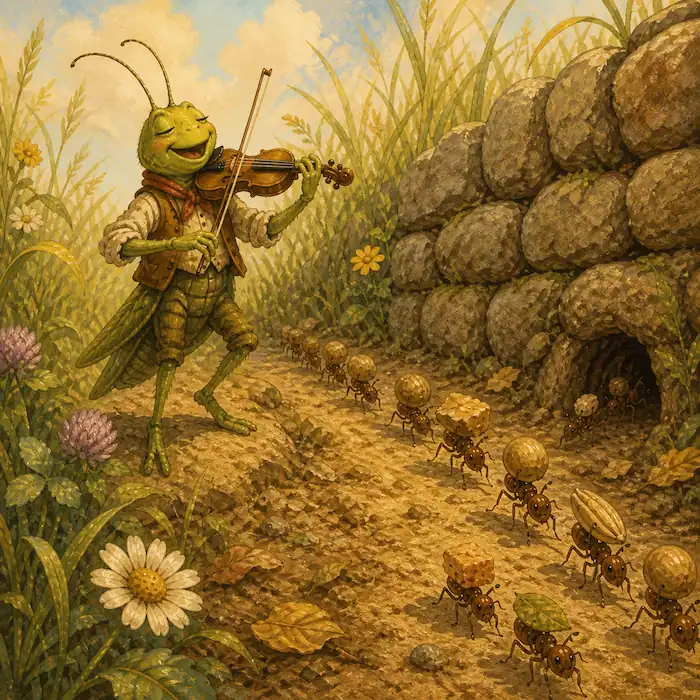
Jasper Grasshopper plays his fiddle while ants carry food toward their storeroom in The Ants & the Grasshopper Aesop’s fable.

Jasper watched them hurry past.

“Friends!” he called. “Come and hear my new song. It has a jump and a twirl.”

An ant named Mina stopped for half a breath. She had a grain of wheat balanced across her back.

“It sounds lovely, Jasper,” she said. “But we have work to do.”
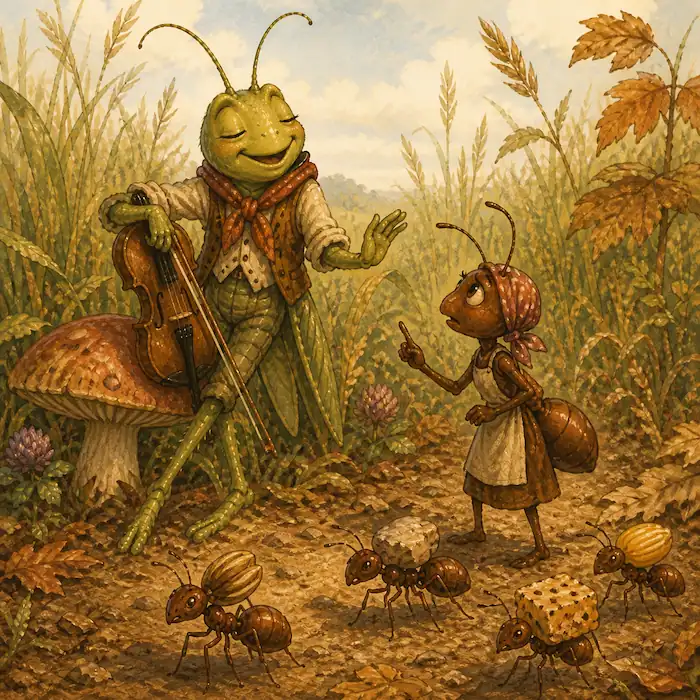
Mina the ant warns Jasper Grasshopper to prepare for winter while other ants carry food in The Ants & the Grasshopper.

“Work?” Jasper laughed. “Today?”

“Especially today,” said Mina. “The sun helps us dry the grain. Summer won’t last.”

Jasper looked up at the wide blue sky. Not a single cloud crossed it.

“Winter?” he said. “That is ages away.”

Then he played faster than before.

Meanwhile, the ants worked from sunrise until the shadows grew long. They did not grumble. They simply kept going, one small task after another.

“Enough of that,” said Uncle Bram. “Food first, fun after.”

Jasper gave a grand bow. “Then I’ll provide the fun while you bring the food.”

“That’s not how winter works,” said Uncle Bram. But Jasper had already leaped onto a mushroom and started another song.

Warnings in the Warm Days

As summer deepened, the meadow changed.

The green wheat in the field turned gold. Blackberries darkened in the hedge. Evenings cooled a little sooner. At dawn, silver dew covered the grass.

Mina found Jasper lying beneath a fern, plucking lazy notes on his fiddle.

“Jasper,” she said gently, “have you stored any food yet?”

He rolled over and smiled. “I had a raspberry yesterday. A splendid raspberry!”

“That was yesterday.”

“I expect there will be another today.”

“And tomorrow?”

“Tomorrow may bring two raspberries.”

Mina set down the seed she carried. “You should listen while there’s still time.”

Jasper laughed. “Dear Mina, nothing feels urgent in summer. That’s the problem.”

Uncle Bram came up behind her.

“Nights grow colder,” he said. “Geese are flying south. Spiders are mending thick webs. Mice are carrying nuts to their holes. All the meadow knows what comes next.”

“Mock winter if you like,” he added. “It won’t warn you. It just arrives.”

For a moment, Jasper looked toward the field. The tall grain bowed in the breeze. It did look less green than before.

Then a butterfly fluttered over his nose.

“Ah!” cried Jasper. “A dance partner!”

And off he sprang after the butterfly.
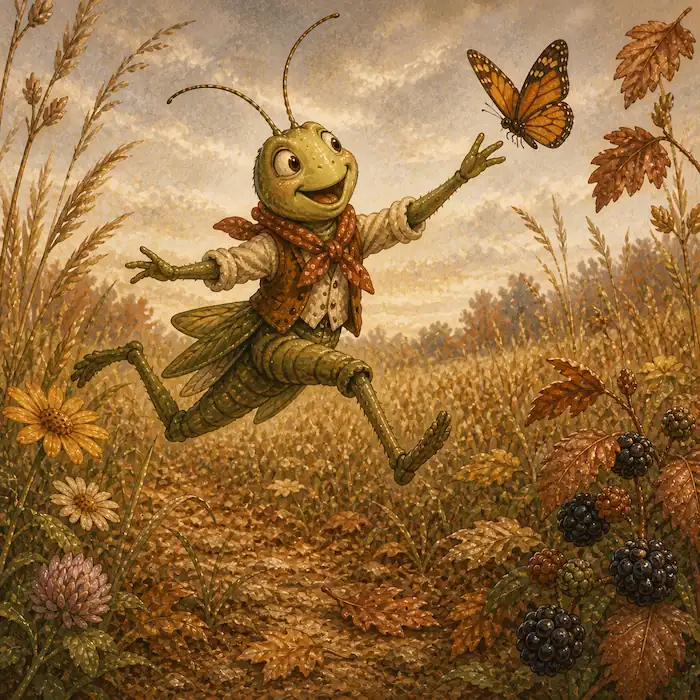
Jasper Grasshopper chases a butterfly through an autumn meadow instead of gathering food in The Ants & the Grasshopper Aesop’s fable.

Late Autumn Sunshine

At last, late autumn came to the meadow.

The air smelled of dry leaves and woodsmoke from the farmhouse chimney. The sun still shone, but it had lost its summer heat. Shadows stretched thin and blue across the ground.

The ants chose a bright morning to dry their stored grain one final time. They carried it out of their underground rooms and spread it on flat stones near the wall. Corn kernels gleamed yellow. Wheat grains glowed brown. Seeds lay in tidy little heaps.

Mina checked each pile carefully.
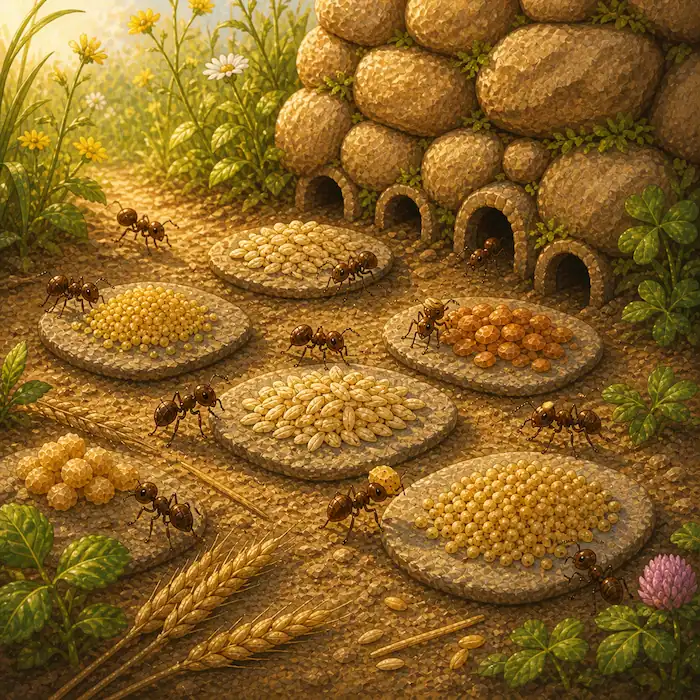
Ants dry piles of grain and seeds on flat stones near their underground home in The Ants & the Grasshopper.

“Turn these,” she said. “Brush away that dust. Keep the damp leaves back.”

The youngest ants worked hard, but they were proud. Their storerooms were full. Their tunnels were clean. Their moss beds were ready.

Then a thin sound drifted across the meadow.

It was not a happy fiddle tune. It was a shaky little squeak.

Jasper appeared at the edge of the path, looking cold and tired. His knees knocked together. His fiddle hung under one arm.
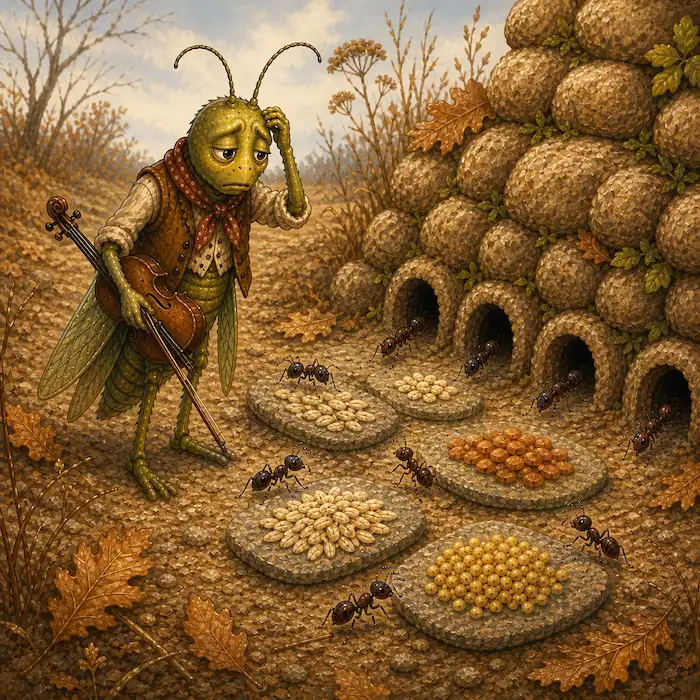
Hungry Jasper Grasshopper stands beside the ants’ stored food in late autumn in The Ants & the Grasshopper Aesop’s fable.

“Good morning,” he said.

No one answered at first.

Jasper tried to smile. “It is a crisp day, isn’t it?”

“It is,” said Mina.

“A very crisp day,” said Jasper. “Quite empty too.”

“Empty?” asked one young ant.

“My stomach,” said Jasper.

Jasper Asks for Help

Jasper stepped closer to the drying grain. His eyes followed a kernel of corn as if it were treasure.

“Mina,” he said, “could you spare a bite? Just a crumb? I have searched the meadow, but the berries are gone, the grass is tough and the seeds have vanished.”

Uncle Bram crossed his front legs. “Vanished?”

“Well,” said Jasper, “perhaps not vanished. Perhaps collected. By you.”

The young ants huddled nearer the grain.

Mina looked at Jasper’s thin face. She remembered his summer songs and his silly bows. She also remembered every warning he had laughed away.

“What did you store for winter?” she asked.
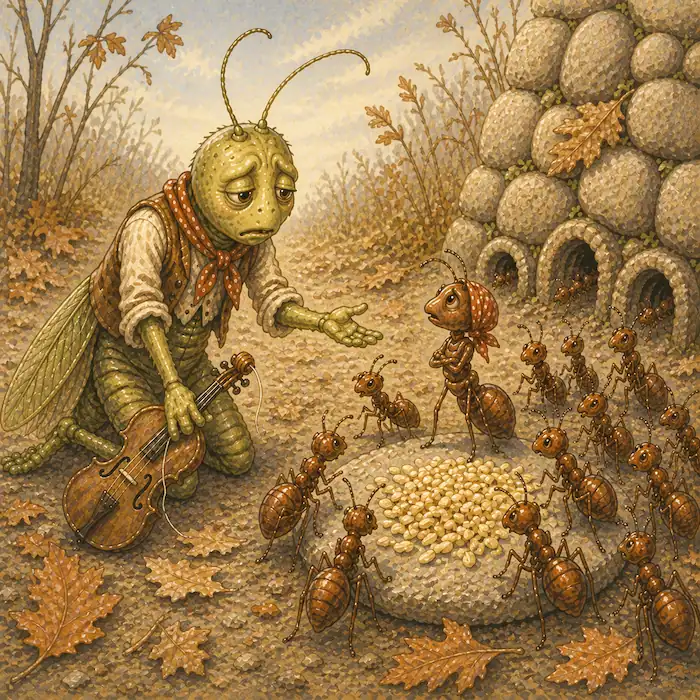
Jasper Grasshopper asks Mina and the ants for help beside their stored grain in The Ants & the Grasshopper.

Jasper rubbed one leg against the other. “Nothing much.”

“How much is nothing much?” asked Uncle Bram.

Jasper looked at the ground. “Nothing.”

A cold breeze rattled the dry leaves.

“What were you doing all summer?” asked Mina, though she already knew.

“I was playing music.”

“And when we warned you?”

“I didn’t listen.”

The ants fell silent.

Jasper swallowed. “I thought there would always be enough. There was food everywhere in summer. I did not understand how fast it could disappear.”

Uncle Bram’s voice grew sharp.

“You didn’t pay attention. That’s the truth. We carried food while you laughed. We mended tunnels while you sang. We dried grain while you danced.”

Jasper lowered his head.

Mina touched Uncle Bram’s shoulder. “He knows that now.”

“Knowing it now doesn’t fill a pantry,” said Uncle Bram.

“No,” said Mina.

Jasper’s feelers drooped. “I am sorry. I should have listened.”

She turned to Jasper. “We cannot give away what we need to survive. Every grain here has a purpose. Every seed took effort.”

“I know,” said Jasper quickly. “I do not ask for a feast. I only ask not to starve.”

Uncle Bram looked at the gray sky, then at the storeroom door.

“Summer had a time for music,” he said. “Autumn was for work. You chose only music.”

Jasper nodded.

“So,” said Uncle Bram, “what time is it now?”

Jasper stared at his fiddle. His voice came out very small.

“A time to learn?”

Mina studied him for a moment. “Can you carry?” she asked.

Jasper looked surprised. “Carry?”

“Can you sweep leaves away from the drying grain? Can you help seal the lower tunnel before frost? Can you mend your fiddle string and play softly for the youngest ants when the dark evenings feel long?”

“I can do all that,” said Jasper. “I will try.”

Uncle Bram frowned. “Trying is not the same as doing.”

“Then I will do it,” said Jasper.

Mina picked up a tiny flake of corn and held it out. “Eat this first, then work.”

Jasper took the food with both hands. He did not gobble it, though he wanted to. Instead, he ate slowly. The corn tasted plain, but to him it felt like a feast.

“Thank you,” he said.

“Do not thank us yet,” said Uncle Bram. “There are leaves to move.” So Jasper worked.

Mina showed him how to push with his shoulder instead of pulling with his legs. Soon Jasper cleared leaves from the stones and brushed dust away from the grain.
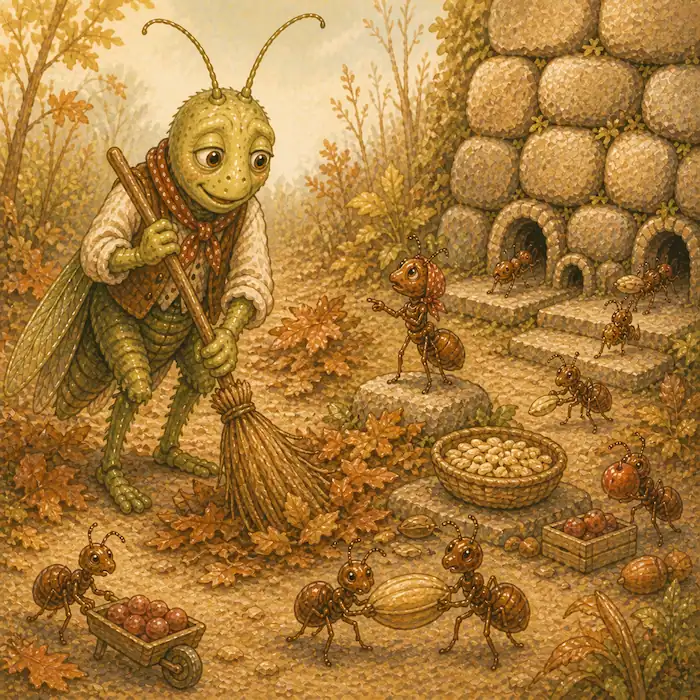
Jasper Grasshopper sweeps autumn leaves and helps the ants prepare their home for winter in The Ants & the Grasshopper.

The work felt strange. It wasn’t like playing his fiddle. With every small task, Jasper felt a little warmer.

Winter at the Door

Jasper slept in a sheltered corner near the ant tunnel, wrapped in dry moss. He woke before sunrise and saw his breath puff in the air.

For the first time, he did not reach for his fiddle. Instead, he reached for a broom of dried stems.

When Mina came out, Jasper had already swept frost from the entrance.

“You are early,” she said.

“I was cold,” said Jasper. “Then I remembered the lower tunnel.”

Mina nodded. “Good.”

All morning, the ants finished their final tasks. Jasper helped where he could. He fetched dry grass. He pushed pebbles into cracks. He carried tiny crumbs one by one.

By midday, the grain had dried enough. The ants carried it back inside. Jasper stood to one side, making sure no seed rolled away.
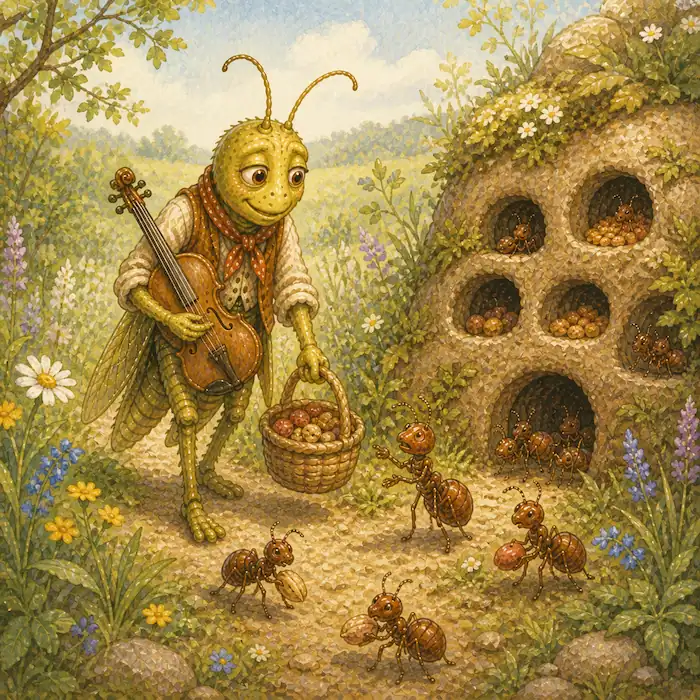
Jasper Grasshopper helps the ants gather food when spring returns in The Ants & the Grasshopper Aesop’s fable.

When the last kernel crossed the threshold, Uncle Bram turned to him.

“You helped today,” he said.

Jasper straightened. “Yes.”

“You worked without making a speech.”

“Yes.”

“You dropped only three seeds.”

“Four,” Jasper admitted. “But I found the fourth.”

Uncle Bram nodded. “Then come inside.”

Inside the ant home, the tunnels smelled of dry grain, earth and moss.

Jasper had never seen such order. Seeds sat in chambers by size and type. Moss beds lined the sleeping rooms. Little pebbles marked the paths. The ants had built a whole world beneath the wall.

“You made all this?” he asked.

“We made it together,” said Mina.

Jasper touched the wall gently. “I spent summer filling the air with songs. You spent it building a place to live.”

“Songs matter,” said Mina. “But they’re not enough on their own.”

Jasper nodded. “Next summer, I will do both.”

The first snow began to fall outside. It covered the meadow, the fern and the mushroom stage where Jasper had danced all summer.

That evening, after supper, Jasper mended his fiddle string with a thread Mina found in the storeroom. He tuned it carefully. Then he played a gentle song, not bright and boastful like his summer tunes, but warm and steady.
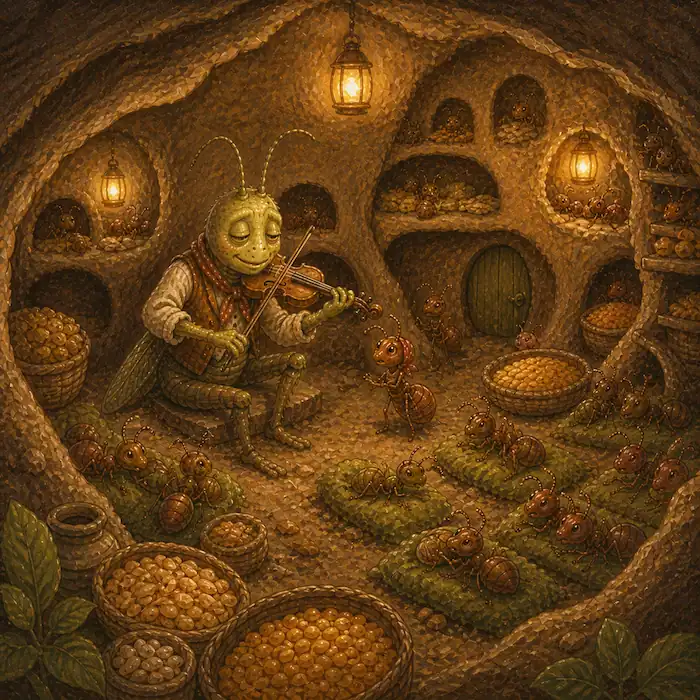
Jasper Grasshopper plays his fiddle inside the warm ant home while ants rest with their stored food in The Ants & the Grasshopper.

The young ants curled into their moss beds. Mina leaned against the tunnel wall and listened. Even Uncle Bram closed his eyes.

“What is that song called?” Mina asked.

Jasper smiled. “There Is a Time for Everything,” he said.

Uncle Bram opened one eye. “A sensible title.”

Jasper laughed softly. “Then that is what it shall be.”

Spring Brings a New Tune

Jasper did not become an ant. He still loved music, but he learned.

He learned that small jobs matter. He learned that full cupboards do not fill themselves.

When spring finally returned, Jasper stepped out into the meadow with Mina and Uncle Bram. Green shoots pushed through the soil. Birds called from the hedge. Sunlight warmed the old stone wall.

Jasper lifted his fiddle. “May I play?” he asked.

Mina smiled. “After we check the first seed patch.”

Jasper tucked the fiddle under one arm and picked up a basket.

“Then let’s check it,” he said.

The ants stared.

“What?” Jasper asked. “I can carry a basket and a fiddle.”

Uncle Bram grunted. “We shall see.”

So Jasper worked through the morning. Then, when the seed patch was clear, he climbed onto the mushroom and played.

This time, the tune had a marching beat, a dancing turn and a steady middle part that sounded like ants carrying grain together.

The meadow listened. The bees hummed along. The daisies bobbed in the breeze.

And when Jasper sang, he sang the lesson plainly:

“Work first,” he sang softly,
“then play.”

The ants laughed and clapped their tiny feet.

From then on, whenever summer arrived, Jasper played music in the meadow. He also stored food, watched the weather and helped his friends when the harvest came.

That is why The Ants & the Grasshopper is still told today.

Moral of The Ants & the Grasshopper

The moral of The Ants & the Grasshopper is that there is a time for work and a time for play. Enjoying life matters, but so does planning ahead and taking responsibility.

In this version, Jasper learns that music and fun are valuable, but they cannot replace preparation. The ants are not shown as cruel. They are careful, hardworking and fair. Jasper is helped, but he also has to take responsibility and work.

This makes the story useful for teaching children that:

  • Choices have consequences
  • Preparation makes difficult times easier
  • Kindness should not remove responsibility
  • Work and play both have their place

Vocabulary Spotlight

Fable – A short story, often with animal characters, that teaches a lesson

Meadow – Meadow

Fiddle – A violin, often used for folk music

Storeroom – A place where food or supplies are kept

Grain – Seeds from plants such as wheat, corn or barley

Harvest – The time when crops are gathered

Pantry – A place where food is stored

Frost – A thin layer of ice that forms when it is very cold

Tunnels – Underground passages

Prepare – To get ready for something before it happens

Teacher’s Note

The Ants & the Grasshopper is a useful fable for classroom work because it opens discussion without giving children an overly simple answer.

Older versions of the fable can feel harsh because the grasshopper is sometimes refused help completely. This retelling keeps the traditional moral about preparation, but also allows space to discuss compassion, fairness and responsibility.

Teachers can use this story to explore:

  • why fables use animal characters
  • how stories teach morals
  • whether the ants are fair
  • whether Jasper deserves help
  • how work and creativity can both matter
  • how people can learn from mistakes


This story works particularly well for literacy, character education, drama and discussion-based learning.

Parent and Teacher Discussion Questions for The Ants & the Grasshopper

  1. What does Jasper enjoy doing at the beginning of the story?
  2. What are the ants doing while Jasper plays music?
  3. Why does Mina warn Jasper about winter?
  4. Why does Jasper ignore the warnings?
  5. How does the meadow change as summer turns into autumn?
  6. What happens when Jasper becomes hungry?
  7. Do you think Uncle Bram is too strict, or is he being fair?
  8. Why does Mina decide to help Jasper?
  9. Why does Jasper have to work before he is fully accepted into the ant home?
  10. What does Jasper learn by the end of the story?
  11. Is music important in the story? Why?
  12. Can work and play both be valuable?
  13. What would have happened if the ants had not prepared?
  14. What would you have done if you were Mina?
  15. What does the story teach us about choices?

Classroom Activities for The Ants & the Grasshopper

1. Work, Play and Planning Sort

Best for: Ages 5–8
Skills: Comprehension, sequencing, decision-making, SEL
Time: 20–30 minutes

Give pupils a set of cards with actions from the story, such as:

  • Jasper plays his fiddle
  • Mina dries grain
  • ants carry seeds
  • Jasper chases a butterfly
  • ants mend tunnels
  • Jasper asks for food
  • Jasper sweeps leaves
  • Jasper plays music in winter

Ask children to sort them into three columns:

Work | Play | Planning Ahead

Then discuss:

  • Can an action belong in more than one column?
  • Is music always just play?
  • Can work be enjoyable?
  • Why is planning ahead different from just working?

Extension:
Ask pupils to add three examples from their own lives, such as packing a school bag, saving pocket money, practicing reading or tidying their room.


2. Jasper’s Choices Timeline

Best for: Ages 6–10
Skills: Sequencing, cause and effect, story structure
Time: 30–40 minutes

Ask pupils to draw a timeline with four sections:

  1. Summer
  2. Late summer
  3. Autumn
  4. Winter

In each section, they write or draw:

  • what Jasper does
  • what the ants do
  • what changes in the meadow
  • what consequence follows

Key teaching point:
This activity helps children see that Jasper’s problem does not happen suddenly. It builds from repeated choices.

Extension for older pupils:
Add a second line underneath called “What Jasper could have done instead.”

Example:

Story Event

Better Choice

Jasper ignores Mina’s warning

He stores one basket of food each day

Jasper chases a butterfly

He helps the ants for one hour first

Jasper arrives hungry

He apologizes and offers to work


3. Courtroom Debate: Were the Ants Fair?

Best for: Ages 8–12
Skills: Speaking and listening, persuasive writing, reasoning
Time: 45–60 minutes

Set up a simple classroom debate.

Divide pupils into groups:

  • Team Jasper: Argues that Jasper should be helped because he is hungry and sorry
  • Team Ants: Argues that the ants worked hard and cannot give away food carelessly
  • Judges: Listen and decide what is fair
  • Witnesses: Mina, Uncle Bram, Jasper and a young ant

Give pupils sentence starters:

  • “I believe Jasper should / should not be helped because…”
  • “The evidence from the story shows…”
  • “A fair solution would be…”
  • “Mina’s choice matters because…”

Strong outcome:
Children should reach a balanced answer: Jasper should not be left to starve, but he should also take responsibility and help.

Writing follow-up:
Write a short judgement beginning:

After hearing both sides, I think the fairest decision is…

4. Rewrite the Moral

Best for: Ages 7–12
Skills: Inference, summarising, moral reasoning
Time: 20–30 minutes

Give pupils the original moral:

There is a time for work and a time for play.

Ask them to rewrite it in different ways:

  1. As a sentence for younger children
  2. As a proverb
  3. As a modern classroom rule
  4. As advice from Mina to Jasper
  5. As a text message Jasper might send to a friend

Examples:

  • “Have fun, but do not forget what needs doing.”
  • “Play is better when the work is finished.”
  • “Tomorrow is easier when you prepare today.”

Extension:
Ask pupils whether the moral should include kindness too. This encourages deeper thinking beyond a simple “work hard” message.

5. Fable Features Hunt

Best for: Ages 7–11
Skills: Genre knowledge, reading analysis
Time: 30 minutes

Ask pupils to find evidence that this story is a fable.

They should look for:

  • animal characters with human traits
  • a clear moral
  • a simple conflict
  • consequences for choices
  • a lesson that applies to real life

Use a table:

Fable Feature

Example from the Story

Animal characters act like people

Jasper plays a fiddle and speaks

Moral lesson

Work and play both matter

Consequence

Jasper becomes hungry because he did not prepare

Human problem shown through animals

People sometimes avoid work until it is too late

Extension:
Compare this fable with The Boy Who Cried Wolf or The Hare and the Tortoise.

6. Build an Ant Storeroom STEM Challenge

Best for: Ages 6–10
Skills: STEM, teamwork, problem-solving
Time: 45–60 minutes

Children work in small groups to design a safe ant storeroom for winter.

Materials could include:

  • paper cups
  • cardboard
  • straws
  • craft sticks
  • tissue paper
  • cotton wool
  • scrap paper
  • tape

Their storeroom must include:

  • space for food
  • a sleeping area
  • an entrance
  • protection from cold or rain
  • a way to organize supplies

After building, each group explains:

  • how their ant home works
  • where the food is stored
  • how it protects the ants
  • what they would improve

Literacy link:
Write a short description titled:

Inside Our Ant Storeroom

7. Jasper’s Weekly Planner

Best for: Ages 6–9
Skills: Planning, time management, PSHE
Time: 25–35 minutes

Give children a blank weekly planner for Jasper.

They must include:

  • time for music
  • time for food gathering
  • time for helping the ants
  • time for rest
  • time for checking the weather

The aim is not to remove fun. It is to balance fun with responsibility.

Discussion questions:

  • How much time should Jasper spend playing?
  • How much time should he spend preparing?
  • Why is balance better than doing only one thing?

Personal link:
Children create their own mini planner for one school day, including learning, play, reading, food and rest.

8. Hot-Seating Jasper, Mina and Uncle Bram

Best for: Ages 7–12
Skills: Drama, empathy, inference
Time: 30–45 minutes

Choose three pupils to sit in role as:

  • Jasper
  • Mina
  • Uncle Bram

The rest of the class asks questions.

Example questions for Jasper:

  • Why did you ignore the warnings?
  • Did you really think winter would not come?
  • How did you feel when you saw the ants’ food?

Example questions for Mina:

  • Why did you help Jasper?
  • Were you angry with him?
  • Did you think Uncle Bram was being too strict?

Example questions for Uncle Bram:

  • Why were you worried about giving food away?
  • Did Jasper deserve another chance?
  • What made you let him come inside?

Writing follow-up:
Write a diary entry from one character’s point of view.

9. Weather Watch and Seasonal Change

Best for: Ages 5–8
Skills: Science, observation, vocabulary
Time: 20 minutes plus follow-up

Use the story to discuss signs that seasons are changing.

Ask children to find signs in the story:

  • wheat turns gold
  • blackberries darken
  • evenings cool sooner
  • dew covers the grass
  • geese fly south
  • frost appears
  • snow falls

Then pupils create a Season Signs Chart for summer, autumn and winter.

Extension:
Go outside and look for real signs of the current season. Children can draw or write what they notice.

10. Write a New Ending

Best for: Ages 8–12
Skills: Creative writing, moral development, character growth
Time: 45–60 minutes

Ask pupils to write a new ending where one thing changes.

Options:

  1. The ants refuse to help Jasper
  2. Jasper prepares earlier
  3. Mina gives Jasper a job sooner
  4. Uncle Bram changes his mind
  5. Jasper teaches the ants a song that helps them work

Children must keep the story’s moral clear.

Success criteria:

  • The ending must match the characters
  • The moral must still make sense
  • The story should show consequences
  • Dialogue should sound natural

High-level extension:
Ask pupils to explain how their new ending changes the message of the fable.

Fun Facts About Ants and Grasshoppers

  • Ants often live in organized colonies with different jobs.
  • Many ants carry food back to their nest.
  • Grasshoppers are insects with strong back legs for jumping.
  • Grasshoppers make sounds by rubbing parts of their bodies together.
  • Ants communicate using scent trails.
  • A fable is not meant to be a science lesson. The animals act like people so the story can teach a human lesson.

History of The Ants & the Grasshopper

The Ants & the Grasshopper is one of the best-known stories linked to Aesop’s Fables. Aesop was a storyteller from ancient Greece, traditionally believed to have lived more than 2,500 years ago.

Like many fables, this story uses animal characters to teach a lesson about human behavior. The hardworking ants prepare for winter, while the grasshopper enjoys the present and ignores the future. Different versions of the story have changed the ending over time. Some versions are strict and leave the grasshopper without help. Other modern versions, including this retelling, keep the lesson about planning ahead while also showing kindness and the chance to learn from mistakes.

You can read more about Aesop here: Britannica – Aesop

About Aesop’s Fables

Aesop’s fables are short traditional stories that usually teach a moral. They often feature animals who speak, make choices and face consequences. These animal characters help children think about real human behavior in a simple and memorable way.

The Ants & the Grasshopper remains popular because its lesson is easy to understand but still worth discussing. It asks children to think about preparation, responsibility, fairness and kindness.

We narrated this story because it works well as a read-aloud fable. The changing seasons, repeated warnings and clear character voices make it suitable for bedtime reading, classroom discussion and independent reading practice.

Frequently Asked Questions about The Ants & the Grasshopper

  • What is The Ants & the Grasshopper about?

    The Ants & the Grasshopper is a classic Aesop’s fable about a grasshopper who spends the summer playing music while the ants prepare for winter. When cold weather arrives, the grasshopper learns why planning ahead matters.

  • What is the moral of The Ants & the Grasshopper?

    The moral of The Ants & the Grasshopper is that there is a time for work and a time for play. The story teaches children that preparation and responsibility help us face the future.

  • Who wrote The Ants & the Grasshopper?

    The Ants & the Grasshopper is traditionally credited to Aesop, an ancient Greek storyteller associated with many famous fables.

  • Is The Ants & the Grasshopper an Aesop’s fable?

    Yes. The Ants & the Grasshopper is one of Aesop’s best-known fables. It uses animal characters to teach a lesson about preparation and consequences.

  • What age is The Ants & the Grasshopper suitable for?

    This retelling is suitable for children aged 7–10. Younger children may enjoy it as a read-aloud story, while older children can discuss the moral, characters and fairness of the ending.

  • Why does the grasshopper not have food in winter?

    The grasshopper does not have food because he spends the summer playing music instead of preparing. He ignores the ants’ warnings and only understands the problem when food becomes hard to find.

  • Are the ants mean in The Ants & the Grasshopper?

    The ants are not simply mean. They have worked hard to prepare for winter and cannot give away everything they need to survive. In this retelling, they help Jasper, but they also expect him to take responsibility.

  • What does Jasper learn in the story?Question

    Jasper learns that fun and music matter, but they are not enough on their own. He learns to work, prepare and help others before enjoying his playtime.

  • Why is The Ants & the Grasshopper a good story for children?

    It is a good story for children because it teaches planning, responsibility and consequences in a simple way. It also opens discussion about kindness, fairness and second chances.

  • What type of story is The Ants & the Grasshopper?

    The Ants & the Grasshopper is a fable. A fable is a short story, often with animals as characters, that teaches a moral or life lesson.

  • Can The Ants & the Grasshopper be used in the classroom?

    Yes. This fable works well for classroom reading, social-emotional learning, literacy, drama, debate, moral discussion and creative writing activities.

  • What are the main themes of The Ants & the Grasshopper?

    The main themes are work, play, planning ahead, responsibility, consequences, kindness and learning from mistakes.