

The Story
Rico the Rabbit in the Mexican Desert
Under a wide blue sky, where the sun poured gold across the sand, a small rabbit named Rico lived among the cactus and stone. Rico was not big. He was not fierce. He did not have claws like the wildcat or wings like the hawk. Yet all across the desert, animals spoke his name with respect.
“That rabbit can slip out of trouble like water through fingers,” lizards whispered from warm rocks.
“He can make a hungry fox chase his own tail,” the quail said.
Even old Owl, who trusted very few creatures to use their wits well, would sometimes nod and say, “Rico thinks first and leaps second. That is a rare gift.”
Rico liked the praise, but he liked adventure even more. Every morning he burst from his burrow with bright eyes and twitching ears, ready to see what the day might bring. He loved the smell of hot earth after dawn. He loved the scratchy song of crickets hiding in the brush. He loved the way tiny flowers somehow bloomed in such a dry place, as though the desert kept secrets in its heart.
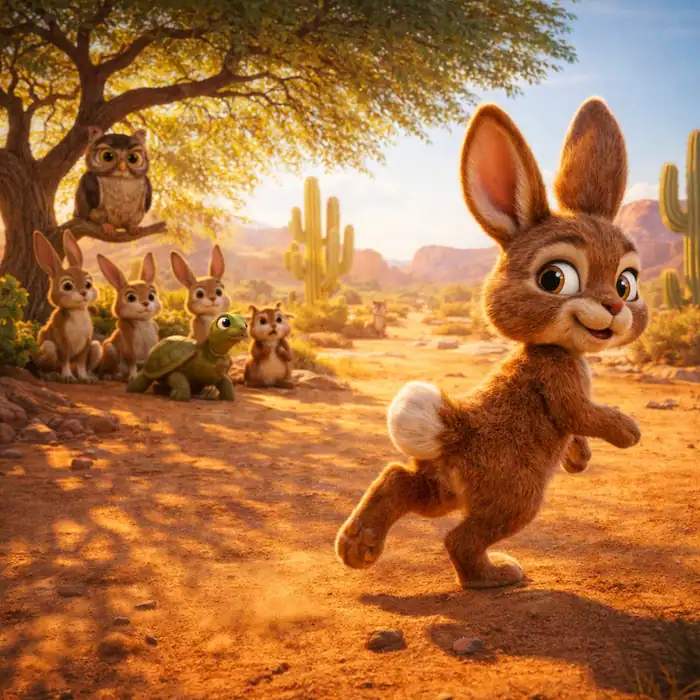
One morning, the air already shimmered with heat though the sun had barely climbed the sky. Rico bounded along a winding path between prickly pear cactus and spiny agave, kicking up soft dust behind him. Soon he spotted a cluster of animals gathered in the shade of a tall mesquite tree.
Old Owl perched on a low branch. Underneath him stood Tortoise, who never hurried but always arrived. A ground squirrel twitched so fast he seemed made of nerves. Three jackrabbits listened with wide eyes.
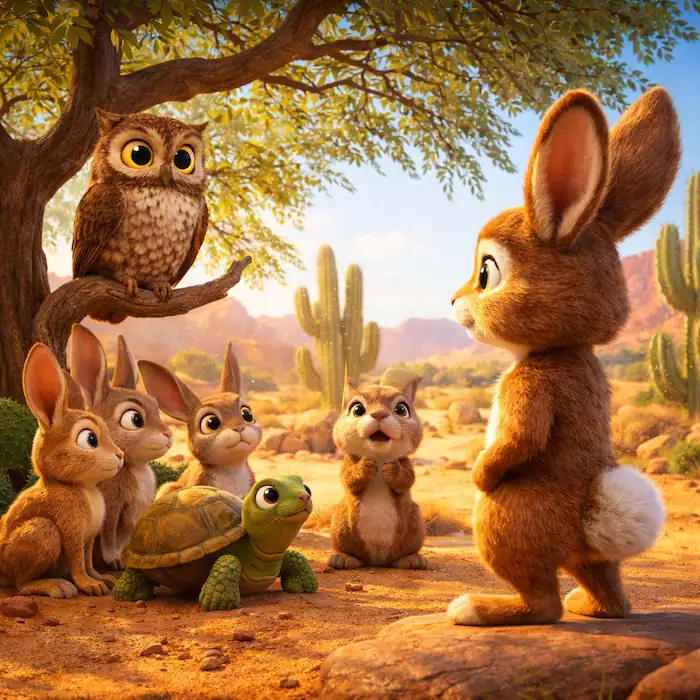
Rico slowed. “What happened?”
Ground Squirrel squeaked, “Coyote has been prowling again.”
At once, the little group stirred uneasily.
“He came close to my burrow last night,” said one jackrabbit.
“He sniffed around the wash at dawn,” muttered another jackrabbit.
“He has not caught much lately,” Owl said, lifting one broad wing. “A hungry coyote becomes bold. A desperate coyote becomes foolish and dangerous.”
Rico sat up on his hind legs. “Has he chased anyone?”
“Not today,” said Tortoise, “but the desert feels restless.”
Owl looked straight at Rico. “You are clever, but do not let curiosity carry you where caution should lead.”
Rico gave a respectful nod. He meant it too. Still, inside him, curiosity had already begun to glow like a coal. A hungry coyote nearby? To Rico, that sounded less like trouble and more like something he had to see for himself.
Coyote’s Trap in the Thorn Bush
Not far away, beyond a dry wash lined with stones, Coyote prowled alone. He was lean even for a desert coyote. His ribs showed faintly under his fur. His yellow eyes were sharp, but today they were clouded with hunger. He had chased a lizard and missed. He had lunged at a quail and landed in dust. He had spent half the night sniffing for mice and found none.
His stomach growled so loudly that he stopped and glared down at it.
“Quiet,” he muttered. “You are not helping.”
Coyote was clever. Everyone knew it. He could sneak, flatter, trick and pretend with the best of them. But when his belly ached, his cleverness often turned crooked. Hunger made him impatient. Impatience made him sloppy.
He paused under a patch of thorny brush and narrowed his eyes. “Rico,” he murmured. “Fast feet, quick tongue, head full of tricks. If I catch that rabbit, I will feast tonight.”
Then an idea slipped into his mind.
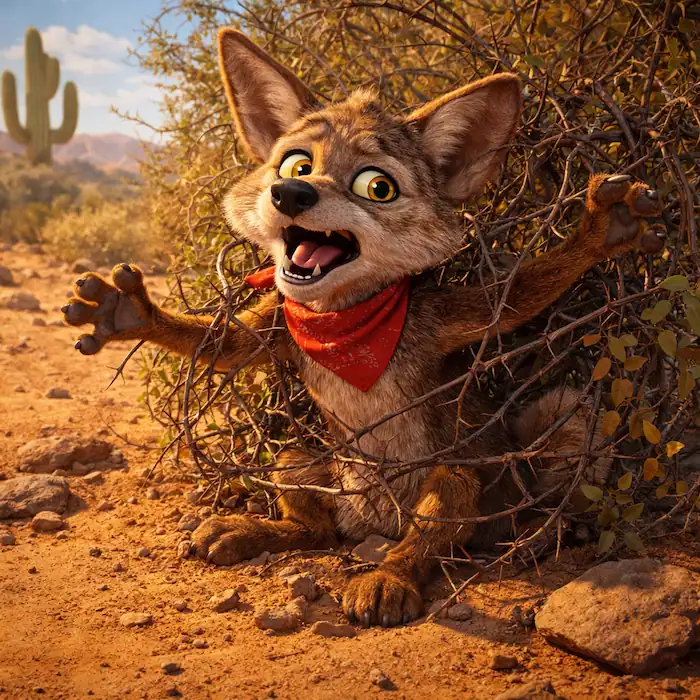
He pushed himself into a thick tangle of branches and yelped as the thorns scratched his fur. Then he arranged his legs just so, twisted his body and let out a long, miserable cry.
“Help!” he howled. “Help me! I’m trapped!”
He stopped and listened.
Nothing.
So he cried again, even louder this time. “Somebody help me! I’m stuck! I’ll die in here!”
At the mesquite tree, Rico’s ears sprang up. The other animals froze.
“That’s him,” whispered Ground Squirrel. “Do not go.”
“Stay where you are,” said Owl firmly.
But Rico’s nose twitched. “What if he really is trapped?”
Jackrabbit snorted. “Then the thorns are wiser than we thought.”
A few animals laughed, but Rico did not. He was cautious, yes. Still, he also believed that a creature in trouble ought to be checked on. Besides, if it was a trick, he wanted to see it for himself.
“I’ll be careful,” he said.
Owl’s eyes grew grave. “Careful is not always enough.”
Rico dipped his head. “I know. I’ll use my brain.”
Before anyone could stop him, he was off, darting across the sand toward the distant cries.
Rico Faces the Coyote
Rico followed the sound to a thorn thicket near a low ridge of red stone. There, tangled among the branches, lay Coyote. At first glance, he truly looked trapped. Thorny stems pressed against him. His tail lay awkwardly in the dust. He lifted his head when he saw Rico and let out a weak groan.
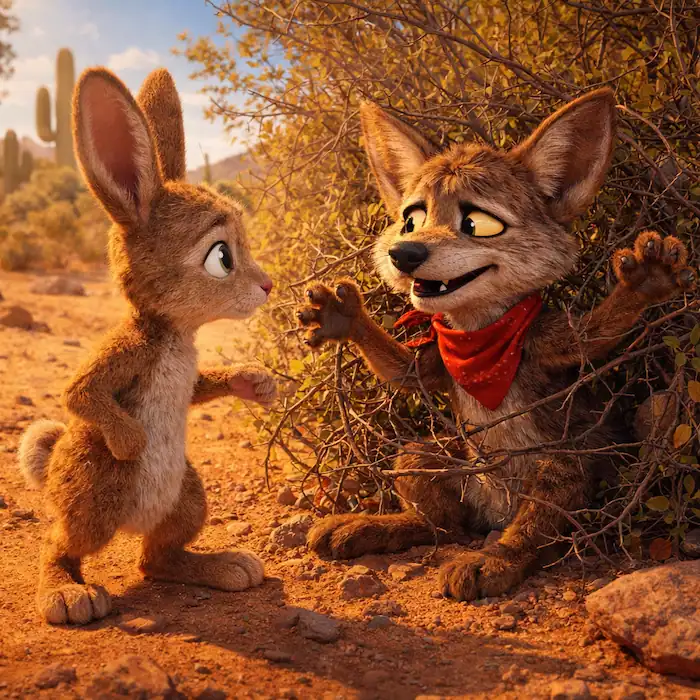
“Oh, thank the sun,” Coyote said. “Little rabbit, you came.”
Rico stayed well back. “What happened?”
Coyote sighed heavily. “I chased a roadrunner through the brush. Foolish, I know. I slipped and fell in. Now I can’t move.”
Rico studied him. The branches did look tight. The scratches on Coyote’s muzzle looked real enough. Yet something in Coyote’s eyes glittered too brightly.
“Are you badly hurt?” Rico asked.
“Only my pride,” said Coyote with a sad little laugh. “Please help me. I know what folks say about me, but I would not forget a kindness.”
Rico hopped one step closer, then stopped.
“You wouldn’t snap at the one who saved you?”
Coyote pressed a paw to his chest. “I swear it.”
That almost made Rico laugh. A hungry coyote’s promise was thinner than a cobweb.
Still, Rico leaned near enough to tug at a branch with both paws. “Hold still.”
Coyote did as he was told.
Rico pulled. The branch moved a little. So he pulled another.
As he worked, he kept talking.
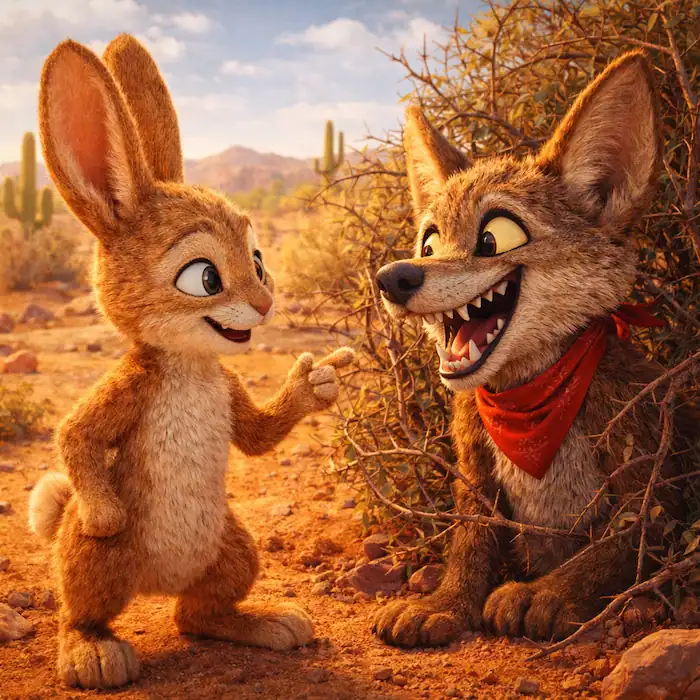
“How did you get this far from the wash?”
“Following scent.”
“What scent?”
“Rabbit.”
Rico’s whiskers twitched. “Rabbit?”
“Yes,” said Coyote carelessly. “A plump one. Very quick. Very clever. Hard to catch.”
Rico sat back. “Sounds familiar.”
Coyote gave him a look. “Perhaps you know him.”
“Maybe,” said Rico lightly.
Then he tilted his head and said, almost lazily, “You know, this is interesting.”
“What is?”
“I heard a story this morning,” Rico said. “It was about a rabbit planning to catch a coyote.”
Coyote blinked. “A rabbit?”
“Yes. The rabbit was so clever that he did not run from danger. He invited danger to walk right into his paws.”
Coyote frowned. “That sounds like nonsense.”
“Does it?” Rico tugged at another branch. “This rabbit was famous. Everybody in the desert knew him.”
Coyote’s ears lifted despite himself. “What was his name?”
Rico smiled. “Rico.”
For one quick moment Coyote forgot to act trapped. His body tightened. His eyes flashed. Rico saw it. There it was. The truth. Still, Rico did not run. Not yet. He had a better idea.
How Rico Tricks Coyote
Rico pretended not to notice Coyote’s slip. Instead, he bent low over the branches and said in a thoughtful voice, “Maybe I should not free you.”
Coyote’s voice sharpened. “Why not?”
“Because if you are hunting Rico, then you might eat him.”
Coyote quickly forced his face back into a look of sorrow. “Eat him? No, no. I only wish to speak with him.”
“About what?”
“About… about friendship.”
Rico nearly choked.
“Friendship?”
“Yes,” said Coyote, now inventing wildly. “I have realized that chasing rabbits is lonely work. Better to make peace.”
Rico gave a solemn nod as if he believed every word. “That is very wise.”
“Then help me out,” said Coyote.
Rico tugged thoughtfully at a thorn branch. “Perhaps. But if you truly want Rico as a friend, you’ll need a good plan.”
Coyote licked his lips. “What kind of plan?”
Rico lowered his voice. “Rico never trusts anyone. You cannot just ask him to come close. He is too sharp. But if he saw a poor creature stuck and helpless…”
Coyote stared.
Slowly, understanding lit his face.
“Yes,” he breathed. “Yes.”
Rico went on, “So here is what we do. I help you out. Then I show you exactly how to trap this famous rabbit. I will pretend to be caught in the branches instead. You hide nearby. When Rico comes close, you leap.”
Coyote’s tail twitched with delight. “Little rabbit, you may be smarter than I thought.”
“Oh, I certainly am,” Rico murmured under his breath.
“What?”
“I said, this plan will work only if you stay patient.”
“I can do that,” said Coyote.
Rico braced his feet. “Good. Now push when I pull.”
He yanked hard on the branches. Coyote shoved with his shoulders. Twigs snapped. Dust flew. With one final wrench, Coyote burst free.
The moment his paws hit open ground, Rico sprang backward. Coyote wheeled toward him.
Rico grinned. “There. You’re not stuck anymore.”
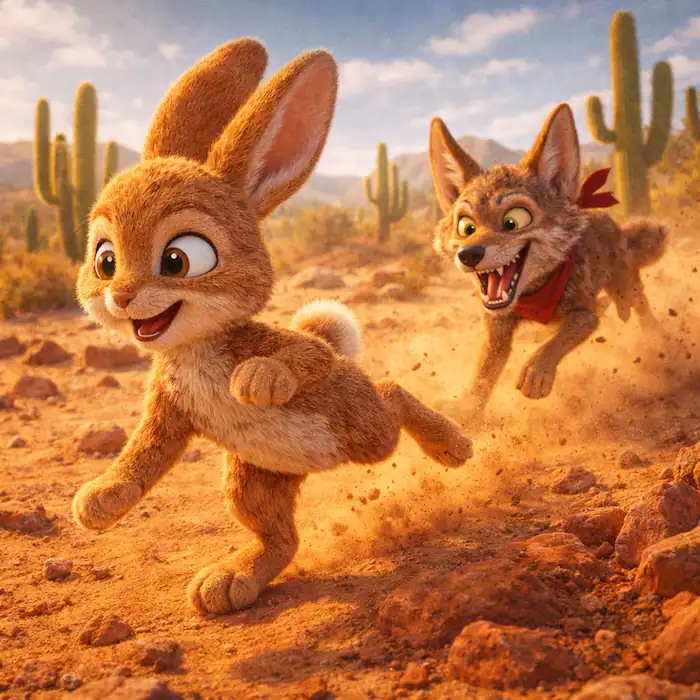
For a heartbeat, Coyote was too surprised to move. Then Rico shouted, “Catch me if you can!” and he flew across the sand.
Coyote roared and gave chase.
The Chase Through the Desert
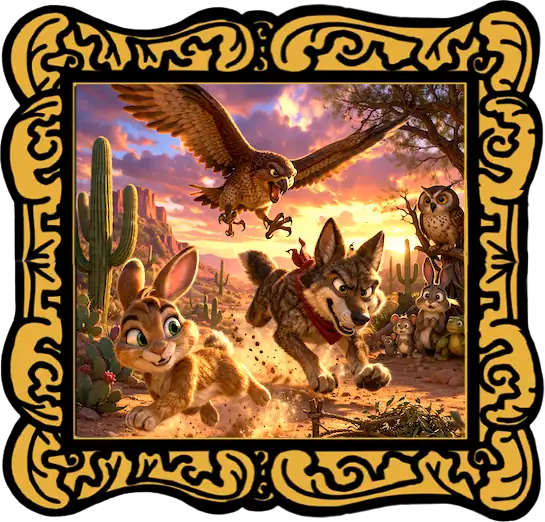
Rico ran like a scrap of wind. He darted between cactus clumps, zipped around fallen logs and shot over stones still warm from yesterday’s sun. Behind him, Coyote pounded forward in long, hungry leaps.
“You tricked me!” Coyote barked.
“You tricked yourself!” Rico called back.
Coyote ran faster. Rico swerved left. Coyote followed. Rico swerved right. Coyote nearly crashed into a prickly pear and had to jump sideways at the last second.
“You’re slow today,” Rico teased.
“I am saving my strength for supper!”
Rico laughed. “Then you should have eaten breakfast.”
The chase cut across open desert and up into broken red rocks. Lizards skittered out of the way. Small birds burst from dusty shrubs. Even the grass seemed to flatten as the two raced past.
Rico knew this land better than any creature alive. He knew where the stones were loose. He knew where the paths narrowed. Most of all, he remembered a small cave hidden between two boulders on the far side of the ridge.
If he reached it first, he might do more than escape. He might make Coyote stop and think for once.
Rico shot through a crack in the rocks and disappeared into the cave. Inside, the air felt cool and dim. A large round stone rested near the entrance, balanced on a slope of gravel.
Perfect.
Outside, Coyote skidded to a stop.
“Rico!” he barked. “Come out.”
Rico’s voice floated from the dark. “Why? It’s nice in here.”
“You cannot stay there forever.”
“Maybe not. But you can stay out there forever if you like.”
Coyote flattened his ears. “Coward.”
Rico chuckled. “If you are so brave, come in.”
That was exactly what Coyote did. With a growl, he lunged into the cave.
At once Rico kicked the round stone with all his might. It rolled down the slope and slammed across the entrance with a thud that echoed through the cave. Dust puffed up. Sunlight vanished. Coyote spun around and crashed nose-first into the blocked opening.
Rico leaped onto a ledge above him. “Now who’s trapped?”
Coyote Trapped in the Cave
Coyote snarled and shoved at the stone.
It did not move.
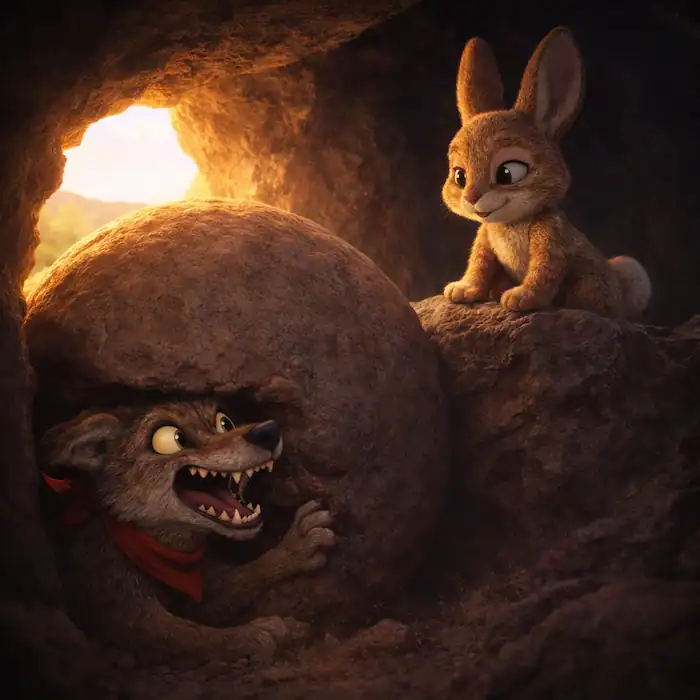
He scratched at the dirt around it. Pebbles fell. The stone stayed where it was. He lunged again and again until his breath came fast and harsh.
Up on the ledge, Rico watched in silence. At last Coyote sank back on his haunches.
The cave grew quiet except for their breathing.
Then, to Rico’s surprise, Coyote said, “You were right.”
Rico blinked. “About what?”
“About brains.” Coyote kept his eyes on the stone. “I chase and grab and lunge. You look and think and wait. That is why you keep winning.”
Rico did not answer right away.
At last he said, “Are you just starting another trick?”
Coyote let out a tired huff. “I would if I could. But I’m too hungry and too beaten for tricks.”
He looked over his shoulder, and for the first time that day there was no sly shine in his eyes. Only weariness.
“I am tired of being hungry,” he said quietly. “Tired of chasing what I can’t catch. Tired of everybody running the moment they smell me. I know I’ve earned that. Still, I’m tired of it.”
Rico’s ears tipped back a little.
Coyote went on. “I should not have tried to fool you. I should not have hunted you. If you roll this stone aside, I will not chase you again.”
“That is a big promise.”
“I know.”
“How do I trust you?”
Coyote swallowed. “You don’t. Not yet. But maybe I can earn it.”
Rico studied him for a long moment. Then he hopped down from the ledge and stood at a safe distance.
“If I help you, things change.”
Coyote raised his head. “How?”
“No more sneaking after me. No lying to the smaller animals. No tricks that end with someone in your jaws.”
Coyote gave a crooked smile. “You are asking a lot from a coyote.”
“I am offering a lot to one,” Rico said.
The cave stayed still.
Finally Coyote nodded. “Agreed.”
Rico placed both paws against the stone. Coyote pushed from the other side. Gravel shifted. The stone rolled just enough to let in a sharp stripe of sunlight. Then more. Then the whole desert flashed bright again.
Coyote stepped out and stood blinking in the light. He could have snapped. He could have lunged. He did neither. Instead he stepped back.
Rico noticed. Rico did not trust him yet, but he noticed.
The Hawk and the Desert Animals
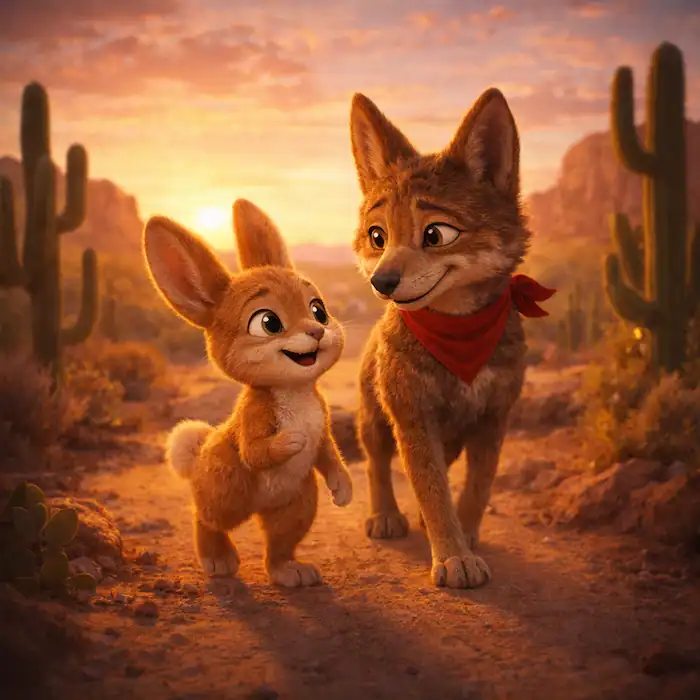
Days passed. At first, the desert animals did not believe what they saw. Rico and Coyote walking in the same direction? Rico talking while Coyote listened? Rico pointing out hidden water holes and Coyote leaving the rabbits alone?
Ground Squirrel nearly fainted.
Owl simply watched.
Rico did not let Coyote off easily. Whenever Coyote grew impatient, Rico said, “Think first.” Whenever Coyote tried to cut corners, Rico said, “That is how the thorns got you.” Coyote grumbled, but slowly he learned.
He learned to hunt lizards without wasting all his strength. He learned where quail liked to dust-bathe. He learned that if he shared a meal, animals stopped fearing every rustle in the brush. He did not become gentle overnight. He just became less foolish.
Then one evening trouble came from the sky.
A hawk had built a nest high on the cliff beyond the mesquite grove. Hawks belonged to the desert like every other creature, but this one had grown reckless. He swooped too low and too often. He frightened the young. He snatched chicks and nearly carried off a squirrel kit.
So the animals gathered beneath the mesquite tree once more.
Owl spoke first. “We need a plan.”
The others turned to Rico, then, nervously, to Coyote.
Coyote shifted his paws. Not long ago, these same animals had hidden from him. Now they were waiting to see whether he would help.
Rico stepped forward. “We have a plan.”
Ground Squirrel squeaked, “We?”
“Yes,” said Rico. “Coyote runs fast. I think fast. Together we can lead the hawk where he should not go.”
Owl’s eyes narrowed with interest. “Go on.”
They worked until dusk laying a snare from braided grass. It would not hurt the hawk badly, Rico promised, but it would tangle one wing long enough to frighten him away from the grove.
Then the hawk came. He dropped from the sky like a thrown spear.
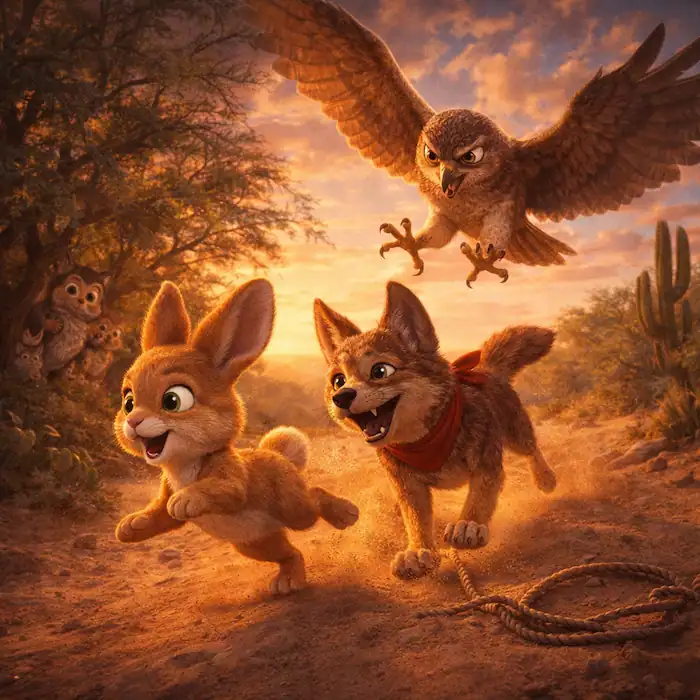
Rico bounded into the open. “Here I am!” he shouted.
The hawk screamed and folded his wings. Down he came. At once Rico darted aside. The hawk twisted to follow.
Then Coyote burst from behind a boulder, barking and snapping at the air beneath the hawk’s belly. The hawk flared upward, startled, and wheeled toward this larger target.
“That’s right,” Coyote called. “Try me!”
He raced toward the dry wash. The hawk chased him, fierce and angry now.
At the last instant Coyote ducked beneath the two low branches. The hawk swept after him and hit the hidden snare.
Whip.
The grass loop tightened around one wing. The hawk tumbled into the sand in a storm of feathers and fury.
Rico leaped onto a stone. “Stay back!” he told the others.
Coyote stood over the trapped bird, not touching him, only guarding.
The hawk beat his free wing wildly. “Let me go!”
Owl flew down to a branch above them. “Will you leave our young in peace?”
The hawk panted. His fierce eyes darted from Owl to Rico to Coyote. He had expected a frightened flock. Instead he had found a desert that stood together.
“Yes,” he spat at last. “I will hunt elsewhere.”
Rico nodded to Coyote. Together they loosened the snare.
The hawk sprang up, beat his wings and rose into the darkening sky without another word.
The animals stared after him. Then cheers broke out under the mesquite.
“We’re safe!”
“They did it!”
“Rico and Coyote saved us!”
Coyote stood very still. Praise felt strange on him, like rain on a creature born to dust. Yet he did not dislike it.
Rico nudged him. “You did well.”
Coyote looked down at the small rabbit beside him. “So did you, partner.”
What the Coyote and the Rabbit Learned
After that night, no one could deny the truth. Rico was still the cleverest rabbit in the desert. Coyote was still quick, sharp and full of mischief. He still liked a trick now and then, but now he was more likely to aim it at trouble than at his neighbours.
Sometimes he forgot himself. Sometimes hunger made him grumble. Sometimes Rico had to remind him, “Use your head before your teeth.”
And every time, Coyote would sigh and say, “Yes, yes. I know.”
One evening, the two sat side by side on a ridge while the sun melted into bands of orange and red. The sand glowed. The cactus shadows stretched long. Somewhere below them, Ground Squirrel was probably telling the story wrong already.
Coyote looked at Rico. “You know, the first time I saw you that day, I thought, ‘There is my supper.’”
Rico twitched an ear. “And I thought, ‘There is trouble in a fur coat.’”
Coyote laughed. Then he grew thoughtful.
“You could have left me in that cave.”
“You could have chased me the minute I rolled away the stone.”
They sat quietly for a moment.
At last Coyote said, “Funny how a trap can become the place where things change.”
Rico smiled. “Only if somebody learns something.”
“And what did you learn?”
Rico looked out across the desert. “That some creatures only begin to change when they have nowhere left to run.”
Coyote nodded. “And I learned that being feared may fill your belly for a day, but it will not make anyone stand beside you.”
The first stars blinked awake overhead.
Then Rico rose and stretched. “Come on. Tortoise said there might be ripe cactus fruit near the wash.”
Coyote stood too. “Race you there?”
Rico grinned. “You can try.”
And off they went through the warm desert dusk, rabbit and coyote, quick feet and long legs, laughter skipping across the sand ahead of them.