
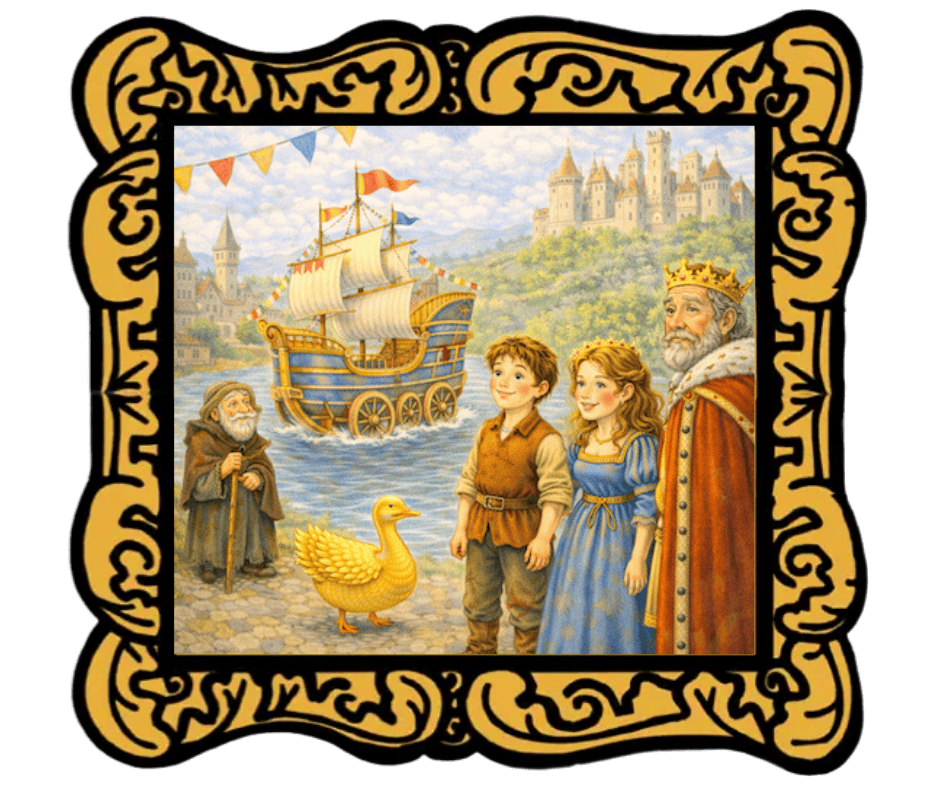

The Golden Goose is a classic fairy tale by the Brothers Grimm where kindness leads to surprising good fortune. This retelling is written for children ages 6–12 and works for read-aloud or independent reading. It hints at a simple lesson: a generous choice can lead to the happiest kind of luck.
A Family That Underestimated One Boy
A man and his wife lived beside a great forest with three sons. The two older boys were quick with their hands and quicker with their opinions. The youngest liked to watch and listen. He spoke slowly and smiled a lot so everyone called him Simpleton.
His brothers used the name “Simpleton” as a mean nickname and repeated it often. So, if a tool went missing they blamed him. If chores ran late they blamed him. When guests came to visit the older boys showed off and pushed Simpleton aside.
The father loved all three of his sons but trusted strength more than gentleness. The mother worked from sunrise to sunset. She did not mean to be unfair, yet she saved the best for the two older boys because they complained the loudest.
One chilly morning the father stared at the empty woodpile. “Winter is coming,” he said. “One of you must go out to the woods and cut firewood.”
The oldest son jumped up. “I will go.”
The First Two Trips
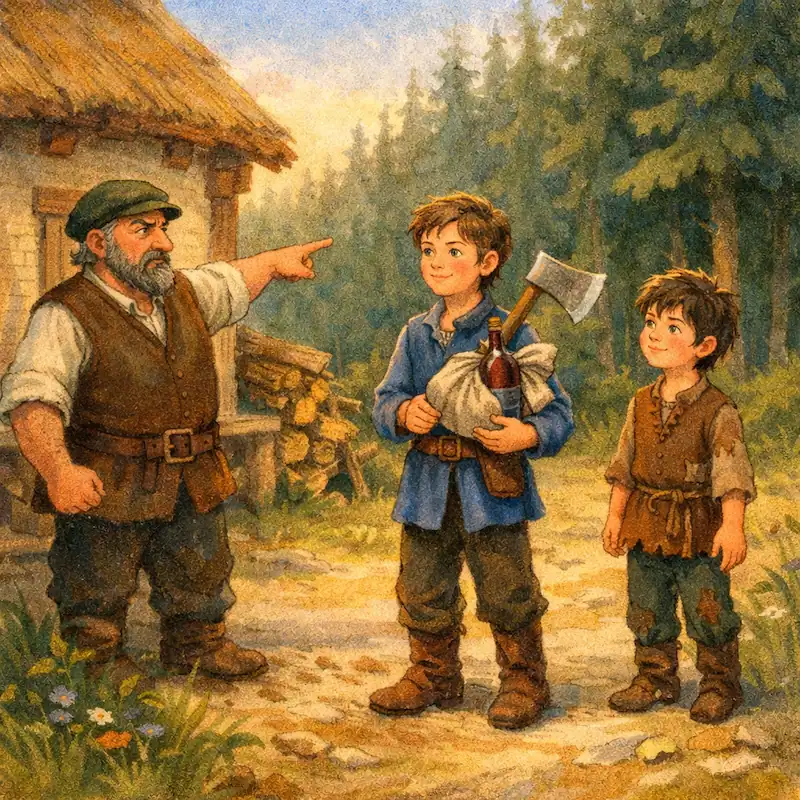
Mother packed the oldest boy a sweet cake and a bottle of good wine. She wrapped it carefully and patted his shoulder. “My strong boy,” she said, “do not tire yourself.”
The forest path twisted between tall trunks. Not far in, a little old man stepped out from behind a fern and bowed.
“Good day,” he said. “I am hungry and thirsty. Will you share a bite of cake and a sip of wine?”
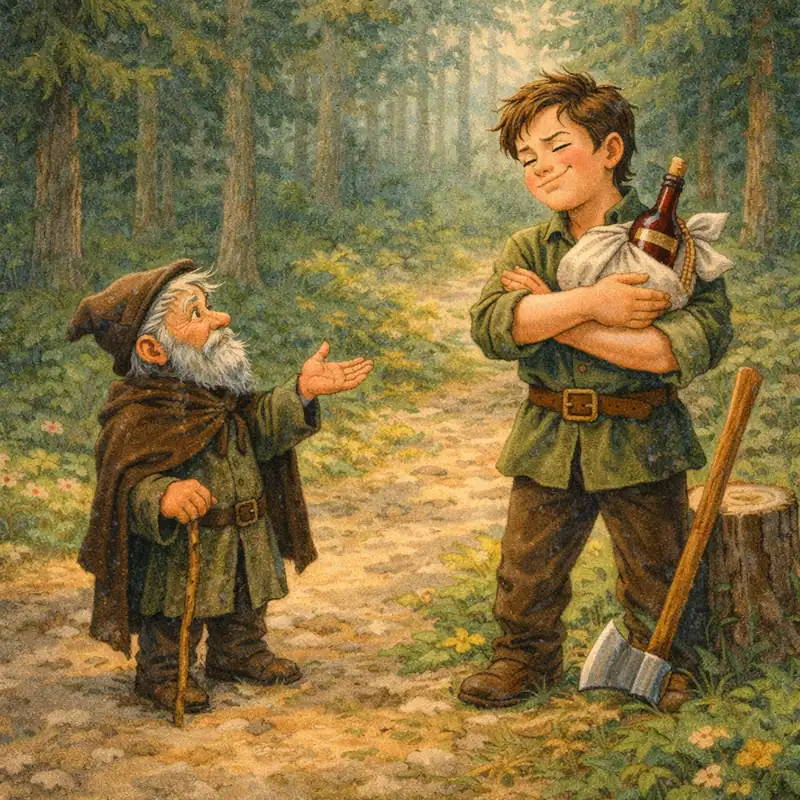
The oldest son glanced at the man’s thin coat and bony hands then pulled the bundle closer. “No. This is my food and I’m keeping it. Go away.”
The old man watched him go and after that the forest suddenly felt quiet. Even the birds seemed to.
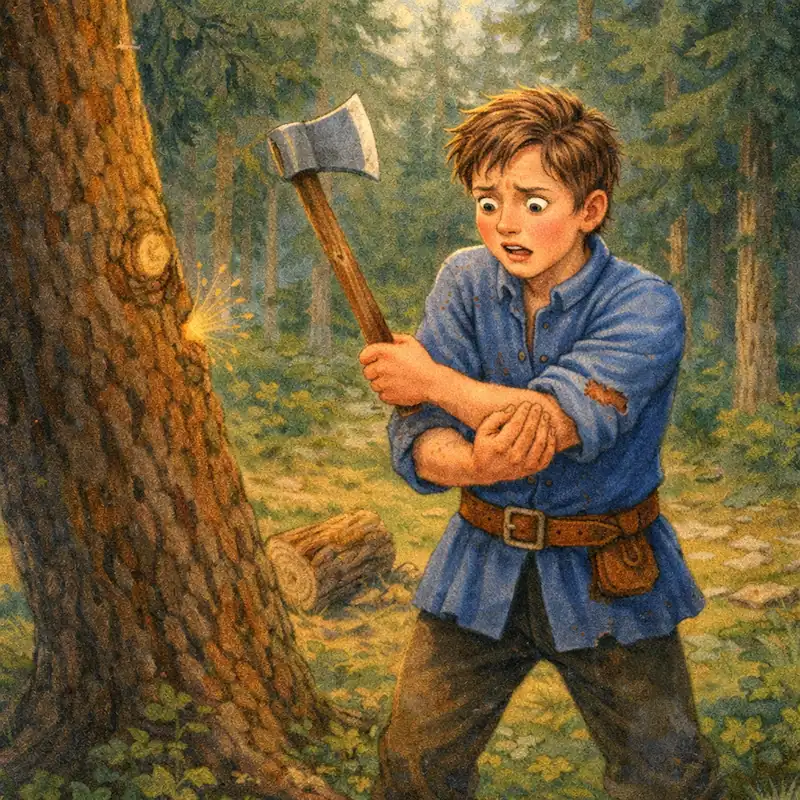
But the boy strode on, chose a thick tree and swung his ax as if he were chopping down the whole forest. The blade caught on a knot and made the ax slip into his arm. He yelled and ran home.
The next morning the father sent the second son. Mother gave him the same fine lunch, even adding a slice of sausage.
Before long, the second son spotted the same little old man waiting by the path. The old man asked again for food and drink.
The second son shook his head. “No. I’m not sharing my lunch.”
Again the old man only nodded, but the woods seemed to hold its breath. Somewhere deep among the trunks a twig snapped and nothing else moved.
The second son started to chop the wood quickly. Two swings later his ax bit into his leg. He cried out and neighbors hurried to carry him home.
The father groaned. “This forest has turned against us.”
Simpleton Walks Into the Trees
Simpleton said, “Father let me go cut the wood.”
His brothers laughed and his father shook his head. Yet Simpleton asked again and again, calm as rain, until the father gave up. “Go then. Experience will teach you.”
His mother did not expect him to come back with much so she gave him the poorest food left in the house. She mixed flour with water and baked it in the ashes. She poured sour beer into an old bottle. It was not meant to be cruel, but it still stung.
Still, Simpleton thanked her anyway and walked into the forest. He held the little bundle as carefully as if it were something precious.
Soon the little old man stepped onto the path again. “Good day,” he said. “I am hungry and thirsty. Will you share?”
Simpleton opened his bag. “It is only ash cake and sour beer,” he said, “but we can share. Sit with me.”
They sat on a fallen log and Simpleton shared without hesitation.
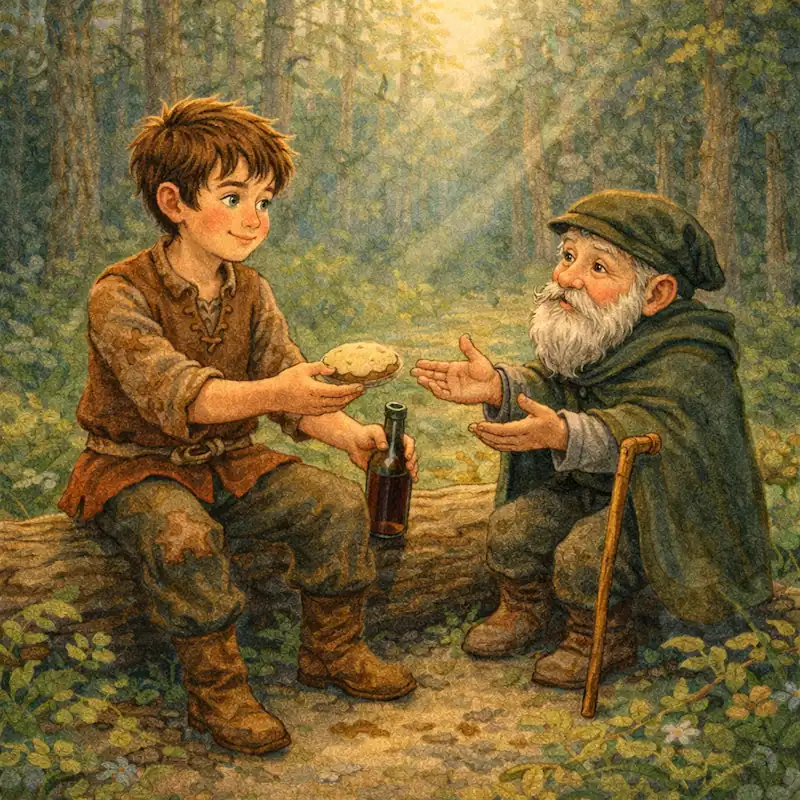
At once the ash cake turned rich and golden, warm as if it had just left an oven. When Simpleton uncorked the bottle the sour beer turned into good wine.
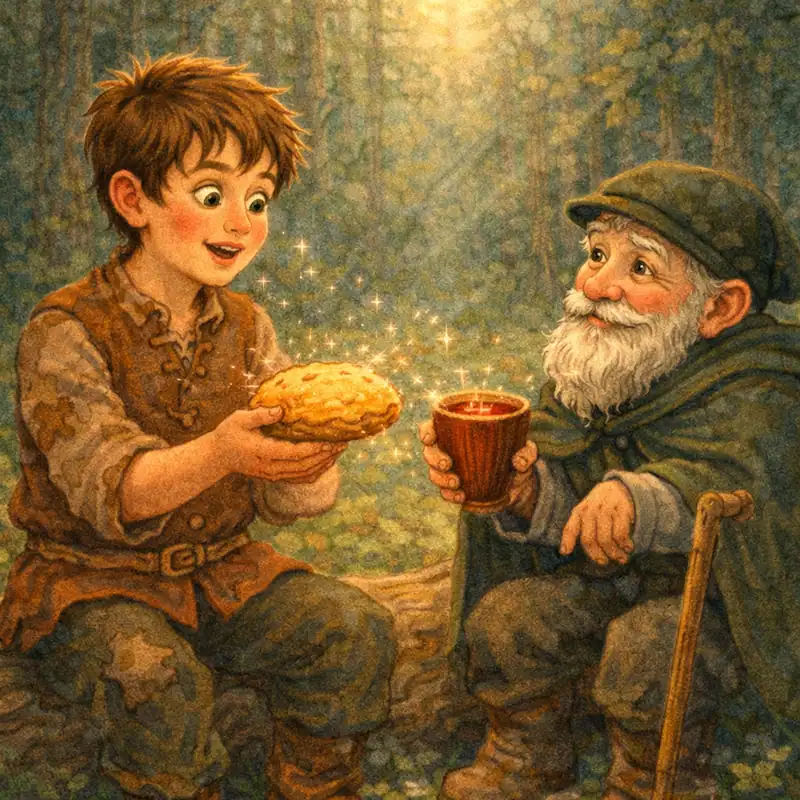
Simpleton’s eyes went wide. “I have never tasted anything like this.”
The old man smiled. “Kindness can be a feast.”
The Tree With a Secret
After they finished eating the old man stood up. “You gave willingly,” he said. “Cut down that crooked tree yonder and look among its roots.”
Then he turned, took two small steps and vanished between the trees. It was as if the forest folded him away.
Simpleton chopped down the tree. It groaned, leaned and crashed. Among the roots sat a goose with feathers of pure gold. It looked at Simpleton as calmly as if it were an ordinary barn bird. Its golden feathers caught the light like sunrise.
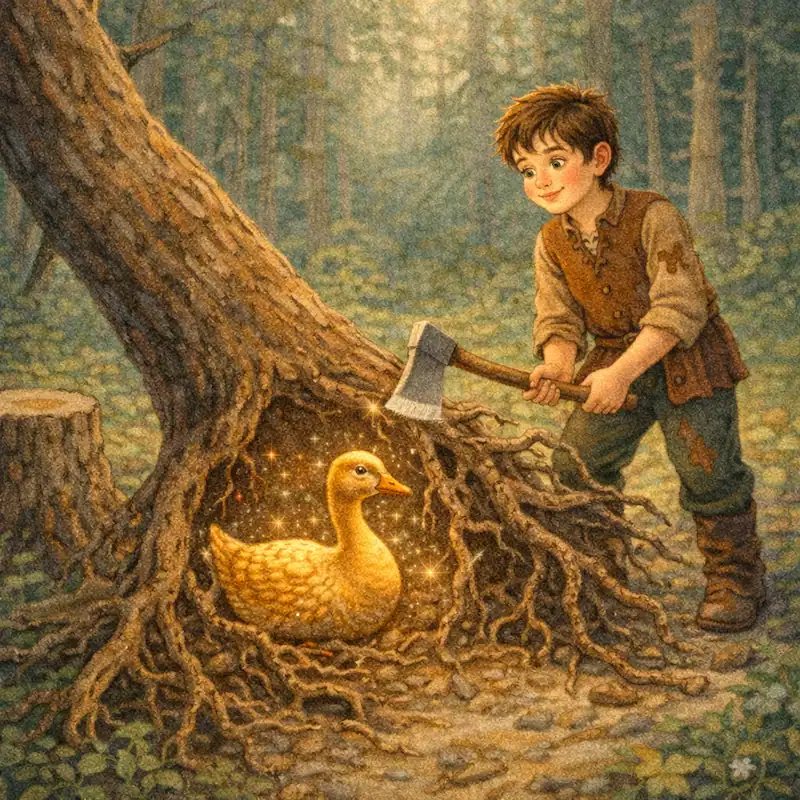
Simpleton lifted it gently. The feathers felt smooth and warm, not sharp like metal. Instead of going home, he tucked the goose under his arm and carried it to the nearest inn to spend the night. He kept glancing down at it, as if he could hardly believe The Golden Goose was real.
The Golden Goose and Sticky Fingers
The innkeeper welcomed Simpleton, yet the innkeeper’s three daughters could not take their eyes off the golden goose.
“A bird like that could buy a new roof,” whispered the oldest.
“Or a chest full of ribbons,” said the second.
The youngest leaned closer. “Just one feather,” she breathed.
Simpleton put the goose in his room and went downstairs for supper. He closed the door carefully, but curiosity was quick.
The Sticky Mistake
The oldest daughter crept into the room. “Just one feather,” she told herself. She grabbed the wing and at once her hand stuck fast. In a panic, she tugged, but the goose did not even ruffle its feathers.
With a shriek, the oldest daughter squealed. Then the second daughter rushed in to help and stuck fast too. The third sister ignored every warning and stuck fast as well. Their arms stretched like a silly ribbon.
Before long all three stood linked to the goose, tugging and whining. The goose only blinked.
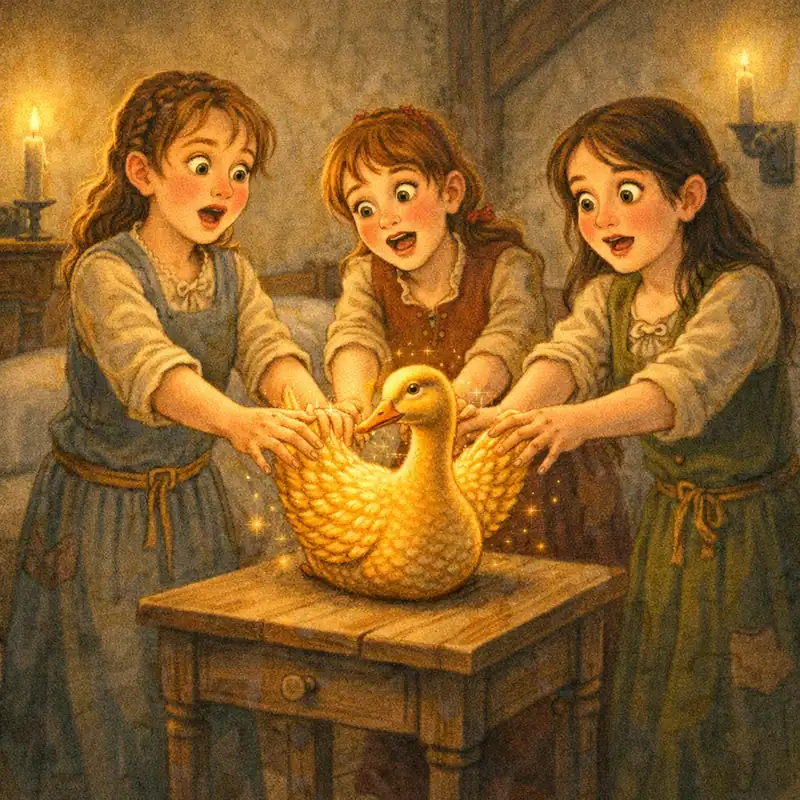
Simpleton returned and stared. “I do not know how to fix this,” he said. “Maybe the spell ends when it chooses.”
The sisters spent an uncomfortable night half sitting and half standing while Simpleton slept and the goose rested quietly. Even so, no one got much dignity out of that night.
A Parade That Grows
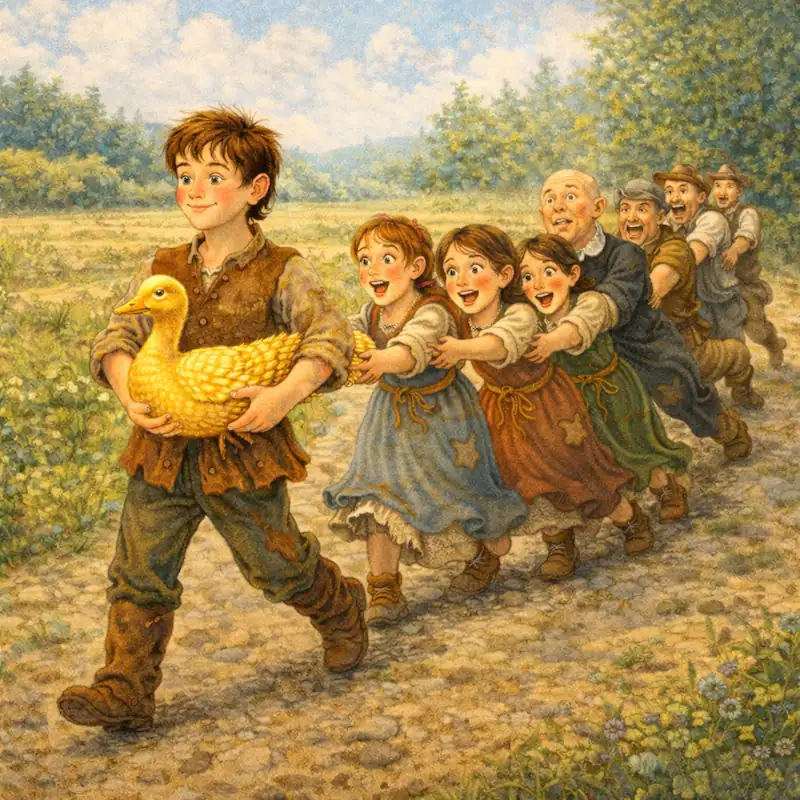
At dawn Simpleton picked up the golden goose and walked out. The three sisters stumbled after him, still stuck fast. If he slowed, they bumped into one another. If he sped up, they had to run. People pointed from doorways.
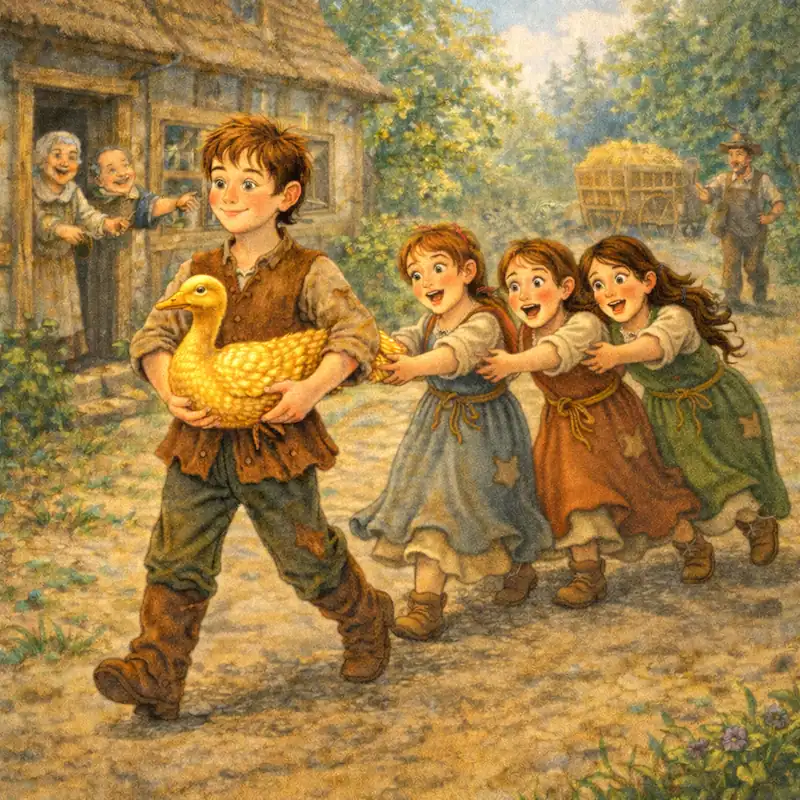
In the fields a parson saw them and shouted, “Shame on you! Let go!” He grabbed the youngest sister to pull her back but his hand stuck fast.
A farmer grabbed the parson’s coat and stuck fast too. Two workers tried to pull the farmer free and stuck fast as well.
One by one they grabbed the person in front and stuck fast. No one looked dignified.
So now seven people ran behind Simpleton in a wobbly chain, hopping and panting. Simpleton kept walking because stopping did not help and turning back did not help. Besides, the road kept going forward.
The Princess Who Never Smiled
Later that day they reached a city with stone walls and a king with one daughter. No one ever made the princess laugh. Storytellers had tried. Jugglers had tried. She always thanked them politely then returned to her quiet thoughts.
So the king announced, “Whoever makes my daughter laugh shall marry her.”
Simpleton heard the news in the market. He looked at his ridiculous parade and shrugged. “It seems I brought my own joke.” He did not sound proud. He sounded surprised.
The Golden Goose Makes Her Laugh
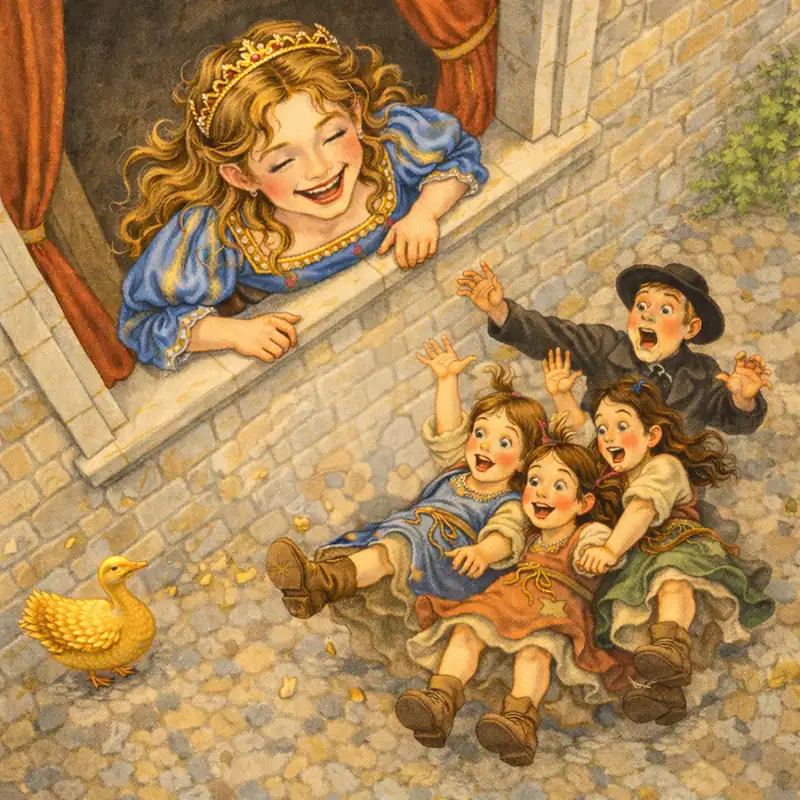
In the palace courtyard the princess came to a window when she heard the shouting. She saw the golden goose shining in the sun. She saw the line of people wobbling behind it, each one clinging to the next like a string of beads.
For a heartbeat she stayed serious. Even the courtyard seemed to wait.
Then she burst out laughing.
Her laughter rang out bright and loud. Tears ran down her cheeks. As she laughed the spell broke, so everyone tumbled backward, rubbing sore palms and blinking in relief. Hands flew up. Hats toppled. Someone sat down hard on the stones.
The parson straightened his collar. “Next time,” he muttered, “I will ask questions first.”
Embarrassed, the sisters hurried away, red-faced and furious, yet secretly glad their hands were their own again.
Hearing that laughter, the king came running out. Simpleton bowed. “Your Majesty, I have made your daughter laugh. I ask for her hand in marriage.”
The king saw Simpleton’s plain clothes and frowned. He did not want a poor-looking boy for a son-in-law. His eyes dropped to the patched tunic then to the worn boots.
Three Tests and One Last Gift
“I will not break my promise,” the king said, “but you must prove you are more than a lucky wanderer. First bring me a man who can drink a whole cellar of wine.”
So Simpleton returned to the forest. He did not argue. He simply turned and went.
A Thirst That Would Not Quit
Near the stump of the old tree a miserable man sat with cracked lips. “I am thirsty,” he moaned. “I drank a barrel of wine and it was nothing.”
“Come with me,” Simpleton said. “You will drink your fill.”
In the king’s cellar the man drank until every cask was empty. Servants watched with mouths open. When the last drop vanished the man sighed like someone stepping into shade on a hot day.
Next the king grumbled, “Now bring me a man who can eat a whole mountain of bread.”
Back in the forest Simpleton found a man tightening a strap around his waist.
“I am hungry,” the man said. “I ate an oven full of loaves and I still feel empty.”
“Come,” Simpleton said. “There is bread for you.”
The king ordered bakers to pile bread into a mountain in the courtyard. The hungry man ate until not a crumb remained. Then the mountain vanished as if it had never been there.
At last the king tried one last trap. “Bring me a ship that can travel on land and water. If you do then you may marry my daughter.”
Keep Your Heart the Same
Simpleton went back to the forest and the little old man waited by the stump, smiling as if he had expected this.
“A kind act is like a seed,” the old man said. “It keeps growing.”
He led Simpleton to a ship with sturdy wheels beneath a smooth hull. The wheels looked strong enough for stone roads and the hull looked smooth enough for water.
“It will roll on land and sail on water,” the old man said. “Take it and keep your heart the same.” He tapped his walking stick once, as if the words mattered.
A Wedding Earned the Gentle Way
Simpleton drove the ship to the city. It rolled over the road then slipped onto the river and floated. The wheels lifted clear and the ship glided like it belonged there.
At that point the king could not refuse anymore. The princess came down to meet Simpleton and she smiled, soft and real. This time the smile reached her eyes.
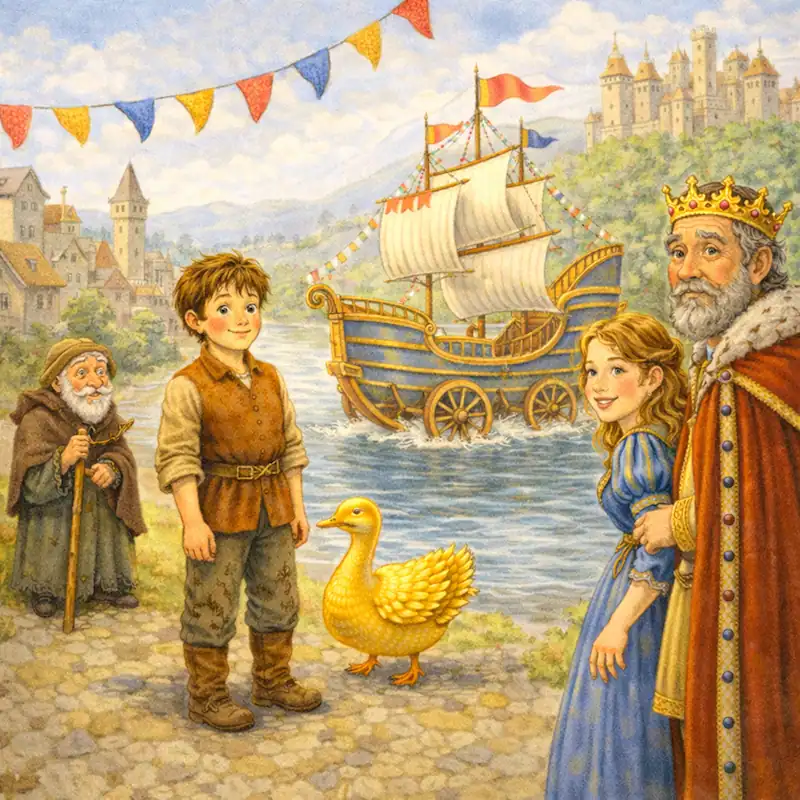
“You brought joy without trying to steal,” she said. “You shared when you had little.”
Simpleton nodded. “I only did what felt right.”
“Then stay beside me,” she said. Not as an order, but as an invitation.
So the king kept his word. They celebrated the wedding with music, bread and laughter. The princess laughed again that night, not because she had to, but because she wanted to.
Simpleton kept the golden goose safe in the palace garden. He never plucked a feather. Instead, he fed it grain and let children watch it waddle through the grass, shining like a small piece of sunrise.
In time Simpleton inherited the kingdom. He remembered how others ignored him so he listened for the quiet voices in a crowd. He remembered the hungry stranger on the forest path so he made sure travelers could find soup and a place to rest.
People remembered the golden goose, but they remembered his kindness even more.
People stopped calling him Simpleton and called him The Good King.


