
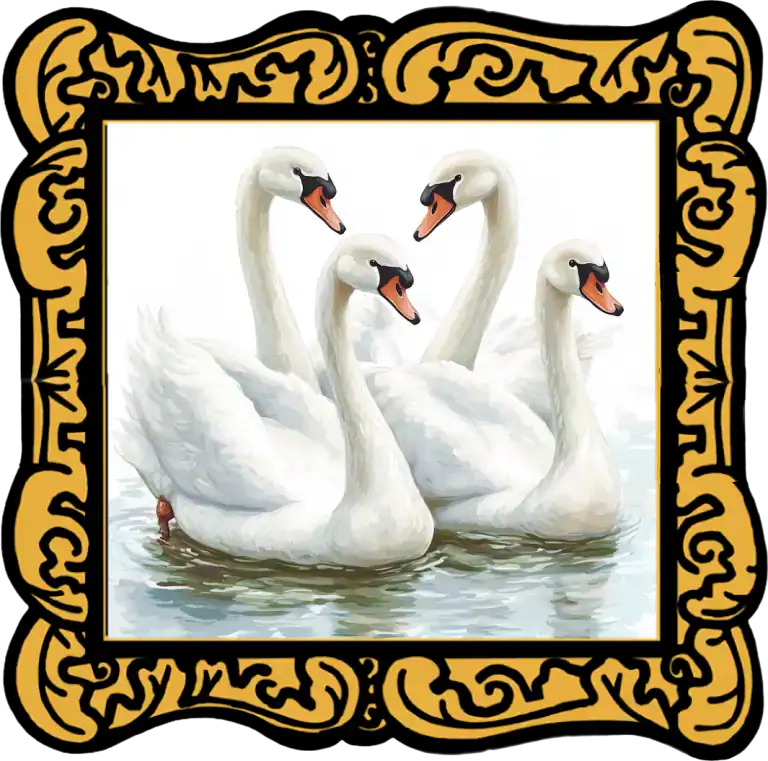

The Story of The Children of Lir
A Happy Family
Long ago in the mists of ancient Ireland, there lived a magical people. They were gifted in the ways of sorcery, nature and wisdom. They ruled over the green hills and silver lakes of Ireland. Their king was a just and fair ruler who sought peace among his people.

The Sea Lord and the King
However, not all were content. One powerful noble, a sea lord named Lir, grew resentful of the King. Lir withdrew from the royal court and bitterness brewed between the two men.

A Happy Family and a Tragic Loss
Yet, because he valued harmony above all, the King decided to offer peace in the form of marriage. He offered Lir his eldest daughter, Aoibh (pronounced “Eve”), in marriage, in the hope that love might heal the rift between them.

At first, the marriage was one of duty. However, over time love blossomed between Aoibh and Lir. Their happiness only deepened when they were blessed with four healthy and happy children— a beautiful daughter followed by three younger brothers.

For many years the family lived in joy. They laughed together, explored the land and filled their home with music and warmth. Their daughter was wise and caring beyond her years and her brothers adored her. Lir doted on all his children and Aoibh’s heart was full of joy, but as often happens in old tales, this happiness did not last for long.
Tragically, Aoibh fell ill.

Although Lir called for the most skilled healers in the land, nothing could be done and sadly Aoibh passed away, leaving behind four grieving children and a heartbroken husband.

The King, seeing Lir’s sorrow, offered his second daughter, Aoife (pronounced “Ee-fa”), to be Lir’s new wife. He hoped she would help care for the children and bring comfort to the grieving family. At first, Aoife seemed gentle and kind—just like her sister. She stepped into her new role with grace and Lir believed his family might find happiness again.

Aoife’s Jealousy and the Terrible Curse
But as the months passed, a different side of Aoife began to emerge. She saw how much Lir loved his children and how deeply they loved him in return. A shadow of jealousy crept into her heart. Instead of nurturing the children, Aoife grew bitter. She wanted Lir’s affection all to herself and every moment he spent with his children only made her envy worse.
Eventually, Aoife could bear it no longer. She devised a cruel plan. One summer morning, under a sky as blue as cornflowers, she told Lir she would take the children on a trip to visit the King.

As they travelled they came upon the still waters of a magnificent lake. The children, innocent and full of joy, ran to the lake to play.

The Children Become Swans
Without warning Aoife drew out a magic wand and cast a spell. A flash of light lit up the sky and the children’s laughter was replaced by silence. When the brightness faded the four children were no longer human. In their place were four majestic swans, their feathers were as white as snow but their eyes were filled with sorrow and confusion.
The daughter, ever brave, spoke first. “What have you done to us, Aoife?”

Nine Hundred Years of Wandering
Aoife’s eyes were cold as she replied, “You shall be swans for nine hundred years. Three hundred years you will spend here on the lake then three hundred more by the Sea. Finally, you will spend your last three hundred years on an island. Only the sound of a Christian bell will break this curse.” Then, Aoife left them there and continued her journey, pretending that nothing had happened.
When the King saw Aoife arrive without the children he knew something was wrong. Soon enough, the truth came out. Furious and heartbroken, he used his own magic to punish Aoife. He transformed her into a demon of the air—condemned to wander the skies without rest, never again to know peace.
The four swans were still able to speak and sing with human voices so they told their tale to anyone who would listen.
Meanwhile, Lir rushed to the lake. When he heard his children’s voices coming from the swans, his heart shattered once more. As he was unable to break the spell, he left his beloved sea and built a home by the lake so he could spend every day with them, listening to their songs and sharing stories until the end of his life.

Eventually, the first three hundred years passed and the swans flew north to the stormy Sea.

Life there was harsh as bitter winds constantly tore across the waves. Often the swans were separated by gales and storms and only found each other by calling out for one another across the crashing sea. Still, they sang together when they could and their love kept them strong.

After another three hundred years the time came to leave once more. Though they were weary, they flew west to an Island where life was gentler.

The air was warmer, the seas calmer and food easier to find. Yet, the weight of time pressed upon them. They had seen the world change. New people now walked the land and the old magic was fading.
The Bell and the End of the Curse
Then, one misty morning, the swans heard a sound unlike any they had ever heard before. They followed the sound and landed on the shore near a small stone chapel.

A kind monk stood there, his robe rough and simple but with a warm friendly smile. When he saw the four swans he was astonished but when they spoke, telling their tale of sorrow and magic, he wept for them. The monk invited them to stay with him. There, he cared for them, telling them about a new faith, a faith based on compassion and light. The swans listened and though they had lived through centuries of pain, they began to feel hope.

One day a warrior king arrived. He had heard tales of the magical singing swans and demanded to take them as a gift for his bride. The monk refused, standing in front of the swans to protect them. Angrily, the warrior king reached out to seize them but just then the bell rang.

A great wind swept across the land and the swans were surrounded by light. Slowly their feathers began to fall away and in their place stood four very old people. Their long curse had finally ended but their time on earth was nearly over.

That night the monk dreamed of four radiant swans flying high into the sky, their wings glowing in the starlight. He smiled in his sleep, knowing that the Children of Lir had finally returned to their mother and father and had found peace at last.