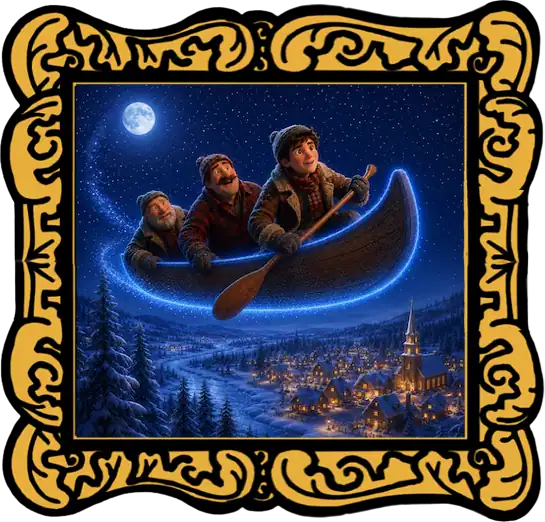

The Flying Canoe is a traditional French Canadian folk tale from Quebec, also known as La Chasse-Galerie or The Bewitched Canoe. Rooted in Quebec’s folklore, French Canadian storytelling traditions and 19th-century winter logging culture, it tells of homesick lumberjacks who long to see their families on New Year’s Eve. This child-friendly retelling is suitable for read-alouds with children aged 6–12, with an independent reading age of around 8–12, and explores promises, temptation and thinking carefully before making a risky choice.
- Independent Reading Age: Ages 8–12
- Reading Level: Upper Elementary, Grades 3–6
- Reading Time: 10-15 minutes
- Author / Source: Traditional French Canadian folk tale, inspired by La Chasse-Galerie
- Story Type: Folk Tale, Legend, Cautionary Tale
- Region / Origin: Quebec, Canada
- Main Characters: Baptiste, Pierre, Old Henri, Marie, Luc, the mysterious stranger
- Moral / Themes: Think carefully before making promises, beware tempting shortcuts, keep your word
The Story
A Winter Far from Home
Long ago, deep in the forests of Quebec near the frozen Gatineau River, snow covered the paths between the pines. By evening, the trees looked black against the winter sky.
In a rough wooden cabin lived a group of lumberjacks. They had come to the forest to cut timber through the coldest months of the year. Every morning, before the sun rose, they pulled on their boots, wrapped scarves around their necks and went out with axes on their shoulders.
Chop. Crack. Thump.
All day, the sound of work rang through the forest. Trees fell. Logs rolled. Sledges scraped over the snow.
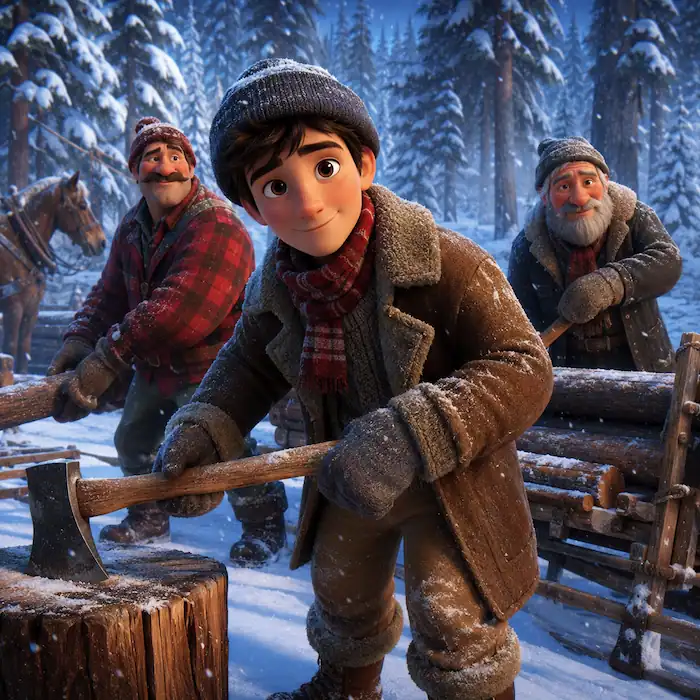
By evening, the men returned to the cabin with aching arms and red cheeks. They stamped snow from their boots, warmed their hands by the fire and ate bowls of thick stew. Sometimes they sang old songs. Sometimes they told funny tales. Yet as New Year’s Eve drew near, their laughter grew quieter.
They missed home. They missed bright windows, warm kitchens and familiar voices. Most of all, they missed the New Year’s celebrations in their village, far away across the snowy land.
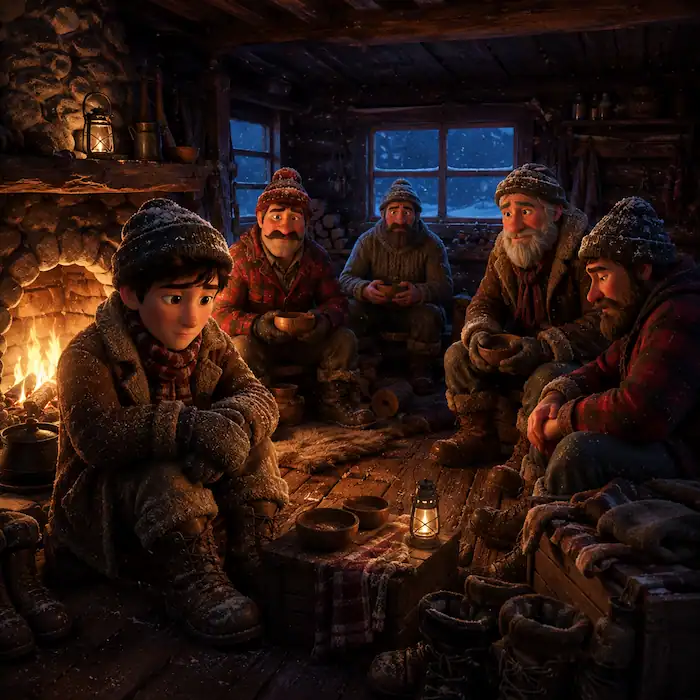
One young lumberjack felt this longing more deeply than the rest. His name was Baptiste.
Baptiste Looks at the Moon
Baptiste was strong enough to carry heavy logs and gentle enough to share the last piece of bread. He had dark eyes, quick hands and a kind way of speaking. Still, every night, sadness sat beside him like a silent friend.
After supper, while the others played cards or sang beside the fire, Baptiste often stood by the small frosty window.
Outside, the moon shone over the forest. Its light turned the snow silver.
“Thinking of home again?” asked Pierre, a broad-shouldered man with a booming laugh.
Baptiste smiled, but only a little. “Yes.”
“Your wife will still be there when winter ends,” Pierre said kindly.
“I know,” said Baptiste. “But tonight the village will be full of music. The church bells will ring. Families will dance. Children will run with lanterns. I should be there.”
The other men grew quiet. They understood. Each of them carried a picture of home inside his heart.
Old Henri rubbed his gray beard. “The forest is too wide, lad. The snow is too deep. Even the fastest horse could not take us there tonight.”
“I know,” Baptiste said again.
Then he looked up at the moon.
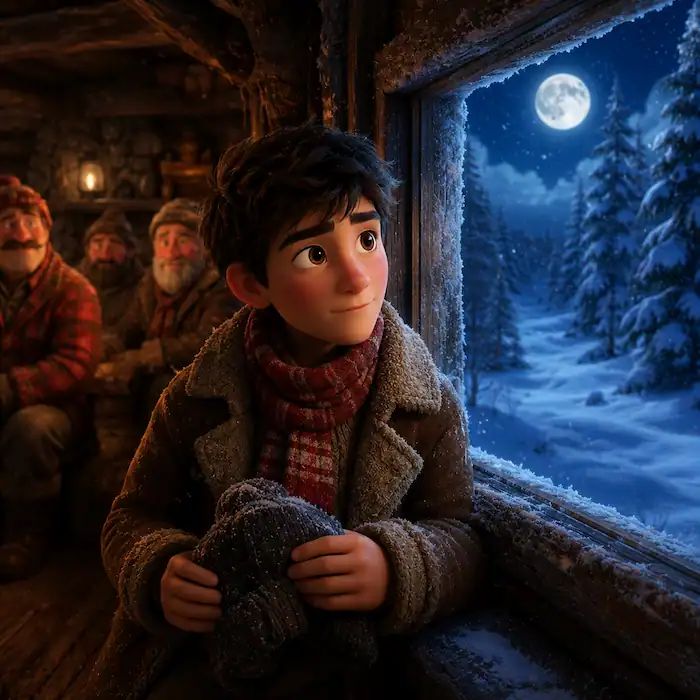
“If only we could fly.”
The men chuckled at first. Then the wind outside gave a long, strange whistle and the fire flickered low.
A Tale Baptiste Had Heard
Baptiste turned from the window. His eyes looked brighter now, as if a dangerous thought had sparked inside him.
“There is one way,” he said.
Pierre leaned forward. “One way? What way?”
Old Henri’s face tightened. “Careful, Baptiste. Some roads are better left closed.”
Baptiste lowered his voice. “My grandfather told a tale once,” Baptiste said. “He called it the chasse-galerie. A canoe that could ride the night air, if men were foolish enough to call on it.”
The room fell silent.
One of the younger men crossed himself. Another stared into the fire.
Pierre tried to laugh, but it came out small. “A flying canoe? That is only an old New Year’s tale.”
“Maybe,” said Baptiste. “Or maybe the old tales remember things people should not try.”
Henri stood slowly. “That story comes with a price.”
Baptiste did not answer.
Outside, the wind whistled again.
The Stranger at the Door
Just as the clock neared midnight, the cabin door creaked open.
No one had touched it.
Cold air swept across the floor. Snowflakes spun into the room. The fire snapped and hissed.
In the doorway stood a tall stranger dressed in black from his boots to his hat. His coat looked fine enough for a city gentleman, yet no snow clung to it. His smile was thin. His eyes glimmered red in the firelight.
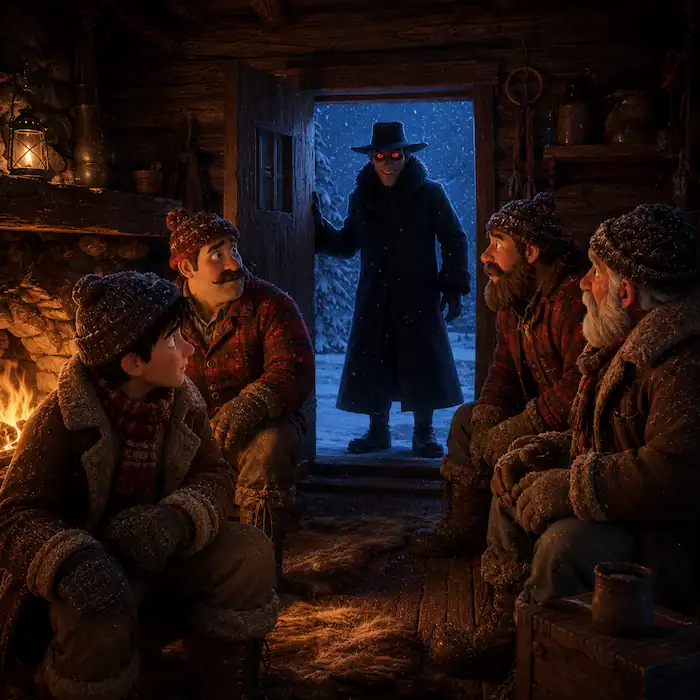
The lumberjacks froze.
“Good evening, messieurs,” said the stranger.
No one answered.
He stepped inside as if he had been invited. “You look troubled.”
Pierre reached for his axe. “Who are you?”
“A traveler,” said the stranger smoothly. “A helper, perhaps.”
Old Henri narrowed his eyes. “No traveler walks this forest at midnight in winter.”
The stranger gave a small bow. “Then perhaps I am no ordinary traveler.”
Baptiste’s heart beat hard. He knew, without knowing how, that this man had not come from any road.
The stranger turned to him. “You wish to see your wife tonight.”
Baptiste swallowed. “How do you know that?”
“I hear many wishes on New Year’s Eve,” said the stranger. “Some are whispered. Some are sung. Some are carried by the wind.”
The men looked at one another.
The stranger spread his hands. “Why sit here in sorrow? Your village is not so far if you travel the right way.”
Pierre snorted. “The right way? There is no road through the sky.”
“No road,” said the stranger. “But there is a canoe.”
The Canoe That Rose
At that, the men laughed nervously.
“A canoe?” said Pierre. “In this snow?”
“A canoe belongs on water,” said Henri.
“Most canoes do,” replied the stranger.
He walked to the open door and pointed into the darkness. At first, the men saw only snow. Then a pale blue glow appeared between two pine trees. Slowly, a long wooden canoe slid forward as if an invisible river carried it.
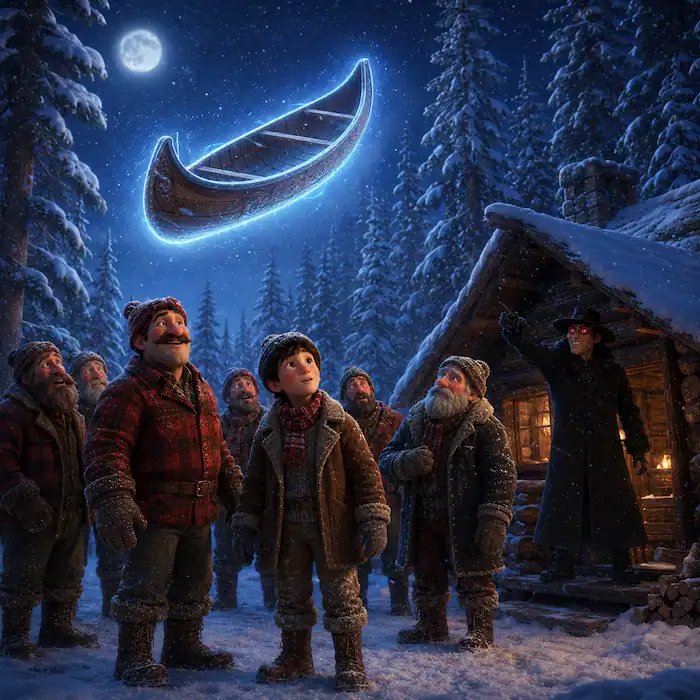
It did not touch the ground. The canoe floated above the snow.
Its sides shone like polished maple. Its paddles rested neatly inside. A faint light trembled around it, soft and strange as moonlight on ice.
Baptiste stepped closer. “It flies?”
“It flies,” said the stranger. “It can carry you over forests, rivers, hills and villages. It can take you home before the bells finish ringing.”
Pierre’s mouth fell open. “And then bring us back?”
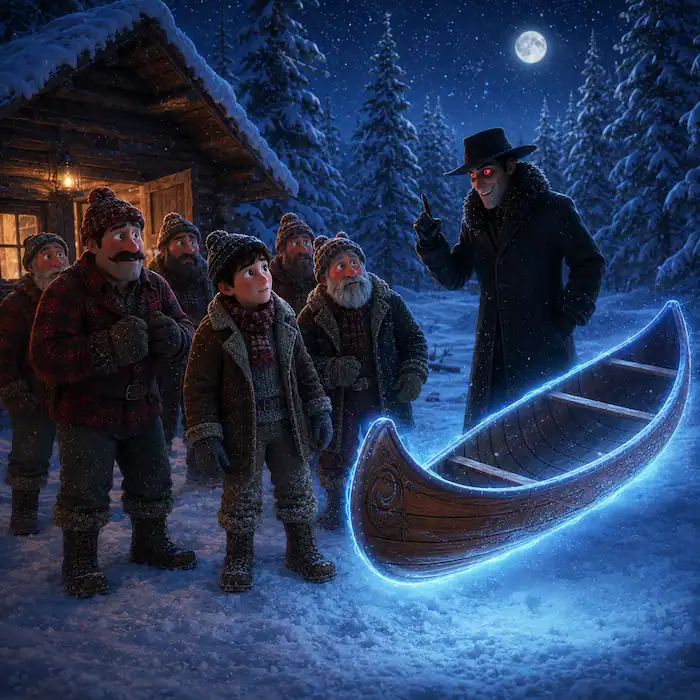
“If you return before dawn,” said the stranger.
Excited whispers filled the cabin.
“Our families!”
“New Year’s supper!”
“The dancing!”
Baptiste looked at the glowing canoe. Hope rose inside him so quickly it almost hurt.
Then Old Henri lifted one hand. “Nothing so wondrous comes free. What is the price?”
The stranger smiled wider.
“Only obedience.”
The Dangerous Promise
The cabin seemed colder than before.
The stranger spoke slowly, so every word landed clearly.
“You may fly tonight. You may visit your village. You may sing, dance and see those you love. But you must follow two rules.”
The men leaned in.
“First, you must not speak God’s name while you ride in the canoe.”
Baptiste’s stomach tightened.
“Second, you must not let the canoe touch the steeple of any church.”
Outside, the wind moaned.
“If either rule is broken,” said the stranger, “the canoe is mine. So are the souls inside it.”
No one spoke.
The fire popped.
Pierre took off his cap and twisted it in his hands. “That is a heavy bargain.”
“It is a simple bargain,” said the stranger. “Keep quiet and steer well.”
Henri looked at Baptiste. “This has the smell of danger.”
Baptiste knew Henri was right. Yet in his mind he saw his wife’s face. He saw the village hall bright with candles. He heard fiddles and laughter. He imagined stepping through his own door, if only for one precious hour.
“We will be careful,” Baptiste said.
Henri shook his head. “Careful men can still make foolish promises.”
“Then we will be more than careful,” said Baptiste. “We will be silent in the canoe. We will fly high over every steeple. We will return before dawn.”
“And no more drinking once we reach the village,” Henri said sharply. “Clear heads, clear tongues and steady hands.”
Pierre sighed. “You take the fun out of everything, old friend.”
“I am trying to keep your soul inside your coat,” Henri replied.
One by one, the men nodded.
The stranger’s eyes flashed.
“Then climb in.”
Up Over the Pines
The men pulled on their coats, grabbed their scarves and hurried outside. The night bit their noses and cheeks, but excitement warmed them.
Baptiste climbed into the front of the canoe. Pierre sat behind him. Henri settled near the middle with a worried frown. The others squeezed in, laughing softly and clutching the sides.
The stranger stood in the snow.
“Remember,” he said. “No careless holy words. No church steeple. Back before dawn.”
Baptiste gripped a paddle. “We remember.”
The stranger lifted one finger.
The canoe rose.
At first, it hovered just above the snow. Then it climbed past the cabin roof, past the tallest pine branches and up into the star-filled sky.
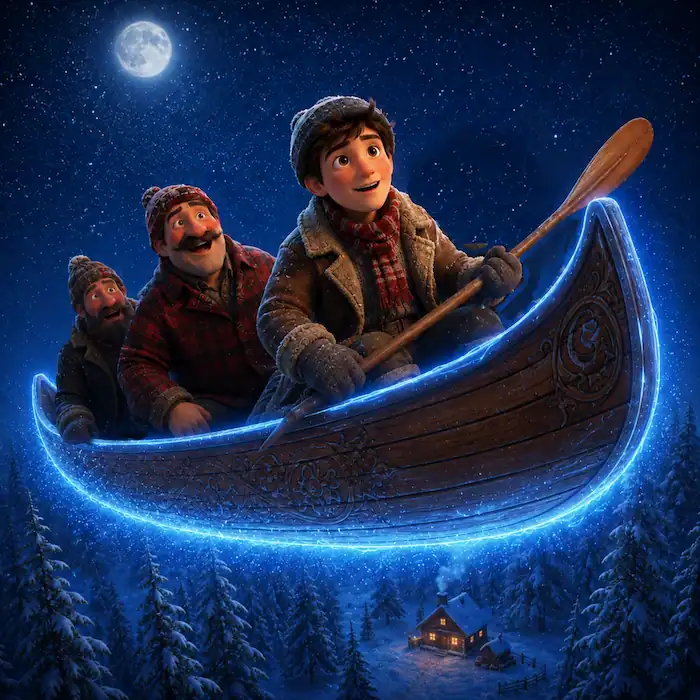
The men gasped.
Below them, the forest stretched wide and dark. The cabin shrank to a tiny square of light. Frozen rivers wound through the trees like silver ribbons. Far away, hills rolled under the moon.
Pierre laughed so loudly that the canoe wobbled.
“Sit still!” cried Henri.
“I cannot help it!” said Pierre. “We are flying!”
Baptiste felt the wind rush through his hair. Fear fluttered in his chest, but joy flew beside it. He dipped the paddle into the air as if the sky were water.
The canoe surged forward.
New Year’s Eve in the Village
They flew over the winter forest. They flew over sleeping farms. They flew over frozen rivers where moonlight glittered like scattered coins.
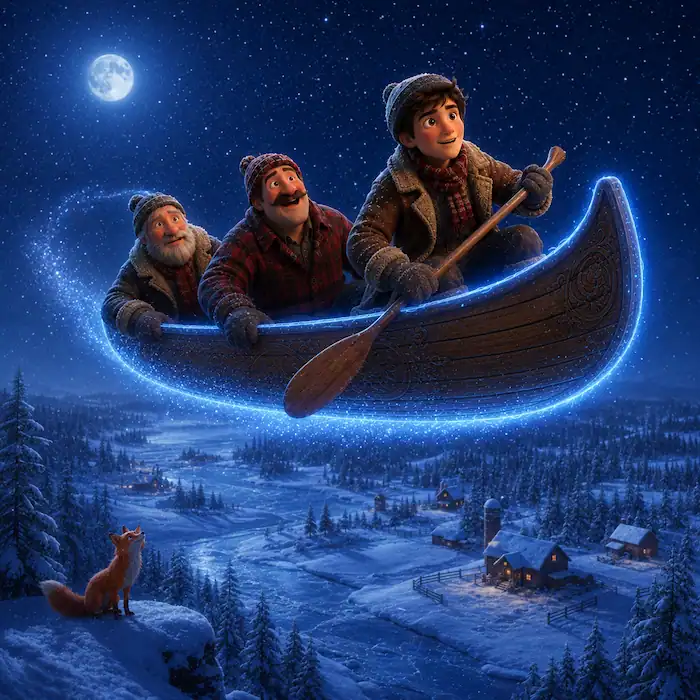
Far below, they saw dark church steeples rise from villages along the way. Each time, Baptiste steered the canoe higher.
Soon, a warm glow appeared ahead.
“The village!” cried Baptiste.
Below, lanterns shone along the lanes. Smoke curled from chimneys. Music drifted into the night.
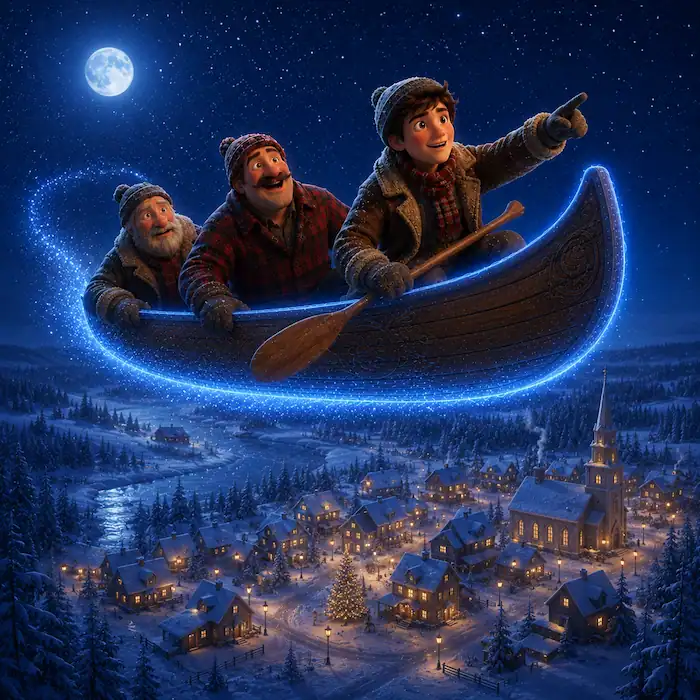
Baptiste guided the canoe downward, far from the church steeple. He remembered the rule and kept his hands steady.
The canoe landed softly behind a barn.
“Back here before the first gray light,” warned Henri. “Not a moment later.”
“Yes, yes,” said Pierre. “But first, supper!”
“And remember,” Henri added. “No more drink.”
The men tumbled out and hurried through the snow.
Baptiste ran to his small house at the edge of the village. Light glowed behind the curtains. He knocked once, then opened the door.
His wife, Marie, sat by the fire with mending in her lap. When she saw him, she dropped the cloth.
“Baptiste?”
“I am here,” he said.
She rushed into his arms.
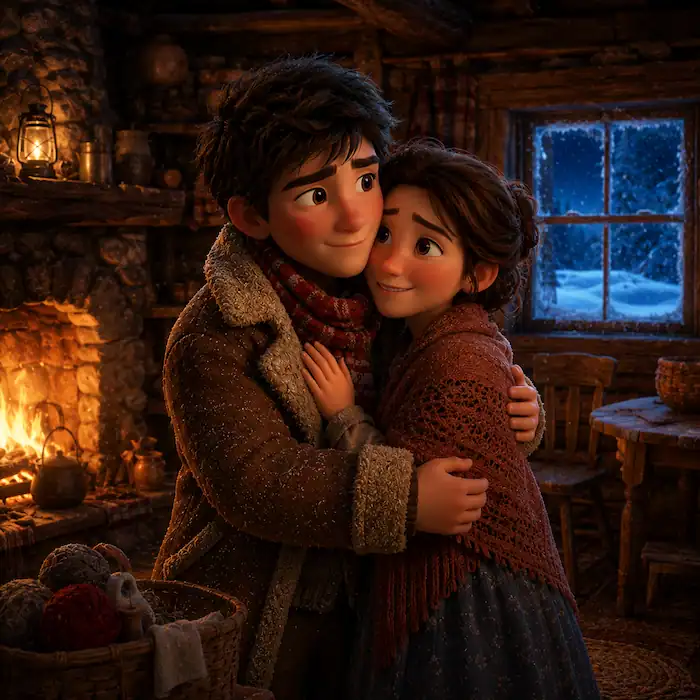
For a moment, the cold forest, the stranger and the dangerous bargain all seemed far away. Baptiste held Marie close and breathed in the smell of woodsmoke and bread.
“How did you come?” she asked.
Baptiste hesitated. “By a strange road.”
Marie looked into his face. “A safe road?”
He did not answer quickly enough.
Her smile faded.
Dancing Before Dawn
Soon, bells rang across the village. Fiddles played. Families gathered with pies, soups, roasted apples and warm cider. Children darted between tables. Old friends clapped one another on the back.
The lumberjacks entered the hall to cheers and laughter.
“You came!”
“From the forest?”
“In this weather?”
Pierre bowed grandly. “We are men of great determination.”
Henri muttered, “And poor judgment.”
Baptiste danced with Marie. Around and around they went while the fiddles sang. Her eyes shone with happiness, but worry stayed at the edge of her smile.
“Baptiste,” she said softly, “promise me you will return safely.”
“I promise.”
“Do not make promises lightly,” she said.
Those words struck him harder than he expected.
Although Henri warned them, not every man kept a clear head. One young lumberjack, Luc, drank from a cup someone pressed into his hand. Then he drank again. Soon his cheeks burned redder than the fire.
The hands crept forward and Baptiste’s joy began to tangle with fear.
At last, Henri rose and struck his walking stick on the floor.
“Enough. We leave now.”
Pierre groaned. “The night is young.”
“The night is nearly over,” said Henri.
Baptiste kissed Marie’s hands. “I must go.”
She held him a moment longer. “Then keep your head clear and your word true.”
“I will.”
He ran back through the snowy lane with the others stumbling behind him.
The Wild Ride Home
The canoe waited where they had left it, glowing faintly behind the barn.
One by one, the men climbed in.
“Quiet now,” Baptiste said. “No careless words. No shouting. No joking near the church.”
“Who is joking?” said Henri. “I would rather walk home barefoot than break that bargain.”
Luc hiccuped.
The canoe lifted into the air.
At first, the flight felt smooth. The village lights faded behind them. The forest opened ahead. Baptiste kept the canoe high and steady.
Then clouds swallowed the moon. Darkness thickened. The wind rose and the canoe rocked.
“Hold tight!” Baptiste called.
A gust shoved them sideways. The canoe dipped toward the village church, where the steeple pointed sharp and black against the snow.
Henri shouted, “Left! Left!”
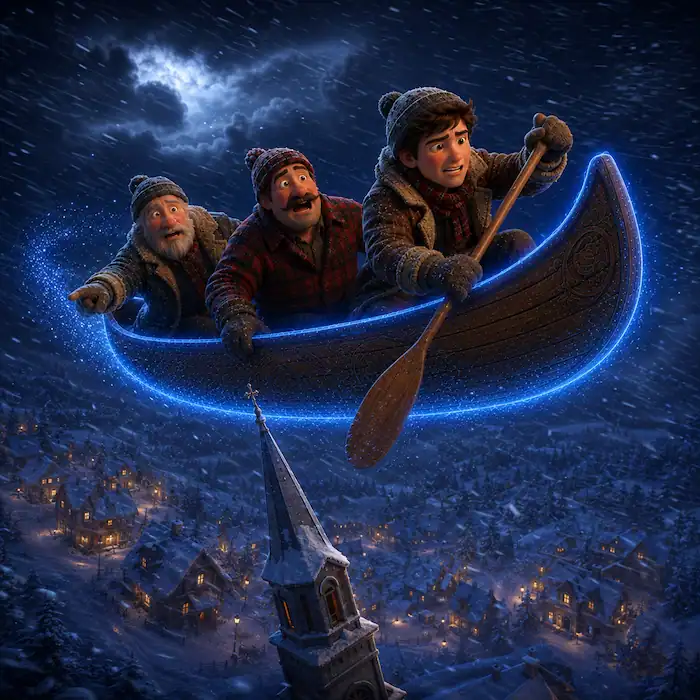
Baptiste dug his paddle into the air. The canoe swerved just in time. The steeple passed beneath them with only a few feet to spare.
Pierre went pale. “That was close.”
“Too close,” said Baptiste.
They flew on, but the storm chased them. Snow lashed their faces. The stars vanished. The canoe bucked like a frightened horse.
Luc began to mutter. His words tumbled together in a careless muddle.
“I do not like this,” he said.
“Keep calm,” said Henri.
The canoe dropped suddenly. Everyone lurched forward.
Luc flung up his hands and blurted out the forbidden holy words.
The Canoe Breaks the Sky
The moment the words left his mouth, the canoe stopped.
Not slowed. Stopped.
It hung in the storm as if a giant hand had seized it.
Then the sky split with thunder.
The blue glow around the canoe turned red. The paddles rattled. The wooden sides groaned.
Baptiste felt the bargain snap like a frozen branch.
“No!” he cried.
A laugh rolled through the clouds. It was the stranger’s laugh, sharp and cold.
The canoe spun.
Pierre grabbed Baptiste’s coat. Henri clutched the middle bench. Snow whirled so thickly that no one could see the ground.
“Hold on!” shouted Baptiste.
He thought of Marie. He thought of her warning. Do not make promises lightly.
With all his strength, he swung his paddle. Henri did the same. Then Pierre joined them. The other men grabbed paddles too, frightened but trying.
“Together!” Baptiste shouted. “Pull together!”
They paddled through wind, snow and fear.
The canoe lurched downward.
Tree branches rushed up.
Crash!
The canoe smashed into the top of a tall snowy pine, then plunged into a deep snowbank beneath the trees. Wood cracked. Snow flew. Men tumbled out in a heap.
For several long seconds, no one moved.
Then Henri groaned. “I am too old for flying.”
Pierre sneezed snow from his mustache.
Baptiste pushed himself up. His arms shook. His heart hammered. Around him, the others sat blinking in the moonlight, bruised and frightened but alive.
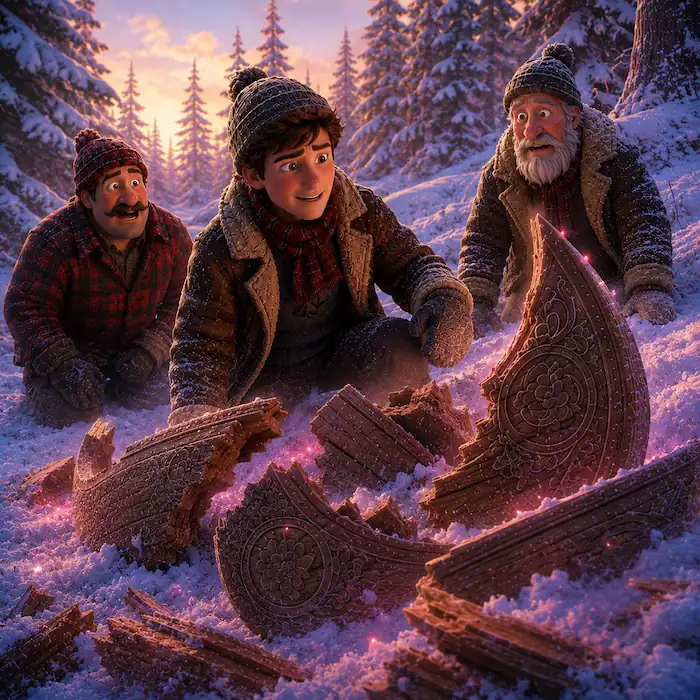
The canoe lay broken in the snow.
The red glow faded.
Far above, the stranger’s laugh drifted away on the wind.

Footprints Back to the Cabin
The men did not speak for a while.
At last, Baptiste stood. “Can everyone walk?”
One by one, they nodded.
Henri looked at the broken canoe. “We came close to losing far more than our way.”
“Yes,” said Baptiste.
No one argued.
They found the direction of the lumber camp by the slope of the land and the line of familiar pines. Then they began the long walk back through the snow.
No one sang. No one joked.
By the time they reached the cabin, the sky had begun to pale. Dawn touched the treetops. Smoke no longer rose from the chimney, but the cabin still stood.
Pierre opened the door and stared at the cold hearth. “Home sweet freezing home.”
Henri gave him a tired look. “Light the fire.”
Soon, flames warmed the room again. The men sat close together, wrapped in blankets and silence.
Baptiste looked out at the brightening sky. He had seen Marie. He had held her. Yet he had also risked everything for one night of joy.
When spring came, Baptiste returned to his village. He never forgot The Flying Canoe. Each New Year’s Eve after that, when music filled the hall and lanterns glowed in the snow, he told the tale to anyone who would listen.
“A homesick heart can pull harder than a team of horses,” he would say. “But a man still has to watch where it pulls him.”
And sometimes, on the coldest winter nights in Quebec, people still look up at the moon and listen.
If the wind whistles over the pines just right, they say you can hear paddles dipping through the sky.
Moral of The Flying Canoe
The moral of The Flying Canoe is that tempting shortcuts can come with hidden risks. Baptiste and the lumberjacks want to see their families so much that they agree to a dangerous bargain, but the flight soon teaches them that promises matter.
This French Canadian folk tale also shows that homesickness and hope are powerful feelings. However, even when your heart wants something badly, you still need to think clearly and choose wisely.
More Canadian Folk Tales and Stories with Similar Themes
If children enjoyed The Flying Canoe, they may also enjoy these Canadian and North American folk tales:
How the Bear Lost Its Tail
A traditional North American animal tale found in Canadian and Indigenous storytelling traditions, about a bear, a trickster fox and the lesson of not being too easily fooled.
Sedna, Goddess of the Sea
An Inuit legend from the Arctic about Sedna, the sea and the origins of sea animals. This story is powerful, mysterious and deeply connected to Inuit tradition.
The Tale of Gelert
A Welsh legend about loyalty, trust and rushing to judgement.
The Pied Piper of Hamelin
A cautionary tale about broken promises and consequences.
The Children of Lir
An Irish legend about family, sorrow and endurance.
The Fairies’ Harp
A Welsh folk tale about a magical gift, kindness and using power wisely.
For readers who want to explore an early written version, Honoré Beaugrand’s La Chasse Galerie and Other Canadian Stories is available through the Internet Archive.
Vocabulary Spotlight
Lumberjack – A person who cuts down trees for timber.
Quebec – A province in Canada where many people speak French.
Folk tale – A traditional story passed down through families and communities.
La Chasse-Galerie – The French name often linked with The Flying Canoe legend.
Bewitched – Magically changed or controlled, often in a mysterious way.
Bargain – An agreement between people. In this story, the bargain is dangerous because it comes with hidden consequences.
Steeple – The tall pointed tower on a church.
Cautionary tale – A story that warns readers to think carefully before making a mistake.
Teacher’s Note
The Flying Canoe works well for classroom discussion because it combines adventure, folklore and moral choice. The story gives children a clear plot, but it also opens up deeper questions about temptation, homesickness, rules and responsibility.
Teachers can use this tale to introduce French Canadian folklore, New Year traditions, oral storytelling and the way older stories often warn people against reckless promises. For younger children, focus on the adventure and the importance of keeping your word. For older pupils, compare this retelling with other versions of La Chasse-Galerie and discuss how folk tales change when they are adapted for children.
Parent and Teacher Discussion Questions for The Flying Canoe
- Why do the lumberjacks want to return home on New Year’s Eve?
- Do you think Baptiste makes the right choice when he agrees to the bargain? Why or why not?
- Why does Old Henri worry about the flying canoe?
- What rules do the men have to follow during the journey?
- Why does Luc’s mistake put everyone in danger?
- How does Marie help Baptiste think more carefully?
- What does the broken canoe show at the end of the story?
- How is this story similar to other folk tales about magical bargains?
- What would you have done if you were one of the lumberjacks?
- What lesson does the story teach without simply telling readers what to think?
Classroom Activities
1. Map the Journey
Ask pupils to draw a simple map of the story. Include the logging camp near the frozen river, the snowy forest, the village, the church steeple and the crash in the pine trees.
Learning focus: setting, sequence, geography, story structure
2. Promise and Consequence Chart
Create two columns: “Promise Made” and “What Happened Next.” Pupils can track the rules of the bargain and explain how each choice affects the story.
Learning focus: cause and effect, moral reasoning, comprehension
3. Design the Flying Canoe
Children design their own version of the magical canoe. Encourage them to include details from the story, such as birch bark, paddles, moonlight and the fading glow.
Learning focus: visual literacy, close reading, creative response
4. Hot Seat Baptiste
One pupil plays Baptiste while the class asks him questions. Why did he want to fly home? Was he scared? Would he do it again?
Learning focus: character motivation, speaking and listening, empathy
5. Compare Folk Tale Warnings
Compare The Flying Canoe with another cautionary tale, such as The Pied Piper of Hamelin or The Fisherman and His Wife. Ask pupils what each story warns people about.
Learning focus: comparison, theme, traditional storytelling
6. Write a New Ending
Older pupils can write a short alternative ending. What if the men turned back before reaching the village? What if Baptiste refused the bargain?
Learning focus: creative writing, plot development, moral choices
7. Retell It Like a Folk Tale
Ask pupils to retell part of The Flying Canoe aloud in pairs or small groups, using a storyteller’s voice. They should include repeated phrases, suspenseful pauses and clear changes in voice for Baptiste, Pierre, Old Henri and the stranger.
Learning focus: oral storytelling, performance, folklore traditions, speaking and listening
That would make the section feel more specific to this story rather than simply “good activities for any tale.”
Fun Facts About The Flying Canoe
The Flying Canoe is linked to a French Canadian legend called La Chasse-Galerie.
The story is often connected with lumberjacks working far from home in the winter forests of Quebec.
Many versions take place on New Year’s Eve, which makes the story feel festive as well as mysterious.
The magical canoe is sometimes called a bewitched canoe because it flies through the sky instead of floating on water.
The tale has been retold in books, songs, festivals and animated versions across Canada.
History of The Flying Canoe
The Flying Canoe, also known as The Bewitched Canoe or La Chasse-Galerie, is one of the best-known legends from French Canadian folklore. It is strongly connected with Quebec, where lumberjacks often worked far from home during the long winter months.
In many traditional versions, a group of homesick lumbermen want to visit their sweethearts or families on New Year’s Eve. Because they are far away in the forest, they use a magical canoe to fly through the night sky. However, the flight comes with strict rules. They must avoid church steeples and must not speak carelessly while in the canoe.
The tale became especially famous through a version by French Canadian writer Honoré Beaugrand, published in the late nineteenth century. Like many folk tales, the story has changed over time. Some versions are darker, while child-friendly retellings often soften the frightening details and focus on the adventure, the promise and the lesson.
This retelling keeps the heart of the legend while making it suitable for children.
Why We Narrated This Story
We narrated The Flying Canoe because it is a vivid winter folk tale with strong read-aloud energy. The story has mystery, movement, danger and warmth, which makes it ideal for children who enjoy magical adventures.
It also introduces young readers to French Canadian storytelling and gives families and teachers a chance to talk about promises, temptation and the choices people make when they miss home.
Frequently Asked Questions About The Flying Canoe
-
What is The Flying Canoe about?
The Flying Canoe is about a group of lumberjacks in Quebec who miss their families on New Year’s Eve. They make a dangerous bargain that lets them fly home in a magical canoe, but they must follow strict rules to return safely.
-
Is The Flying Canoe the same as La Chasse-Galerie?
Yes. The Flying Canoe is the English title often used for La Chasse-Galerie, a French Canadian legend from Quebec. It is also sometimes called The Bewitched Canoe.
-
What does La Chasse-Galerie mean in English?
La Chasse-Galerie is usually translated as The Flying Canoe or The Bewitched Canoe. The title refers to the magical canoe that carries the men through the sky.
-
Is The Flying Canoe a true story?
No. The Flying Canoe is a folk tale or legend, not a true historical event. However, it reflects real parts of Quebec history, including winter logging camps, French Canadian storytelling and New Year traditions.
-
Where does The Flying Canoe come from?
The story comes from French Canadian folklore, especially Quebec. It is often associated with lumberjacks who worked in remote winter forests far from home.
-
Who wrote The Flying Canoe?
The story is traditional, which means it existed as folklore before it was written down. A famous literary version was written by French Canadian author Honoré Beaugrand.
-
What is the moral of The Flying Canoe?
The moral is to think carefully before making a promise, especially when someone offers an easy solution with a hidden cost. The story also warns against reckless choices, careless words and ignoring wise advice.
-
Is The Flying Canoe suitable for children?
This version is suitable for children. It keeps the mystery and adventure of the traditional story but softens the darker parts so it works for read-aloud and independent reading.
-
Why is there a church steeple in The Flying Canoe?
The church steeple is important because the men are warned not to let the canoe touch one. This rule adds danger to the flight and reminds readers that the bargain has serious limits.
-
Why do the lumberjacks fly on New Year’s Eve?
New Year’s Eve is when their families and village are celebrating. The lumberjacks feel lonely in the forest, so the thought of music, dancing and home becomes too tempting to resist.
Copyright Notice
© Kooky Kids World. This original retelling, illustrations, audio narration and supporting educational content are protected by copyright. The underlying folk tale is traditional and may exist in many public domain or oral storytelling versions.