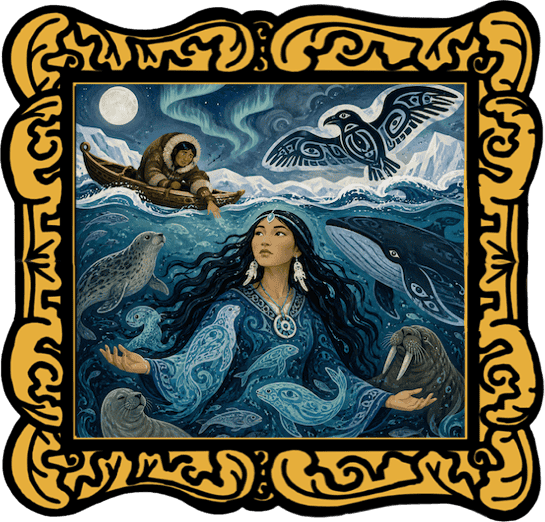

Sedna Goddess of the Sea

Sedna Goddess of the Sea is a powerful Inuit myth for children aged 7–12. This child-friendly retelling of the Sedna Inuit story explains how Sedna became the powerful sea spirit, often known as a sea goddess, and guardian of seals, whales, walruses and other ocean animals.

Audio read-aloud cover for Sedna Goddess of the Sea with Sedna, sea animals, kayak and bird-spirit in a gold frame.
0:00 / 0:00
Sedna Goddess of the Sea
Kooky Kids World Cloud Logo showing where the audio read aloud file is.

Content Note: This is a child-friendly retelling of a traditional Inuit myth. Some older versions of the Sedna story include darker details. This version keeps the heart of the story while softening the most frightening moments for young readers.

Source and Adaptation Note

This is a child-friendly retelling of a traditional Inuit story about Sedna, the powerful sea spirit often known as the guardian of seals, walruses, whales and other ocean animals.

Sedna stories are important in Inuit storytelling traditions across Arctic regions, and versions vary by community, region, storyteller and published collection. Sedna may also be known by other names in different Inuit traditions, including Nuliajuk and other regional names.

This Kooky Kids World version has been adapted for young readers, reading aloud and classroom discussion. Some older versions include darker details about betrayal, violence and Sedna’s fingers becoming sea animals. This version keeps the main shape and meaning of the myth while softening the most graphic moments for children.

It should not be treated as the only version of the Sedna story or as an official cultural teaching resource.

The Story

Sedna and the Cold Northern Sea

Long ago, beside the icy northern sea, there lived a young woman named Sedna. Her home stood near the shore, where the wind swept across the snow and the waves rolled beneath a wide grey sky.

The people in her camp knew the sea well. They travelled by kayak and sewed warm clothing from animal skins. The sea gave food, warmth and life, but it also demanded respect.
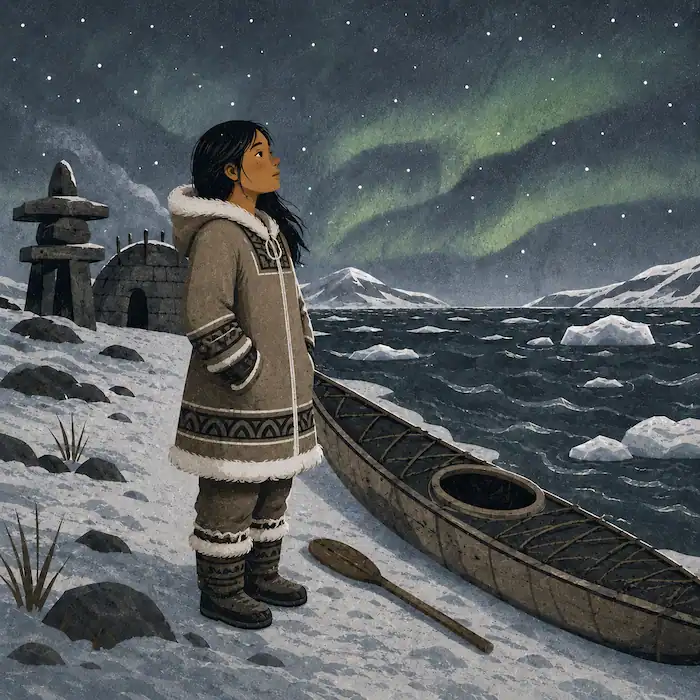
Young Sedna from Sedna Goddess of the Sea stands beside a life-size kayak on an icy Arctic shore under the northern lights.

Sedna lived with her father, who was growing older. He worried about her future and often told her she should marry a good hunter.

“Sedna,” he said one evening, as the lamp flickered beside them, “I will not always be here to care for you. A good husband could bring food, furs and safety.”
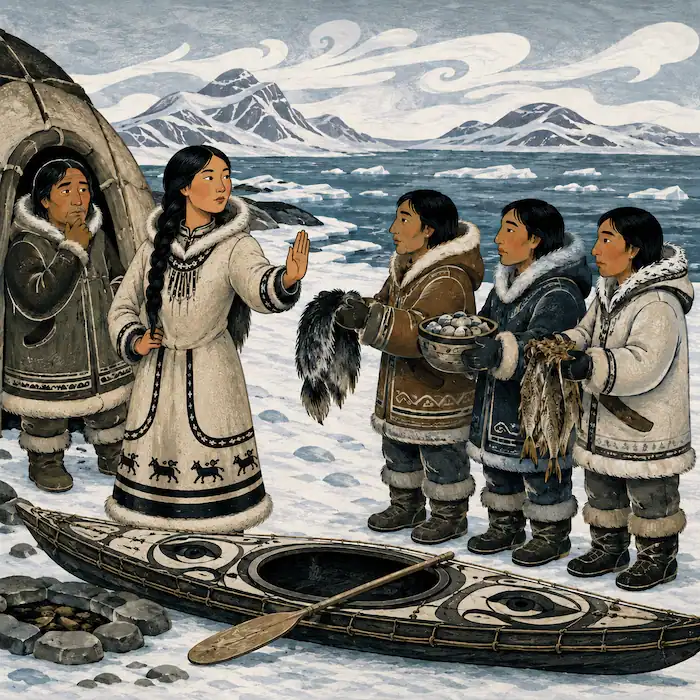
Sedna refuses three hunters offering furs and food while her father watches beside the snowy Arctic sea.

Sedna looked toward the dark water outside. “I do not want to marry just because someone asks,” she said.

Many hunters had already come to her father’s home. One brought fine furs. Another promised fresh meat. A third boasted that he had the fastest kayak in the camp. Sedna refused them all.

Her father sighed each time, but Sedna knew her own mind.
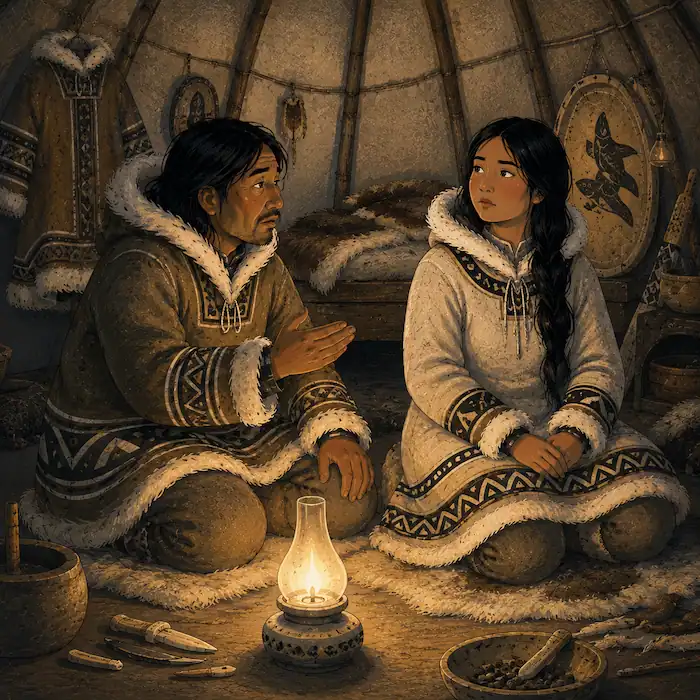
Sedna listens uncertainly as her father urges her to marry inside a warm Arctic home lit by a glowing lamp.

The Stranger in the Fur Hood

One day, a stranger came from far across the sea. He wore thick furs and kept his face hidden beneath a deep hood. His voice sounded soft and smooth, like wind moving over snow.
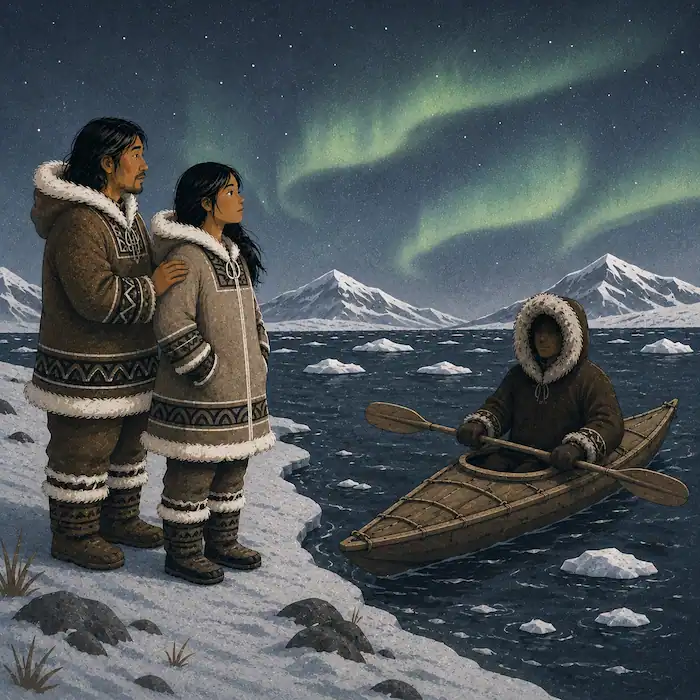
A hooded stranger arrives by kayak across the icy sea while Sedna and her father watch from the snowy shore.

“I have come for Sedna,” he said. “I live on a fine island. My home is warm. Food is plentiful. She will never be hungry.”

Sedna’s father listened carefully. The stranger seemed polite. His clothes looked rich and warm. He spoke as though he had everything a family could need.

Sedna studied him. “Will I have a proper home?” she asked.

“Yes,” said the stranger.

“Will there be warm skins?”

“Yes.”

“Will there be plenty to eat?”

“More than you can imagine,” he replied.

Sedna hesitated. Something about the stranger still felt hidden, but her father seemed pleased.

“This may be a good match,” he told her. “He says he has food, warmth and a safe home. You should go with him.”

Sedna looked once more at the stranger’s fur hood. Then she looked at her father, who was waiting for her answer. At last, she nodded.

So Sedna agreed to go with him.
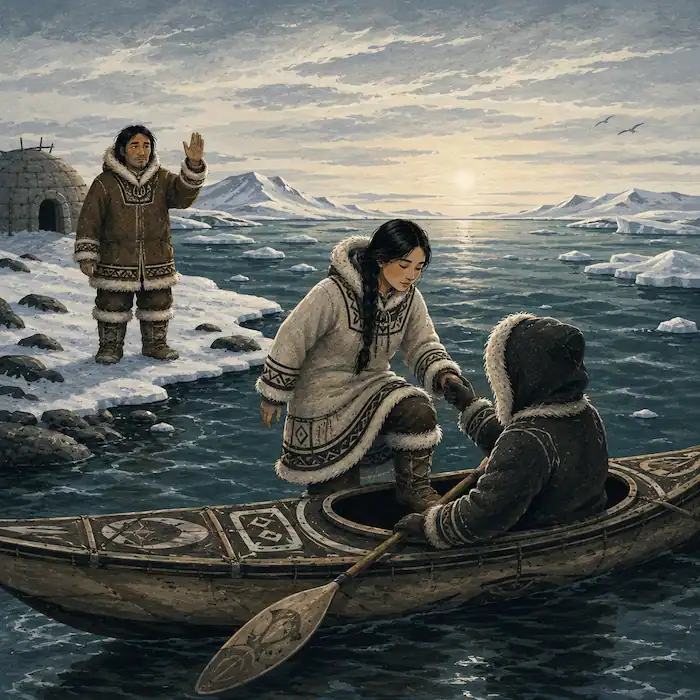
Sedna steps from the snowy shore into the stranger’s kayak while her father watches her leave across the Arctic sea.

She stepped into his kayak and left her father’s shore behind. The sea stretched cold and wide around her as the stranger paddled away from the camp. After a long journey, they reached a lonely island of rock.

Sedna looked around in dismay. There was no warm house, no soft sleeping skins and no store of food. Instead, she saw a rough nest made from sticks, moss and feathers clinging to the stones.

“What is this?” she cried.

The stranger lifted his hood. Sedna stepped back in shock. He was not a man at all. He was a great bird-spirit, with dark feathers, sharp eyes and a hooked beak.
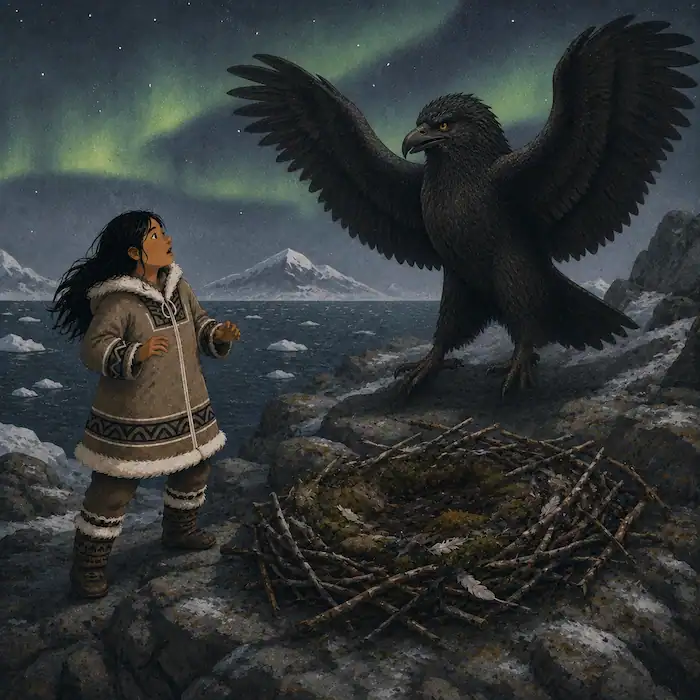
Sedna discovers a rough nest on a lonely rocky island as the stranger reveals himself as a great dark bird-spirit.

“You promised me a home,” said Sedna.

“I gave you one,” said the bird-spirit, spreading his wings.

“You promised me food.”

“I catch fish,” he replied.

Sedna’s heart sank. The island was cold and bare, and the wind snapped at her face. The bird-spirit brought fish, but little else. There was no family, no laughter and no warm lamp glowing in a snug home. Each day, Sedna stood on the rocks and looked across the water.
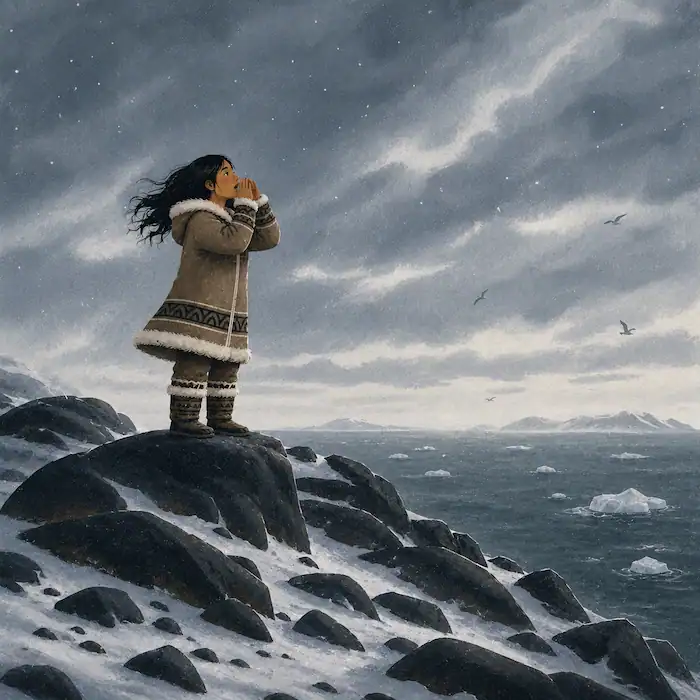
Sedna stands alone on a rocky Arctic island calling across the cold sea for her father to hear her.

“Father,” she called into the wind, “please hear me.”

Her Father Comes to Save Her

Far away, across the sea, Sedna’s father heard her cries. At first, he thought it was only the wind moving over the ice. Then he heard her voice again.

“Father! Help me!”

His heart grew heavy. He remembered how quickly he had trusted the stranger and how strongly he had urged Sedna to marry. Without waiting any longer, he pulled his kayak to the water, took up his paddle and set out across the sea.

The journey was hard. Cold spray struck his face, and waves lifted his kayak before dropping it again. Still, he paddled on until the lonely island rose ahead of him.

Sedna saw him first and hurried down from the rocks.

“Father!” she cried.

Her father looked at the rough nest, the feathers, the empty stones and the cold sky above them. Shame filled him.

“Come,” he said. “I am taking you home.”

Sedna climbed into the kayak, and her father pushed away from the island. Sedna looked back and saw a dark shape rising from the rocks.

The bird-spirit had seen them.
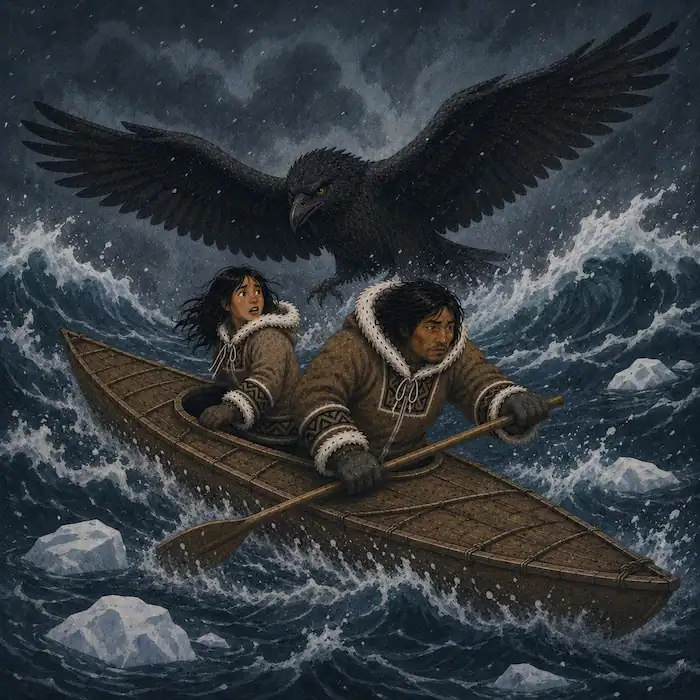
Sedna hurries over snowy rocks toward her father as he arrives by kayak to rescue her from the lonely island.

His wings beat the air as he flew after the kayak.

Faster and faster he came, his cry sharp above the waves.

“He is coming!” said Sedna.

Her father paddled harder. The bird-spirit swept low over the sea and struck the water with his wings. At once, the calm ocean changed. Clouds rolled across the sky, the wind roared and waves rose high around the kayak.

Sedna gripped the sides while freezing water splashed over them both. Her father tried to keep the kayak steady, but the storm grew stronger. The bird-spirit circled above, beating his wings against the sea.

Then fear took hold of Sedna’s father.

Sedna Falls Into the Sea

The kayak rocked wildly. Sedna’s father looked at the waves, then at his daughter. In that terrible moment, fear spoke louder than love.

“If I do not save myself, we will both drown,” he said.

Sedna stared at him. “Father?”

Before she could say more, he pushed her from the kayak. She fell into the icy sea, and the water closed around her. With all her strength, she fought her way back to the surface and grabbed the side of the kayak with her fingers.
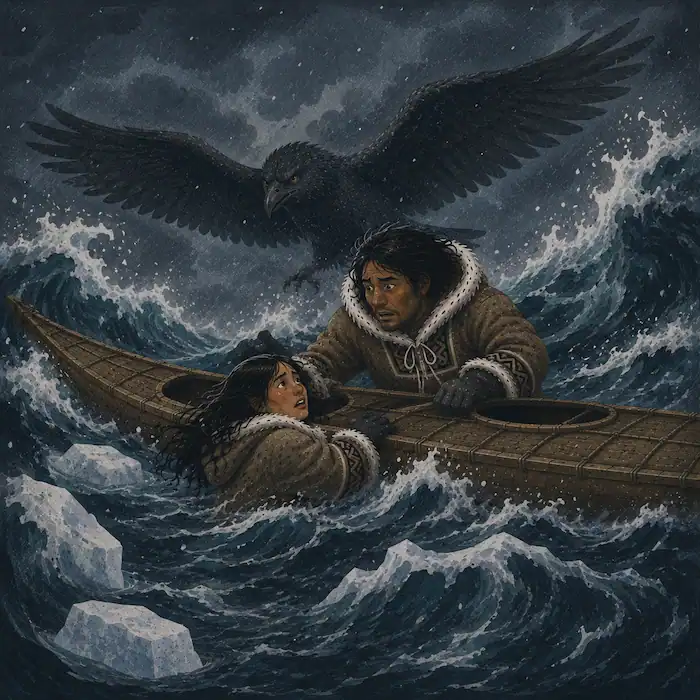
Sedna clings to the side of the kayak in a storm while her frightened father looks down and the bird-spirit circles above.

“Help me!” she cried.

The waves crashed around them. Her father shook with terror.

“Let go!” he shouted.

“I cannot!” said Sedna.

So he struck at her fingers with his paddle until they slipped beneath the waves. Sedna cried out as the cold sea pulled them down, but then something wondrous happened. As Sedna’s fingers drifted through the dark water, some became seals, some became walruses and some became whales.

Sedna reached again and caught the kayak with what remained of her hands.

“Please, Father,” she begged.

Still the storm raged. Still the bird-spirit circled above. Fear had hardened her father’s heart, and again he struck at her hands until they slipped beneath the sea.
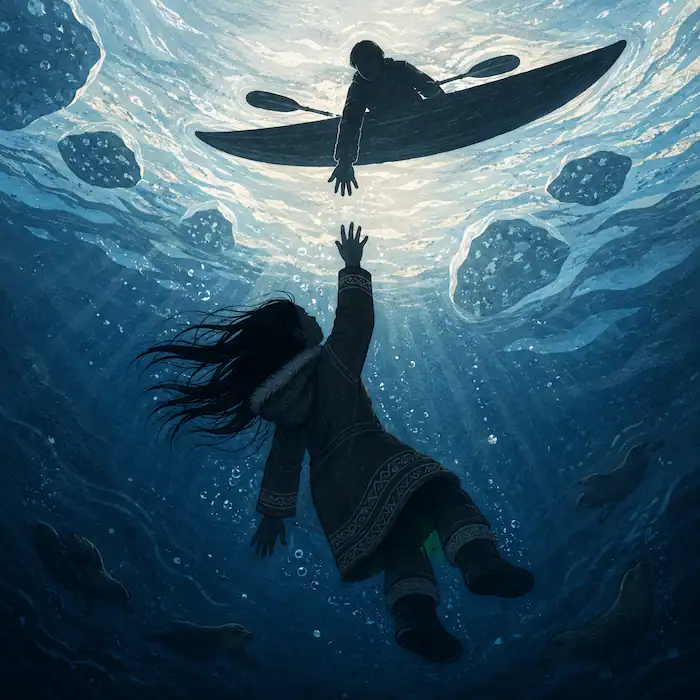
Sedna sinks beneath the Arctic water in silhouette while her father reaches from the kayak above.

Down they sank, and as they fell, more sea animals came into being. Around Sedna, the deep ocean filled with life.

Then Sedna sank below the waves. The storm quieted, and the bird-spirit vanished into the grey sky. Her father sat alone in the kayak, trembling. He had saved his own life, but he had lost his daughter.

The Home Beneath the Waves

Sedna sank deeper and deeper. The water grew dark around her, yet she did not disappear. She changed.
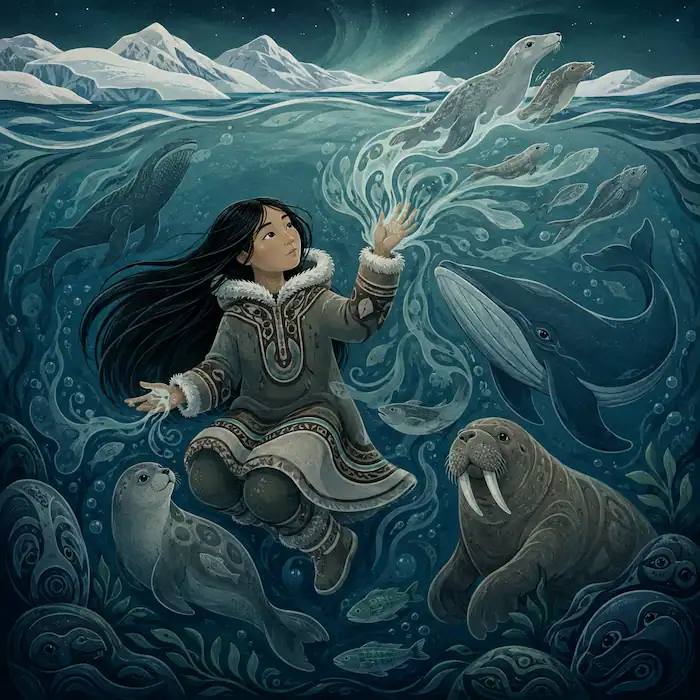
Beneath the Arctic water, Sedna’s fingers magically transform into seals, walruses, whales and fish.

Below the cold waves, beneath the drifting ice and far under the paths of the kayaks, Sedna found a new home. Around her swam the animals of the sea. Seals twisted through the water. Whales moved like mountains in the blue-black deep. Walruses rested nearby, and fish shone like silver sparks.

These animals were now part of Sedna’s story. In the myth, they came from her, and she became linked to them forever.

Sedna became the powerful spirit of the sea. In many retellings, she is known as Sedna, Goddess of the Sea, or as an Inuit sea goddess who watches over the animals of the ocean. Different Inuit communities tell similar stories with different names, but the meaning remains strong. Sedna is remembered as the one who lives beneath the ocean and watches over the sea animals.

The Meaning of the Sedna Myth

The story of Sedna is not an easy story. It tells of broken promises, fear, betrayal and loss. However, it also tells of power, change and respect.

Sedna began as a young woman who wanted to choose her own life. She was tricked by a bird-spirit and failed by her father. Yet from the deepest part of the sea, she became one of the most important beings in Inuit mythology.

Sedna did not become powerful simply because she fell into the sea. She became the Goddess of the Sea because, in the myth, the sea animals came from her. Her fingers and hands changed into seals, walruses, whales and other ocean animals, linking her forever to the creatures of the deep. That is why hunters remembered Sedna before they went out on the water. She was the guardian of the animals they needed to survive.

The Sedna Inuit story teaches that life near the frozen sea depends on respect. No hunter is greater than the ocean. No family can live without the animals. No one should take more than they need.

So, when the northern lights shimmered above the snow and the sea breathed beneath the ice, people told the story of Sedna. They told it to children so they would understand the sea. They told it to hunters so they would show gratitude. They told it to everyone so they would remember this truth:

The sea gives life, but it must always be respected.

Moral of Sedna Goddess of the Sea

The moral of Sedna Goddess of the Sea is that the natural world must be treated with respect. In the story, Sedna becomes the guardian of the sea animals after her fingers and hands change into seals, walruses, whales and other ocean creatures.

The tale reminds children that people depend on nature for food, warmth and survival. However, it also shows that nature is not something to use carelessly. The sea gives life, but it must always be respected.

This story also teaches that fear can lead people to make terrible choices. Sedna’s father acts out of panic during the storm, and his choice changes Sedna’s life forever. Even so, Sedna becomes powerful, watchful and deeply connected to the sea.

Vocabulary Spotlight

Inuit – The Inuit are Indigenous peoples whose homelands are across Arctic regions, including parts of Canada, Greenland and Alaska.

Myth – A traditional story that often explains how something in the world came to be, such as animals, weather, stars or natural forces.

Kayak – A narrow boat traditionally used in Arctic regions, often by hunters travelling across cold waters.

Bird-spirit – A powerful magical being in the story who first appears as a mysterious stranger.

Guardian – Someone who watches over or protects something. Sedna becomes the guardian of the sea animals.

Walrus – A large sea animal with tusks that lives in cold northern waters.

Respect – To treat someone or something with care and value. In this story, people must respect the sea and the animals.

Retelling – A new version of an older story, told in fresh words while keeping the main meaning.

Teacher’s Note

Sedna Goddess of the Sea is a useful story for exploring mythology, oral storytelling, environmental respect and character choices. It works well for upper primary pupils because it has a strong narrative structure, clear emotional conflict and a powerful moral.

This version has been adapted for children, but the original myth is much darker. Teachers may wish to explain that traditional stories often change slightly between communities, families and storytellers. Sedna is known by different names in different Inuit traditions, including names such as Nuliajuk, Taleelayuk and others. The Canadian Encyclopedia describes Sedna as one of the best-known figures in Inuit traditional stories, with names that vary across regions.

The story also supports discussion around how people depend on the natural world. In many Sedna traditions, she becomes the powerful guardian of the sea animals, and humans must treat the sea with care. The Winnipeg Art Gallery notes that Nuliajuk/Sedna stories vary across oral traditions, but often present her as guardian of the sea animals.

This story can be linked to:

  • Reading comprehension
  • Myths and legends
  • Traditional storytelling
  • Arctic environments
  • Respect for animals and nature
  • Character motivation and consequences
  • Creative writing and visual storytelling

Parent and Teacher Discussion Questions

  1. Why does Sedna refuse the hunters who want to marry her?
  2. Why does Sedna’s father want her to marry?
  3. Do you think Sedna should have trusted the mysterious stranger? Why or why not?
  4. How does the island make Sedna feel?
  5. Why does Sedna’s father feel ashamed when he reaches the island?
  6. What causes the storm during the escape?
  7. Why does Sedna’s father make such a terrible choice in the kayak?
  8. How do Sedna’s fingers and hands become important to the story?
  9. Why do people remember Sedna before going out to hunt?
  10. What does the story teach us about respecting the sea?
  11. Is Sedna weak or powerful by the end of the story? Explain your answer.
  12. Why do you think different communities might tell slightly different versions of the same traditional story?

Classroom Activities

1. Story Sequence Activity

Ask pupils to put the main events of the story in order. They can use short sentence cards, picture cards or their own drawings.

Suggested events:

  • Sedna refuses the hunters.
  • A mysterious stranger arrives.
  • Sedna travels across the sea.
  • The stranger reveals himself as a bird-spirit.
  • Sedna calls for her father.
  • Her father rescues her.
  • The bird-spirit creates a storm.
  • Sedna falls into the sea.
  • Her fingers become sea animals.
  • Sedna becomes guardian of the sea.

2. Character Feelings Map

Ask pupils to track Sedna’s feelings across the story. They can choose words such as confident, unsure, afraid, hopeful, betrayed, powerful and calm.

Then ask:

  • What caused her feelings to change?
  • Which moment was the most important?
  • How does Sedna change by the end?

3. Myth and Meaning Discussion

Explain that myths often help people understand nature, animals or the world around them. Ask pupils:

  • What does this myth explain?
  • Why are the sea animals important?
  • Why would a story like this matter to people living near the Arctic sea?

4. Respect for the Sea Poster

Pupils create a poster with the message:

The sea gives life, but it must always be respected.

They can include seals, whales, walruses, fish, kayaks, waves and Sedna as guardian of the sea.

5. Write a Diary Entry

Ask pupils to write a diary entry from Sedna’s point of view. Good moments to choose include:

  • The night before she leaves home
  • Her first day on the lonely island
  • The moment she sees her father’s kayak
  • Her first day beneath the waves

Encourage pupils to include feelings, setting and sensory details.

6. Compare Two Myths

Compare Sedna with another myth or legend where a natural feature or animal is explained through story. Pupils can compare:

  • Main character
  • Setting
  • Problem
  • Magical event
  • Moral or message

7. Create a Sea Guardian

Ask pupils to design their own guardian of a natural place, such as a forest, river, mountain or desert. They should explain:

  • What does the guardian protect?
  • What makes the guardian angry?
  • How can people show respect?

History and Cultural Background

Sedna is one of the best-known figures in Inuit mythology. She is often described as a powerful sea spirit or sea goddess who lives beneath the ocean and watches over marine animals. Different Inuit communities tell the story in different ways, and Sedna may also be known by other names, including Nuliajuk, Taleelayuk and others.

Many versions of the story explain how Sedna became connected to seals, walruses, whales and other sea animals. In some versions, her fingers fall into the sea and become sea creatures. The Canadian Museum of History describes a version in which Sedna’s fingers turn into a seal, walrus, whale and fish, and she becomes the mother of all sea animals.

This matters because animals of the Arctic sea were essential for food, clothing, tools, warmth and survival. The story reminds listeners that hunting must be done with care and respect. It also reflects the importance of oral storytelling, where stories are passed down, retold and sometimes changed by different communities and storytellers.

This version has been written as a child-friendly retelling for modern readers. It keeps the main shape of the myth while softening some darker details so that parents, teachers and children can read it together.

Frequently Asked Questions on Sedna Goddess of the Sea

  • Who is Sedna?

    Sedna is a powerful figure in Inuit mythology. She is often described as a sea spirit or sea goddess who lives beneath the ocean and watches over sea animals.

  • What is Sedna Goddess of the Sea about?

    Sedna Goddess of the Sea tells how Sedna is taken across the sea by a mysterious bird-spirit, falls into the ocean during a storm and becomes the guardian of seals, whales, walruses and other sea animals.

  • Is this the original Sedna story?

    This is a child-friendly retelling based on traditional Sedna stories. The Sedna myth exists in many versions across Inuit storytelling traditions, and some older versions are much darker.

  • Why did Sedna become the Goddess of the Sea?

    In the myth, Sedna becomes the Goddess of the Sea because the sea animals come from her. Her fingers and hands become seals, walruses, whales and other ocean creatures, linking her forever to the animals of the deep.

  • Is Sedna a myth or a folktale?

    Sedna is usually described as an Inuit myth because the story explains the origin of sea animals and Sedna’s role as guardian of the ocean.

  • Is Sedna suitable for children?

    This version is suitable for children aged around 7–12. It has been carefully retold to keep the meaning of the traditional story while softening the darkest moments.

  • What is the moral of Sedna Goddess of the Sea?

    The moral is that the sea gives life, but it must always be respected. The story also shows that fear can lead to harmful choices, and that nature should never be taken for granted.

Copyright Notice

© Kooky Kids World. This original retelling, illustrations, audio narration and supporting educational content are protected by copyright. The underlying myth is traditional and may exist in many public domain or oral storytelling versions.