
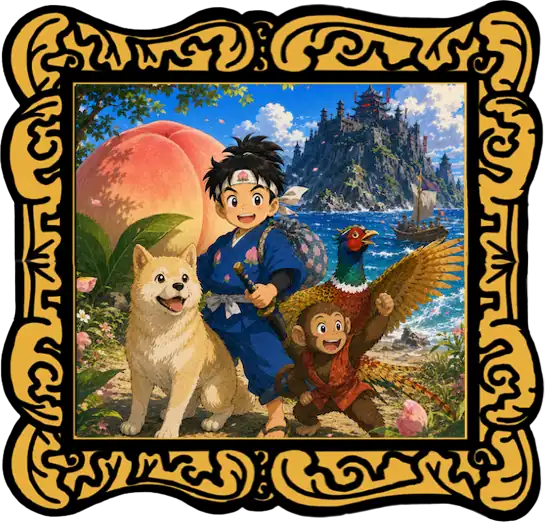

The peach in the river
Long ago, in a quiet village in Japan, an old man and an old woman lived in a small wooden house near the hills. In spring, pink blossoms dusted the path. In summer, dragonflies flashed over the rice fields. In autumn, the maples turned red and gold. In winter, frost silvered the bamboo fence.
Each morning the old man went into the hills to cut grass and gather firewood, returning at dusk with a bundle tied to his back. While he worked among the trees, the old woman cooked, mended clothes and carried laundry down to the river, where she washed it on the smooth stones by the bank.
They had little, but they shared what they could. If a neighbor needed soup, they made soup. If a child lost a sandal in the mud, they helped look for it. Still, when evening came and the fire burned low, their house felt very quiet.
One bright morning, the old woman carried a basket of clothes to the river.
Splash, swish, splash.
She rubbed the cloth against the stones and sang softly to herself. Then she heard a strange sound coming down the water.
“Donbura ko, donbura ko.”
Something bobbed in the current.
The old woman shaded her eyes. A peach was floating toward her, but not an ordinary peach. It was not small, and it was not merely large. It was the largest peach she had ever seen, round as a cooking pot and glowing pink in the sun.
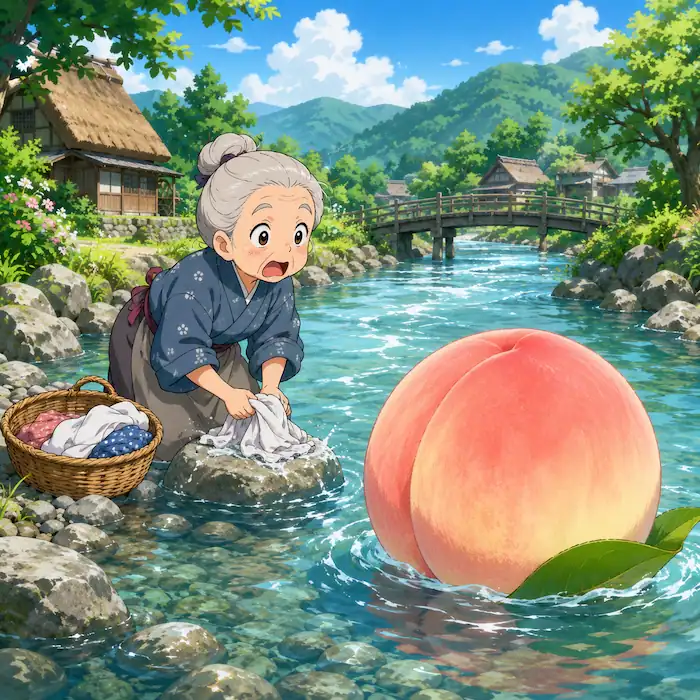
“My, my,” she said. “Where did you come from?”
The peach bumped against a stone and spun away. The old woman stepped carefully into the shallows, caught it with both hands and tugged. It was heavier than it looked. She pushed, pulled, slipped, laughed at herself, and at last rolled the peach into her basket.
“My husband must see this,” she said, and hurried home as fast as her old legs would carry her.
A baby from the peach
That evening, the old man came back from the hills with firewood on his back and burrs on his sleeves.
“I found something wonderful,” said the old woman.
“A turnip as big as a drum?” he asked.
“Better.”
“A fish as long as my arm?”
“Better than that.”
She led him into the kitchen and pointed to the great peach on the low table. The old man stared at it, then at her.
“That came from the river?”
“It came floating right to me.”
The old man washed his hands. The old woman brought a knife. Together, they leaned over the peach, but before the blade touched the skin, the peach trembled.
They both jumped back.
It trembled again. Then, with a soft crack, it split open by itself.
Inside lay a baby boy.
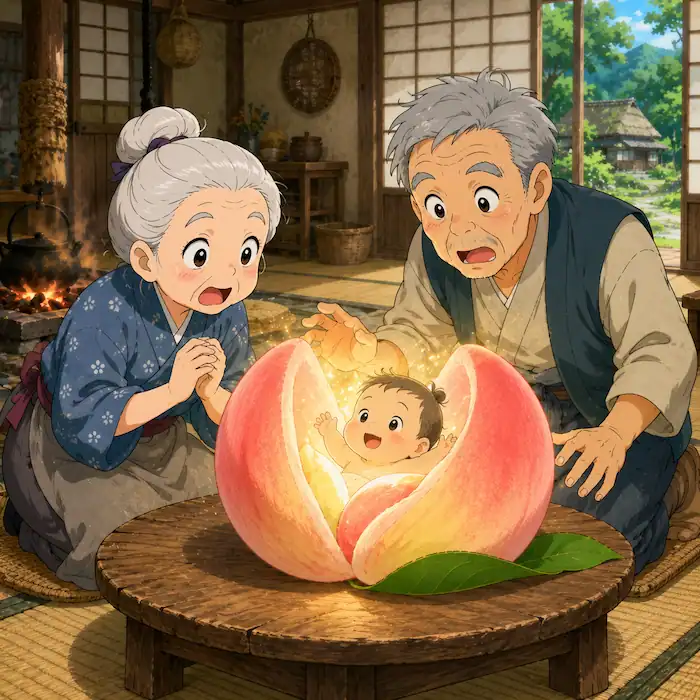
He was plump and rosy, with bright eyes and tiny fists. He did not cry. He stretched both arms toward the old woman and gave a cheerful squeak.
The old woman pressed her hands to her mouth. “A child.”
The old man looked at the baby for a long moment. “A gift,” he said.
They wrapped him in a clean cloth and held him close. The house that had seemed so quiet before suddenly felt awake, with the kettle singing, the fire snapping and the old couple laughing through their tears.
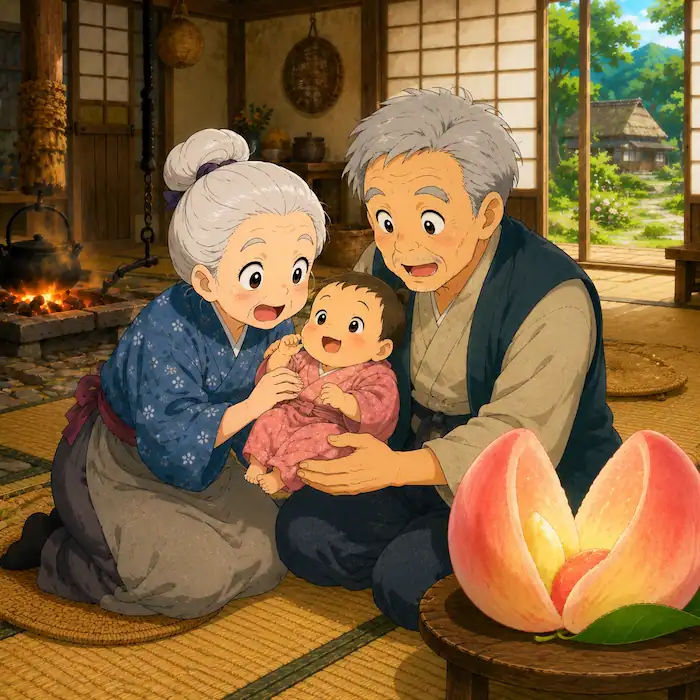
“What shall we call him?” asked the old woman.
The old man smiled. “He came from a peach. Let us call him Momotaro.”
So they named him Momotaro, which means Peach Boy.
From that day on, their home changed. Momotaro crawled across the mats before other babies could sit. He walked before the neighbor’s rooster had finished crowing at dawn. Soon he was running through the yard with a bamboo stick over his shoulder, pretending to be a traveler on a great road.
He grew strong, but he was not cruel. He helped his mother carry water and his father stack firewood. When birds pecked at the garden, he clapped his hands to shoo them away, but he never threw stones.
“Go on,” he told them. “But leave some beans for us.”
The old woman laughed every time.
News from Ogre Island
Years passed, and Momotaro grew into a strong, cheerful boy.
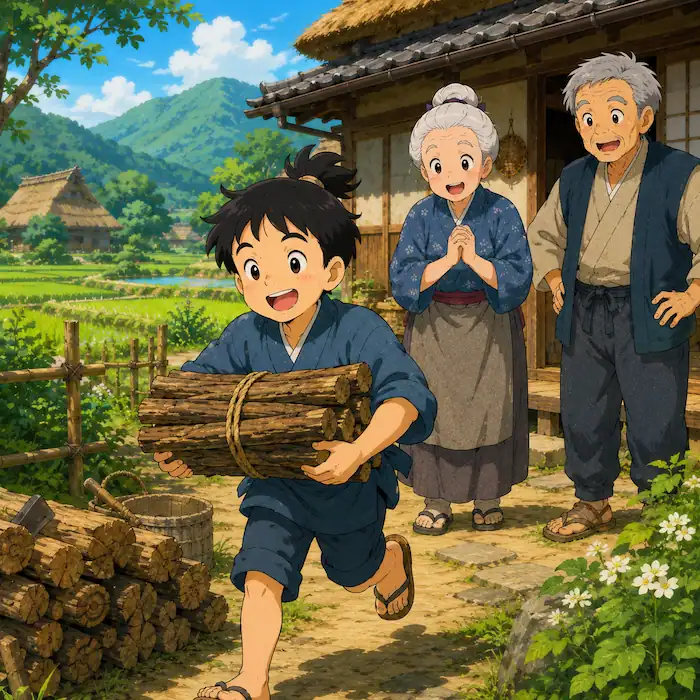
One evening, while the family ate rice and pickles by the fire, a traveler knocked at the door. His cloak was torn, his sandals were muddy, and he looked as if he had walked a long way without rest.
“Come in,” said the old man. “Warm yourself.”
The traveler sat near the hearth and drank tea from a chipped cup. For a while he said nothing. Then he sighed.
“Bad news has come from the coast,” he said. “The oni of Ogre Island have attacked again.”
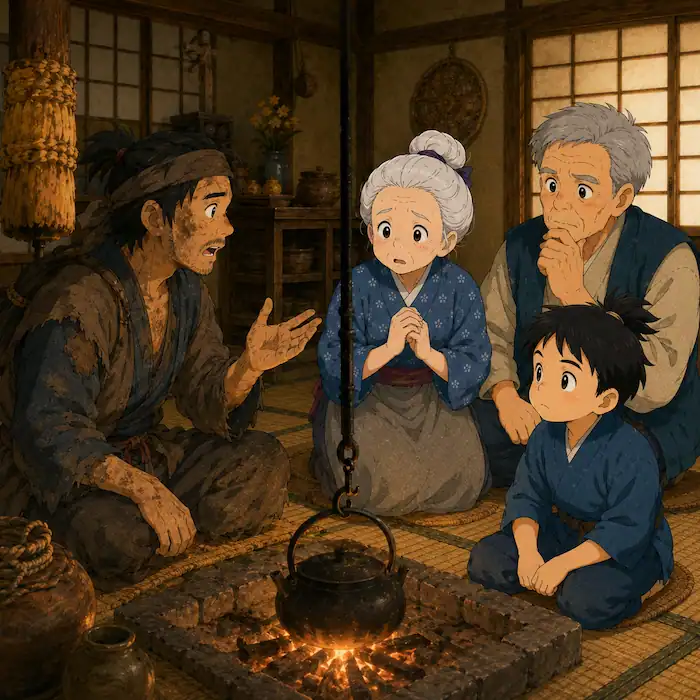
Momotaro looked up. “Oni?”
“Red ogres, blue ogres and black-horned ogres,” said the traveler. “They come from their island at night. They steal rice, cloth, tools and gold. They beat on their drums until children hide under blankets. No village near the sea sleeps easy now.”
The old woman went still.
After the traveler left, the little house was quiet except for the fire. Outside, a night bird called from the trees.
Momotaro stared into the flames. “Father, Mother, I must go to Ogre Island and stop the ogres.”
His mother looked at him sharply. “You are our only child.”
“I know.”
“The sea is rough,” said his father. “And ogres do not frighten easily.”
Momotaro nodded. “Then I must be careful. But I cannot stay here and pretend I have not heard.”
His mother wiped her hands on her apron though there was nothing on them. “A brave heart is not enough.”
“I know,” said Momotaro. “But I have to try.”
The old man watched him for a long time. At last, he nodded.
“I will go to stop the ogres,” said Momotaro.
The old woman turned away, but only to hide her tears. “Then I will make food for the road.”
The kibidango
Before sunrise, the old woman steamed millet and pounded it with rice flour. She shaped the mixture into round dumplings called kibidango, soft and golden and firm enough to carry.
“These are not fancy,” she said, tying them into a cloth bag. “Eat when you are hungry. Rest before you are foolish with tiredness. And remember where home is.”
The old man placed a hand on Momotaro’s shoulder. “You are strong. But keep your head. Strength alone will not bring you home.”
Momotaro bowed to them both. He wore a simple coat, a headband and sturdy sandals. At his side, he carried a short sword, though he hoped he would not need it. Over his shoulder went the bag of kibidango.
Then he stepped onto the road.
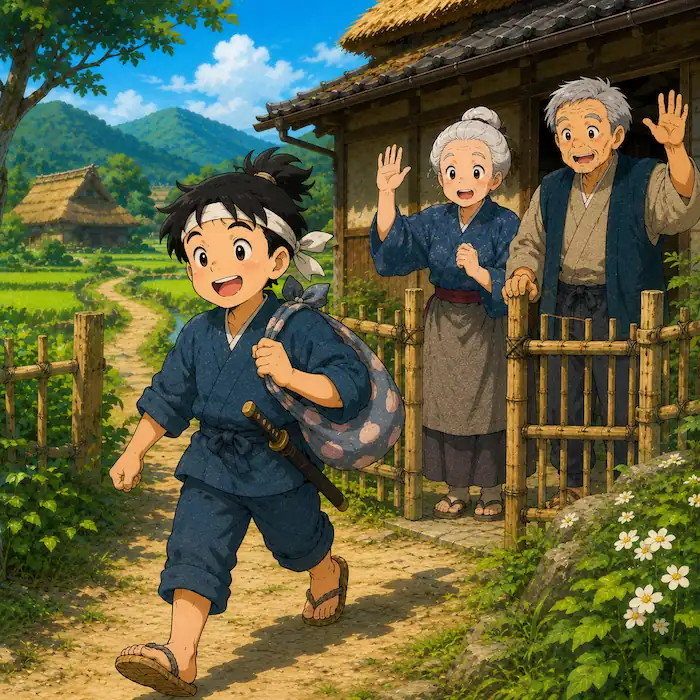
The morning smelled of grass and woodsmoke. Sparrows hopped along the fence. Behind him, his parents stood at the gate, watching until the road curved and he vanished from sight.
Momotaro walked past rice fields, over small bridges and between dark green cedars. By midday, the sun was warm on his back and his stomach had begun to complain. He sat beneath a pine tree and opened the cloth bag.
A dog trotted out from the bushes.
“Woof,” said the dog. “What is in that bag?”
“Kibidango,” said Momotaro.
The dog sniffed the air. “Give me one.”
Momotaro looked at him. “I am going to Ogre Island. The ogres have been stealing from the villages. If you come with me and help, I will share.”
The dog sat up straighter. “Ogre Island?”
“Yes.”
“Dangerous?”
“Very.”
The dog wagged his tail once, as if trying not to look too pleased. “Good. I am quick, and I do not run from trouble.”
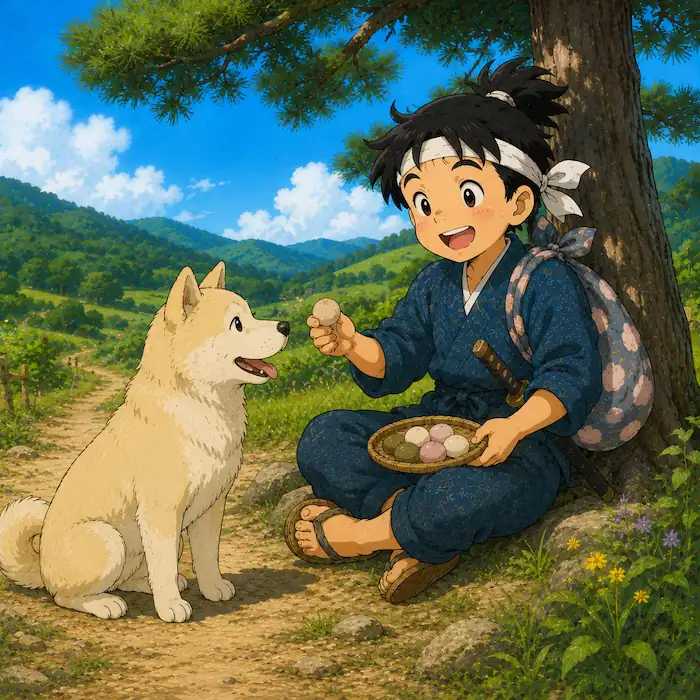
Momotaro gave him a kibidango. The dog swallowed it in three bites and licked his nose.
“I am your companion now,” he said.
“Then come on,” said Momotaro, and they walked on together.
The monkey in the trees
The road climbed into the hills, where vines twisted around tree trunks and sunlight broke through the leaves in bright patches. The dog trotted ahead, nose low, until something dropped from a branch and landed in the path.
It was a monkey with quick hands, lively eyes and a face full of mischief.
“Where are you two going?” asked the monkey.
“Ogre Island,” said Momotaro.
The monkey scratched his chin. “Bad choice for a picnic.”
“We are not going for a picnic,” said the dog.
“I guessed that,” said the monkey. His eyes moved to the cloth bag. “What have you got there?”
“Kibidango,” said Momotaro.
The monkey came a little closer. “I have heard of those. Sweet, chewy and wasted on dogs.”
The dog growled. “And what can a monkey do?”
Momotaro held up a hand. “If you want one, come with us. We need help.”
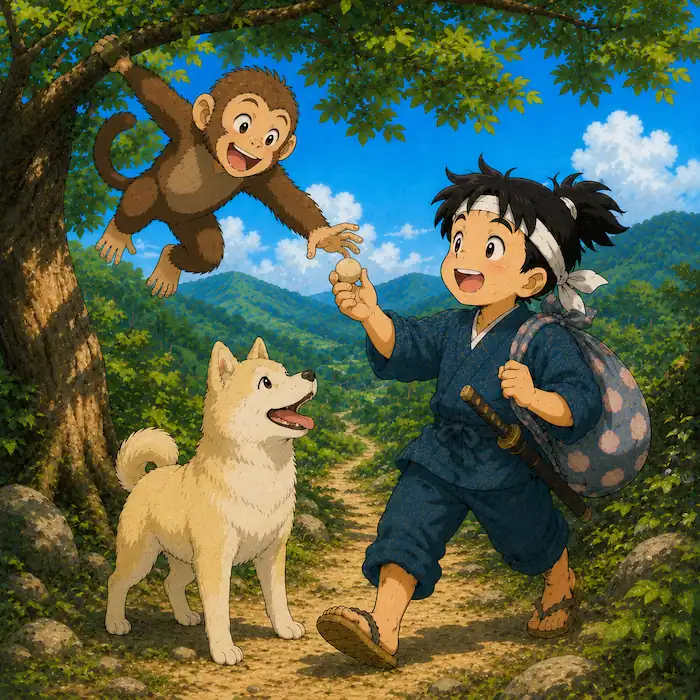
The monkey put a hand to his chest. “Can dogs climb walls? Untie ropes? Slip through a window and open a gate from the other side?”
The dog blinked.
“No,” said the monkey. “They cannot.”
“Dog can run and guard,” said Momotaro. “You can climb and use your hands. I will need both of you.”
The monkey liked the sound of that. Momotaro gave him a kibidango, and he ate it in small, careful bites, as if it were treasure.
“Lead the way, Peach Boy,” he said, springing back into the trees.
So Momotaro, Dog and Monkey continued toward the sea. They crossed a valley where cicadas buzzed in the heat, drank from a cold stream, and climbed until the air smelled of salt. When the path grew steep, Monkey spotted fruit in the branches and tossed some down. When shadows gathered, Dog kept watch.
By evening they reached a windy cliff. Far below, waves flashed silver. Far across the water, a dark shape rose from the sea.
Ogre Island.
The pheasant in the sky
The next morning, the three travelers followed the coast. Gulls cried overhead, and fishing boats rocked near the shore, though none of the fishermen would sail close to the island.
“The ogres have a fortress there,” one fisherman warned. “High gate, stone walls, watchtowers. Boats that go near that island do not come back.”
Momotaro thanked him and asked to borrow a small boat.
The fisherman stared. “You are either brave or foolish.”
“Probably both,” said Monkey.
Dog gave him a look.
Before they pushed the boat into the water, a pheasant swept down and landed on a post. Her feathers shone green, red and gold, and her eyes were as sharp as needles.
“I heard you speak of Ogre Island,” she called.
“We are going there,” said Momotaro.
“Then you will need someone above the walls. I can see guards, gates and trouble before it reaches you.”
Monkey folded his arms. “And I suppose you want a kibidango.”
The pheasant tilted her head. “Of course. I am helpful, not foolish.”
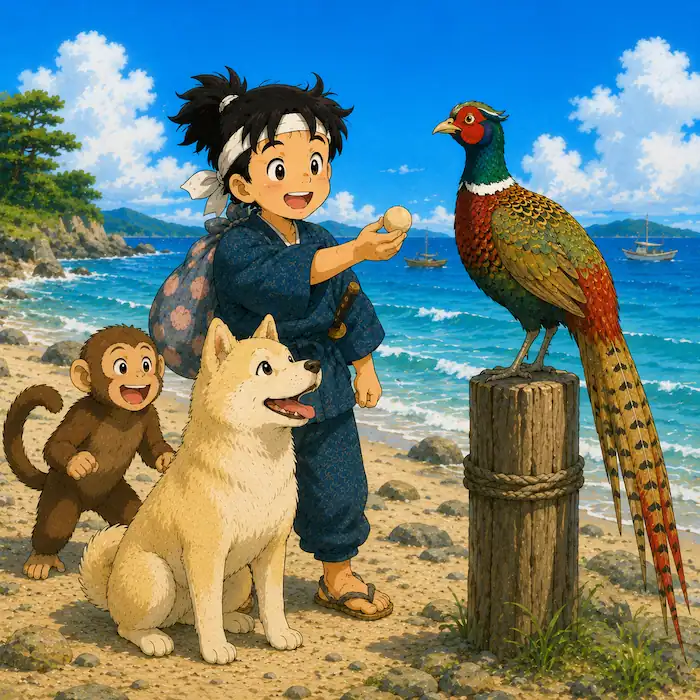
Momotaro laughed and gave her one. She pecked it up neatly.
“Good,” said Dog. “Now we have paws, hands and wings.”
“And a boat that I do not like,” muttered Monkey.
They pushed into the surf. Dog sat in the bow with his nose to the wind. Monkey gripped the side and tried not to look sick. Pheasant flew above them in wide circles while Momotaro rowed.
The sea slapped the boat. Clouds crossed the sun. Ogre Island grew larger with every stroke.
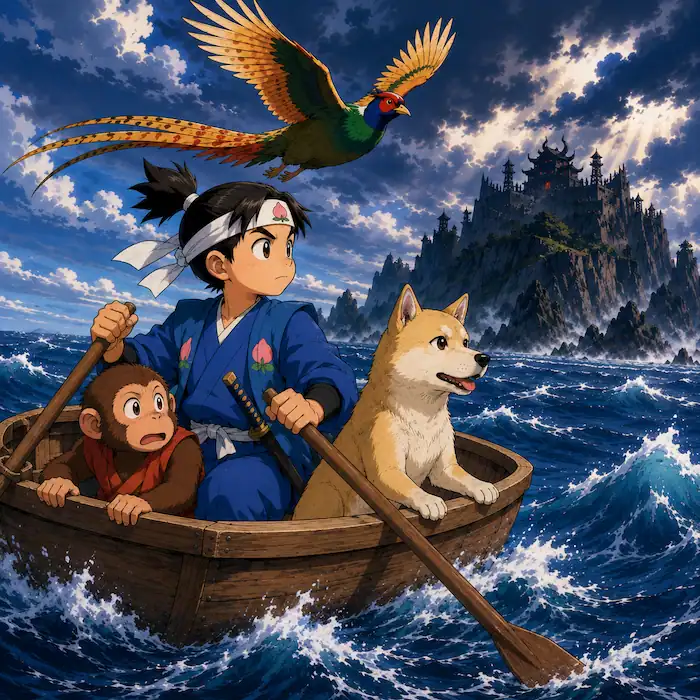
At last Pheasant swooped low.
“The gate is shut,” she called. “Two guards outside. More asleep in the courtyard. I see drums, clubs and treasure chests.”
Momotaro pulled the oars once more. “Then we will be quiet at first,” he said. “And loud later.”
The gate of Ogre Island
The boat scraped against black stones. Momotaro and his companions climbed ashore. Ogre Island smelled of smoke, seaweed and old storms. Jagged rocks rose around them like teeth, and at the top of the path stood a fortress with a huge iron gate.
Behind the wall, someone snored like thunder.
Monkey rubbed his hands. “My turn.”
He scampered up the stones, climbed the wall and vanished over the top. A moment later, Dog heard a clink. Then another.
The gate creaked open.
Dog charged in first. “Woof! Wake up, you thieves!”
The courtyard erupted.
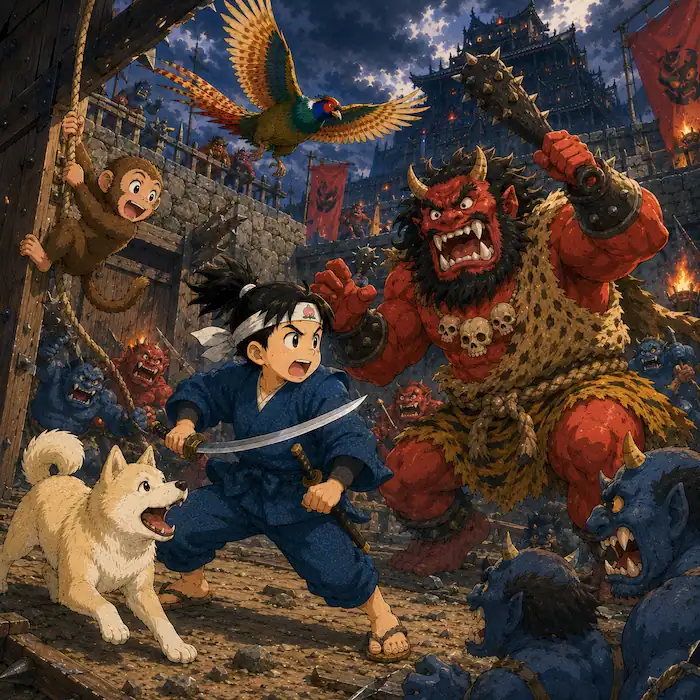
Red ogres, blue ogres and green ogres leaped from their mats. Some had horns. Some had tusks. All had the sour look of creatures woken before breakfast.
“Who dares enter our fortress?” roared the largest ogre.
“I am Momotaro,” said the boy. “You have stolen from the villages. Return what you took and leave them in peace.”
The ogres stared. Then they laughed so hard the roof tiles rattled.
“A peach child,” sneered one.
“A boy with pets,” growled another.
Dog bared his teeth. “Say that closer.”
Monkey swung down from a beam. “No, let him keep talking. He may tire himself out.”
Pheasant dropped from the sky and pecked the largest ogre’s helmet.
Clang.
The ogre yelped. “Get that bird!”
“Try,” cried Pheasant, already out of reach.
Then the courtyard became a storm of paws, wings, ropes, clubs and shouting.
Peace in the village
At last, Momotaro returned to the little house by the hills.
His mother saw him first and cried out before she could stop herself. His father hurried from the woodpile, and for a moment all three of them held each other in the yard without saying anything useful at all.
“You came home,” said the old woman at last.
“I came home,” said Momotaro.
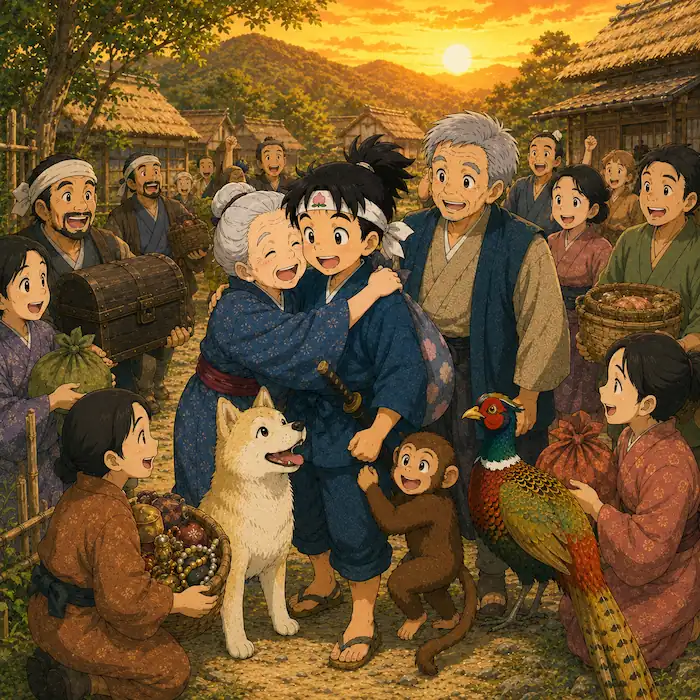
Dog sat neatly by the door. Monkey bowed as if he had personally invented victory. Pheasant perched on the fence like a bright flag.
The old man wiped his eyes and pretended he had dust in them. “Friends must be fed.”
So the old woman made a feast. She cooked rice, soup, grilled fish, pickles and more kibidango. Dog received a fine bowl. Monkey got fruit and dumplings. Pheasant pecked happily from a dish of millet.
That evening, neighbors filled the yard. Children listened with wide eyes as Momotaro told the tale of the road, the boat, the gate and the battle.
“When the gate was shut, Monkey opened it,” he said.
Monkey sat taller.
“When danger came from behind, Pheasant warned me.”
Pheasant spread her wings.
“And when the ogres charged, Dog stood firm.”
Dog thumped his tail against the ground.
A child near the front frowned. “Did you keep any treasure?”
“No,” said Momotaro. “It already belonged to someone.”
The child thought about this. “So being brave is not only fighting?”
Momotaro smiled a little. “No. Sometimes it is sharing your food. Sometimes it is asking for help. Sometimes it is knowing when to stop.”
From then on, the villages near the coast slept peacefully. No ogre drums sounded across the sea. Farmers returned to their fields. Fishermen sailed without fear. Children played by the river where the great peach had once floated by.
And whenever someone asked how a boy from a peach defeated the ogres of Ogre Island, the villagers gave the same answer.
“Not alone,” they said. “Dog ran beside him. Monkey opened the gate. Pheasant watched from the sky. Momotaro listened to them all.”
