

The Grateful Crane: Japanese Folk Tale

The Grateful Crane is a traditional Japanese folk tale for children aged 6–12. This version has been retold for young readers, with clear language, audio support and a gentle focus on kindness, gratitude and keeping promises.

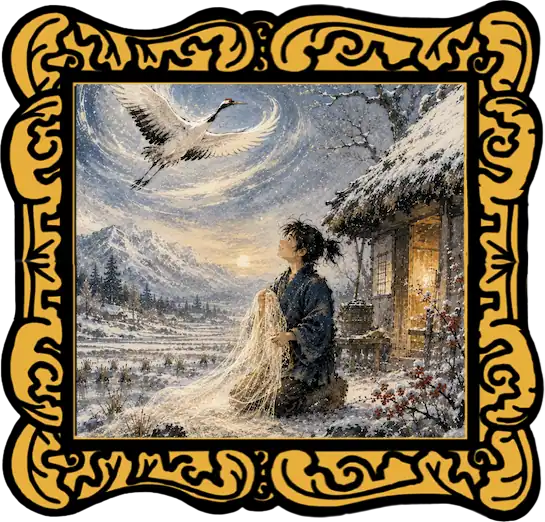
Audio cover for The Grateful Crane showing Haru holding the glowing cloth as the crane flies over a snowy Japanese landscape
0:00 / 0:00
The Grateful Crane
Kooky Kids World Cloud Logo showing where the audio read aloud file is.

About This Retelling

This child-friendly retelling keeps the main shape and meaning of the traditional Japanese story while using clear language for young readers. Traditional folk tales can vary between regions, families and storytellers, so this version should be read as an introduction rather than the only version.

The Grateful Crane Story

The Crane in the Snow

Long ago, in a quiet village in Japan, a young farmer named Haru lived alone at the edge of a wide rice field. His house was small, his coat was patched and his meals were often plain. Even so, Haru had a kind heart.

Each morning, he rose before the sun. He washed his face in cold water, tied his straw sandals to his feet and walked out to work. “Rice does not grow by wishing,” he often told himself. “So I had better keep working.”
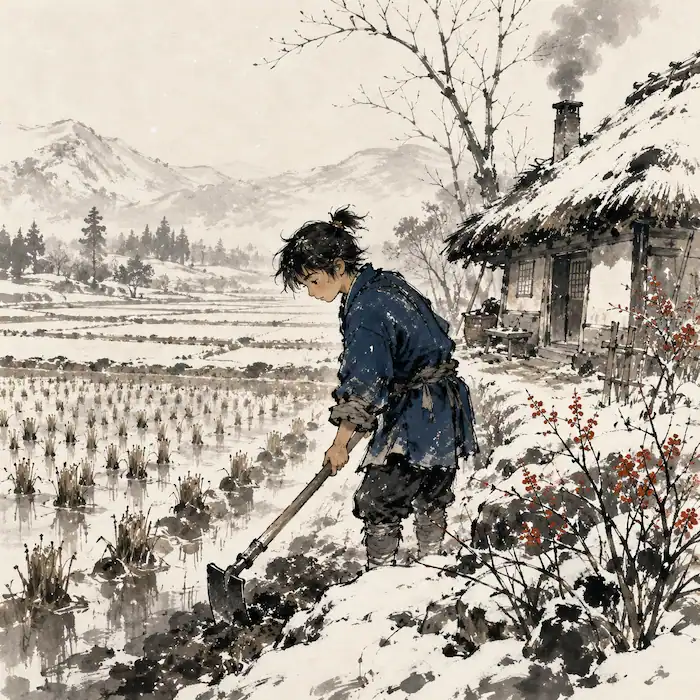
Haru working beside a snowy rice field near his cottage in The Grateful Crane Japanese folk tale

One winter afternoon, pale snow began to fall. It drifted over the fields and settled on the bamboo fence. Haru was gathering firewood when he heard a sharp cry.

“Kraaa!”

He stopped to listen. The wind moved through the dry reeds, and for a moment, everything went quiet.

Then the cry came again.

“Kraaa!”

Haru gripped his bundle of firewood. Was it a fox? A trapped bird? Something hurt and alone? He stepped carefully through the snow, following the sound toward the riverbank.
There, in a patch of frozen grass, a beautiful white crane struggled in the snow. One of its wings dragged at its side. A hunter’s arrow had pierced the feathers.
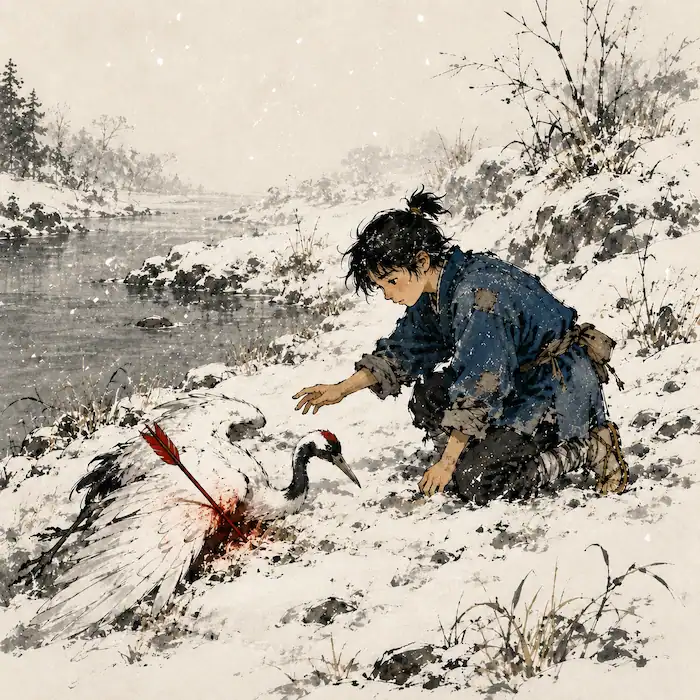
Haru kneeling beside an injured white crane with an arrow in its wing beside a snowy riverbank

“Oh, poor thing,” Haru whispered. The crane stared at him with bright black eyes. It trembled, but it did not strike at him.

“Easy now,” said Haru. “I will not hurt you.”

He knelt beside the bird and gently held its wing. Then, with careful fingers, he pulled the arrow free. The crane cried out, and Haru’s heart twisted.

“I know, I know,” he murmured. “Just a little longer.”
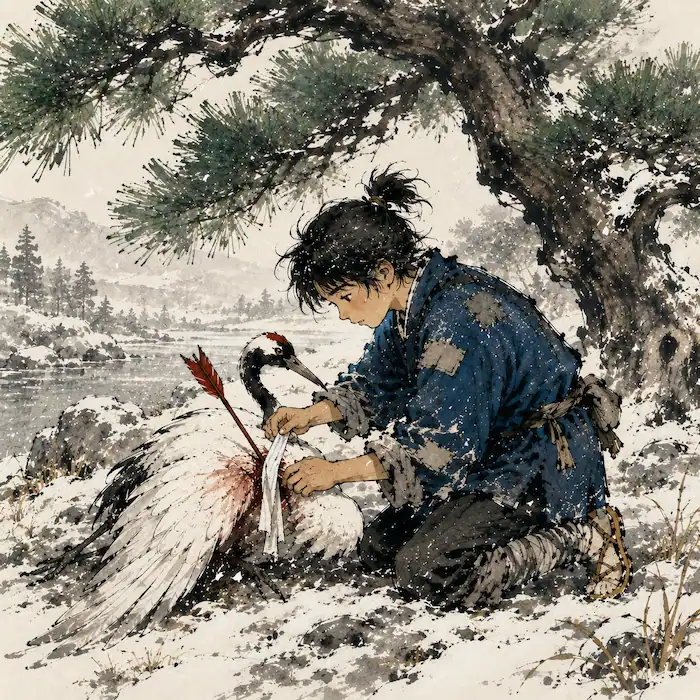
Haru gently bandaging the injured crane beneath a pine tree in The Grateful Crane Japanese folktale

He tore a clean strip from the inside of his sleeve and wrapped the wound. Next, he carried the crane to the shelter of a pine tree, where the snow fell less heavily.

“There,” he said. “Rest awhile.” The crane lowered its long neck as if it understood.

A Kindness Repaid

For three days, Haru returned to the pine tree. He brought the crane a few cooked rice grains, fresh water and a little warmth from his hands. Each day, the bird stood a little taller. Each day, its wing spread a little wider.

On the fourth morning, the crane beat its wings and rose from the snow. Haru laughed with delight. “You can fly!”
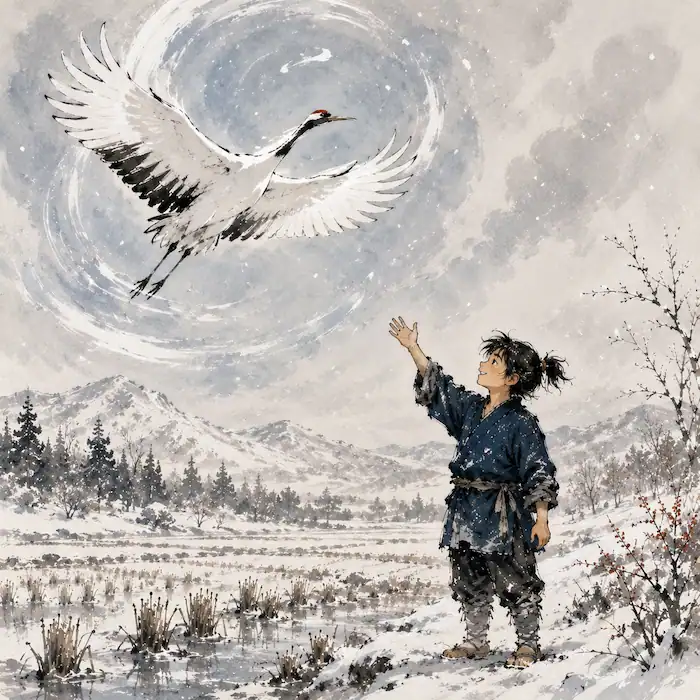
The healed white crane flying above Haru in a snowy Japanese landscape after he saves it

The crane circled above him once, twice, three times. Its white wings flashed against the gray winter sky.

“Stay away from hunters,” Haru called. “And be careful.”

The crane gave one last cry. Then it flew toward the mountains until it looked no bigger than a white petal in the wind.

That evening, Haru walked home through the snow. His fingers ached from cold, but he felt happy. “I have no coins,” he said to himself, “but at least I helped one living creature today.”
When he reached his cottage, a soft light shone from the doorway. Haru froze. He never left a lamp burning. Oil cost too much.

“Who is there?” he called.

The door slid open and a young woman stood inside. She wore a simple white kimono, and her dark hair fell neatly over her shoulders. Her face looked gentle, but her eyes held something deep and bright, like moonlight on water.

“Welcome home,” she said.
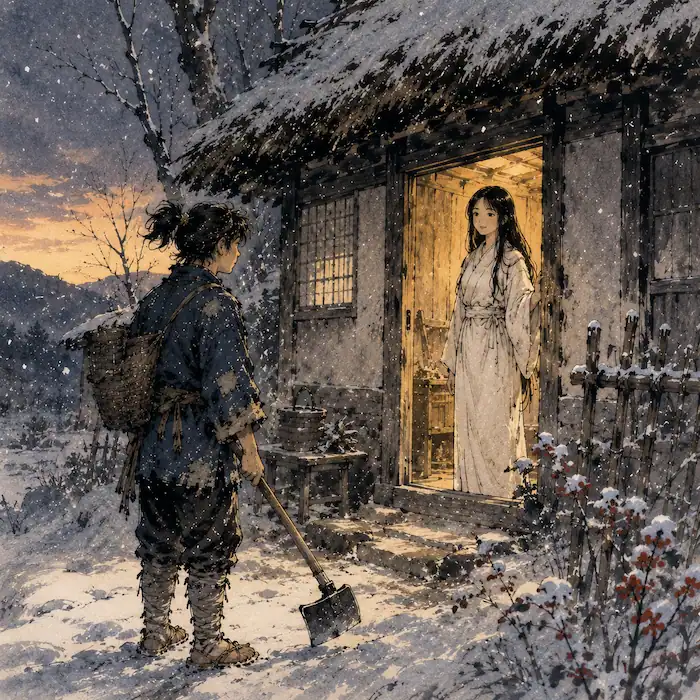
Yuki standing in Haru’s cottage doorway at dusk in The Grateful Crane Japanese folk tale

Haru stepped back. “Forgive me, but who are you?”

“My name is Yuki,” she replied. “I have come to be your wife, if you will have me.”

Haru nearly dropped his firewood. “My wife?” he said. “You must be mistaken. I am only a poor farmer. I have little rice, little money and only one thin blanket.”

Yuki smiled. “Then we will share the blanket. As for rice, do not worry.”

She pointed to a small sack near the hearth. Haru frowned. “That sack was almost empty this morning.”

“Look inside,” said Yuki.

Haru opened the sack. It was full of rice. He stared at it, then looked back at Yuki.
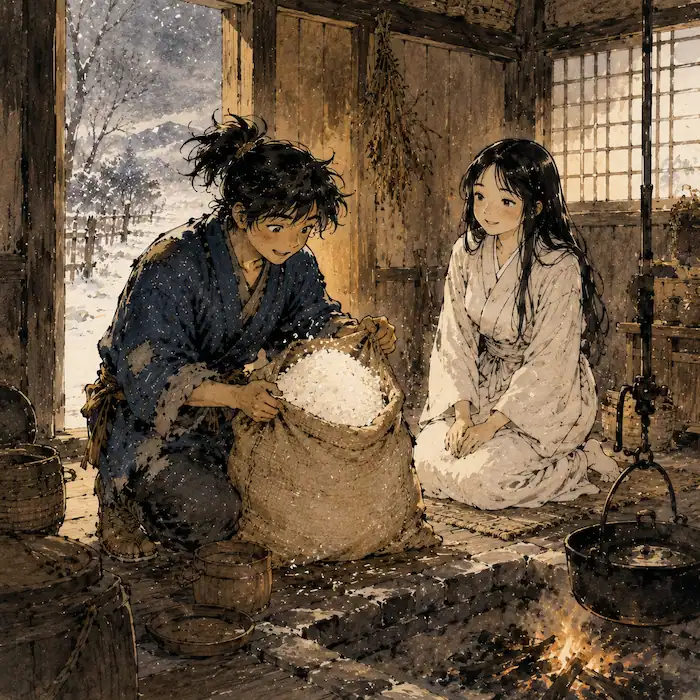
Yuki watching as Haru opens a full sack of rice inside their warm cottage

“How can this be?”

“Sometimes kindness returns in strange ways,” she said.

Haru did not understand, but he felt no fear. The cottage, which had always seemed cold and lonely, now felt warm. So Yuki stayed.

The Little House Grows Warm

Life changed after that. Yuki cooked rice each evening, and somehow the small sack never emptied. Haru worked in the fields while she swept the house, mended his clothes and sang soft songs that sounded like wind moving through reeds.

Soon, Haru found himself smiling more often.

One morning, he said, “Yuki, I still cannot believe you chose this house.”

She looked around the small room. Smoke curled from the hearth. Sunlight slipped through the paper window. A cracked teacup sat beside a wooden bowl.

“It is enough,” she said.

“But you could have lived somewhere finer.”

She shook her head. “A kind heart makes a poor house rich.”

Haru lowered his eyes. “Then I hope I never disappoint you.”

For several weeks, they lived quietly and happily. In the village, people noticed that Haru no longer looked so tired.

“Your house has changed,” said an old neighbor.

Haru smiled. “Yes. I think it has.”

One afternoon, Yuki sat beside him while he repaired a basket.

“Haru,” she said softly, “will you build me a small weaving room?”

“A weaving room?” he asked.

“Yes. It need not be large. Only a little room with a door that closes tightly.”

Haru nodded. “Of course. I will start building it tomorrow.”

Yuki touched his sleeve. “There is one more thing.”

“What is it?”

“When I weave, you must promise never to look inside.”

Haru blinked. “Never?”

“Never,” she said. “No matter what you hear. No matter how long I stay inside. Promise me.”

Her voice shook slightly, and Haru saw fear in her eyes. So he placed his hand over his heart.

“I promise.”

The Weaving Room

Over the next week, Haru built the room at the back of the cottage. He made the walls from wood and paper screens. He hung a reed mat over the floor. Then he set up a small loom inside.

Yuki stepped into the room and turned to face him. “Remember your promise. When I weave, you must never look inside,” she said.
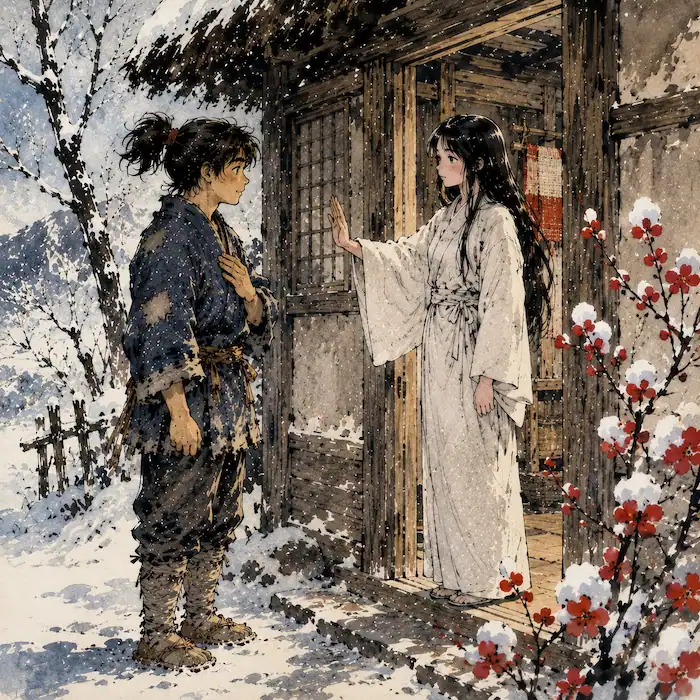
Yuki asking Haru to promise never to look inside the weaving room in The Grateful Crane

“I remember,” Haru replied. “I will not look. I promise.”

She smiled, then closed the door. At once, the loom began to move. Clack. Clack. Clack. All day, the sound filled the cottage.

Haru cooked rice for himself and left a bowl outside the weaving room. When morning came, the bowl remained untouched.

“Yuki?” he called.

“I am well,” she answered from inside. “Do not open the door.”

So Haru waited. On the second day, the loom still moved. On the third day, Haru grew worried. On the fourth day, his worry became a stone in his chest.
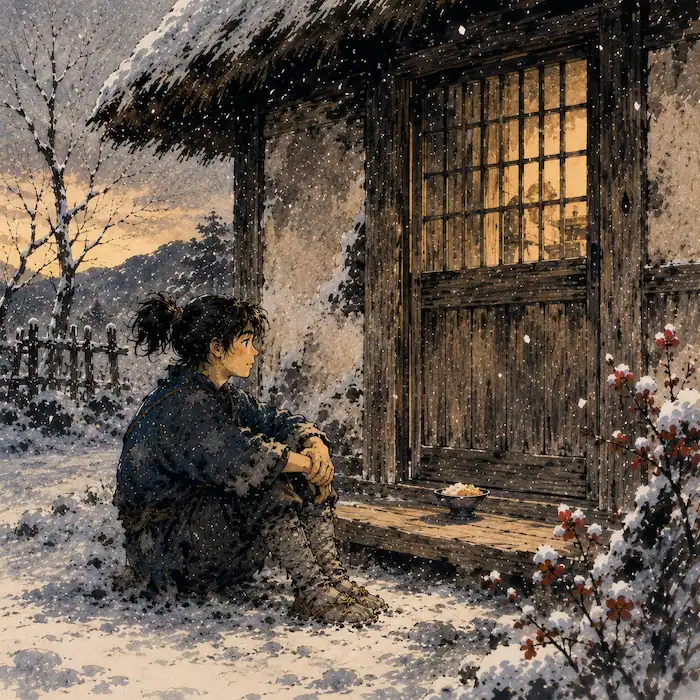
Haru sitting outside the closed weaving room while Yuki works at the loom inside

“Please rest,” he called.

“Soon,” Yuki answered. Her voice sounded faint.

Still, Haru kept his promise.

On the seventh day, the loom fell silent. The door opened, and Yuki stepped out, pale and trembling. In her hands she held a roll of cloth unlike anything Haru had ever seen.

It shone white as snow. Silver threads glimmered through it like moonlight and when Haru touched the edge, it felt soft as mist.

“This is wonderful,” he breathed.

“Take it to town,” said Yuki. “Sell it for a good price.”

“But you look tired.”

“I will rest when you return.”

Haru wanted to argue, but Yuki folded the cloth and placed it in his arms.
“Go carefully,” she said.

The Cloth of Moonlight

The next morning, Haru walked to town. He carried the cloth wrapped in plain brown paper. At the market, merchants shouted over fish baskets, vegetable stalls and jars of pickled plum.

“Fine cloth!” called one trader. “Silk from Kyoto!”

Haru unwrapped Yuki’s weaving, and the noise around him seemed to stop. A rich merchant hurried over. “Where did you get this?”
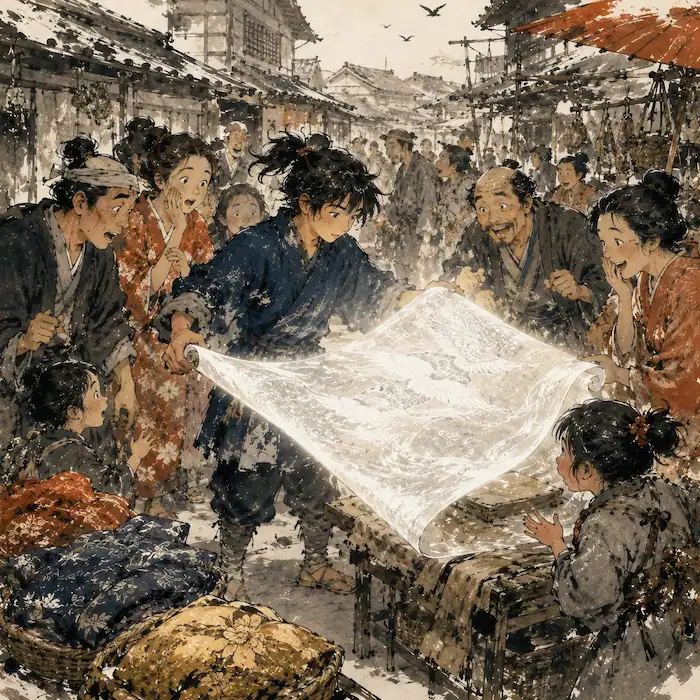
Haru showing Yuki’s glowing woven cloth to amazed merchants in a busy Japanese market

“My wife wove it,” said Haru.

The merchant touched the cloth with one finger. “I have never seen such beauty.”

Soon, other merchants gathered. They argued. They bid higher and higher. At last, the rich merchant placed a heavy pouch of coins in Haru’s hands.

“For this,” he said, “I would pay twice again.”

Haru had never held so much money. He bought rice, fish, lamp oil and warm blankets. He also bought a small comb for Yuki, carved with a flying crane.

When he returned home, Yuki smiled at the comb.

“It is beautiful,” she said.

“You earned it,” Haru replied.

Her smile faded. “Haru, listen to me. We have enough now. Please do not ask me to weave again.”

“I will not,” said Haru quickly.

For a little while, they lived in comfort. Their meals grew warmer. Their roof no longer leaked. Haru even repaired the old fence. However, news of the cloth spread.

Soon, people came to the cottage. “Can your wife make another?” asked one merchant.
“I will pay more than the last man,” said another.

Haru shook his head. “No. My wife is tired.” But the merchants kept coming, and each offer grew larger.

A Promise Tested

One evening, Haru sat by the hearth and counted the coins they still had.

“It is enough,” said Yuki.
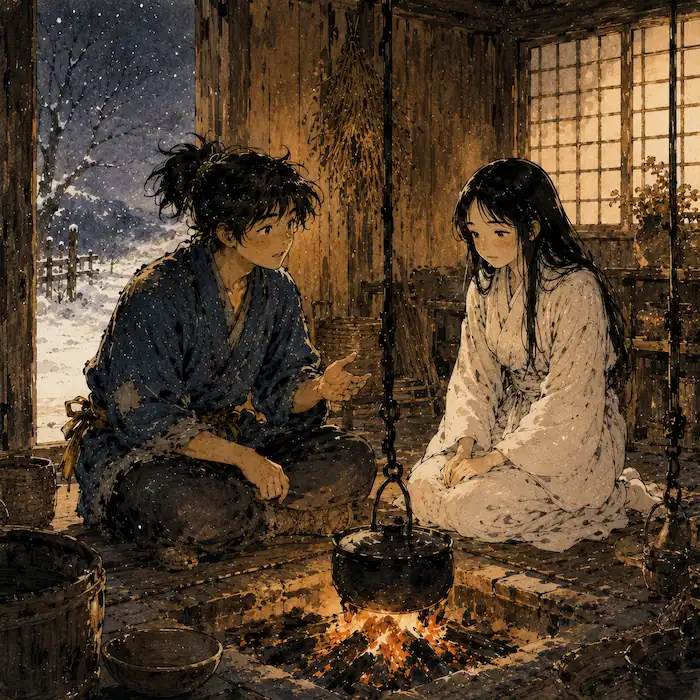
Haru and Yuki sitting by the hearth as he asks her to weave one more cloth

“Yes,” said Haru. Yet his eyes moved toward the weaving room.

With more money, he could buy a stronger ox, repair the field wall, help the old neighbor who had no sons and make life easier for Yuki. At least, that was what he told himself.

The next day, he spoke carefully. “Yuki, would you weave one more cloth?”

She grew very still. “Haru,” she said, “you promised not to ask.”

“I know. But only one more, then never again.”

Yuki looked at his worn hands. Then she looked at the patched wall, the rough floor and the small lamp between them. At last, she nodded.

“One more,” she said. “But you must keep your other promise.”

“I will,” said Haru.

So Yuki entered the weaving room again. The door closed, and the loom began its steady song.

Clack. Clack. Clack.

This time, Haru found it harder to wait. On the first day, he paced. On the second day, he pressed his ear to the door.

“Yuki?” he called.

“I am working,” she answered, but her voice sounded weak.

On the third night, Haru heard something strange beneath the clacking of the loom. A soft cry. Then another.

His heart pounded. What if she had hurt herself? What if she needed help but would not ask? What if something terrible hid inside that room?

He reached for the door, then pulled his hand back. “I promised,” he whispered.

But worry and curiosity kept tugging at him. One thought led to another until he could not sit still. By morning, Haru could think of nothing else.

Behind the Door

On the fourth day, the loom clacked more slowly.

Clack.

Clack.

Clack.

Haru stood outside the weaving room with cold hands. “Just one look,” he told himself. “If she is safe, I will close the door at once.”

He slid the door open a finger’s width.
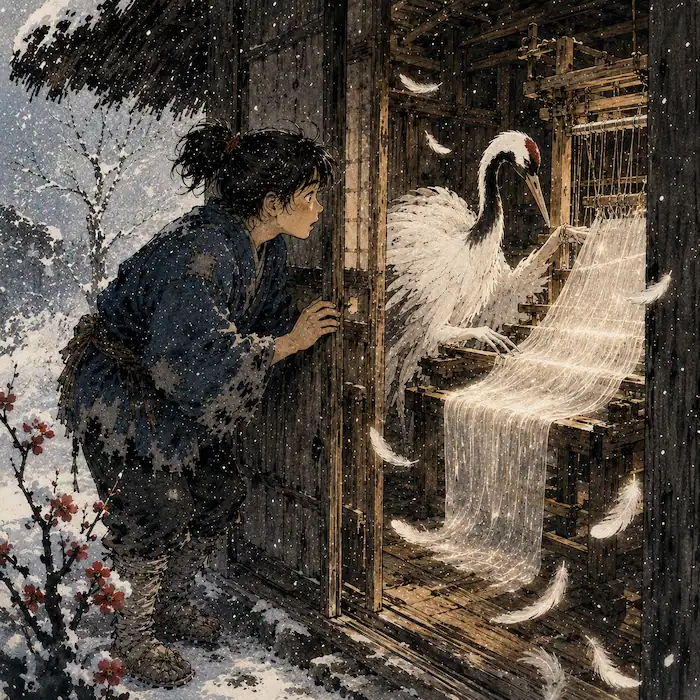
Haru peeking into the weaving room and seeing a white crane weaving with its own feathers

Inside, no young woman sat at the loom. A white crane stood there.

Its wings were thin and ragged. With its beak, it plucked feathers from its own breast. Then it wove them into the cloth. Each feather became a shining thread.

Haru gasped. The crane turned, and its dark eyes met his. The loom stopped. For a long moment, neither of them moved.

Then the crane spoke in Yuki’s voice. “Haru,” she said, “you have seen me.”

He stumbled into the room. “Yuki, I did not mean to. I was worried. I thought you might be hurt.”

“I was hurt,” she said gently. “But not in the way you feared.”

Haru sank to his knees. “You are the crane.”

“Yes. I am the crane you saved in the snow.”
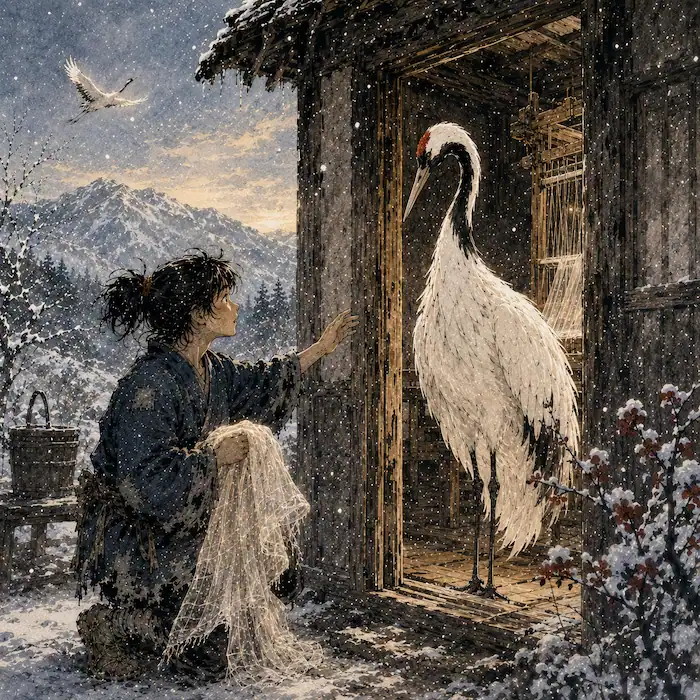
Haru holding the final cloth as the crane prepares to leave in The Grateful Crane Japanese folk tale

Inside, no young woman sat at the loom. A white crane stood there.

Its wings were thin and ragged. With its beak, it plucked feathers from its own breast. Then it wove them into the cloth. Each feather became a shining thread.

Haru gasped. The crane turned, and its dark eyes met his. The loom stopped. For a long moment, neither of them moved.

Then the crane spoke in Yuki’s voice. “Haru,” she said, “you have seen me.”

He stumbled into the room. “Yuki, I did not mean to. I was worried. I thought you might be hurt.”

“I was hurt,” she said gently. “But not in the way you feared.”

Haru sank to his knees. “You are the crane.”

“Yes. I am the crane you saved in the snow.”

The Last Gift

The crane stepped away from the loom. Her body shimmered, and for one breath, Haru saw Yuki standing before him again in her white kimono. She looked pale, but her smile still held kindness.

She lifted the unfinished cloth and placed it in his hands.

“Keep this,” she said. “Not for its price. Keep it so you remember.”

“I do not want the cloth,” Haru said. “I want you to stay.”

“I know.”

Tears filled his eyes. “I was greedy.”

“You were human,” said Yuki. “But next time you make a promise, keep it.”

Outside, the wind stirred the bamboo leaves. Yuki stepped toward the open door. As she moved, her shape changed. White feathers flashed and her wings unfurled.

Haru reached toward her, but he did not touch her.

“Thank you,” he said, though his voice broke. “For the rice, the warmth and the time we shared.”

The crane bowed her long neck, then sprang into the sky.

Haru ran outside. Snow had begun to fall again. The crane rose higher and higher, her wings shining against the clouds. She circled over the cottage, then flew toward the mountains and vanished into the white sky.
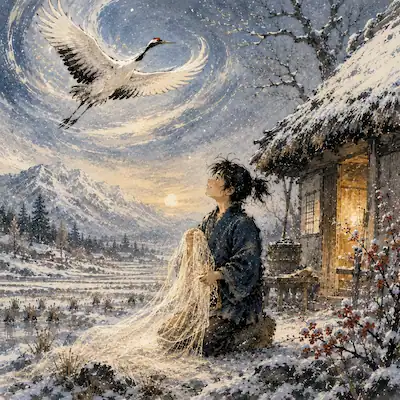
Cover image for The Grateful Crane showing Haru holding the shining cloth as a white crane flies above his snowy cottage

The Empty Cottage

For many days, Haru spoke little. The rice sack no longer stayed full. The weaving room stood silent. The cottage felt larger and colder than before.

Still, Haru did not sell the last cloth. He folded it carefully and placed it beside the hearth. Whenever he looked at it, he remembered Yuki’s voice.

“Keep it.”

Spring came at last. The snow melted from the fields, and frogs began to sing in the ditches. Haru planted rice. He worked hard, but he no longer wished for riches.

When birds landed near his field, he scattered grain for them. When he heard hunters in the distance, he shouted and clapped until the birds flew safely away.

Sometimes, in the evening, a white crane passed across the sunset. Haru would stop his work and watch until it disappeared. He never knew if it was Yuki, but he always bowed his head.

“Be safe,” he whispered.

Years later, village children came to hear the tale of the beautiful crane and the shining cloth. Haru always told it simply.

“I once received a great gift,” he said. “Kindness brought it to me, but a broken promise carried it away.”

The children sat very still when he finished. Then one small child asked, “Did you ever see her again?”

Haru looked toward the mountains, where the clouds glowed white in the evening light.

“Not as I wished,” he said. “But every crane that flies free reminds me to keep my word.”

And from that day on, whenever the village children made a promise, they remembered The Grateful Crane.

Moral

Kindness can bring unexpected gifts, but promises must be kept because trust is precious and once broken it may never return.

Short Summary of The Grateful Crane

The Grateful Crane tells the story of Haru, a poor Japanese farmer who saves an injured crane in the snow. A mysterious woman named Yuki later comes to his cottage and brings warmth, rice and beautiful woven cloth. When Haru breaks his promise not to look inside her weaving room, he discovers her secret and loses the magical gift that kindness brought him.

Main Characters in The Grateful Crane

Haru: A poor but kind young farmer who helps the injured crane.

Yuki: A mysterious young woman who comes to Haru’s cottage after he saves the crane.

The Crane: A beautiful white bird whose true identity is hidden for much of the story.

The Merchants: Townspeople who offer money for Yuki’s shining cloth.

Vocabulary from the Story

Crane: A tall bird with long legs, a long neck and wide wings.

Loom: A frame used for weaving thread into cloth.

Hearth: The area around a fireplace or fire.

Merchant: A person who buys and sells goods.

Kimono: A traditional Japanese robe.

Gratitude: A feeling of thanks.

Promise: Something a person says they will or will not do.

Trust: The belief that someone will do what they said they would do.

Discussion Questions

  1. Why did Haru help the crane even though he was poor?
  2. What does Haru’s kindness tell us about his character?
  3. Why did Yuki ask Haru never to look inside the weaving room?
  4. What changed after Haru sold the first cloth?
  5. Why do you think Haru broke his promise?
  6. Was Haru only curious, or was he also worried about Yuki?
  7. Why does Yuki leave after Haru sees her true form?
  8. What does the ending teach us about trust?

Activities for Children

Draw the scene: Draw the white crane flying over Haru’s snowy cottage. Add three details from the story, such as the rice field, the glowing cloth or the weaving room.

Story movement map: Place four signs around the room: the crane in the snow, Yuki at the cottage, the weaving room and the crane flies away. Children move from sign to sign and retell one part of the story at each stop.

Crane balance challenge: Stand on one leg like a crane, then stretch both arms out like wings. Children can try holding the pose while saying one word from the story, such as kindness, trust, promise or gratitude.

Outdoor bird watch: Go outside and look for signs of birds, such as feathers, nests, footprints, birdsong or birds in flight. Talk about how Haru showed care for a living creature and why wild animals should be treated gently.

Weaving craft: Use strips of paper, ribbon or wool to make a simple woven mat. This links to Yuki’s weaving room and helps children practise careful hand movements.

Promise jar: Write down kind promises that children can keep at home or school, then place them in a jar or box. Examples could include “I will help tidy up” or “I will listen when someone is speaking.”

Act it out: Perform the scene where Haru hears the loom and tries not to open the door. Ask children to show worry, curiosity and self-control using their face, body and voice.

Soundscape activity: Create the sounds of the story as a group. Children can make soft snow sounds, a crane call, the clack of the loom, the market crowd and the quiet farewell.

Teachers’ Notes

Best curriculum fit: Reading comprehension, traditional stories, moral stories, Japanese folk tales, speaking and listening, drama and PSHE / social-emotional learning.

Key learning themes: Kindness, gratitude, trust, keeping promises, curiosity, self-control and consequences.

Before reading: Ask children what they think it means to make a promise. You could also show a picture of a crane and discuss what children notice about the bird’s long legs, wings and neck.

During reading: Pause when Yuki asks Haru not to look inside the weaving room. Ask children what they think Haru should do and why the promise might matter.

After reading: Discuss whether Haru broke his promise because he was greedy, worried, curious or a mixture of all three. Encourage children to support their answers with details from the story.

Cross-curricular links:
Art: Japanese ink-style illustration, crane drawing or paper weaving.
Drama: Act out the loom scene and the crane’s farewell.
Nature study: Observe local birds and discuss how to treat wild animals with care.
PSHE: Talk about trust, promises and how choices affect others.
Writing: Write a diary entry from Haru’s point of view after Yuki leaves.

Why This Version Works for Children

This version keeps the traditional story’s main events while making the language clear for children aged 6–12. It keeps the important lesson about keeping promises but avoids making the crane’s suffering too frightening or graphic for young readers.

The story also gives children several ideas to discuss: helping others without expecting a reward, keeping promises, managing curiosity and understanding that some choices cannot easily be undone.

What Parents and Teachers May Want to Know

The Grateful Crane has a sad ending, but it is gentle rather than frightening. Younger children may need help understanding why Yuki leaves and why Haru cannot undo the promise he broke.

This story works well for discussions about trust, kindness, gratitude and self-control. It can also support cross-curricular learning through Japanese folk tales, bird observation, simple weaving crafts, drama and movement activities.

Story Background

The Grateful Crane is a traditional Japanese folk tale often linked in English with stories known as The Crane Wife. Like many folk tales, it has been told in different ways across storytellers, books and retellings, but the main pattern usually stays the same: a poor person helps a crane, a mysterious woman appears, a promise is made and the magical visitor leaves when the promise is broken.

The story reflects common folk tale themes of kindness, gratitude, secrecy and trust. The crane is also an important bird in Japanese culture and is often connected with beauty, long life and good fortune.

This version is written as a child-friendly introduction for young readers. It keeps the core lesson about kindness and keeping promises while avoiding details that would make the crane’s suffering too graphic for children.

Further Reading for Adults and Teachers

The Grateful Crane is often linked with traditional Japanese stories known in English as The Crane Wife. In Japan, a related tale is known as Tsuru no Ongaeshi, translated as The Gratitude of the Crane. Adults and teachers may wish to compare different versions of the tale to see how the details change while the main lesson about kindness, gratitude and trust remains similar.

For more background, see the Government of Japan article The Home of Folk Tales about Cranes, which discusses Nanyō City in Yamagata Prefecture and its connection with Tsuru no Ongaeshi.

Frequently Asked Questions About The Grateful Crane

  • What is The Grateful Crane about?

    The Grateful Crane is about a poor young farmer named Haru who saves an injured crane. Later, a mysterious woman named Yuki comes to his cottage and repays his kindness in a magical way.

  • What is the moral of The Grateful Crane?

    The moral of The Grateful Crane is that promises should be kept. The story also shows that kindness matters, even when no reward is expected.

  • What age is The Grateful Crane suitable for?

    This version is suitable for children aged 6–12. Younger children may enjoy it most as a read-aloud with an adult because the ending is gentle but sad.

  • Is The Grateful Crane a fairy tale or a folk tale?

    The Grateful Crane is best described as a Japanese folk tale. It has magical elements like a fairy tale but it comes from traditional storytelling.

  • Where does The Grateful Crane come from?

    The Grateful Crane comes from Japanese folk tale traditions. Versions of the story can vary, and in English it is sometimes linked with or compared to stories called The Crane Wife.

  • Why does Yuki leave at the end of The Grateful Crane?

    Yuki leaves because Haru breaks his promise and sees her true form. The ending shows that trust is precious and that some broken promises cannot easily be repaired.

  • What can children learn from The Grateful Crane?

    Children can learn that kindness matters, promises should be taken seriously and trust can be difficult to rebuild once it is broken. The story also encourages empathy for animals and respect for other people’s wishes.

  • How can teachers use The Grateful Crane in class?

    Teachers can use The Grateful Crane for reading comprehension, moral discussion, drama, sequencing, vocabulary work, simple weaving crafts and outdoor bird observation. It also works well as part of a topic on Japanese folk tales or stories about kindness.

Copyright Notice

© Kooky Kids World. This original retelling, illustrations, audio narration and supporting educational content are protected by copyright. The underlying folk tale is traditional and may exist in many public domain or oral storytelling versions.