
The Seven Ravens: A Grimm Fairy Tale for Kids

The Seven Ravens is a Grimm fairy tale for children aged 5 to 10. This Kooky Kids World retelling follows a brave sister who journeys across the world to find her seven brothers after an angry wish changes them into ravens.

Read the story, listen along with audio and explore a gentle fairy-tale lesson about careful words, courage, forgiveness and bringing a family home.

Listen Along

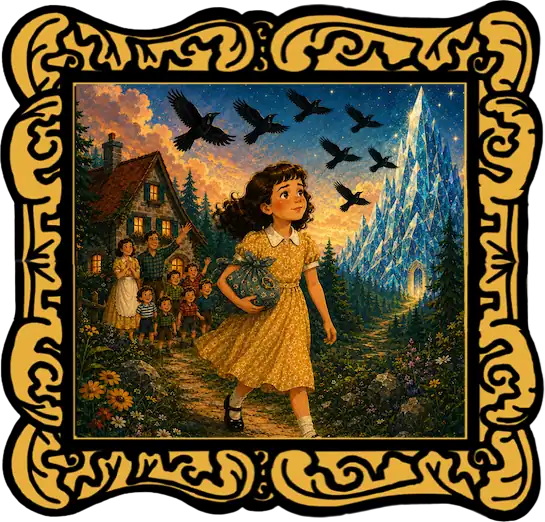
Audio cover for The Seven Ravens showing the story cover artwork with a gold frame, a girl walking toward a glass mountain and seven ravens in the sky.
0:00 / 0:00
The Seven Ravens

Listen along to Kooky Kids World audio for The Seven Ravens.

Kooky Kids World Cloud Logo showing where the audio read aloud file is.

Story Details

  • Independent Reading Age: 7 to 10 years
  • Read-Aloud Age: 5 to 10 years
  • Reading Level: Lower to middle elementary, US Grades 2 to 4
  • Reading Time: About 9 to 12 minutes
  • Author / Source: Traditional Brothers Grimm fairy tale, freshly retold for Kooky Kids World
  • Story Type: Grimm fairy tale / magical quest story
  • Region / Origin: German fairy-tale tradition
  • Main Characters: The brave sister, her seven brothers, the mother, the father, the sun, the moon, the morning star and the old woman in the Glass Mountain
  • Moral / Themes: Careful words, courage, family love, forgiveness, responsibility and hope

About This Retelling

This child-friendly retelling keeps the main shape and meaning of the traditional public-domain fairy tale best known from the Brothers Grimm. Traditional fairy tales can vary between versions, so this version uses clear gentle pacing and a hopeful family ending for young readers and listeners.

The Story

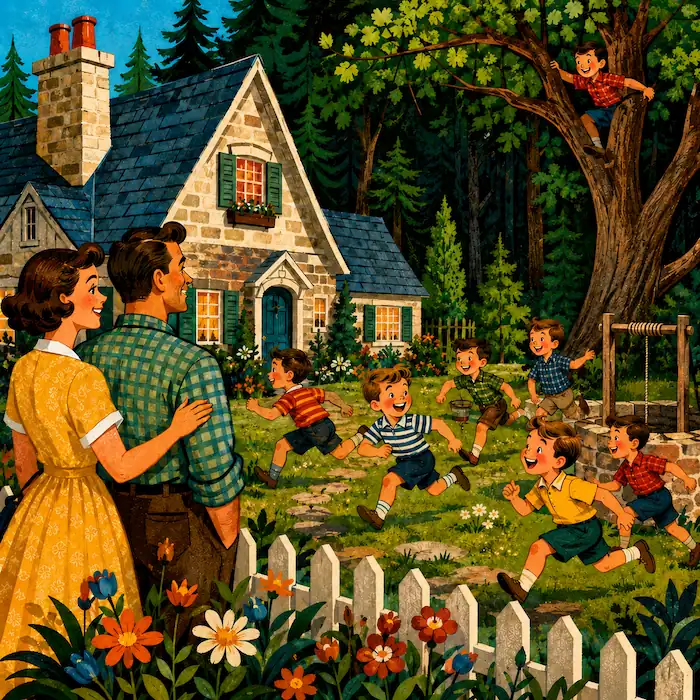
The Seven Ravens story illustration showing two parents watching seven boys run, play and climb near a cottage garden by the forest.

The Seven Brothers

Long ago, on the edge of a deep green forest, there lived a mother, a father and their seven sons. The boys were quick, noisy and full of life. From dawn to dusk, they ran through the yard, climbed trees, chased each other around the well and filled the little house with laughter.

Their parents loved them dearly, but their hearts held one quiet wish. They wished for a daughter too.
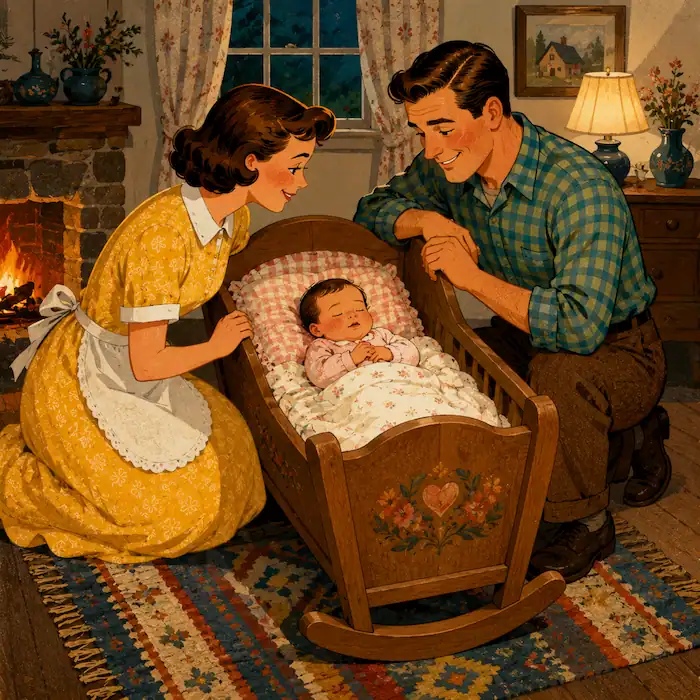
The Seven Ravens story illustration showing a mother and father leaning over their newborn baby girl in a wooden cradle by the fireplace.

At last, a baby girl was born.

The parents were overjoyed, but the baby was small and weak. She lay in her cradle with her tiny hands folded against her chest, and her breathing was so soft that everyone in the room lowered their voices and listened.

“She must be baptized at once,” said her father. “Run to the well, boys. Bring fresh water as quickly as you can.”
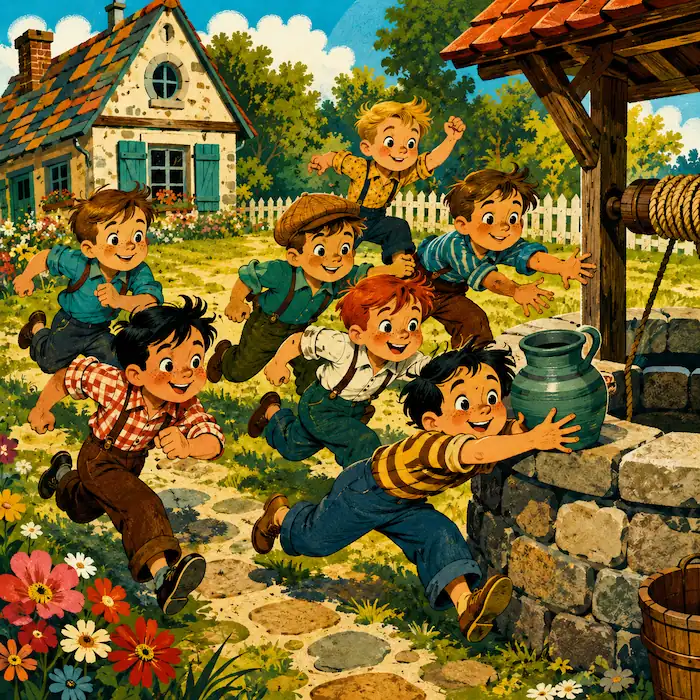
The Seven Ravens story illustration showing seven excited brothers racing toward a stone well in a sunny cottage yard.

The seven brothers raced outside together, each wanting to be the one who helped his little sister. They all reached for the water jug at the same time.

“Let me carry it!” cried the oldest.

“No, let me!” said another.
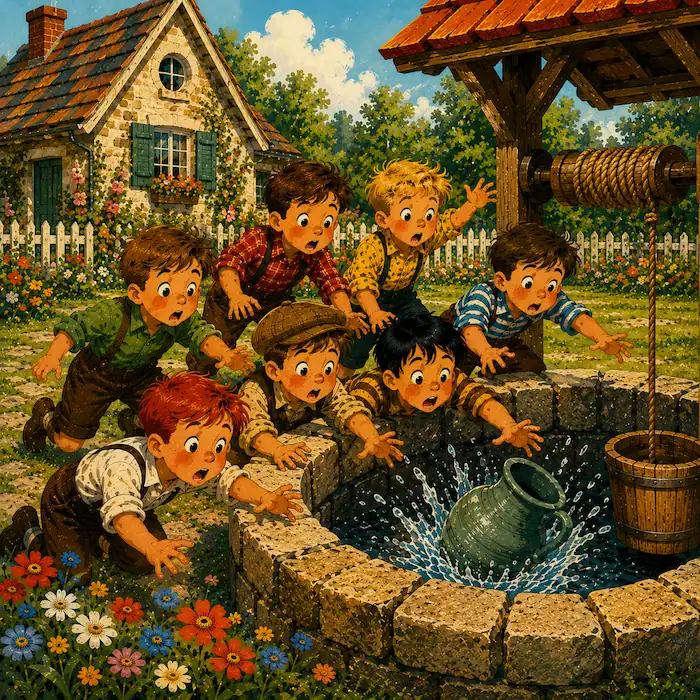
The Seven Ravens story illustration showing seven startled brothers leaning over a stone well as a water jug splashes into the dark water.

In all the pushing, pulling and shouting, the jug slipped from their hands and fell into the well with a splash.

The boys froze.

For a moment, no one spoke.

Then they peered down into the dark water. The jug was gone.

“What shall we do?” whispered the youngest brother.

The boys looked toward the house. They knew their father was waiting. They knew their baby sister needed the water. But they were frightened, and the longer they stood there, the harder it felt to go back.

“We cannot tell him,” said one brother.

“He will be furious,” said another.

So they stayed by the well, whispering and worrying, while the shadows crept across the yard.
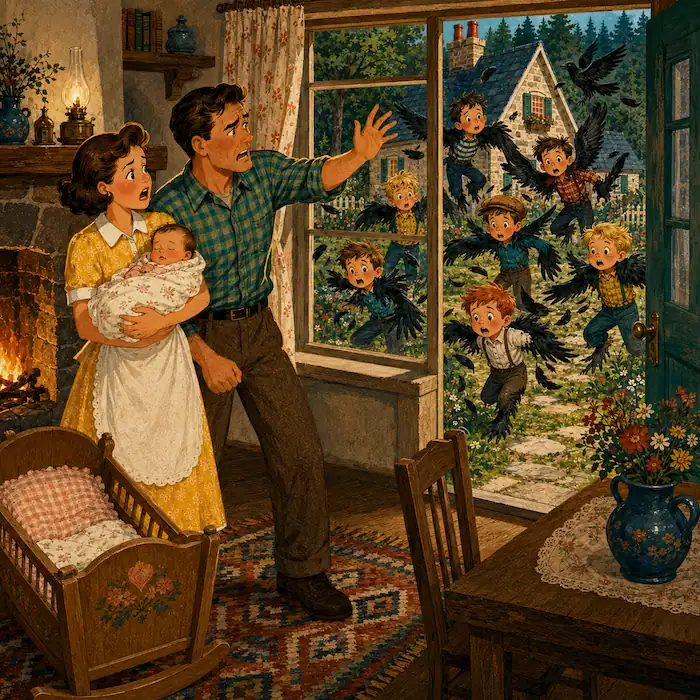
The Seven Ravens story illustration showing anxious parents inside the cottage while the seven brothers gather outside the open window.

Inside the house, their father waited. The baby’s mother held the little girl close and looked toward the door.

When the boys did not return, their father grew frightened and angry.

“Where are those boys?” he cried. “Have they forgotten their sister? I wish they would all turn into ravens and fly away!”
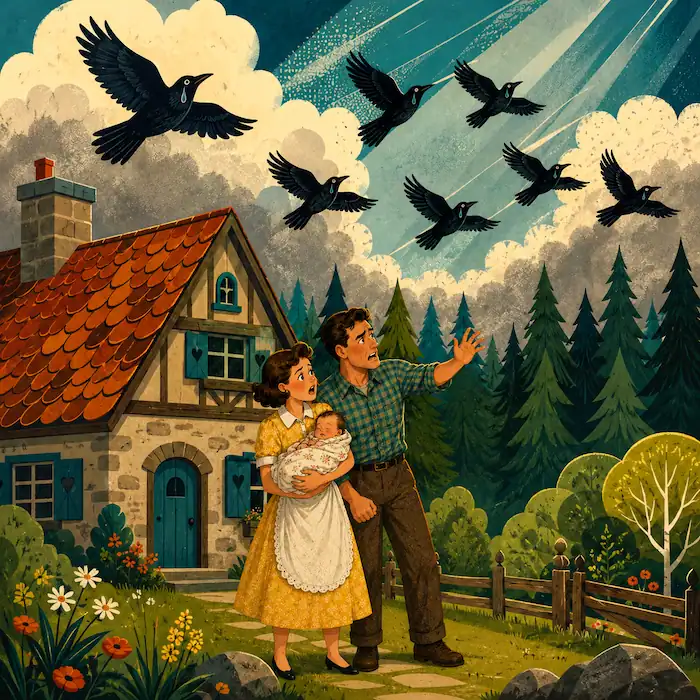
The Seven Ravens story illustration showing a mother holding the baby and a father watching seven black ravens fly away over the cottage.

The words had barely left his mouth when a rush of wings filled the air.

Outside the window, seven black ravens rose from the ground. They circled the house once, calling sadly, then flew off over the forest.

The father ran outside, but it was too late.

His sons were gone.

The mother wept. The father bowed his head in sorrow. The baby girl, who knew nothing of what had happened, slept quietly in her cradle.

The Sister Learns the Truth

The little girl grew stronger day by day. She learned to smile, then to crawl, then to walk. She grew into a kind child with bright eyes and a brave heart.

Her parents loved her very much, but there was always a sadness in the house. Sometimes her mother would look at seven empty chairs by the table. Sometimes her father would stand by the well and say nothing at all.
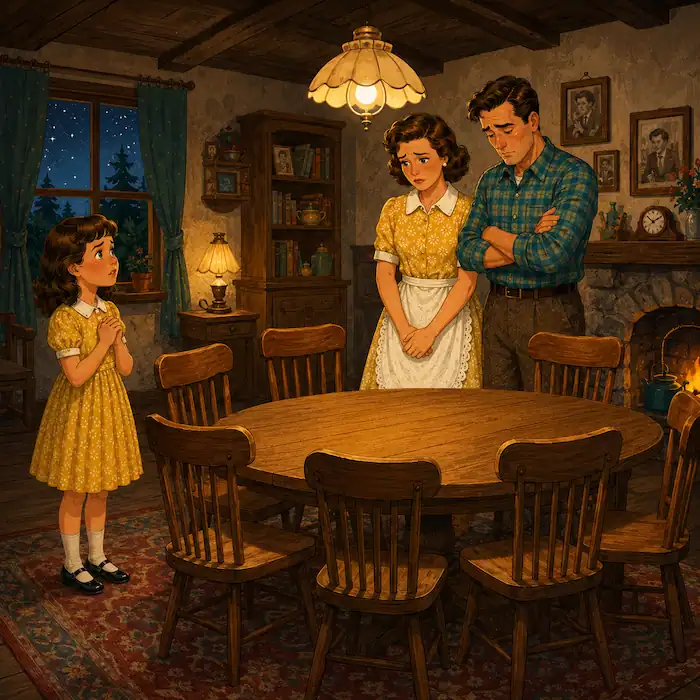
The Seven Ravens story illustration showing a young girl facing her worried parents across a table with seven empty chairs in the room.

One day, when the girl was old enough to notice these things, she asked, “Why are there seven chairs no one uses?”

Her mother turned pale.

The girl asked again, “Did someone live here before me?”

At last, her parents told her the truth. They told her about her seven brothers, the broken errand, the angry wish and the ravens that had flown away.

The girl listened with tears in her eyes.

“So they were lost because of me,” she said softly.

“No,” said her mother, holding her close. “You were only a baby. None of it was your fault.”

But the girl could not forget the story. All night she lay awake, thinking of seven brothers with black wings, flying far from home.

By morning, she had made up her mind.

“I will find them,” she said. “I will bring them back if I can.”

Her parents begged her to stay. The world was big, and she was still young, but the girl’s heart was firm.

“I cannot sit safely at home while they are lost,” she said.
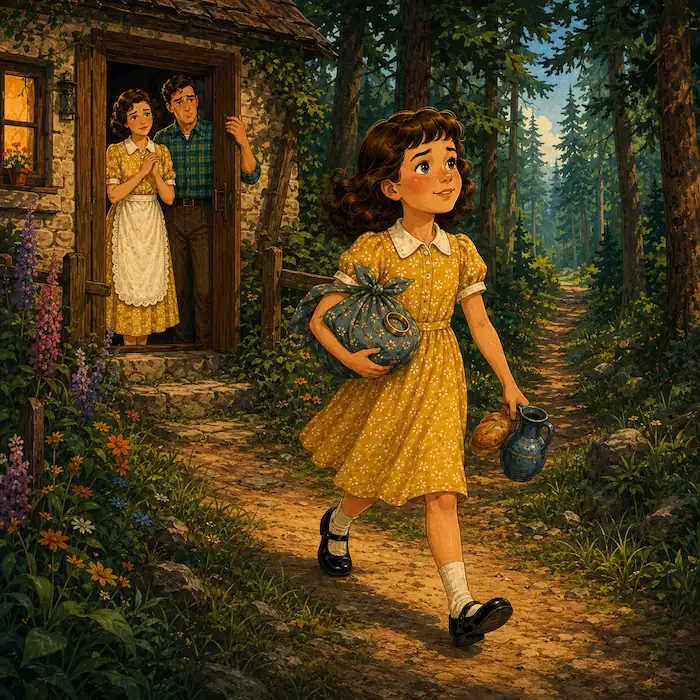
The Seven Ravens story illustration showing a girl in a yellow dress carrying a bundle and water jug as she walks into the forest.

So her parents gave her a small ring that had belonged to them, a loaf of bread, a little jug of water and their blessing. She kissed them goodbye and set off into the forest.

The trees were tall and the path was narrow. Birds sang above her and foxes slipped between the bushes. At night, the girl slept under the stars with her cloak wrapped around her shoulders.

The Journey to the Sun, Moon and Morning Star
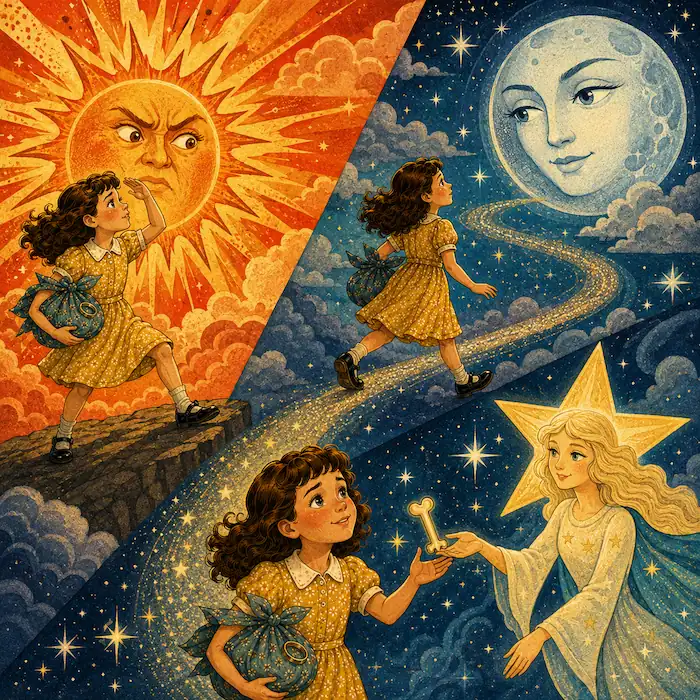
The Seven Ravens story illustration showing a girl in magical skies meeting a fierce sun, a gentle moon and a star maiden with a key.

She walked for many days, asking every traveler, bird and breeze whether they had seen seven ravens flying over the world. At last, she came to a strange, bright place where the sky seemed close enough to touch and the road shimmered with heat.

There, high above the road, she saw the sun.

The sun blazed bright and hot, with golden rays that burned the ground.

“Great sun,” said the girl, shielding her eyes, “you look across the whole wide world. Have you seen seven ravens who were once my brothers?”

The sun looked down with a face too fierce to bear.

“I see forests, fields, rivers and roads,” said the sun, “but my light is too bright and my heat too strong for a child to stay here long. Go on to the moon, who watches when my day is done.”

The girl thanked the sun and hurried away.

Next, she came to the moon.

The moon was pale and cold, shining over a silver field.

“Gentle moon,” said the girl, “have you seen seven ravens who were once my brothers?”

The moon’s light trembled.

“I watch the night,” said the moon, “but even I do not know every sorrow under the stars. Go to the morning star. The star is kinder and may guide you.”

So the girl traveled on until she reached the morning star, shining clear and bright before dawn.

“Dear star,” said the girl, “I am looking for my seven brothers. They were changed into ravens and flew away. Can you help me?”

The morning star looked at her with soft, silver light.

“You have walked far for love,” said the star. “Your brothers live in the Glass Mountain, beyond the dark plain. Take this small bone key. It will open the door.”

The girl thanked the star and held the tiny key carefully in her hand.

The Glass Mountain

She crossed the dark plain. The wind blew cold there, and no flowers grew. Even her footsteps sounded lonely, as if the earth itself were made of silence. Then, at the far edge of the plain, she saw the Glass Mountain rising before her.

It was more beautiful and more terrible than anything she had ever seen. Its sides glittered like frozen moonlight. Its cliffs shone blue, silver and white. Deep inside the glass, tiny sparks of color flickered and vanished, as if stars had been trapped there long ago.

In the side of the mountain was a door as smooth as silk. The girl reached into her pocket for the key.

Her pocket was empty.

A cold feeling ran through her. She remembered the long road, the dark plain and the wind tugging at her cloak. Somewhere behind her, the tiny bone key had slipped away.

For a moment, the girl wanted to sit down and cry. She had come so far. Her brothers were so close. One little key stood between them.

Then she took a deep breath.

“I will not turn back now,” she said.

Beside the door was a narrow crack, just large enough for a key. The girl looked at the crack, then at the small ring her parents had given her. It was the only treasure she had from home.
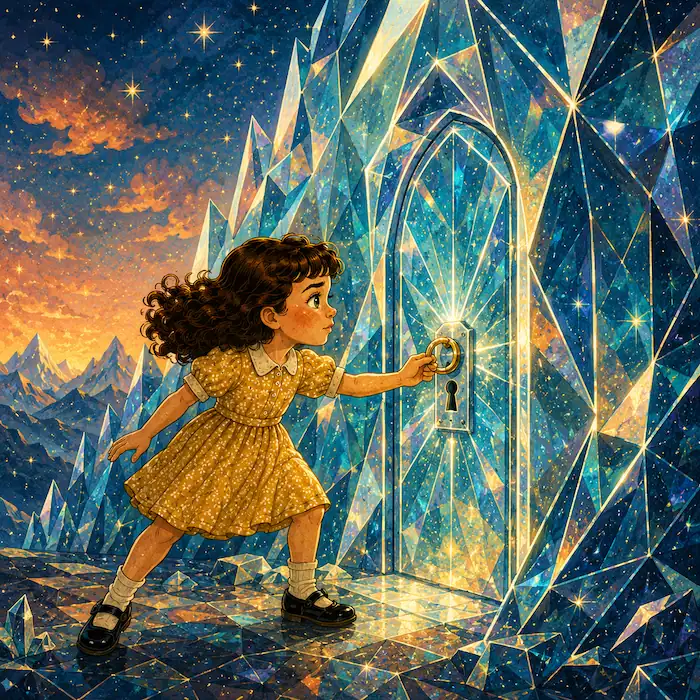
The Seven Ravens story illustration showing a girl pressing a glowing ring to the door of a sparkling glass mountain under a starry sky.

“If love brought me here,” she whispered, “then love must open the way.”

She pressed the ring into the crack.

The ring shone with a warm light.

Slowly, the door opened.

Inside the Glass Mountain

Inside the Glass Mountain was a bright hall. In the middle of the hall stood a table with seven plates, seven cups and seven little chairs.

An old woman came forward.

“Who are you?” asked the old woman.

“I am looking for seven ravens,” said the girl. “They are my brothers.”

“The ravens will return soon,” said the old woman. “They come home each evening. But you must hide for now. If they see you too suddenly, they may be frightened and fly away.”

The girl hid behind a door near the table.

Soon, she heard the beating of wings.
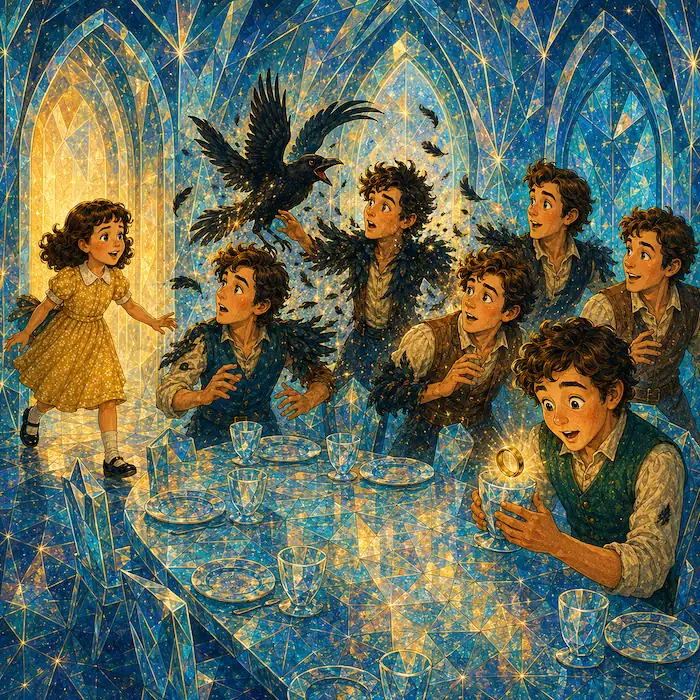
The Seven Ravens story illustration showing a girl inside a glittering glass hall as seven brothers and a black raven gather around a table.

Seven ravens flew into the hall and settled beside the table. All day they wore their black feathers and crossed the sky as birds. But inside the mountain, when evening came, the spell loosened its hold. One by one, they shook their wings. Feathers fluttered to the floor like scraps of night, and seven young men stood beside the table.

The girl held her breath.

The brothers sat down to eat. Each had a small plate and a cup. The girl quietly stepped forward while they were looking away. She placed a tiny piece of bread from home on each plate. Then she dropped her parents’ ring into the youngest brother’s cup.

The youngest brother lifted the cup and saw the ring shining at the bottom.

He gasped.

“This is our parents’ ring,” he said. “Someone from home has found us.”

The brothers stood at once.

“If only our sister were here,” said the oldest, “then the spell might be broken.”

The girl could wait no longer.

“I am here,” she said.

She stepped from behind the door.

For a moment, the brothers stared at her in wonder. Then the youngest ran to her, and the others followed.

“Our sister!” they cried.

As they spoke, the black feathers that still clung to their shoulders fell away. The spell broke like mist in sunlight.

The seven ravens were seven brothers again.

The girl laughed and cried at the same time. Her brothers gathered around her, asking a hundred questions all at once.

“How did you find us?”

“Were Mother and Father well?”

“Did you come alone?”

“You are braver than all of us!”

The girl smiled.

“I came because you were missing,” she said. “And because our family was not whole without you.”

Home Again

The brothers led her out of the Glass Mountain. The dark plain did not seem so frightening now. The moon lit their path. The morning star watched over them. Even the sun, when it rose, seemed warm instead of fierce.
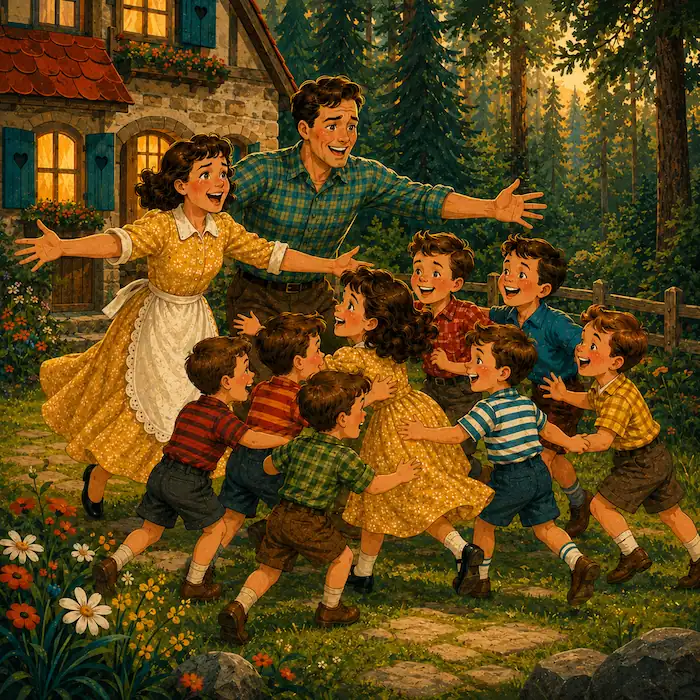
The Seven Ravens story illustration showing the mother, father and seven brothers joyfully welcoming the girl home outside the forest cottage.

At last, they reached the little house by the forest.

Their mother was standing by the door. Their father was near the well.

When the parents saw eight children coming toward them, they could hardly believe their eyes.

The mother ran to her sons and held them close. The father wept and asked their forgiveness.

“I spoke in anger,” he said. “I have wished every day that I could take those words back.”

The brothers forgave him, for they had long wished to come home too.

From that day on, the seven chairs were never empty again. The house was noisy once more, filled with fun, stories and laughter.

And whenever anyone in the family grew angry, they remembered the ravens.

They learned that words can fly farther than we mean them to, and love must sometimes travel even farther to bring everyone home.

Moral

Words spoken in anger can hurt, but courage, love and forgiveness can help make a family whole again.

Short Summary

In The Seven Ravens, seven brothers are sent to fetch water for their baby sister, but the water jug falls into the well. Their frightened father speaks an angry wish, and the boys are changed into ravens. Years later, their sister learns the truth and sets out to find them. With courage and help from the morning star, she reaches the Glass Mountain, finds her brothers and helps break the spell so the whole family can return home.

After reading The Seven Ravens, visit our fairy-tale collections for more enchanted forests, brave children, magical helpers and classic stories retold for young readers.

Grimms Fairy Tales
Fairy Tales for Kids
Bedtime Stories for Kids

Main Characters

  • The sister: A brave and loving girl who will not give up on her brothers.
  • The seven brothers: Boys who are changed into ravens after a frightened mistake and an angry wish.
  • The father: A worried parent whose angry words cause the spell and who later asks forgiveness.
  • The mother: A loving parent who grieves for her sons and protects her daughter.
  • The sun, moon and morning star: Magical guides on the sister’s journey.
  • The old woman: The keeper inside the Glass Mountain who tells the girl how to wait for the ravens.

Vocabulary Spotlight

  • Raven: A large black bird, often used in fairy tales and legends.
  • Baptized: A religious ceremony mentioned in many older fairy tales.
  • Curse: A magical harm caused by words or a spell.
  • Glass Mountain: A magical mountain that shines like glass in the story.
  • Morning star: A bright star-like light seen near dawn, used here as a magical guide.
  • Forgiveness: Letting go of anger when someone is truly sorry.
  • Courage: Doing what is right even when something feels difficult or frightening.

Discussion Questions

  1. Why did the seven brothers feel afraid after the jug fell into the well?
  2. Why were the father’s angry words so important in the story?
  3. How did the sister show courage on her journey?
  4. Which helper was most useful to the sister: the sun, the moon or the morning star? Why?
  5. Why did the ring matter at the Glass Mountain?
  6. What does the story teach about speaking when we are angry?
  7. How did forgiveness help the family at the end?
  8. What would you have packed for a journey to the Glass Mountain?

Classroom Activities for Children

  • Journey map: Draw the sister’s route from home to the sun, moon, morning star, dark plain and Glass Mountain.
  • Careful words activity: Make a two-column chart with words that hurt and words that help.
  • Raven transformation art: Draw one picture showing the brothers as ravens and another showing them restored.
  • Fairy-tale object study: Talk about the jug, ring, key, table, cups and chairs. Ask what each object does in the story.
  • Freeze-frame drama: Act out silent scenes such as the broken jug, the ravens flying away, the morning star giving the key and the family reunion.
  • Forgiveness sentence starters: Practice kind repair language such as “I am sorry because…” and “Next time I will…”
  • Compare fairy tales: Compare The Seven Ravens with another Grimm story that includes a quest, a spell or a brave family member.

Teachers’ Notes

Best curriculum fit: Fairy tales, Brothers Grimm stories, journey structure, magical helpers, family stories, emotional literacy and careful speech.

Before reading: Explain that traditional fairy tales often use magic to show real-life feelings, such as fear, anger, guilt, courage and forgiveness.

During reading: Ask children to notice when words change the story and when actions help repair the harm.

After reading: Discuss the difference between blame and responsibility. The sister is not to blame for the curse, but she chooses a loving action that helps her family.

Teacher tip: Keep the focus on careful words and repair rather than making the father’s mistake feel too heavy for younger children.

Why This Version Works for Children

This version keeps the magical journey, the seven ravens and the Glass Mountain while softening the harshest parts of the older fairy-tale tradition. The sister’s courage is clear, the family ending is hopeful and the moral is easy for children to understand without making the story feel like a lecture.

What Parents and Teachers May Want to Know

This story includes an angry parental wish, a magical curse, sadness and a lonely journey. It is best shared with younger children as a read-aloud. The ending is warm and restorative, with apology, forgiveness and reunion.

Story Background

The Seven Ravens is a traditional European fairy tale best known from the Brothers Grimm. Like many Grimm stories, it uses magical transformation and a difficult journey to explore family love, responsibility and repair after harm.

This Kooky Kids World version is a fresh retelling based on the public-domain fairy-tale tradition. It is not copied from Grimm or from a modern retelling.

Further Reading for Adults and Teachers

Adults and teachers who want source context can view public-domain Grimm collections through Project Gutenberg’s Grimm’s Fairy Tales record.

Frequently Asked Questions About The Seven Ravens

  • What is The Seven Ravens about?

    The Seven Ravens is about a brave girl who sets out to find her seven brothers after they are changed into ravens by an angry wish. Her journey takes her to the sun, the moon, the morning star and the Glass Mountain.

  • What is the moral of The Seven Ravens?

    The moral is that words spoken in anger can hurt, but courage, love and forgiveness can help make a family whole again.

  • What age is The Seven Ravens suitable for?

    This Kooky Kids World retelling is best for independent readers aged 7 to 10, with read-aloud support for children aged 5 to 10.

  • Is The Seven Ravens a Brothers Grimm fairy tale?

    Yes. The Seven Ravens is a traditional fairy tale best known from the Brothers Grimm. This page uses a fresh child-friendly Kooky Kids World retelling based on the public-domain tradition.

  • Is The Seven Ravens scary?

    This version has magical danger, sadness and a family curse, but the language is gentle and the ending is hopeful. Younger children may prefer it as a read-aloud with an adult.

  • What does the Glass Mountain mean in The Seven Ravens?

    In this retelling, the Glass Mountain is the magical place where the brothers live while they are under the raven spell. It gives the story a sense of wonder, difficulty and hope.

  • How can teachers use The Seven Ravens in class?

    Teachers can use it for lessons on fairy-tale structure, careful words, family love, forgiveness, journey stories, character courage and comparing traditional tales.

  • Does this version include audio?

    Yes. The page includes a read-aloud audio player so children can listen to the story as well as read it.

Copyright Notice

This story is based on a traditional public-domain fairy tale. This Kooky Kids World retelling, page text, audio narration, illustrations and supporting educational materials are © Kooky Kids World. They may not be copied, republished or reused without permission.