

The Story of The Fisherman and His Wife
The Hovel by the Shore
There once lived a fisherman and his wife in a crooked little cottage by the sea. The roof sagged when it rained. The wind whistled through the walls. When the tide was high, the whole place smelled of salt, wet rope and old smoke. Still, it was home.
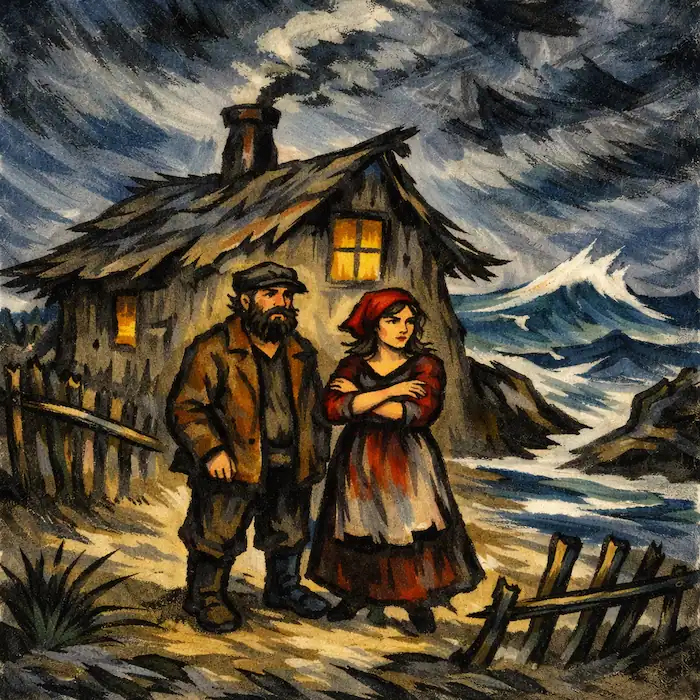
Every morning the fisherman took his line and hook and walked down to the shore. He was a quiet man with kind eyes and slow, careful hands. He never shouted at gulls, never stamped at the waves and never grumbled when the fish were scarce. He simply cast his line and waited.
His wife was different. She was sharp-eyed and quick-tongued and always noticed what other people had: a better roof, a bigger stove, a clean path, a garden fence. Even when she had bread in her hand, she could think of honey she did not have.
One gray morning the fisherman sat on a rock and lowered his line into water so clear he could see the silver sway of seaweed below. He waited a long time. The sea breathed in and out. Clouds drifted over the sun. Still he sat.
Then suddenly the line jerked hard.
The fisherman pulled with both hands. Up came a great flounder, broad and gleaming, with strange bright eyes. It twisted on the hook and said in a clear voice, “Please let me go, fisherman. I am no ordinary fish. I am an enchanted prince.”
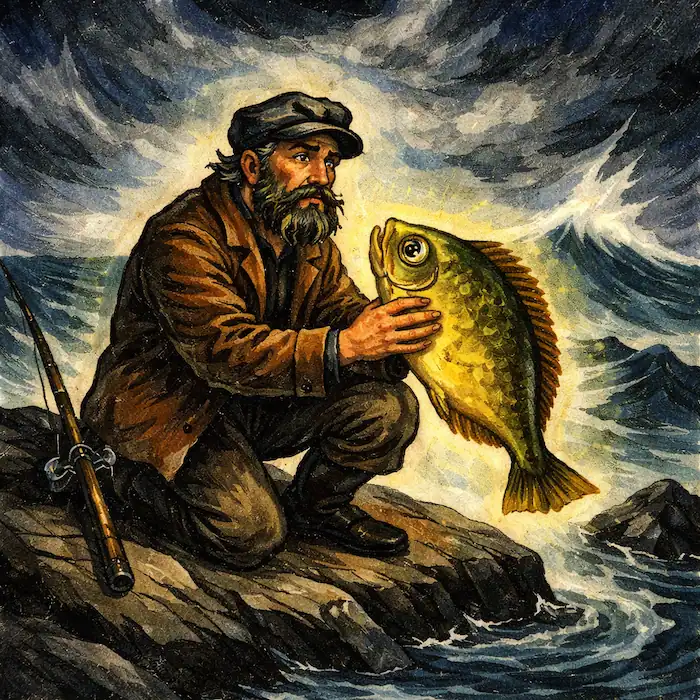
The fisherman nearly dropped his rod, but the flounder went on.
“If you take me home, I will be of no use to you. I would make a poor meal. Put me back in the sea and spare me.”
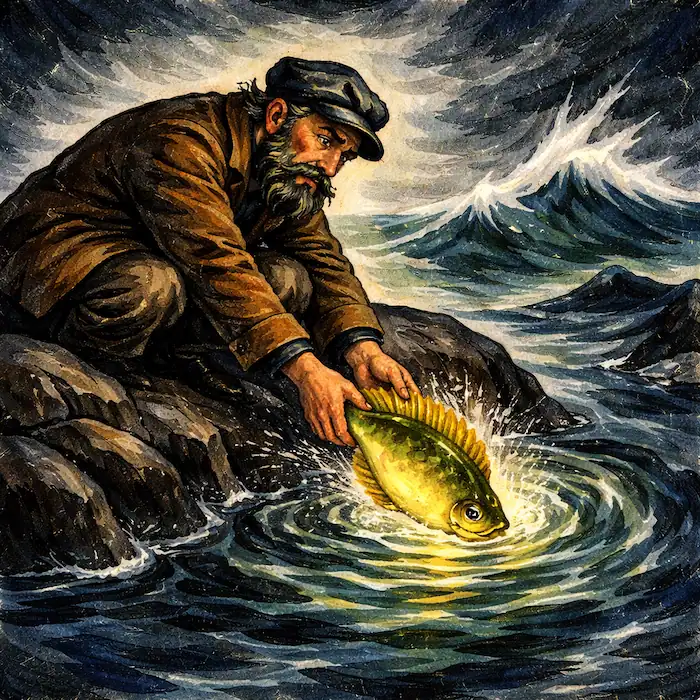
The fisherman stared. Then he gave a little shrug. “Well, if you can talk, you are too remarkable for my frying pan.”
He eased the hook free and slipped the flounder back into the water. The fish flicked its tail once and vanished into the green-blue depths.
A Wish Never Asked
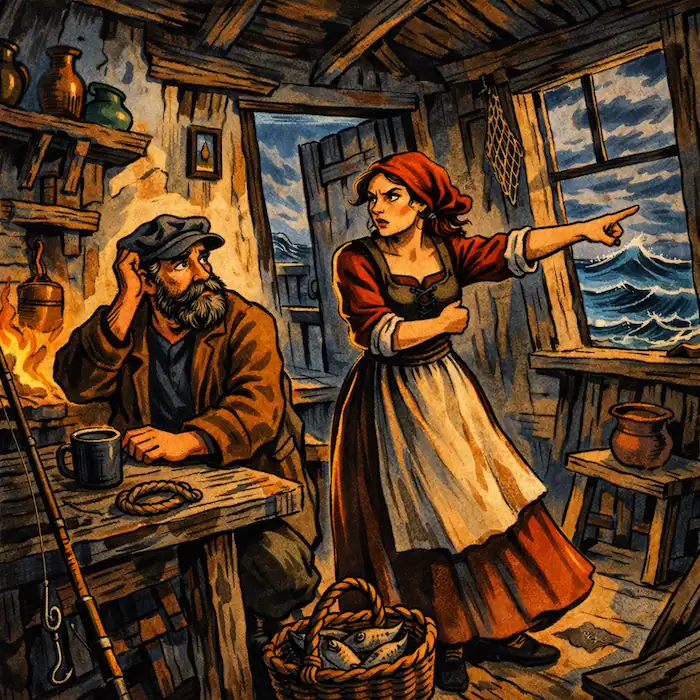
When the fisherman returned to the hovel with an empty basket, his wife was waiting in the doorway with her arms crossed.
“Well?” she said. “Did you catch nothing at all?”
“I caught a flounder,” said the fisherman, setting down his rod. “But it spoke to me. It said it was an enchanted prince, so I let it go.”
His wife blinked. “It spoke?”
“Yes.”
“And you asked for nothing?”
The fisherman looked puzzled. “Why would I?”
She threw up her hands. “Because we live in this miserable house, that is why. The floor is damp, the walls lean and the chimney smokes. You should have wished for a little cottage.”
The fisherman rubbed the back of his neck. “I did not think of it.”
“Well, think of it now,” she snapped. “Go back and call the fish.”
The fisherman did not want to go. He had been glad to save the strange fish. Asking for a reward felt wrong somehow. Yet his wife would not stop. At last he sighed and trudged back to the sea.
The water had changed. It was no longer clear and shining. It had turned cloudy green and yellow, as if something below had stirred up the sand.
He stood on the shore and called:
Flounder, flounder in the sea,
hear me now and come to me.
Though I ask with little pride,
my wife wants more than I decide.
At once the flounder rose from the water.
“What does she want?”
“She wants a cottage.”
The flounder dipped its head.
“Go home. She has it already.”
The Cottage With the Garden
The fisherman hurried back and stopped in surprise.
The bent old hovel was gone.
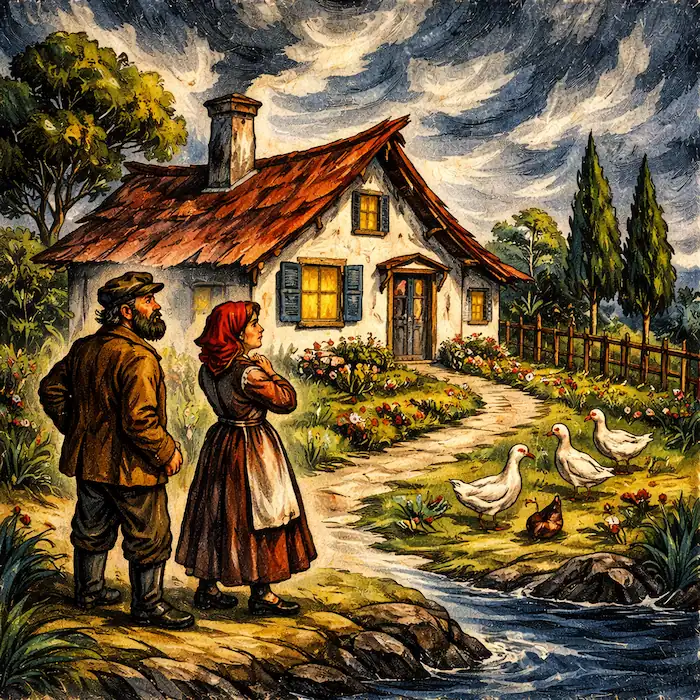
In its place stood a pretty white cottage with a red roof and blue shutters. A small path ran to the front door. A tidy garden bloomed with beans, cabbage and marigolds. Ducks waddled in a pen. Chickens scratched by the fence.
His wife sat on a wooden bench in the sun as if she had always belonged there.
Inside, the cottage was warm and bright. Copper pans hung by the stove. Fresh bread cooled on the table. There was a snug bedroom with a quilted bed and a chest for clothes.
The fisherman’s face softened.
“This is more than enough. Now we can live in peace.”
His wife ran her fingers over the polished table.
“Perhaps,” she said.
For a while they did live comfortably. They ate good soup, slept in a dry bed and watched their vegetables grow. The fisherman thought the matter was settled.
Before long, his wife stood in the garden, looking toward the hill.
“This place is small,” she said. “The rooms are narrow. The yard is cramped. The fish could have done better.”
The fisherman stared at her. “Better? We have everything we need.”
She shook her head. “I want a great stone house. No, a castle. A proper one, with steps and tall windows and servants.”
“A castle?” said the fisherman. “That is foolish talk.”
“Go to the flounder,” she said. “Ask.”
“I do not like it,” he answered.
“Go.”
So he went.
The Castle on the Hill
When he reached the sea, it had darkened again. The water was thick and restless, purple and slate blue under a low sky.
He called the flounder, and the fish rose once more.
“What does she want now?” it asked.
The fisherman swallowed. “She wants a stone castle.”
“Go home,” said the flounder. “She has it already.”
The fisherman turned and climbed the path, but when he looked up he almost lost his footing.
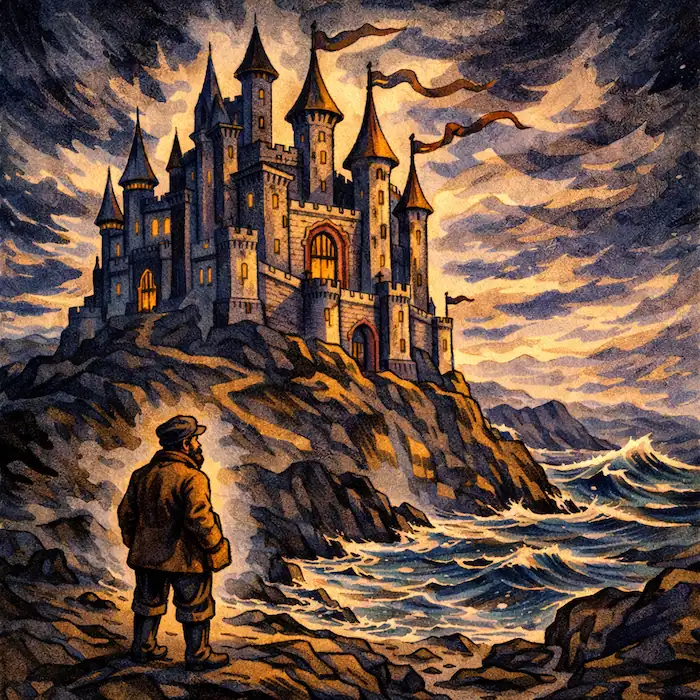
A vast stone castle stood where the cottage had been. Towers rose above the trees. Flags cracked in the wind. Great doors of carved oak stood open and his wife waited on the wide front steps wearing a velvet gown.
“Come in,” she said, pleased as a queen.
Inside were marble floors, glittering chandeliers and walls hung with bright woven tapestries. Servants bowed as they passed. There were silver dishes in the dining hall, soft rugs in every room and a grand stable beyond the courtyard. The gardens stretched farther than the fisherman could see. Deer moved between the trees. Fountains leaped in the sunlight.
The fisherman felt small among all that splendor.
Still, he said, “Surely now you are satisfied?”
His wife smiled without looking at him. “We shall see.”
A Crown Too Heavy
The next morning dawned clear and gold. From her high window the wife looked over fields, roads and villages far below.
She nudged her husband awake. “Why should we live in a castle and still answer to others?” she asked. “All that land should belong to me. Go tell the flounder that I want to be Queen.”
The fisherman sat up. “Queen? I do not want such a thing.”
“You do not have to,” said his wife. “I do.”
He pleaded with her. He argued. He begged her to be content. But she only grew harder.
So he went back to the sea.
Now the water smelled sour. It had turned dark gray and surged in heavy waves that slapped the shore.
The flounder appeared.
“What now?”
The fisherman wrung his cap in his hands. “My wife wants to be Queen.”
“Go home,” said the fish. “She is Queen already.”
When the fisherman returned, the castle had grown larger still. Guards stood at the gates. Trumpets sounded. Banners streamed from the towers.
He entered a great throne room bright with gold and scarlet. At the far end, on a raised platform, sat his wife. She wore a heavy crown of gold. A jeweled scepter glittered in her hand. Courtiers lined the hall in rows.
“Well, wife,” said the fisherman quietly, “now you are Queen.”
“Yes,” she said. “Now I am Queen.”

He hoped that would be the end of it.
It was not.
By evening she had grown restless. “A Queen rules one country,” she said. “That is too little. Tomorrow I shall be emperor.”
The fisherman turned pale. “This has gone far enough.”
“Far enough for you,” she said. “Not for me.”
The Sea Turns Black
The next time he walked to the shore, the wind tore at his coat. The sea was black and thick with foam. The sky hung low and the gulls had all flown inland.
The flounder rose without a splash.
“She wants to be emperor,” said the fisherman before the fish could speak.
“Go home,” said the flounder. “She is emperor already.”

Back he went through booming gates and marble halls brighter than before. Nobles in rich robes hurried like servants. Musicians played. Guards stamped their spears.
His wife sat on a throne so grand it seemed to swallow the room. Her robes blazed with gold thread. Her crown shone with rubies and diamonds. People bowed so low their foreheads nearly brushed the floor.
“Well, wife,” said the fisherman, “you are emperor now. There can be nothing more.”
She looked down at him with a cool smile. “Nothing more? There is always more.”
And before another day had passed, she said, “I will be pope.”
The fisherman gasped. “That is impossible.”
“Ask,” she said.
Again he begged her to stop. Again she would not listen.
So back to the sea he went, trembling.
This time a storm rolled above the water. Red streaks tore across the sky. Great waves rose like hills, and the fisherman could hardly stand upright.
The flounder came.
“She wants to be pope,” whispered the fisherman.
“Go home,” said the fish. “She is pope already.”
Splendor Without Peace
When he returned, a mighty church stood at the center of a shining city. Bells rang overhead. Crowds knelt along the roads. Candles glowed in thousands.
Inside the grand church sat his wife on a lofty throne, robed in gold and white, crowned three times over. Kings and emperors bent before her.

“Well, wife,” said the fisherman, his voice small in the enormous hall, “now you are Pope.”
“Yes,” she said. “Now I am Pope.”
He looked at her a long time. She had more power than anyone could dream of. Still, her eyes were not calm. They darted like birds searching for the next branch
That night she tossed and turned. The fisherman, worn out with worry, slept heavily beside her, but she lay awake, staring into the darkness.
Then at dawn she saw the first line of light in the sky.
She sat bolt upright.
“The sun rises,” she said. “The moon sets. Day comes. Night goes. And none of it obeys me.”
The fisherman groaned. “Do not start again.”
She gripped his arm. “Go to the flounder. Tell him I want power over the sun and moon.”

The fisherman fell to his knees beside the bed. “No. Ask anything else. Ask for peace. Ask for rest. But not this.”
Her face twisted with fury.
“Go!”
The Last Demand
The storm that met him was terrible.
Trees bent low. Roof tiles flew through the air. Waves smashed against the rocks with a sound like thunder. The sea boiled black beneath a sky split by lightning. Rain lashed the fisherman’s face, and his feet slid in the mud.
Yet he stumbled on until he reached the shore.
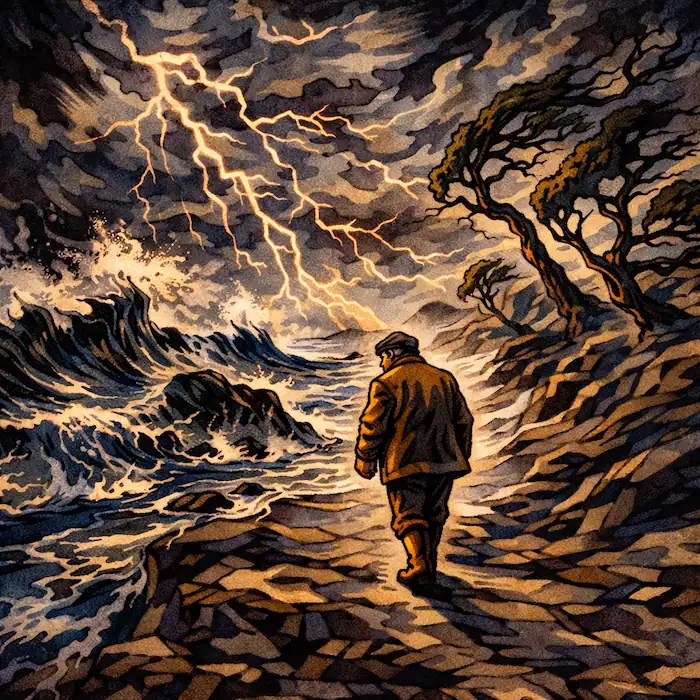
“Flounder, flounder in the sea,” he cried into the gale, “please hear me. My wife wants power over the sun and moon.”
For a moment the storm seemed to hold its breath.
Then the flounder rose through the black water. Its bright eyes fixed on the fisherman, and its voice was colder than the rain.
“Go home,” it said. “You will find her in the old hovel.”
That was all.
The fish disappeared.
The fisherman stood shivering on the shore as the wind whipped around him. Then he turned and made his way home through the dark.
When he reached the hill, the castle was gone.
The city was gone.
The church was gone.
The towers, the guards, the banners, the glittering halls, the servants, the gardens, the fountains, the stables, the jeweled crowns and the golden thrones — all of it had vanished as if it had never been.
There, leaning crookedly near the shore, stood the old hovel.
Smoke dribbled from the broken chimney. One shutter hung loose. The door creaked in the wind.
Inside, his wife sat on their old stool beside the cracked hearth. Her fine robes were gone. Her crowns were gone. Her hands were empty.
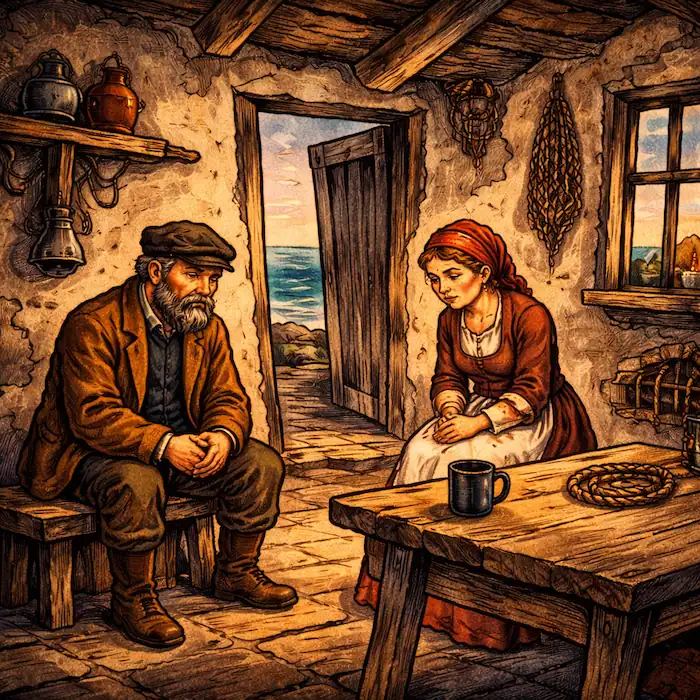
For the first time in a long while, she said nothing.
The fisherman laid down his wet cap and sat on the bench opposite her. The room smelled of smoke, salt and damp wood, just as it had before. Outside, the sea sighed in the dark.
At last his wife looked around the little room.
There was the patched roof.
There was the chipped pot.
There was the rough table and the narrow bed.
All the things she had once hated.
The fisherman waited for her to rage. He waited for her to order him back to the shore. He waited for one more wish.
But none came.
Perhaps she knew at last that no house could ever be large enough for a heart that was never satisfied. Perhaps she understood that each new splendor had only sharpened her hunger. Or perhaps she was simply tired.
The fisherman rose quietly and put another stick on the fire.
The flame flickered brighter for a moment.
Then he sat down again.
Outside, the storm rolled away across the sea. By morning the sky was clear. The gulls returned. Waves washed the shore in long white lines. And though the hovel was poor and the work was hard, the day began as days always do, whether people are grateful or not.
The fisherman picked up his line and hook.
He looked once at his wife.
Then he walked down to the water.
The Shore at Morning
The sea was calm again, pale beneath the rising sun.
The fisherman stood for a while and listened to the waves. He did not call for the flounder. He did not cast his line at once. First he breathed the cold clean air and watched the light spread over the water.
Then he gave a small nod, as if to someone far away.
After that, he set to work.
Back in the hovel, his wife opened the door and looked out at the sea. She saw the small figure of her husband on the shore and the wide bright morning around him. No trumpets sounded. No servants hurried. No banners snapped in the wind.
Only gulls cried overhead and the tide moved in and out.
For once, that was all.
And this time, it had to be enough.