
Tom Thumb – An English Folk Tale

Tom Thumb is a classic English folk tale about a tiny boy with a very quick mind. Though no bigger than his father’s thumb, he guides a horse, escapes greedy strangers, tricks robbers, survives a very surprising cow adventure and finds his way home after meeting a hungry wolf.

Story Details

  • Independent Reading Age: 8 to 10
  • Listen-Along Age: 5 to 9
  • Reading Level: Medium-length classic fairy tale
  • Reading Time: About 10 to 12 minutes
  • Author / Source: Traditional English folk tale, retold for Kooky Kids World
  • Story Type: English folk tale / fairy tale
  • Region / Origin: England / European folk tale tradition
  • Main Characters: Tom Thumb, his mother and father, two strangers, two robbers, a cow and a wolf
  • Moral / Themes: Clever thinking, courage, family love, home and using your strengths
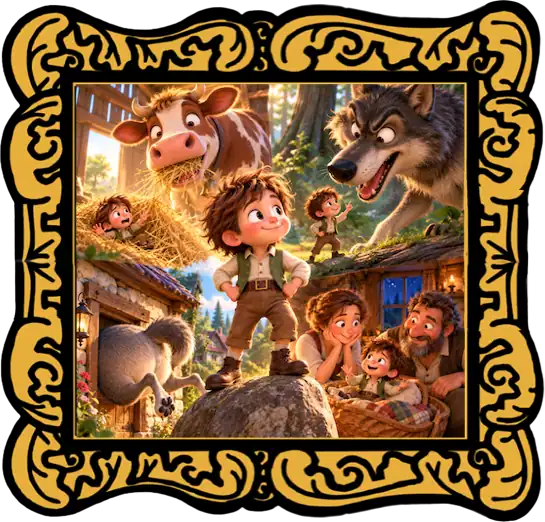
Tom Thumb audio cover illustration showing the tiny hero with the cow, wolf and family from the English folk tale.
0:00 / 0:00
Tom Thumb
Kooky Kids World Cloud Logo showing where the audio read aloud file is.

Tom Thumb

Once upon a time, a poor woodcutter and his wife lived in a small cottage beside a great forest. They had a warm fire, a wooden table and a little garden by the door, but the cottage was very quiet because they had no child.

One evening, the woodcutter’s wife looked at the empty chair beside the fire and sighed. “I would be happy with a child no bigger than my thumb,” she said, “if only we had one to love.”

Not long afterward, their wish came true. A tiny boy was born to them, so small that he could rest in the palm of his mother’s hand. His father stared at him in wonder while his mother wrapped him carefully in a soft scrap of cloth. “We shall call him Tom Thumb,” she said.
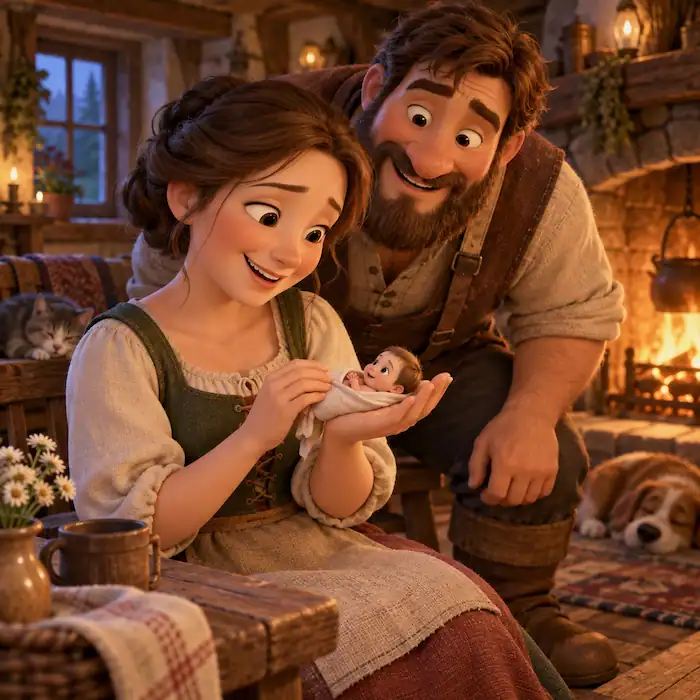
Tom Thumb English folk tale illustration of the woodcutter and his wife wishing for a child no bigger than a thumb.

Tom was tiny, but he was lively, cheerful and full of ideas. He slept in a walnut shell, drank from a thimble and pulled a folded leaf over himself at night like a blanket. His parents loved him dearly, and Tom loved them just as much.
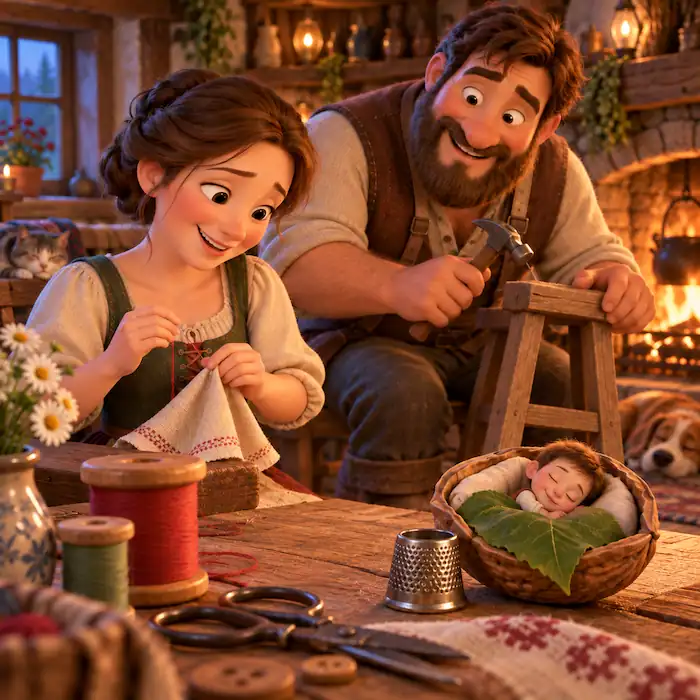
Tom Thumb resting in a walnut shell bed while his parents look on inside the cottage.

As Tom grew older, he stayed no taller than his father’s thumb. That never seemed to bother him. He fetched pins for his mother, counted seeds in the garden and shouted advice whenever his father repaired a stool or sharpened an axe. “Careful with that hammer, Father!” called Tom.

His father laughed. “Thank you, Tom. I have only been using one for thirty years.”

“I thought you might need reminding,” said Tom.

One morning, the woodcutter prepared to take the horse and cart into the forest. Tom scrambled onto the table. “Take me with you, Father. I can help.”

His father smiled. “You are too small to chop wood.”

“I know,” said Tom. “But chopping is not the only useful thing in the world.”

His mother packed him a crumb of bread for his dinner, and his father tucked him safely inside his coat pocket. Then they set off along the bumpy road and into the forest, where tall trees crowded together and the ground smelled of damp leaves and moss.

The woodcutter worked hard all morning. His axe went chop, chop, chop and branches crashed onto the forest floor. Tom watched from the pocket until, by midday, the cart was piled high with wood. “Put me beside the horse’s ear,” Tom called. “I can guide him home.”

His father laughed. “You?”

“Unless the horse has a better idea.”

So the woodcutter gently placed Tom where the horse could hear his tiny voice. “Left a little,” called Tom. “Now right. Straight ahead. Mind that stone!”
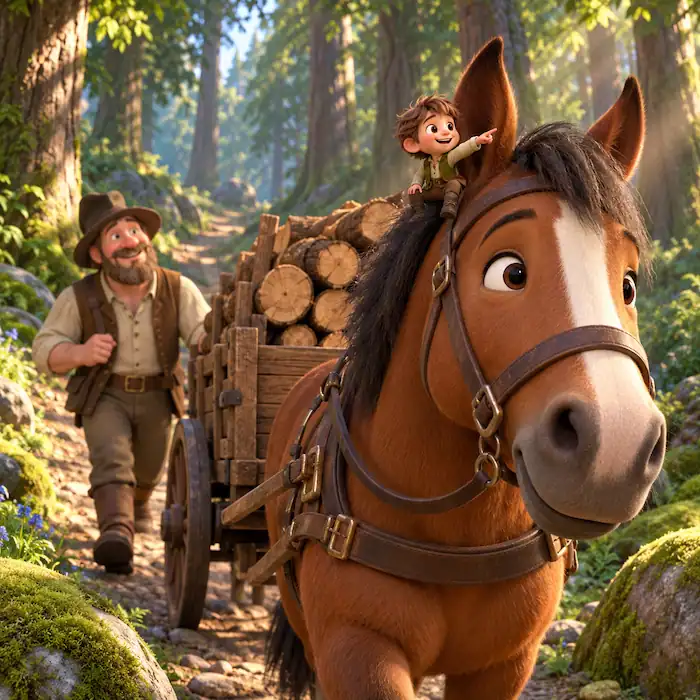
Tom Thumb sits by the horse’s ear and guides the woodcutter’s cart through the forest.

The horse flicked his ear and obeyed every word. Soon the cart was rolling neatly along the forest path with no one sitting at the reins, while the woodcutter walked behind.

Two strangers nearby stopped and stared. “Look at that cart,” said one. “There is nobody driving it.”

Then they heard a tiny voice calling, “Keep going! Not into the bush!”

The strangers crept closer and spotted Tom beside the horse’s ear. One man’s eyes widened. “A little fellow like that could make us rich,” he whispered. “People would pay good money to see him.”

They hurried over to the woodcutter and offered to buy Tom. The woodcutter’s smile vanished at once. “No,” he said firmly. “Tom is my son. He is not for sale.”
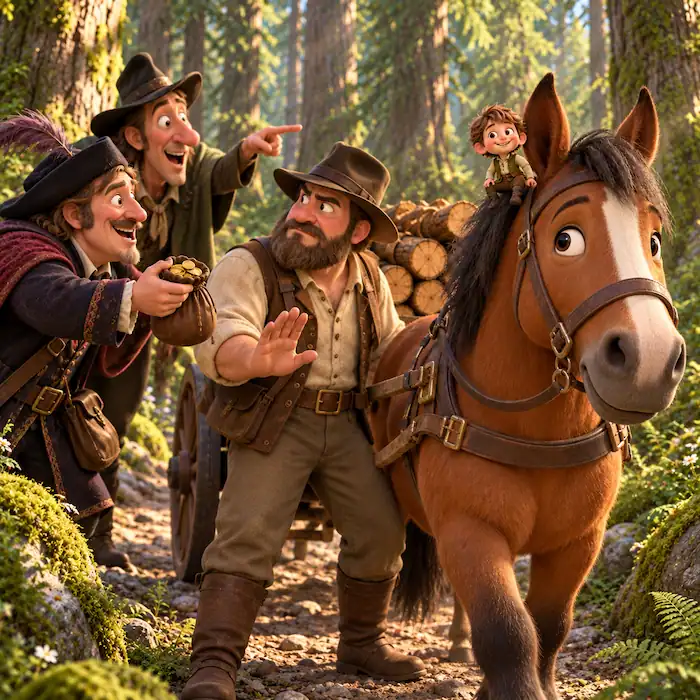
Two strangers stare in surprise as tiny Tom Thumb guides the horse beside his father in the forest.

Tom leaned close to his father’s ear. “Let them take me,” he whispered. “I will come home again.”

The woodcutter stared at him and shook his head, but Tom promised that he had a plan. At last, very reluctantly, his father agreed. The strangers placed Tom on the brim of a hat and carried him away, while the woodcutter watched them disappear between the trees.

Tom sat quietly and studied the path. Thick weeds grew beside the track, and twisted roots pushed up through the soil. When they reached a particularly tangled stretch of forest, he pointed ahead. “Please put me down. My legs have gone stiff.”

One man frowned. “You are hardly bigger than my finger. How can your legs be stiff?”

“They are very small legs,” said Tom. “They stiffen quickly.”

The men laughed and set him on the ground. That was all Tom needed. He dashed beneath a leaf, scrambled over a root and slipped into a narrow crack in the earth before either man could grab him. “Come back!” shouted one.
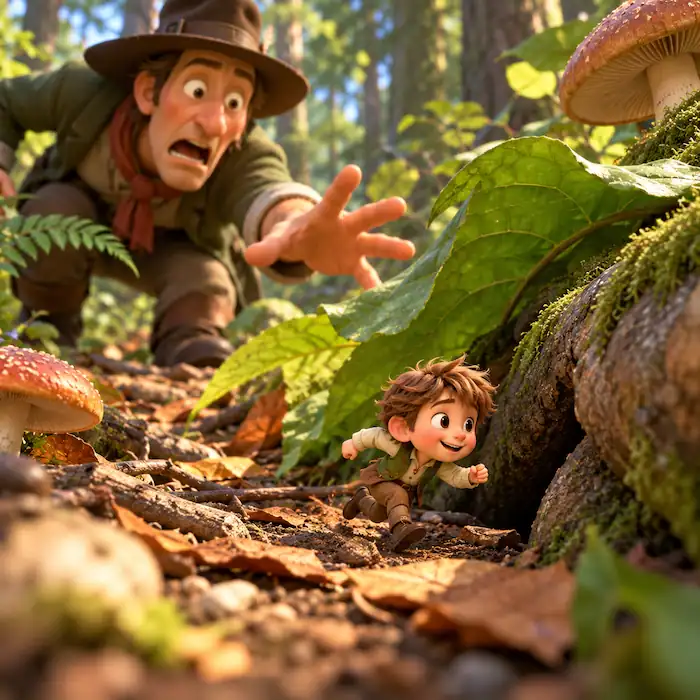
Tiny Tom Thumb hides under a large leaf while a stranger searches for him on the forest floor.

A finger poked into the crack, then a stick. Tom wriggled deeper and pressed himself flat against the soil. The men searched and grumbled until the light began to fade, but Tom stayed as quiet as a beetle. Finally, they gave up and tramped away.

Tom waited until their footsteps disappeared before climbing out. The forest looked very different now. In the fading light, every tree seemed enormous and every root looked like a fallen trunk to someone no bigger than a thumb.

He found an empty snail shell beneath a fern and curled up inside it. “This will do nicely,” he murmured.

Before he could fall asleep, however, he heard footsteps and low voices.

Two robbers were creeping along the path, whispering about a grand house nearby. “There is silver on the table,” said one. “And coins in the cupboard,” said the other.
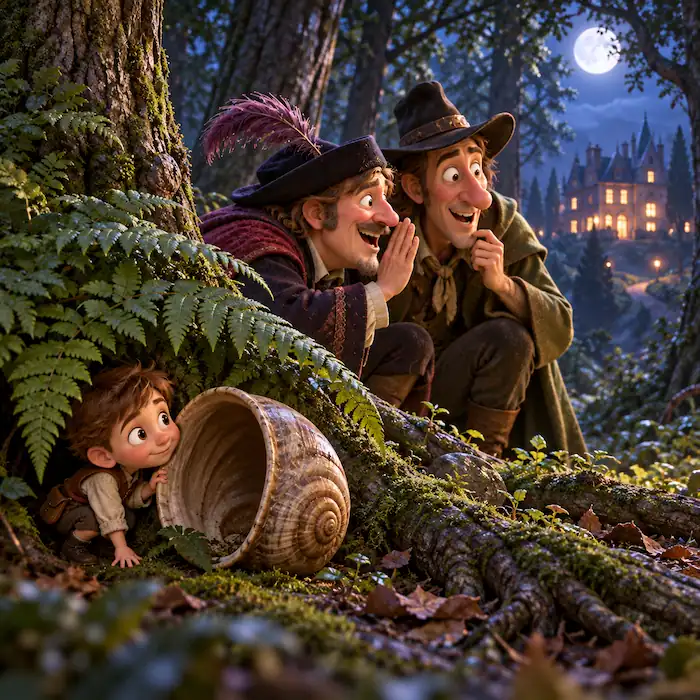
Tom Thumb stands near an empty snail shell while two robbers whisper in the moonlit forest.

Tom poked his head out of the shell. “I can help you.”

The robbers froze and stared around until they noticed the tiny boy standing beside the shell. When Tom told them he was small enough to squeeze through almost any gap, they grinned and carried him to the grand house.

They pushed Tom through a narrow opening beside a window. Inside, moonlight stretched across the floor, and silver plates and spoons gleamed on a table. “Pass them out!” whispered one robber from outside.

Tom looked at the silver, then towards the stairs. “DO YOU WANT THE BIG SILVER PLATE?” he shouted.

“Shhh!” hissed the robbers.

“OR SHALL I GET THE COINS FIRST?”

A dog barked upstairs. A floorboard creaked, and someone called, “Who is there?” The robbers ran so fast they nearly fell over each other. Tom bit his lip to stop himself laughing, then slipped back through the window before anyone came downstairs.
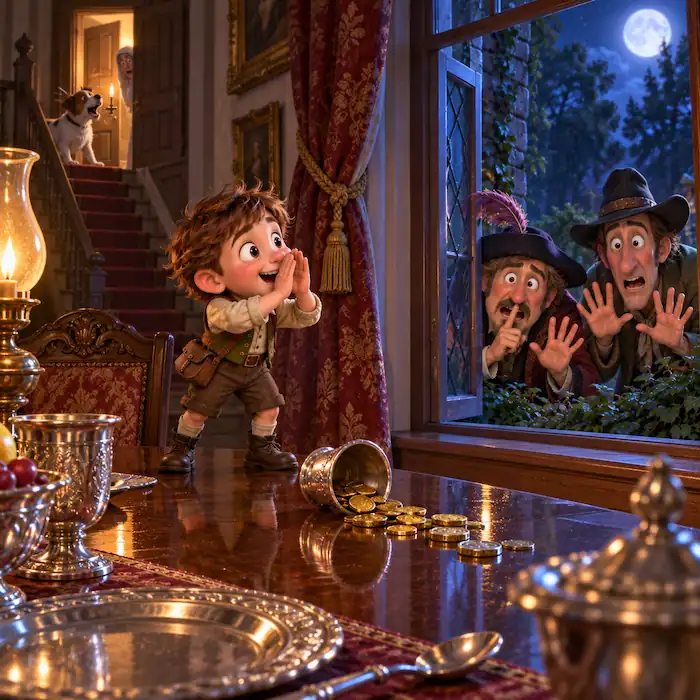
Tom Thumb stands beside silver plates in a grand house while robbers watch nervously from the window.

By now he could hardly keep his eyes open, so when he found a barn, he crawled into a soft pile of hay and fell asleep. Unfortunately, morning brought a hungry cow.
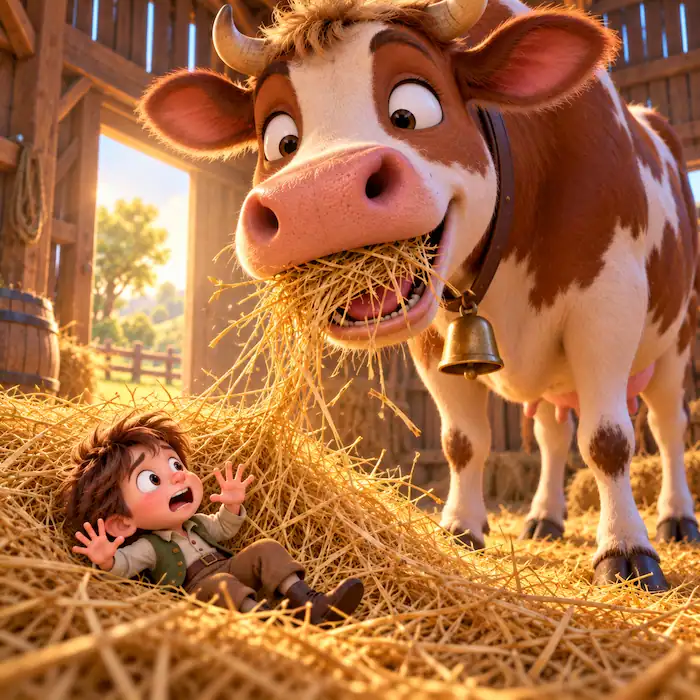
A surprised cow chews hay in the barn while tiny Tom Thumb disappears into the straw.

The cow began munching the hay, and Tom woke just as the straw around him lifted into the air and a huge mouth appeared above him. “Oh, no,” he said.

A moment later, down he went with the cow’s breakfast.

It was warm, dark and terribly squashy inside. Tom pushed at the hay around him and shouted, “No more breakfast, please! There is quite enough in here already!”

A farm girl milking nearby heard the voice and dropped her pail. The farmer came running. “What happened?”

“The cow spoke!”

The farmer stared at the cow. “Moooo,” said the cow.

“That sounded like a cow to me.”

Then Tom shouted again. “I said NO MORE HAY!”

The farmer jumped backwards. The cow coughed once, then twice, and on the third cough Tom shot out into the straw with hay sticking from his hair.
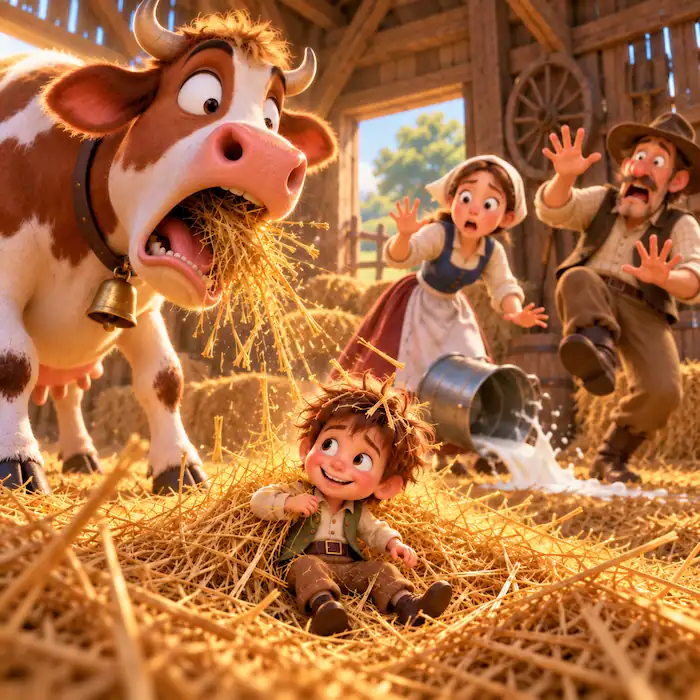
Tom Thumb tumbles into the barn straw as the shocked cow, farmer and farm girl react.

Nobody moved until Tom stood up, brushed himself down and bowed politely. “Good morning,” he said. “I have had better breakfasts.”

Before anyone could catch him, he darted beneath the barn gate and hurried back towards the forest.

Tom wanted nothing more than to find the road home, but after a while he heard something behind him. Pad, pad, pad. He stopped, and the sound stopped too. Tom walked again, and the soft footsteps returned. Slowly, he turned around and saw a hungry wolf standing between the trees.

The wolf lowered his nose and sniffed. “What have we here?” he growled. “A tiny bite wearing boots.”
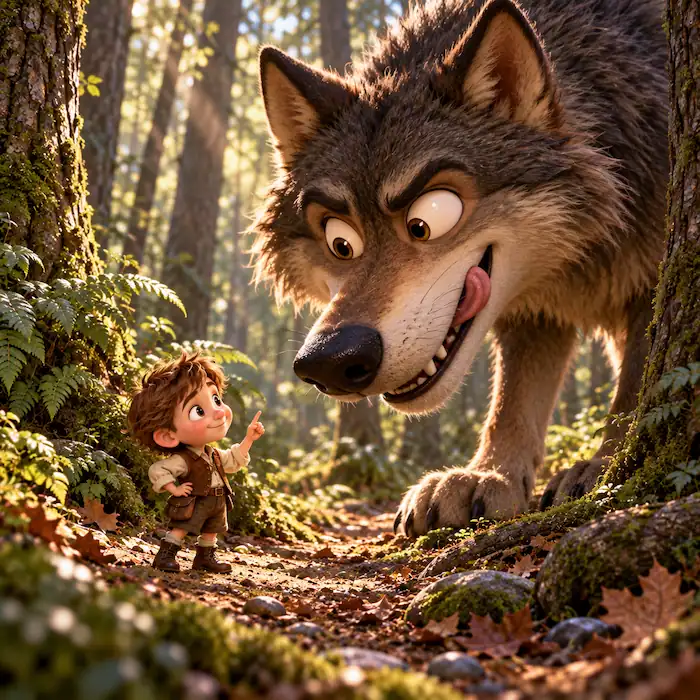
Tiny Tom Thumb stands bravely on the forest path in front of a hungry wolf.

Tom swallowed hard, but he stood his ground. “You could eat me,” he said, “but you would hardly notice.”

The wolf licked his lips. “A bite is a bite.”

“I know somewhere with cakes,” said Tom. “And cheese. And sausages.”

The wolf’s ears lifted. “Where?”

Tom described his parents’ cottage and the little opening beside the door. The wolf did not wait to hear another word. He raced away between the trees, and Tom followed as fast as his tiny legs could carry him.

When Tom finally reached the cottage, the wolf had already squeezed inside. He had found the cakes, then the cheese and then the sausages. He ate and ate until his stomach was round as a barrel.

At last, the wolf tried to crawl back outside. He pushed, wriggled, huffed and puffed, but he was much too full to fit through the opening.

Tom climbed onto a shelf and shouted, “Father! Mother! Wake up! I am home!”

The woodcutter and his wife rushed into the kitchen. “Tom!” they cried. Then they saw the wolf.
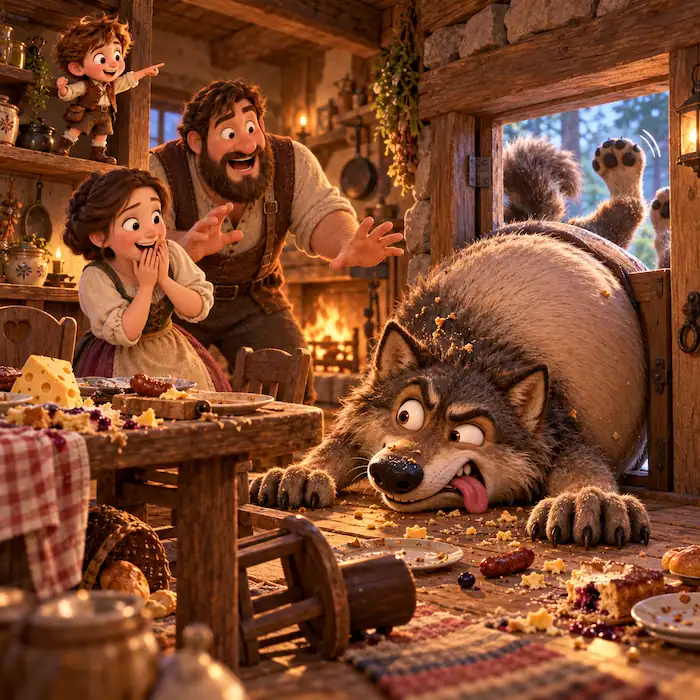
Tom Thumb’s parents wake in their cottage as the overfull wolf gets stuck beside the table.

The woodcutter grabbed his axe. With one careful blow, he killed the wolf, then lifted Tom safely down from the shelf.

Tom’s mother held him close. “My dear little boy,” she said. “We thought we had lost you.”

His father smiled with tears in his eyes. “You are worth more than all the silver in the world.”

Tom grinned. “I told you I would come home.”

That evening, Tom sat in his walnut shell beside the fire and told his parents about the strangers, the robbers, the cow and the wolf. His father listened with growing amazement until Tom finally reached the end. “That is quite enough adventure for one little boy,” he said.

Tom glanced towards the dark forest beyond the window. “For now,” he said.
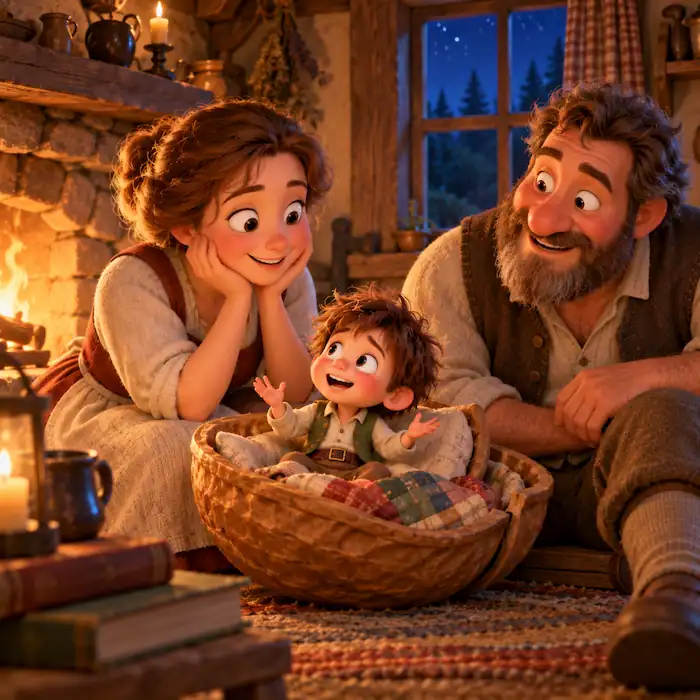
Tom Thumb smiles from his walnut shell beside the fire while his parents sit close by.

Moral

Moral: Being small does not mean being helpless. Tom Thumb uses courage, quick thinking and a loud voice at the right moment to get himself home.

Short Summary

Tom Thumb is a tiny boy born to a poor woodcutter and his wife. Although no bigger than a thumb, he uses quick thinking to escape greedy strangers, outwit robbers, survive a strange encounter with a cow and return home after tricking a hungry wolf. The story shows that courage and clever thinking can matter more than size.

About This Retelling

This child-friendly retelling keeps the main shape and meaning of the traditional Tom Thumb story while using clear language for young readers. Traditional stories can vary between regions, families and storytellers, so this version should be read as an introduction rather than the only version.

Main Characters

  • Tom Thumb: A tiny but fearless boy who uses humor, quick thinking and confidence to escape trouble.
  • The woodcutter: Tom’s loving father, who worries about his tiny son but learns to trust Tom’s cleverness.
  • The woodcutter’s wife: Tom’s caring mother, who longs for a child and is overjoyed when Tom returns home.
  • The strangers: Greedy men who hope to make money from Tom’s unusual size.
  • The robbers: Thieves who try to use Tom to steal silver and coins from a grand house.
  • The farm girl and farmer: Two astonished people who cannot understand why a voice seems to be coming from the cow.
  • The wolf: A hungry and greedy wolf whom Tom tricks into going to his parents’ cottage.

Vocabulary Spotlight

  • Woodcutter: A person who cuts wood for work.
  • Cottage: A small house, often in the countryside.
  • Thimble: A small metal or plastic cap worn on a finger when sewing.
  • Brim: The edge of a hat.
  • Tangled: Twisted together in a messy way.
  • Fern: A green plant with soft, feathery leaves.
  • Gleamed: Shone softly or brightly.
  • Wriggled: Moved by twisting from side to side.

Discussion Questions

  • Why did Tom’s parents call him Tom Thumb?
  • What jobs did Tom find a way to do even though he was tiny?
  • Why did Tom tell his father to let the strangers take him?
  • How did Tom stop the robbers from stealing?
  • Which part of the story was funniest to you?
  • Which part felt the most dangerous?
  • Why did the wolf get stuck in the cottage?
  • What does Tom’s story show about being clever?

Classroom Activities for Children

1. Tom Thumb Escape Map

Children draw Tom’s journey as a map, including the cottage, forest path, tangled roots, snail shell, grand house, barn, cow, wolf and home again. Add arrows to show the sequence of events.

2. Tiny Hero, Big Ideas

Fold a page into four boxes. In each box, children draw one problem Tom faces and write or tell the clever idea he uses.

3. Make a Walnut-Shell Bed

Children design a tiny bed for Tom using paper, card, leaves, fabric scraps or a drawn walnut shell.

4. Listen-Along Voice Game

Choose four Tom lines and read each one in a different voice: brave, cheeky, worried and loud enough to wake a house.

5. Build a Thumb-Sized Obstacle Course

Use safe classroom objects to build a miniature obstacle course for Tom. Children explain how Tom would climb, hide, crawl and escape.

6. Good Choice or Bad Choice?

Sort story choices into “good choice,” “bad choice” or “tricky choice,” including Tom helping his father, the strangers trying to buy Tom and Tom shouting to wake the house.

7. Finish the Adventure

Ask children to write or tell one more tiny adventure for Tom with one problem, one clever idea and one funny ending.

8. Tom Thumb Size Challenge

Children measure their own thumb, estimate whether classroom objects are longer or shorter, then measure and compare the results.

9. Build Tom a Bridge

Children build and test a small bridge that Tom could use to cross a gap, then improve the design after checking what worked.

Teachers’ Notes

  • Best curriculum fit: Traditional tales, story sequence, character problem-solving, speaking and listening, measurement and scale.
  • Key learning themes: Clever thinking, courage, family love, greed, safety and using your strengths.
  • Before reading: Ask children what a thumb-sized person might find easy or difficult.
  • During reading: Pause after each danger and ask what Tom could do next.
  • After reading: Sequence Tom’s escapes and compare the different tricks he uses.
  • Cross-curricular links: Measurement, map-making, drama, design technology and emotional literacy.
  • Teacher tip: Keep the cow and wolf scenes brisk and matter-of-fact for younger listeners.

Why This Version Works for Children

This version keeps the traditional adventure pattern and the famous cow and wolf episodes, but the danger is told briskly rather than graphically. Tom is small, but he is active, funny and resourceful, so children can follow the tension without feeling that he is helpless.

What Parents and Teachers May Want to Know

This story includes old fairy tale danger: strangers try to buy Tom, he is swallowed with hay by a cow and the wolf is killed at the end. The retelling keeps those traditional events but avoids graphic detail. The scene where strangers offer to buy Tom can be used to reinforce that people are not objects and Tom’s father clearly says his son is not for sale.

Story Background

Tom Thumb is a traditional English and European tiny hero tale. Versions vary, and older tellings often include rougher comic danger, magical details or different adventures. Common themes include cleverness, smallness, greed, family love and the idea that courage is not measured by size.

Further Reading for Adults and Teachers

For public-domain background, adults and teachers may compare older versions such as The History of Tom Thumb at Project Gutenberg.

Frequently Asked Questions About Tom Thumb

  • What is Tom Thumb about?

    Tom Thumb is about a tiny boy who has a series of adventures after helping his father in the forest. He escapes strangers, tricks robbers, survives a cow, outwits a wolf and finds his way home.

  • Is Tom Thumb a fairy tale?

    Yes. Tom Thumb is a traditional fairy tale about a child no bigger than a thumb who uses cleverness to survive big dangers.

  • What is the moral of Tom Thumb?

    The moral is that being small does not mean being helpless. Tom is tiny, but he is brave, quick-thinking and determined to get home.

  • Is this Tom Thumb story suitable for children?

    Yes. This Kooky Kids World version is suitable for children aged about 5 to 9 when shared with an adult and for independent readers around ages 8 to 10. Younger children may prefer an adult nearby for the cow and wolf scenes.

  • Why do the strangers want to buy Tom Thumb?

    The strangers think Tom’s tiny size could make them money. The story makes it clear that this is wrong: Tom’s father says Tom is his son and is not for sale.

  • How does Tom Thumb escape the robbers?

    Tom escapes the robbers by shouting loudly inside the house. His noise wakes the people upstairs, and the robbers run away before they can steal anything.

  • How does Tom Thumb get home?

    Tom tricks the hungry wolf into going to his parents’ cottage. When the wolf gets stuck after eating too much, Tom calls to his parents and is safely rescued.

  • What age is Tom Thumb best for?

    This version works well for children aged about 5 to 9 when shared with an adult and for independent readers around ages 8 to 10. Children who enjoy clever heroes, funny danger and traditional fairy tales are likely to enjoy it most.