
The Story
A Hungry Monkey
The dry season had bitten hard into Monkey’s homeland. For many weeks, rain had not fallen. The ground had cracked beneath the thorn trees, and the little bulbs Monkey used to dig from the earth had shriveled away. Earth beans had vanished. The insects that once buzzed among the grasses were nowhere to be found. Even the scorpions had crept deep beneath the stones, where Monkey could not reach them.
At last, Monkey sat beneath a dusty acacia tree and pressed both hands to his empty belly. “I cannot stay here any longer,” he said. “If I do, I shall grow too weak even to climb.”
So he left his home and traveled across the dry country in search of work. The days were hot, the nights were cold, and the land seemed to offer nothing but dust. Sometimes he found a few sour berries. Sometimes he caught a beetle beneath a stone. But it was not enough to keep a hungry monkey strong.
After many weary days, Monkey came to the home of his great uncle, Orangutan, who lived in a greener place beyond the hills. Great Uncle Orangutan was old and broad shouldered, with wise, patient eyes. He listened while Monkey described the empty ground, the vanished food and the cracked riverbeds of home.
“You are welcome here,” said Great Uncle Orangutan. “There is always work for willing hands.”
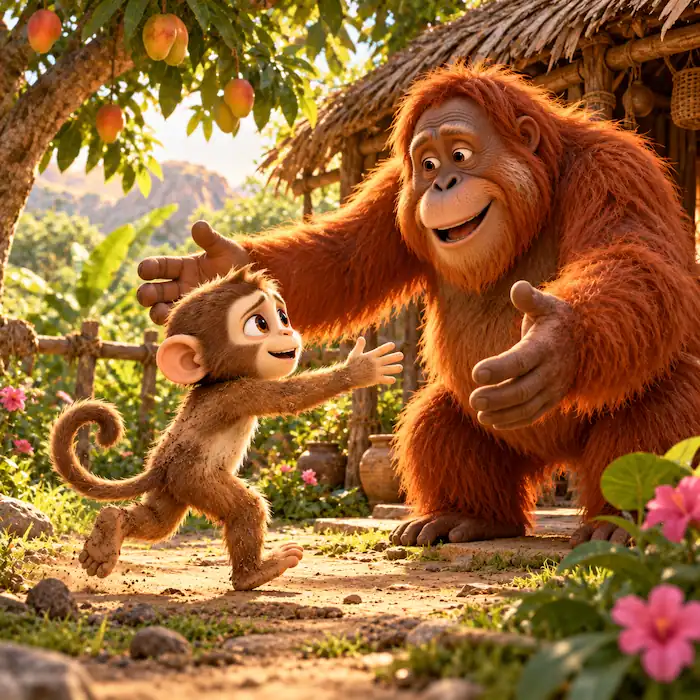
Monkey stayed. He gathered fruit, carried water, mended the roof after storms and helped clear thorn branches from the path. He worked steadily through the changing weeks, and little by little, his strength returned.
Then, one morning, when the first rains smelled of dust and leaves, Monkey said, “Great Uncle, I think it is time for me to go home. Perhaps the land will be kinder now.”
Great Uncle Orangutan nodded. “You have earned more than food and shelter. You have earned a gift.”
He disappeared into his hut and returned carrying three things: a small wooden fiddle, a smooth bow for drawing music from its strings, and a hunting bow with a quiver of arrows. Monkey’s eyes widened.
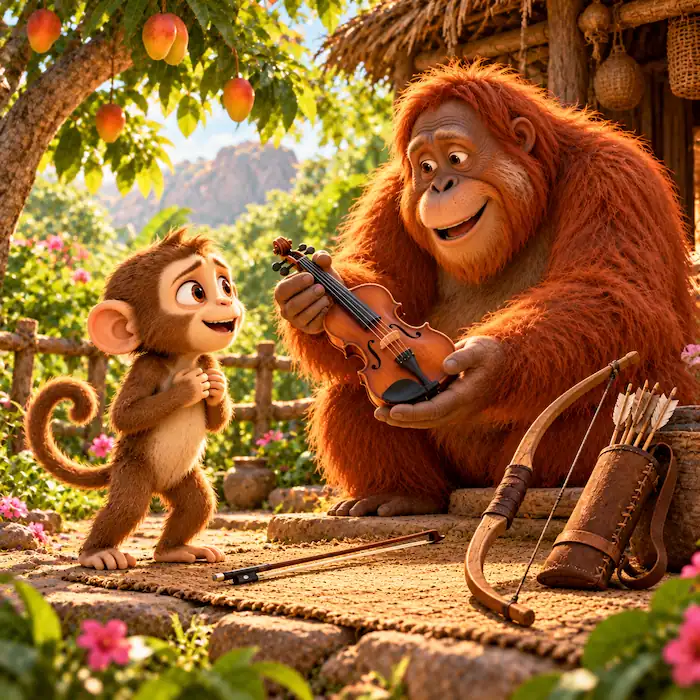
“This hunting bow will send an arrow true to any creature you can see,” said Great Uncle Orangutan. “Use it wisely. Never let hunger turn your heart cruel.”
Then he lifted the fiddle carefully and placed it in Monkey’s hands. “And this is no ordinary instrument. If you play it, every creature who hears it must dance.”
Monkey ran one finger along the polished wood. “Every creature?”
“Every creature,” said Great Uncle Orangutan. “But remember this: a gift may help a foolish creature escape trouble, yet wisdom keeps a creature from walking into it.”
Monkey thanked his great uncle until the old orangutan laughed and waved him away. Then he set out for home with the hunting bow over one shoulder, the fiddle strapped safely across his back and a hopeful song in his heart.
Gifts From Great Uncle Orangutan
Before long, Monkey met Wolf on a narrow path between the thorn trees. Wolf looked thin and dusty. His ribs showed beneath his gray coat, and his yellow eyes were sharp with hunger.
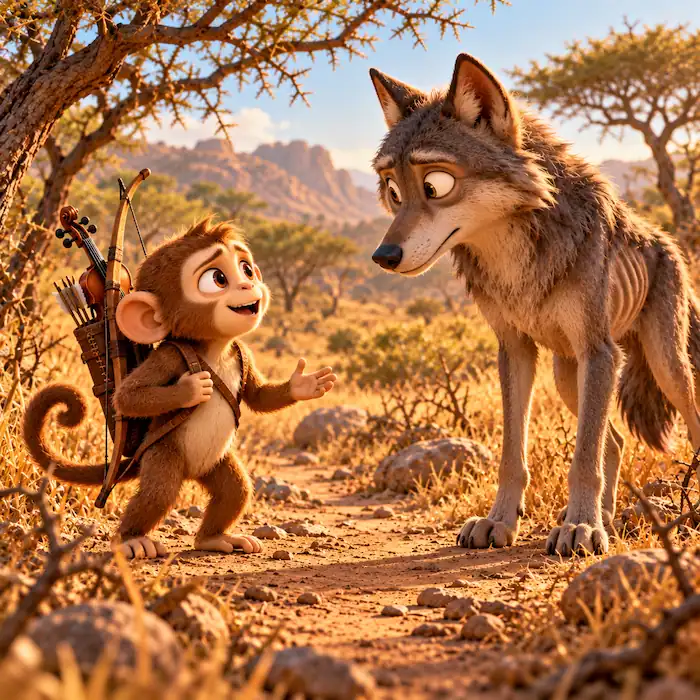
“Monkey!” cried Wolf. “You have returned at last. Tell me, what news have you brought from beyond the hills?”
Monkey was pleased to see a familiar face. He sat beside Wolf in the shade and told him about Great Uncle Orangutan’s home, where fruit hung heavy from the branches and water ran bright over stones. Then Wolf noticed the bows on Monkey’s back.
“And what are those?” he asked.
Monkey proudly showed him the hunting bow and its arrows. “This bow was given to me by my great uncle. If I can see what I am aiming at, the arrow will not miss.”
Wolf’s ears pricked up. “Not miss?”
“Not miss,” said Monkey.
Wolf glanced toward the long yellow grass. “Since sunrise, I have been stalking a deer. Each time I creep close, it hears me. Each time I spring, it escapes. If your bow is truly as good as you say, perhaps you could help an old friend.”
Monkey agreed. They moved quietly through the grass until Wolf pointed with his nose. Near a shallow pool, a deer lowered its head to drink. Monkey drew an arrow, raised the bow and let it fly.
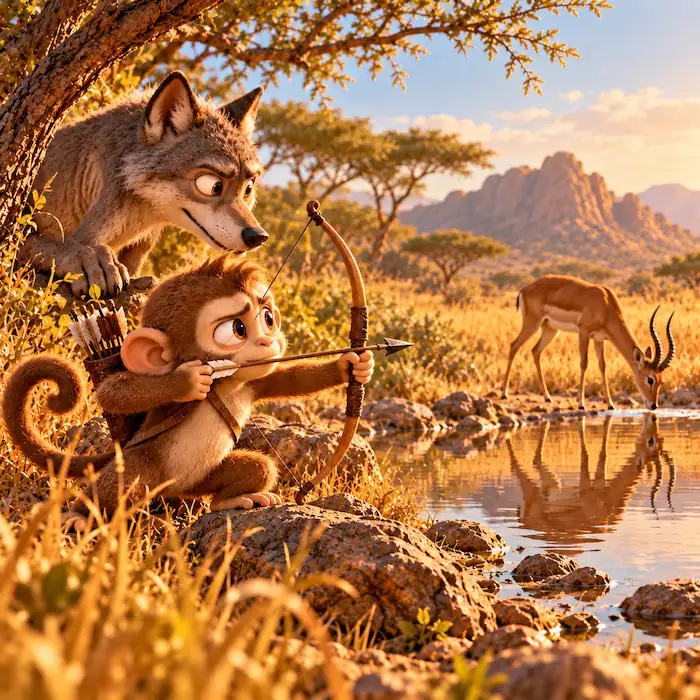
The arrow struck true. The deer fell, and Wolf gave a hungry howl of delight.
Together they made a meal. Monkey ate until his stomach no longer ached, and Wolf ate until there was nothing left but bones. At first, Wolf thanked Monkey warmly. He praised the bow. He praised Monkey’s sharp eyes. He even called him “Cousin Monkey,” though they were not cousins at all.
But as the sun moved westward, Wolf’s gratitude turned sour.
“That bow should belong to a hunter,” he said.
“It does,” replied Monkey. “It belongs to me.”
Wolf’s eyes narrowed. “A monkey does not need such a bow.”
“A monkey who has crossed dry country and faced hunger needs any good tool he has earned,” said Monkey.
Wolf rose slowly. He was larger than Monkey, stronger than Monkey and very sure that strength should get whatever it wanted. “Give it to me,” he growled.
Wolf Wants the Bow
Monkey tightened his grip on the bow. “No.”
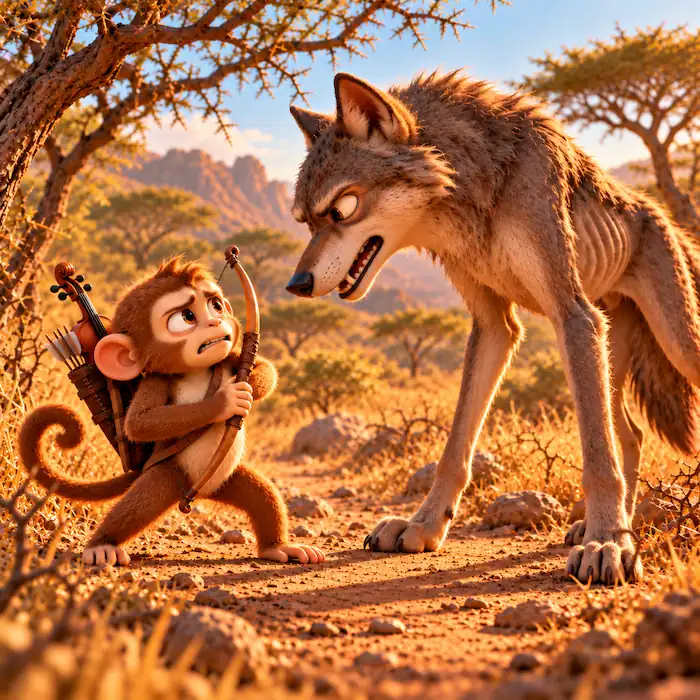
At that moment, Jackal came trotting along the path. He saw Wolf standing over Monkey and stopped at once.
“What is the trouble here?” asked Jackal.
Wolf did not hesitate. “Monkey has stolen my hunting bow.”
Monkey stared at him. “That is a lie. My great uncle gave it to me.”
Jackal looked from Wolf to Monkey. His eyes rested on the fine bow, then on the quiver of arrows. He imagined how easily he could bring down rabbits, birds and antelope if the bow belonged to him.
“This is too important for me to decide alone,” said Jackal, putting on a grave expression. “We must take the matter before Lion’s court. Lion is king over the animals, and Leopard sits beside him. Let them judge what is right.”
Wolf agreed because he believed the court would fear him. Monkey agreed because he believed the truth would protect him.
“Until then,” said Jackal, “I will keep the bow safe.”
Monkey hesitated, but Jackal held out his paw with such a solemn face that Monkey handed it over.
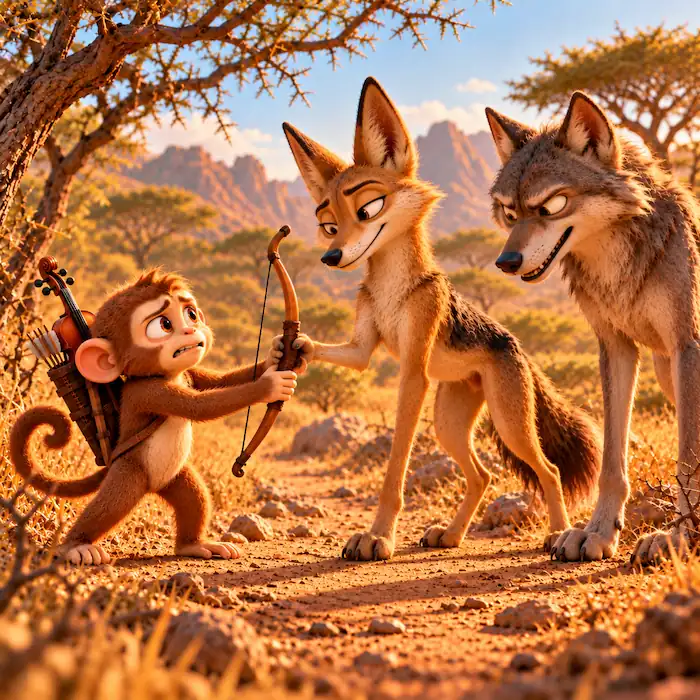
The three animals started toward Lion’s court. Yet Jackal moved slowly. He stopped to sniff bushes, search among rocks and wander from the path whenever something caught his eye. When he returned, the bow was always across his back, but the quiver grew lighter and lighter.
Jackal had discovered that Monkey’s arrows did not miss. First he shot a guinea fowl.
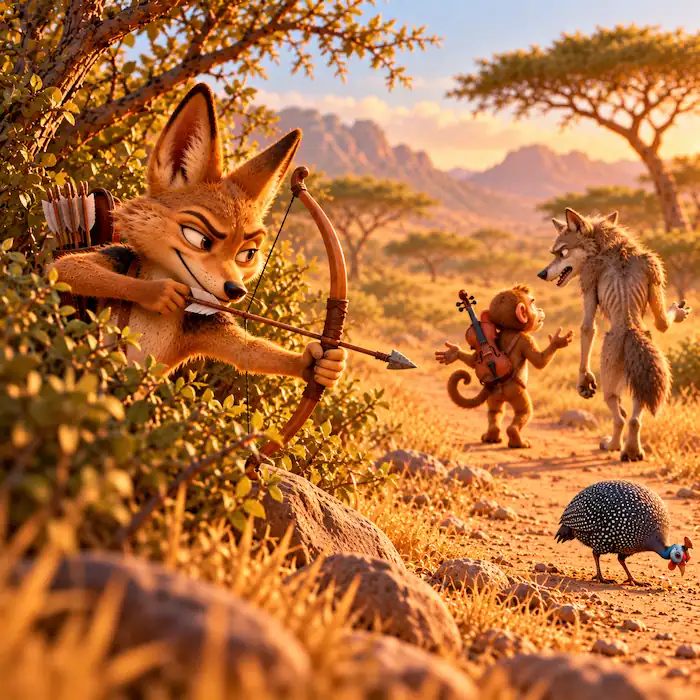
Then he shot a hare. Later, while Monkey and Wolf argued ahead of him, he brought down a fat little antelope. Jackal ate well all the way to Lion’s court, and each time he used one of Monkey’s arrows, he smiled to himself.
By the time they reached the court, Jackal had already decided what he would say.
Lion’s court was held in a wide clearing beneath an ancient tree. Lion sat in the shade, his great mane glowing in the late afternoon sun. Leopard sat beside him. Hyena, Hare, Tortoise and many others gathered in a circle to hear the case.
Wolf spoke first. “That bow is mine. Monkey stole it and tried to claim it for himself.”
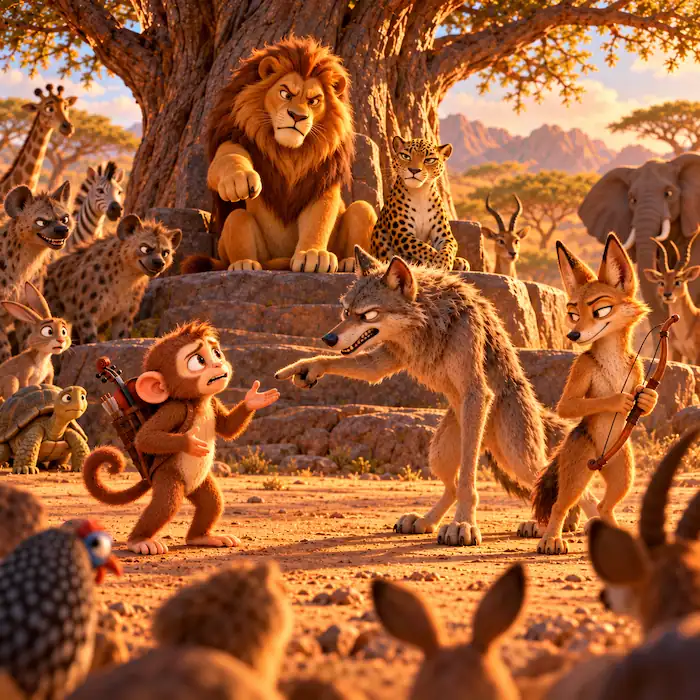
Monkey stepped forward. “My great uncle gave it to me when I left his home. Wolf saw it, asked for it and then threatened me when I refused.”
Lion turned to Jackal. “You held the bow while these two traveled here. What do you know?”
Jackal lowered his head as if the truth pained him. “I heard Monkey boast about the bow. He said it could bring down anything he wished. I did not hear Great Uncle Orangutan give it to him. I only know that Wolf claimed it was his, and Monkey would not hand it over.”
“Jackal, you know that is not what happened,” said Monkey.
But Jackal would not meet his eyes. The court murmured. Wolf stood tall. Monkey looked around the circle and saw doubt on every face.
Lion raised one heavy paw for silence. “Theft is a serious wrong. If Monkey has stolen from Wolf, he must be punished.”
Monkey tried again to tell them about the dry land, the long journey, the work he had done and Great Uncle Orangutan’s gifts. Yet his words sounded small beside Wolf’s angry growls and Jackal’s smooth lies.
At last, Lion gave his judgment.
“Monkey is guilty,” he said. “At sunset, he will be hanged from the old tree at the edge of the clearing.”
Lion’s Court
Monkey felt the world grow still. Then his fingers touched the strap of the fiddle at his side.
“King Lion,” he said quietly, “before I die, may I play one last tune?”
The animals looked at Lion. Lion considered the request, then nodded. “One tune. No more.”
Monkey lifted the fiddle from his shoulder and tucked it beneath his chin. For a moment, he remembered Great Uncle Orangutan’s words about gifts and wisdom. Then he drew the bow across the strings.
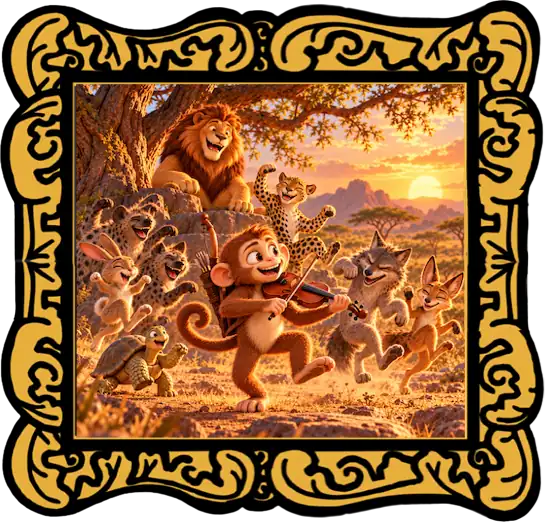
The first note was low and sweet. Leopard’s tail began to twitch. Monkey played another note, and Hyena’s paws shuffled against the dust. Hare’s ears bobbed in time. Even Tortoise, who almost never hurried anywhere, lifted one foot and set it down with an unexpected tap.
Monkey began to play a lively tune called Cockcrow.
At once, the court began to dance.
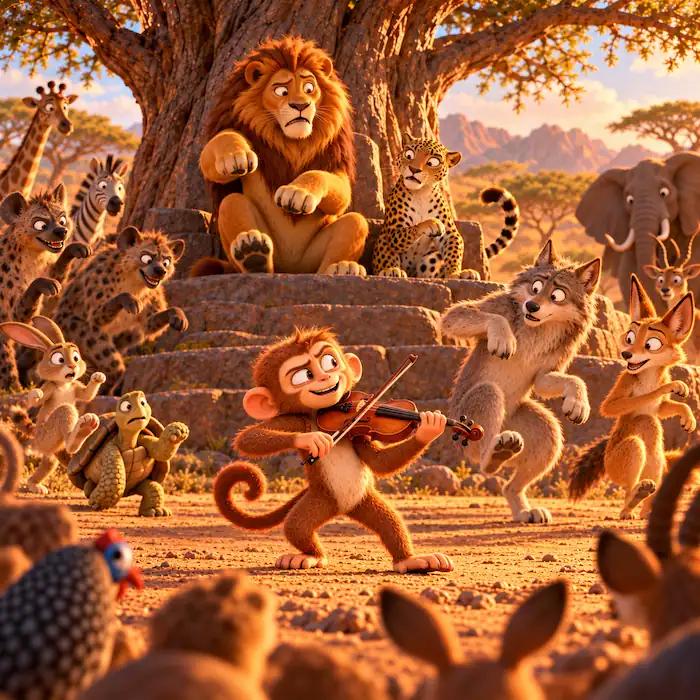
Wolf leaped backward, then sideways, then spun in a circle so quickly that he nearly fell over. Leopard tried to keep his dignity, but his paws stepped faster and faster. Hyena bounced across the clearing, laughing between gasps. Even Lion rose from his place beneath the tree and began to turn with great, unwilling steps.
Monkey played on. The tune grew quicker, and the animals danced harder. Dust rose in clouds around their feet. Jackal kicked his legs so wildly that he lost the bow he was meant to be guarding and sent it skidding across the ground. Lion whirled with Leopard, and Leopard spun past Hyena and Hare. Tortoise was dragged into a jig with Hare, though he protested that he did not know the steps.
Monkey closed his eyes and played as if he had forgotten the whole world.
“Stop!” panted Wolf.
Monkey played faster.
“Please stop!” cried Hyena, stumbling into a bush.
Monkey played faster still.
At last Lion, who had danced three furious circles around the entire clearing, roared above the music. “Monkey! What must we do to make you stop?”
Monkey opened one eye. “Withdraw the sentence. Give me back my bow and arrows. And let Wolf tell the truth before everyone here.”
Wolf’s legs were still hopping against his will. “I lied!” he cried. “The bow was Monkey’s. I said it was mine because I wanted it for myself.”
“And Jackal?” asked Monkey.
Jackal spun helplessly on one foot. “I took Monkey’s bow while pretending to keep it safe. I wanted it for myself, and I used its arrows all the way here. Please, Monkey, I beg you! Stop playing!”
Lion’s mane flew around his face as he danced. “The sentence is withdrawn! Monkey is innocent. Give him his bow at once!”
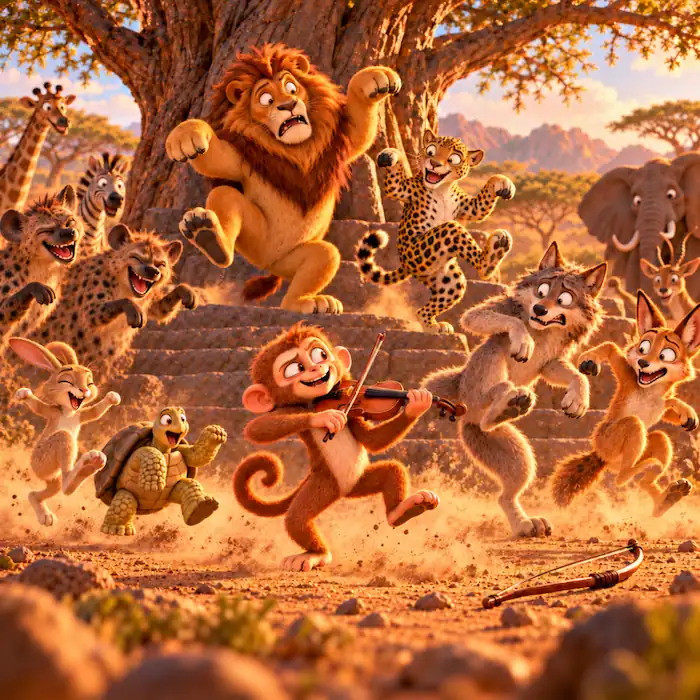
Monkey played three more bright, merry turns of Cockcrow. Then he stopped.
The clearing fell silent. Wolf pushed the hunting bow toward Monkey without meeting his eyes. Jackal gathered the remaining arrows and laid them beside it. Monkey picked up his gifts, slung the bow across his back and tucked the fiddle safely beneath his arm.
Then he climbed into the nearest camel thorn tree. From its highest branch, he looked down at Lion’s court, where the animals were still catching their breath. Each one looked at Monkey’s fiddle, then at the others.
No one wanted to hear another note of Cockcrow.
Lion hurried away first, pretending he had important kingly business elsewhere. Leopard followed so closely that his tail brushed Lion’s mane. Hyena limped into the long grass. Hare raced for the rocks, Tortoise set off as quickly as a tortoise could, and even Wolf and Jackal disappeared without another word.
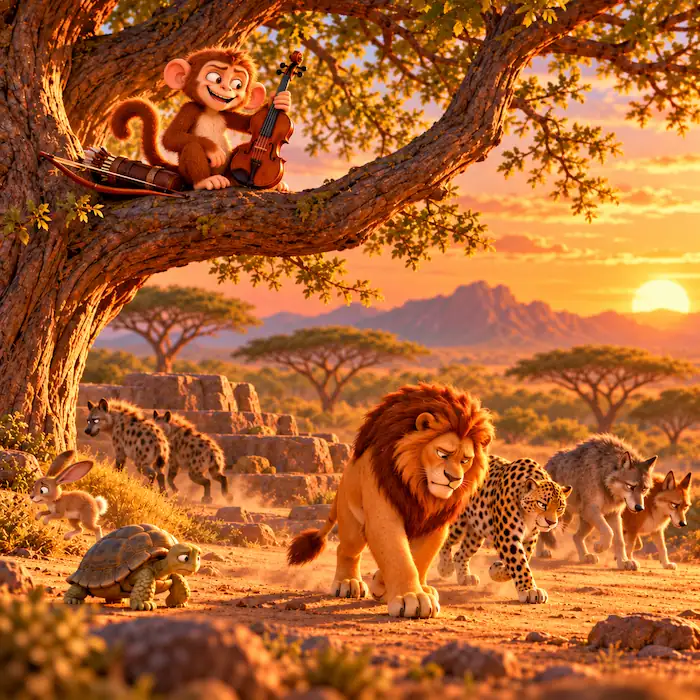
Before long, the great court stood empty beneath the ancient tree. Only the dust settled slowly over the clearing.
Monkey rested his chin on the fiddle and watched them go. Then he swung from branch to branch until the thorn trees hid him from sight.
