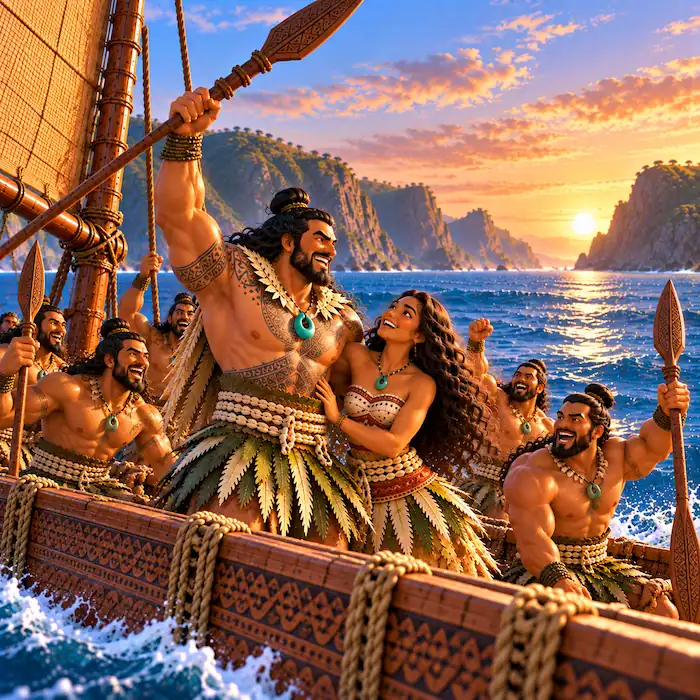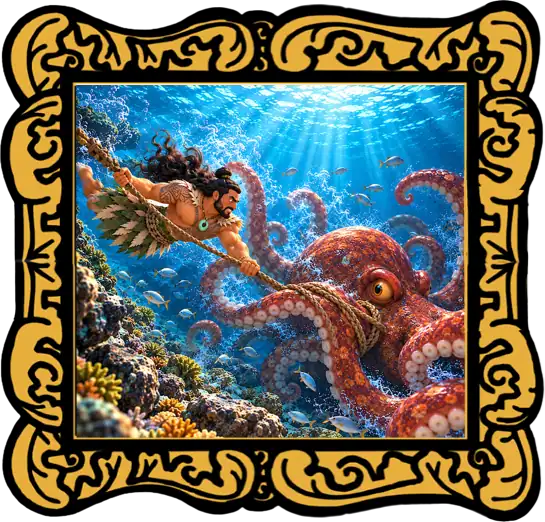

Kupe and Te Wheke o Muturangi
Long ago, Kupe lived in the homeland of Hawaiki, where the sea provided food for his people. The fishermen knew the best places to cast their nets, and on good days their canoes returned heavy with fish. Families would gather happily on the shore to share the catch.
Then something changed. One morning, Kupe joined the other fishermen before sunrise. The sea lay calm beneath a pale morning sky as the crew paddled towards their usual fishing grounds. They lowered their lines and waited patiently as the canoe rocked on the gentle water.
When they pulled the lines back up, every hook was bare. “Again,” said Kupe. The fishermen added fresh bait and tried once more, but this time one of the nets jerked sharply beneath the surface.
“I’ve got something!” cried a fisherman as he grabbed the rope. Another man rushed to help him pull, but suddenly the rope ripped through their hands. The water beside the canoe churned and the net disappeared beneath the surface. For a moment, everyone stared at the dark water. Then the sea became calm again.
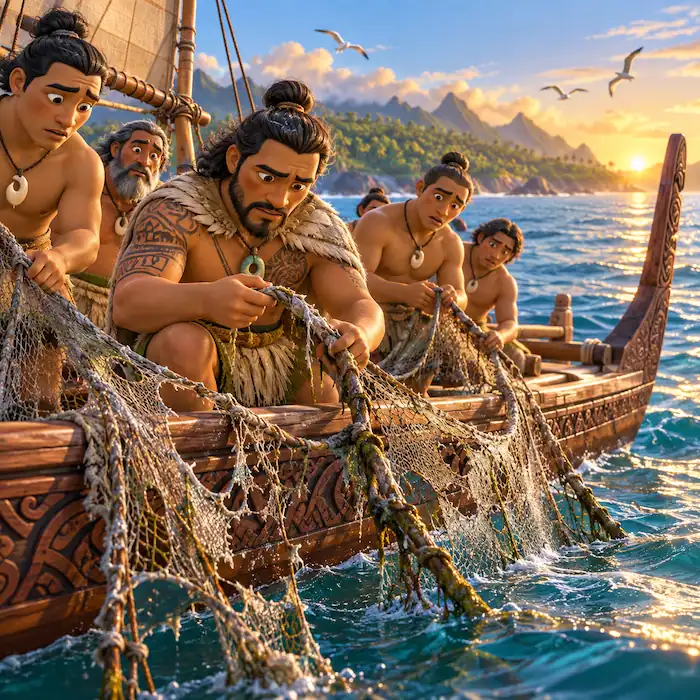
“What did that?” whispered one of the fishermen.
Kupe leaned over the side and examined the broken rope. A strange, slippery mark clung to it. He touched it carefully, then looked across the water. “This wasn’t the current,” he said.
Over the following days, the same thing happened again and again. Hooks lost their bait, nets tore and fish vanished before the crews could bring them home. Soon the people of Hawaiki began to worry. Children waited for meals that grew smaller each day while fishermen repaired their nets only to have them damaged again.
Kupe watched, listened and thought. At last, the clues began to fit together: a giant octopus was hunting in their fishing grounds, and Kupe believed he knew whose creature it was.
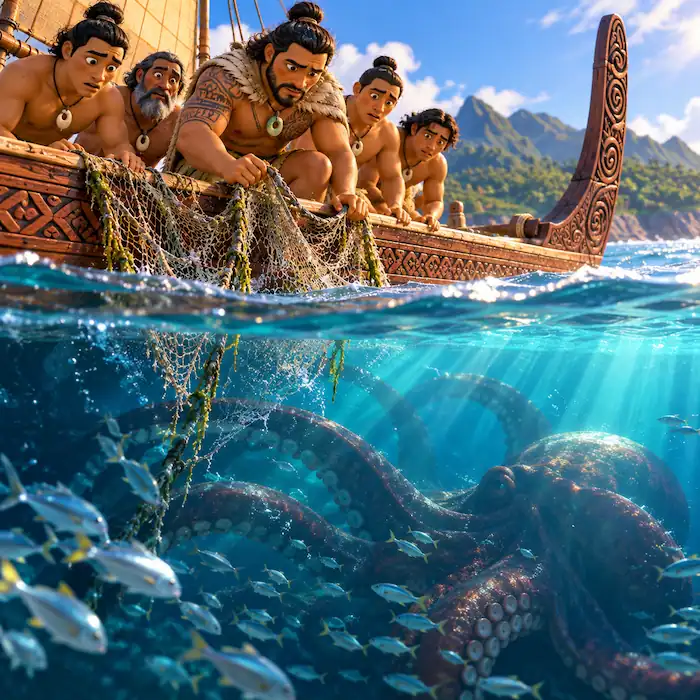
A man called Muturangi was associated with the huge octopus, so Kupe went to speak with him.
“Our fishing grounds are being ruined,” Kupe said. “Your giant octopus is taking our bait and destroying our nets. Call it away.”
Muturangi showed little concern. “The creature swims where it chooses,” he replied.
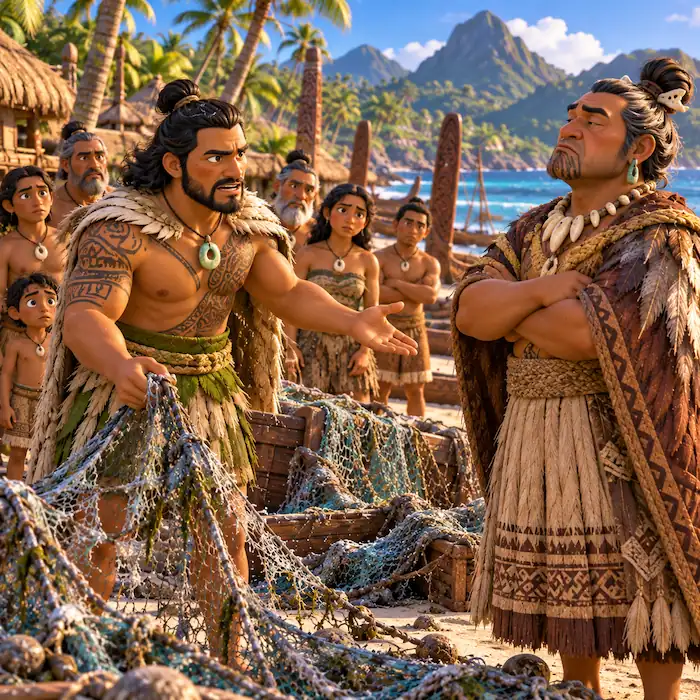
Kupe stared at him. His people were hungry and their nets lay torn on the shore. Doing nothing was no longer an option.
“Then I will follow the giant octopus,” Kupe said. “I will stop it from troubling our people.”
When Kupe returned home, he began preparing for a long journey. Food and fresh water went aboard his great ocean-going canoe. Skilled paddlers joined the crew while Kupe’s family prepared to travel with him, including his wife, Kuramārōtini.
Everyone knew they might travel far from Hawaiki, but nobody knew how far the octopus would lead them. At last, Kupe’s great canoe pushed away from shore. Kupe looked back at his homeland for a moment before turning towards the open ocean.
“Find the octopus,” he told his crew. The paddles dipped into the sea, and the chase began.
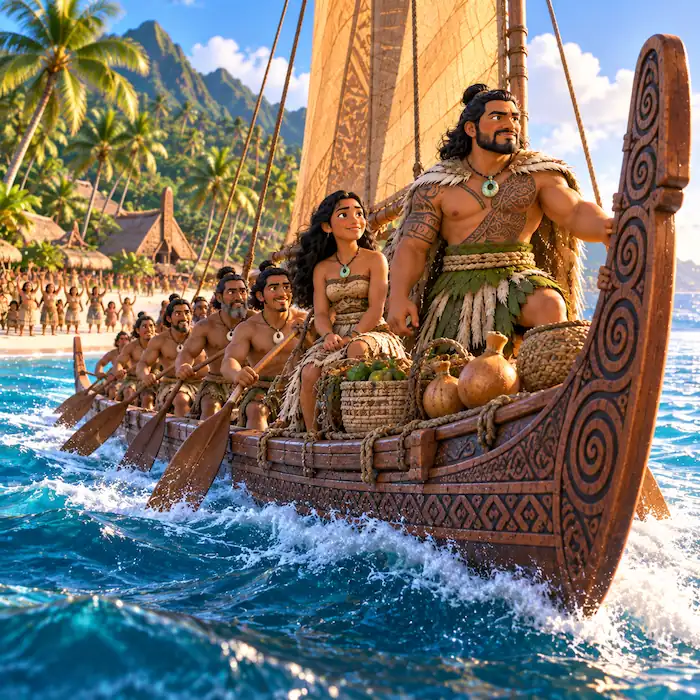
For days, they searched. Kupe watched the seabirds, waves and currents while his crew scanned the water for anything unusual. Then, without warning, a school of fish scattered beside the canoe as though something enormous was rising beneath them.
“There!” cried a paddler.
A dark shape moved through the water. Before anyone could react, a tentacle burst through the surface and curled towards the canoe, its pale suckers flashing in the sunlight.
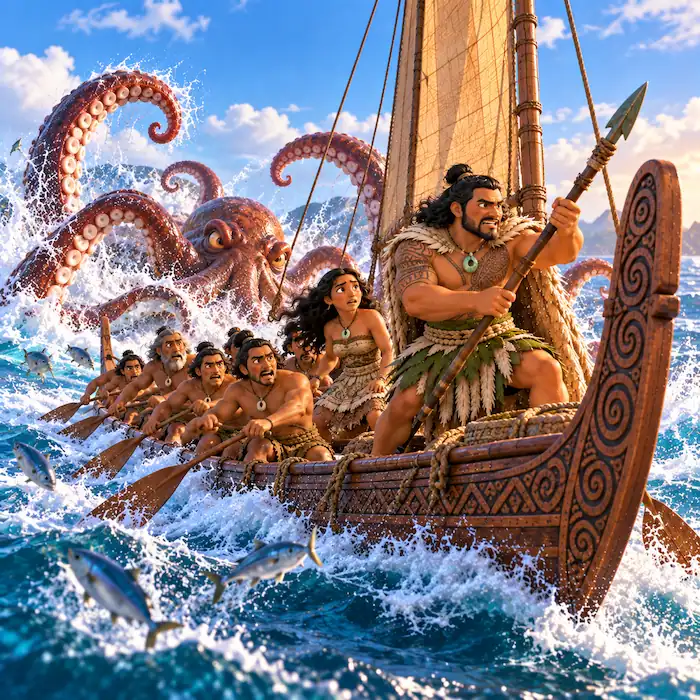
“Paddle!” Kupe shouted, and the crew pulled hard. The tentacle slapped the water just behind them and sent spray high into the air. A second arm appeared, then a third, until the sea seemed full of twisting tentacles.
Kupe struck at the nearest one, and Octopus recoiled. Water exploded around the creature as it turned and fled across the sea.
“After it!” called Kupe. Kupe’s great canoe surged forward. The octopus raced ahead, leaving a trail of churning water behind it, but Kupe had no intention of letting it disappear.
The chase stretched on for many days. Sometimes Kupe could see the octopus ahead, while at other times it vanished completely, leaving only disturbed water, scattered fish or the brief shadow of a tentacle beneath the waves.
The crew learned to watch for every sign. At night, stars filled the sky, and those who understood them used their knowledge of the heavens, winds and ocean to guide the canoe. By day, the paddlers searched the horizon until their eyes ached.
Their arms grew tired from paddling, salt dried on their skin and their supplies slowly disappeared. Yet whenever someone feared they had lost the creature, another clue appeared. A swirl in the water, a flock of startled birds or a dark shape beneath the waves told them that The octopus was still ahead.
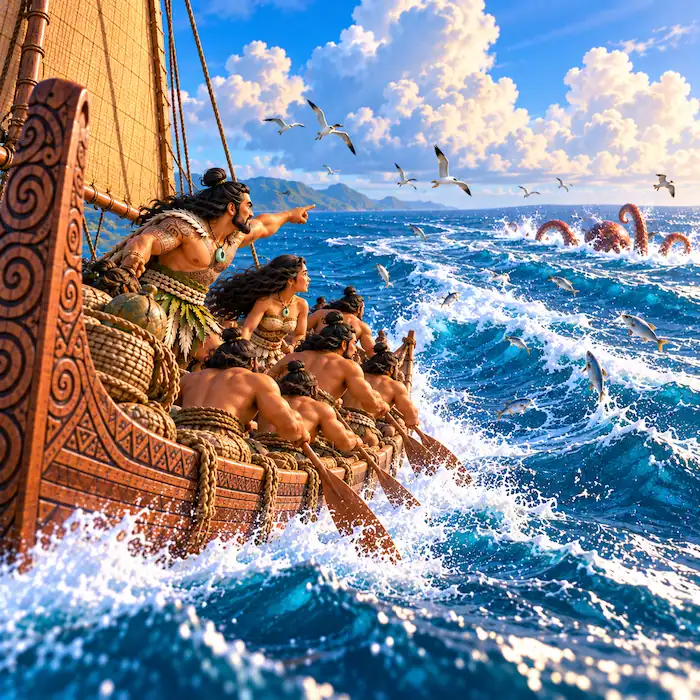
Then, one morning, Kuramārōtini stared towards the horizon. At first, she said nothing. She narrowed her eyes and leaned forward as though trying to make sense of something far away.
“Kupe!” she called.
Everyone turned as Kuramārōtini pointed ahead. A long white cloud stretched across the horizon, and beneath it lay a dark shape rising from the sea.
Land she called. “A long white cloud!”
The exhausted crew lifted their heads. They had crossed a vast ocean, and now a new land rose ahead of them.
But Kupe had little time to celebrate. A dark shape moved through the water beneath the distant cloud. The giant octopus was there too, racing through the waters beside New Zealand.
Kupe’s great canoe followed the creature along the coast, but Kupe had not forgotten why they had crossed the ocean. Somewhere nearby, the giant octopus was hiding.
Soon the chase began again. They followed the creature along the coast as it raced through open water, vanished into sheltered bays and slipped between rocky shores. Each time Kupe thought they were gaining on it, the octopus found another way to escape.
At one point, the creature disappeared near a rocky hiding place just as darkness began to fall. Kupe studied the water, but the light was fading quickly.
“We wait until morning,” he decided.
The exhausted crew rested while night covered the sea. The water became dark and still, and for several hours there was no sign of the giant octopus.
At dawn, Kupe searched the empty water, but the creature had vanished. For a moment, the crew feared their long pursuit had been wasted. Then Kupe noticed a faint disturbance farther out at sea. He watched it for a few seconds and smiled.
“Clever,” he said. “But not clever enough.”
The paddlers took up their paddles once more, and Kupe’s great canoe gave chase.
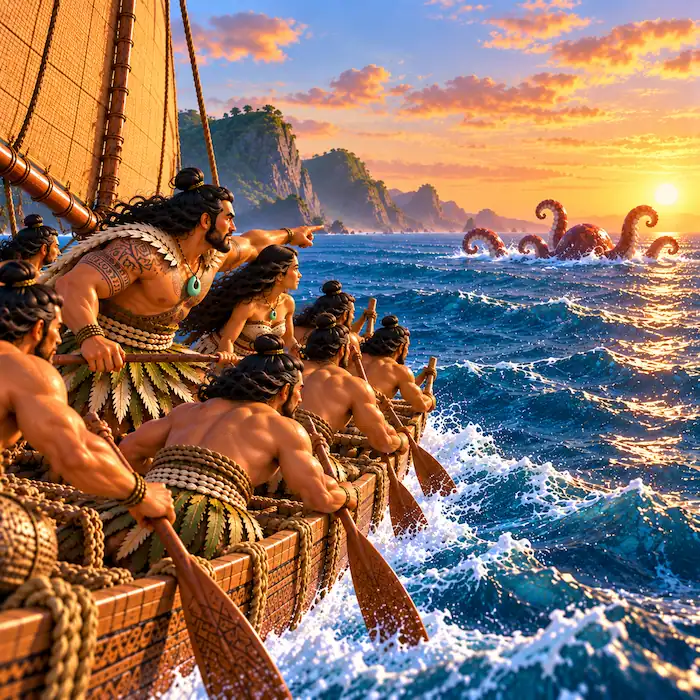
The pursuit eventually carried Kupe towards Cook Strait. Here the sea could change quickly. Powerful currents twisted between the islands, waves struck from different directions and narrow waterways gave the octopus many places to turn and hide.
Kupe knew the creature had an advantage in such dangerous water, but still he followed. Without warning, the sea beside the canoe exploded.
A huge tentacle crashed against the canoe. The crew cried out and grabbed the sides as another arm curled around the hull. Wood groaned beneath the pressure.
“Hold on!” shouted Kupe.
He struck at the gripping tentacle until the octopus released them, but another arm immediately slammed into the side of the canoe. Water splashed across the floor as the crew struggled to keep the canoe steady. The creature no longer wanted to escape. Now it meant to destroy them.
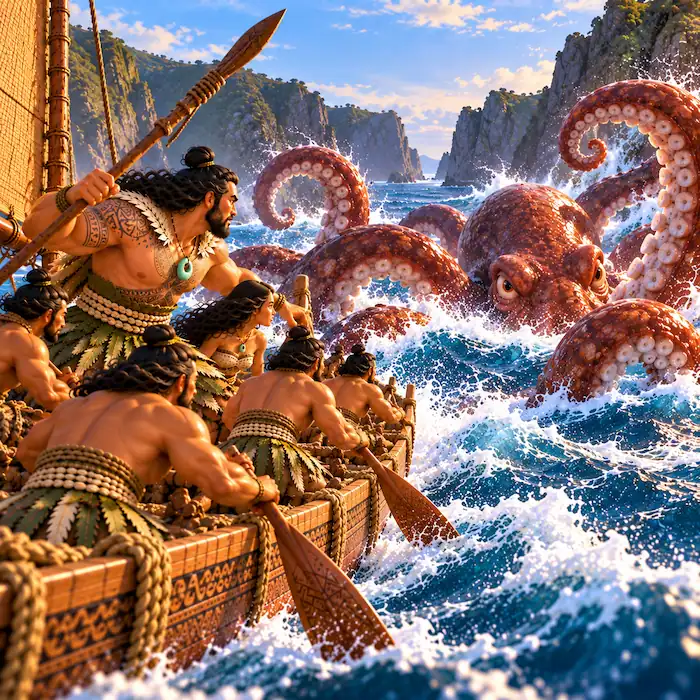
The battle raged across the water. Whenever the paddlers tried to move clear, another tentacle swept towards them. Kupe struck one away only for another to take its place.
“To the left!” he shouted.
The crew paddled hard and a huge arm missed them by inches.
“Now right!”
The canoe turned again, but the octopus seemed to learn with every attack. Its tentacles spread around the canoe until the crew could barely see a way through them. Everyone aboard was exhausted, and Kupe knew they could not continue fighting like this forever.
He needed another plan. Then he saw a bundle of gourds they had carried aboard the canoe.
“Give them to me!” he called.
The crew passed the bundle forward, and Kupe threw it overboard. Tossed by the waves, it looked enough like a person in the water to fool the octopus.
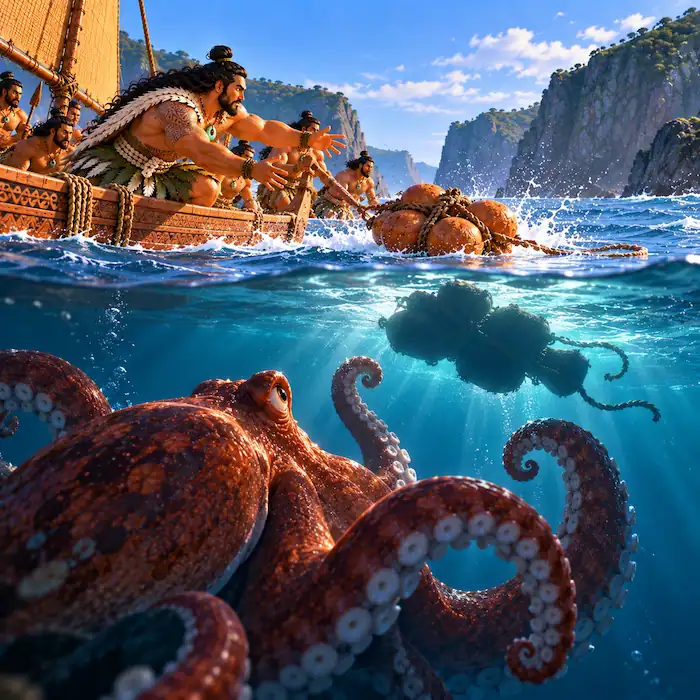
For a moment, The giant octopus seemed confused. Then one of its great arms shot towards the floating bundle. Another tentacle followed, and then another as the creature turned its attention away from the canoe.
“Now!” cried Kupe.
The crew drove the canoe forward. Kupe watched the octopus carefully as it rose higher from the water and stretched its arms towards the gourds. Before the creature could turn back, Kupe leaped from the canoe onto its broad back and struck its head with all his strength.
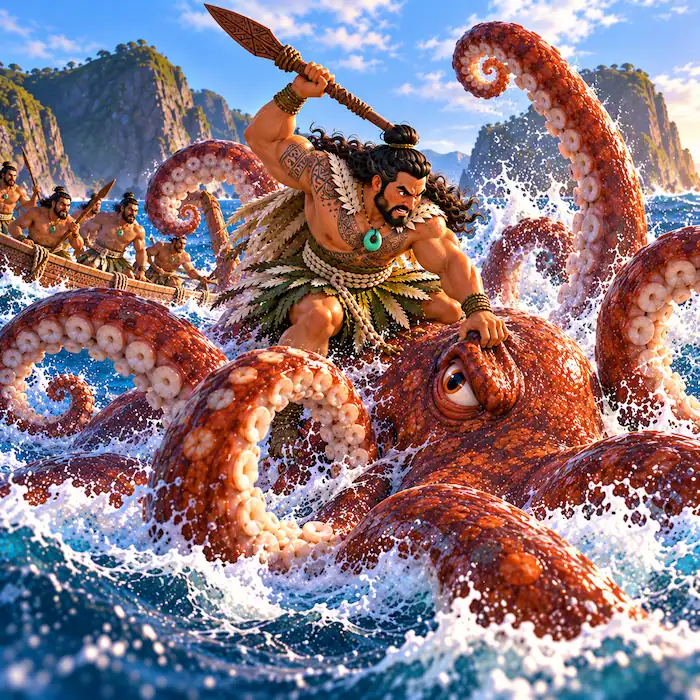
The giant octopus thrashed wildly. Waves rolled away from its enormous body as foam and spray filled the air. The crew clung to the canoe while the creature twisted and struck the water around them.
Then its movements began to slow. The great tentacles loosened and sank towards the sea.
At last, the water grew quiet.
The giant octopus would trouble Kupe’s people no more.
For several moments, nobody spoke. The crew simply listened to the waves tapping softly against the canoe. Then someone cheered, another voice joined in and soon the whole crew was celebrating.
Kupe looked towards the distant land. Their journey had taken them far beyond Hawaiki. They had crossed an immense ocean, and faced a creature powerful enough to destroy their canoe. Yet Kupe had kept the promise he made to his people.
As the canoe moved into calmer water, Kuramārōtini looked towards the land beneath the long white cloud. Ahead waited new shores and new stories, while behind them the wake of the great canoe glittered in the sun.