Tiddalik the Very Thirsty Frog

About This Story

Tiddalik the Very Thirsty Frog is a child-friendly retelling of a traditional Aboriginal Australian story. In this version, Tiddalik drinks all the water in the billabong, and the other animals must find a way to make him laugh so the water can return.

Search data for this draft showed stronger demand around the spelling Tiddalick the frog in both Australia and the US, while the uploaded story uses Tiddalik. The page keeps the story title as Tiddalik and naturally mentions Tiddalick as a spelling families may search for.

Story Details

  • Independent Reading Age: 6 to 8
  • Listen-Along Age: 4 to 8
  • Reading Level: Early elementary
  • Reading Time: About 6 to 8 minutes
  • Author / Source: Traditional Aboriginal Australian story, retold for Kooky Kids World
  • Story Type: Traditional story
  • Region / Origin: Aboriginal Australian storytelling tradition
  • Main Characters: Tiddalik, Kangaroo, Emu, Kookaburra, Platypus, Wombat and Snake
  • Themes: Sharing water, caring for others, community, laughter and responsibility

Listen Along – Tiddalik Audio Story

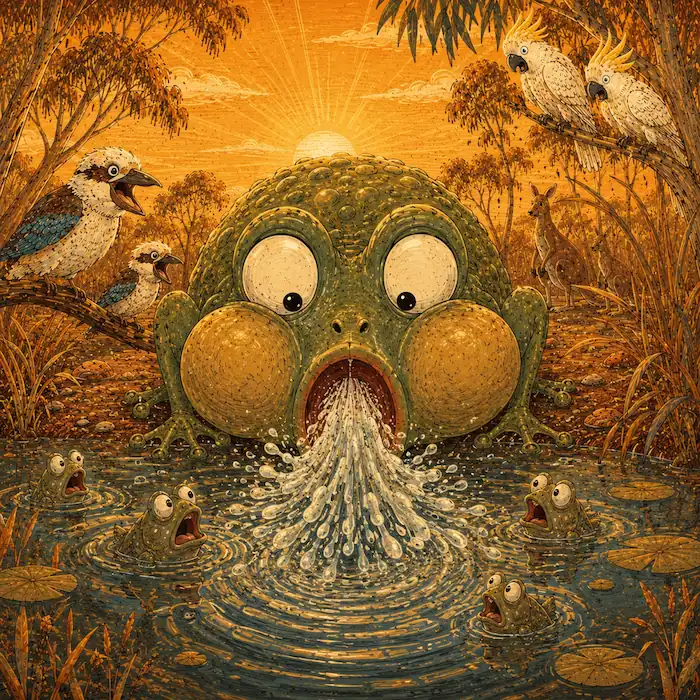
Audio cover showing Tiddalik the frog with Australian animals
0:00 / 0:00
Tiddalik The Very Thirsty Frog

Listen to this child-friendly Aboriginal Australian story read aloud, then read the full story below.

Kooky Kids World Cloud Logo showing where the audio read aloud file is.

Tiddalik the Very Thirsty Frog Story

Long ago, in the warm Australian bush, the morning sun peeped over the gum trees. The kookaburras laughed, the cockatoos screeched, and the kangaroos hopped softly through the grass.

Beside a quiet billabong, a little frog slowly woke up. His name was Tiddalik.
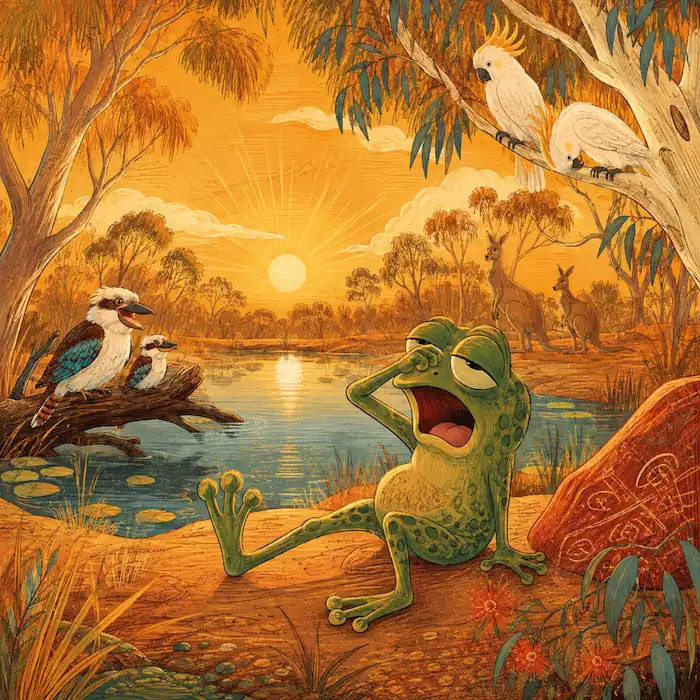
Tiddalik the frog wakes beside a billabong at sunrise with kookaburras and cockatoos nearby


Tiddalik opened one eye, then he opened the other. He blinked. He stretched one leg, then he stretched the other. Then he smacked his wide frog lips and said, “I am thirsty.”

So Tiddalik hopped to the billabong.

Plop.

He took one drink.

Slurp.

Then another.

Slurp, slurp.
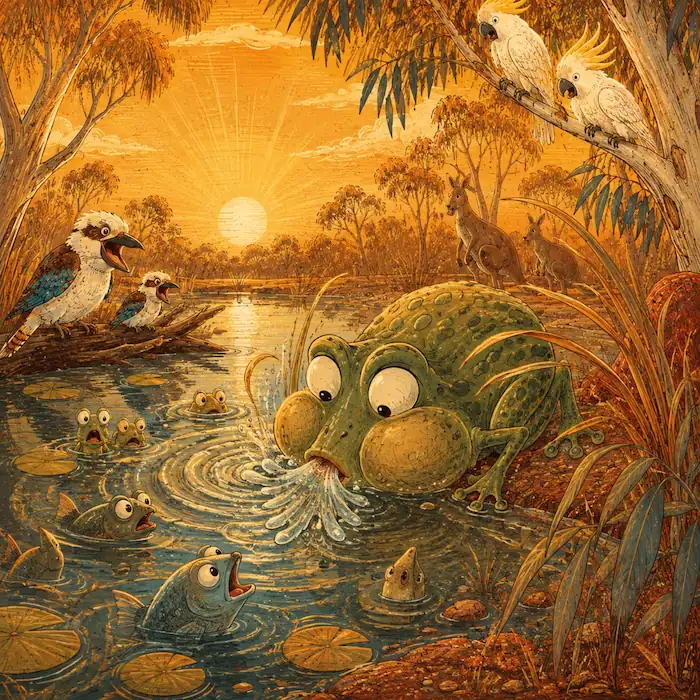
Tiddalik drinks from the billabong while fish, birds and kangaroos watch

Then another.

SLURP, SLURP, SLURP!

Tiddalik gulps water from the billabong as small fish look worried


The water slid into his round belly. The billabong got lower and lower, but Tiddalik kept drinking.

The reeds drooped. The mud cracked. The fish flapped. The waterbirds stared.

Still Tiddalik drank.

SLUUUUURP!

At last, the billabong was empty. Not one little drop was left.

Tiddalik sat in the mud with a huge, wobbling belly.

“Oh,” he said. “That was better.”

Then he gave a tiny burp.

Bup.

But all around him, the bush went quiet.

The kangaroos came looking for water. There was none.

The emus came looking for water. There was none.

The lizards came looking for water. There was none.

Even the little ants marched to the billabong and stopped.

No water. No puddle. No drip. No drop.

“Who drank it all?” cried Kangaroo.

“Who took every sip?” asked Emu.

“Who has a belly as round as the moon?” whispered Lizard.

Everyone turned.

There sat Tiddalik. His belly was so big that he could hardly hop.
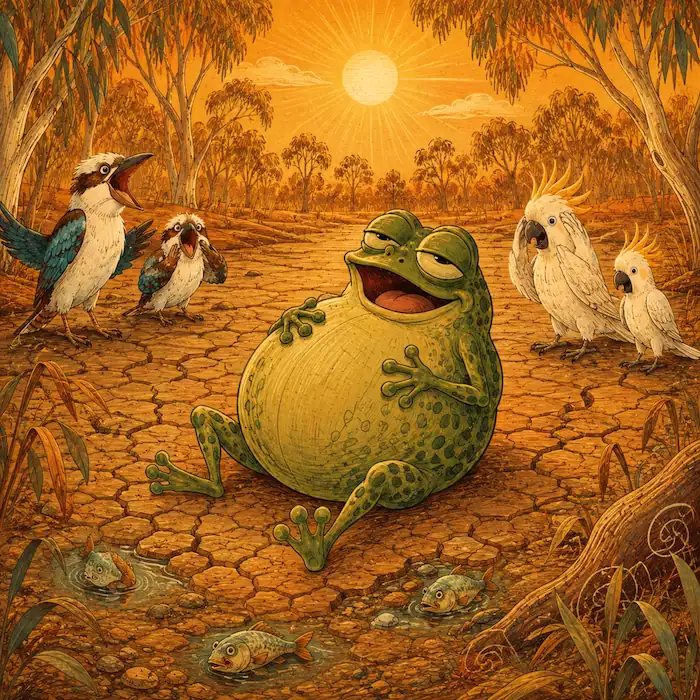
Tiddalik sits with a huge belly beside the empty cracked billabong while birds stare

“Tiddalik!” cried the animals. “You drank all the water!”
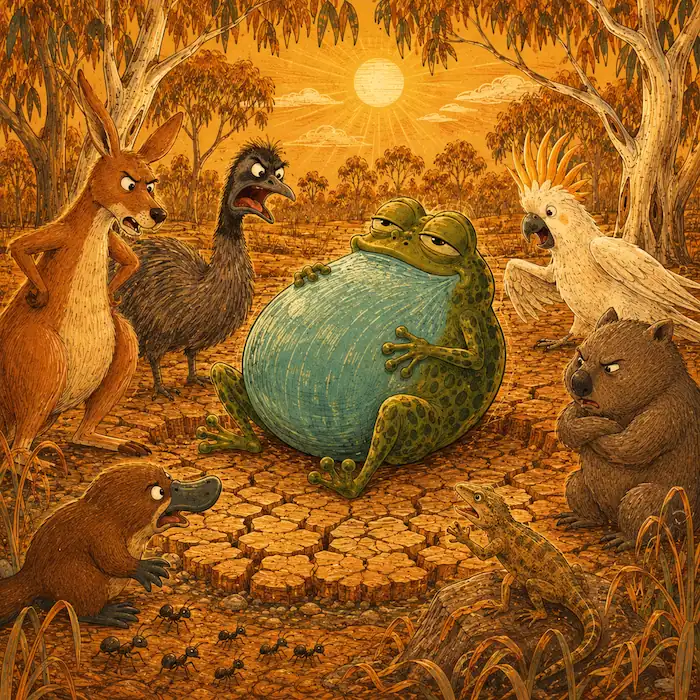
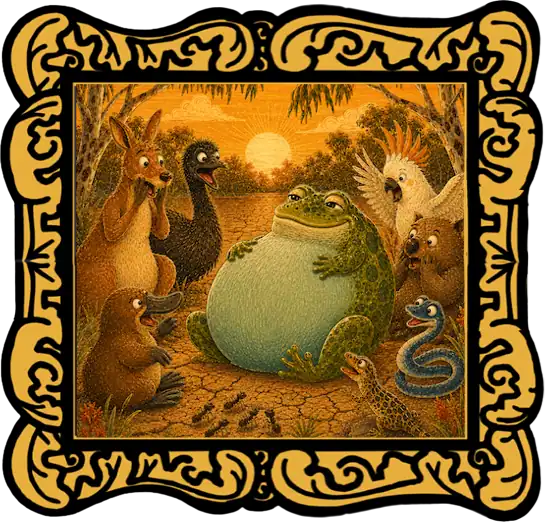
Kangaroo, Emu, Cockatoo, Platypus and Wombat gather around Tiddalik and his huge belly

Tiddalik blinked slowly.

“Yes,” he said.

“But we need water too,” said Kangaroo.

“The birds need water,” said Cockatoo.

“The fish need water,” said Platypus.

“The trees need water,” said Wombat.

Tiddalik looked at them. Then he looked at his belly.

Then he gave another tiny burp.

Bup.

But not one drop came out.

The animals gathered in a circle.
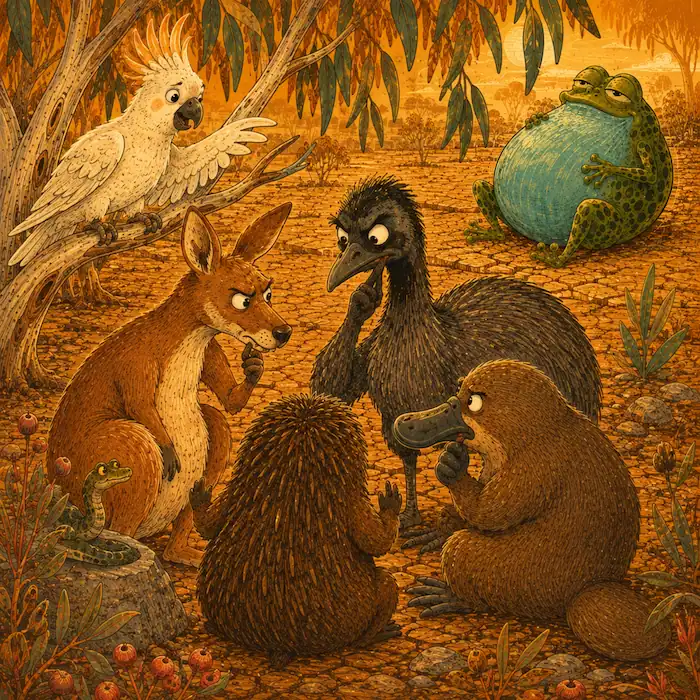
Australian animals gather in the dry bush while Tiddalik sits in the background

“We must make him laugh,” said Kookaburra. “If Tiddalik laughs, the water may come tumbling out.”

“That is a good idea,” said Kangaroo.

So Kookaburra hopped onto a branch. He puffed up his feathers. Then he laughed his loudest laugh.

“Koo-koo-koo-koo-KAAAA!”

The birds laughed. The wallabies giggled. Even the ants wiggled.
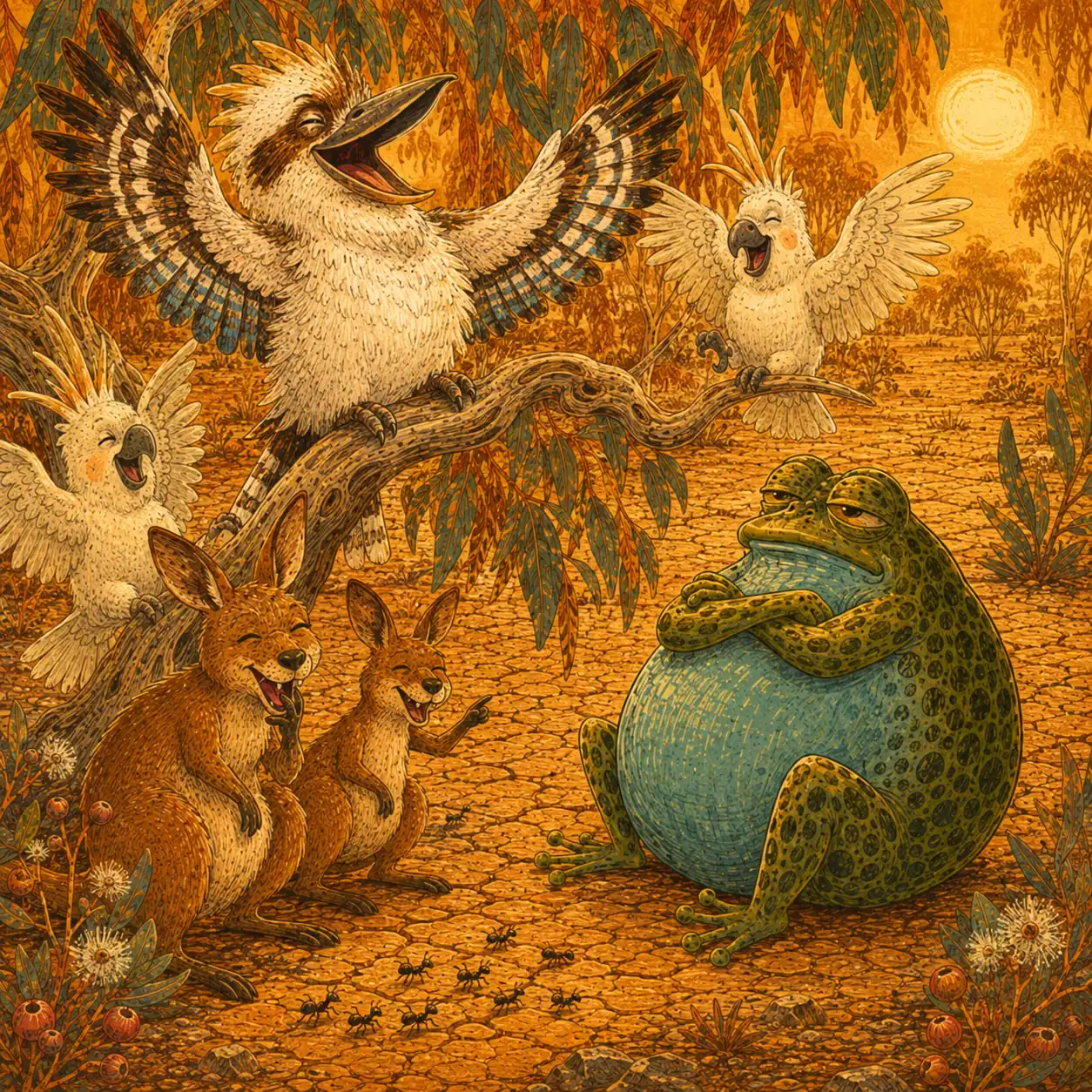
Kookaburra laughs loudly from a branch while Tiddalik watches without laughing

But Tiddalik did not laugh. He only blinked.

“That was not funny,” he said.

Next, Kangaroo came forward.

“I can make him laugh,” she said.

She bounced high.

Boing!

She bounced higher.

BOING!

Then she bounced so high that she landed nose-first in a bush.

Rustle, rustle, rustle!
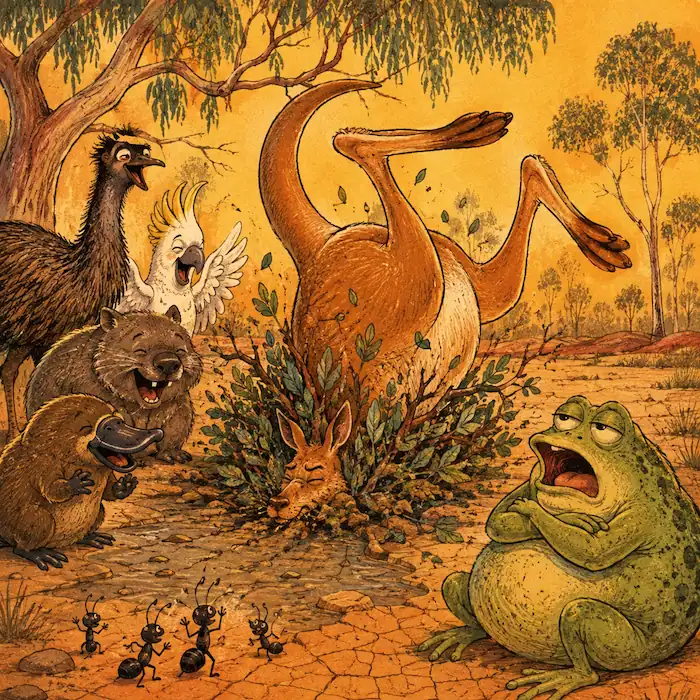
Kangaroo flips nose-first into a bush while the animals laugh and Tiddalik watches

Her tail stuck out. Her feet kicked in the air.

The animals roared with laughter.

But Tiddalik did not laugh. He only yawned.

“Too bouncy,” he said.

Next came Emu.

“Watch me,” said Emu.

She strutted left. She strutted right. She fluffed her feathers.

Then she tried to dance on one skinny leg.

Hop.

Hop.

Wobble.

Wobble.

FLUMP!

Emu sat down in the dust.

The cockatoos screeched with laughter. The lizards rolled on their backs.

But Tiddalik did not laugh. He only rubbed his belly.

“Too dusty,” he said.

The animals groaned. The sun climbed higher. The ground grew hotter. The trees drooped lower. The little fish gasped in the mud.

“We must try again,” said Platypus.

So Platypus waddled forward. He crossed his webbed feet. He spun in a circle.

He slipped.
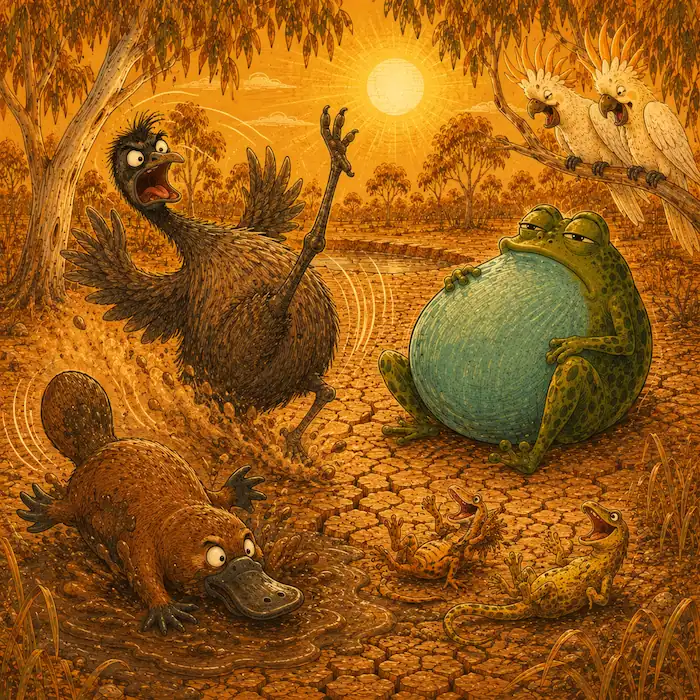
Emu dances in the dust in front of Tiddalik while cockatoos watch from a branch

Splodge!

His bill landed in the mud.

Now Platypus had mud on his nose, mud on his tail, and mud on his bottom.

The animals laughed so hard that Cockatoo nearly fell off her branch.

But Tiddalik still did not laugh. He only said,

“Too muddy.”

Everyone sighed.

“What will make him laugh?” whispered Wombat.

Then, from behind a stone, came a small, quiet voice.

“I will try.”

It was Snake. Long, shiny, wriggly Snake.

The animals looked at him.
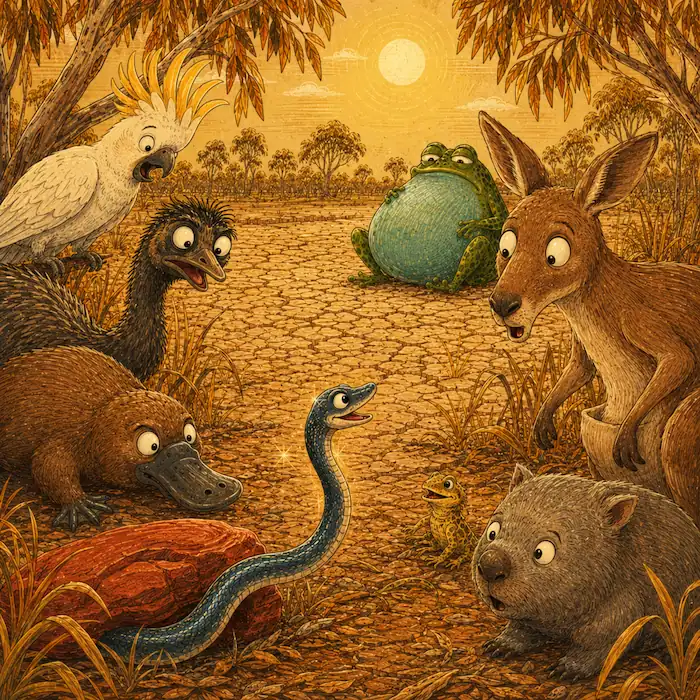
Platypus looks muddy near the animals while Tiddalik sits in the dry bush

“You?” said Kangaroo.

“You are very small,” said Emu.

Snake smiled.

“Sometimes small things can do big things,” he said.

He slid across the dry ground.

Slip.

Slide.

Wiggle.

He curled himself into a loop. Then into a knot. Then into a twisty, turny, tangly shape.

Tiddalik watched.

Snake twisted again. Now his tail was near his nose. His nose was near his tail. His middle was somewhere in between.

Tiddalik blinked.

Snake wriggled upside down. He wriggled right-side up. He tied himself into a wobbly bow.

The animals held their breath.

Tiddalik’s mouth twitched.

Snake wiggled faster. He spun like a ribbon in the wind. He pulled the silliest face he could.

Then he sneezed.

“Achoo!”
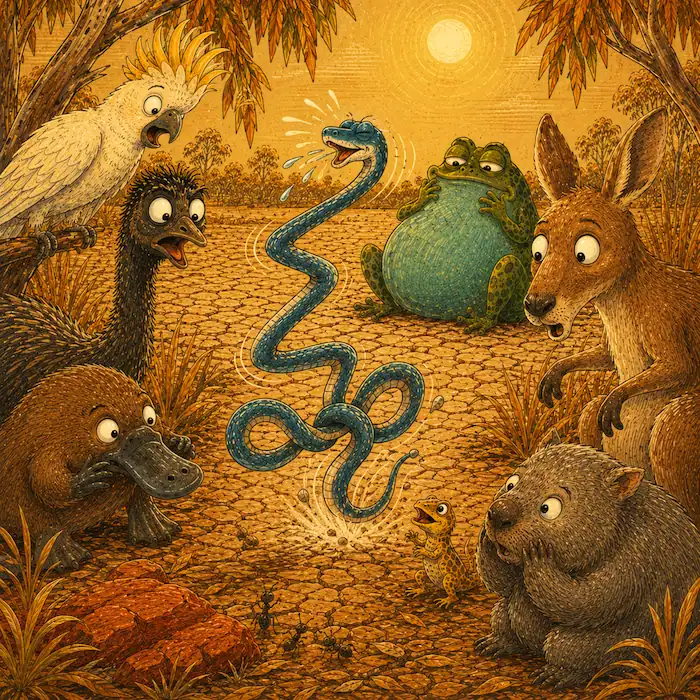
Snake twists and wriggles in front of Tiddalik while the animals watch

His whole long body sprang into the air.

Boing-wiggle-wiggle-SPLAT!

Tiddalik stared. His round belly jiggled. His wide mouth opened.

And then…

“Heh.”

The animals leaned closer.

Tiddalik tried to stop it.

“Heh-heh.”

His belly wobbled. His cheeks puffed.

“Heh-heh-heh!”

“Keep going!” cried Kangaroo.

Snake rolled down a little hill like a curly stick.

Tiddalik could not hold it in any longer.

He laughed.

“HA!”

The ground trembled.

He laughed again.

“HA HA!”

The trees shook.

Then Tiddalik laughed the biggest frog laugh the bush had ever heard.

“HAAAAA HA HA HA HAAAAA!”

And out came the water.

Splash!
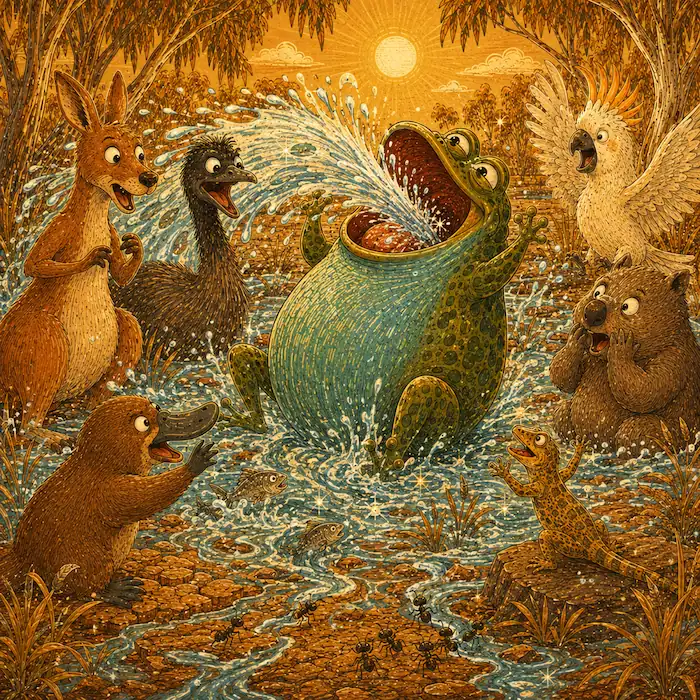
Tiddalik laughs as water pours out and rushes back across the billabong

It poured from his mouth. It rushed across the mud. It filled the cracks in the ground. It ran under the trees. It swirled around the reeds.

It lifted the fish.

It filled the billabong again.

The animals cheered.

The kangaroos drank. The emus drank. The lizards drank. The ants drank tiny ant-sized drops.
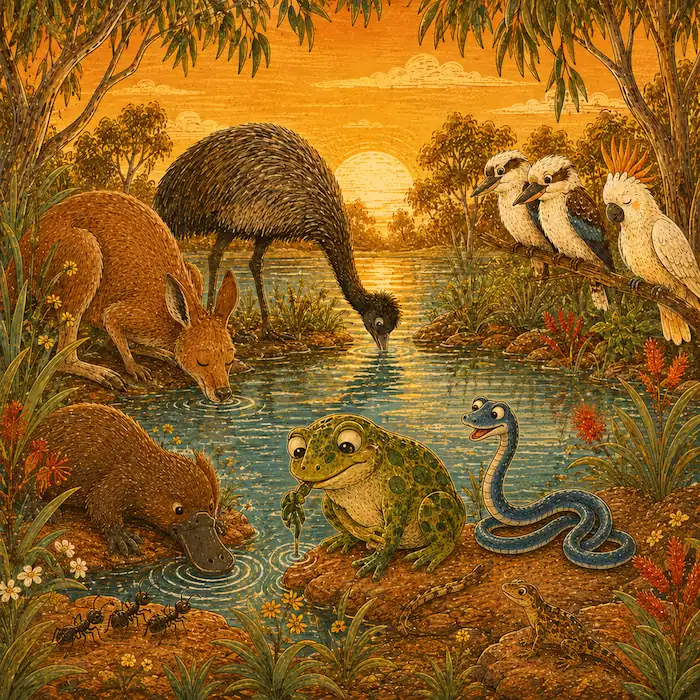
Australian animals drink at the full billabong after Tiddalik shares the water again

The trees lifted their leaves. The birds sang.

And Tiddalik?

Tiddalik sat beside the billabong with a much smaller belly. He looked at the animals. Then he looked at the shining water.

“I think,” he said slowly, “I drank too much.”

Kangaroo nodded.

“Water is for everyone.”

Emu nodded.

“Even for little ants.”

Platypus nodded.

“And muddy platypuses.”

Snake smiled.

“And thirsty frogs.”

Tiddalik dipped one toe into the cool water.

“I am sorry,” he said.

Then he took one very small sip.

Just one.

The animals laughed. Tiddalik laughed too.

And from that day on, whenever Tiddalik felt thirsty, he remembered the dry billabong, the worried animals, and clever little Snake.

So he drank carefully.

Sip.

And he always left enough water for everyone else.

Story Lesson

Water is for everyone. Tiddalik learns that one choice can affect the whole bush, and that sharing water matters for animals, plants and even the smallest ants.

Short Summary

Tiddalik wakes up thirsty and drinks all the water from the billabong. The animals are left with no water, so they try to make him laugh. Kookaburra, Kangaroo, Emu and Platypus all try, but Tiddalik does not laugh. At last, Snake wriggles and twists until Tiddalik laughs so much that the water comes pouring back.

Main Characters

Tiddalik

Tiddalik is the thirsty frog who drinks too much water from the billabong. He learns to think about the other animals and leave enough water for everyone.

Snake

Snake is small and quiet, but he finds the way to make Tiddalik laugh. His part in the story shows that small characters can make a big difference.

The Other Animals

Kangaroo, Emu, Kookaburra, Platypus, Wombat, Cockatoo and the other animals all need the water too. They help children see that the billabong belongs to the whole community.

Vocabulary Spotlight

  • Billabong: A waterhole or pool, often connected with an old river channel in Australia.
  • Kookaburra: An Australian bird known for a call that sounds like laughter.
  • Cockatoo: A crested parrot found in Australia and nearby regions.
  • Platypus: An Australian animal with webbed feet and a duck-like bill.
  • Thirsty: Needing a drink.
  • Share: To let others have or use something too.
  • Community: A group of living things that share a place.

Discussion Questions

  1. Why did Tiddalik drink from the billabong?
  2. What happened when he drank too much water?
  3. How did the other animals feel when the water was gone?
  4. Which animal finally made Tiddalik laugh?
  5. Why did the water need to come back?
  6. What does the story teach about sharing?
  7. How can people care for water in real life?

Classroom Activities for Children

1. Water Sharing Circle

Give children counters or blue paper drops. Ask them to share the drops fairly between different animals and talk about why everyone needs water.

2. Make Tiddalik Laugh Drama Game

Children take turns acting as Kookaburra, Kangaroo, Emu, Platypus or Snake. Keep the activity silly, gentle and respectful.

3. Billabong Vocabulary Picture

Children draw a billabong and label frog, water, reeds, bird, fish and tree.

4. Small Things Can Do Big Things

Talk about Snake in the story. Ask children to name a small kind action that can help a group.

5. Water Care Poster

Children make a poster with one simple message, such as Water is for everyone or Save water for plants and animals.

Teachers’ Notes

This retelling can support discussion about sharing, water, community and Australian animals. Present it respectfully as a traditional Aboriginal Australian story with many versions, not as a generic tale label or as the only correct telling.

For younger children, keep the learning focus simple: Tiddalik drank too much, the other animals needed water too, and the water came back when he laughed. For older children, the story can open a careful discussion about water, responsibility and how stories teach values.

Why This Version Works for Children

  • The repeated drinking sounds make it easy to read aloud.
  • The animal attempts to make Tiddalik laugh give children a clear sequence to follow.
  • The story has a strong visual problem: the dry billabong.
  • Snake gives the story a satisfying turning point.
  • The ending brings the water back and leaves children with a simple sharing message.

What Parents and Teachers May Want to Know

Tiddalik is also often searched as Tiddalick the frog or Tiddalick the frog story. This page uses the uploaded KKW title spelling, Tiddalik, while keeping the alternate spelling in supporting copy so families can still find it.

Because this is an Aboriginal Australian story, it should be introduced with respect. It is better to say traditional Aboriginal Australian story than to use a generic label.

Story Background

Tiddalik is a traditional Aboriginal Australian story often told to children as a tale about water, laughter and sharing. Versions differ in spelling, animal cast and details, including Tiddalik and Tiddalick.

This Kooky Kids World retelling is written in simple read-aloud language for families, teachers and younger readers. It is not intended to replace community-owned tellings or local cultural teaching.

Frequently Asked Questions About Tiddalik the Very Thirsty Frog

  • What is Tiddalik the Very Thirsty Frog about?

    Tiddalik the Very Thirsty Frog is about a frog who drinks all the water in the billabong. The other animals try to make him laugh so the water will come back for everyone.

  • Is Tiddalik an Aboriginal Australian story?

    Yes. Tiddalik is widely shared as a traditional Aboriginal Australian story. This Kooky Kids World version is a child-friendly retelling and is not presented as the only version.

  • What age is this Tiddalik story good for?

    This retelling works well for children aged 4 to 8 as a listen-aloud story, and for many children aged 6 to 8 as an early independent reading story.

  • What is the lesson of Tiddalik the Frog?

    The story can help children talk about sharing, water, caring for others and noticing how one choice can affect a whole community.

  • Who makes Tiddalik laugh in this retelling?

    In this retelling, Snake makes Tiddalik laugh by wriggling, twisting and doing something silly. When Tiddalik laughs, the water comes tumbling back.

  • Why is water important in the story?

    Water matters to every animal, plant and person. In the story, the dry billabong helps children see why water should be shared and cared for.