


Act I: The Secret Under the Crown
Long ago in Korea, a king ruled a walled city where drums marked the hours and banners rippled over the gates. Because the king loved order, he measured garden stones, checked parade lines and even noted the angle of his shadow at noon. For this, he was called Wise King Jin.
After he became king, his ears began to grow, long and soft like a donkey’s, but he told no one. He kept a calm face in front of people, but inside his stomach flipped. He was frightened that people would laugh and the thought stung more than any sword. He pulled his crown lower, told no one, and vowed to keep his ears hidden.

“A king must look like a king,” he muttered to his mirror.
As the ears grew longer, his hair was grown long to pad the space beneath the crown and blur the outline of his ears.
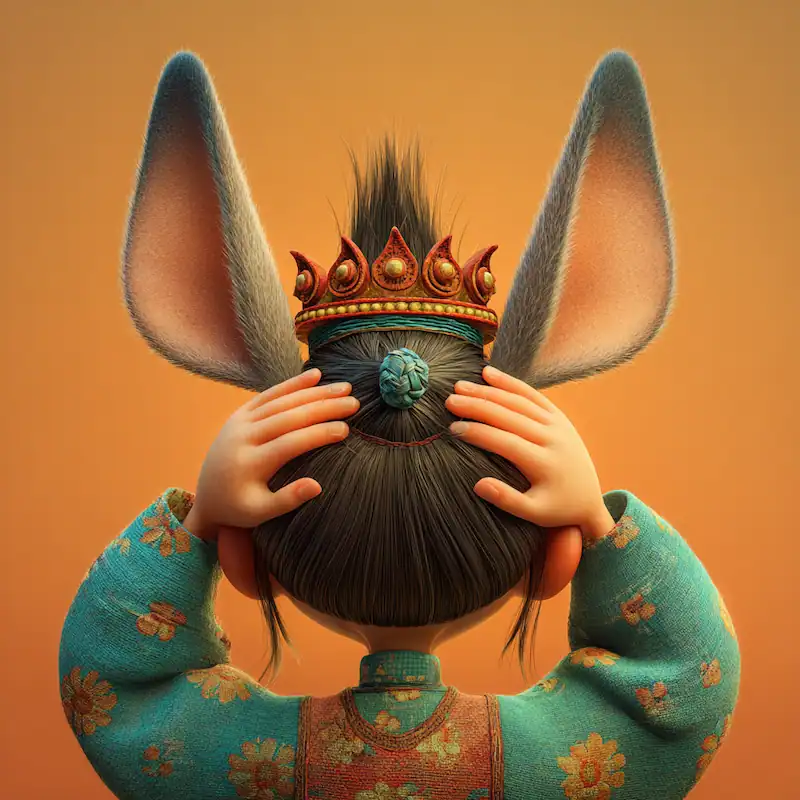
The crown frame was raised and the inner silk padding was thickened, turning his hidden ears into what looked like a grand new style. Courtiers praised the splendour. People admired the shine. The king pretended to smile while worry thudded in his chest like a hidden drum.
The Barber’s Summons
At last his hair had grown so heavy that he could hardly sleep. The royal barber, a careful man named Mok, was summoned. He was known for steady hands and quiet feet. He could trim a child’s fringe while a kitten slept in his lap. He could shape a scholar’s beard so neatly that not a whisker went astray.

Mok entered through the East Gate, passing silk screens and guards who stood like stone. In the inner room, the king sat on a low platform, his crown wrapped in red cloth beside him, a silk cover draped over his head.
“Barber Mok,” the king said, “you will cut my hair. Keep your eyes low and your mouth shut. Fail me and you will regret it.”
Mok bowed so low his forehead touched the floor. “Your Majesty, I will be as silent as a stone.”
The silk cover was lifted. There they were, long donkey ears, soft as new leaves.
He froze for a heartbeat, then steadied himself and returned to work. His gaze was lowered. The king’s hair was combed. Careful snips were made. The long hair was gathered into a neat bundle and tied with a ribbon, and the crown was set back, steady as sunrise.
“It is done,” he whispered.
“You saw nothing,” the king said.
“I saw nothing,” Mok echoed.
“You will tell no one.”
“I will tell no one.”
Mok stepped out backwards and left through the East Gate. His legs trembled like bamboo in the wind.
Act II: The Weight of a Secret
A Stone on the Chest
Days turned to weeks, and the secret pressed on him like a stone on his chest. He woke before dawn with his heart thudding and his mouth dry. At work his careful hands began to shake. Twice a fringe was snipped unevenly, and apology after apology was given. His favourite soup was pushed away. He even stopped playing with his little son, afraid the secret might fly out by accident. At night he lay still and hardly breathed, in case a word should escape while he slept.
His wife cupped his face. “You are carrying something too heavy,” she said. “Let me help.”
When no explanation was given, the village healer was sent for. The healer listened to his tight breath, saw his trembling hands, and nodded kindly. “You are carrying a large burden,” she said. “If you cannot tell a person, tell the earth. Secrets need a safe place, or they make you ill.”
Mok wanted to whisper in his wife’s ear, but the king’s warning cracked like thunder in his ears, and the words were not allowed to touch her.
So, when the house was quiet, Mok walked beyond the walls to the stream where reeds bent over the water. Stars pricked the dark. Crickets sang. A small hollow was dug in the soft bank. He bent close and breathed into the dark:
“The king has donkey ears.”

The stream chattered on. The sky did not split. The knot in his chest loosened. He whispered again, a little stronger, “The king has donkey ears.” The words were covered with earth, the ground was patted flat, and, for the first time in weeks, his shoulders lowered and his breath came easy.
Bamboo by the Stream

Children found it first. “This was not here before,” they cried. Farmers came next, hands on hips. “Bamboo in this corner,” they wondered. The bank was stony and no shoots had grown there for years, so the sudden grove felt strange, but also useful.
The bamboo felt the wind and loved it. Air flowed through the hollow stems. Their music gathered syllables, then words. On a bright afternoon a playful gust rushed the grove, and the bamboo sang, clear as temple bells:
“The king has donkey ears!”

Children giggled. Farmers frowned, then leaned closer. Travellers cupped their ears. By evening the city buzzed. By morning the palace knew.
Storm in the Throne Room
“What did you say?”
“The bamboo sings, Majesty. It sings a phrase.”
“What phrase?”
“It says, ‘The king has donkey ears.’”
Silence scraped across the floor.
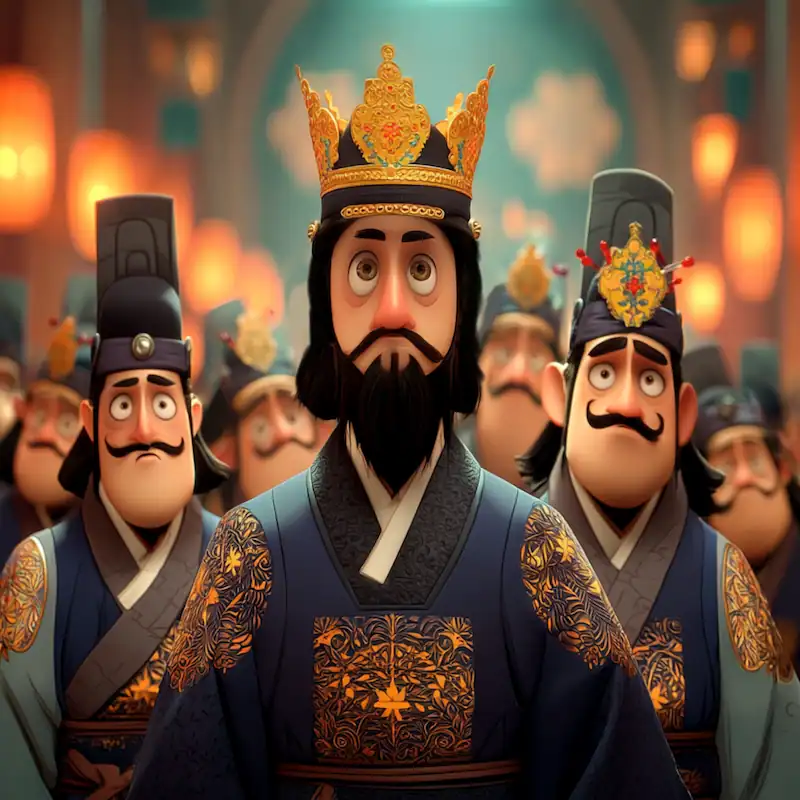
“Who dares?” said the king. “Bring me the barber.”
Soldiers ran. Soon Mok stood before the throne, pale but upright. Outside the gate, his wife and their little boy waited with hands clenched tight.
“You broke your word,” the king said. “You told my secret.”
Mok’s knees trembled, but he lifted his head.
“Your Majesty, no person was told,” he said. “The secret pressed so hard I could not sleep or eat. My wife sent for the healer, and she said if I could not tell a person, I should tell the earth or I would fall ill. So I dug a tiny hole by the stream, whispered the words into the ground, and covered them. That is all. No harm was meant.”
The king’s eyes flickered. It had not been known to him that a secret could make a man shake and starve.
“I see,” he said slowly, though anger still burned. “You were trying not to break. Even so, take him away. Cut down the bamboo. Every stalk.”

Soldiers reached the grove and swung their axes. Bamboo toppled with drum thuds. The wind chased itself through the cut stems and, even as they fell, the grove sang:
“The king has donkey ears!”
People gasped. Children clapped hands to mouths, then giggled because the sound tickled. Axes flashed. Still the truth flew on the wind.
Act III: Wind, Truth, and a New Beginning
The Hat Maker’s Answer
Back in the palace, the faint chant seemed to perch in the corners of the room. The king pressed his hands to his crown until his knuckles went white.
Inside the palace, the brave and kind royal hat maker heard the rumour about the king’s donkey ears. Ceremonial headgear had been crafted by her since she was young. Her stitches were neat as rain on still water.

She slipped through the screens and bowed in front of the king.
“Your Majesty, forgive my boldness,” she said softly, “but you cannot breathe under that crown. If the wind speaks, let it speak. You need air.”
“Air,” the king repeated.
“Allow me to make a soft everyday hat that fits what is true,” said the hat maker. “A hat should shelter a head, not crush it. It can be made so your ears are seen, not squashed.”
No one had spoken to him like this since he was a boy with grass stains on his knees. The memory of the bamboo’s song brushed the eaves. His hands dropped.
“Make the hat,” he said.
The hat maker worked through the afternoon. Strong, soft fabric the colour of late summer clouds was chosen. The crown was shaped high and light, with side openings so the ears could stand free. A smooth silk lining was added, with a hidden ribbon so it would sit steady even when the wind played. It would not pretend. It would simply fit, and his ears would be visible.
When she returned, she met his eyes. “May I?”
He nodded. For the first time in months the heavy crown was lifted. His long ears sprang free, alert like friendly watchmen. Air kissed them. They shivered with relief. The new hat was set gently in place, and the ears rested through the openings without pain.
“How does it feel?” she asked.
He breathed in, then out. His own shape was felt again. “It feels like mine,” he said.
The Day of the Open Gate
That night he thought for a long time. Hiding had brought fear, not peace. By dawn a choice had been made.
The city gates were ordered open. Trumpets sounded. People flooded the square like bees to blossom. The hat maker stood near the steps. Mok’s wife and their little boy found a place at the back.
The king walked out wearing the new soft hat that showed his ears. Sunlight trembled on silk. A thin breeze lifted the brim and teased the tips of his ears. The square held its breath.

Then, as if the wind remembered, a whisper seemed to hover, soft, not cruel, simply true:
“The king has donkey ears!”
A small child in front waved. “I like them,” she called. “They look soft.”
An old man cupped a hand to his own ear. “Mine are just wrinkly,” he chuckled.
The king could hide again or stand and breathe. He chose to breathe.
“Yes,” he said, steady as a bell. “I have donkey ears. I did not ask for them, but they are mine. I wore a heavy crown because I feared laughter. I arrested an innocent man who was trying not to break under a burden I gave him. I am finished with fear.”
He turned to the guards. “Release Barber Mok.”
Mok was brought forward. His wife pressed a hand to her mouth. Their little boy stood on tiptoe.
“Mok,” said the king, “silence was kept as best you could. When the secret crushed you, the earth was told instead. Bamboo grew, and the wind carried the truth I needed to hear. I was wrong to blame you.”
The king stepped down two stairs and bowed, only a little, but enough to make the court blink. “Forgive me.”

Mok’s eyes shone. He bowed. “I forgive you, Majesty. May your days be light.”
A smile warmed the king’s face, and his ears twitched in a way that made the children grin.
“From today,” he called to the crowd, “no one will be punished for speaking the truth kindly. We will listen first, ask questions, and give mercy.”
Bamboo, Wind, and a Lighter Crown
Weeks passed. Though soldiers had cut it, the bamboo grove by the stream sprouted again, because bamboo is stubborn and brave. The wind found it and played it like a flute. Sometimes the sound was a bright song. Sometimes it was only leaf talk and water chuckle. People learned to hear many songs at once.
The king visited often, sometimes alone, sometimes with the hat maker, sometimes with Mok.

The stalks were listened to as they clicked, and the leaves were heard as they murmured. People began to say, “Our king hears us.” His unusual ears proved useful. Which bridge shook in storms was learned. Which family needed rice after a failed harvest was discovered. Which songs helped tired workers lift heavy loads was remembered.
The soft everyday hat was worn, not to hide who he was, but to keep him warm in cold wind and shaded in the sun. “A hat should shelter a head, not crush it,” he said. The hat maker nodded. Mok smiled.
A New Kind of Wisdom
Life went on. Roads still needed repairs. Fields still needed rain. Babies still needed lullabies. But decisions grew kinder. Meetings grew shorter. The king listened before he spoke, and because listening was done, learning followed.
On quiet afternoons his hat was taken off, and the wind was allowed to comb his ears. He bowed slightly to the grove. “Thank you for singing,” he said.
The bamboo answered in rustles and sighs. If you listened carefully, a message might be heard, “Truth told kindly is a gift.” Or perhaps it was the wind. Perhaps it was both.
As for Mok, hair was cut by him with a steady hand and an easy laugh. The story was told, carefully, of the day a king bowed to a barber, and his little boy was taught to sweep the shop with pride.
The hat maker kept making things that fit what was true, hats for scholars with wild hair, for farmers with sun tough skin, and for children who wanted brims wide enough to catch dreams.
People still called their ruler Wise, but the word had changed shape. Wisdom was not only a sharp mind or a straight road. It lived in ears brave enough to feel the wind, in headwear light enough to let a person breathe, and in a heart honest enough to say, “This is me.”