
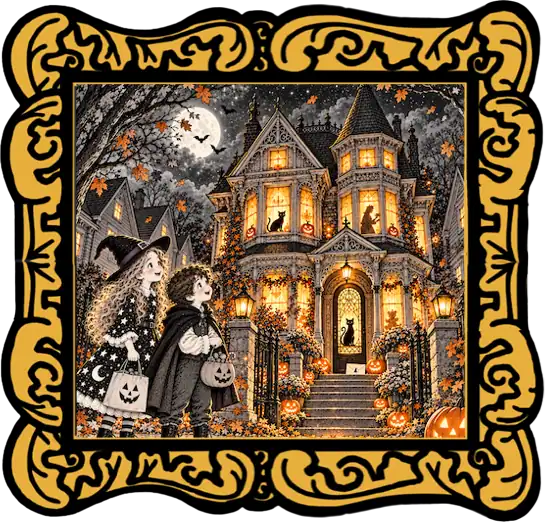
The House that Appeared on Halloween
Amelia Carter knew every house on Maple Street. She knew Mr. Bell’s pumpkin lanterns, the blue shutters at 18 and the birdbath outside 20. So when she and Ben Ruiz reached the gap between those two familiar homes, Amelia stopped so quickly that her witch hat tipped sideways.
A Victorian house stood there.
It had not been there yesterday. Its warm windows shone against the dark Halloween sky. A stained-glass black cat watched from the front door beside a brass letterbox.
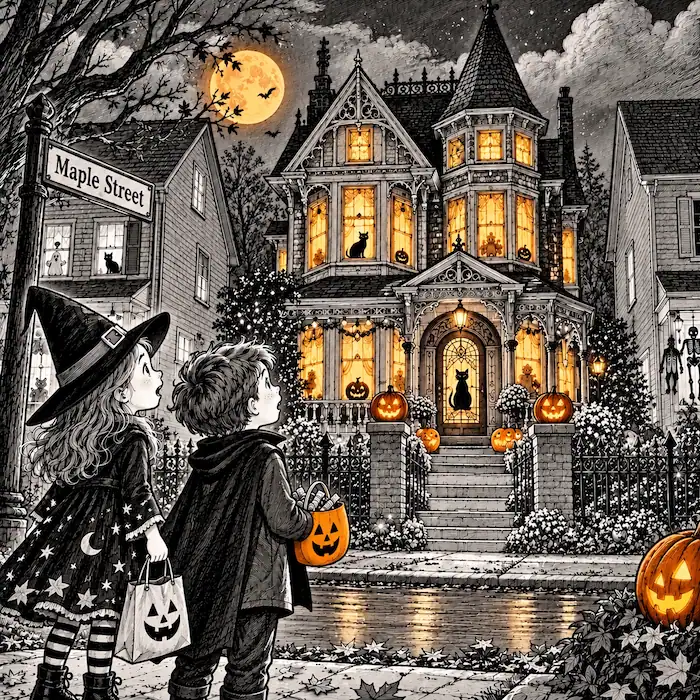
Amelia and Ben had already visited half the street, collecting chocolate coins, pretzels and one apple-shaped cookie that Ben was saving for later.
The street was busy with trick-or-treaters. A little astronaut hurried past. Mr. Bell’s lawn skeleton wore an orange scarf. Amelia checked her watch. It was nearly ten o’clock.
“Look,” Ben said in amazement.
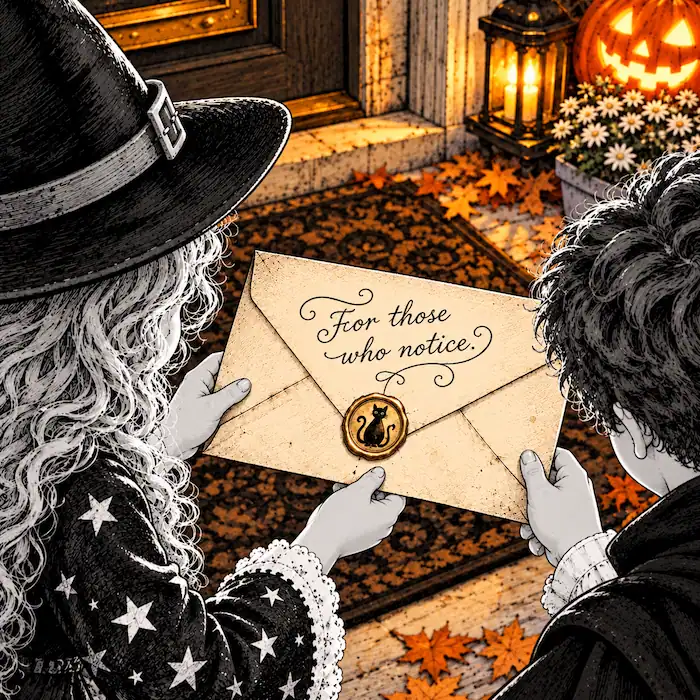
The brass letterbox clicked open by itself. A cream envelope slid onto the step. A tiny clock was stamped where an address should have been. Amelia picked it up and read the words on the front: Bring back the missing key before the final midnight bell.
Ben turned it over. On the back, in curly handwriting, were the words: For those who notice.
“That sounds like a challenge,” Amelia said.
The front door opened a few inches.
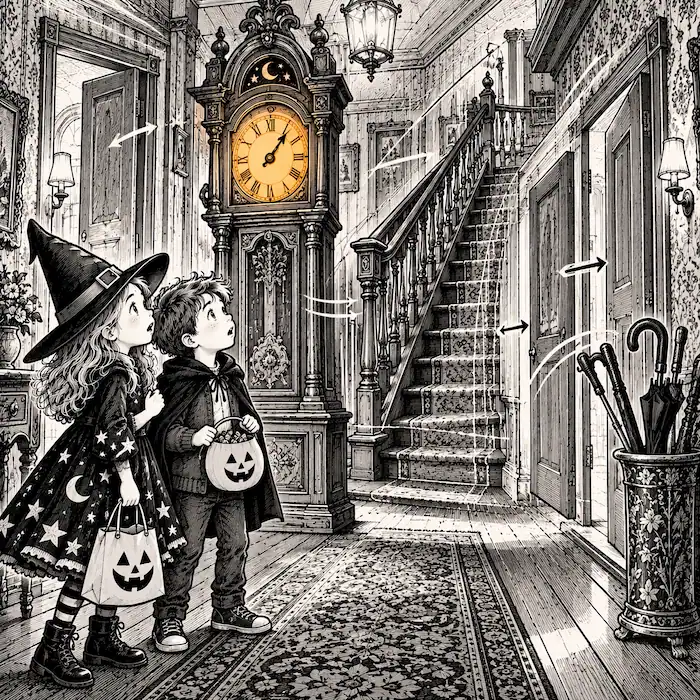
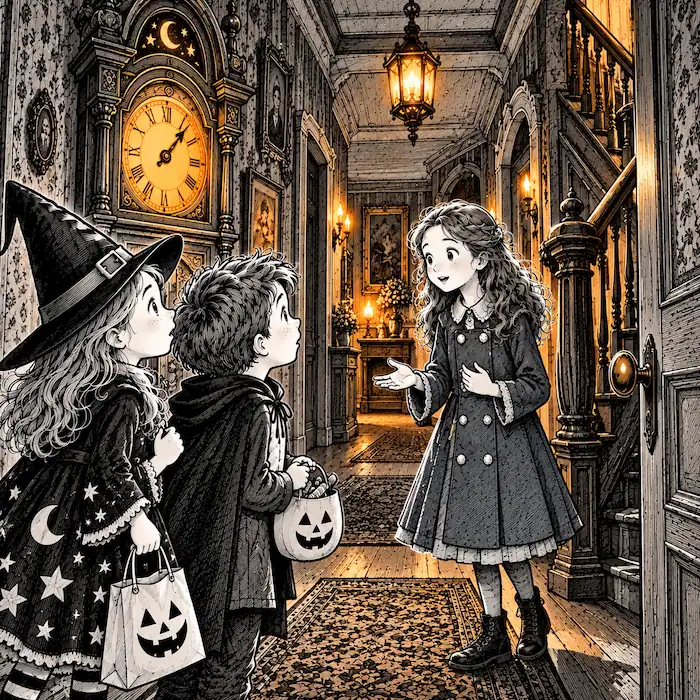
They stepped inside together. The entrance hall smelled of cinnamon and polished wood. A grandfather clock stood opposite the door, its hands moving backward. Tock, tick. Tock, tick. The minute hand crept back away from the twelve.
“Not how clocks usually behave,” Ben said.
Below the clock face, Amelia noticed a small brass arrow pointing toward eleven. Beside twelve was a small clock symbol. Under the arrow were five tiny words: “First midnight bell, turn home.” She read them aloud, then copied the arrow and clock symbol on the back of the invitation.
An umbrella stand took Ben’s umbrella and tucked it beside three walking sticks.
“Thank you?” Ben said.
The stand gave a pleased rattle. A chime sounded and the hallway gave a slow, harmless sway. The staircase slid to the left wall and a door beside Amelia glided to the far end of a corridor.
“The rooms move when it chimes,” Ben said.
A girl stood at the end of the corridor. She wore a blue coat with pearl buttons and held the wallpaper with one hand, as if checking that it was still there. She looked eleven, exactly Amelia’s age.
“You got my invitation,” she said.
“My name is Susan,” the girl said. “I sent it when the house appeared.”
Amelia showed her the envelope. “What is the missing key for?”
“My father was a clockmaker,” Susan said, looking toward the grandfather clock. “When I was eleven, I accidentally activated his magical clock. It began running backward then its key and pendulum vanished into the house’s secret hiding places. The clock froze Father in his workshop, then carried our house outside ordinary time. Father hasn’t woken since and I’ve been trapped here with him.”
Ben looked around the shifting hall. “Can’t you follow the clues yourself?”
“I have tried,” Susan said. “When I am alone, the rooms change and the house will not reveal its path to me. It responds to new visitors who notice clues. That is why I sent the invitation.” She rested her hand on the wallpaper. “Every Halloween at dusk, the house appears on Maple Street for one night. Unless someone restores the clock before the final stroke of midnight, it disappears again, taking me with it.”
“How long have you been here?” Ben asked.
Susan looked down at her pearl buttons. “I don’t know how many Halloweens have passed. I was eleven when the clock stopped, and I haven’t grown any older.” Over time she had watched people pass the windows, heard laughter from the street and waited for someone who could understand the clock.
Amelia felt the invitation grow heavier in her pocket. Susan did not sound like a spooky secret. She sounded like a girl who had waited much too long.
“If we find the key and pendulum, can we fix it?” Amelia asked.
“Yes. We must put them back before midnight. If the clock runs forward, the house can stay.” The clock chimed again. A doorway slid open to reveal walls covered with portraits.
“The gallery likes clues,” Susan said.
Four portraits hung in a row. Under the paintings were four doors marked with a small painted symbol: a star, a crescent moon, a leaf and a heart.
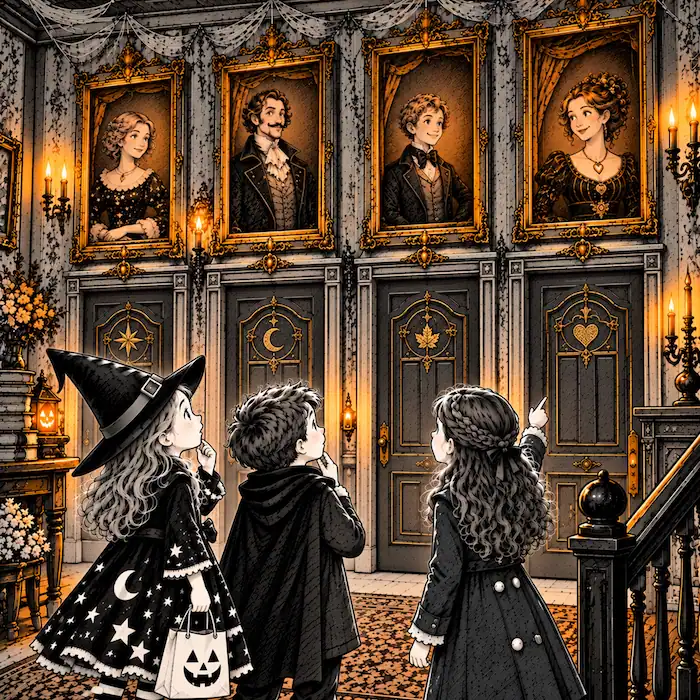
The woman above the star said, “Begin where night first shines.”
The man above the moon said, “After the moon, follow what grows.”
The boy above the leaf said, “After the leaf, choose what beats.” The woman above the heart whispered, “Check every sign.”
Amelia copied the four symbols onto the invitation, studying each one carefully. The star door opened a crack.
“Night first shines at the moon,” she said quickly. “We should take the moon door.”
They stepped through it into a cheerful conservatory full of potted ferns. At first, nothing happened. The house chimed, and the room slid farther down a hallway. Ben checked his watch. “That cost us a chime.”
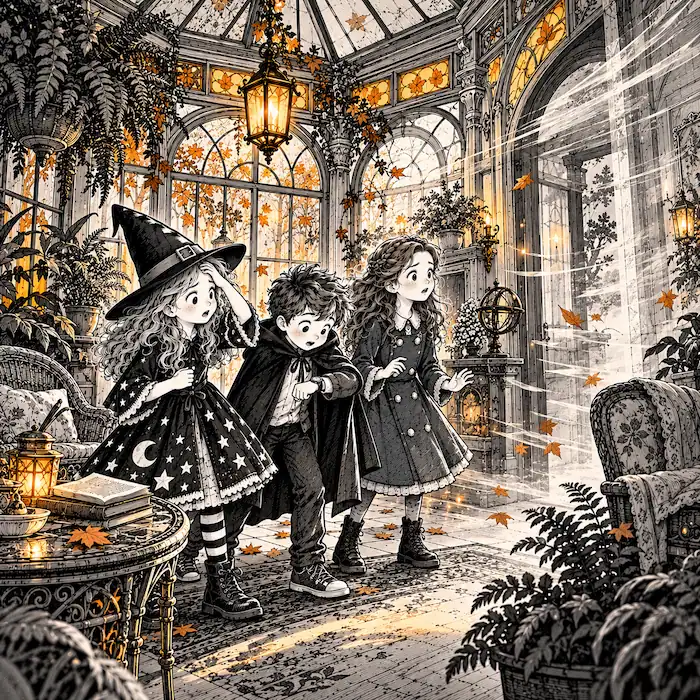
Amelia’s cheeks warmed. “I read the first clue too fast.” Ben pointed through the doorway at the four portraits. “The star portrait says ‘begin.’ The moon is only the next one. And the heart says to check every sign.”
Amelia looked again. A tiny painted arrow beside each symbol pointed toward the next door. The heart’s arrow pointed back to the star.
“You’re right,” she said. “The symbols make a circle. Star, moon, leaf, heart, then back to star. I chose a door because I liked one word, not because I checked the whole clue.”
“That happens,” Ben said. “Now we have the better answer.”
At the next chime, the conservatory door opened back into the gallery. The minute hand on Ben’s watch had moved closer to eleven, and Amelia chose the star door.
The star door led to a library. Shelves climbed to the ceiling, and a fire crackled behind a grate without making smoke. On a desk sat a wooden music box shaped like a tiny workshop. Its plaque read: “E. Vale, Clockmaker.”
“My father’s,” Susan whispered.
Amelia lifted the lid. Instead of music, it held a silver winding key in a velvet purse. A small star topped the key. Ben smiled. “The first symbol led to the key.”
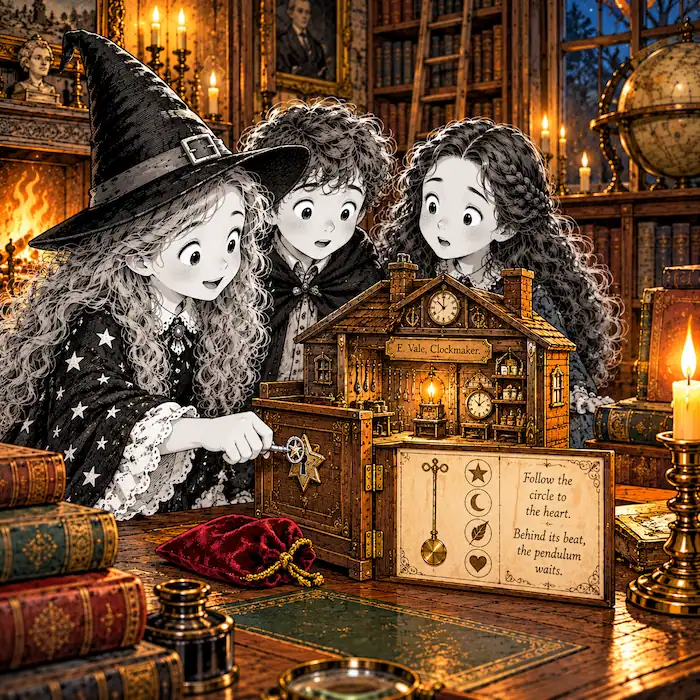
On the music box’s side was a star-shaped keyhole. Amelia fitted the key inside and turned it. A little panel opened. Inside was a picture of a long pendulum, with four simple symbols beneath it: star, moon, leaf, heart. A message appeared below: Follow the circle to the heart. Behind its beat, the pendulum waits.
“The heart door is the last door in the circle,” Amelia said. “And ‘behind its beat’ means behind a clock.” Susan touched the music box gently. “Father hid important things in things that could explain themselves.”
“Then the heart door should take us to the clock room,” Ben said. He checked his watch. “We have only a few chimes left.”
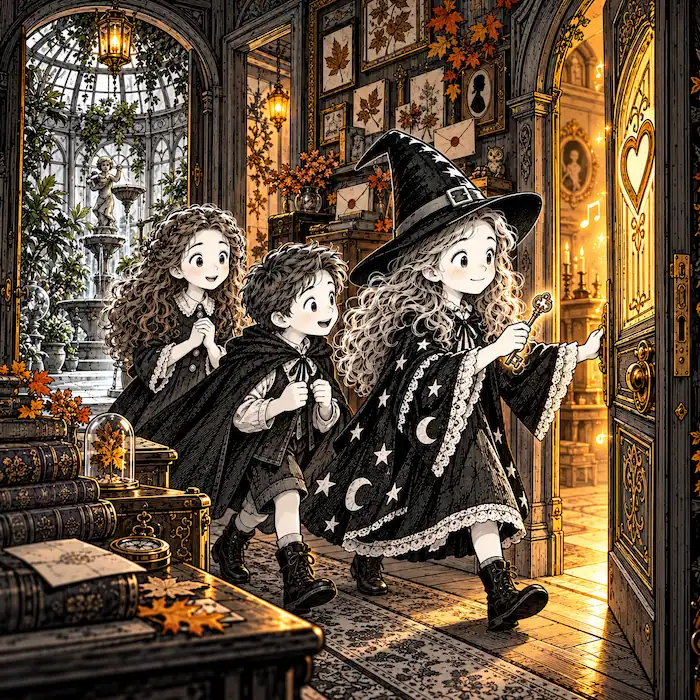
Amelia folded the invitation carefully. “This time, we follow the whole clue.”
Amelia stepped back through the star door into the gallery. Then she chose the moon door again. It opened into the same conservatory, where silver lamps glowed among the potted ferns. This time, a leaf-marked door had appeared on the far wall.
The leaf door led them through a small autumn room filled with pressed leaves, old letters and picture frames. Beyond it waited the heart door.
“Star, moon, leaf, heart,” Amelia said. “We checked every sign.”
The heart door opened, and the house gave a soft approving chime.
Beyond the heart door lay a room full of clocks. Round clocks, square clocks and clocks shaped like ships covered every wall. In the center stood another grandfather clock, taller than Amelia. Its pendulum window was dark. Beside it was a small shelf with the four symbols carved in a circle. The star-shaped keyhole waited in the middle.

Amelia placed the key in the keyhole. “The message says follow the circle to the heart.” She turned the key toward the star. A soft click sounded. She turned it toward the moon, then the leaf, then the heart. The bookcase beside the tall clock slid aside.
Behind it, in a padded little space, hung the pendulum. Its silver bob shone. Ben reached for it, then stopped. “Wait. There is a string holding it.” He found a blue ribbon tied to the brass rod. A tag on it read: Lift by the rod, not the bob.
“Good observation,” Amelia said. Ben untied the ribbon. Amelia lifted the pendulum carefully by its rod and Susan gave a small laugh of relief.
“Now the main clock,” Ben said. “It’s almost midnight.”
They hurried through the calm, shifting rooms. Ben watched for each chime and told them when to pause. Amelia used the symbol circle to choose the right doors. Susan stayed beside them, no longer gripping the wallpaper.
At the entrance hall, the main clock’s pendulum window opened when Amelia touched its latch and hung the pendulum on its hook, and Ben slid the silver key into the winding hole and turned the key.
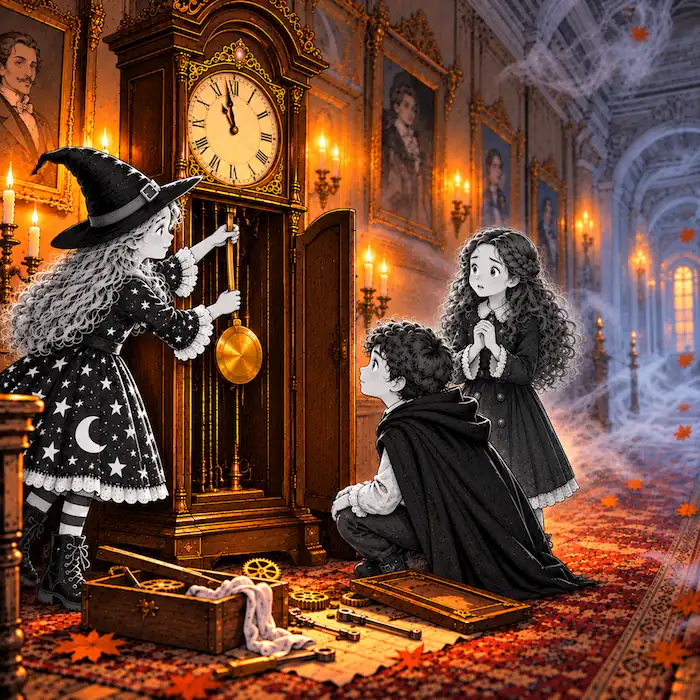
It swung, but the clock hands kept creeping backward.
For one worried moment, no one spoke. The hallway edges began to fade behind a thin wash of mist. The front door became partly see-through. Through it, Amelia could see Maple Street’s pumpkin lights shimmering softly.
“The house is slipping,” Susan said. Her voice shook, but she stood close to the clock. “Will it take me with it?”
Amelia took a slow breath. “We still have the clue.” She looked at the little brass arrow below the clock face and saw the words she had copied when they first entered: First midnight bell, turn home. The arrow still pointed to eleven.
“The arrow must move from eleven to the clock symbol at twelve when the first midnight bell begins,” Amelia said. “That is what ‘turn home’ means.”
Outside, the town clock began to strike midnight. At its first bell, Amelia pressed the arrow and turned it from eleven to the clock symbol at twelve. The main clock hand shivered and briefly stopped before moving forward.
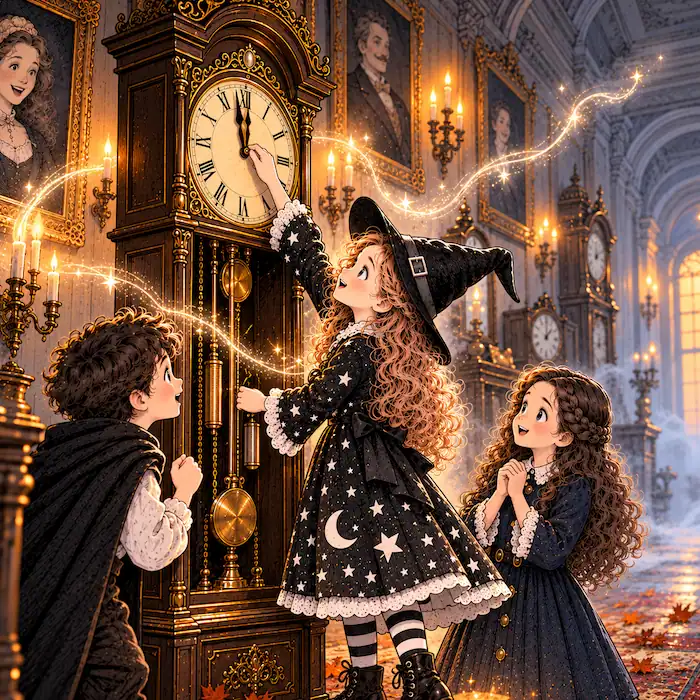
The misty edges cleared at once. The front door became solid again, warm and polished beneath Amelia’s hand. Other clocks answered. The portraits smiled and the walls settled with a comfortable sigh.
The front door opened onto Maple Street. A brass number 19 appeared beside it, as if it had always belonged there.
Susan stepped outside. Cold night air lifted a curl of hair from her cheek. She looked from the steady house to the bright neighbors’ porches, the pumpkin lanterns and the last trick-or-treaters carrying their candy home.
“It’s staying,” she said. Her voice sounded amazed. “I’m staying.”
“You are free,” Amelia said.
A workshop door opened inside the house. A man stepped into the hall, blinking as though waking from a nap. He saw Susan, and his face brightened.
“Susan,” he said. “There you are.”
“Father!” Susan ran to him and he held her close.
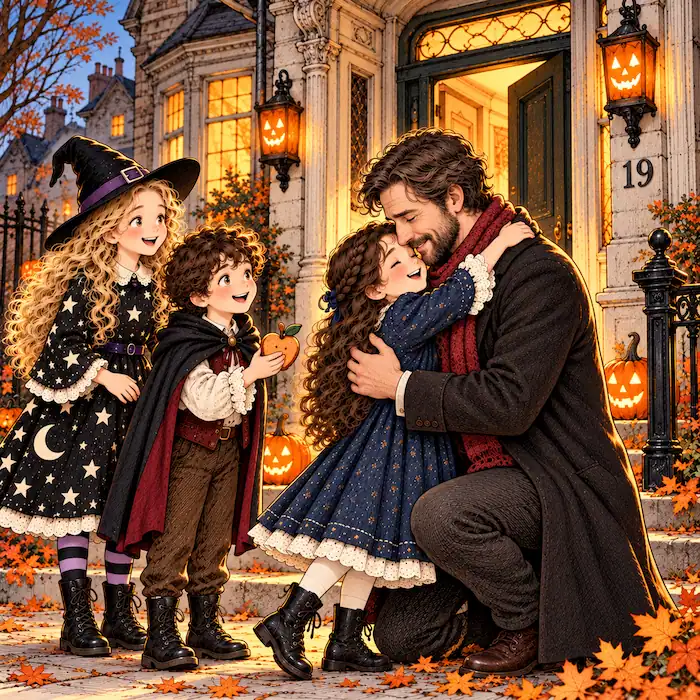
Amelia smiled. The children had repaired the clock. Now it was time to live life to the full.
Susan looked back at Amelia and Ben. “I can have an ordinary life with Father now.”
“My family lives nearby. You must both come over for breakfast tomorrow.”
Ben offered Susan the apple-shaped cookie from his candy bag. “For your first ordinary breakfast.”
She accepted it with both hands. Her father smiled at the cookie. “I would like that very much,” Susan said.
A little after midnight, Amelia and Ben walked home. Behind them, number 19 glowed warmly on Maple Street, safe and no longer waiting for Halloween.
