
The Story
A Village of Early Risers
In a small village in Mexico, the days began before sunrise.
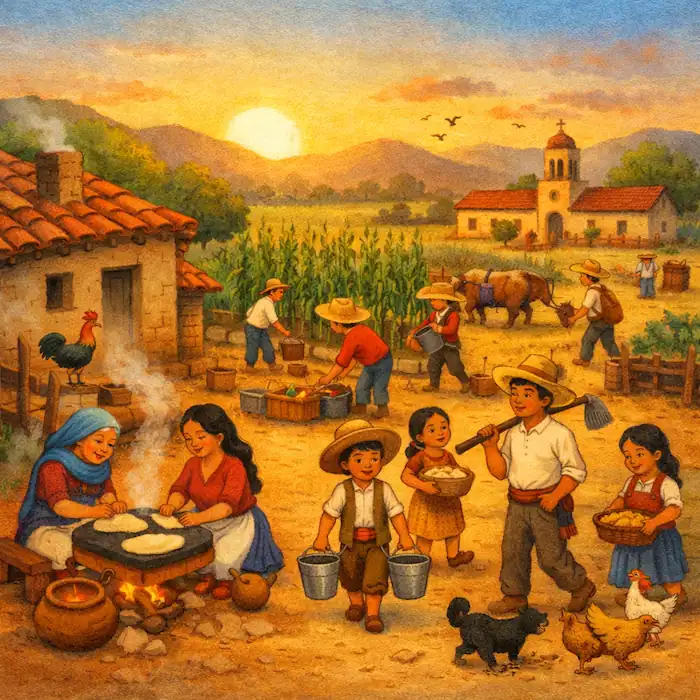
Roosters crowed from low fences. Dogs barked at the pale morning light. Smoke curled up from cooking fires as mothers patted corn dough into tortillas and fathers stepped out with hoes across their shoulders. Children carried buckets, gathered eggs or ran messages from one house to another. Beyond the village, rows of maize stretched toward the hills. Beans climbed poles and squash leaves spread wide over the ground.
The people of the village worked hard, but they did not grumble. They knew the seasons and they knew the soil. If they planted on time, weeded with care and prayed for enough rain, the earth usually gave back what they needed.
Among them lived a farmer named Tomás. He had good land. Everyone knew it. His field lay near the edge of the village where the soil was dark and rich. When rain fell, it soaked deep into the ground. A narrow ditch brought water close by. If someone had worked that field with steady hands, it could have grown tall maize, fat squash and enough beans to fill many jars.
But Tomás did not like work.
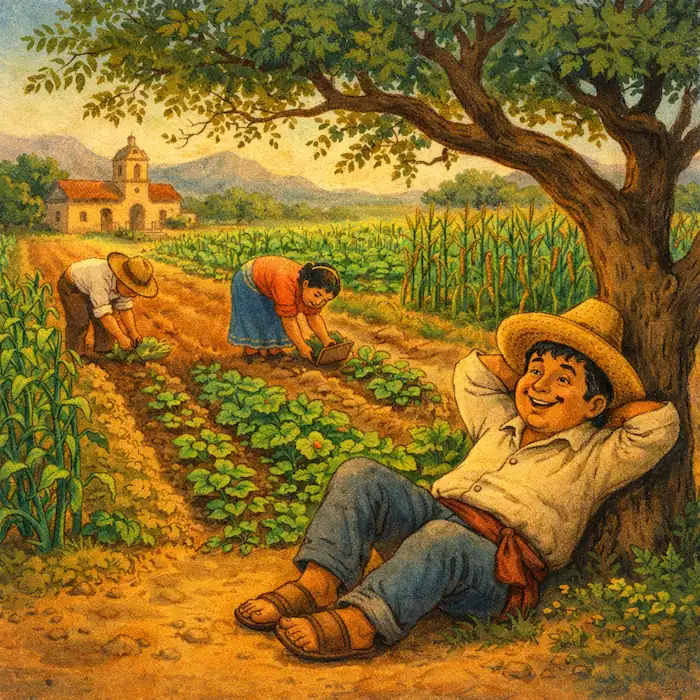
While his neighbors tied up their sandals and headed out at dawn, he rolled over on his sleeping mat and pulled his blanket to his chin. When others sharpened tools, he sat beneath a mesquite tree and yawned. When villagers bent over rows of young plants, he watched clouds drift across the sky and said, “What is the hurry? The earth knows how to grow things without all that fuss.”
His hoe leaned against the wall of his house. Rust crept over the metal. A rake lay under a broken basket. Seed sacks sat untouched in a corner while mice nibbled at the strings.
At first, people only shook their heads.
“He is lazy,” old Doña Marta said as she ground corn at her stone metate.
“He will learn,” said Don Luis, who was kind and slow to judge.
But Tomás did not learn. In fact, each year he seemed a little lazier than before.
The Farmer With Clever Words
Tomás had one talent. He knew how to ask for things.
He never marched up and demanded food. Instead, he tilted his head, let out a long sigh and spoke in a soft, sad voice. “Neighbor,” he would say at harvest time, “what bad luck has followed me. Look at my poor empty jars. I have had such a difficult season.”
If he spoke to Doña Marta, he pressed his hand to his stomach and looked thin and pitiful. If he spoke to Don Luis, he stared at the ground and muttered, “Perhaps I was born under an unlucky star.” If he came upon a family shelling beans in the yard, he stood nearby until someone noticed him, then said, “I would never ask if I were not in need.”
The villagers were generous people. They believed no one should go hungry if food could be shared. So they gave him ears of maize, handfuls of beans, a squash here and a bundle of dried chilies there.
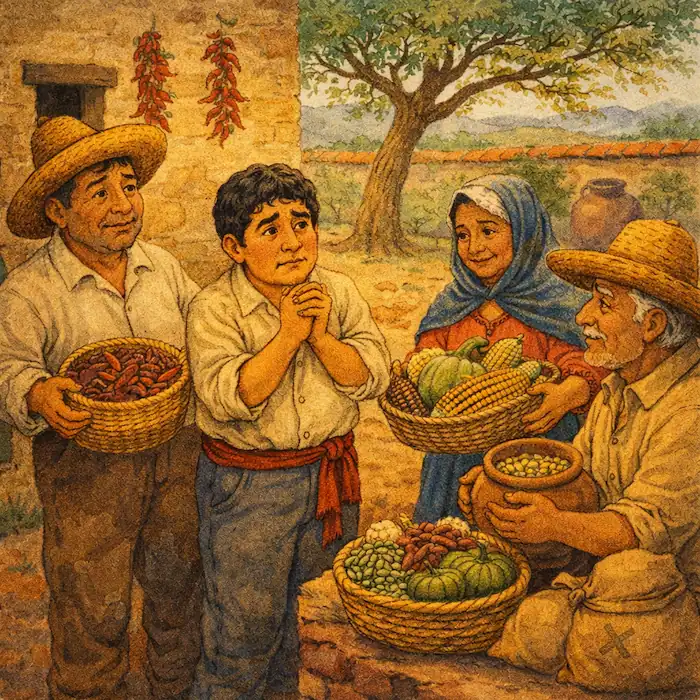
Tomás thanked them with a humble smile. Then he went home, cooked what they had given him and rested in the shade as if he had earned it.
One season passed, then another. Soon the villagers began to notice something. Tomás always arrived when the work was done. He never came when fields needed clearing. He never came when fences had fallen. He never came when irrigation ditches were clogged or a roof needed patching before the rain. Still, when the granaries were full and the baskets heavy, there he was.
One morning, when the sun was already warm, Tomás wandered past the fields and saw his neighbors working side by side. Don Luis was guiding his ox. Doña Marta’s grandsons were pulling weeds. Rosa and her daughters were carrying water. Even little Mateo, who was only seven, was chasing chickens away from the seed rows with a stick and a great deal of shouting.
Tomás leaned against a fence post and grinned. “You all work too much,” he called. “Look at your sweaty faces. Look at your tired backs. Life is meant to be enjoyed.”
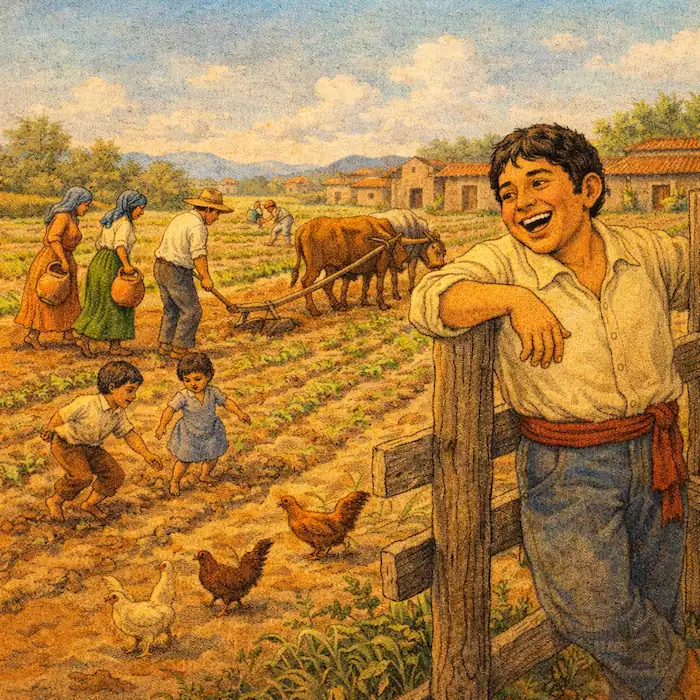
Rosa straightened up and brushed dirt from her skirt. “Enjoyed, yes,” she said, “but not wasted.”
Tomás laughed. “Why should I dig in the heat when kind people like you always have enough to share?”
The villagers looked at one another, but no one answered.
That evening, as the sky turned orange over the maize fields, they spoke quietly among themselves.
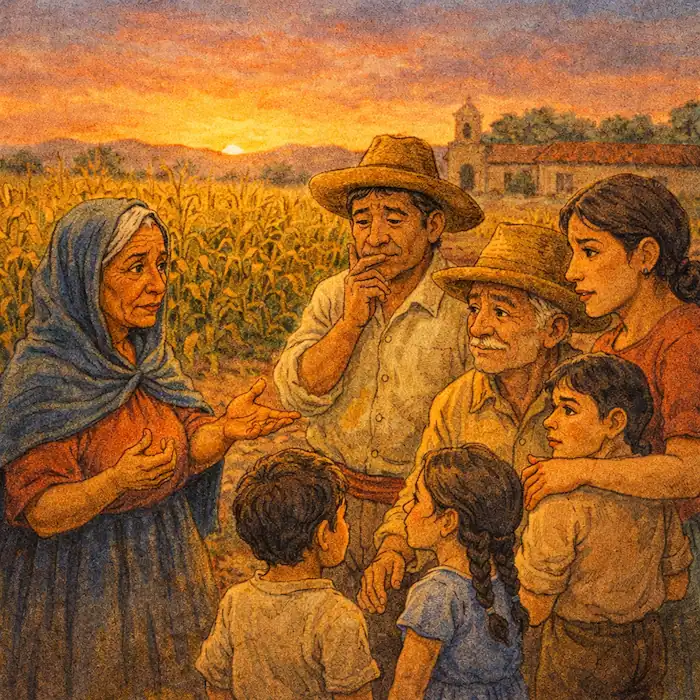
“Help is for trouble,” said Doña Marta, “not for laziness.”
“He is not sick,” said Rosa.
“He is not old,” said Mateo’s mother.
“He simply refuses,” said Don Luis.
Even then, they did not harden their hearts. They only hoped that next season Tomás would do better.
The Unworked Field
Spring came again.
The first rains darkened the earth. Frogs sang from puddles. The village stirred with new energy. Men repaired plows. Women sorted seed. Children ran errands and carried lunch to the fields in cloth-wrapped bundles.
Tomás stood in his doorway and watched. His own field waited. It needed brush cut back and stones cleared. The soil needed turning before the sun baked it hard. Seeds should have been planted while the ground was still moist.
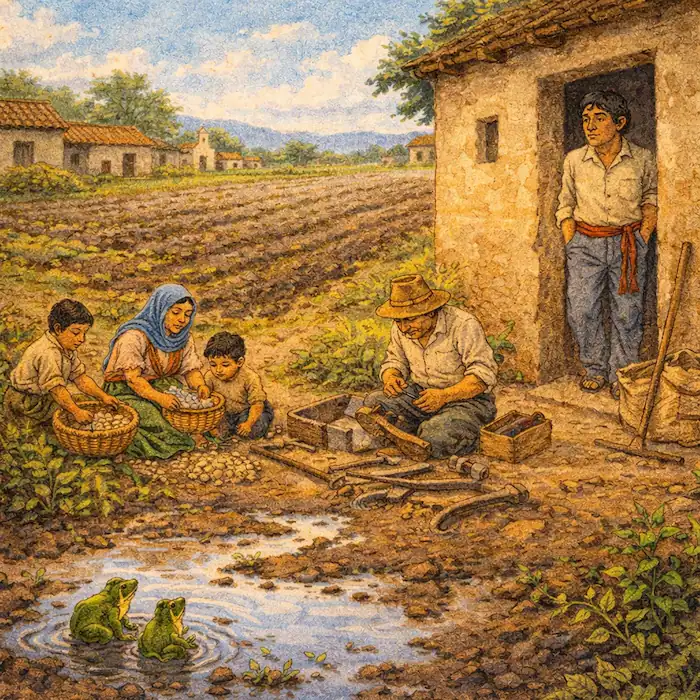
Instead, Tomás scratched his chin and said, “Tomorrow.”
The next day, he said, “The clouds look uncertain. Better wait.”
After that, he said, “Why hurry? There is still time.”
But time does not sit still for anyone.
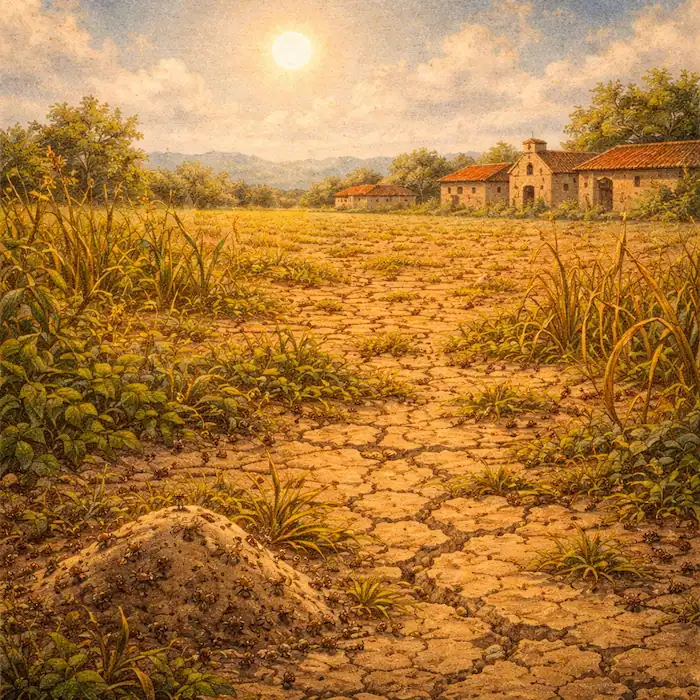
The rains passed. The sun grew hotter. Thin weeds sprang up first, then thick ones. They pushed across Tomás’s field until the land looked like a rough green blanket. Dry stalks from the year before rattled in the wind. Ants built hills in the furrows that should have held maize.
One afternoon, Don Luis stopped by. “Tomás,” he said, “I am mending my fence tomorrow. After that I can spare an hour to help you start your field. But you must be there ready to work.”
Tomás stretched in the shade. “An hour? What good is an hour?”
“It is enough to begin,” said Don Luis.
Tomás shrugged. “Maybe another day.”
Don Luis looked over the field, then back at the man in the shade. “Another day becomes no day at all.”
Still, Tomás did nothing.
Soon his soil changed. Without turning, it grew hard. Without care, it split open in the heat. Cracks ran through the earth like crooked lines in an old clay bowl. Rain fell now and then, but the water slipped away or pooled in the weeds. Seeds tossed onto such ground would never settle deep enough to grow.
It was as if the land itself had given up on him.
Tomás did not like that thought, so he pushed it away.
Empty Jars at Harvest Time
By late summer, the village fields were full of life. Maize rose high, leaves whispering in the breeze. Squash blossoms flashed gold near the ground. Bean pods hung in clusters. Everywhere people were busy. They cut, carried, shelled, dried and stored. Laughter mixed with the scrape of baskets and the thump of boots on packed earth.
Tomás’s field was silent. A few skinny weeds leaned under the sun. A lizard darted over cracked soil. Nothing more.
As the harvest went on, Tomás’s food ran low. Then it ran out. He scraped the bottom of a bean jar and found dust. He lifted a basket and found only one shriveled chili. The last tortilla disappeared. Hunger came to sit beside him like an unwelcome guest.
At first, he told himself it was nothing. “I can visit Doña Marta tomorrow,” he murmured. Then, “Don Luis will surely spare some maize.” And then, “Rosa’s family has plenty.”
So off he went, smoothing his shirt and practicing his sad look.
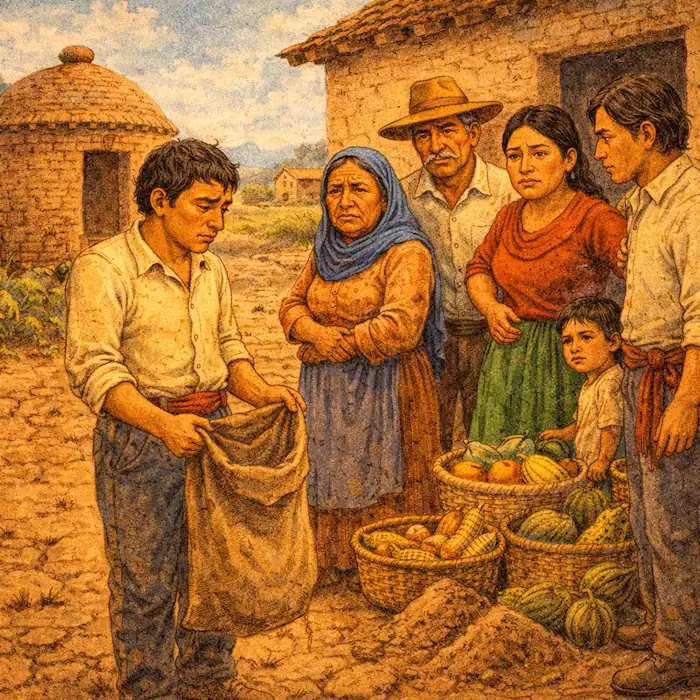
He found Doña Marta tying dried herbs into bundles. “Good day,” he said weakly. “I have fallen on difficult times again.”
Doña Marta did not stop working. “Again?”
Tomás blinked. “Well, yes. You know how cruel luck can be.”
She turned and looked at him with calm old eyes. “Luck did not keep you sleeping while others worked.”
Tomás shifted his feet. “Perhaps just a little maize, then.”
Doña Marta sighed. “I shared when I thought you needed help. Now I see you need a lesson.”
Tomás left with burning ears and an empty sack.
Next, he tried Rosa. She was stacking squash in her yard.
“Neighbor,” he began, “I have had a terrible season.”
Rosa gave him a long look. “Terrible because the rains failed?”
“No.”
“Because worms ate your crop?”
“No.”
“Because sickness kept you from your field?”
Tomás swallowed. “No.”
“Then your season was terrible because you chose not to work,” she said.
Tomás turned away without another word.
At last, he went to Don Luis. Of everyone in the village, Don Luis had always been the softest-hearted. Don Luis was storing maize in a clean clay granary. He listened without interrupting as Tomás gave his sad speech once more.
When Tomás finished, Don Luis closed the granary door and said gently, “My friend, a village should care for the hungry, the sick and the unlucky. But a village cannot carry a man who refuses to walk.”
Tomás looked up. “So you will not help me?”
“I will help you learn to help yourself,” said Don Luis. “Tomorrow at sunrise I will come with my hoe. If you are ready, we will begin. If not, do not ask again.”
Tomás wanted food. He wanted it at once. He wanted a sack of maize and a bundle of beans and perhaps a squash besides. But Don Luis offered none of those things.
Only work.
Tomás trudged home with a hollow belly and heavier thoughts than he had ever carried before.
Sunrise in the Barren Field
That night Tomás did not sleep well. Moonlight crept over his floor. He turned one way and then another. His stomach growled. His empty jars stood in the corner like quiet judges.
Before dawn, he sat up. For a long moment he almost lay back down. Then he remembered Doña Marta’s eyes, Rosa’s questions and Don Luis saying, A village cannot carry a man who refuses to walk.
Slowly, Tomás stood. He washed his face in cool water. He found his hoe and rubbed the rust from it with an old cloth. He took his rake from under the basket and tightened the loose handle. When the first streak of pink appeared above the hills, he was outside waiting.
Don Luis arrived just as the roosters began to crow. To Tomás’s surprise, Don Luis did not smile and say, “Good, you are ready.” He only nodded toward the field and asked, “Shall we?”
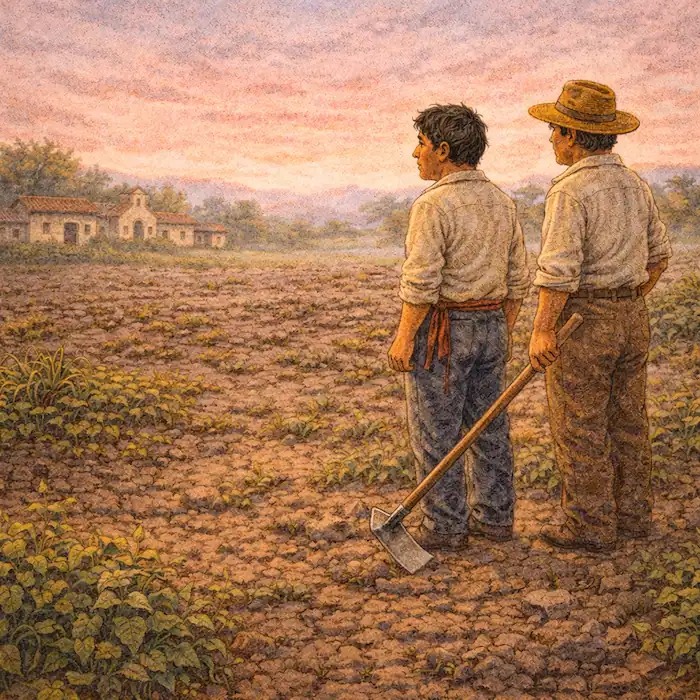
The work was terrible, or so Tomás thought. The ground fought every blow of the hoe. Dry weeds tangled around his ankles. Stones hid in the dirt and jarred his wrists. Before an hour had passed, sweat rolled down his face. Blisters swelled on his palms. His back began to ache.
“Enough,” he gasped at last.
Don Luis leaned on his tool. “Enough for today if you come again tomorrow.”
Tomás looked over the field. They had cleared only a small strip. It seemed hopeless. Yet when he glanced behind him, he saw something he had not seen there for a very long time: a beginning.
The next day he nearly stayed home. But hunger pushed him out the door. Shame pushed him farther. By the third day, something else joined them. Pride, perhaps, or stubbornness.
He worked alone sometimes and with Don Luis at other times. Little by little the weeds disappeared. Stones were carried away. Furrows took shape. When Tomás dropped seeds into the earth, he did it carefully now, one by one, covering them with his own hand.
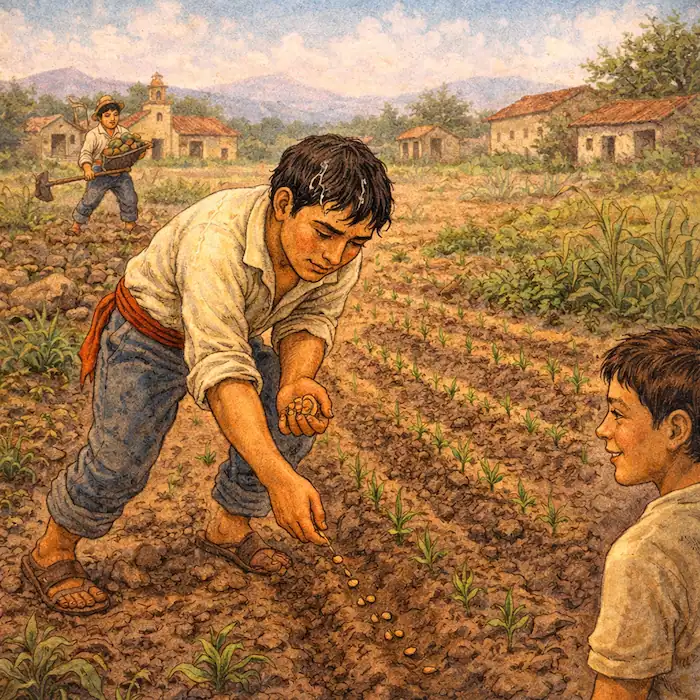
Soon he began to notice things he had never cared about before. How soft the soil felt after rain. How the smell of wet earth rose rich and clean in the morning. How small green shoots seemed to appear by magic, though he now knew that the real magic was patience.
One afternoon Mateo stopped by the field.
“You are really doing it,” the boy said.
Tomás wiped his brow. “I am trying.”
Mateo grinned. “Your rows are crooked.”
Tomás snorted. “They may be crooked, but they are mine.”
The boy laughed and ran off. For the first time in years, Tomás laughed too.
A Harvest Earned at Last
The season was not easy. A goat got through the fence one morning and chewed tender leaves. Tomás chased it half the length of the field. A heavy rain washed part of a row flat and he had to replant. Once, when his shoulders hurt so badly he could hardly lift his arms, he sat beneath the mesquite tree and stared at the work ahead.
No one would have blamed him if he had stopped.
But he did not.
He rose, picked up his hoe and kept going.
When summer rolled toward harvest, his field did not look like Rosa’s, or Don Luis’s, or Doña Marta’s grandsons’ field. Those were richer and fuller. Their maize stood taller. Their baskets filled faster.
Still, Tomás’s land no longer looked dead. Green rows crossed the earth. Ears of maize hung thick enough to gather. Beans dried in their pods. Squash glowed pale gold among broad leaves.
It was not a grand harvest. It was a true one.
Tomás carried his first basket home with both hands and set it down on the table. For a while he only stared at it. Then he touched one ear of maize as if he could not quite believe it was real.
That evening, as villagers worked in their yards, Tomás walked to the center of the village carrying two small squash and a bundle of beans.
He stopped at Doña Marta’s house first.
“These are for you,” he said.
She raised her brows. “For me?”
“For the food you shared in past years,” said Tomás. “I cannot repay it all, but I can begin.”
Doña Marta accepted the gift. “A beginning,” she said, and this time there was kindness in her voice.
Next he brought maize to Don Luis and beans to Rosa. He thanked them without excuses and without sad stories. Word spread quickly through the village.
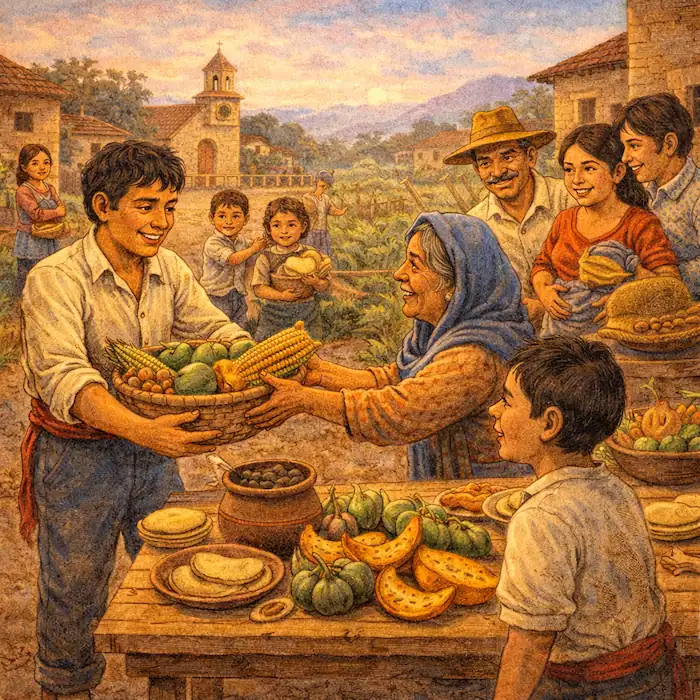
The next Sunday, after the church bell rang and families gathered in the square, Tomás arrived carrying a basket of roasted squash to share at the meal. No one pitied him now. They greeted him as they greeted any other neighbor.
Rosa passed him a stack of warm tortillas.
Mateo asked, “Are your rows still crooked?”
Tomás grinned. “Less crooked than before.”
Don Luis lifted his cup. “To honest work.”
“And honest food,” said Doña Marta.
Tomás looked around at the people who had once fed him from kindness and later refused him out of wisdom. At last he understood both gifts. His field had given him maize and beans and squash. Work had given him something more. It had given him back his place among others.
The Lesson Tomás Learned
From then on, when the roosters crowed, Tomás rose with the rest of the village. He still liked the shade of the mesquite tree. He still enjoyed watching clouds drift over the hills. But he did those things after the work was done, not instead of it.
And whenever a child complained about chores, some grandparent would smile and say, “Do you remember The Lazy Farmer?”
Then the child would groan, because everyone knew how the story ended.
The man who wanted food without labor learned that the earth does not reward empty wishes. It rewards willing hands.