
The Story
The House Beneath the Forest Canopy
In the old days, when the forests were thick and the rivers ran bright beneath the sun, a grandmother kept house with four boys. Two were older and two were younger. The older half-brothers were Hun Batz and Hun Chuen. The younger half-brothers were Hunahpu and Xbalanque.
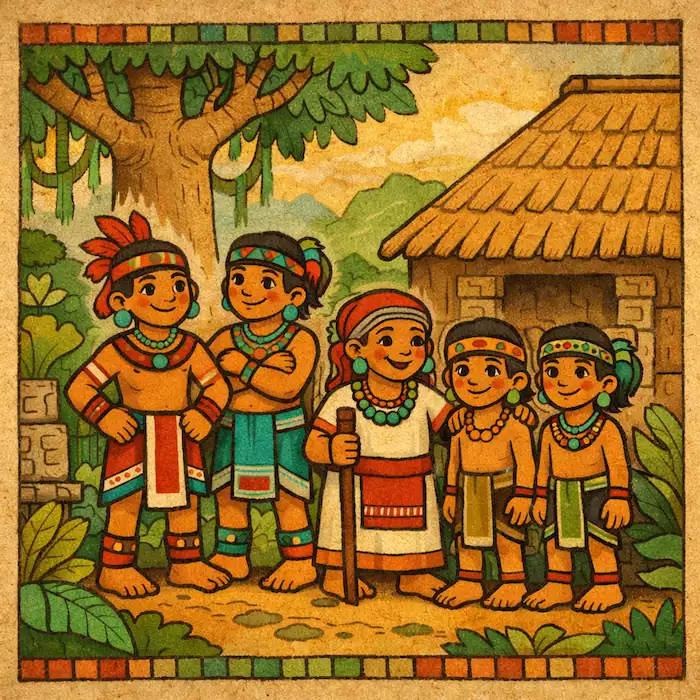
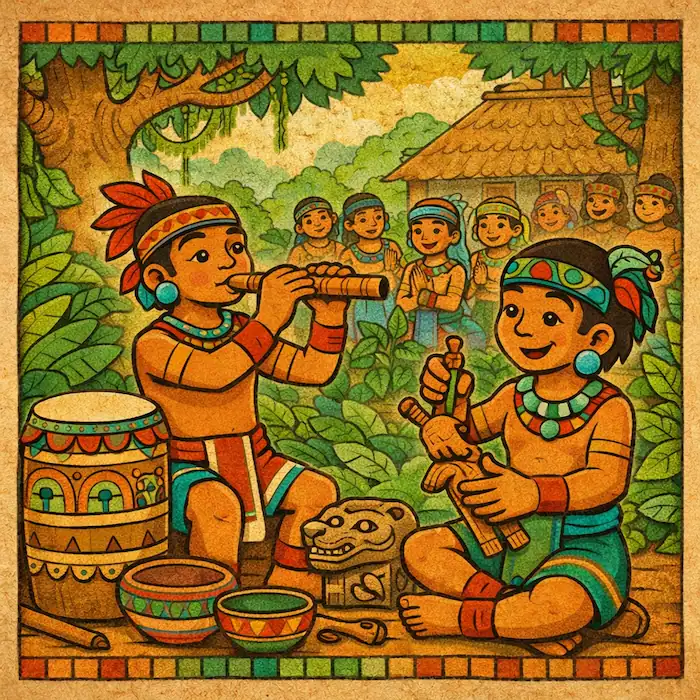
Hun Batz and Hun Chuen were famous for their gifts. When they sang, people stopped to listen. When they played their flutes and drums, feet began to tap. Their hands could shape wood and clay into beautiful things. They painted, carved and made music so well that many people praised them wherever they went.
“They are truly gifted,” the neighbors would say.
“They can make a block of wood seem alive,” others whispered.
Hearing such praise again and again made the older brothers proud. At first it was only a small pride, the kind that lifts the chin and puts a smile on the face. Yet pride, when it grows too large, can leave little room for anything else.
Hunahpu and Xbalanque were not artists in quite the same way. They were younger, quieter and often sent out to work while their older brothers stayed close to home. The twins carried firewood, tended the garden and went into the forest with their blowguns to hunt birds for supper. They learned to move softly through leaves and roots. They noticed small things. They watched the way a rabbit sprang, the way a hawk turned and the way shadows changed before rain.
Most of all, they noticed people.
Hun Batz and Hun Chuen noticed people too, but in a different way. They noticed who was admiring them. They noticed who clapped the loudest. Then, little by little, they began to notice something else.
The twins were clever.
The younger brothers could finish hard chores in a blink and still return smiling. They could solve problems before anyone asked for help. They worked together so smoothly that it seemed they shared one thought between them.
That troubled the older brothers.
One afternoon, Hun Batz stood in the doorway watching the twins return from the hills.
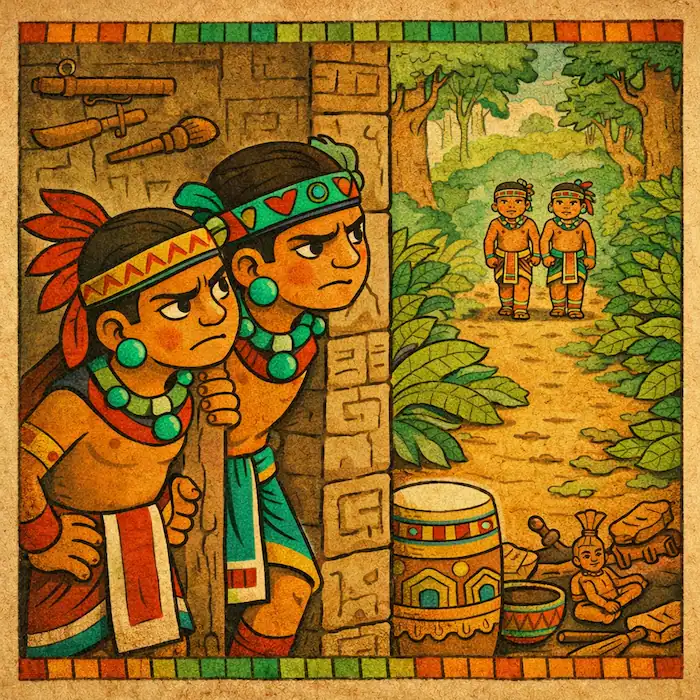
“They are always praised now,” he muttered.
Hun Chuen frowned. “Yes. People speak of their skill, their luck and their quick minds.”
Hun Batz picked at a carving knife with his thumb. “We are the ones with gifts. We are the ones the people should admire most.”
From the cooking fire, the grandmother looked up, but she said nothing. She had lived long enough to know how dangerous envy could be.
A Bitter Plan
The next morning, the older brothers sat together polishing instruments and painting bright designs on a wooden bowl. They worked beautifully, but their talk was ugly.
“We should send the twins after something difficult,” said Hun Chuen.
“So difficult that they fail,” said Hun Batz.
“Then people will laugh at them instead.”
The two brothers smiled at each other. It was not a kind smile.
That day, when Hunahpu and Xbalanque returned from the garden, Hun Batz called out in a cheerful voice that did not fool them for a moment.
“Brothers, we need your help.”
“We shot several fine birds,” added Hun Chuen, pointing toward the forest. “They landed high in a tree. We could not reach them. Since you are so clever, perhaps you can fetch them for us.”
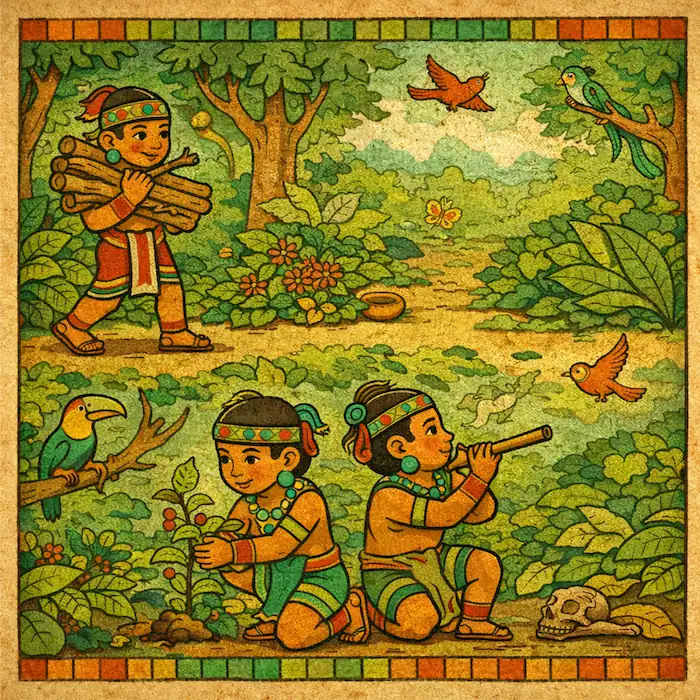
Hunahpu glanced at Xbalanque. Xbalanque glanced back. Neither answered right away.
The older brothers stood waiting with innocent faces, but their eyes were bright and sharp.
Finally, Hunahpu said, “Show us the tree.”
So all four brothers walked into the forest. The path wound under broad leaves and between thick roots. Bright parrots flashed overhead. Insects hummed in the heat. Before long, they reached a tall tree rising above the others, straight as a spear and smooth along the trunk.
“There,” said Hun Chuen, pointing high up.
Sure enough, several birds seemed caught among the upper branches.
Hun Batz folded his arms. “Well?”
Hunahpu rested his blowgun on his shoulder. “Those birds are high.”
“Yes,” said Xbalanque mildly. “Very high.”
The older brothers tried not to grin.
The Tree That Reached the Sky
“Go on then,” said Hun Batz. “Climb.”

Hunahpu shook his head. “You are older. You should lead.”
Hun Chuen puffed out his chest at once. He would not look timid in front of the twins. “Of course.”
He sprang at the trunk and began to climb. Hun Batz followed close behind. Up they went, higher and higher, reaching for the trapped birds.
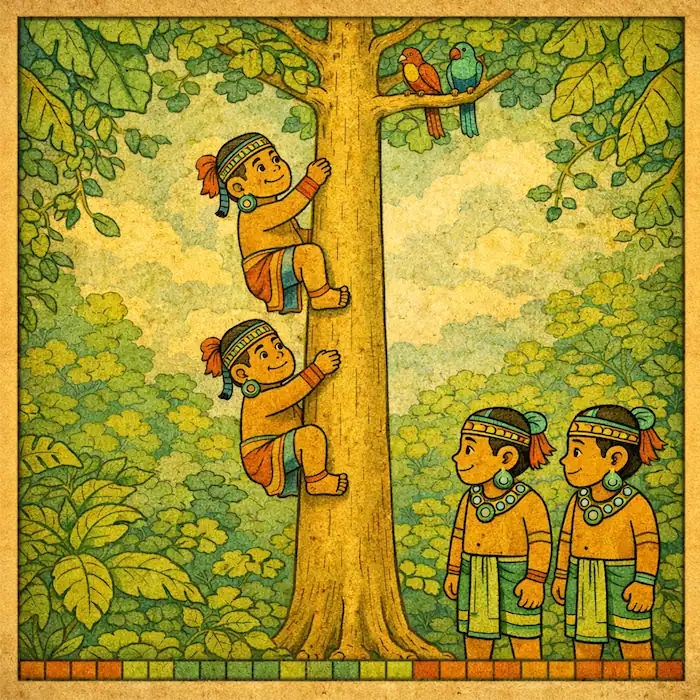
At first, the twins stood quietly below. Then Xbalanque whispered a few words under his breath.
At once, the tree began to grow.
Its trunk stretched upward. Its branches climbed into the sky. Leaves shook and spread. The bark lengthened beneath the older brothers’ hands until they found themselves far above the ground.
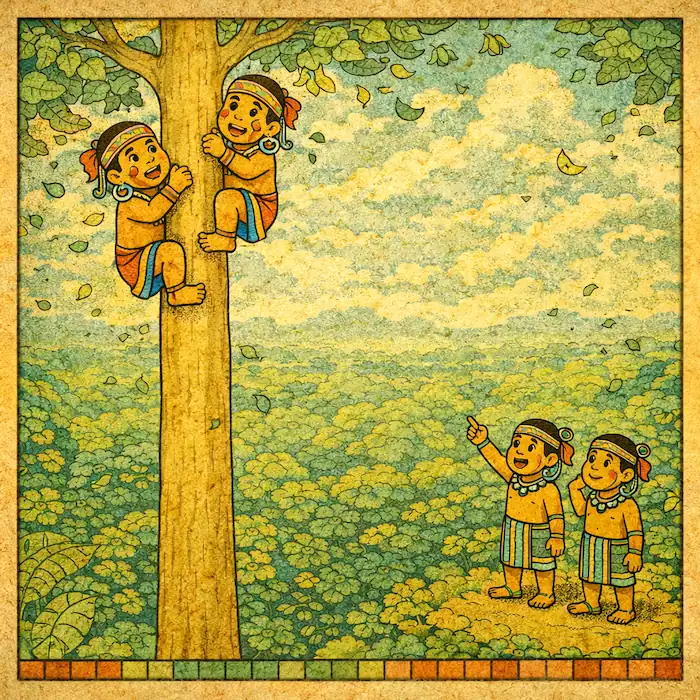
Hun Chuen looked down and gasped.
Hun Batz clung to the trunk so hard his fingers ached. “What is happening?”
“The tree is growing,” said Hunahpu.
“We can see that!” shouted Hun Chuen.
Below, the twins looked small as seeds.
“Jump down,” called Xbalanque.
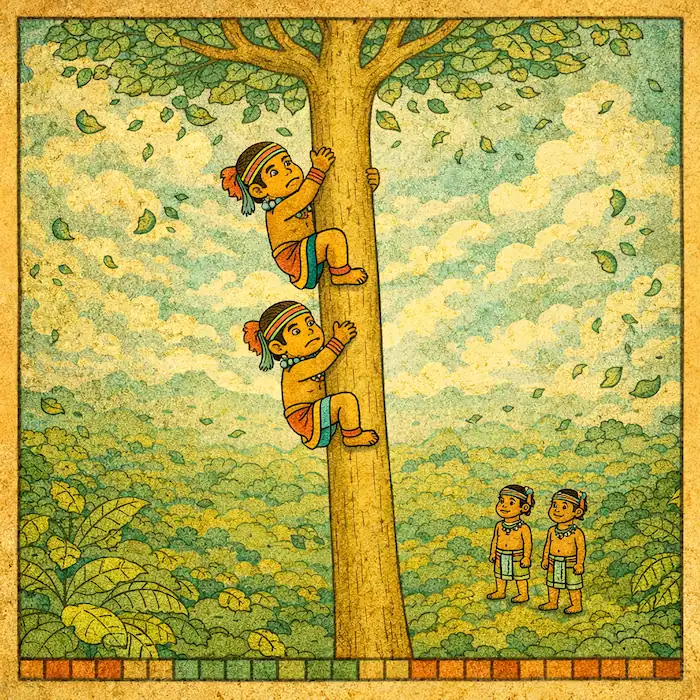
“We cannot!” cried Hun Batz. “We are too high!”
The older brothers clung there, frightened now, their pride slipping away. Wind brushed the leaves. Far below, the forest floor seemed to spin.
“Help us!” Hun Chuen shouted.
Hunahpu looked up as if thinking hard. “There may be a way.”
“Yes, yes,” said Hun Batz quickly. “Tell us!”
“Take off your loincloths,” said Hunahpu, “and tie them behind you. Let them hang long. Then you can climb down more easily.”
Hun Chuen blinked. “That sounds foolish.”
“Does it?” asked Xbalanque. “It is the only idea we have.”
The older brothers were too frightened to argue. With shaking hands, they untied their garments and fastened them behind themselves.
The moment they did, the cloth changed.
It twisted and lengthened into tails.
Hun Batz cried out. Hun Chuen yelped. Hair sprang across their bodies. Their arms and legs changed shape. Their hands gripped the bark in a new way. Their faces stretched. Their voices broke into wild cries that rang through the forest.
They were no longer boys.
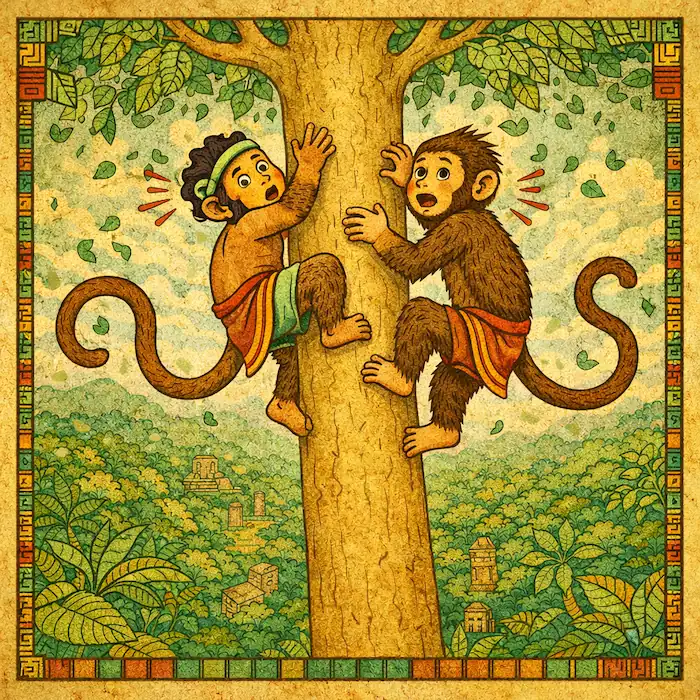
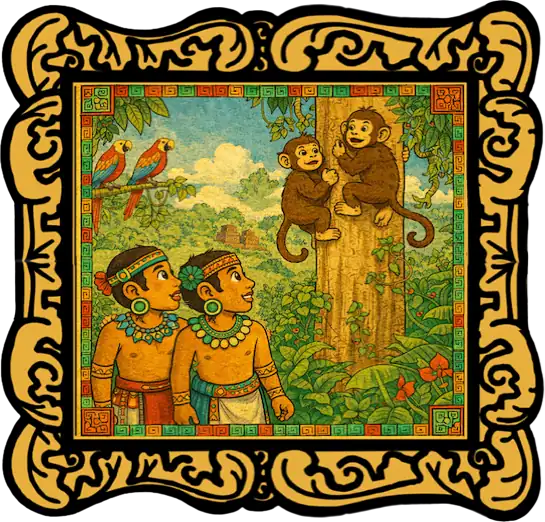
They had become monkeys.
The tree stopped growing.
Down they scrambled at last, swift and jerking, grabbing trunk and branch with long limbs that no longer felt like their own. When they reached the ground, they stared at each other in horror.
Hun Batz touched his face. Hun Chuen grabbed at his tail. Both of them began to shout, but the only sounds that came out were rough howls and chattering cries.
Hunahpu and Xbalanque watched in silence.
The monkey brothers leaped from side to side in shame and rage. Their eyes flashed. Their mouths opened in fierce cries.
Even then, they did not bow their heads.
Laughter at the Doorway
The twins hurried back to the house and told their grandmother what had happened.
At first, she covered her mouth. “My poor grandsons.”
Then she heard rustling in the leaves outside. Hun Batz and Hun Chuen came swinging toward the house, wild-haired and long-tailed, still trying to carry themselves with their old dignity.
The sight was too much.
The grandmother burst into laughter.
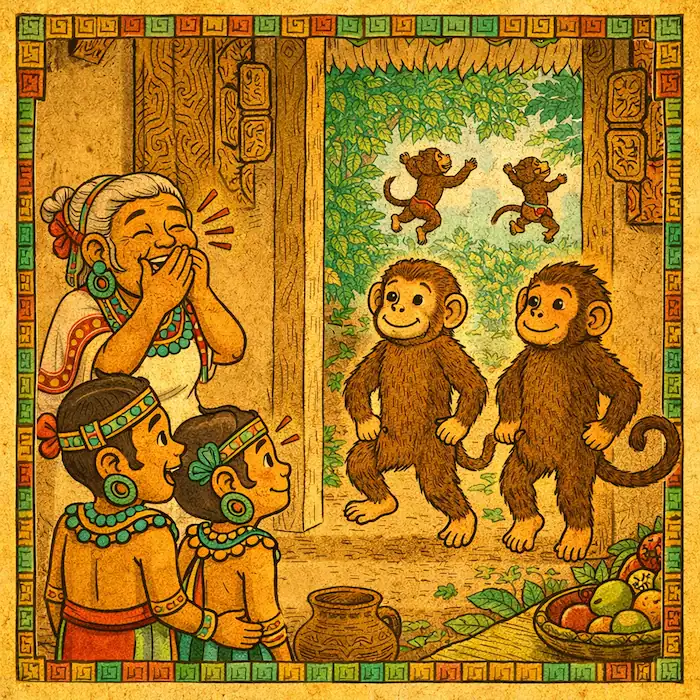
She tried to stop. She truly did. She pressed both hands over her lips and turned away. Yet one look at the two monkey brothers, still offended and still proud, made her laugh again.
Hun Batz froze.
Hun Chuen let out a long, unhappy howl.
Without another moment, both monkeys sprang to the roof beam, then to a tree branch, then high into the forest canopy. Leaves shook behind them. Their cries echoed farther and farther away.
The grandmother lowered her hands. Her laughter faded. “Oh dear,” she said sadly. “Now they are gone.”
Xbalanque looked toward the trees. “Not entirely.”
From deep in the forest came a moaning call. It rolled over the branches like a drum with a broken heart inside it.
Hunahpu listened. “They will be remembered.”
The grandmother sat by the fire for a long while, thinking of the brothers as they had once been. Hun Batz and Hun Chuen had truly been gifted. They had sung beautifully. They had made fine things. Their hands had known how to shape beauty out of ordinary matter. Yet they had fed their pride more carefully than they fed their love for family.
That evening, the twins brought in wood, stirred the stew and shared the work without complaint. Their grandmother watched them and nodded.
“You are clever,” she said, “but cleverness alone is not enough.”
Hunahpu smiled. “We know.”
Xbalanque added, “Being clever is no good if you use it to hurt your own family.”
The old woman nodded again. “Good. Remember that.”
Cries Through the Trees
Days passed. The forest remained full of sound. Macaws screeched. Toucans clicked. Leaves whispered in the wind. Yet now another cry carried through the trees, deeper and stranger than the rest.
It was the call of the monkey brothers.
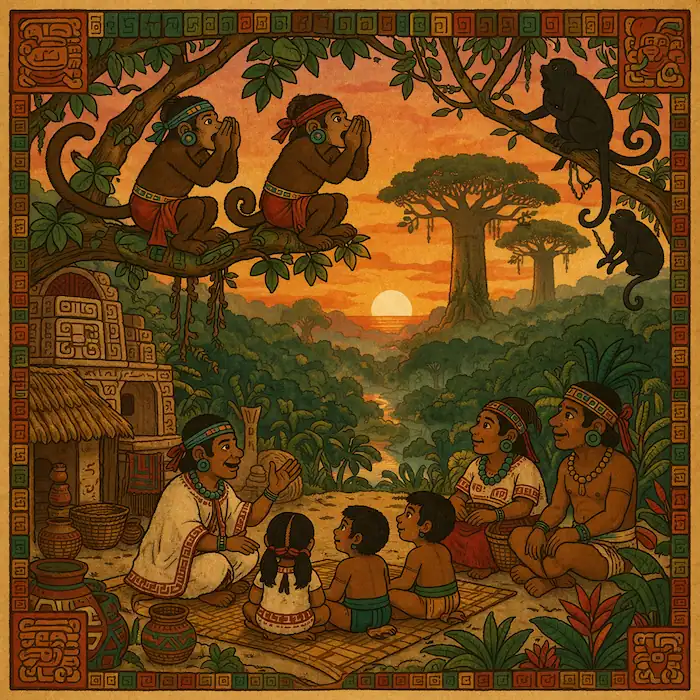
Hun Batz and Hun Chuen had not vanished from the world. They lived in the canopy now, swinging from branch to branch with powerful arms. Their cries traveled over valleys and through morning mist. People heard them and looked up.
Children asked, “Who is calling?”
Then the elders told the story.
They told of the gifted older brothers who could sing and carve and paint. They told of praise that turned sour. They told of jealousy growing where love should have grown. They told of the younger twins who answered trickery with wit. They told of the moment when pride changed shape and ran into the forest with a tail behind it.
What the Twins Knew
As for Hunahpu and Xbalanque, they went on growing in wisdom and skill. They still hunted in the forest. They still helped at home. They still faced dangers with bright eyes and quicker minds. Sometimes, when they worked beneath the trees, they would hear the calls of Hun Batz and Hun Chuen overhead.
Then they would pause.
Hunahpu would look up through the leaves. “They might have been great teachers.”
“They still teach,” Xbalanque would answer.
At sunset, when the sky burned gold and red above the treetops, the old grandmother sometimes sat outside her house and listened to the forest calls. Her face would grow thoughtful, but not hard.
“I remember you,” she would whisper.
From the canopy came the long cry of a howler monkey, rising and falling over the trees.
Maybe it was grief.
Maybe it was anger.
Or maybe, at last, it was the sound of understanding coming too late.
Still, the people listened.
Still, they told the tale.
And in the deep green forest, the voices of Hun Batz and Hun Chuen carried on the evening air.