
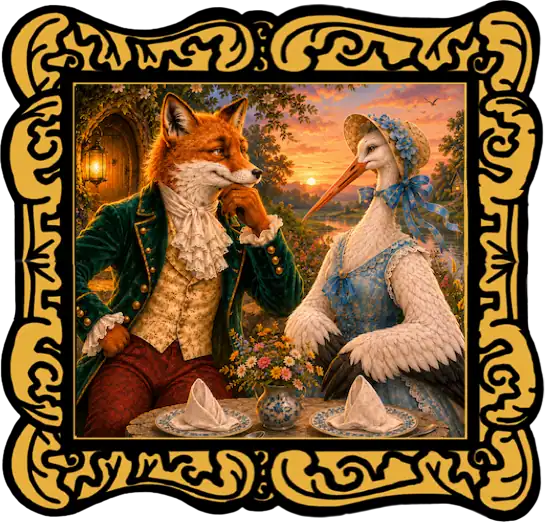

The Fox and the Stork

The Fox and the Stork is a short Aesop fable for children aged 4 to 8. This child-friendly retelling keeps the classic lesson about kindness, fairness and thinking about how others feel.

In this story, a sly fox plays a dinner trick on a stork. When the stork invites him back, the fox learns that a joke is not funny when it is meant to make someone else feel foolish.

Story Details

  • Independent Reading Age: 6 to 8
  • Listen-Along Age: 4 to 8
  • Reading Level: Early elementary
  • Story Reading Time: About 5 to 9 minutes
  • Author / Source: Based on an Aesop fable, retold for Kooky Kids World
  • Story Type: Fable
  • Region / Origin: Aesop fable tradition
  • Main Characters: Fox, Stork
  • Moral / Themes: Fairness, kindness, empathy, manners and treating others well

Listen Along

The Fox and the Stork Audio Story

Audio cover art for The Fox and the Stork Aesop fable read aloud for kids
0:00 / 0:00
The Fox and the Stork - Aesops Fable
Kooky Kids World Cloud Logo showing where the audio read aloud file is.

About This Retelling

This version of The Fox and the Stork is based on the traditional Aesop fable. The story has been retold in warm, clear language for young readers while keeping the familiar plot: Fox invites Stork to dinner in a way that only Fox can enjoy, then Stork returns the invitation in a way that helps Fox understand how unfair he has been.

The Story

Fox Plans a Dinner

Fox was known all through the woods for his quick feet, bright eyes and clever smile.

He liked to joke. He liked to chatter. Most of all, he liked to feel that he had outsmarted someone.

One sunny morning, Fox sat outside his den and watched Stork stepping through the meadow on her long, thin legs. Stork moved slowly and carefully. Her long beak dipped here and there as she searched for breakfast near the stream.
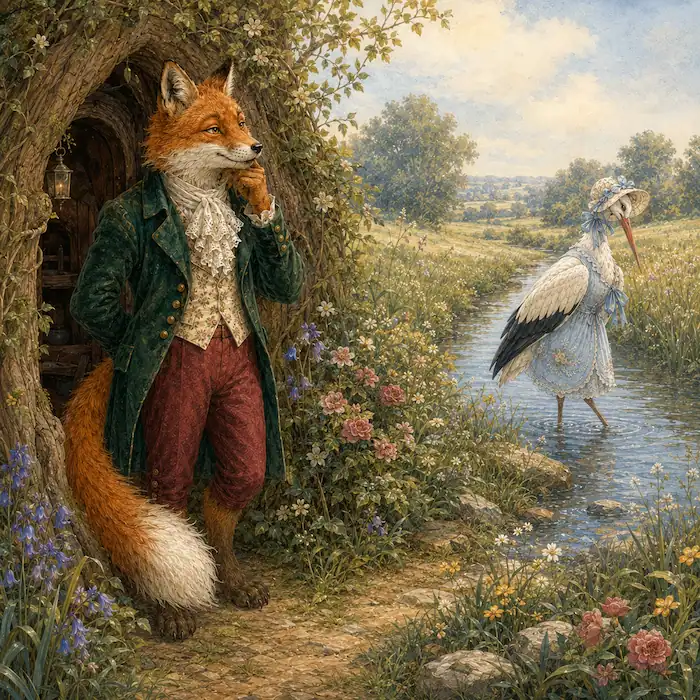
Fox smiles as he invites Stork to supper beside a sunny woodland stream

Fox tilted his head.

“What a strange way to walk,” he said to himself. “And what a long beak! I wonder if Stork can laugh at a joke.”

The more Fox thought about it, the more he wanted to play a trick.

So he brushed his tail, put on his friendliest smile and trotted across the grass.

“Good morning, dear Stork,” said Fox. “What a fine day it is.”

“Good morning, Fox,” said Stork politely.

“I have been thinking,” said Fox. “We are neighbors, yet we hardly ever dine together. Will you come to my home for supper tonight?”

Stork was pleased. She liked friendly invitations, and she believed Fox meant well.

“That is kind of you,” she said. “Thank you. I would be happy to come.”

Fox bowed low.
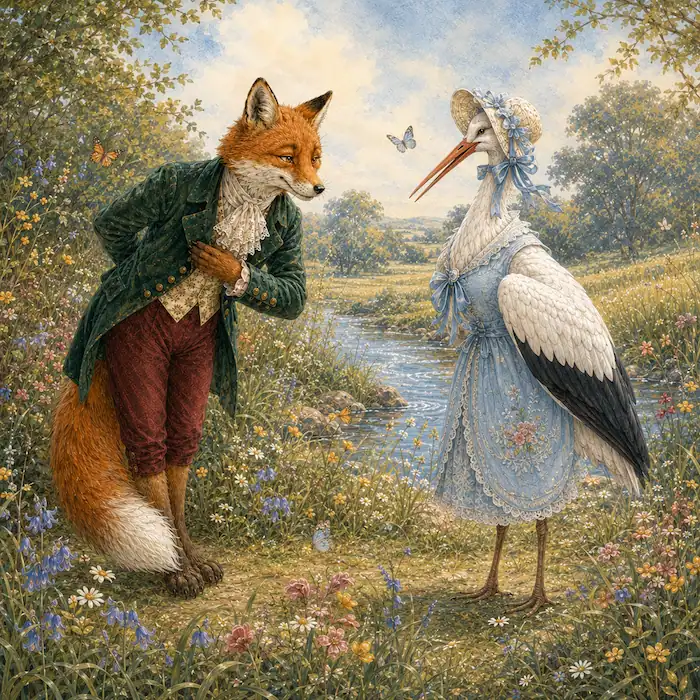
Stork arrives at Fox’s woodland den for supper at sunset

“Wonderful,” he said. “Come when the sun begins to set. I shall prepare something delicious.”

As Fox turned away, his smile became a grin.

Supper at Fox’s Den

That evening, Stork arrived at Fox’s den just as the sky turned pink and gold.

Fox had set two places on a smooth flat stone. A little lamp glowed beside the doorway. The air smelled warm and savory.

“Welcome, welcome!” cried Fox. “You are just in time.”

“This smells lovely,” said Stork.

“It is my special soup,” said Fox. “Thin, smooth and full of flavor.”

Then Fox carried out the supper.
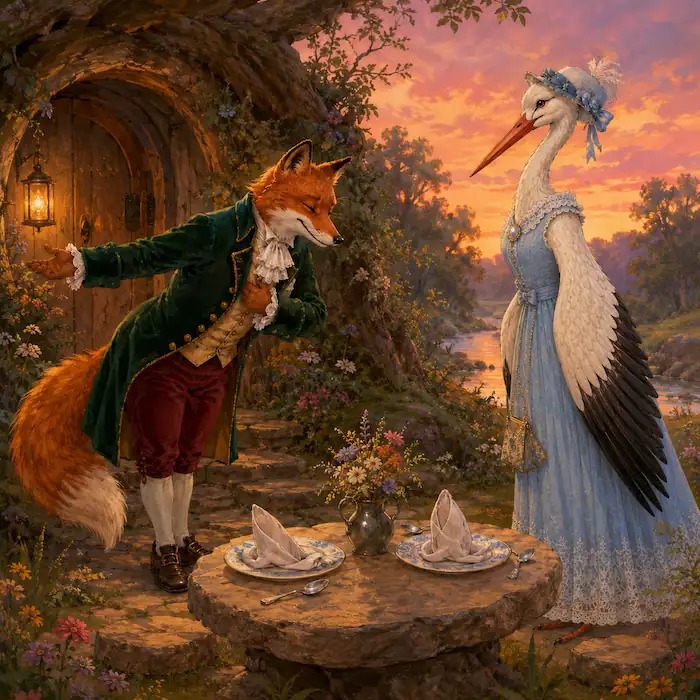
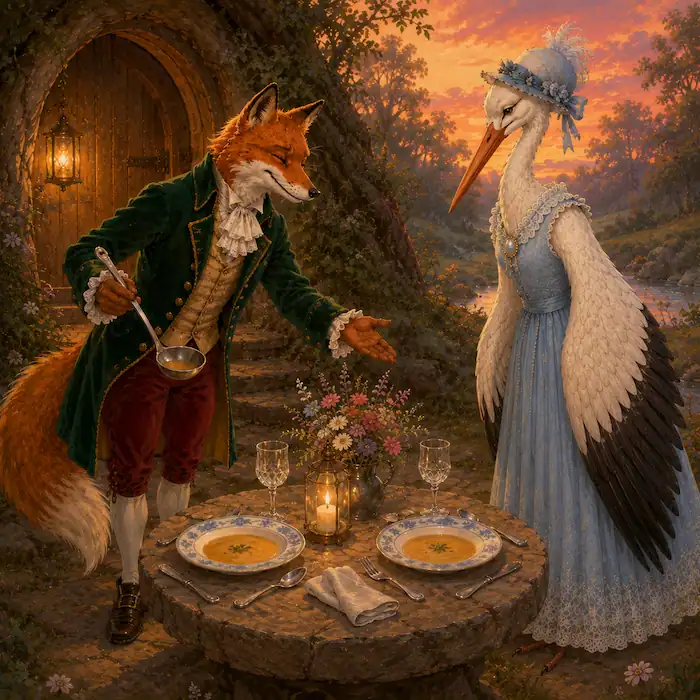
Fox serves soup on shallow plates that Stork cannot eat from with her long beak

But he did not serve the soup in deep bowls.

He did not serve it in cups.

He poured the soup into two very shallow plates.
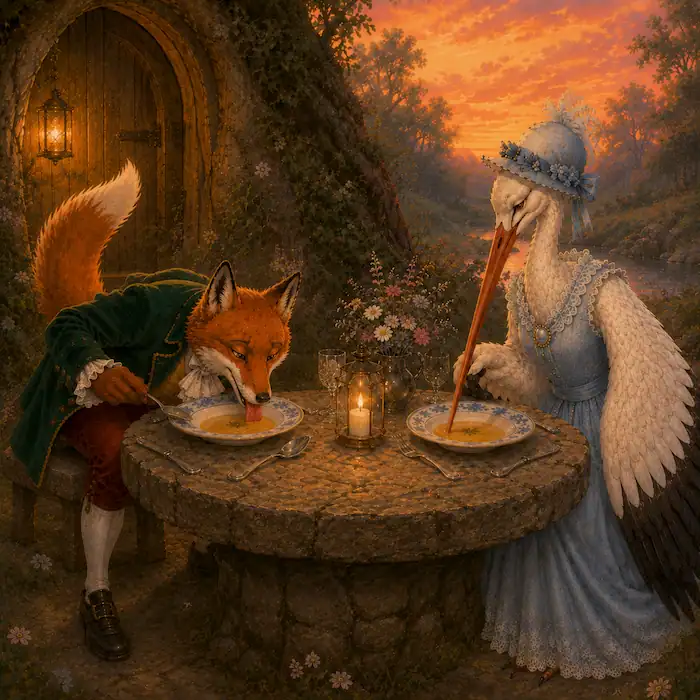
Stork taps her long beak on a shallow plate while Fox eats his soup

The soup spread across each plate in a thin golden puddle.

Fox bent down and began to lap up his soup at once.

“Delicious!” he said between mouthfuls. “Do eat, dear Stork. Do not be shy.”

Stork lowered her long beak to the plate. She tapped the soup. She tried to scoop some up. She tried again from the side. But her long beak could not gather the thin soup from the flat plate.
Stork leaves Fox’s den after eating almost nothing from the shallow plate

Tap, tap, tap went her beak.

Slurp, slurp, slurp went Fox.

“Is something wrong?” asked Fox, pretending to be surprised.

Stork lifted her head. She was hungry, but she kept her voice calm.

“It is a little difficult for me to eat from such a shallow plate,” she said.

“Oh dear,” said Fox. “How unfortunate. I find it quite easy.”

Then he finished his soup, licked his whiskers and leaned back with a satisfied sigh.

Stork had eaten almost nothing.

“Thank you for inviting me,” she said, standing up.

Fox looked pleased with himself.

“Any time,” he said. “I do hope you enjoyed the meal.”

Stork looked at the empty plate and then at Fox.

“I learned something from it,” she said.

Fox did not understand what she meant. He only chuckled as she walked home through the dim evening light.
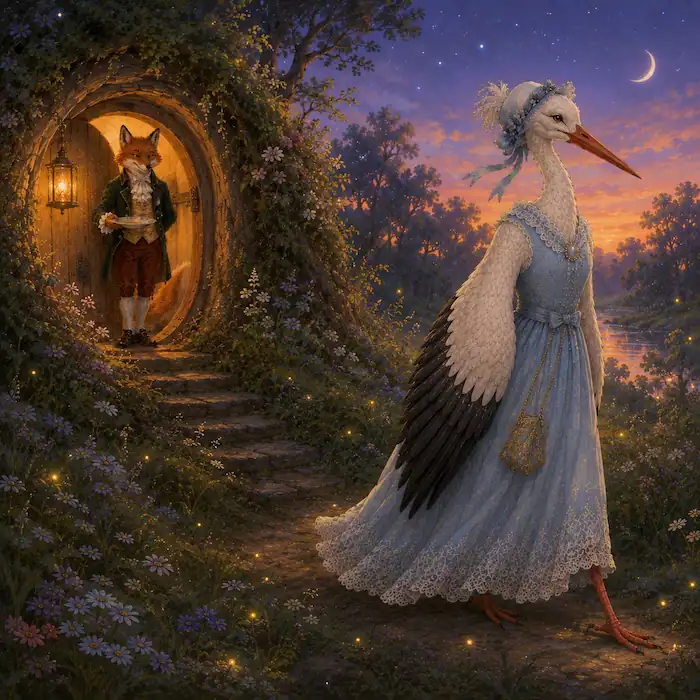
Stork politely invites Fox to dinner near her home by the stream

Stork Sends an Invitation

The next morning, Fox stretched outside his den. He was still amused by his trick.

Then he saw Stork coming along the path.

“Good morning, Fox,” she said.

“Good morning, dear Stork,” said Fox. “Have you come to thank me again for supper?”

“I have come to return your kindness,” said Stork. “Will you dine with me tonight?”
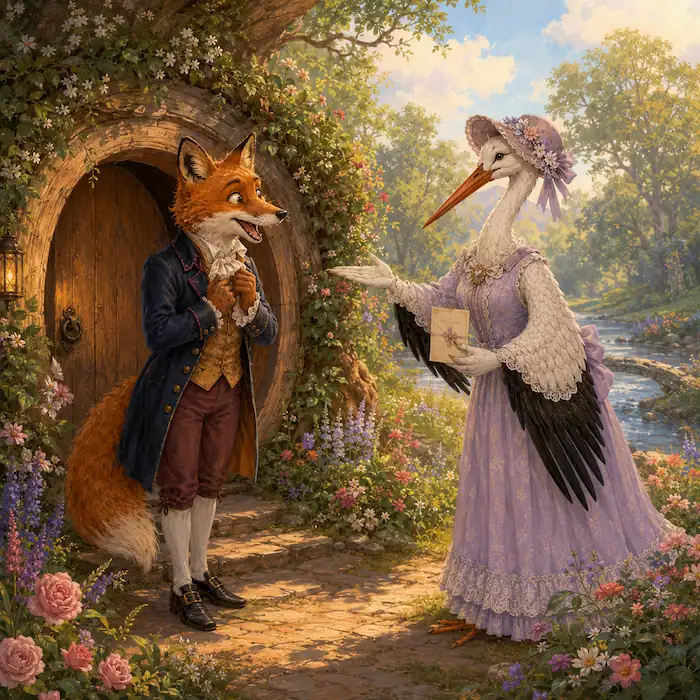
Hungry Fox walks to Stork’s home by the stream for supper

Fox’s ears pricked up.

“With pleasure,” he said. “I always enjoy a good meal.”

“I shall prepare something special,” said Stork.

Fox’s mouth watered at the thought.

“All day,” he told himself, “I will save my appetite.”

So Fox spent the afternoon dreaming of supper. He imagined roasted roots, berries, cakes and thick stew. By sunset, his stomach rumbled like a little drum.

He hurried to Stork’s home by the stream.
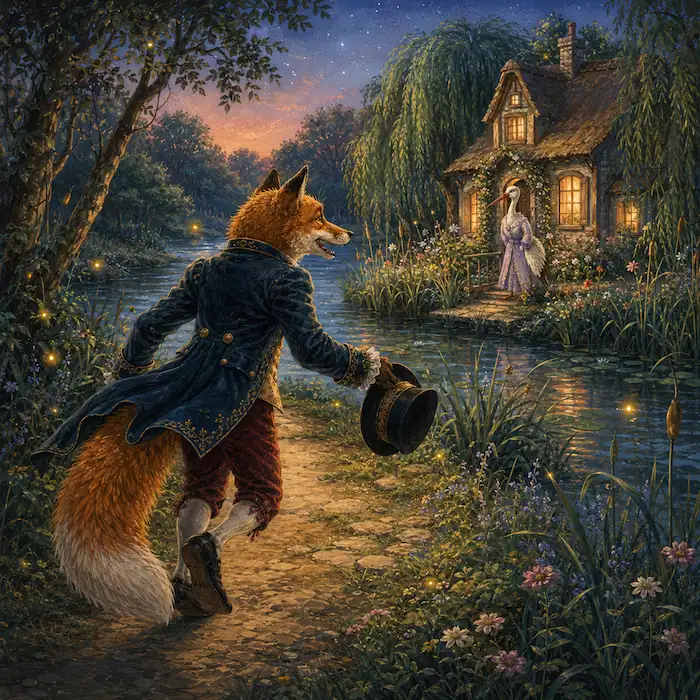
Stork serves stew in tall narrow jars that fit her beak but not Fox’s nose

Stork had made everything neat and welcoming. Reeds rustled beside the water. Fireflies blinked above the grass. A wonderful smell drifted from her doorway.

“Come in, Fox,” said Stork. “Supper is ready.”

Supper at Stork’s Home

Fox stepped inside and looked around eagerly.

There on the table were two tall, narrow jars. Each jar had a long thin neck and a round belly full of stew.
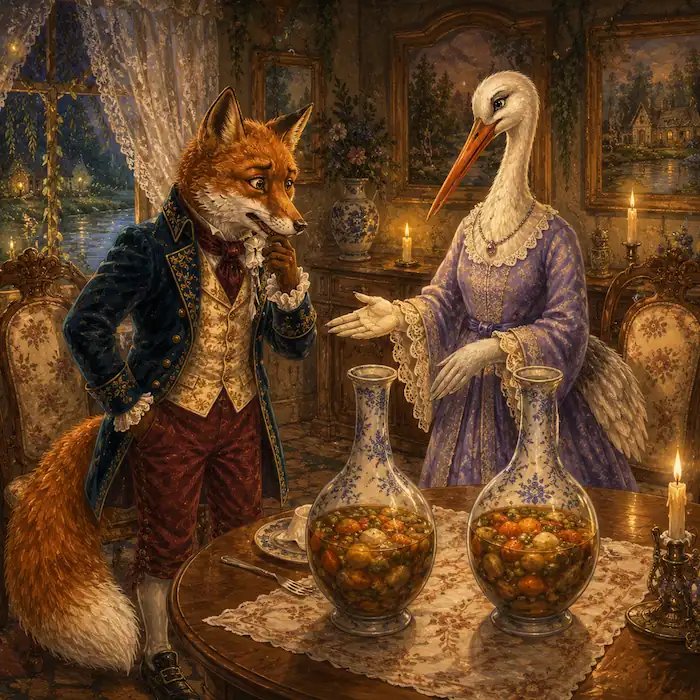
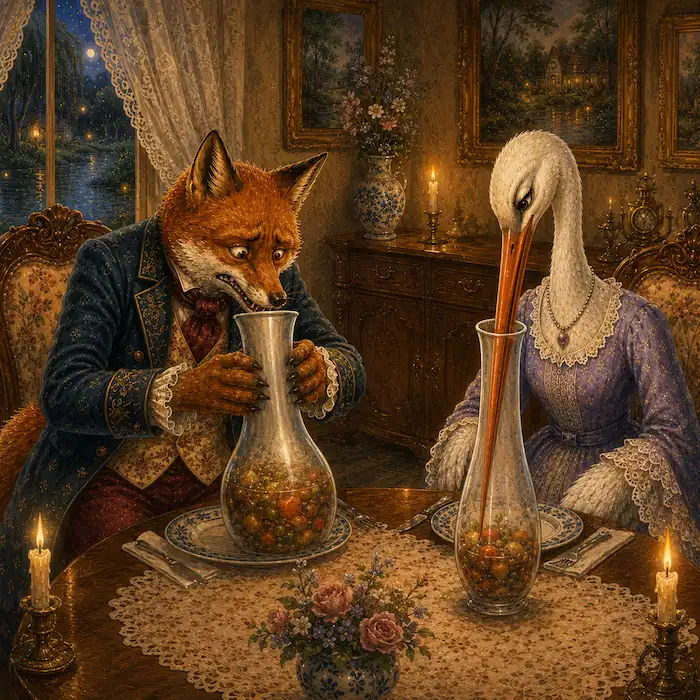
Fox tries to eat stew from a tall narrow jar but cannot fit his nose inside

The stew smelled rich and warm.

Fox licked his lips.

“What an interesting dish,” he said.

“One of my favorites,” said Stork. “Please begin.”

Stork dipped her long beak into her jar. Down went her beak, deep into the narrow neck. Up came a mouthful of stew.

“Very good,” she said. “Do eat, Fox.”

Fox pushed his nose toward his jar.

It would not fit.

He tried to lick the top.

He could only reach a tiny drop.

He tipped his head one way. He tipped his head the other way. He sniffed and snuffled and turned the jar around with his paw.

But the neck of the jar was too narrow for his face.
Fox looks sorry as he understands the lesson Stork has taught him

Stork ate slowly and politely.

Fox’s stomach growled.

“Is something wrong?” asked Stork.

Fox’s ears grew hot.

“It is a little difficult for me to eat from such a narrow jar,” he said.

“Oh dear,” said Stork. “How unfortunate. I find it quite easy.”

Fox looked at Stork.

Stork looked back calmly.

Then Fox remembered the shallow plates at his own den. He remembered Stork tapping at the soup. He remembered how he had laughed inside while she went hungry.

His tail drooped.

Fox Learns the Lesson

At last, Fox stepped back from the table.

“I understand,” he said quietly.

Stork set down her jar.

“Do you?” she asked.

“Yes,” said Fox. “I invited you to supper, but I did not really share with you. I served the food in a way that only I could enjoy. I thought it was a joke, but it was not kind.”

Stork nodded.

“A meal should make a guest feel welcome,” she said. “A joke should not leave someone hungry.”

Fox looked at the floor.

“I am sorry,” he said.

Stork studied him for a moment. Fox did look sorry, and not only because his own stomach was empty.

“Then let us both remember,” said Stork. “If we want kindness, we should offer kindness. If we want fairness, we should be fair.”

Fox nodded.

Stork brought out a small loaf of bread and a bowl wide enough for them both to use.
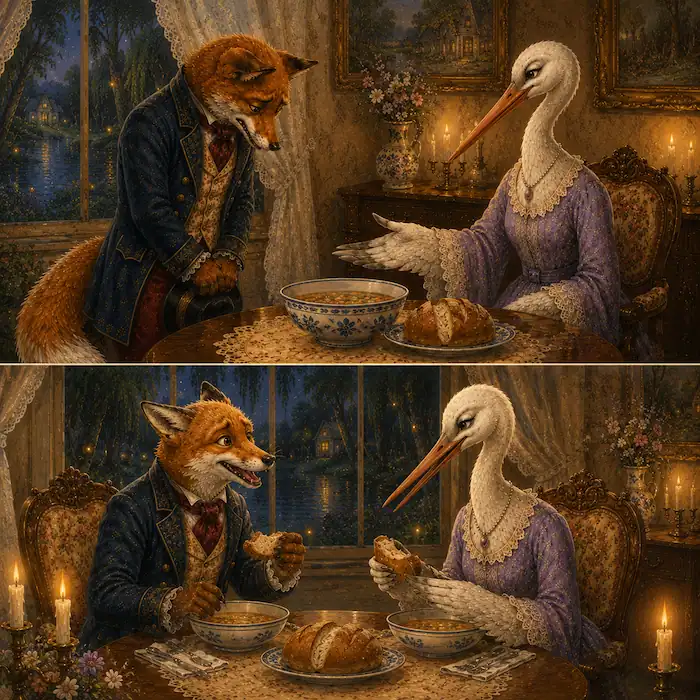
Fox and Stork share food from a bowl after Fox learns to be fair and kind

“This is not part of the lesson,” she said with a small smile. “This is because I do not like to send a guest home hungry.”

Fox smiled back, but this time it was not a sly smile.

“Thank you,” he said.

They shared the bread, and Fox ate slowly. He was thinking more than he was talking, which was unusual for Fox.

After that day, he still liked jokes. He still liked clever plans. But when he invited someone to dinner, he made sure the food was served in a way every guest could enjoy.

And whenever he saw Stork stepping carefully by the stream, he remembered the tall narrow jar, the shallow plate and the lesson he had learned at last.
Moral of The Fox and the Stork

Treat others with the same kindness and fairness you would want for yourself.

Short Summary

Fox invites Stork to supper, but he serves the soup on shallow plates that only he can use. Stork goes home hungry. The next day, she invites Fox to her own home and serves stew in tall narrow jars. Fox cannot reach the food, and he understands how unfair his trick was. The fable teaches children to think about other people’s needs and treat guests kindly.

Main Characters

Fox

Fox is clever and playful, but at first he uses his cleverness unkindly. He likes the idea of outsmarting Stork until he learns how unfair his trick feels.

Stork

Stork is polite, calm and thoughtful. She does not shout at Fox. Instead, she teaches him by showing him what unfair treatment feels like.

Vocabulary Spotlight

  • Fable: A short story that teaches a lesson.
  • Stork: A tall bird with long legs and a long beak.
  • Shallow: Not deep.
  • Narrow: Thin from side to side.
  • Polite: Showing good manners and respect.
  • Fair: Treating people in a reasonable and kind way.
  • Guest: A person invited to visit or share a meal.
  • Lesson: Something useful that a story or experience teaches us.

Discussion Questions

  1. Why could Fox eat from the shallow plate but Stork could not?
  2. Why could Stork eat from the tall jar but Fox could not?
  3. Was Fox’s first dinner invitation kind? Why or why not?
  4. Did Stork teach Fox in a fair way?
  5. What could Fox have done differently when he invited Stork to supper?
  6. What does the story teach about jokes and kindness?
  7. Can you think of a time when someone needed help in a different way from you?

Classroom Activities for Children

1. Plate or Jar Sorting

Show children pictures of plates, bowls, cups and jars. Ask which ones would work for Fox, which would work for Stork, and which would be fair for both.

2. Feelings Chart

Ask children how Stork might feel at Fox’s supper and how Fox might feel at Stork’s supper. Use simple words such as hungry, embarrassed, surprised, sorry and kind.

3. Retell with Puppets

Use a fox puppet, a stork puppet, a pretend plate and a pretend jar. Children can retell the story in order and practice polite dialogue.

4. Kind Invitation Role Play

Ask children to plan a fair meal or game for two friends who need different things. This supports empathy and inclusive thinking.

5. Draw the Moral

Children draw Fox and Stork sharing food fairly. Older children can add a sentence about treating others kindly.

6. Fair or Unfair Sorting Game

Read simple examples aloud, such as sharing crayons, leaving someone out or choosing a game everyone can play. Children sort each example into fair or unfair and explain why.

7. Design a Fair Dinner

Children plan a meal that both Fox and Stork could enjoy. They can draw the food, choose the serving dishes and label what makes the meal fair for both animals.

Teachers’ Notes

The Fox and the Stork works well for lessons about fairness, empathy, manners and classroom kindness. The visual contrast between a shallow plate and a tall jar makes the problem easy for children to understand.

The story also opens discussion about jokes. Children can talk about the difference between laughing together and making someone else feel left out.

Why This Version Works for Children

  • The trick is easy to understand through clear visual contrasts: shallow plate and tall jar.
  • The story is short enough for early elementary readers.
  • The moral is practical for school, family and friendship situations.
  • Fox is corrected without the story becoming harsh or frightening.
  • Stork models calm, thoughtful problem solving.

What Parents and Teachers May Want to Know

The Fox and the Stork is a traditional Aesop fable. Some older versions make the revenge feel sharper. This Kooky Kids World retelling keeps the lesson clear while making the ending more suitable for children: Fox understands, apologizes and learns to share fairly.

Story Background

The Fox and the Stork is one of Aesop’s best-known fables. Aesop’s fables are short traditional stories, often linked with ancient Greece, that use animals to teach lessons about choices, behavior and character.

In this fable, the lesson is not only about table manners. It is about thinking beyond what is easy for ourselves and noticing what is fair for someone else.

Further Reading for Adults and Teachers

Adults and teachers can compare this child-friendly retelling with a public-domain reference version:

Frequently Asked Questions About The Fox and the Stork

  • What is the moral of The Fox and the Stork?

    The moral is to treat others with the same kindness and fairness you would want for yourself.

  • Is The Fox and the Stork an Aesop fable?

    Yes. The Fox and the Stork is commonly told as one of Aesop’s fables. This Kooky Kids World version is a fresh child-friendly retelling.

  • What age is The Fox and the Stork good for?

    This retelling works well for children aged 4 to 8 as a read-aloud or early elementary story.

  • Why could Stork not eat Fox’s soup?

    Fox served the soup on a shallow plate, so Stork’s long beak could not scoop it up.

  • Why could Fox not eat Stork’s stew?

    Stork served the stew in a tall narrow jar. Her beak could reach inside, but Fox’s nose could not.

  • What can children learn from this fable?

    Children can learn that jokes should not hurt or embarrass others, and that being fair means thinking about what other people need too.