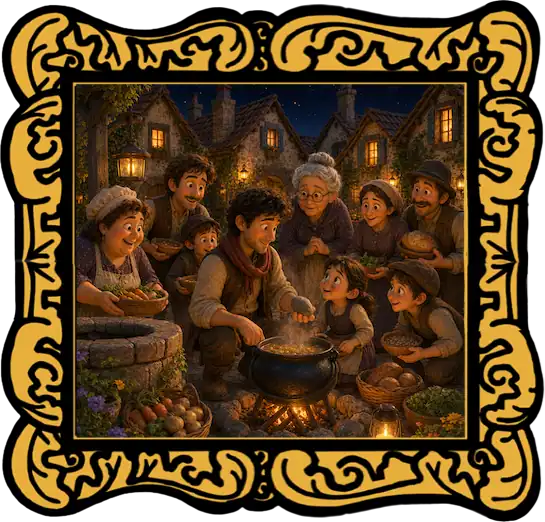

Stone Soup Story for Kids

Stone Soup is a traditional folk tale for children aged 5 to 9. This Kooky Kids World version has been retold for young readers with clear language, warm humor and a gentle focus on sharing, kindness and community.

The story begins with a hungry traveler and a village where everyone thinks they have too little to give. By the end, one ordinary stone helps the villagers discover that small gifts can become something generous when people work together.

Story Details

Independent Reading Age: 6 to 9 years

Listen-Along Age: 4 to 8 years

Reading Level: Early readers with support, developing readers and shared classroom reading

Reading Time: Around 7 to 9 minutes

Author / Source: Traditional folk tale, retold by Kooky Kids World

Story Type: Folk tale

Region / Origin: Traditional European folk tale, with versions told in many places

Main Characters: The traveler, Pip, Granny Tansy, Mrs. Crumb, Mr. Barley and Cook Mallow

Moral / Themes: Sharing, kindness, cooperation, generosity, community and problem-solving

Listen Along

Stone Soup read aloud cover art for the Kooky Kids World audio story
0:00 / 0:00
Stone Soup

Listen to the Stone Soup read-aloud audio, then read the full story below.

Kooky Kids World Cloud Logo showing where the audio read aloud file is.

The Story

A Hungry Traveler Comes to the Village

A hungry traveler walks toward a village at sunset carrying a pot and walking stick

At the end of a long dusty road stood a village with crooked chimneys, small gardens and doors that closed a little too quickly when strangers came near.

The people who lived there were not cruel. They were tired. The winter had been long, the spring had been wet and everyone had learned to count potatoes before putting them in the pot. Even the cats looked as if they were saving their meows for later.

One evening, just as the sun was setting, a traveler came over the hill. He carried a small pack on his back, a black cooking pot in one hand and a walking stick in the other. His boots were gray with dust and his stomach made such a loud growl that a sparrow hopped backward in surprise on a fence post.

“Oh, do excuse me,” the traveler said to the sparrow. “That was not thunder. That was supper asking a question.”

The sparrow tilted its head, then flew away.

Three Closed Doors
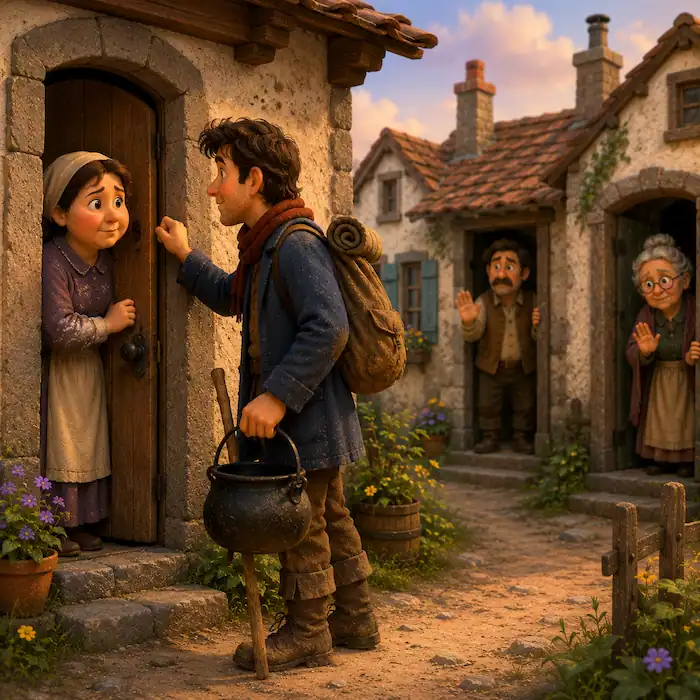
The Stone Soup traveler knocks at a cottage door while villagers watch from nearby homes

The traveler knocked at the first door. A woman with flour on her sleeve opened it only as wide as a teacup.

“Good evening,” said the traveler. “Could you spare a little food for a hungry traveler?”

Mrs. Crumb the baker pressed her lips together. “I am sorry. Bread is short and flour is dear.”

The door closed with a small, polite click.

At the next cottage, Mr. Barley the farmer shook his head before the traveler had finished asking. “The garden has not given much,” he said. “I’m sorry, but I cannot spare any food.”

At the third door, Granny Tansy peered out with a child beside her. The child had bright eyes, a smudge on her nose and the sort of curiosity that never stayed indoors.

“I wish we had enough to share,” the child whispered.

“So do I, Pip,” Granny Tansy said gently, and she closed the door.

The Traveler Begins Stone Soup
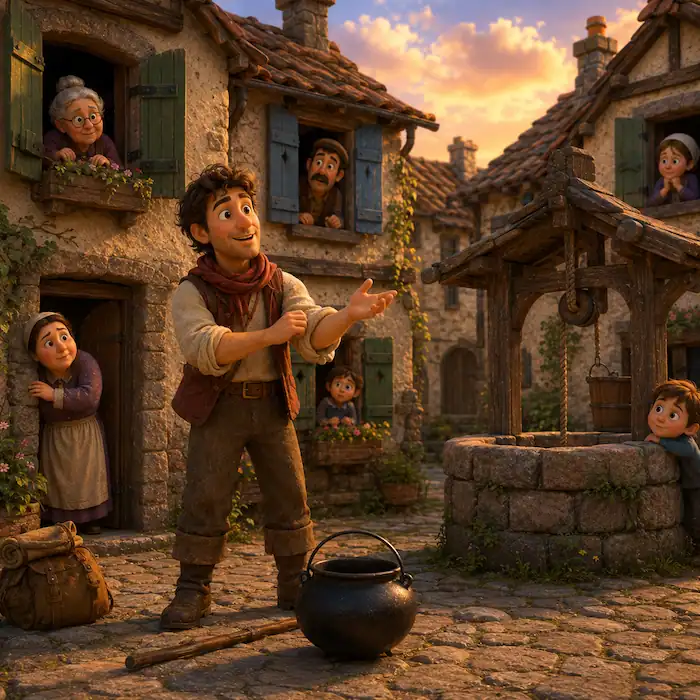
The traveler stands by the village well with his pot as curious villagers peek from windows

The traveler stood in the village square beside the old stone well. A little wind ran around his coat, tugged at his scarf and seemed to say, Well? What now?

The traveler smiled as if the wind had asked a very sensible question. He set down his pot, rolled up his sleeves and announced, “In that case, I shall make stone soup.”

One shutter creaked open.

“Stone soup?” Mrs. Crumb muttered from behind it.

“Stone soup,” said the traveler. “A fine dish. It begins with almost nothing and improves with every good addition.”

That opened two more shutters.

The traveler filled his pot with clear water from the well. He built a small fire, set the pot over it and reached into his pocket with great care.
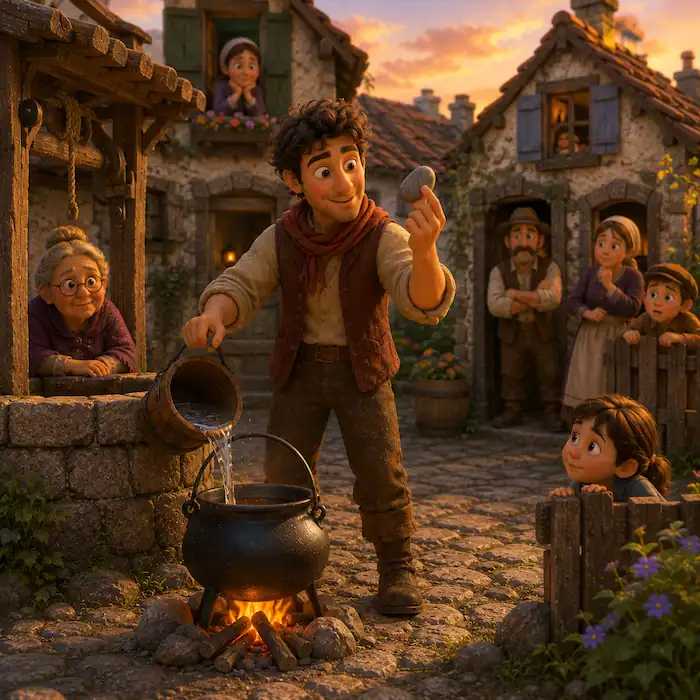
The Stone Soup traveler pours water into a pot and holds up a smooth gray stone

Out came a smooth ordinary looking gray stone.

He washed it carefully, then placed it in the pot.

Pip could not bear it any longer.
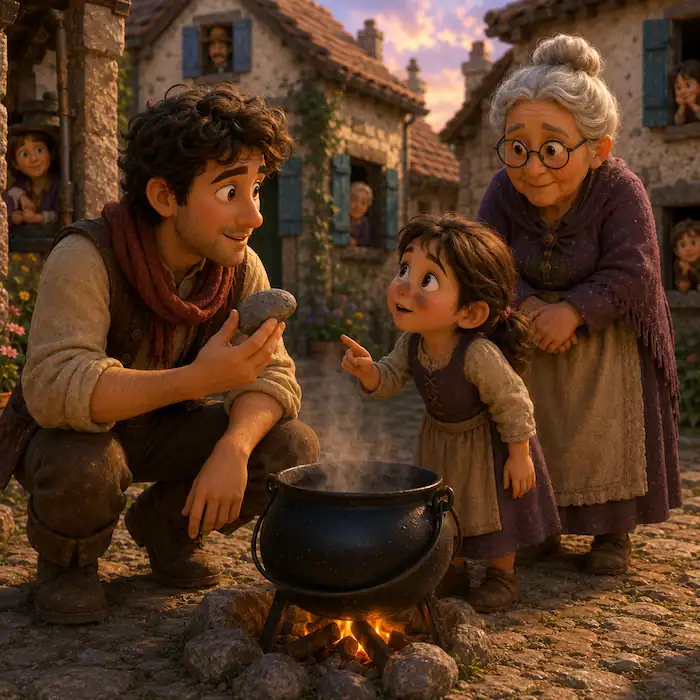
A child asks the traveler about the stone beside a steaming pot in the village square

She slipped out from behind Granny Tansy’s skirt and hurried closer. “Can you truly make soup from a stone?”

“Oh yes,” said the traveler. “A good stone knows where to begin. Of course, even the finest stone soup tastes better with a pinch of salt.”

The First Pinch of Salt
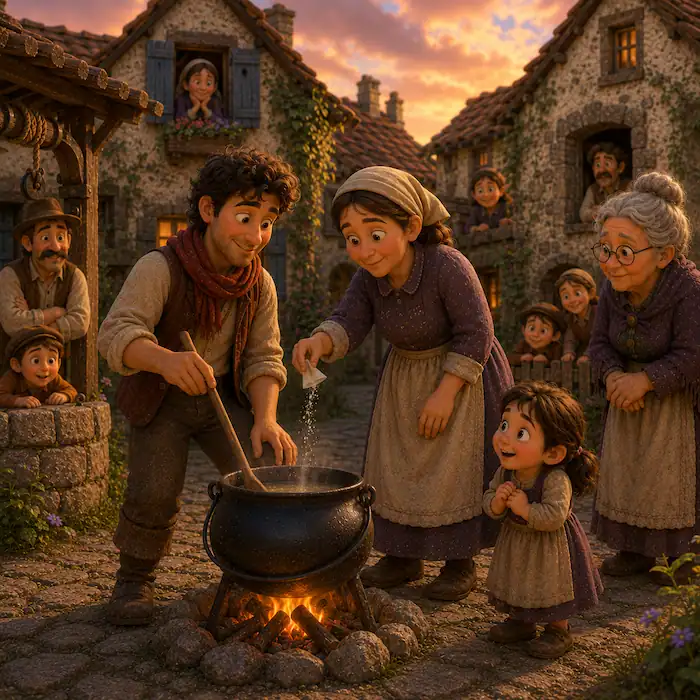
A village woman adds salt to the Stone Soup pot while the traveler stirs

There was a pause.

Then Mrs. Crumb opened her door. “Well, I might have a pinch of salt. Not a barrel. Not a mountain. Just a pinch.”

“A pinch is exactly the right size for beginning,” said the traveler.

Mrs. Crumb came out with a little twist of paper and tipped the salt into the pot. The traveler stirred once around the edge and once through the middle. “Ah,” he said. “Now the stone is stretching.”

Mr. Barley folded his arms in his doorway. “Stones do not stretch.”

“This one does,” said the traveler. Pip giggled. Mr. Barley tried not to, but one corner of his mouth gave him away.

Steam began to rise. It smelled mostly of water, but everyone leaned forward as if it might surprise them.

Granny Tansy stepped into the square.
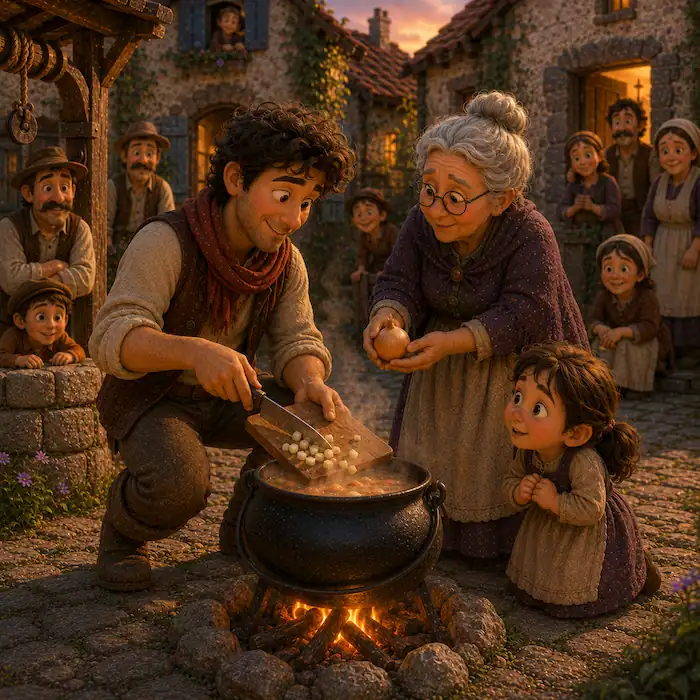
Granny Tansy gives an onion while the traveler adds chopped onions to the soup

“If the stone is stretching, perhaps it would like an onion.”

She brought one small onion, no bigger than a child’s fist.

The traveler bowed again. “An onion gives soup a good start.”

He chopped it and slid it into the pot. Soon the steam changed. A warm smell drifted around the square and found its way under nearby doors.

Onion, Carrots and Potatoes
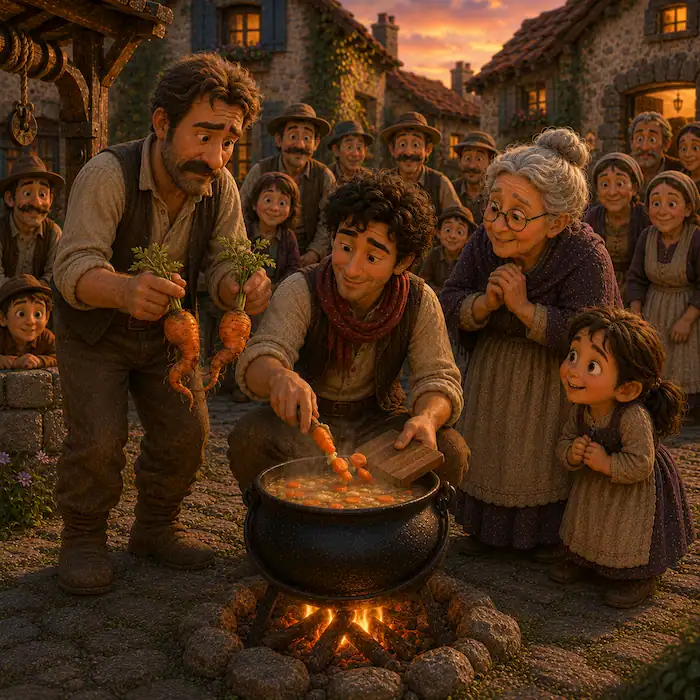
Mr Barley brings carrots as the Stone Soup traveler adds sliced carrots to the pot

Mr. Barley sniffed once. Then he sniffed again, pretending the second sniff had been an accident.

“A soup with onion is respectable,” he said. “But a carrot would give it color.”

“I would never argue with a carrot,” said the traveler.

Mr. Barley disappeared and came back with two carrots, bent and knobbly from the garden. “They are not pretty,” he said.

“Good,” said the traveler. “Knobbly carrots often taste best.”

Into the pot they went. The soup began to look less like a trick and more like a promise.

Pip ran to Granny Tansy and came back holding three small potatoes in both hands. “They are not very big.”

“Small potatoes are excellent swimmers,” said the traveler.

Pip laughed and dropped them into his waiting hand. He cut them into chunks and added them to the pot.

By now the square was filling.
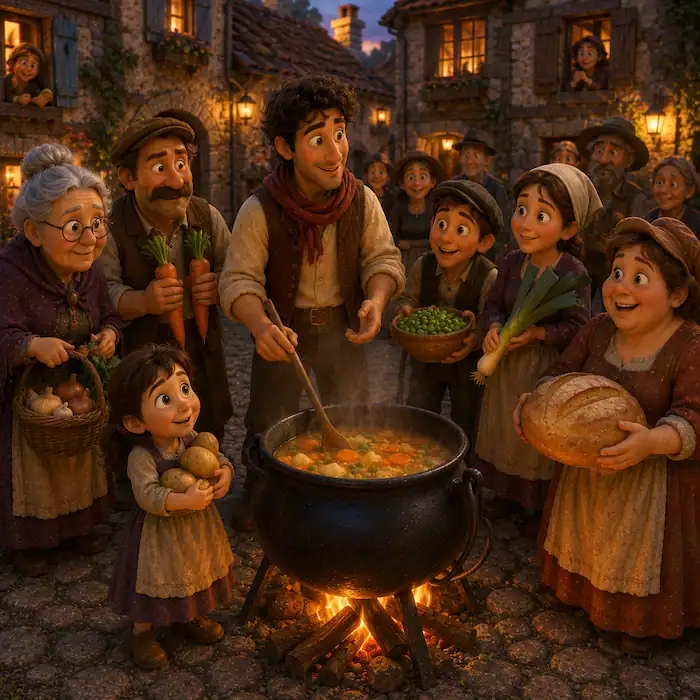
Villagers bring potatoes, peas, leeks, bread and carrots to a bubbling soup pot

People who had said they had nothing began remembering something. Mrs. Crumb found a heel of bread that could be toasted. Mr. Barley’s wife brought a handful of peas. A quiet man with a red scarf brought a leek from behind his shed and looked astonished to find it there, although he had hidden it there himself.

Then the village cook arrived.

She was a round, brisk woman called Cook Mallow, and she carried a wooden spoon as long as a broom handle. She had been watching from her kitchen window with the face of someone who did not approve of nonsense, unless the nonsense smelled delicious.

“If you are making soup in my village,” she said, “then someone had better stir it properly.”

Cook Mallow Takes the Spoon
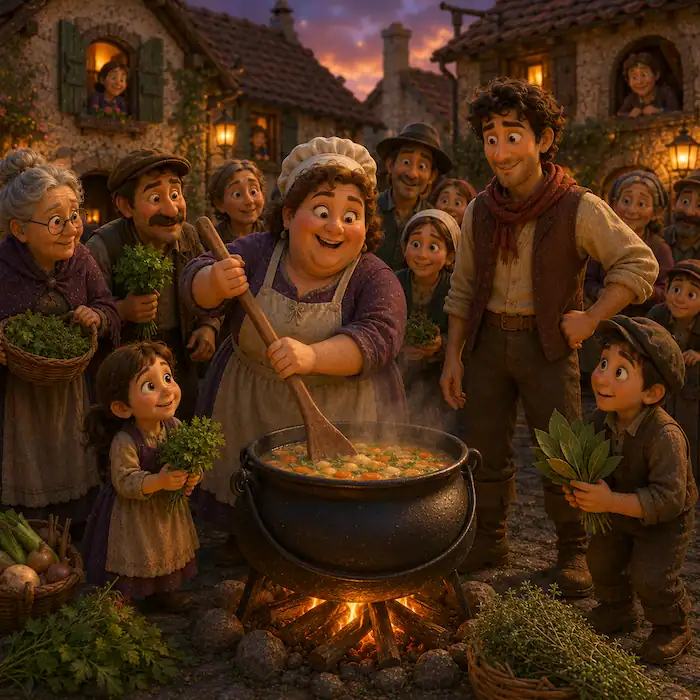
Cook Mallow stirs the Stone Soup pot while children and villagers bring herbs

“Madam,” said the traveler, stepping aside, “the soup has been hoping you would come.”

Cook Mallow took the spoon. She stirred once, twice, three times. The pot made a warm bubbling sound.

“Hmm,” she said. “It needs herbs.”

Three people ran to fetch some. Soon parsley, thyme and a little bay leaf floated in the pot.

The stone sat at the bottom, looking important and saying nothing at all.

Pip leaned over the pot, not too close because Cook Mallow had already warned everyone about hot soup and foolish noses. “What does the stone do?” she asked.

“It begins the soup,” said the traveler.

“But the vegetables make it taste good,” said Pip.

“And the salt,” said Mrs. Crumb.

“And the stirring,” said Cook Mallow.

“And the fire,” said Mr. Barley.

“And the sharing,” said Granny Tansy.

The Village Shares Supper
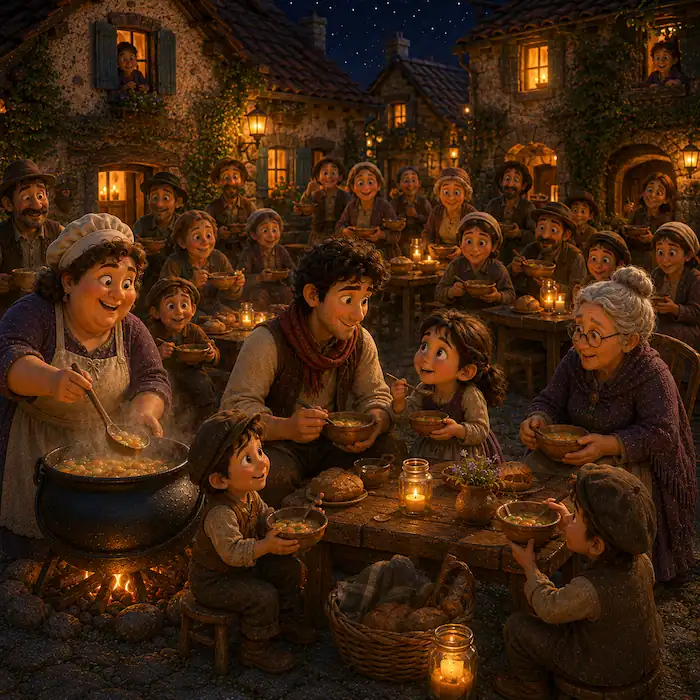
The whole village eats Stone Soup together at outdoor tables under the stars

For a moment, the village square grew quiet.

Then the traveler smiled. “I think this soup is ready.”

Cook Mallow fetched bowls. Mrs. Crumb toasted the bread until the edges crackled. Someone brought a bench. Someone else brought stools, then a blanket, then candles in jars. Mr. Barley found a table that had only three legs, so two children held up the missing corner leg and declared it a very important job.

Before long, the whole village sat together in the square, eating stone soup under the first stars of evening. The soup was warm and thick. It tasted of onion, carrots, soft potatoes, green herbs and bread dipped in broth.

It also tasted, though nobody said it at first, like having enough.

“This is remarkable,” said Mrs. Crumb, wiping her bowl with a crust. “From one stone,” said Mr. Barley, shaking his head.

Cook Mallow tapped her spoon on the side of the pot. “From one stone and a great many people who suddenly remembered their cupboards.”

Everyone laughed, even Mr. Barley.

Pip looked into the empty pot. “May I see the stone?”

The traveler lifted it out with his spoon, washed it in a cup of water and placed it in her palm. It was smooth, gray and perfectly ordinary.

Pip turned it over. “It is just a stone.”

“Yes,” said the traveler. “But it was brave enough to begin.”

Pip Keeps the Stone
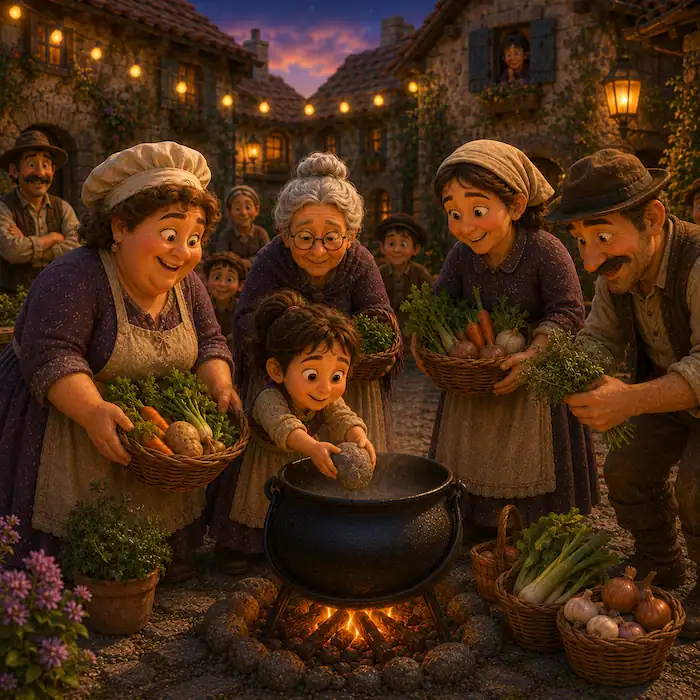
Pip places the smooth gray stone into the pot while villagers hold baskets of vegetables

Granny Tansy chuckled. “I think we did the rest.”

“So you did,” said the traveler, and he smiled.

The next morning, the traveler packed his pot, tied his blanket and prepared to follow the road beyond the hill. The villagers gathered to say goodbye. This time their doors stood open and nobody seemed in a hurry to close them.

Mrs. Crumb gave him a warm roll for the road. Mr. Barley tucked two carrots into his pack. Cook Mallow handed him a little paper of herbs and told him not to let the next village under-stir anything.

Pip ran up last. In her hand was the smooth gray stone. “You forgot this.”

The traveler shook his head. “Keep it.”

“For soup?”

“For remembering,” he said. “Sometimes people think they have nothing to give. Then someone starts with something small and everyone discovers they had a little more than they thought.”

Pip held the stone carefully.

That evening, after the traveler had gone, the village square filled again. Cook Mallow brought the pot. Mrs. Crumb brought bread. Mr. Barley brought vegetables. Granny Tansy brought stories. Pip placed the stone gently in the bottom.

“What shall we make?” asked a boy.

Pip grinned. “Enough for everyone.”

And that is exactly what they did.

Moral

Moral: Small acts of sharing can grow into something generous when people work together.

Short Summary

A hungry traveler arrives in a village where everyone says they have no food to spare. Instead of giving up, he begins making soup with a stone and a pot of water. One by one, the villagers add salt, vegetables, herbs, bread and help, until the whole village shares a warm meal together.

About This Retelling

This child-friendly retelling keeps the main shape and meaning of the traditional Stone Soup story while using clear language for young readers. Traditional folk tales can vary between countries, families and storytellers, so this version should be read as an introduction rather than the only version.

In many versions, a hungry stranger shows a village that everyone has something small to contribute. This version keeps that central idea while giving the village named characters, gentle humor and a warm classroom-friendly ending.

Main Characters

The Traveler: A hungry stranger who uses cleverness, patience and humor to help the village share.

Pip: A curious child who asks questions and notices the truth about the stone soup.

Granny Tansy: Pip’s grandmother, who cares about helping but worries there may not be enough.

Mrs. Crumb: The baker who begins by saying bread and flour are short, then adds the first pinch of salt.

Mr. Barley: The farmer who is cautious at first but joins in when the soup begins to grow.

Cook Mallow: The village cook who brings skill, confidence and proper stirring to the soup.

The Villagers: The community who slowly remember that each person has something small to offer.

Vocabulary Spotlight

Traveler: A person who journeys from one place to another.

Village: A small community where people live near one another.

Spare: To give something extra that you can manage without.

Pinch: A very small amount, often held between finger and thumb.

Respectable: Good enough to be taken seriously.

Knobbly: Bumpy, uneven or lumpy in shape.

Broth: A thin soup or liquid made with vegetables, herbs or other ingredients.

Community: A group of people who live, work or share things together.

Discussion Questions

  1. Why do the villagers close their doors when the traveler first arrives?
  2. Do you think the villagers are unkind, frightened or worried? What clues in the story help you decide?
  3. Why does the traveler begin with a stone instead of asking again for food?
  4. Which character is the first to help? Why is that important?
  5. How does Pip help the reader understand what is really happening?
  6. What changes in the village between the beginning and the end of the story?
  7. Why does the traveler let Pip keep the stone?
  8. What small thing could you share or contribute to help a group?

Classroom Activities for Children

1. Class Stone Soup Circle

Sit in a circle and place a clean stone or picture of a stone in the middle. Each child names one kind action or small contribution that could help a class, family or community. Write the ideas on paper vegetables and place them around the stone.

2. Sequence the Soup

Give children mixed-up story cards for the main events, then ask them to place the cards in order and retell the story in pairs or small groups.

3. Make a Paper Soup Pot

Children draw or cut out a large paper pot. They add paper vegetables, herbs, bread and labels showing what each villager contributed.

4. Role Play the Village Square

Assign roles such as the traveler, Pip, Mrs. Crumb, Mr. Barley, Granny Tansy, Cook Mallow and the villagers. Children act out how the village changes.

5. Real or Pretend Ingredients Sorting

Give children pictures or word cards with ingredients and non-ingredients. They sort them into good for soup, not for soup and silly tall-tale soup.

6. Sharing Is Like Soup Writing Prompt

Ask children to finish the sentence: A classroom is like stone soup because… Encourage answers about kindness, ideas, listening and help.

7. Stone Painting Fine-Motor Activity

Children paint or decorate smooth stones with words such as share, help, kindness, listen, include or thank you.

8. Soup Movement Game

Children move around the room as different parts of the soup: bubbling water, stirring spoons, floating carrots, rolling potatoes, rising steam and warm bread.

9. Outdoor Community Hunt

Outside or near a window, children look for small things that work together in nature, such as ants, birds, leaves, soil, rain and sunlight.

10. Design a Helping Poster

Children create posters with the message Everyone Can Add Something. They draw a soup pot and add words or pictures showing ways people can help.

Teachers’ Notes

Best curriculum fit: Folk tales, traditional stories, moral discussion, PSHE / social-emotional learning, community, cooperation, sequencing, vocabulary and oral storytelling.

Key learning themes: Sharing, scarcity, generosity, trust, cooperation, clever problem-solving and how communities change when people work together.

Before reading: Ask children what it means to have enough. Discuss whether people sometimes say no because they are unkind or because they are worried.

During reading: Pause each time a new ingredient is added. Ask children what changed in the village and why the next person might feel more willing to help.

After reading: Ask children whether the stone made the soup or whether the people did. This leads naturally into discussion about symbols, teamwork and moral meaning.

Cross-curricular links: English, PSHE / SEL, art, drama, maths and science.

Teacher tip: Avoid reducing the story to “the traveler tricks people”. The richer classroom discussion is about fear, scarcity and how one small safe beginning helps a community become generous again.

Why This Version Works for Children

This version gives Stone Soup a warm village setting, clear characters and gentle humor without making the language too flowery. Children can follow the repeated pattern as one small contribution leads to another.

Pip gives younger readers someone to identify with. She asks the question children are likely to ask: what does the stone actually do? The answer helps the moral feel discovered rather than preached.

The ending is reassuring because the village changes. Doors that were closed at the beginning are open by the end, and the stone becomes a reminder that sharing can start with something small.

What Parents and Teachers May Want to Know

This story includes hunger and scarcity, but the tone is gentle and hopeful. The villagers are not presented as cruel. They are tired, worried and careful with what little they have.

The traveler’s method is playful and symbolic. Adults may want to explain that the story is not really about making soup from a stone. It is about helping people see that everyone can add something small.

Stone Soup is useful for classroom and home discussion because it avoids a simple good people and bad people divide. It shows that communities can become kinder when trust begins to grow.

Story Background

Stone Soup is a traditional folk tale with versions told in many countries, especially across Europe. In the common story shape, hungry travelers arrive in a village where people are unwilling or afraid to share. The travelers begin making soup from a stone, then invite villagers to add small ingredients until everyone has helped make a meal.

Versions vary. Some stories use one traveler, while others use soldiers, monks or several strangers. The ingredients also change from version to version. The central idea usually stays the same: when people each contribute a little, the whole community can benefit.

This Kooky Kids World version keeps that traditional pattern while making the village, the child character and the soup-making scene warm and accessible for young readers.

Further Reading for Adults and Teachers

For adult background on Stone Soup and related folk tale versions, D. L. Ashliman’s folktale index includes Stone Soup texts and related tale-type notes:

SD. L Ashlimans Folktale Index

Use this as adult background only. The Kooky Kids World story text should remain an original child-friendly retelling, not a close paraphrase of any source version.

Frequently Asked Questions About Stone Soup

  • Is Stone Soup a real recipe?

    No. Stone Soup is a folk tale, not a real recipe. The stone begins the story, but the soup becomes good because people add real ingredients.

  • What is the moral of Stone Soup?

    The moral is that small acts of sharing can become something generous when people work together.

  • Where does Stone Soup come from?

    Stone Soup is a traditional folk tale with versions told in many places, especially across Europe. There is no single official version.

  • Why do the villagers say they have no food?

    The villagers are worried that they do not have enough. Their fear makes them close their doors, even though they each have something small they could share.

  • Is the traveler tricking the villagers?

    The traveler uses a clever idea to help the villagers begin sharing. The story works best when discussed as a tale about trust, cooperation and community rather than only as a trick.

  • Why does Pip keep the stone at the end?

    Pip keeps the stone as a reminder that good things can begin with something small when people are willing to help.

  • Is Stone Soup good for classroom teaching?

    Yes. Stone Soup is useful for lessons on folk tales, sequencing, sharing, community, vocabulary, drama and moral discussion.