
Paul Bunyan and Babe the Blue Ox Story for Kids

Paul Bunyan and Babe the Blue Ox is an American tall tale for children aged 5-10. This retelling keeps the giant lumberjack, his enormous blue ox and the playful exaggeration that makes the story famous, while keeping the language clear and child-friendly.

Tall tales are not meant to sound ordinary. They stretch the truth until it becomes funny, surprising and much too big to fit inside a normal day.

Story Details

  • Independent Reading Age: 7-10
  • Listen-Along Age: 5-10
  • Reading Level: Medium
  • Reading Time: About 9-11 minutes
  • Author / Source: Traditional American tall tale, retold for Kooky Kids World from public-domain and folklore sources
  • Story Type: American tall tale / folklore story
  • Region / Origin: North American logging-camp folklore, especially the northern United States and Great Lakes/Lake States tall-tale tradition; versions vary
  • Main Characters: Paul Bunyan, Babe the Blue Ox, the cook and the logging crew
  • Moral / Themes: Kindness, teamwork, problem solving, imagination, tall-tale humor and using strength with care

Listen Along

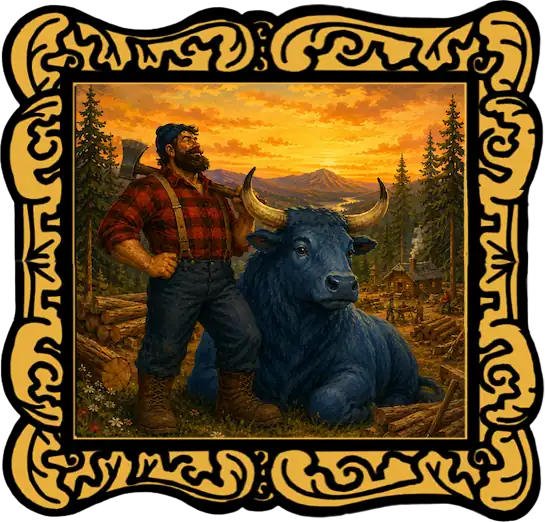
Paul Bunyan stands with Babe the Blue Ox inside a gold frame for the read-aloud version of the story.
0:00 / 0:00
Paul Bunyan and Babe the Blue Ox

Listen along to the Kooky Kids World audio for Paul Bunyan and Babe the Blue Ox.

Kooky Kids World Cloud Logo showing where the audio read aloud file is.

About This Retelling

This retelling is based on the Paul Bunyan tall-tale tradition, with special attention to Paul, Babe the Blue Ox, giant-sized problems and playful explanations for natural places. It draws on public-domain Paul Bunyan sources and general folklore references, but the wording is original for Kooky Kids World.

Versions of Paul Bunyan stories vary a lot. Some place Paul in Maine, some in the Great Lakes region, some in Minnesota and some farther west. This version does not claim to be the one official story. It is a child-friendly tall tale that keeps close to the familiar spirit: Paul is enormous, Babe is blue, the camp is full of impossible problems and every solution is bigger than the last.

The Story

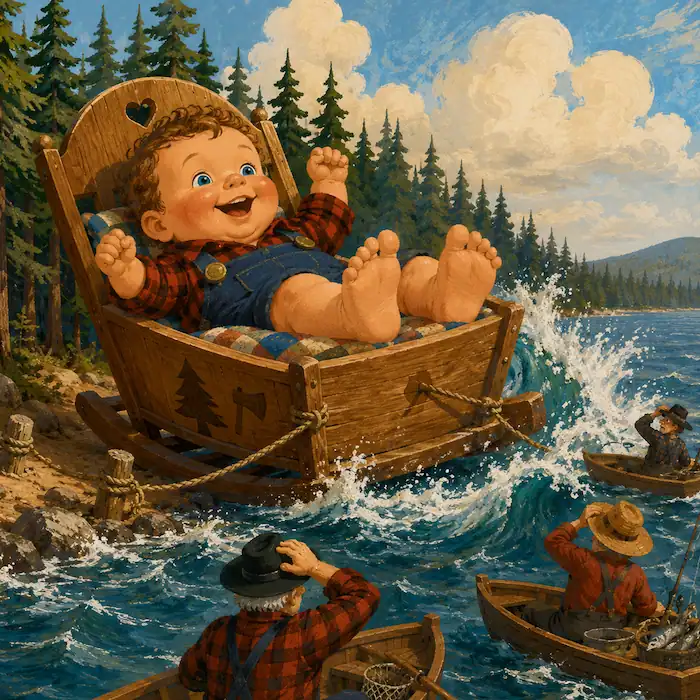
Baby Paul Bunyan laughs in a wooden cradle rocking on the water in the Paul Bunyan and Babe the Blue Ox tall tale.

Long ago, when the forests of North America seemed to stretch farther than any person could walk, people told stories about a lumberjack so big that no measuring stick seemed long enough. His name was Paul Bunyan.

Some folks said Paul was born in Maine. Some said he first appeared in the Great Lakes country. Some said lumberjacks had been telling stories about him for so long that nobody could remember where the first tale began.

Everyone agreed on one thing: Paul Bunyan was enormous.

When Paul was a baby, his cradle had to be tied to the shore like a boat. If he rocked too hard, waves rolled across the bay and fishermen had to hold on to their hats. When he sneezed, pine needles shook from trees miles away. When he laughed, windows rattled in little towns that had never even met him.

By the time Paul was grown, he could step over a river without getting his boots wet. He could carry an ax that looked like a church steeple with a handle. And when he called good morning, the echo sometimes came back at dinnertime.
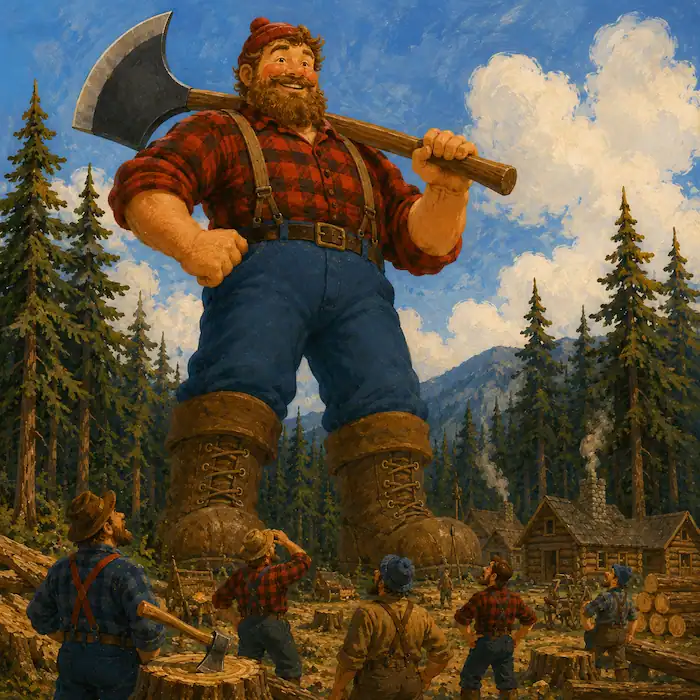
Giant Paul Bunyan stands with his ax above a busy lumber camp in the Paul Bunyan and Babe the Blue Ox story.

Paul worked in the great forests with a crew of lumberjacks. They were strong, cheerful workers, but even they had trouble keeping up with him.

One winter, the cold came down harder than anyone had ever known. The snow looked blue in the morning light. Icicles hung from the branches, sharp and shiny, and the men said even the shadows were shivering.

Paul pulled his red cap low and smiled. “Boys, this is good working weather.”
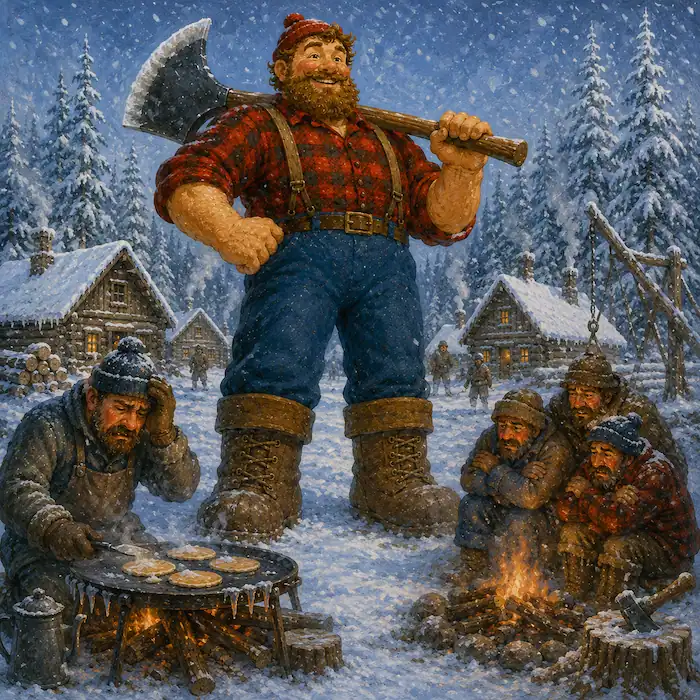
Paul Bunyan stands in the snowy lumber camp while the crew gathers around a frozen winter breakfast.

The crew stared at him.

“Good working weather?” said the cook. “The pancakes froze before I could flip them.”

Paul grinned. “Then make them bigger. A cold day needs a warm breakfast.”

So the cook mixed pancake batter in a kettle as wide as a pond. He poured it onto a griddle so large that two men had to skate across it with butter tied to their boots.

That breakfast might have fed the crew all morning, if something strange had not drifted in from the snowy woods.
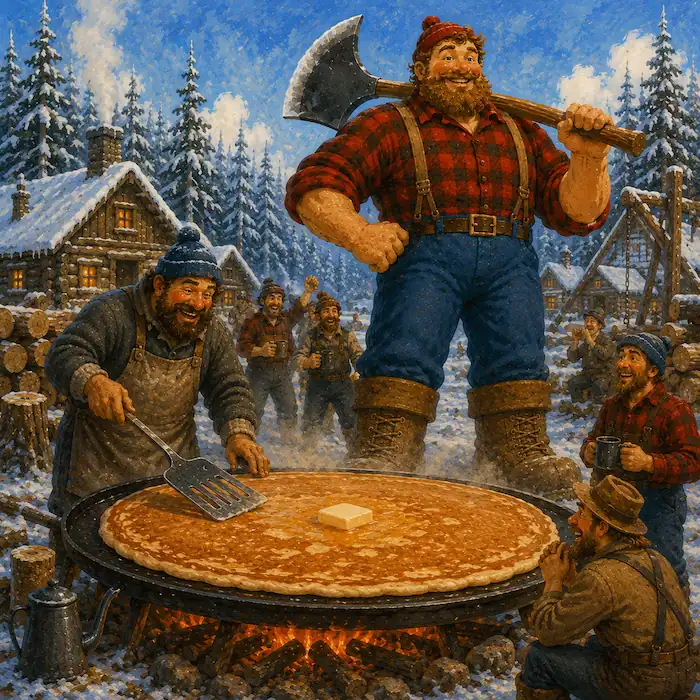
Paul Bunyan watches the camp cook and lumberjacks make an enormous pancake on a giant griddle.

It was not a howl. It was not a growl. It was a small, sad moo.

Paul turned his head. “That sounds like someone needing help.”

He followed the sound through the blue snow.
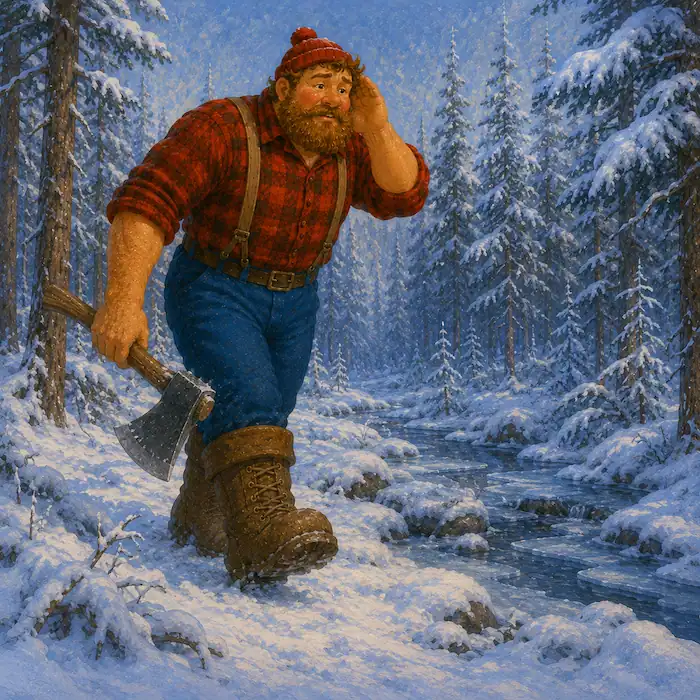
Paul Bunyan walks through a snowy forest listening for a small sad sound in the American tall tale.

Under a drift beside a frozen creek, he found an ox calf. Paul called him tiny, but to anyone else the calf was already the size of a wagon. His coat was blue from the cold, his nose was frosty and his ears drooped low.

“Well now,” Paul said gently. “You are a long way from warm hay.”

He lifted the calf in both arms and carried him back to camp.
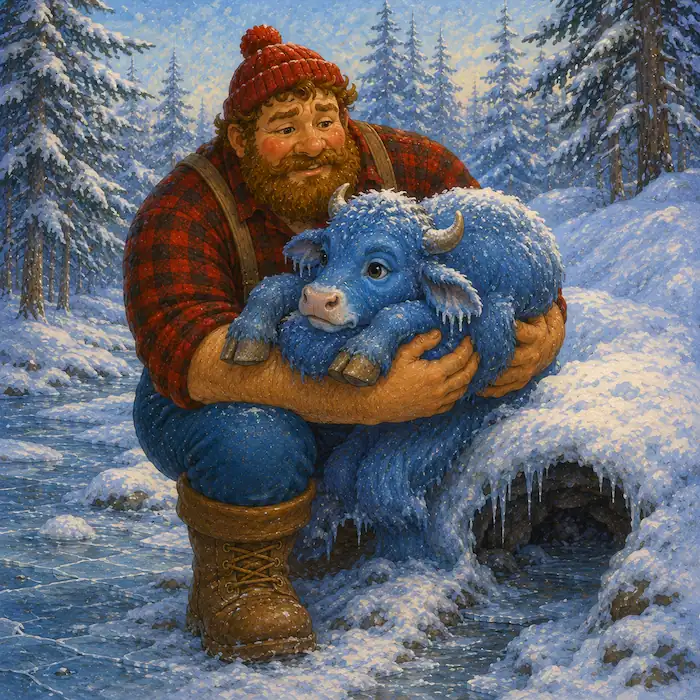
Paul Bunyan gently carries the little blue ox calf Babe beside a frozen creek in the snowy woods.

The cook wrapped him in a blanket, the crew warmed him by the stove and Paul fed him a barrel of oats with half a stack of hay.

By morning, the calf was still blue, but he was no longer cold. He was bright blue, sky blue, winter-morning blue.

Paul scratched his chin. “A blue ox needs a good name.”

The calf looked up and sneezed a little snow cloud.

“I’ll call you Babe,” said Paul.
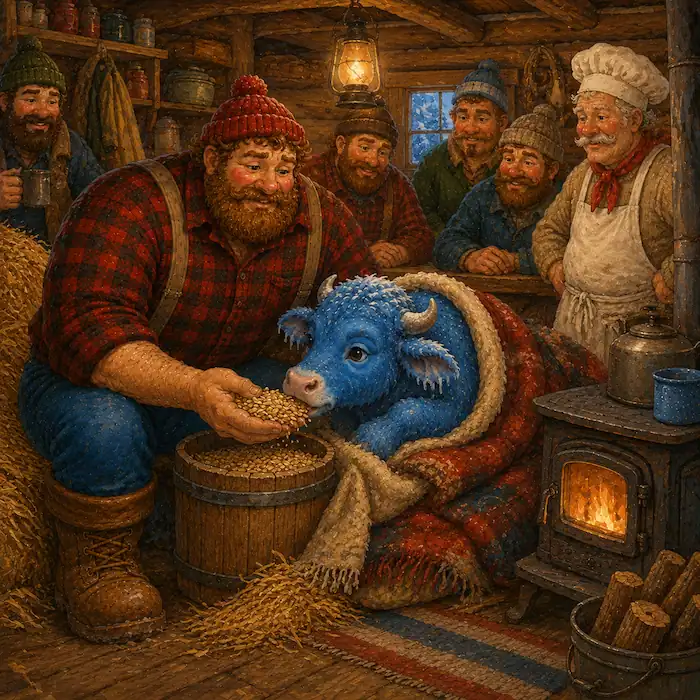
Paul Bunyan and the logging camp crew warm Babe the Blue Ox beside the stove after finding him in the snow.

From that day on, Babe the Blue Ox followed Paul everywhere. And Babe grew.

He grew in the morning. He grew at lunchtime. He grew while the crew was telling stories after dinner. One night, the men tucked Babe into a barn. By morning, Babe was standing calmly in the valley with the barn balanced on his back like a hat.
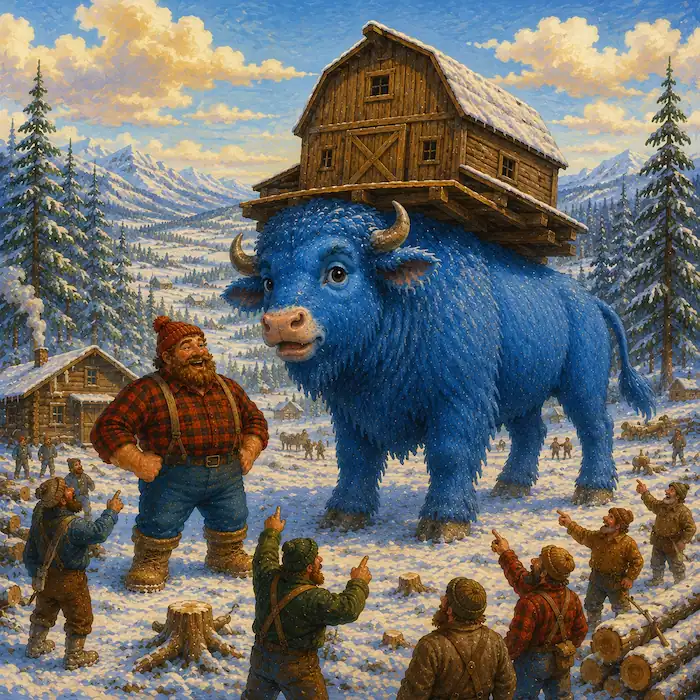
Babe the Blue Ox stands in the snowy valley with a barn balanced on his back while Paul and the crew look on.

Paul laughed until the snow shook from the trees. “Babe,” he said, “you and I are going to get along just fine.”

Babe was strong, but he was also very gentle. He could pull almost anything, no matter how huge or heavy it was. If a road curled the wrong way, Babe could tug it straight. If a river wriggled across the land like a ribbon, Babe could pull the kinks out of it.

One spring, Paul’s crew reached a river that twisted so much nobody could float logs down it. The river looped left, curled right, doubled back and seemed to forget where it was going.

The men stood on the bank and scratched their heads.

“That river is too crooked,” said one.

“It travels ten miles to go one mile,” said another.

Paul looked at Babe. Babe looked at Paul.

“I suppose,” Paul said, “we should help it make up its mind.”

Paul tied one end of a rope around a bend in the river and the other end to Babe’s harness. “Easy now, Babe,” he said. “Just a friendly pull.”
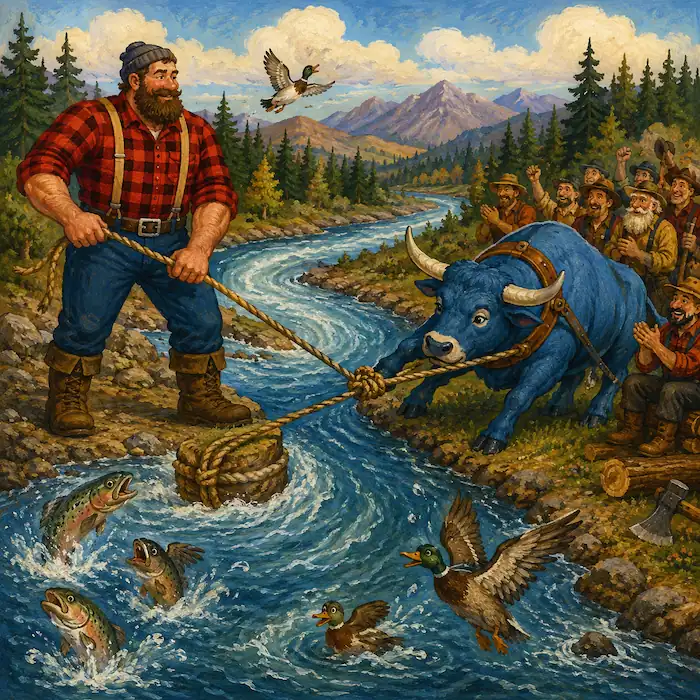
Paul Bunyan and Babe the Blue Ox work beside a rushing river while the logging crew and ducks watch.

Babe leaned forward. The river gave a splash, a wobble and a surprised gurgle.

Then it straightened.

Fish popped their heads above the water and blinked. Ducks, who had been swimming around corners all morning, suddenly found themselves going the right way.

“There,” said Paul. “Much better.”

After that, the logs floated smoothly. The crew cheered, and the cook said straight rivers made it much easier to deliver lunch.

But Paul’s biggest jobs were never small for long.

One hot summer, Babe grew thirsty. Not a little thirsty. Not bucket thirsty. Not even water-tank thirsty.

Babe was lake thirsty.

He lowered his huge blue head and sniffed the air. “Moo,” said Babe.

Paul understood at once. “I know, old friend. You need a drink.”

The cook came first with his biggest soup kettle and said, “This was for soup, but I suppose soup can wait.” Babe drank it in one gulp. Then the crew brought barrels, and Babe drank them. They brought wagonloads of water, and Babe drank those too.

Still, he looked thirsty.

Paul studied the land. Then he took his giant ax and began to scoop out a basin. He scooped once. He scooped twice. He scooped again and again until the earth held a hollow so wide that the clouds seemed to pause above it and wonder what it might become.

Rain filled the hollow. Streams ran into it. Soon there was a shining lake big enough for Babe to drink from.
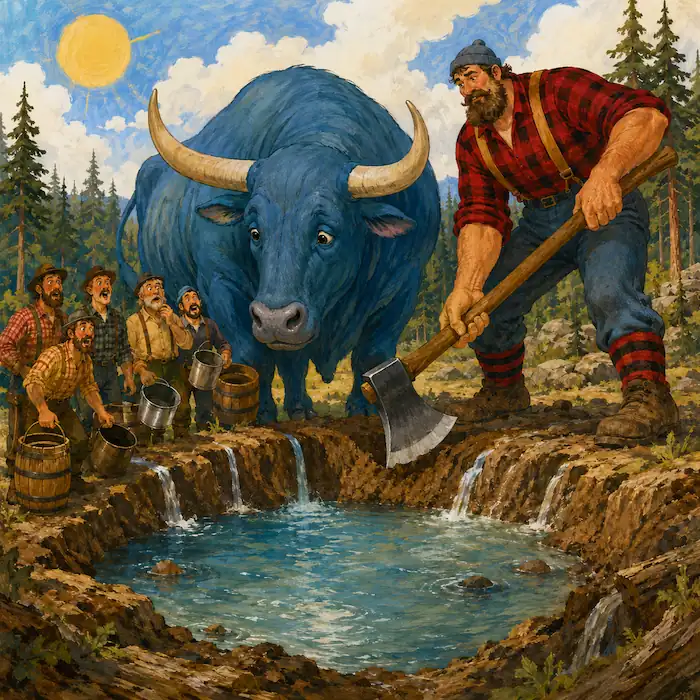
Paul Bunyan works beside Babe the Blue Ox at a bright blue pool while the crew watches the tall-tale landscape take shape.

“That should do,” said Paul.

Babe drank until he was happy. The crew stood beside the new water and stared.

“What shall we call it?” asked the cook.

Paul shrugged. “A lake that big can probably choose its own name.”

Some storytellers say Paul made more than one great lake that way. Others say he only helped shape them in the tale. That is how tall tales work. They take a little wonder, add a little geography and stir in a spoonful of impossible.

As the years went on, people told more and more stories about Paul and Babe. They said Paul’s footprints made valleys. They said Babe’s hoofprints filled with rain and became ponds. They said Paul could stack logs so high that the moon had to go around them.

They even said one winter was so cold that words froze in the air. The crew had to gather them in a sack, thaw them by the stove and listen to yesterday’s conversation at breakfast.

Paul did not mind the stories growing taller. In fact, he liked them.

“A story should have room to stretch,” he told Babe.

Babe nodded, which made the treetops sway.

One evening, after a long day of impossible work, Paul and Babe sat on a hill above camp. The cook’s fire glowed below. The crew sang softly. The forest stood dark and quiet around them.

Paul rested his giant hand on Babe’s blue neck. “We have done some big things,” he said.

Babe gave a gentle moo.

“But the best work,” Paul continued, “is not just being big. It is helping your friends, solving the problem in front of you and leaving a good story behind.”

The moon rose over the trees.
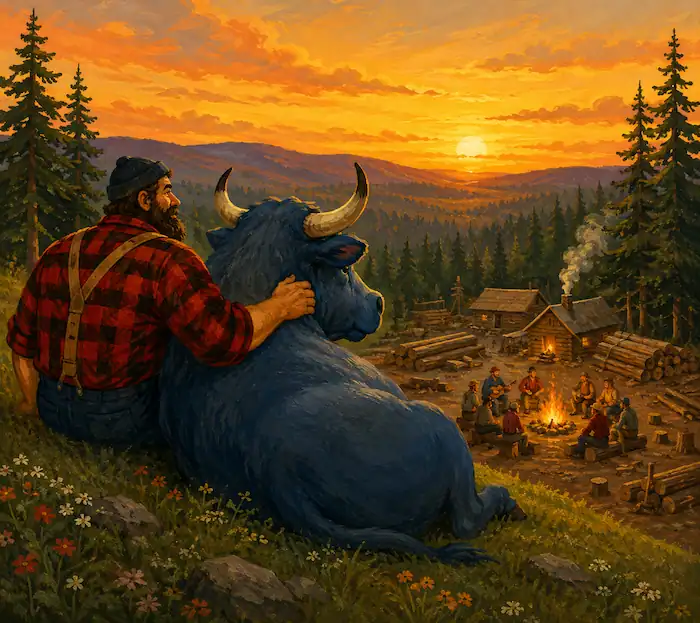
Paul Bunyan and Babe the Blue Ox rest on a hillside at sunset above the forest camp.

Far away, a child heard a grown-up tell of a giant lumberjack and his blue ox. The child laughed and asked, “Could that really happen?”

The grown-up smiled. “In a tall tale, almost anything can happen, if the story is big enough.”

And somewhere, in the wide woods of imagination, Paul Bunyan tipped his red cap, Babe the Blue Ox shook the stars from his horns and another impossible story began.

Moral

Great strength matters most when it is used with kindness, teamwork and imagination.

Short Summary

Paul Bunyan is a giant lumberjack from American tall tales. In this child-friendly retelling, Paul finds a cold blue ox calf and names him Babe. Babe grows enormous and becomes Paul’s gentle friend. Together they straighten a crooked river, help the logging crew and create giant-sized stories that explain the world in funny, impossible ways.

Main Characters

  • Paul Bunyan: Paul Bunyan is the giant lumberjack at the center of the tall tale. He is strong, cheerful and larger than life. In this version, he uses his size to help others rather than frighten them.
  • Babe the Blue Ox: Babe is Paul’s enormous blue ox and closest companion. He is gentle, loyal and strong enough to pull almost anything.
  • The cook: The cook keeps Paul’s huge camp fed. He adds humor because ordinary meals become impossible when the workers are giants.
  • The logging crew: The crew helps show the scale of Paul’s world. Their problems are big, but Paul and Babe usually find an even bigger solution.

Vocabulary Spotlight

  • Tall tale: A funny story that exaggerates events until they become larger than life.
  • Lumberjack: A worker who cuts or moves trees.
  • Ox: A strong cattle animal often used for pulling heavy loads.
  • Harness: Straps used to connect an animal to something it pulls.
  • Basin: A low area that can hold water.
  • Exaggeration: Making something sound much bigger, smaller, stranger or funnier than normal.
  • Folklore: Stories, songs and traditions passed from person to person.

Discussion Questions

  1. How can you tell that Paul Bunyan is a tall tale and not a realistic story?
  2. Why does Paul help Babe when he finds him in the snow?
  3. What makes Babe a good friend to Paul?
  4. Which part of the story is the funniest or most impossible?
  5. Why do people enjoy stories that exaggerate?
  6. How does Paul use his strength kindly?
  7. What would you add if you were making the story even taller?

Classroom Activities for Children

Tall-tale exaggeration activity

Ask children to start with a normal sentence, such as “It rained a lot.” Then turn it into a tall tale: “It rained so much that the frogs needed umbrellas and the ducks asked for boats.”

Map and geography activity

Show a simple map of the United States and the Great Lakes region. Explain that tall tales often play with real places, but they are not factual geography lessons.

Babe the Blue Ox art activity

Children draw Babe the Blue Ox and add three giant things he might pull.

Writing activity

Children write a short new Paul Bunyan sentence beginning: “Paul was so big that…”

Teamwork discussion

Ask children to name the jobs Paul, Babe, the cook and the crew each do. Talk about why big tasks are easier when everyone helps.

Materials and building activity

Connect this story to STEM by asking children what tools and materials people might use to move heavy objects safely today.

Movement activity

Invite children to act out giant steps, careful ox pulls and tiny lumberjack jobs, keeping all movement slow, safe and controlled.

Outdoor observation

Look outside for natural shapes, puddles, paths or slopes. Ask children how a tall-tale storyteller might explain them in a funny impossible way.

Teachers’ Notes

Best curriculum fit: Tall tales, American folklore, exaggeration, story structure, geography, creative writing and the difference between legend and history.

Before reading: Explain that a tall tale deliberately makes events too big to be realistic.

During reading: Ask children to listen for clues that the story is exaggerating for humor.

After reading: Invite children to create one new impossible Paul and Babe adventure that still has a kind or helpful purpose.

Cross-curricular links: Geography, drama, art, STEM, oral storytelling and social-emotional learning.

Teacher tip: Avoid presenting Paul Bunyan as literal history. Use “some versions say” or “storytellers say” rather than factual claims about places Paul created.

Why This Version Works for Children

This version keeps the familiar Paul Bunyan elements: the giant lumberjack, Babe the Blue Ox, the blue-snow winter, impossible strength, a crooked river and giant changes to the land. It also keeps the tone playful and clear, so children can enjoy the exaggeration without being confused about what is factual.

The story is better for 5-10 than for 0-5 because children need to understand that tall tales deliberately stretch the truth.

What Parents and Teachers May Want to Know

Paul Bunyan stories come from North American lumber-camp folklore and later printed retellings. Some older versions include rough work-camp humor, outdated language or stronger violence. This Kooky Kids World version avoids those elements and focuses on imagination, kindness, teamwork and the tall-tale tradition.

Adults may want to explain that Paul Bunyan is a folklore character, not a proven historical person. Some sources connect the tales with the northern United States, the Great Lakes and logging culture, while others discuss possible Canadian influences.

Story Background

Paul Bunyan is one of the best-known figures in American tall tales. He is usually shown as a giant lumberjack with a huge blue ox named Babe. The tales are associated with North American logging camps and frontier storytelling.

Sources disagree about the exact origin of the legend. Some accounts connect Paul Bunyan with Maine, some with the Great Lakes or Lake States and some with French Canadian or wider North American logging traditions. The Library of Congress describes Paul Bunyan and Babe as prominent figures in American folklore, while other sources note that the stories were passed through many storytellers before becoming popular in print.

Because versions vary, this page should not claim one official origin or one original version.

Further Reading for Adults and Teachers

Frequently Asked Questions About Paul Bunyan

  • Who is Paul Bunyan?

    Paul Bunyan is a giant lumberjack from American tall tales. He is famous for his enormous size, impossible strength and adventures with Babe the Blue Ox.

  • Is Paul Bunyan a real person?

    Paul Bunyan is best treated as a folklore character rather than a proven historical person. The stories grew through oral storytelling, lumber-camp humor and later printed retellings.

  • What is a tall tale?

    A tall tale is a story that uses playful exaggeration. It may include real places or jobs, but the events become much too big, funny or impossible to be realistic.

  • Who is Babe the Blue Ox?

    Babe is Paul Bunyan’s giant blue ox. In many stories, Babe is Paul’s loyal companion and is strong enough to pull huge loads, straighten rivers or help with impossible jobs.

  • What age is this Paul Bunyan story best for?

    This version is best for children aged 5-10 as a listen-along story or 7-10 for independent reading. Older children aged 8-12 may enjoy the folklore background and tall-tale writing activities.

  • What is the moral of Paul Bunyan and Babe the Blue Ox?

    The story suggests that strength is best when it is used with kindness, teamwork and imagination.

  • Why are Paul Bunyan stories important?

    Paul Bunyan stories are part of American tall-tale folklore. They show how workers and storytellers used humor and exaggeration to make hard work, big landscapes and ordinary problems feel larger than life.