
Odysseus and the Sirens

Odysseus and the Sirens is a Greek myth episode for children aged 7 to 11. This version is based on an episode from Homer’s Odyssey and has been retold in clear, child-friendly language with a focus on self-control, teamwork and trust.

In this retelling, Odysseus wants to hear the Sirens’ song without putting his crew in danger. The story is tense, but the danger is handled gently for young readers.

Story Details

  • Independent Reading Age: 8 to 11
  • Listen-Along Age: 7 to 11
  • Reading Level: Middle elementary
  • Reading Time: About 8 to 10 minutes
  • Audio Length: About 11 minutes
  • Author / Source: Based on an episode from Homer’s Odyssey, retold for Kooky Kids World
  • Story Type: Greek myth episode
  • Region / Origin: Ancient Greek literary tradition
  • Main Characters: Odysseus, Odysseus’ sailors, Circe, the Sirens
  • Moral / Themes: Self-control, teamwork, temptation, planning, trust, leadership

Listen Along

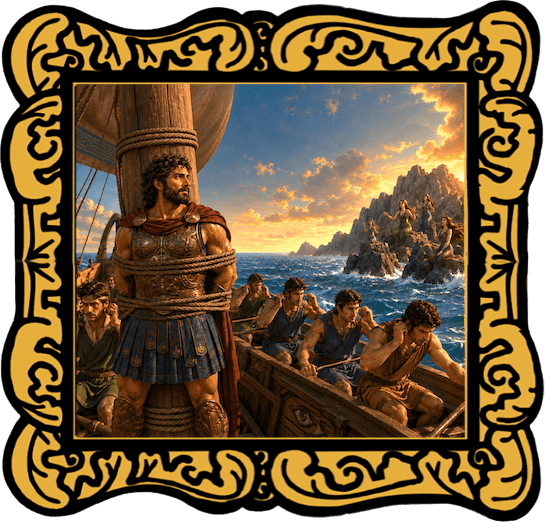
Audio cover for Odysseus and the Sirens with Odysseus at the mast and sailors rowing
0:00 / 0:00
Odysseus and the Sirens

Listen along to this child-friendly Greek myth episode about Odysseus, the Sirens and the plan that helps his ship pass safely.

Kooky Kids World Cloud Logo showing where the audio read aloud file is.

Odysseus and the Sirens Story

Circe’s Warning

For many long days, Odysseus and his sailors had traveled across the sea. They had faced storms, strange islands and dangers they would never forget. Still, Odysseus kept thinking of home. Far away across the waves was Ithaca, the island where his family waited.

Before the sailors left the island of the sorceress Circe, she gave Odysseus a serious warning.

“Your ship must pass the Sirens,” Circe told him. “They sit beside the sea and sing. Their voices are sweet, but their song is dangerous. Any sailor who steers toward them will forget his home, his friends and his journey.”

Odysseus listened carefully. He was brave, curious and sometimes too eager to know what others did not know. The thought of the Sirens’ song filled him with both fear and wonder.

“How can we pass them safely?” he asked.

Circe told him the plan. “Soften beeswax and press it into your sailors’ ears. Then they will not hear the song.
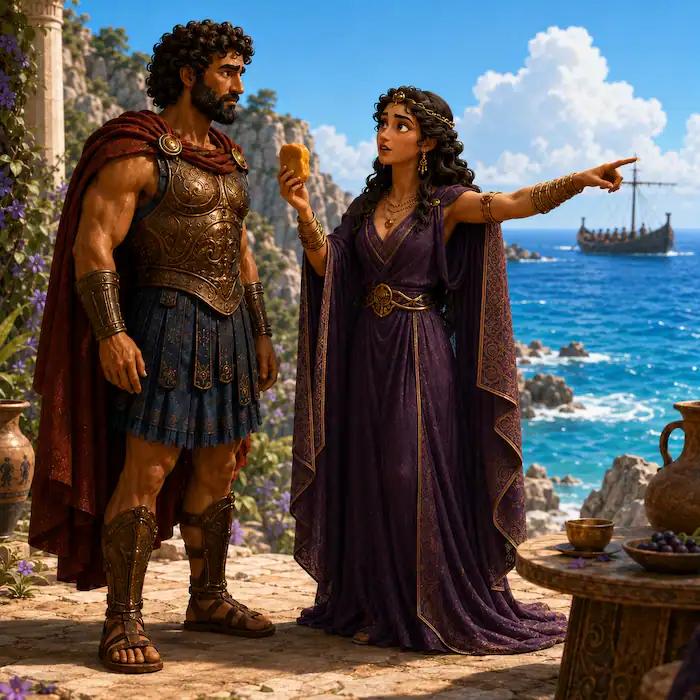
Odysseus and Circe looking toward a ship leaving the island

If you wish to hear it yourself, you must not be free to move. Tell your men to tie you tightly to the mast. No matter what you shout, they must not untie you until the ship has passed beyond the Sirens and the song has faded.”

Odysseus thanked Circe. He understood the warning. This danger could not be defeated with a sword or a spear. It would take planning, trust and self-control.

A Plan on the Open Sea

The next morning, the sailors pushed the ship into the bright water. The sail filled with wind, and the island of Circe slowly slipped behind them. For a while, the sea was calm. The oars rose and fell, the ropes creaked softly and the sun flashed on the waves.

Odysseus stood at the stern and watched the path ahead.

Odysseus’ ship sailing across calm blue water toward rocky cliffs

He knew the Sirens waited somewhere beyond the next stretch of sea. He also knew he had to tell his crew the truth.

“My friends,” he said, “we are sailing toward a dangerous place. The Sirens sing so beautifully that sailors forget everything else. If we listen and steer toward them, we may never reach home.”

The crew grew quiet.

“What shall we do?” asked one sailor.

“Circe gave us a way through,” Odysseus said. “You must soften beeswax and block your ears. Then you must row with all your strength. I will hear the song, but only because you will tie me to the mast. You must not release me, even if I beg. You must not release me, even if I command it.”

The sailors looked at one another. Odysseus was their leader. They were used to obeying his voice. Now he was asking them to disobey him for his own safety and for theirs.

At last, the oldest sailor nodded. “If that is the plan that brings us home, we will follow it.”

Wax for the Sailors

Odysseus took a round of beeswax and cut it into pieces. He warmed the wax in his hands until it grew soft. The sailors did the same, kneading it carefully until each piece could be pressed into an ear.

One by one, they blocked their hearing.
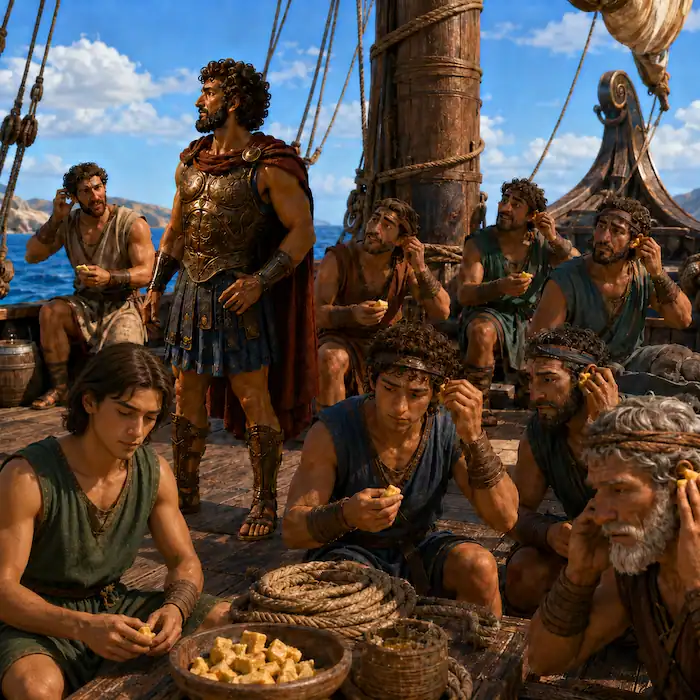
Sailors preparing wax on deck before passing the Sirens The ship became strangely quiet for them. They could see the sea, they could feel the wind, they could watch Odysseus’ mouth move, but the ordinary sounds of the ship faded away.

Then the sailors then tied Odysseus to the mast. They used strong ropes and wrapped them around his waist, chest and arms. They pulled the knots tight enough that he could not step away or lift his hands to free himself. Odysseus tested the ropes. They held firm.

He looked at his crew with a serious face.

“Remember,” he said, though most of them could not hear him now. “No matter what I do, keep rowing.”

The sailors nodded. Some could not hear the words, but they understood the look in his eyes. They took their places, gripped the oars and started to row.

The First Notes of the Song

The ship moved on. The waves slapped gently against its sides. White birds circled overhead. In the distance, dark rocks rose from the sea, and beyond them lay a quiet shore.

At first, Odysseus heard only the wind.

Then a sound drifted across the water.

It was soft at first, so soft that he wondered if he had imagined it. Then it grew clearer. The sound was music, but not like any music he had heard in halls or around campfires. It seemed to know his name. It seemed to know every wish hidden in his heart.

The Sirens were singing.

“Odysseus,” the song called, sweet as honey. “Come closer. Stay with us. We know the stories of heroes. We know the secrets of the sea. We know the glory that belongs to you.”
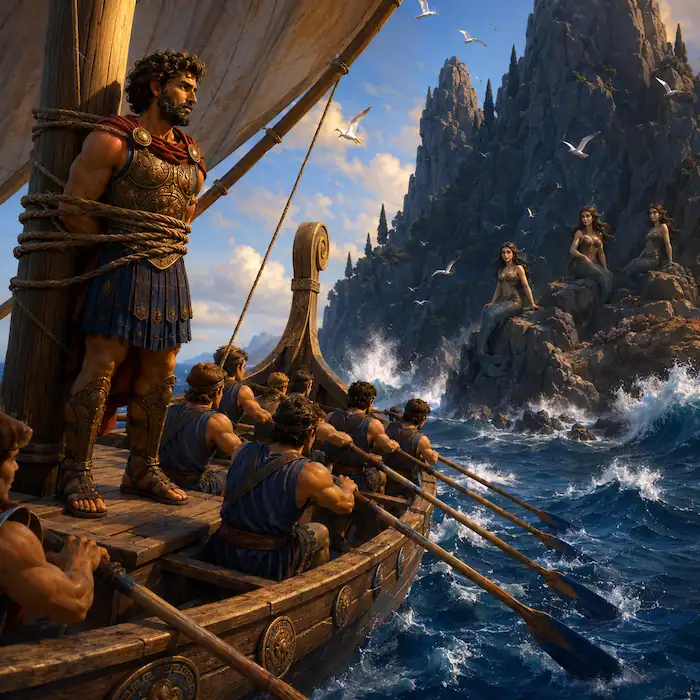
Odysseus tied to the mast as sailors row toward a rocky shore

Odysseus’ heart beat faster. He strained against the ropes, but they held him in place.

The sailors kept rowing. Their ears were sealed with wax, so they heard nothing. They saw the rocks, they saw their captain pull against the ropes, they saw his face change, but they did not stop rowing.

The Sirens’ Promise

The ship drew closer to the shore. The Sirens’ song grew stronger and clearer.

They sang of battles Odysseus had survived, they sang of wisdom no other person knew. They promised to tell him what had happened in lands far away, they promised songs of honor, fame and answers.

To Odysseus, every word felt like a golden thread pulling him toward the rocks.

“Untie me!” he shouted.
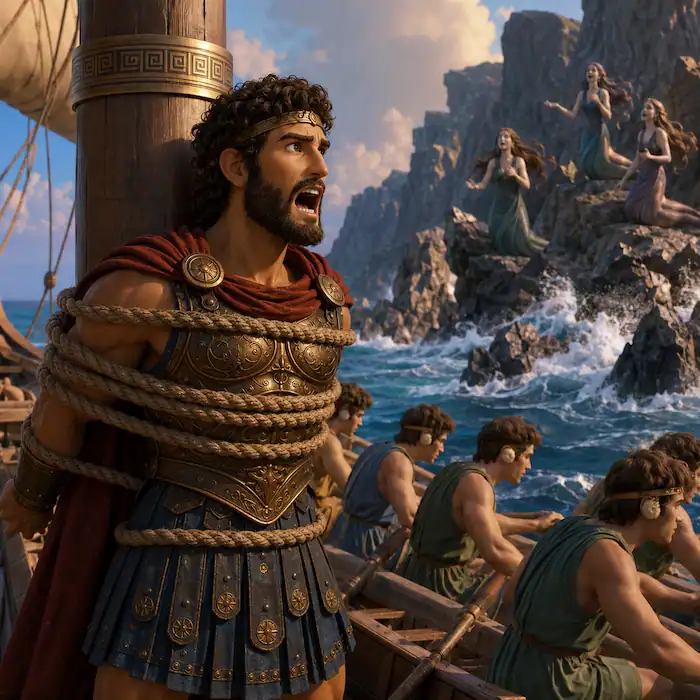
Odysseus straining against ropes as sailors row near the Sirens’ shore

The sailors did not hear him. They bent over the oars and rowed.

Odysseus twisted against the ropes. “Untie me! I command you!”

Two sailors saw him struggling. They remembered the warning. Instead of loosening the ropes, they stood up carefully, crossed the deck and tied him even tighter.
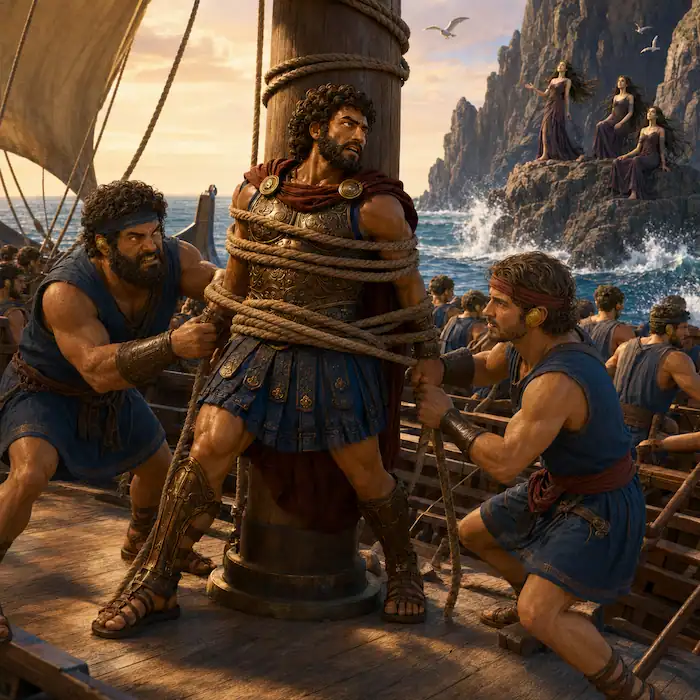
Sailors tightening the ropes around Odysseus to keep the ship safe

Then they returned to the oars.

Odysseus was angry in that moment. The song filled his ears and crowded out every wise thought. He wanted only to go closer. He wanted only to hear more.

But the plan was good.

The ropes held, the sailors rowed, and the ship kept moving forward.

Past the Rocks

The Sirens’ island slid beside them. The water near the rocks looked bright and dangerous. Foam curled and broke against stone. The sailors pulled harder, their arms aching as the ship passed the most dangerous place.
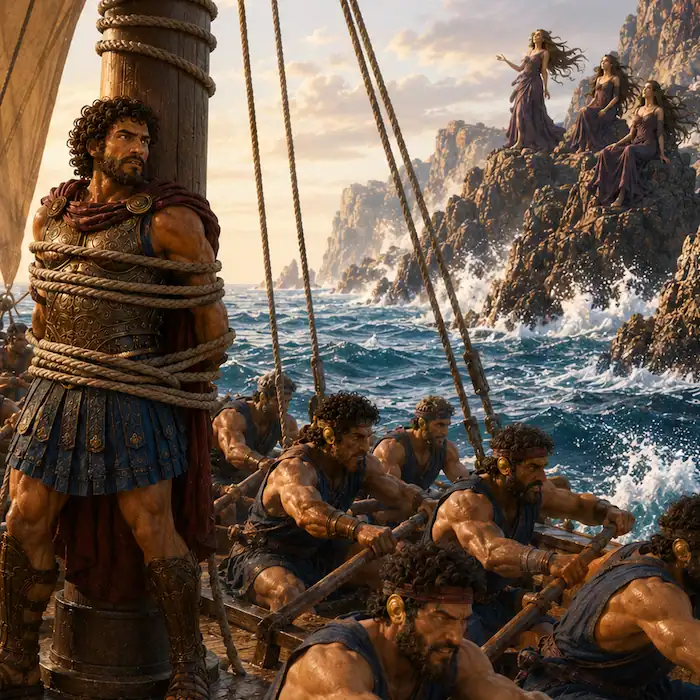
Sailors rowing hard past rocks while Odysseus remains tied to the mast

Odysseus could still hear the song.

“Stay, Odysseus,” it called. “Why hurry home? Why leave knowledge behind? Why turn away from glory?”

For a moment, Odysseus shut his eyes. He thought of Ithaca. He thought of his home, his family and the men who trusted him. He thought of Circe’s warning and the plan he had made before the music began.

He could not make himself stop wanting the song, but he could let the ropes and the sailors protect him until the wanting passed.

The ship moved farther from shore.

The song grew softer.

The rocks fell behind them.

Still the sailors rowed.

When the Song Faded

At last, the Sirens’ voices faded into the wind. The sweet call became a thin thread of sound, then a whisper, then nothing at all.

Odysseus stopped struggling. His shoulders dropped against the mast and his breath slowed down. The powerful longing that had filled him began to loosen, like a knot being untied.

The sailors watched him carefully. When Odysseus no longer strained against the ropes, the oldest sailor lifted a hand and pointed behind them. The Sirens’ shore was far away now.

Odysseus nodded.

Only then did the sailors remove the wax from their ears. The sounds of the world rushed back to them: waves, wind, wood, rope and the tired breathing of men who had rowed with all their strength.

“Are we safe?” one sailor asked.

Odysseus looked back at the distant rocks. “Yes,” he said. “We are safe because you followed the plan.”

The sailors untied him from the mast. His arms were stiff, and the ropes had pressed deep marks into his cloak, but he was unharmed.
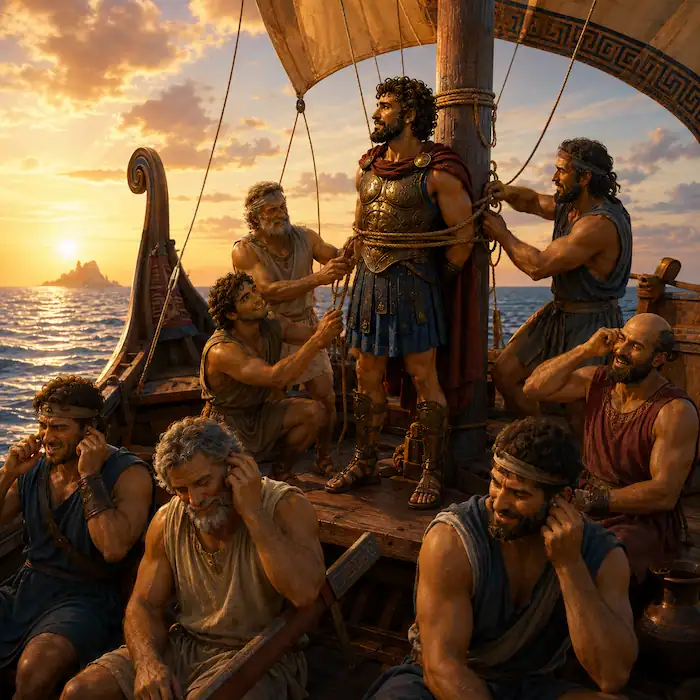
Odysseus and his sailors safe on the ship after passing the Sirens

The Lesson at the Mast

Odysseus stood quietly for a while. He had heard the Sirens and lived, but he knew he had not passed the danger by strength alone. If his sailors had obeyed his shouting instead of his earlier wisdom, the ship might have turned toward the rocks.

“You did well,” he told them. “You trusted the plan even when I fought against it.”

The oldest sailor smiled wearily. “You told us not to untie you. We remembered.”

Odysseus looked at the mast where the ropes had held him. He understood something important. A wise person does not only make a good plan when the sea is calm. A wise person also makes sure the plan will hold when temptation is loud.

The ship sailed on toward the next stretch of sea. Behind them, the Sirens’ song was gone. Ahead of them lay more trials, more choices and the long hope of home.

Odysseus stayed near the mast for a little while longer, listening to the honest sounds of the ship: the oars, the waves and the steady breath of his crew.

Those sounds were not as sweet as the Sirens’ song.

But they were the sounds that carried him home.

Moral

Moral: A wise plan and trusted friends can help us make safe choices when temptation feels strong.

Short Summary

Odysseus learns from Circe that his ship must pass the dangerous Sirens. He tells his sailors to block their ears with wax and tie him to the mast so he can hear the song safely. When the Sirens tempt him with promises of knowledge and glory, Odysseus shouts to be released, but his sailors follow the plan and row past the rocks. After the song fades, Odysseus thanks his crew and understands that a wise plan must hold even when feelings change.

About This Retelling

This child-friendly retelling keeps the main shape and meaning of the Greek myth episode while using clear language for young readers. Stories from ancient epics can vary between translations, classrooms and retellings, so this version should be read as an introduction rather than the only version.

Main Characters

  • Odysseus: A Greek hero and king of Ithaca who is brave, curious and clever enough to ask his crew to protect him from his own temptation.
  • Odysseus’ sailors: The crew members who trust the plan, block their ears with wax and row past the Sirens.
  • Circe: A powerful figure from the Odyssey who warns Odysseus about the Sirens and tells him how to pass them safely.
  • The Sirens: Mysterious singers from Greek myth whose beautiful song tempts sailors away from their safe course.

Vocabulary Spotlight

  • Sirens: Beings from Greek myth whose song tempts sailors toward danger.
  • Mast: The tall pole on a ship that holds the sail.
  • Beeswax: Wax made by bees, used in this story to block the sailors’ ears.
  • Temptation: A strong pull toward doing something, even when it may not be safe or wise.
  • Glory: Great honor, fame or praise.
  • Self-control: The ability to pause and make a wise choice, even when feelings are strong.
  • Oars: Long poles used to row a boat through the water.
  • Ithaca: The island home of Odysseus in Greek myth.

Discussion Questions

  1. What warning did Circe give Odysseus about the Sirens?
  2. Why did the sailors put wax in their ears?
  3. Why did Odysseus ask to be tied to the mast?
  4. What did the Sirens promise in their song?
  5. Why was it important that the sailors did not obey Odysseus when he shouted to be released?
  6. How did teamwork help the ship pass safely?
  7. Was Odysseus brave, curious, risky or all three? Explain your answer.
  8. What can this story teach us about making a plan before a difficult moment happens?

Classroom Activities for Children

  1. Ship Safety Plan: Ask children to draw Odysseus’ ship and label the mast, ropes, oars and wax. Then write three steps in the sailors’ safety plan.
  2. Temptation and Wise Choices Sort: Give children simple cards such as eating all the sweets, asking for help, keeping a promise and following a safety rule. Sort them into tempting choices and wise choices, then talk about why some choices are difficult.
  3. Captain’s Coming Playground or Gymnasium Game: Play a ship-themed listening and action game in a safe open space such as the playground or gymnasium. Use directional commands: Bow means run to the front, Stern means run to the back, Port means run to the left and Starboard means run to the right. Add solo actions: Captain’s Coming means stand tall, salute and freeze until At Ease; At Ease means release the salute and prepare for the next command; Climb the Rigging means mimic climbing a rope ladder; Scrub the Deck means kneel and pretend to scrub; Hit the Deck means drop safely onto the stomach. Link the game back to the story by asking how the sailors listened carefully and followed the plan.
  4. Silent Rowing Movement Game: Children pretend to row in teams while following silent hand signals from a leader. This connects to the sailors rowing with wax in their ears and supports movement, listening and cooperation.
  5. Wax Seal Fine Motor Activity: Use modeling clay or play dough instead of real wax. Children roll small soft pieces, press patterns into them and discuss how the sailors used softened wax to block sound.
  6. Story Sequence Rope: Stretch a safe classroom rope or string along a table or wall. Children clip event cards in order: Circe warns Odysseus, wax is softened, Odysseus is tied to the mast, the Sirens sing, the sailors row past and the song fades.
  7. The Mast Drama Scene: In small groups, children act out the scene without making it frightening. One child plays Odysseus, several play sailors and one narrator explains why the sailors must follow the earlier plan instead of the later shouting.
  8. Feelings Compass: Children name how Odysseus might feel at different points: curious, confident, tempted, angry, relieved and grateful. Discuss how feelings can change quickly.
  9. Sound Walk Outdoors: If possible, take a short outdoor listening walk. Children close their eyes for a few seconds at safe stopping points and notice ordinary sounds. Back inside, compare real helpful sounds with the imagined Sirens’ song.
  10. Design a Warning Sign: Children create a child-safe warning sign for sailors approaching the Sirens. The sign should include one picture and one clear safety instruction.
  11. Retell in Five Objects: Children choose or draw five objects from the story, such as wax, rope, mast, oar and island. They use the objects to retell the episode in order.

Teachers’ Notes

  • Best curriculum fit: Greek myths, classical literature introductions, myths and legends, hero stories, character choices, self-control, teamwork and planning.
  • Key learning themes: Temptation, wise planning, trust, leadership, listening, self-control and returning home.
  • Before reading: Explain that this is one episode from a much longer ancient Greek story called the Odyssey. Tell children that the Sirens’ song is dangerous because it tempts sailors away from safety, but this version keeps the danger gentle.
  • During reading: Pause when Odysseus tells the sailors not to untie him. Ask children why a leader might give an instruction that must be followed later, even if he changes his mind.
  • After reading: Discuss how the sailors showed courage by following the plan. Ask children to think of safe everyday examples where a rule or plan helps people when feelings are strong.
  • Cross-curricular links: Ancient Greece, map work around the Mediterranean, music and sound, drama, PSHE or SEL discussion about self-control and decision-making.
  • Teacher tip: Keep the discussion focused on planning and teamwork rather than the danger of the Sirens. This makes the myth useful for classroom reflection without making it too frightening.

Why This Version Works for Children

This retelling keeps the core mythic plot: Circe’s warning, the wax in the sailors’ ears, Odysseus tied to the mast, the tempting song, the order to be released and the crew rowing safely past. It avoids graphic danger while keeping the emotional challenge clear.

The language is clear enough for middle elementary readers, but it does not talk down to them. Odysseus is shown as brave and intelligent, but also vulnerable to temptation. That makes the story useful for discussing self-control, planning and teamwork.

What Parents and Teachers May Want to Know

The Sirens episode can be tense because it involves danger at sea and a song that tempts sailors toward harm. This Kooky Kids World retelling keeps the suspense but avoids graphic description, death or frightening detail.

Children who enjoy adventure stories, Greek myths and problem-solving tales may find this story exciting. Sensitive children may benefit from a short introduction that explains the sailors survive because they follow a careful plan.

Story Background

Odysseus and the Sirens is based on an episode from Homer’s Odyssey, an ancient Greek epic poem about Odysseus’ long journey home after the Trojan War. The Sirens are figures from Greek myth whose song tempts sailors away from safety.

The story is part of the public-domain classical tradition and has been translated and retold many times. This page does not present an official or complete version of the Odyssey. It offers a child-friendly introduction to one episode, using cautious language and keeping the focus on the journey home.

Common themes in the episode include temptation, self-control, planning, trust between a leader and crew, and the importance of remembering home and purpose when something tempting calls us away.

Further Reading for Adults and Teachers

Adults and teachers who want to compare this child-friendly retelling with a public-domain source may use Project Gutenberg’s edition of The Odyssey by Homer. The Sirens episode appears in Book 12. Teachers should preview older translations before sharing them with children because the source material may be more intense than this retelling.

Frequently Asked Questions About Odysseus and the Sirens

  • Is Odysseus and the Sirens a Greek myth?

    Yes. This story is based on an episode from Homer’s Odyssey, an ancient Greek epic poem. It is commonly retold as a Greek myth episode for children and students.

  • Who are the Sirens in the story?

    The Sirens are mysterious singers from Greek myth. Their beautiful song tempts sailors to steer toward them instead of staying on a safe course.

  • Why does Odysseus put wax in the sailors’ ears?

    Odysseus has the sailors block their ears with softened wax so they cannot hear the Sirens’ song. This helps them keep rowing safely past the island.

  • Why is Odysseus tied to the mast?

    Odysseus wants to hear the Sirens’ song without steering the ship toward danger. He tells his sailors to tie him to the mast and not release him until the song has faded.

  • What do the Sirens promise Odysseus?

    In this retelling, the Sirens promise knowledge, glory and stories that would tempt Odysseus to come closer. Their song is dangerous because it makes him forget the safe plan for a while.

  • How do Odysseus and his sailors survive?

    They survive by following Circe’s warning and Odysseus’ plan. The sailors block their ears, tie Odysseus securely to the mast and row past until the Sirens’ song can no longer be heard.

  • Is this version suitable for children?

    This retelling is written for children aged about 7 to 11. It keeps the adventure and lesson of the myth but avoids graphic danger or frightening detail.

  • What is the moral of Odysseus and the Sirens?

    The story shows that a wise plan, self-control and trusted friends can help us make safe choices when temptation feels strong.

  • Is audio available for this story?

    Yes. This draft includes a listen-along audio file for Odysseus and the Sirens.