
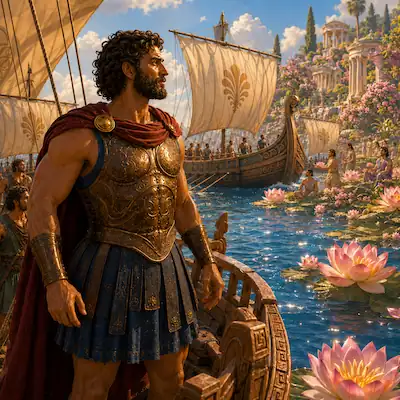
Odysseus and the Lotus Eaters is a Greek myth episode for children aged 7 to 11. This version is based on an episode from Homer’s Odyssey and has been retold in clear, child-friendly language with a focus on memory, temptation and the importance of remembering home.
In this retelling, Odysseus and his sailors reach a gentle island after storms at sea. Some of the crew taste the sweet lotus food and forget their journey, so Odysseus must act quickly to bring them back to the ship.
Story Details
- Independent Reading Age: 8 to 11
- Listen-Along Age: 7 to 11
- Reading Level: Middle elementary
- Reading Time: About 10 to 12 minutes
- Audio Length: About 12 minutes
- Author / Source: Based on an episode from Homer’s Odyssey, retold for Kooky Kids World
- Story Type: Greek myth episode
- Region / Origin: Ancient Greek literary tradition
- Main Characters: Odysseus, Odysseus’ sailors, the Lotus Eaters
- Moral / Themes: Remembering home, resisting temptation, leadership, loyalty, purpose
Listen Along
Listen along to this child-friendly Greek myth episode about Odysseus, the Lotus Eaters and the long journey home.
About This Retelling
This child-friendly retelling keeps the main shape and meaning of the Greek myth episode while using clear language for young readers. Stories from ancient epics can vary between translations, classrooms and retellings, so this version should be read as an introduction rather than the only version.
Odysseus and the Lotus Eaters Story
A Storm-Tossed Journey

Odysseus and his sailors longed for home. They had left the war behind them and set their faces toward Ithaca, the rocky island where Odysseus was king. Each man dreamed of familiar hills, warm doorways and the people waiting for him across the sea.
But the sea did not make the journey easy.
For many days, fierce winds drove the ships far from their path. Waves rose like dark hills. Rain stung the sailors’ faces. The men pulled at ropes, gripped the oars and shouted to one another over the roar of the storm.
Odysseus stood with them through wind and spray. He watched the sky, the sails and the restless water. He wanted to bring every ship safely home, but each storm pushed them farther from the course they knew.
At last, the wind grew tired. The clouds opened. Sunlight returned to the sea, and the sailors saw land ahead.
“An island!” cried one man.
The sailors cheered weakly. They were hungry, thirsty and worn out from the storm. Even Odysseus felt hope rise in his chest as the shore came nearer.
The Gentle Shore
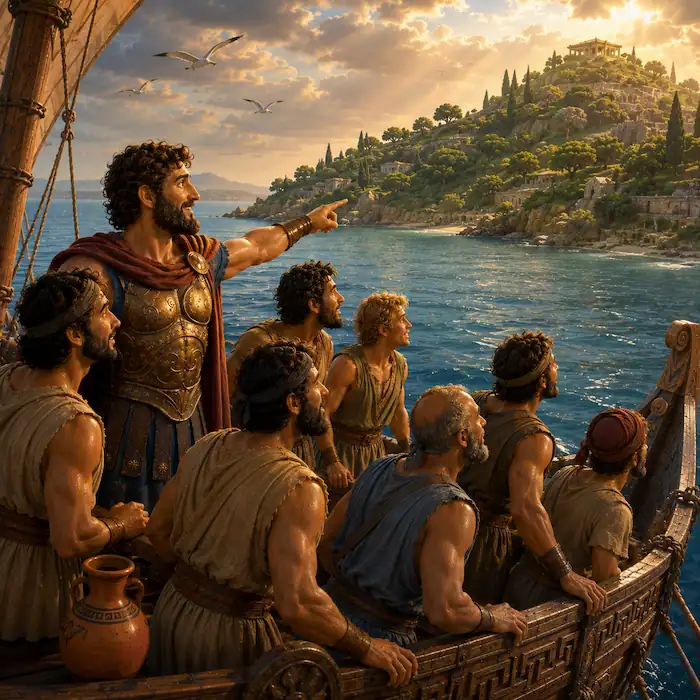
The island did not look dangerous. There were no high walls, no shouting warriors and no smoke from battle fires. Soft trees grew near the beach, warm air moved through the leaves, beyond the sand, the land seemed quiet and green.
Odysseus ordered the ships to anchor near the shore. The sailors climbed onto the beach, glad to feel solid ground beneath their feet. Some filled water jars. Others repaired ropes and checked the ships for damage.
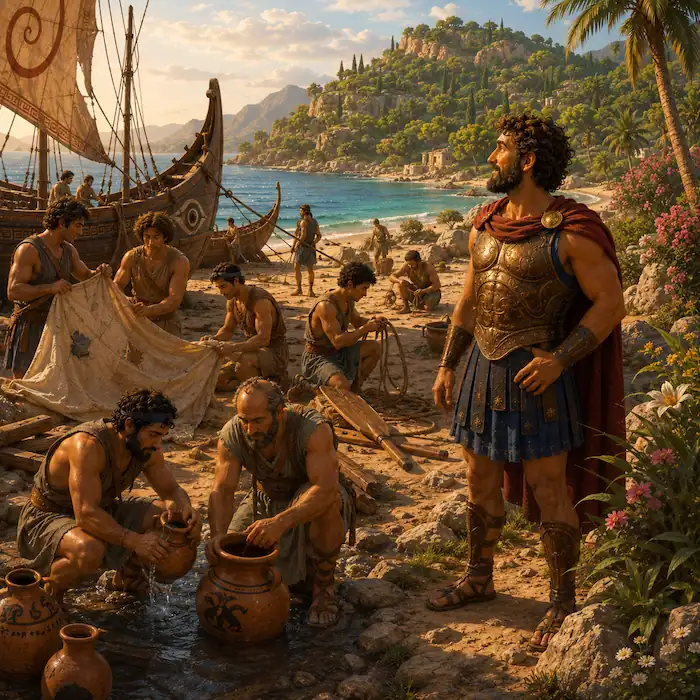
For a little while, the men rested in the sun.
“This place seems peaceful,” said a sailor.
“Peaceful places can still hide strange things,” Odysseus answered. He was glad for the rest, but he had learned not to trust a new land too quickly.
He chose three men to search the island and learn who lived there.
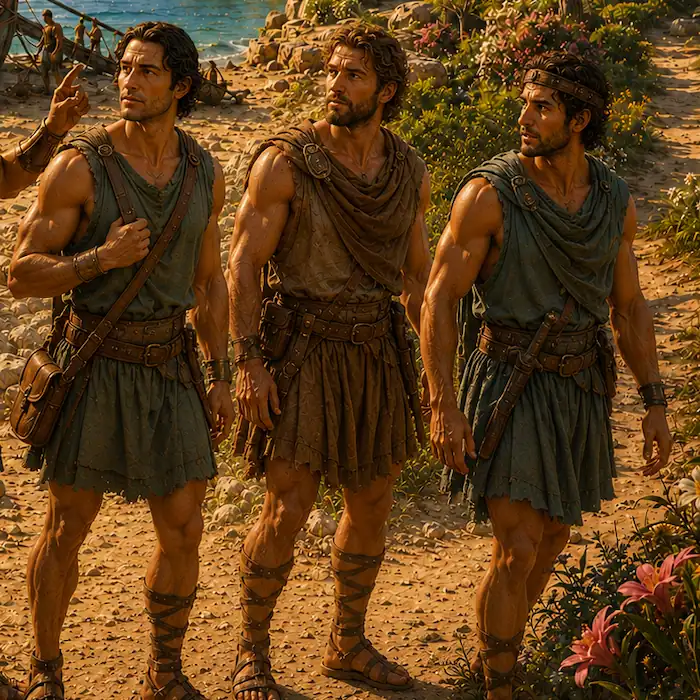
“Go carefully,” Odysseus told them. “Find out whether the people are friendly. Speak kindly, take nothing by force and return before the sun moves far.”
The three scouts nodded. They walked inland through the trees, leaving footprints in the pale sand behind them.
The People of the Lotus
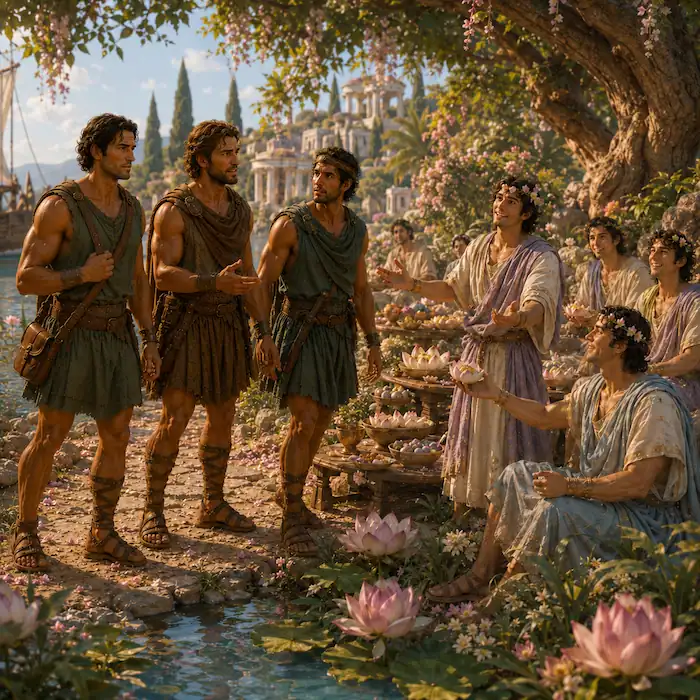
The scouts expected to find houses, fields or perhaps a village market. Instead, they found people sitting in the shade near flowering plants and low tables of food. These people did not carry weapons, shout or chase the strangers away.
They smiled.
“Welcome,” said one of the island people. “You have come from the sea. You must be tired.”
The scouts looked at one another. After the storm, the kind voices sounded like music.
“We are sailors,” one scout said. “Our leader is Odysseus. We are trying to return home.”
“Then rest,” said the islander. “Eat with us. Taste the lotus.”
The scouts saw pale sweet fruit and soft food made from the lotus plant. It smelled fresh and like honey. The island people ate it slowly, as if there were no hurry in all the world.
One scout hesitated. “Odysseus told us to return soon.”
“Soon can wait,” said another islander gently. “You have traveled far. Sit in the shade first.”
The scouts were tired. Their legs ached from the storm and their stomachs were empty. At last, they sat down and tasted the lotus food.
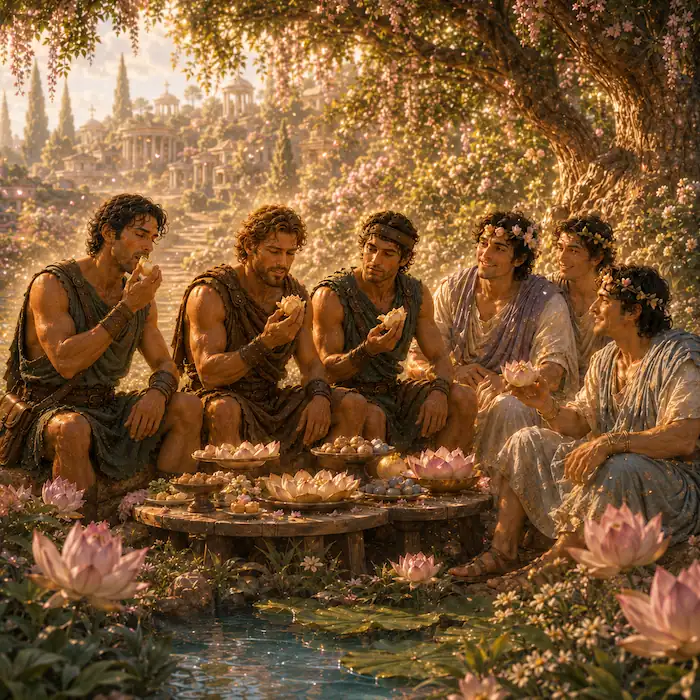
It was sweet.
Sweeter than they expected.
A warm, dreamy feeling spread through them. The shore, the ships and Odysseus’ instructions seemed to drift far away. The thought of Ithaca grew faint, like a song heard from the other side of a hill.
Forgetting the Way Home
The scouts stayed with the Lotus Eaters. They ate more of the sweet food and listened to the quiet voices around them. No one was cruel to them. No one locked them up. No one threatened them.
That was what made the danger so strange.
The scouts did not feel trapped. They felt comfortable and they forgot to be worried and alert. They forgot the ship waiting at the shore. They forgot the families and friends they had hoped to see again.
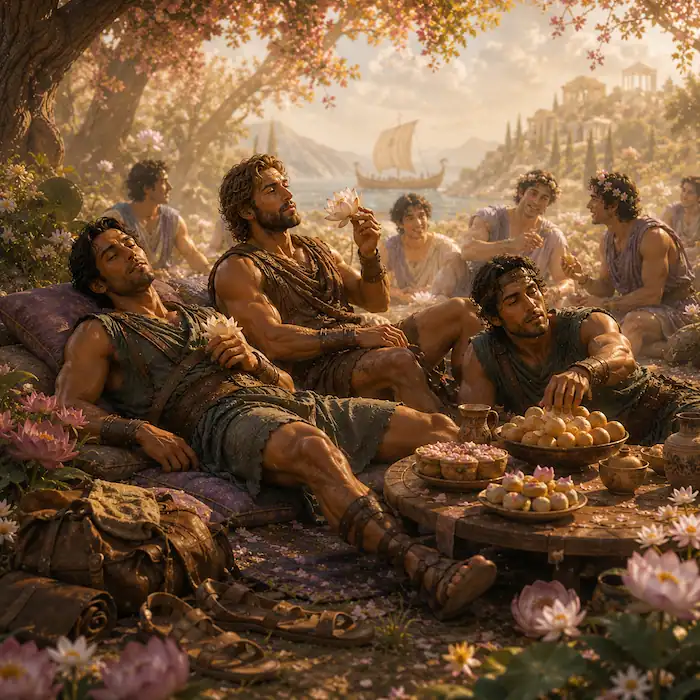
One scout leaned back under the shade and smiled sleepily. “Why should we hurry away?” he said.
Another nodded. “The sea is hard. The storms are fierce. Here there is food and rest.”
The third looked toward the path that led back to the beach. For a moment, something stirred in his memory. A ship. A captain. A home far away.
Then someone offered him another piece of lotus.
The memory faded.
“We can stay,” he said softly.
Back at the shore, Odysseus waited.
Odysseus Grows Worried
The sun climbed higher. The sailors finished filling the water jars. They patched a torn sail and checked the oars. Still, the three scouts did not return.
Odysseus watched the trees beyond the beach.
“They should be back by now,” he said.
“Perhaps the people are friendly,” said one sailor. “Perhaps they have been invited to eat.”
“Perhaps,” said Odysseus. But his face grew serious. “Or perhaps they have found trouble that does not look like trouble at first.”
He called several strong sailors to his side. “Come with me. We will find them.”
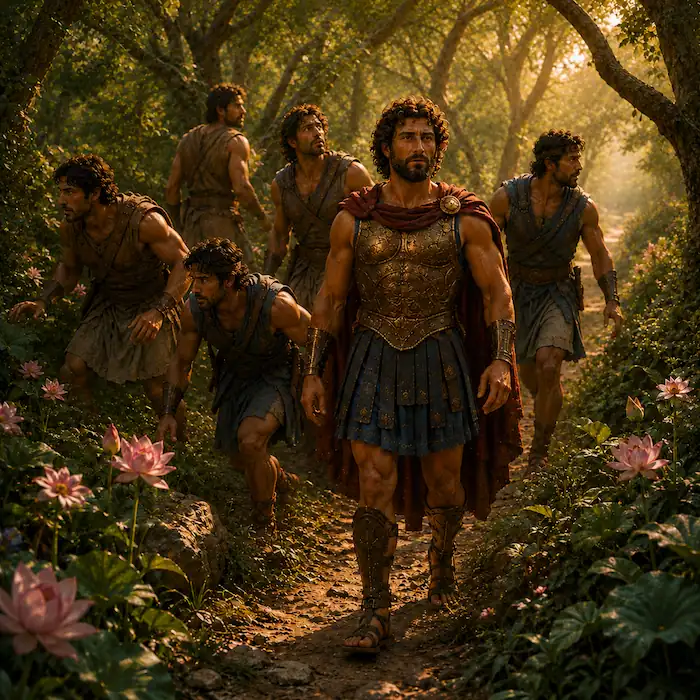
The men followed Odysseus inland. They did not draw swords or rush forward angrily. They moved with care, listening for voices among the trees.
Soon they saw the Lotus Eaters. The island people sat peacefully in the shade, offering food to the guests. Nearby were the three scouts.
Odysseus stopped.
His men were alive. They were not tied up. They were not hurt. Yet something was wrong.
The scouts looked at Odysseus as if they barely knew why he had come.
The Sweet Forgetfulness
“Friends,” Odysseus called. “It is time to return to the ship.”
One scout smiled dreamily. “Return? Why?”
Odysseus stepped closer. “Because we are sailing home.”
“Home,” the scout repeated. The word sounded strange in his mouth.
Another scout held out a piece of lotus food. “Taste this, Odysseus. Then you will not want to leave either.”
Odysseus looked at the food, then at his men’s faces. Their eyes were soft and far away. These were brave sailors who had crossed stormy seas, but now they spoke as if their journey did not matter.
Odysseus understood. The island’s danger was not a monster or a battle. It was forgetfulness. The lotus made travelers stop caring about the road home.
“No,” Odysseus said firmly. “I will not taste it.”
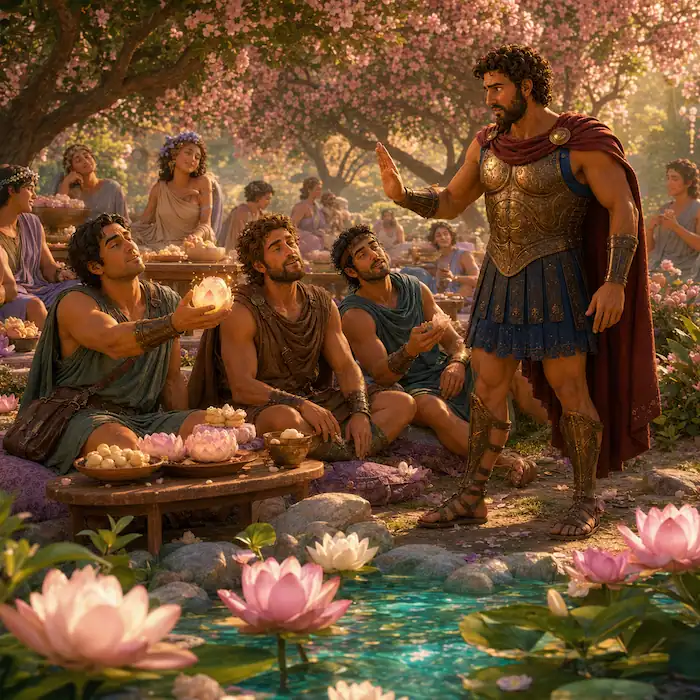
The Lotus Eaters did not attack him. They only watched with calm eyes.
“Let them stay,” one said. “They are happy here.”
Odysseus shook his head. “They have forgotten what they wanted. I have not.”
Back to the Ships
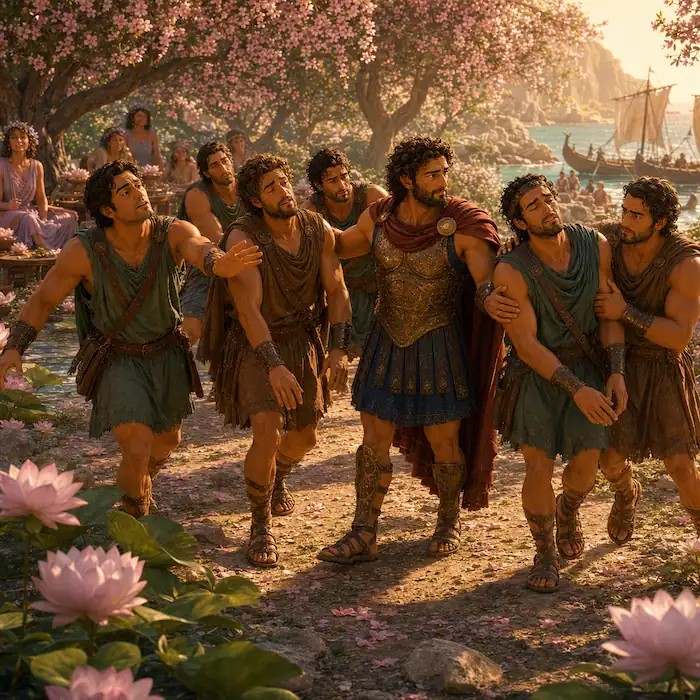
Odysseus took the first scout by the arm. “Come. You belong with your crew.”
The scout pulled back, not in anger but in confusion. “I do not want the ship. I want to stay here.”
The other two said the same. They spoke gently, but their words troubled every sailor who heard them.
Odysseus’ heart felt heavy. He did not want to drag his friends away from a place that seemed kind. Yet he knew the lotus had stolen their purpose. If he left them behind, they might never remember Ithaca again.
“We are going,” he said.
He ordered his sailors to help. Carefully but firmly, they led the three scouts away from the shade. The scouts begged to return. They looked back toward the lotus food and the quiet people beneath the trees.
“Please,” one said. “Let us stay.”
Odysseus did not let them go.
Step by step, he brought them down the path, through the trees and back to the bright beach. The waiting crew stared in surprise when they saw their friends being guided toward the ships.
“What happened?” a sailor asked.
“They tasted the lotus,” Odysseus said. “It made them forget home.”
A hush fell over the crew.
No One Else Must Taste It
The three scouts were brought aboard and settled safely on the ship. They still looked toward the island with longing. Their voices were quiet and sad.
“Just one more taste,” one murmured.
Odysseus turned to the rest of the crew. “No one else will go inland. No one will eat the lotus. We leave now.”
Some sailors glanced toward the green shore. After days of storms, the island looked restful. The thought of sweet food and shade tempted them.
Odysseus saw the temptation on their faces.
“That is why we must leave quickly,” he said. “A place can be dangerous even when it feels pleasant. If we forget home, we lose the very thing we have crossed the sea to find.”
The sailors understood. They pushed the ships from the shore. Oars dipped into the water and the sails were raised.
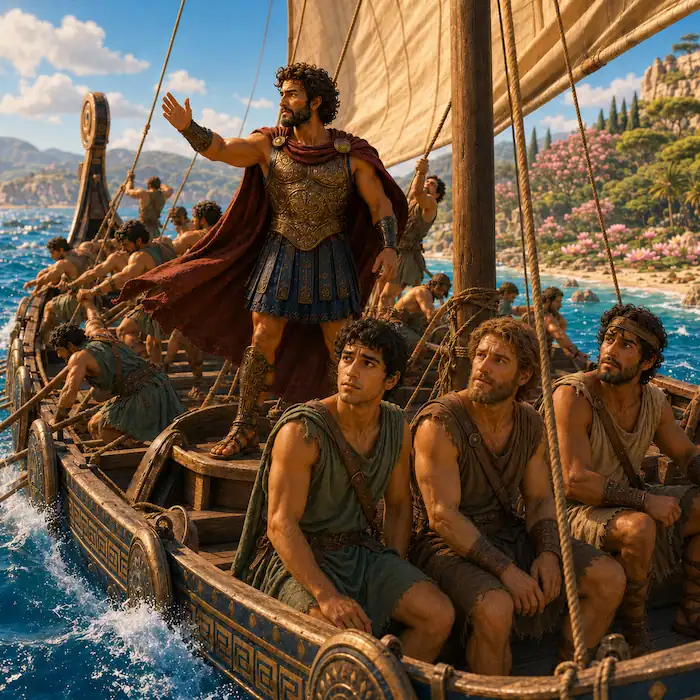
Slowly, the island of the Lotus Eaters began to slip behind them.
The three scouts sat quietly as the ship moved away. At first, they watched the shore with sorrow. Then the fresh sea wind touched their faces. The sound of the oars, the cry of gulls and the voices of their friends began to call them back to themselves.
One scout blinked and looked around. “Odysseus?”
“I am here,” said Odysseus.
“Were we going to stay?”
“You had forgotten the journey,” Odysseus answered. “But you are with us now.”
Remembering Ithaca

As the island faded into the blue distance, Odysseus stood at the stern and watched the water widen behind them.
The sailors rowed in silence for a while. Each man thought about the island. It had seemed gentle. It had offered rest, sweetness and peace. Yet it had almost taken away their memories of home.
At last, Odysseus spoke to the crew.
“We have many miles still to travel,” he said. “The sea may be hard, we may grow tired, but we must remember why we sail.”
The men looked toward the horizon. Somewhere beyond it lay Ithaca, with its rocky hills, bright doorways and waiting families.
The scouts, still ashamed of their forgetfulness, sat close to their friends. No one laughed at them. No one called them weak. Every sailor understood that longing for rest can be powerful when the journey has been long.
Odysseus gave the order to keep sailing.
The ships moved on over the shining sea. Behind them lay the land of the Lotus Eaters, quiet and green. Ahead lay danger, hope and the long road home.
This time, every man remembered where he was going.
Moral
Moral: Do not let comfort or temptation make you forget your home, your purpose or the people who count on you.
Short Summary
After storms drive Odysseus and his sailors off course, they land on the island of the Lotus Eaters. Three scouts taste the sweet lotus food and forget their journey home, wanting only to stay on the island. Odysseus refuses to abandon them, brings them back to the ship and orders the crew to sail away before anyone else forgets Ithaca.
More Stories
- The Lion and the Mouse: An Aesop fable linked to the Greek storytelling tradition, with a gentle lesson about kindness and help.
- The Tortoise and the Hare: A classic Aesop fable about patience, pride and steady effort.
- Hansel and Gretel: A well known tale where children must think carefully to find their way home.
- Rumpelstiltskin: A fairy tale about names, promises and using cleverness under pressure.
- Beauty and the Beast: A classic fairy tale that invites discussion about kindness, choices and looking beyond appearances.
- The Little Mermaid: A longer classic story for older children, with longing, choices and consequences.
- Stories from Around the World: A Kooky Kids World collection for browsing traditional tales, folk tales and world stories.
Main Characters
- Odysseus: A Greek hero and king of Ithaca who keeps his purpose clear and refuses to leave his sailors behind.
- Odysseus’ sailors: The crew traveling home with Odysseus after many storms and trials at sea.
- The three scouts: Sailors sent to explore the island who taste the lotus and forget their journey.
- The Lotus Eaters: Peaceful island people who offer lotus food that makes travelers forget home and want to stay.
Vocabulary Spotlight
- Lotus: A beautiful fragrant flower which you can eat. In this story the sweet food makes travelers forget their journey.
- Scout: A person sent ahead to look around and bring back information.
- Temptation: A strong pull toward something that may not be wise or safe.
- Purpose: The reason someone keeps going or works toward a goal.
- Ithaca: The island home of Odysseus in Greek myth.
- Shore: The land along the edge of the sea.
- Drift: To move slowly away, or to let thoughts become unclear.
- Loyalty: Staying faithful to people who trust and need you.
Discussion Questions
- Why were Odysseus and his sailors so glad to find land after the storms?
- What instructions did Odysseus give the three scouts before they went inland?
- How did the lotus food change what the scouts wanted?
- Why was the island dangerous even though the Lotus Eaters were not violent?
- Why did Odysseus refuse to taste the lotus himself?
- Was Odysseus right to bring the scouts back to the ship even though they wanted to stay? Explain your answer.
- What helped the scouts begin to remember themselves again?
- What can this story teach us about remembering our goals when something comfortable distracts us?
Classroom Activities for Children
- Journey Home Map: Children draw the ship, storm, lotus island and path back to sea. Add arrows to show the order of events and label the goal as Ithaca.
- Memory Anchor Craft: Children make a small paper anchor and write or draw three things that help them remember an important goal, such as family, schoolwork, friendship or kindness.
- Temptation and Purpose Sort: Give children cards with simple choices such as keep practicing, give up because it is hard, help a friend, forget a promise and take a rest then continue. Sort them into choices that help a purpose and choices that distract from it.
- Lotus Island Freeze Frame: In small groups, children create still pictures with their bodies for key scenes: storm at sea, scouts meeting the Lotus Eaters, Odysseus finding the scouts, returning to the ship and sailing away.
- Safe Shore Movement Game: Mark one side of the room as the ship and another as the island. Children move slowly like tired sailors, then respond to teacher prompts such as remember home by returning calmly to the ship.
- Story Sequence Oars: Children cut out paper oars, each with one event from the story. They place the oars in the correct order beside a drawn ship.
- Feelings Change Chart: Children track how the scouts might feel across the story: tired, welcomed, dreamy, forgetful, upset, confused and relieved. Discuss how feelings can change when people get help.
- Outdoor Focus Walk: If possible, take children outside for a short walk with a simple goal, such as finding three leaf shapes or listening for three natural sounds. Discuss how having a goal helps attention.
- Dialogue Practice: Pairs act out a short conversation between Odysseus and a scout who wants to stay. Encourage clear voices, respectful disagreement and child-safe emotion.
- Retell with Three Objects: Children choose or draw three objects from the story, such as a ship, lotus and anchor. They use the objects to retell the beginning, middle and ending in their own words.
Teachers’ Notes
- Best curriculum fit: Greek myths, classical literature introductions, myths and legends, journey stories, character choices, memory, temptation and goal-setting.
- Key learning themes: Remembering purpose, resisting temptation, leadership, loyalty, safe decision-making, home and perseverance.
- Before reading: Explain that this is one episode from a much longer ancient Greek story called the Odyssey. Tell children that the lotus food in this retelling makes people forget their journey, but the episode is not violent or scary.
- During reading: Pause when the scouts first taste the lotus. Ask children to predict why a sweet, pleasant thing might still cause a problem.
- After reading: Discuss why Odysseus does not leave the scouts behind. Invite children to think of safe everyday examples where someone might need help remembering an important goal.
- Cross-curricular links: Ancient Greece, map work around the Mediterranean, PSHE or SEL discussion about choices, drama, vocabulary, story sequencing and art.
- Teacher tip: Keep the discussion focused on memory, purpose and support from friends. Avoid framing the lotus as drugs in the child-facing lesson.
Why This Version Works for Children
This retelling keeps the core mythic plot: the storm-tossed arrival, the scouts meeting the Lotus Eaters, the sweet lotus food, the forgetfulness, Odysseus bringing the men back and the ships leaving quickly. It presents the danger as dreamy forgetfulness rather than anything frightening or graphic.
The episode works well for children aged 7 to 11 because the central problem is easy to understand: the sailors almost forget where they belong. Odysseus is shown as a loyal leader who acts firmly but kindly, which gives children a useful way to discuss help, responsibility and purpose.
What Parents and Teachers May Want to Know
The Lotus Eaters episode is one of the gentler episodes from the Odyssey, but it still involves temptation and forgetting home. This Kooky Kids World retelling avoids drug framing in the visible child story and describes the lotus as sweet fruit or food that makes travelers forget their journey.
Children who enjoy Greek myths, sea journeys and problem-solving stories may find this episode thoughtful rather than scary. It can be useful for discussing distraction, homesickness, perseverance and why friends sometimes need help making safe choices.
Story Background
Odysseus and the Lotus Eaters is based on an episode from Homer’s Odyssey, an ancient Greek epic poem about Odysseus’ long journey home after the Trojan War. In this episode, Odysseus’ crew reaches the land of the Lotus Eaters after being driven off course.
The story is part of the public-domain classical tradition and has been translated and retold many times. This page does not present an official or complete version of the Odyssey. It offers a child-friendly introduction to one episode, using cautious language and keeping the focus on the journey home.
Common themes in the episode include temptation, forgetfulness, loyalty, leadership and the need to remember one’s purpose even when rest and comfort feel very appealing.
Further Reading for Adults and Teachers
Adults and teachers who want to compare this child-friendly retelling with a public-domain source may use Project Gutenberg’s edition of The Odyssey by Homer. The Lotus Eaters episode appears in Book 9. Teachers should preview older translations before sharing them with children because the language and framing may need adult guidance.
Frequently Asked Questions About Odysseus and the Lotus Eaters
-
Is Odysseus and the Lotus Eaters a Greek myth?
Yes. This story is based on an episode from Homer’s Odyssey, an ancient Greek epic poem. It is commonly retold as a Greek myth episode for children and students.
-
Who are the Lotus Eaters?
The Lotus Eaters are people Odysseus and his sailors meet on an island during the journey home. In this retelling, they peacefully offer sweet lotus food that makes travelers forget their home and voyage.
-
What happens when the sailors eat the lotus?
The sailors forget their journey and no longer want to return to the ship. They feel comfortable on the island and want to stay with the Lotus Eaters.
-
Why does Odysseus make the sailors leave?
Odysseus knows the scouts have forgotten their real goal of returning home. He brings them back to the ship because he refuses to abandon them or let the rest of the crew forget Ithaca.
-
Is this episode scary for children?
This retelling is gentle compared with many other Odyssey episodes. It includes storms, temptation and forgetfulness, but no scary violence.
-
What is the moral of Odysseus and the Lotus Eaters?
The story shows that comfort and temptation can make people forget their purpose, so it is important to remember home, responsibilities and the people who count on us.
-
Is this version suitable for children?
This retelling is written for children aged about 7 to 11. It keeps the meaning of the myth episode while using child-friendly language and avoiding adult framing of the lotus.
-
Is audio available for this story?
Yes. This draft includes a listen-along audio file for Odysseus and the Lotus Eaters.
Copyright Notice
This story is based on a traditional or public-domain myth episode. This Kooky Kids World retelling, page text, audio narration, illustrations and supporting educational materials are © Kooky Kids World. They may not be copied, republished or reused without permission.