


The Story of the Light Princess
Once Upon a Time…
Once upon a time, in a Scottish kingdom, a king and queen longed for a child. At first, no baby arrived. The king huffed and puffed about it, but the queen told him to be patient.
At last, a daughter was born—a little princess with hair like morning sunshine and eyes as blue as lake water.

Everyone prepared for a grand christening. Trumpets blared. Cakes towered. Lanterns bloomed like glowing flowers. The king proudly wrote the invitations himself. Dukes, duchesses, doctors, dancers and even the head chef’s cat were invited.
However, one person had been forgotten—the king’s own sister, Princess Makemnoit.
Princess Makemnoit lived in a dusty house on the far side of the city. She had clever hands and an even cleverer mind. Sadly, she used both to make trouble. Her little eyes flashed blue when she was angry, pink when she was pleased, and green when she hated someone. She hated a great many people.
When the christening bells rang, she swept into the palace in her best gown and took her place by the silver font. Her eyes glowed pink, for she was delighted with the mischief she was about to cause. As the holy water touched the baby’s brow, the princess spun three times and whispered, loud enough for the nurse to hear:
“Light of spirit, light of bone,
Light of body—every stone.
Never weary human art—
Only crush thy parents’ heart.”
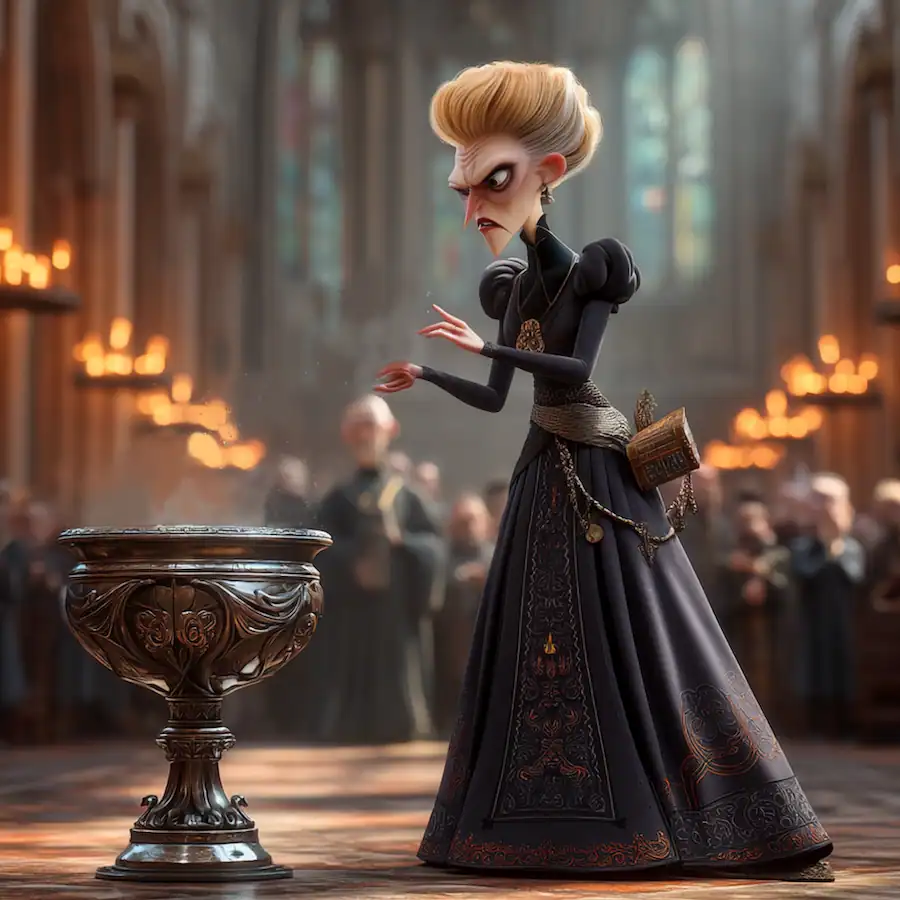
The court thought it was a silly rhyme. The baby thought it was hilarious. She laughed and laughed—so much that the nurse squeaked in alarm, for the baby’s weight had vanished from her arms.
The baby floated.
A Princess Without Gravity

From that moment, the little princess had no gravity. She weighed nothing at all. If anyone lifted her up, she drifted to the ceiling like a dandelion seed.
The servants fetched the tall throne-steps and even the fireplace tongs to bring her down. They learned to keep the windows shut and to hold tight.
Downstairs, the cooks and maids adored her. They played catch with the giggling princess, very gently of course so she would never be hurt. She was the best “ball” in the kingdom.

But upstairs, the king and queen worried. The king fretted about science. The queen worried about safety. Worse yet, the princess laughed at everything—storms, speeches, scoldings, and serious news.
Her laugh sparkled like bells, yet it carried no kindness. She did not yet know how to feel sorry for anyone, not even herself.
“Can nothing be done?” asked the king.
“Perhaps an apology to your sister?” said the queen.
The king apologised, hat in hand. His sister smiled without smiling. Her eyes shone pink again, enjoying the trick she had played, though she said, “I know nothing about curses,” with false innocence.
So, the king brought in two famous scholars—Hum-Drum and Kopy-Keck.
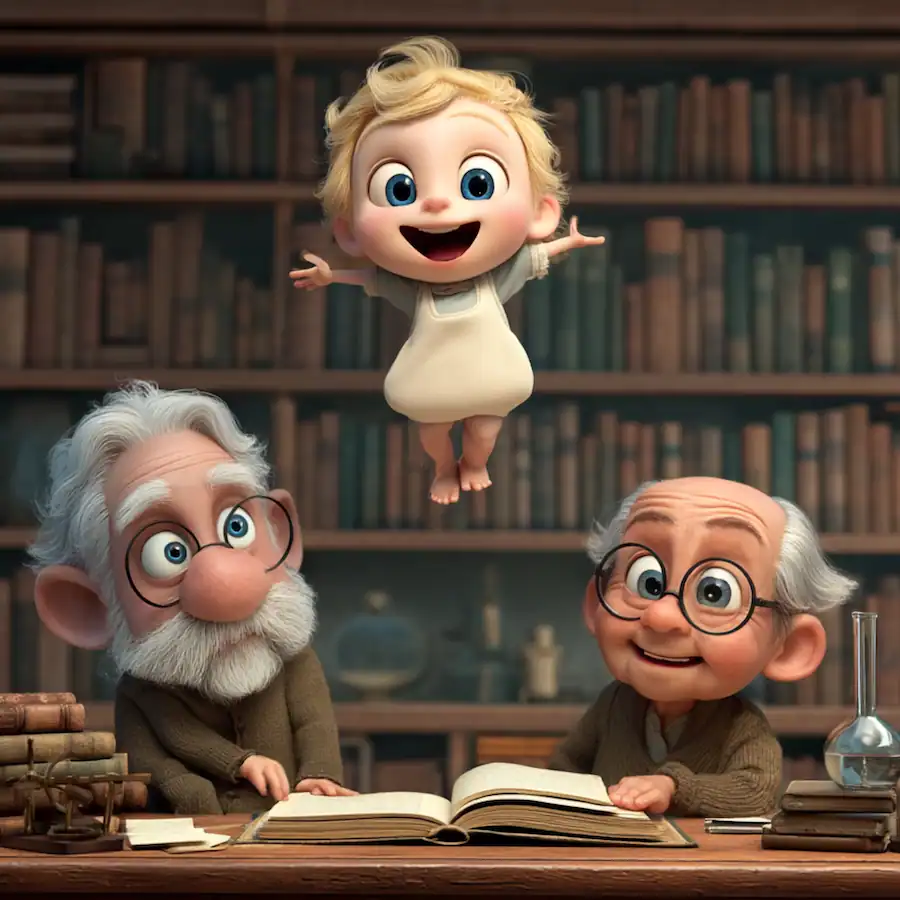
One believed everything was made of matter. The other believed everything was made of mind. They argued for hours. Hum-Drum suggested upside-down heart pumps. Kopy-Keck suggested piles of schoolwork, from dinosaur bones to music scales.
Neither plan helped. The princess stayed weightless and cheerful and very very hard to keep on the floor.
The Lake That Gave Her Weight
One summer evening, the royal family sailed on the kingdom’s great lake. It was smooth as glass, silver as moonlight, and wide as a dream. The princess reached for another boat, missed, and—plop!—fell into the water. Everyone screamed. She had never gone down before.
Then they heard her laugh—like a bright bell across the water. She popped up, swimming like a swan.
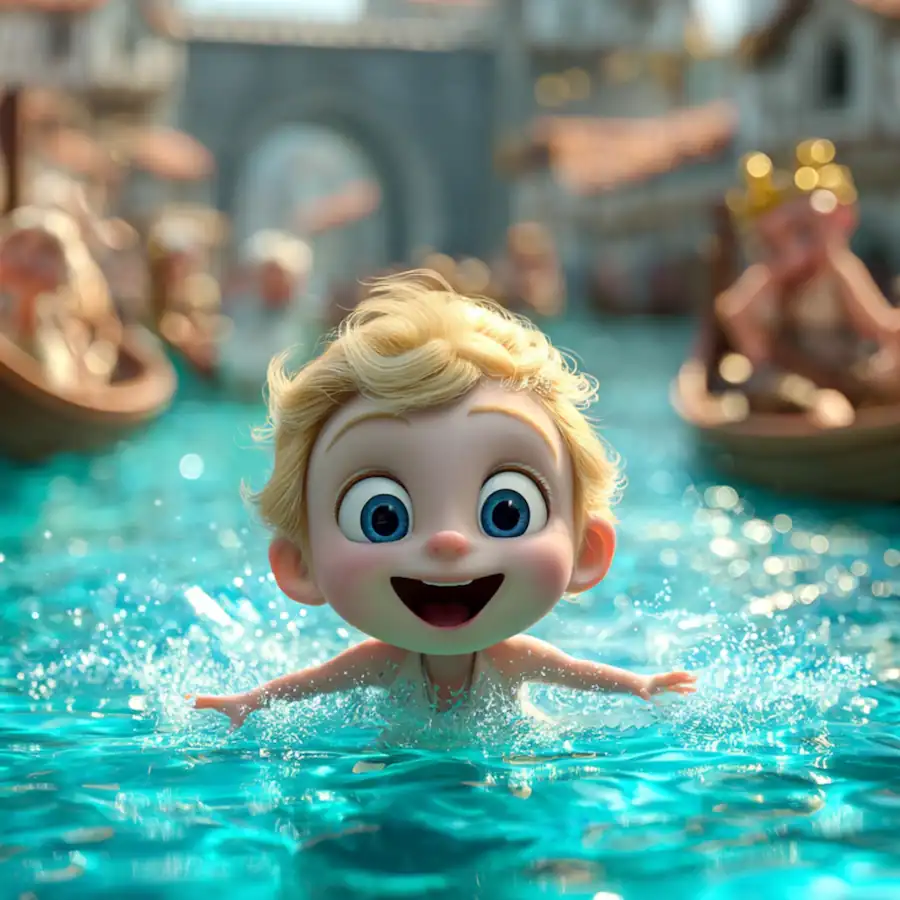
In the lake, the princess had gravity again. Water welcomed her. She could dive and float and splash and kick.
As she got older, she learned flips and underwater races. She felt calm there and no longer laughed at everything, and when she did laugh, her laugh carried kindness. From that night, she loved the lake more than castles, parties, and pastries.

The scholars argued again. “Bury her in earth!” said one. “Water helps; earth will cure!” The king firmly refused. Instead, he ordered silk cords and noble handlers whenever the princess walked outside. The princess bore it for a while but she escaped to the water whenever she could.
The Prince Who Fell In
Far away, a young prince travelled the world. He was brave, polite, and very particular. He met many princesses, yet none felt exactly right.
One twilight, while walking through a wood, he heard a sound across a lake. The sound was half laughter and half something else. He saw a white shape on the water and, without thinking twice, leapt in.
He swam to help, lifted the figure to shore, and—whoosh!—the girl shot up through the air like a feather. She caught a fir-cone, then another, then another, and climbed down looking cross and glowing.
“You naughty man!” she cried. “You threw me to the bottom of the air!”
The prince blinked. “Pardon me. I thought you were drowning.”
“I was swimming,” she said. “Now put me back.”
He carried her to a high rock, and together they leapt. They sliced into the water with a splash as grand as fireworks. When they rose, she grinned. “That, sir, is what I call falling in.”
“Then I am delighted to keep falling,” said the prince, who had already fallen—in love.

Night after night, they met to swim beneath the moon. In the lake, the princess teased less and listened more. On land, she laughed at love as if it were a riddle. In water, her voice softened. The prince thought, “If we marry, perhaps we’ll live by the sea and swim every day. I would be happy like that.”

The Lake Begins to Die
Then, one night, the princess noticed something dreadful. She dived, came up, dived again, and frowned. “The lake feels shallower,” she whispered.
Next day she checked rocks, reeds, and waterlines. She marked the shore with little painted notches. Day by day, the lake was shrinking!
Grass withered. The white stones warmed. Fish flopped in shrinking pools. The princess grew pale. Her steps on land felt heavier; her heart felt emptier. The lake was her joy and her anchor. Now it thinned and thinned, as if it were her very soul drying out.
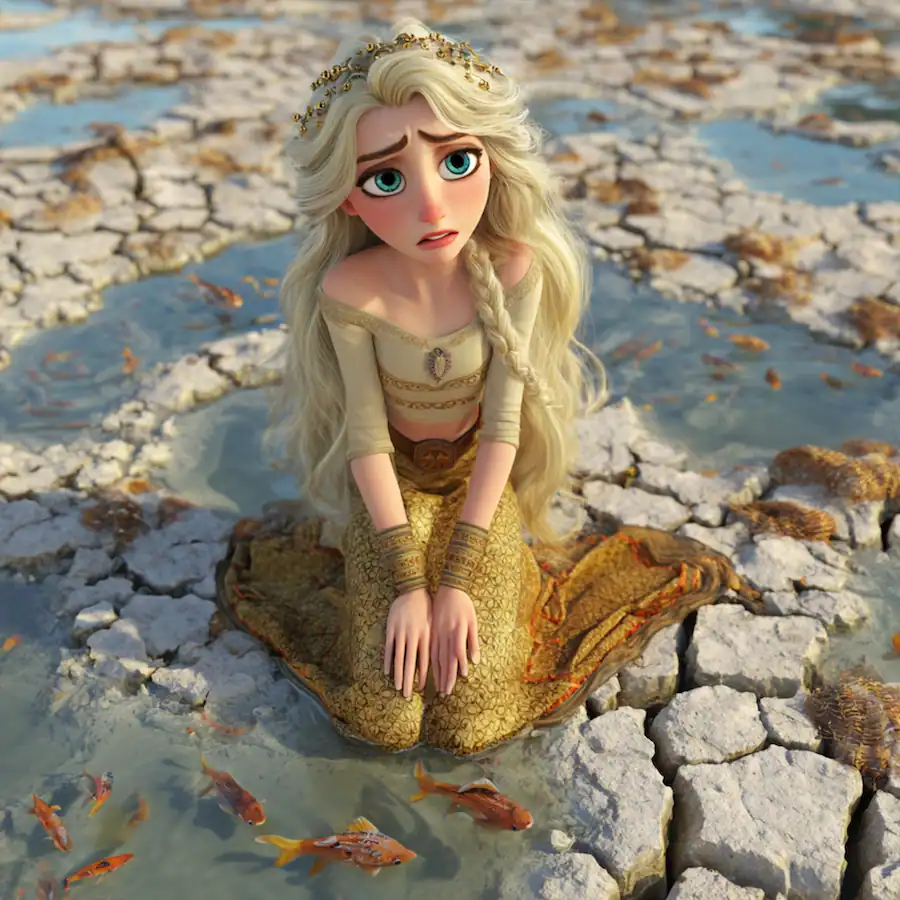
What caused this? Hidden in the deepest cellar, Princess Makemnoit had set a secret plan in motion. With a hiss and a spell and a horrible white serpent, she had opened a tiny drain far beneath the lakebed. Her eyes glowed pink with wicked delight as the water gurgled away, for nothing gave her greater joy than spoiling what her brother and his family loved.
The king offered a grand reward to anyone who could stop the lake draining. The scholars measured. The divers searched but no one found the answer. The lake shrank to several dark basins, deep as wells and ringed with mud.
At last, some children found a gold plate at the very centre of the lake. On it, ancient writing said:
“Death alone from death can save.
Love is death, and so is brave.
Love can fill the deepest grave.
Love lives on beneath the wave.”

On the back, there were instructions. Only one thing can stop the flow—a living person, freely given, must block the hole with their own body until the lake refills.
The court fell silent. The king looked at his boots. The courtiers looked at the floor. No one stepped forward.
At last, a voice broke the silence.
“Here I Am,” Said the Prince
The prince had been away seeking wisdom in the forest. When he returned and heard the prophecy, he didn’t pace. He didn’t sigh. He presented himself to the court and told the King, “If no-one goes, she will die, and life without her would be less than a shadow. I will go, but on one condition,” said the prince calmly. “While I sit in the hole, the princess must be with me. She must feed me, and—now and then—look at me.”

The king agreed at once.
They found the hole in the centre of the deep pool. It was a neat, three-cornered mouth in a broad stone. The guards placed a little boat with a canopy and soft cushions nearby. They carried the princess to it. She covered her face at the sight of the dying waters.
The prince slid down into the sharp hole, sat, and clapped his hands over the remaining gaps. Cold crept into his bones. Little waves licked his knees.
“You may go,” said the princess lazily to the attendants.
The prince began to sing in a low voice about worlds without water and hearts without love. His voice wavered. He stopped. Hours passed. The water rose from ankles to knees to waist. He grew light-headed with hunger.
“Princess?” he said.
“I’m afloat!” she cried, brightening. “How lovely!” Then, as if remembering, she leaned over with a biscuit and a cup.
“You must feed me,” he whispered. “I can’t move my hands.” So she did—slow crumbs, small sips. Now and then, he kissed her fingers. She didn’t pull away.
“Please look at me,” he said. “Just now and then. It helps.”
“Very well,” she said, and to her own surprise, she did. She watched him as the moon rose and the water climbed.
Once she asked, “Why don’t we swim?”
He smiled. “I shall never swim again.”
The water reached his chest, then his neck. “Will you kiss me?” he asked softly.
“Yes,” she said, and kissed him sweetly and coolly, like a promise.
The water touched his lips, his nostrils. He held his breath. His head tipped back. His last bubbles rose like pearls and broke.
The princess’s eyes went wild. With a cry, she leapt into the pool.
She grabbed one leg and tugged. It stuck. She dove again, hair streaming, and pulled with all her strength. The leg came free. Then the other.

She heaved him into the boat and rowed straight to the palace steps. The prince lay like a winter tree. The old nurse worked with the princess all night—rubbing, warming, hoping he would recover.
At sunrise, the prince opened his eyes.
Rain Like Jewels, Tears Like Grace
The princess burst into tears. She had never cried in her life. Now she couldn’t stop. Her sobs fell like rivers.
Outside, as if the sky learned from her heart, rain poured down while the sun still shone. Red, blue, and green drops lit the air. The lake brimmed from shore to shore. Fountains woke up with a laugh. Babies all over the kingdom yawned and smiled.
In her hidden cellar, Princess Makemnoit’s eyes flashed blue with anger as she realised the lake was filling once more.
Inside, something else happened. The princess tried to stand and toppled over. She tried again and bumped her knee.
“My darling!” shouted the old nurse, delighted. “You’ve found your gravity!”
The prince sat up and grinned. “Then so have I.”
Her tears unlocked the spell.
The princess rubbed her elbow and said, “Gravity is awfully poky. It hurts!”
“Sometimes,” the prince said, lifting her as if she were small again. “But this kind is wonderful.” He held her close. “This kind is love.”
She smiled and gave him one kiss for all his patience. After that, whenever she grumbled about tripping or bruising, he jumped with her into the lake, and they made a splash as big as a house. The roof of the secret cavern wore thin from the strong, happy water, and the lake grew deeper than before.
As for Princess Makemnoit, her own house collapsed into the hungry earth one stormy night. Her eyes flashed green with hatred in their final moment, burning until the ground swallowed her whole. No one ever found her body. The lake never emptied again.
A Royal Wedding with Both Feet on the Ground
The prince and princess became engaged. Yet before the wedding, the princess needed to learn to walk properly. It took time. She wobbled, tripped, and giggled. She bruised her shins and bumped her head.
She huffed, “Why does the ground insist on meeting me so quickly?”
“Because it’s very glad to have you,” said the prince, offering his arm.
Step by brave step, she learned. She learned to stand through a whole speech. She learned to kneel without floating. She learned to dance without drifting. Most of all, she learned to feel the weight of her own heart.
The day they married, the bells rang like waterfalls. The people cheered. Children waved lake-blue ribbons.

The princess walked down the aisle—not perfectly, not gracefully, but honestly, with both feet on the ground and a smile that reached her eyes. When the vows were spoken, she reached for the prince’s steady hand. He squeezed back. Then, after the feast, they ran to the lake in full wedding clothes and leapt together into the shining water.
In time, they had children—bright boys and girls who never lost even a pinch of their proper gravity, no matter how high they jumped or how hard they laughed.

Get Dylan’s First Adventure
Join the dancing fun! Grab your free copy of Dylan’s school debut.
Send My CopyCheck your email (and junk folder).
