The Lady of the Lake at Llyn y Fan Fach is a traditional Welsh folktale adapted for children aged 6–12 (Best for independent readers aged 8–12). In this child-friendly retelling, a young farmer falls in love with a mysterious woman from the lake, but their happiness depends on a promise he must never break. Set in the Black Mountains of Wales, this legend explores love, loss, magic, and the lasting power of healing knowledge.
- Independent Reading Age: 8–12 years
- Reading Level: Upper Elementary / Middle Grade (Grades 3–6)
- Reading Time: 10–12 minutes
- Best for: Welsh folklore, classroom myths and legends, cultural heritage studies
- Author / Source: Traditional Welsh Folktale (The Mabinogion era influences)
- Story Type: Legend / Mythology
- Region / Origin: Llyn y Fan Fach, Carmarthenshire, Wales
- Main Characters: Gwyn (farmer), Nelferch (Lady of the Lake), their three sons.
- Moral / Themes: Integrity, promises, the legacy of healing.
The Story of The Lady of the Lake at Llyn y Fan Fach
The Mysterious Waters of the Black Mountains
Long ago in the green hills of Wales nestled in the shadow of the Black Mountains, lay a deep and mysterious lake called Llyn y Fan Fach. The people of the nearby village whispered stories of strange happenings on its shores, but few dared to venture too close. They spoke of a mystical being; the Lady of the Lake, a figure of beauty and enchantment who was said to appear under the moonlit sky.
One such villager was a kind-hearted young man named Gwyn who often took his sheep to graze near the lake. He was an honest and hardworking farmer, though he often felt lonely up on the hills. One evening, as the sun dipped below the hills, Gwyn sat by the water’s edge when he saw something that made him gasp.
The First Glimpse of Nelferch
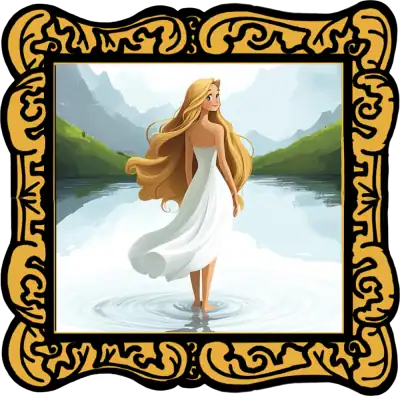
A woman unlike any he had ever seen before stood on the lake’s surface. She was breathtakingly beautiful with long golden hair flowing like sunlight on water and eyes as deep and clear as the lake itself. Her gown shimmered like woven mist and she moved as if floating on air.
Gwyn’s heart pounded. Summoning his courage he called out, “Are you the Lady of the Lake?”
The woman smiled but did not answer. Instead she turned and walked across the water, disappearing into the mist.
The Secret of the Perfect Loaf
The next evening Gwyn couldn’t think of anything but the mysterious woman, so he returned to the lake. This time he brought freshly baked bread from his mother’s kitchen. When the Lady of the Lake appeared again he offered her the bread. She looked at the it, then shook her head gently and vanished.
Determined, Gwyn returned a third time. This time he rose before the sun, lighting a fire in the hearth while the village still slept. He carefully mixed the flour, water and yeast, kneading the dough with gentle hands. He made sure to leave out the salt as he had heard whispers of fairy folk disliking it. As the dough baked, its warm scent filled his small home and Gwyn felt a quiet sense of hope. He wrapped the loaf carefully before making his way back to the lake.
When the Lady of the Lake appeared, she took the bread from his hands and smiled. “You have chosen wisely,” she said in a voice as soft as the wind through the reeds.
The Sacred Promise of Iron
“My name is Nelferch. If you truly wish for my hand you must promise me one thing. You must never let me touch iron, not once, not twice, nor thrice, or I will return to the lake forever.”
Gwyn was eager to have such a wonderful wife and readily agreed. “I swear it,” he promised.
She took a step closer, her expression serious. “You must understand, iron wounds my kind. It burns us as fire burns you. Even the smallest touch causes pain.”
Gwyn was filled with love and determination and vowed to always protect her from iron.
A Marriage Blessed with Lake Magic
Nelferch stepped onto the land and they were married. As a wedding gift she brought with her three cows, three sheep and three magical horses. These made Gwyn’s farm the richest in the valley. Their happiness flourished and they had three strong sons, each wise beyond their years.
Nelferch’s presence filled their home and village with enchantment. The crops grew stronger, the animals thrived and fortune smiled upon their family. She would sing to the cattle and they would give the richest milk said to have healing properties. Her children were blessed with wisdom beyond their years, able to learn and understand things faster than any other children in the village.
Nelferch was unlike any woman the villagers had ever known. She moved with an effortless grace as though she still carried the essence of the water within her. Her touch could calm restless animals and even the most stubborn oxen obeyed her gentle voice. The villagers grew to trust Nelferch’s wisdom and regularly sought her advice. When a child fell ill or the crops withered, she always knew what to do.
The Wisdom of the Mother
As the years passed, her influence in the village grew. Women would come to her, asking for remedies and men sought her advice on when to plant their fields. She was generous with her knowledge, teaching not only her own children but others who wished to learn the ways of healing and the land.
Yet, despite her happiness, there were moments when Nelferch would gaze toward the lake with a faraway look, her eyes filled with longing. Gwyn would sometimes catch her like this and feel a pang of fear. Though he had won her love, the Lady of the Lake could never fully leave behind the waters of her home.
She often walked in the hills near the lake, gathering herbs and whispering to the wind. She taught her sons the art of healing, how to mix remedies and how to read the skies for signs of weather shifts. Her knowledge seemed endless, passed down from a time older than the village itself. Villagers often sought her wisdom and her sons became apprentices, helping those in need.
The Three Fateful Accidents
Fate, however, is not so easily outrun.
The first time Gwyn broke his promise was during an autumn evening. He was in a hurry, trying to mend a broken gate before the winter storms arrived. As he handed Nelferch a tool, his hand slipped and the iron brushed her fingers. She flinched but she said nothing and looked at Gwyn with sorrowful eyes before returning to the house.
The second time, during a village festival Gwyn playfully tapped her shoulder with the iron tip of his riding crop. He had meant it in jest, but Nelferch froze. Though she did not speak she looked shocked, her smile faded and she turned away spending the rest of the evening in silence.
The third and final time came on a fateful spring morning. The family was preparing for market day and Gwyn was saddling his horse. As Nelferch stood beside him, he turned to adjust the straps and without meaning to brushed her arm with the iron buckle.
Nelferch let out a soft gasp and took a step back.“ Gwyn, you broke the promise,” she whispered.
Gwyn’s heart sank. “No! It was an accident—I didn’t mean to!”
Tears filled Nelferch’s eyes as she shook her head. “It does not matter. The old laws cannot be undone.”
The Return to the Depths
Before Gwyn could reach for her she turned and ran towards the lake. He called out, begging her to stay but she did not stop.
As she ran, she called each of the animals’ names one by one. The cows, sheep and horses stopped what they were doing and followed her one by one.
The moment her feet touched the water she faded into the mist. Every one of the animals she had brought with her followed into the lake and vanished beneath the surface.
The Legacy of the Physicians of Myddfai
Heartbroken, Gwyn watched as his beloved disappeared, taking her magic and her gifts with her.
The village mourned her loss. Even the cattle seemed restless and the fields felt emptier without her presence. The villagers whispered of how fate had taken back its gift and how the fairy world would never let one of its own remain among mortals forever.
Yet, though she was gone, she did not abandon her children. Whenever they wandered near the lake she would appear to them, teaching them great knowledge of healing and wisdom. The three sons grew to be the Physicians of Myddfai, famed across all Wales for their skills in medicine. They carried their mother’s knowledge into the world and through them, her magic never faded.
A Legacy That Lived On
And so, the legend of the Lady of Lake lived on, whispered in the valleys and carried by the wind across the hills, a tale of love, loss and the echoes of an undying past.
Moral
Promises must be honoured. This Welsh legend explores the weight of integrity and the consequences of carelessness. It reminds us that trust is a fragile gift; even when an injury is accidental, the damage to a promise can be permanent. It also teaches that even in loss, a legacy of knowledge can continue to heal others.
Vocabulary Spotlight
Enchanting – magically charming or captivating.
Prosperity – a state of being successful, especially with money or food.
Remedies – medicines or treatments used to cure illnesses.
Flinched – a sudden small movement made in reaction to pain or surprise.
Legacy – something handed down from the past, such as a tradition or knowledge.
Physician – an old-fashioned word for a doctor or healer.
Teachers Note
The Lady of the Lake is a perfect “anchor text” for teaching the difference between a Fairy Tale and a Legend. While it contains magical elements, it is tied to a specific geographical location (Llyn y Fan Fach) and a real historical lineage (The Physicians of Myddfai). This provides an excellent opportunity to discuss how folklore preserves local history and environmental knowledge.
This version has been carefully adapted for modern classrooms by replacing the ’causeless blows’ with the ‘iron taboo’ found in wider Celtic mythology. This allows educators to discuss the weight of promises and the fragility of trust without introducing themes of physical violence, making it a safer and more inclusive resource for primary-aged children.

Get Dylan’s First Adventure
Join the dancing fun! Grab your free copy of Dylan’s school debut.
Send My CopyCheck your email (and junk folder).
Parent and Teacher Discussion Questions
-
Gwyn had to bake three different loaves of bread. What does this tell us about his character and his determination?
-
Why was iron so dangerous to Nelferch? What might iron represent in a world of nature and magic?
-
The story says Gwyn broke the promise by accident. Does it matter that he didn’t mean to do it? Why or why not?
-
How did the sons use the “loss” of their mother to help the rest of Wales?
Classroom activities
-
Mapping the Legend: Locate Llyn y Fan Fach on a map of Wales. Research the Black Mountains and describe the terrain.
-
The Physicians’ Herb Garden: Research common herbs used in traditional Welsh healing (like Mint, Lavender, or Comfrey) and create an “Illustrated Remedy Book.”
-
The Three Warnings: Create a storyboard showing the three times Gwyn accidentally touched Nelferch with iron. Discuss how the tension builds each time.
-
Creative Writing: Write a letter from one of the sons to their mother, the Lady of the Lake, telling her about a person they healed using her knowledge.
-
Objective: To explore the symbolic meaning of the “Iron Touch.”
-
Categorize: Give the students a list of items (A wooden spoon, an iron nail, a bundle of herbs, a steel buckle, a leather strap).
-
Sort: Which items belong to Nelferch’s world (Nature/Lake) and which belong to Gwyn’s world (Industry/Farm)?
-
Reflect: Ask the children: “If you had a secret rule that someone kept breaking by accident, how would you feel? Would you stay or would you leave?”
-
Purpose: This builds Empathy and Critical Thinking, moving the story beyond a simple plot into a lesson on social-emotional intelligence.
-
More Welsh Stories
-
The Tale of Gelert – A heartbreaking story of a loyal dog and a tragic mistake.
- The Fairies Harp – explores kindness, music and using gifts wisely
-
Cantre’r Gwaelod – The “Atlantis of Wales” and the danger of a forgotten gate.
Dive deeper into Welsh myths in Welsh Folktales and Their Importance.
Meet another watery hero in Legend of Tír na nÓg.
To find out more about Welsh folktales at the National Library of Wales.
Stories with similar themes
Legend of Tír na nÓg explores love, enchantment and the sadness of leaving one world for another.
The Children of Lir Irish folktale that explores sorrow, transformation and endurance.
The Little Mermaid explores longing, sacrifice and life between two worlds.
History of The Lady of the Lake at Llyn y Fan Fach
The legend of the Lady of the Lake is inextricably linked to the Physicians of Myddfai, a real lineage of herbalists who served the Welsh princes for centuries. The earliest written version of this tale appears in the 13th-century “Red Book of Hergest.” Historians believe the story serves as a foundation myth for the medical expertise of the Myddfai region, blending supernatural origins with practical herbalism. You can explore more about the historical Physicians of Myddfai at the National Library of Wales.
While the Lady of the Lake is a local Carmarthenshire legend, her children’s medical legacy is preserved in the Red Book of Hergest—the same 14th-century manuscript that contains the world-famous stories of the Mabinogion
Frequently Asked Questions the about Lady of the Lake at Llyn y Fan Fach
-
Is she the same as the Lady of the Lake from King Arthur?
No. While they share a name, the Lady of Llyn y Fan Fach is a unique Welsh legend. The Arthurian Lady is linked to Excalibur, while our Lady is the mother of the famous Physicians of Myddfai and represents the ancient healing traditions of Wales.
-
What are the "Three Strikes" in the legend?
The legend centers on a broken contract. Nelferch warns Gwyn that if he touches her three times with iron (or gives her three "causeless blows"), she must return to the lake. These "strikes" usually happen by accident at happy events, a wedding, a christening, and a funeral showing how easily humans forget to respect magical boundaries.
-
What real places are named in the legend?
The story is deeply rooted in the landscape of the Bannau Brycheiniog (Brecon Beacons). Key locations include:
-
Llyn y Fan Fach: The actual glacial lake where she appeared.
-
Esgair Llaethdy: This means "Ridge of the Dairy," named because it is where her magical lake-cows were said to graze.
-
Myddfai: The village where her sons lived and practiced medicine.
-
-
Were the Physicians of Myddfai real people?
Yes! While their origin story is a legend, the Physicians of Myddfai were real medieval healers. They served the Welsh princes and wrote down one of the most famous collections of herbal remedies in history. This blend of "magic" and "real history" is what makes this story so special to Welsh heritage.
-
Why is iron significant in Welsh folklore?
In many Celtic traditions, iron is believed to repel or harm magical beings (the Tylwyth Teg), representing the cold, hard world of man intruding on nature.
-
Is this story appropriate for primary school?
Yes. While some older versions of this legend mention "three causeless blows," our version focuses on the "Three Touches of Iron." This alignment with traditional Celtic folklore makes the story a gentle but powerful way to discuss the importance of keeping promises and respecting boundaries without introducing themes of physical harm.