

The Story
The Fragile Beauty of the Porcelain Palace
Long ago an emperor lived in a palace made entirely of porcelain. It shone white and smooth in the sunlight, and it was so delicate that everyone who walked through it moved with great care.
![Three travelers standing in a lush garden, admiring the emperor's shining white porcelain palace by the sea in the fairy tale The Emperor and the Nightingale.]](https://kookykidsworld.com/wp-content/uploads/2026/02/porcelain-palace-emperor-and-nightingale-.webp)
Beyond the palace gates stretched a famous garden filled with unusual flowers. Tiny silver bells were tied to their stems, and when the breeze passed through, the bells chimed softly and caught every visitor’s attention.
The garden reached so far that even the gardener could not say exactly where it ended. Beyond the last winding path lay a wild forest that sloped down toward a deep blue sea.
Ships sailed close to the shore, where the forest trees leaned out over the water and fishermen worked their nets in the moonlight.
The Song of the Little Gray Nightingale
In one of the tall trees lived a small gray nightingale. She did not look special, yet when she sang, the forest seemed to pause and listen. Fishermen would stop their work and whisper, “Isn’t that beautiful?”
Travelers from many lands came to see the emperor’s city. They admired the porcelain palace and the bell-filled garden, but when they heard the nightingale, they all agreed that her song was the greatest wonder of all. They carried these stories home with them. Scholars wrote books, poets wrote verses, and soon the nightingale was praised far beyond the emperor’s kingdom.
The Emperor Learns of the Most Beautiful Wonder
One day such a book reached the emperor himself. He sat in his golden chair and read with pleasure, nodding as he came to fine descriptions of his city and palace. Then he reached one line that made him stop.

“The nightingale is the most beautiful of all.”
“What nightingale?” the emperor demanded. “Is there such a bird in my empire, even in my garden? Why has no one told me?”
He summoned his lord-in-waiting, a proud man who disliked questions from anyone beneath him. When annoyed, he often answered with a dismissive sound, as if the question meant nothing at all.
“Find this nightingale,” said the emperor. “She will sing here this evening.”
The lord-in-waiting bowed stiffly and hurried away.

He searched halls and corridors. He questioned guards, gardeners and musicians. Yet no one at court had heard of the bird. At last he returned and said, “It must be made up. Books are not always true.”
The emperor tapped the page with his finger. “This book was sent to me by the Emperor of Japan. It cannot be false. If the nightingale does not come tonight, the court will be punished.”
At once the lord-in-waiting ran again and this time half the court ran with him.
A Humble Guide from the Palace Kitchen
The search ended in the palace kitchen. There a young girl scraped plates and carried baskets of scraps. When she heard the question, her eyes widened.
“Oh yes,” she said. “I know the nightingale. Each evening I take food to my sick mother by the sea. On my way home I rest in the woods and hear the bird sing. Then I cry because it reminds me of home.”
The lord-in-waiting stared. A kitchen girl knew what the court did not.

“Take us to the bird,” he said quickly. “You will be rewarded.”
So the girl led them into the forest and the courtiers followed, lifting their fine robes to avoid the mud.
Cows and Frogs and One True Song
A cow mooed loudly in the distance.
“There!” cried one courtier. “That must be her.”
“No, that’s a cow. The nightingale sounds different.”

Frogs croaked in a marsh nearby.
“Now I hear it,” the courtier insisted.
“Those are frogs. You’ll know the nightingale when you hear her.”
Then a clear song floated through the trees. The courtiers fell silent.
“There she is,” the girl whispered, pointing to a small gray bird perched on a branch.

The lord-in-waiting looked shocked. “So plain,” he said. “I expected something grand.”
The nightingale tilted her head calmly.
“Little nightingale,” called the girl, “our emperor wishes you to sing before him.”
“With pleasure,” said the nightingale. “My song is best in the green wood, but I will come since he asks.”
The Nightingale Sings for the Imperial Court
That evening the palace blazed with light. Flowers with silver bells lined the corridors and the bells chimed as people hurried to the great hall. In the center stood a golden perch. The whole court gathered and the kitchen girl was allowed to watch from the doorway.
The emperor entered and nodded once.
The nightingale sang.
Her song did not sound like trumpets or drums. It sounded like moonlight on water and wind in the trees. The hall grew still. Tears filled the emperor’s eyes and slipped down his cheeks.

When the song ended, he leaned forward. ““You shall wear my golden slipper on a ribbon, like a pendant around your neck,” he said.
“Thank you,” replied the nightingale, “but I have been rewarded already. I have seen an emperor cry.”
The court murmured in wonder. Even the servants smiled.
Yet the emperor wished to keep the bird near him. A delicate cage was brought. The nightingale was allowed to fly out at set times, though a silk thread was tied to her leg to guide her back.
She flew, but not freely.

A City That Spoke in Two Words
Soon the whole city spoke of nothing but the nightingale. When people met in the streets, one would say “nighting” and the other would answer “gale,” finishing the name together as a kind of shared joke. Children were named after her, though none could sing a note.
The Arrival of the Jeweled Mechanical Bird
Then another gift arrived.
A casket came from Japan. Inside lay a mechanical nightingale made of gold and covered in jewels. When it was wound, it sang a neat repeating tune and moved its tail in perfect time.

The court gasped. The music master clapped his hands. “With this bird,” he said, “we always know what we will hear. Every note is planned and perfect.” The emperor smiled at the glittering feathers and nodded.
The Nightingale and the Mechanical Bird
Then the two birds sang together. The real nightingale’s song rose and fell like wind through trees, changing with every breath. The mechanical bird kept to its tidy tune, bright and unbending. The sounds bumped against each other instead of blending. After a moment the courtiers glanced at one another, unsure how to applaud.
“Let the jeweled one sing,” someone whispered. The court agreed quickly, and soon everyone was praising the sparkling bird.
No one noticed the real nightingale fly to the open window and disappear into the forest.

When the cage was found empty, the court cried, “Ungrateful!” The emperor agreed and the living nightingale was banished from the empire.
The Night the Mechanical Music Failed
Years passed. The mechanical bird sang the same tune again and again, until one evening something inside it snapped. The music stopped.
A watchmaker examined it and shook his head. “It can be used only rarely now,” he said. “The parts are worn.”
A Somber Visit from Death
Not long after, the emperor fell gravely ill. One night the emperor opened his eyes and saw Death seated at the foot of his bed, holding his crown, sword and banner. Around them hovered shadowy faces, shaped from the deeds of his life.
“Music,” whispered the emperor. “My bird, sing.”
But the mechanical bird was silent.
Restoration Through Genuine Kindness
Then a living song drifted through the open window.
The real nightingale perched outside and sang of rest, memory and hope. The shadows faded. Death listened.

“Give me the crown,” sang the bird. Death did.
“Give me the sword.” Death obeyed.
“Give me the banner.” Death let it fall.
At last Death slipped away like mist.
The emperor slept.
The Emperor’s Promise to the Free Bird
When morning came, the emperor awoke restored. The nightingale sat nearby.
“I will keep you always,” he said.

“I cannot live in a cage,” she replied. “But I will return each evening and sing for you. Promise me this will remain our secret.”
“I promise,” said the emperor.
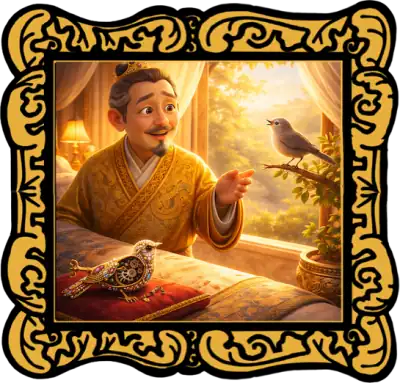
The nightingale flew back to the forest by the sea. That evening, just as the sun dipped low, she returned to the window branch and sang, and the emperor listened in quiet joy.

Get Dylan’s First Adventure
Join the dancing fun! Grab your free copy of Dylan’s school debut.
Send My CopyCheck your email (and junk folder).
