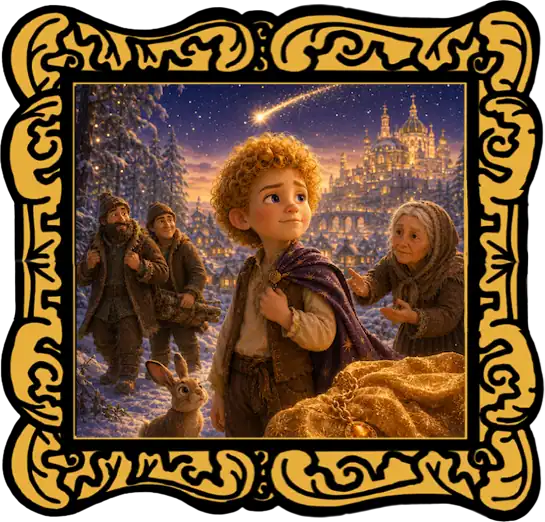

The Star Child is a fairy tale for children aged 8–12, adapted from Oscar Wilde’s public domain story. This children’s version follows a beautiful boy with a proud heart who learns that kindness, humility and compassion matter far more than appearance.
On this page, you can read The Star Child by Oscar Wilde, explore the moral of the story, discover key vocabulary, answer discussion questions and try classroom activities linked to kindness, pride and forgiveness.
- Independent Reading Age: 8–12
- Reading Level: Upper Elementary, Grades 3–6
- Reading Time: 10–12 minutes
- Author / Source: Adapted from Oscar Wilde’s public domain fairy tale
- Story Type: Literary Fairy Tale
- Region / Origin: Ireland / United Kingdom
- Main Characters: The Star-Child, the woodcutters, the woodcutter’s wife, the poor old woman, the hare, the poor sick man, the king and queen
- Moral / Themes: True beauty comes from kindness, humility, compassion and forgiveness
The Story
A Light in the Winter Forest
Long ago, two poor woodcutters walked home through a pine forest on a freezing winter night. Snow covered the ground. Frost glittered on the branches, and every step cracked under their heavy boots.
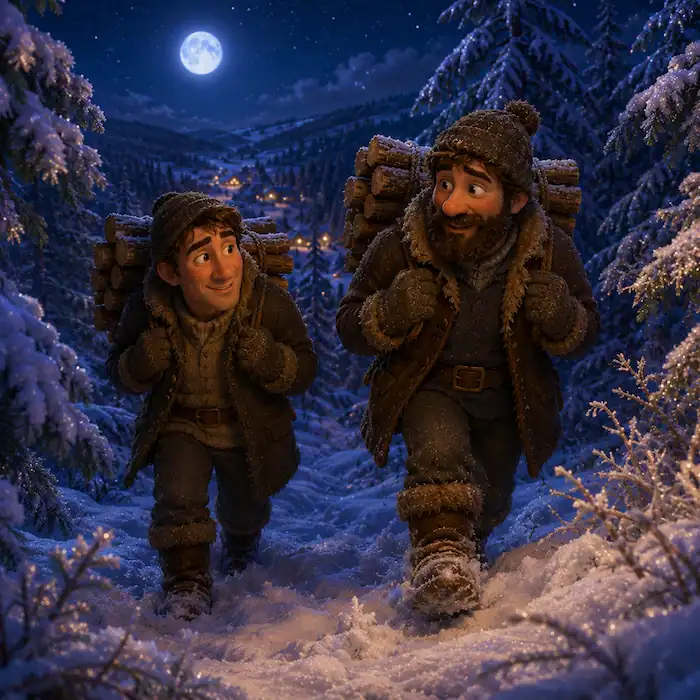
“We must keep going,” said one woodcutter. “The village is not far now.”
His friend nodded. “I can almost see the lights.”
They reached the edge of the forest. Far below, tiny windows shone in the valley. The men laughed with relief. Then their smiles faded. The lights below looked warm, but they knew their own cottages would be cold tonight.
Before either man could speak again, a bright light flashed across the sky.
A shining star seemed to fall from heaven. It slipped past the other stars and dropped behind a clump of willow trees near a sheepfold.

“Treasure!” cried one woodcutter. “A falling star must leave gold behind.”
They ran through the snow toward the willows. There, shining on the snow, lay a golden cloak embroidered with stars.
The woodcutters unfolded the cloth, expecting coins or jewels. Instead, they found a baby sleeping inside with a chain of amber around his neck.
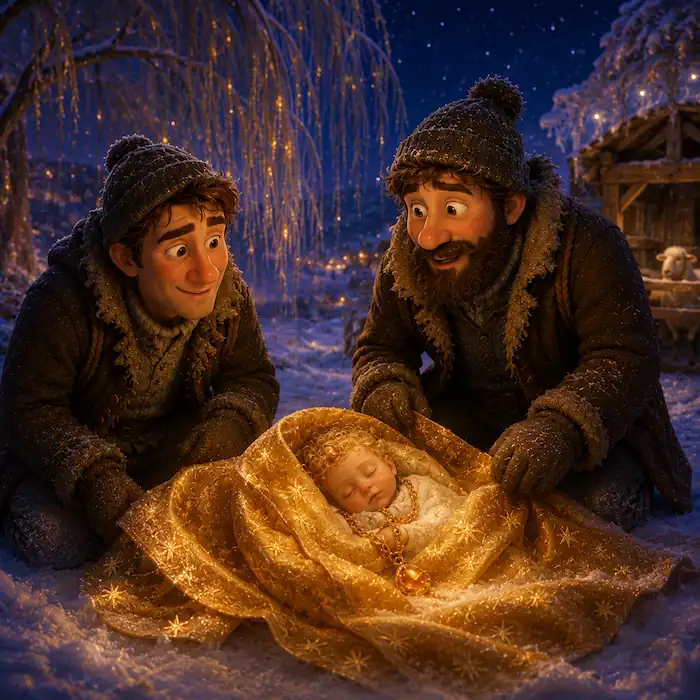
One woodcutter drew back. “This is no treasure. We have children of our own. Leave him here.”
The other man lifted the baby carefully. “No child should be left in the snow. I have little, but I can share it.”
So he wrapped the baby in the golden cloak and carried him down the hill.
The Child by the Hearth
When the woodcutter reached his cottage, his wife opened the door with a cry of joy. Then she saw the baby in his arms.
“What have you brought home?” she asked.
“A child,” said the woodcutter. “I found him in the snow.”
“We can hardly feed our own children,” his wife said. “How can we feed another?”
Then she looked from the baby to her own sleeping children. For a moment, her mouth tightened. Then the baby stirred and gave a tiny sigh. Tears filled her eyes.
“Bring him in,” she whispered.
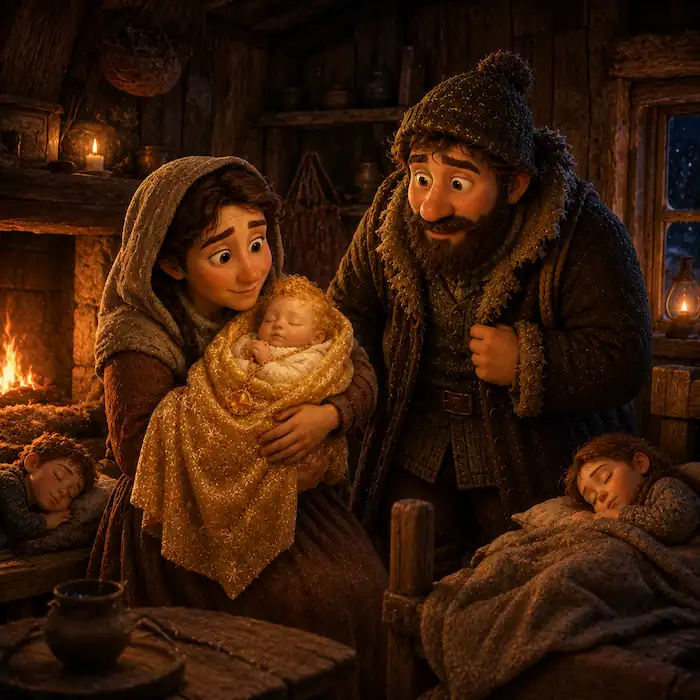
The next morning, the woodcutter locked the golden cloak and amber chain in a chest. The baby grew up beside the woodcutter’s children, sharing their bread, their games and their place by the fire. Because he had been found beneath the falling star, everyone called him the Star-Child.
A Beautiful Boy with a Hard Heart
Year by year, the Star-Child grew more beautiful. His curls shone like gold. His eyes were bright and clear. People in the village often stopped to stare.
The Star-Child heard their praise, and pride crept into his heart.
Soon, he believed he was better than the other children. He told them he had come from a star and made himself their leader.
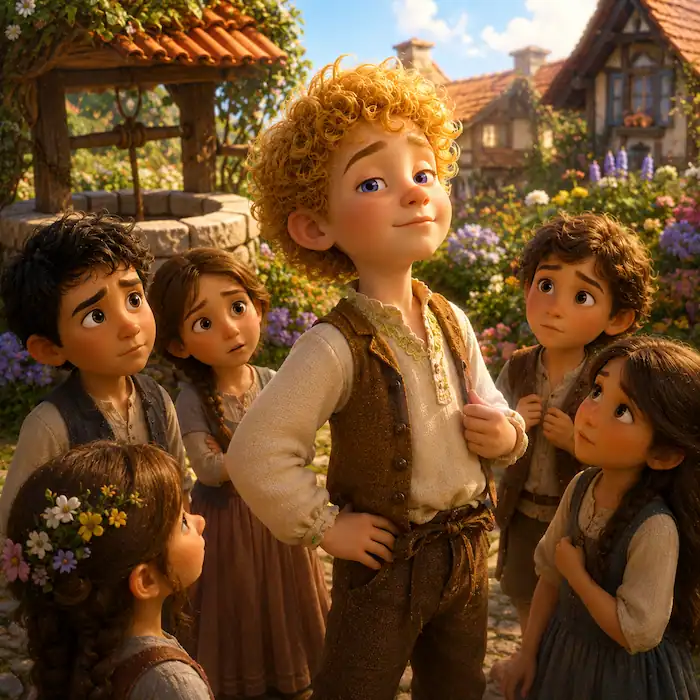
Many children followed him. He could run fast, sing sweetly and invent exciting games.
Yet his games often turned cruel.
He laughed at people who looked poor. He mocked anyone who limped or wore ragged clothes. When beggars came, he chased them away.
The woodcutter warned him again and again.
“We showed you mercy when you were helpless,” he said. “Why do you show none to others?”
Even the village priest spoke to him. “Even the smallest creature deserves kindness,” he said. “Birds, beasts and poor travelers all feel pain.”
But the Star-Child only tossed his golden curls and walked away.
The Woman Beneath the Chestnut Tree
One morning, a poor woman came slowly into the village. Her dress was torn, dust covered her feet and her face looked worn by sorrow. She sat beneath a chestnut tree to rest.
The Star-Child saw her and frowned.
“Look at that beggar woman,” he said to the other children. “Let us drive her away.”
He threw a stone near her feet.
The woman flinched. The woodcutter hurried over.
“Stop this at once!” he cried. “What harm has she done to you?”
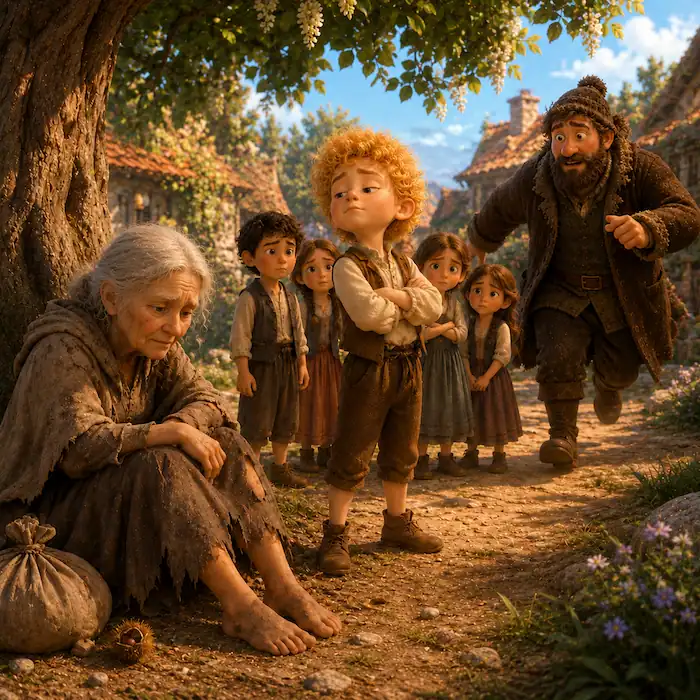
The Star-Child glared at him. “You cannot command me. I am not your son.”
The woodcutter’s face grew sad. “That is true. Yet I showed you pity when I found you in the forest.”
The woman gave a sharp cry and fainted.
The woodcutter carried her into his cottage. His wife gave her water. When the woman woke, she grasped the woodcutter’s sleeve.
“Did you say you found the boy in the forest?”
“Yes,” said the woodcutter.
“Was he wrapped in a golden cloak with stars? Did he wear an amber chain?”
The woodcutter opened the wooden chest and brought out the cloak and chain.
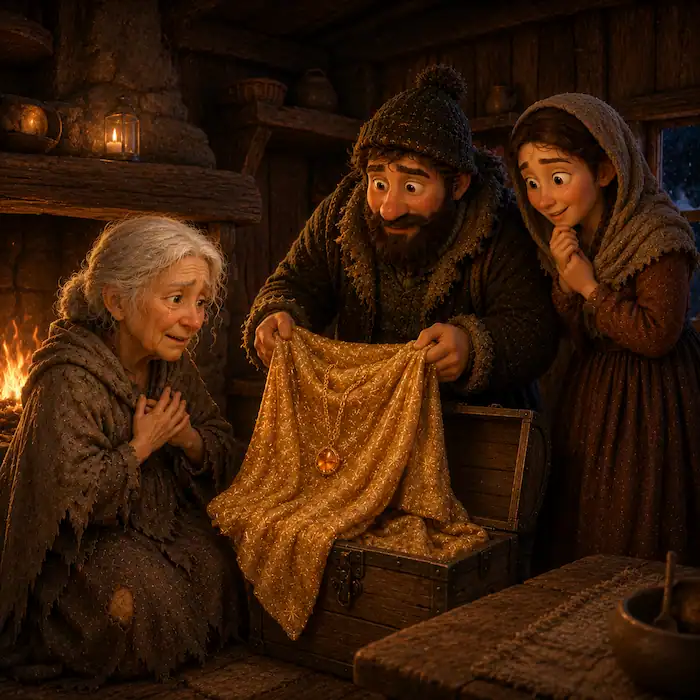
The woman burst into tears. “He is my son. Robbers took him from me when he was a baby. I have searched the world for him.”
The Star-Child’s Cruel Choice
The woodcutter called the Star-Child inside.
“Come quickly,” he said. “Your mother has found you.”
The Star-Child ran in, expecting a noble lady. Instead, he saw the poor woman by the fire.
“That cannot be my mother,” he said. “I see only a beggar.”
The woman held out her arms. “My son, I have searched for you for years. Come with me.”
The Star-Child stepped back.
“No,” he said. “I thought I was the child of a star. I will not be the son of a poor, ragged beggar.”
“Will you not even kiss me before I go?” she asked.
“I will not,” said the Star-Child. “Leave this house.”
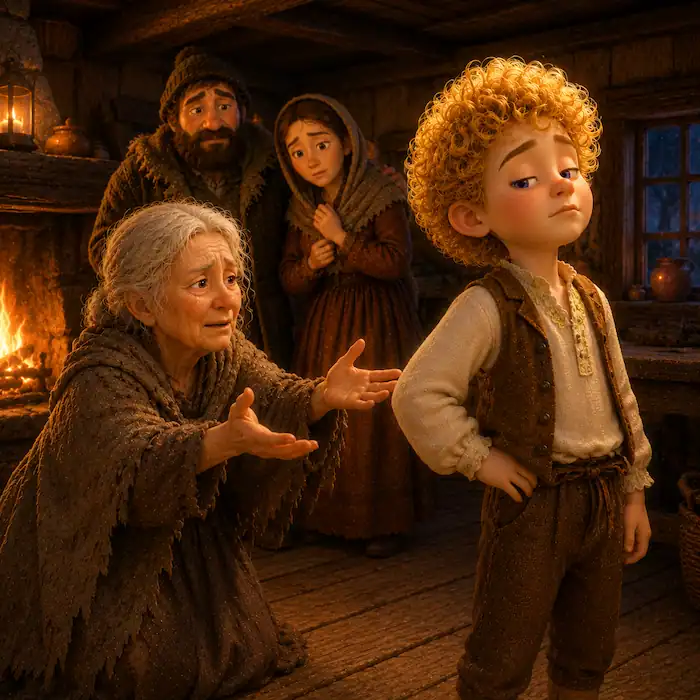
The woman walked into the forest, weeping.
The Star-Child went back to the garden. But when the children saw him, they ran away.
“Do not come near us!” they cried. “You are ugly now.”
The Star-Child raced to the well and looked into the water.
His beauty had vanished. His face looked rough, and his eyes no longer shone.
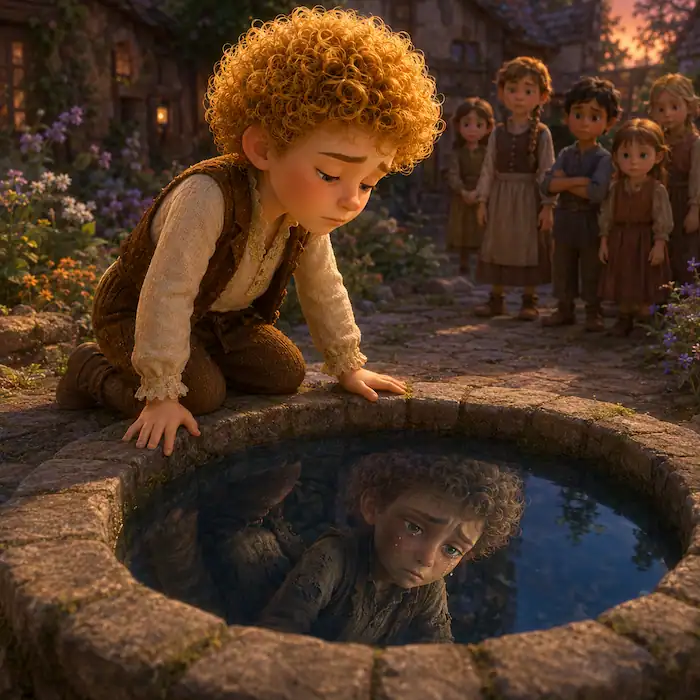
“I denied my mother,” he whispered. “My pride has changed me.”
The woodcutter’s youngest daughter touched his arm.
“Stay with us,” she said. “I will not laugh at you.”
But the Star-Child shook his head. “I must find my mother and ask her forgiveness.”
A Long Search Through the World
He ran into the forest, calling for her. No answer came.
All day, he searched among the trees. At night, he slept on leaves. The animals hid from him because they remembered how cruel he had been.
In the morning, he asked the mole, the linnet and the squirrel if they had seen his mother. Each one turned away, reminding him of the times he had hurt them.
The Star-Child bowed his head. “I am sorry,” he said.
For three years, he wandered from village to village. Doors closed when he asked for shelter. Sometimes, at dusk, he thought he saw his mother’s torn dress far ahead on the road. But when he ran after her, she vanished into mist.
At last, he reached a walled city beside a river. Soldiers stood at the gate with spears in their hands.
“Let me pass,” said the Star-Child. “I treated my mother cruelly, and I must ask her to forgive me.”
The soldiers laughed and blocked the gate.
A richly dressed man looked the Star-Child over as if he were no more than a bundle of firewood.
“He can work,” said the man coldly. “Sell him to the old magician.”
The Magician’s Dark House
The Star-Child was taken into the city and sold as a servant to a magician who lived behind a hidden door in a narrow street.
The magician locked him in a dark room beneath the house.
“You belong to me now,” said the magician.
The next morning, he unlocked the door.
“In the forest outside the city, three pieces of gold lie hidden,” said the magician. “One is white gold, one is yellow gold and one is red gold. Today, bring me the white gold. If you fail, you will suffer.”
Into the forest he went. Thorns caught his clothes. Nettles stung his ankles. Briars scratched his hands. He searched from morning until sunset, but he found no white gold.
As he walked back in fear, he heard a small cry from a thicket.
There, a hare lay trapped by one foot.
He knelt beside it. “Poor creature,” he said. “I am a prisoner too, but I can still set you free.”
Carefully, he opened the trap.
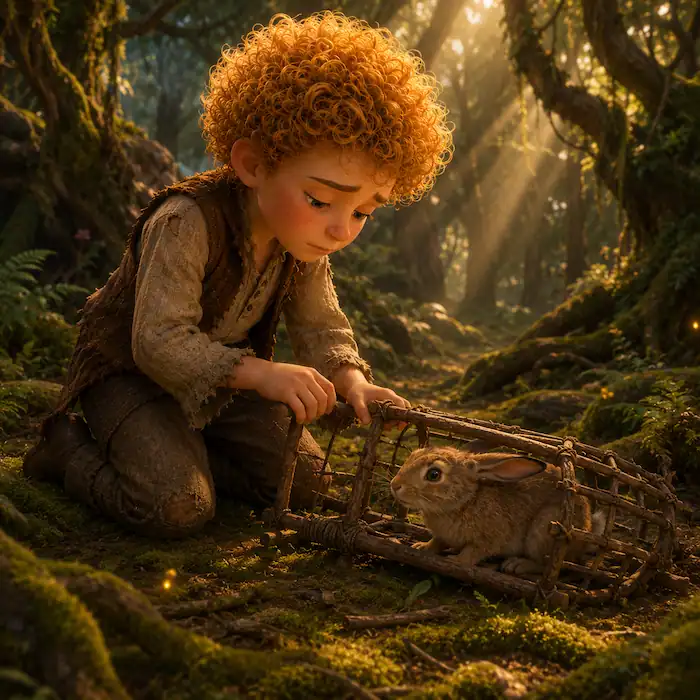
The hare sprang out and looked at him.
“You helped me,” said the hare. “Now I will help you.”
The hare twitched its ears. “You are searching for the white gold,” it said.
The Star-Child stared. “How do you know that?”
“The forest hears many things,” said the hare. “And small creatures hear more than proud people think.”
It led him to an old oak tree. In a crack of the trunk, the white gold shone.
The Three Gifts
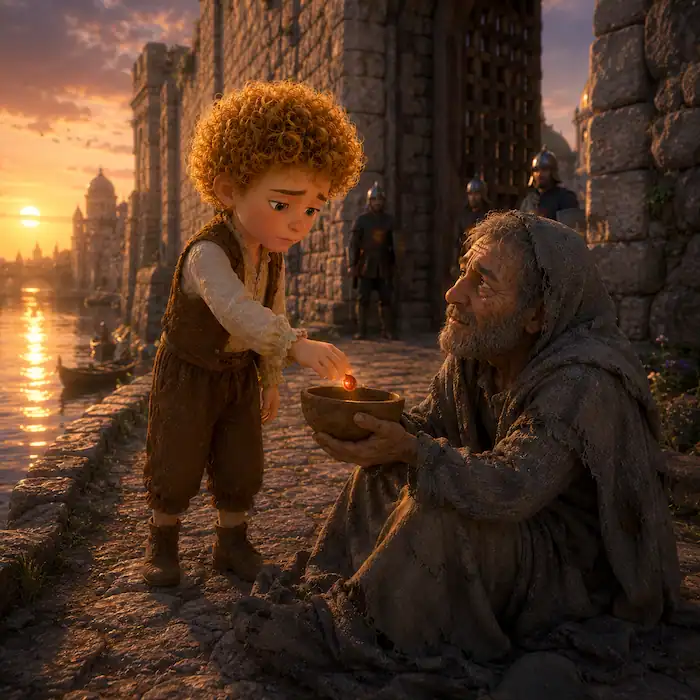
After thanking the hare, he hurried toward the city. At the gate, a poor sick man sat with a wooden bowl.
“Please help me,” the man said. “I am hungry.”
The Star-Child held the white gold tightly. “If I do not take this to the magician, he will punish me.”
The man lowered his head. “Then I may die here.”
The Star-Child remembered his own cold words to his mother. His heart softened.
“Your need is greater than mine,” he said.
He placed the white gold in the man’s bowl. When he returned empty-handed, the magician raged and locked him away.
The next day, the magician sent him for the yellow gold. The Star-Child searched until his feet hurt. At sunset, the hare appeared and led him to a pool. Beneath the clear water lay the yellow gold.
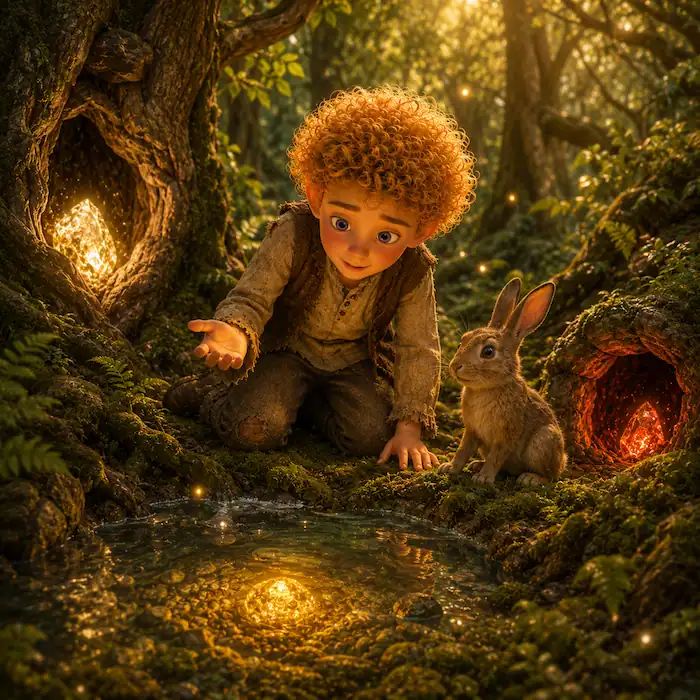
Again, the poor sick man begged at the gate.
The Star-Child hesitated only a moment. Fear still tugged at him, but pity pulled harder. He placed the yellow gold in the man’s bowl.
That night, the magician chained him in the dark room.
On the third morning, the magician’s eyes flashed. “Bring me the red gold. If you fail today, you will not leave this house alive.”
As evening fell, the hare came one last time.
“The red gold lies inside the cave behind you,” it said.
The Star-Child found the red gold in the cave and ran toward the city. At the gate, the poor sick man stood waiting.
“Give me the red gold,” he pleaded. “I have no other hope.”
The Star-Child thought of the magician’s threat. Then he looked at the man’s sorrowful face.
“Your need is greater than mine,” he said once more.
He gave away the red gold.
The Crown and the Mother
The Star-Child walked through the gate, expecting soldiers to seize him. Instead, they bowed.
“Our lord has come!” they cried. “How beautiful he is!”
He thought they were mocking him. But people filled the streets and followed him to a great square before a palace. Priests and nobles came down the palace steps.
“You are the one we have waited for,” they said. “You are the son of our king. Take the crown and rule this city.”
“I cannot,” said the Star-Child. “I denied my mother. I must find her before I can accept honor from anyone.”
Then he saw two figures in the crowd. One was the poor woman he had rejected, the other was the poor sick man from the gate.
With a cry, the Star-Child ran to them and fell at his mother’s feet.
“Mother,” he said, weeping, “I was proud and cruel. Please forgive me. I rejected you when you needed love. Please accept me now.”
The woman placed her hand on his head.
“Rise,” she said.
The sick man placed his hand on the Star-Child’s head too.
“Rise,” he said.
The Star-Child looked up. The poor woman had become a queen. The sick man had become a king.
“This is your father,” said the queen. “You helped him when he came to you in need.”
“And this is your mother,” said the king. “You found her through humility.”
The Star-Child saw his reflection in a polished shield. His beauty had returned, but his eyes had changed. They were gentle now.
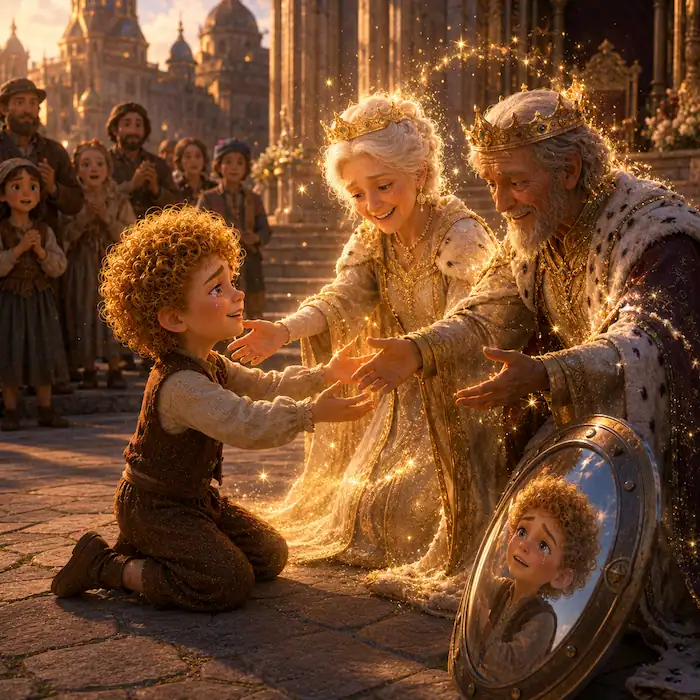
The king and queen embraced him. The people crowned him ruler of the city.
From that day, the Star-Child helped the poor, protected the weak and treated every living creature with care. He sent rich gifts to the woodcutter and his wife, who had saved him long ago.
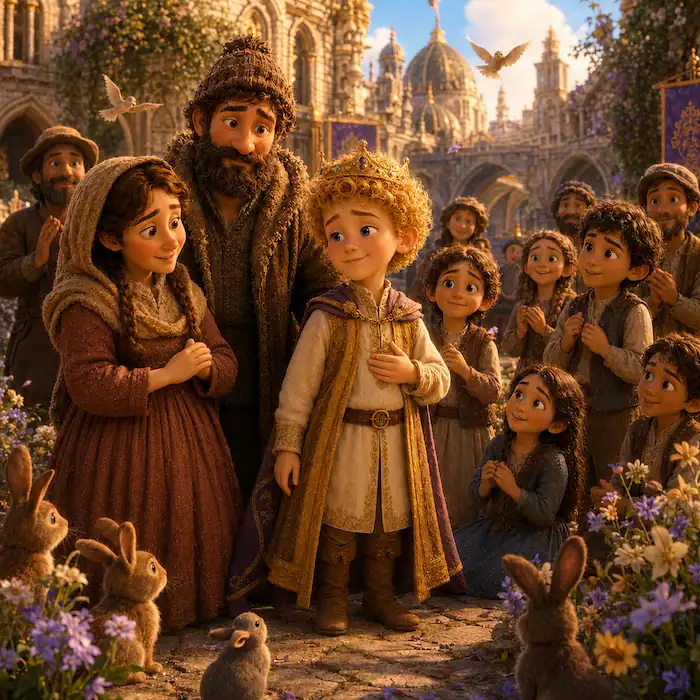
Once, the Star-Child had believed his beauty set him above others. Now, when people praised his face, he listened instead for the quieter praise that mattered more: “He is kind.”
Moral
The moral of The Star Child by Oscar Wilde is that true beauty comes from kindness, humility and compassion, not from appearance.
The Star-Child begins the story proud of his beauty and cruel to people who seem poor or different. Only when he loses his beauty, suffers rejection himself and chooses to help others does he understand what real goodness means.
More Stories from Oscar Wilde
The Selfish Giant – A moving fairy tale about a giant who learns generosity, warmth and love.
The Happy Prince – A beautiful moral story about compassion, sacrifice and helping the poor.
The Nightingale and the Rose – A more bittersweet Oscar Wilde story about love, beauty and sacrifice. Best suited to older independent readers or guided reading.
The Devoted Friend – A cautionary story about friendship, selfishness and fairness. Best suited to older independent readers.
Stories with Similar Themes
The Ugly Duckling – A classic tale about feeling different, growing in confidence and discovering inner worth.
Beauty and the Beast – A fairy tale about looking beyond appearances and learning to value kindness.
The Lion and the Mouse – A short fable showing that kindness is never wasted.
Vocabulary Spotlight
Humility – Humility means not thinking you are better than other people. Example: The Star-Child learns humility when he admits he was wrong.
Compassion – Compassion means caring about someone else’s suffering. Example: He shows compassion when he helps the poor sick man.
Mercy – Mercy means showing kindness to someone who is in trouble or has less power than you. Example: The woodcutter shows mercy by saving the baby in the snow.
Pride – Pride can mean thinking too highly of yourself. Example: Pride makes the Star-Child cruel at the beginning of the story.
Forgiveness – Forgiveness means choosing not to hold anger against someone who is truly sorry. Example: The Star-Child asks his mother for forgiveness.
Ragged – Ragged means torn, worn or shabby. Example: The poor woman wears ragged clothes after years of searching.
Hearth – A hearth is the area around a fireplace. Example: The baby is brought into the warm cottage by the hearth.
Walled city – A walled city is a city protected by high walls. Example: The Star-Child reaches a walled city beside a river.
Teacher’s Note
The Star Child is best suited to independent readers aged 8–12 because the story has a clear plot but a serious emotional journey. It includes pride, rejection, regret, hardship, forgiveness and moral change.
For younger readers in this range, focus on the basic lesson: do not judge people by how they look, and kindness matters more than beauty. For older readers, the story can support deeper discussion about social status, appearance, redemption, responsibility and how people prove they have changed.
Oscar Wilde’s original story is darker than this adapted version. This retelling keeps the central plot and moral while making the language clearer and more suitable for children.
Parent and Teacher Discussion Questions for The Star Child
- Why does the woodcutter decide to save the baby even though he is poor?
- What clues show that the baby is unusual?
- How does the Star-Child behave as he grows older?
- Why do the other children follow the Star-Child?
- Why does the Star-Child reject the poor woman?
- What does the change in his appearance show?
- Why do the animals refuse to help him at first?
- What does the hare’s help show about kindness?
- Why does the Star-Child give away the white, yellow and red gold?
- How do we know the Star-Child has truly changed?
- Why is the ending about forgiveness rather than just reward?
- What does the story suggest about real beauty?
Classroom Activities
1. Kindness Journey Map
Ask pupils to draw a map of the Star-Child’s journey.
They should include these places:
- The snowy forest
- The woodcutter’s cottage
- The village well
- The forest where he searches for his mother
- The magician’s dark house
- The forest where he finds the gold
- The city gate
- The palace square
- Beside each place, pupils write one sentence explaining what the Star-Child learns there.
For example:
At the village well, the Star-Child sees that his cruelty has changed him.
At the city gate, he learns to put another person’s need before his own fear.
2. Character Change Notes
Ask pupils to write two short lists.
First list: What the Star-Child is like at the beginning.
Second list: What the Star-Child is like at the end.
Useful prompts:
At the beginning, the Star-Child is…
At the end, the Star-Child is…
One moment that shows he has changed is…
This works well as preparation for a paragraph about character development.
3. Three Pieces of Gold Writing Task
Ask pupils to choose one piece of gold: white gold, yellow gold or red gold.
They then write one paragraph explaining:
- Where the gold is found
- Why the Star-Child needs it
- Why he gives it away
- what this choice shows about his character
Challenge version:
Ask older pupils to explain why the third gift matters most. By then, the Star-Child knows the danger is greatest, but he still chooses compassion.
4. The Well Reflection Task
Ask pupils to imagine the Star-Child speaking to his reflection in the well.
They write a short diary entry beginning:
When I looked into the water, I saw…
They should include:
- What he sees
- How he feels
- What he regrets
- What he decides to do next
This activity helps pupils explore guilt, self-awareness and the turning point of the story.
5. Draw the Moral
Pupils draw one scene that shows the message of the story.
Good choices include:
- The woodcutter saving the baby
- The Star-Child rejecting his mother
- The Star-Child seeing his changed reflection
- The Star-Child freeing the hare
- The Star-Child giving away the red gold
- The queen and king forgiving him
Under the drawing, pupils write one sentence beginning:
This scene shows the moral because…
6. Hot Seating the Star-Child
One pupil takes the role of the Star-Child. The class asks questions about his choices.
Possible questions:
- Why did you think you were better than the other children?
- How did you feel when your mother said who she was?
- What did you feel when your beauty disappeared?
- Why did you free the hare?
- Why did you give away the gold?
- What would you say to your mother now?
After the activity, pupils write three sentences explaining whether they think the Star-Child deserved forgiveness.
7. Appearance Versus Character Debate
Ask pupils to discuss this statement:
The Star-Child only became truly beautiful when he became kind.
Pupils can agree, disagree or partly agree.
They should support their answer with examples from the story.
This is a strong activity for older independent readers because it links theme, evidence and interpretation.
Fun Facts About The Star Child
The Star-Child was written by Oscar Wilde and published in his collection A House of Pomegranates.
It is a literary fairy tale. That means it was written by a known author rather than passed down anonymously like many traditional folk tales.
The story uses classic fairy-tale features, including a mysterious child, magical objects, a test of character and a royal reveal.
The golden cloak, amber chain and three pieces of gold all help move the plot forward.
The Star-Child’s journey is a transformation story. He changes not because of magic alone but because he learns to act with kindness.
The original story is darker than this adapted version, so this retelling keeps the main moral while making the tone more suitable for children aged 8–12.
History of The Star Child by Oscar Wilde
The Star Child is one of Oscar Wilde’s literary fairy tales and appears in A House of Pomegranates, first published in 1891.
Unlike traditional folk tales passed from storyteller to storyteller, The Star Child comes from a named author. Wilde often wrote about beauty, pride, suffering and compassion. These ideas appear clearly in this story.
The story follows a common fairy-tale pattern. A child with mysterious origins grows proud, faces a punishment and must complete a difficult journey before finding forgiveness. However, Wilde gives the tale a strong emotional and moral focus. The Star-Child does not become good because someone simply tells him to. He changes because he experiences hardship himself and then chooses mercy when others need help.
For a public domain reference, you can link to Project Gutenberg’s edition of A House of Pomegranates by Oscar Wilde, which includes the original version of The Star-Child.
About Oscar Wilde
Oscar Wilde was an Irish writer best known for his plays, stories, essays and his novel The Picture of Dorian Gray. His children’s stories often combine beautiful imagery with serious moral questions.
In stories such as The Happy Prince, The Selfish Giant and The Star Child, Wilde often explores selfishness, kindness, sacrifice and the difference between outward beauty and inner goodness.
Why We Narrated This Story
We chose The Star Child because it gives independent readers a strong and memorable story about kindness, pride and forgiveness.
The plot has many classic fairy-tale elements, including a falling star, a golden cloak, a helpful hare and a royal reveal. However, the main lesson is very human: the way we treat others matters more than how we look.
This version keeps the heart of Oscar Wilde’s fairy tale while making the language clearer for modern children, parents and teachers.
Frequently Asked Questions About The Star Child
-
What is The Star Child by Oscar Wilde about?
The Star Child is about a beautiful boy found in the snow by a poor woodcutter. As he grows up, he becomes proud and cruel. After rejecting his mother, he loses his beauty and must learn kindness, humility and compassion.
-
What is the moral of The Star Child by Oscar Wilde?
The moral of The Star Child is that true beauty comes from kindness and compassion, not from appearance.
-
Who are the main characters in The Star Child?
The main characters are the Star-Child, the poor woodcutter, the woodcutter’s wife, the poor old woman, the hare, the poor sick man and the king and queen.
-
Is The Star Child a fairy tale?
Yes. The Star Child is a literary fairy tale by Oscar Wilde. It includes magical events, a mysterious child, a transformation, a quest for forgiveness and a clear moral lesson.
-
Why does the Star-Child lose his beauty?
The Star-Child loses his beauty after he cruelly rejects the poor woman who says she is his mother. His changed appearance reflects the pride and unkindness inside him.
-
How does the Star-Child change by the end of the story?
By the end of the story, the Star-Child becomes humble and kind. He helps the hare, gives away the three pieces of gold and asks his mother for forgiveness.
-
What are the three pieces of gold in The Star Child?
The three pieces of gold are white gold, yellow gold and red gold. The Star-Child is ordered to find them for the magician, but each time he gives the gold to the poor sick man who needs help.
-
Is The Star Child suitable for children?
This adapted version is suitable for independent readers aged 8–12. Oscar Wilde’s original story is darker, so this retelling keeps the moral and main plot while using clearer, gentler language for children.
Copyright Notice
© Kooky Kids World. This original retelling, illustrations, audio narration and supporting educational content are protected by copyright. The underlying folk tale is traditional and may exist in many public domain or oral storytelling versions.
