


The Story of The Lion and the Mouse
A King’s Nap in the Shade
The sun above was swelteringly hot but one spot stayed cool. A wide tree spread its branches like a roof. Under it a lion stretched out on the ground and fell asleep.
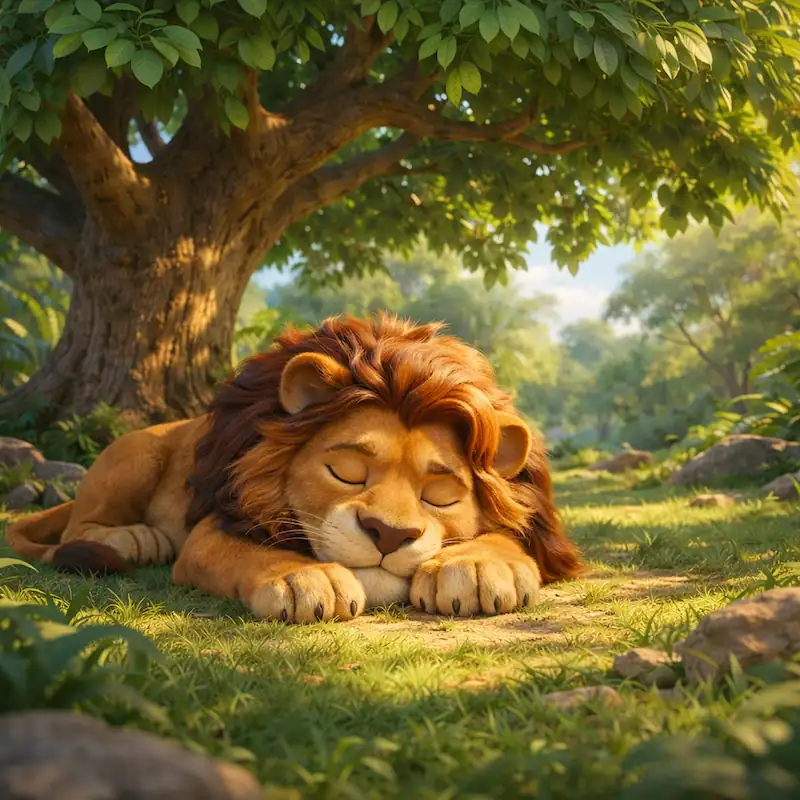
His mane fanned around his head like a golden cloud. His chest rose and fell with slow steady breaths. Now and then his tail twitched as if he were chasing something in a dream.
Not far away a little mouse hurried through the grass. She was quick and curious but her eyes were not the best. In tall grass and shadowy roots she often had to sniff and listen to know where she was going.
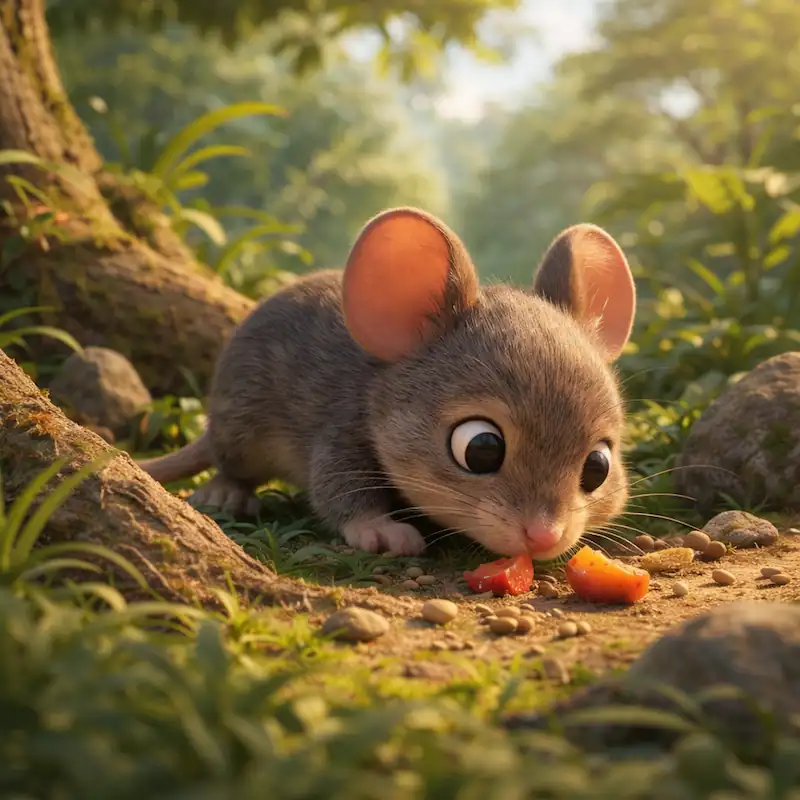
That day she was searching for fallen seeds and bits of fruit. She darted past a root then around a stone. Soon she climbed up a warm hill that felt surprisingly smooth.
But it was not a hill.
It was a Lion!
The mouse’s paws padded across his back. She did not mean to bother him. She thought she was crossing a sunbaked log.
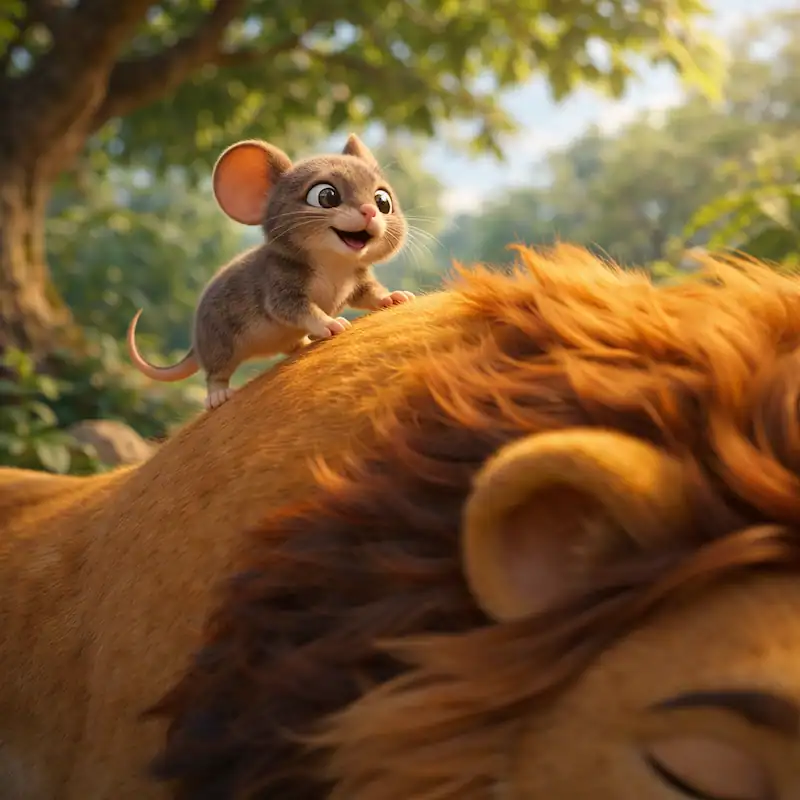
Then she reached the lion’s shoulder. She climbed higher. The air smelled like wildflowers and dust and something strong and catlike. Her whiskers trembled.
She took one more step.
Her foot landed on the lion’s nose.
The mouse froze… She looked down and saw a closed eye as big as a river pebble. She saw teeth tucked behind heavy lips. She saw a paw larger than her whole body.
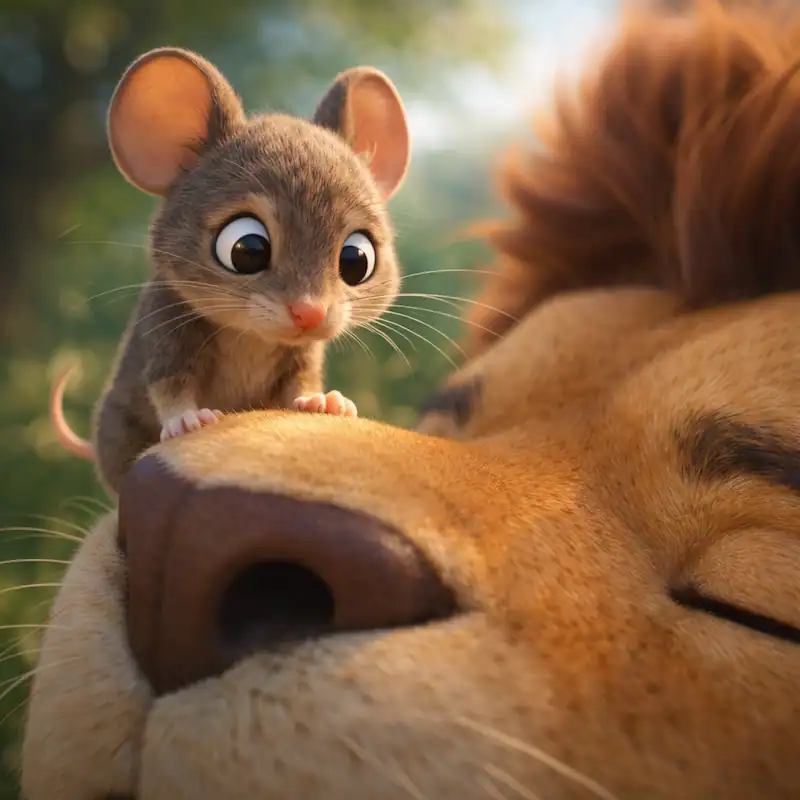
A tiny squeak slipped out of her mouth.
The lion’s eye snapped open.
A Paw Like a Falling Boulder
The lion lifted his head with a deep rumble. His gaze landed on the mouse as if she were a leaf caught in the wind.
The mouse tried to bolt. She turned and ran but in one smooth motion the lion’s paw came down.
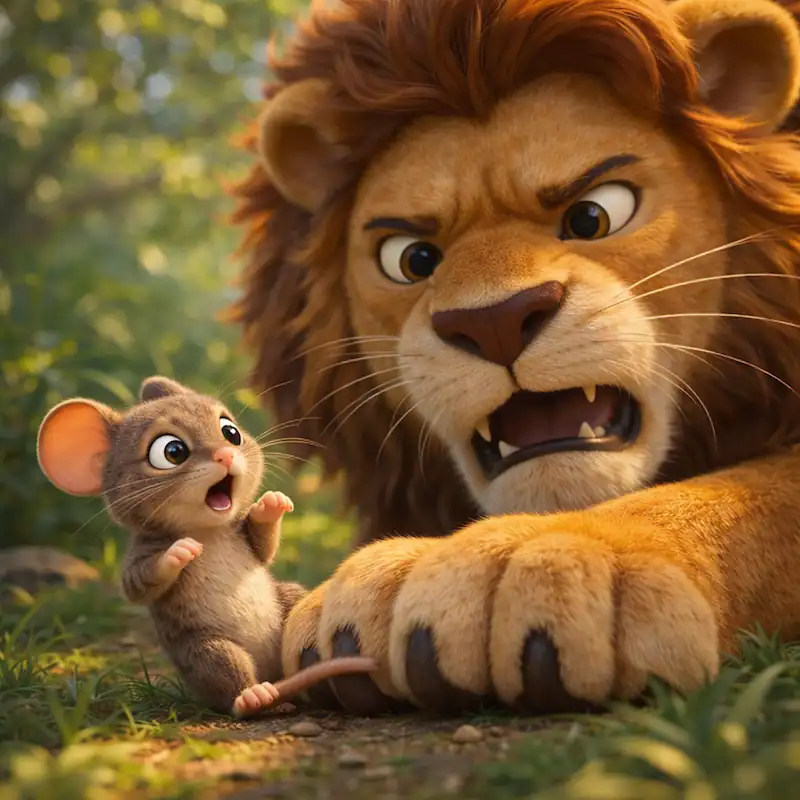
Not hard enough to crush her.
but just hard enough to stop her.
His paw pressed the tip of her tail to the ground. Her heart thumped like a drum.
The lion growled.
“Who DARES to Run Across My Face!”
“I didn’t mean to!” the mouse cried. “I didn’t see you!”
The lion’s ears flicked back. He looked annoyed and sleepy all at once. “I was having a fine dream,” he said. “A zebra was right in front of me. Then you walked all over my nose.”
The mouse swallowed. She tried to stand tall though her knees shook.
“Please do not eat me,” she said. “I am small and clumsy and made a foolish mistake but if you let me go I will repay you, I promise.”
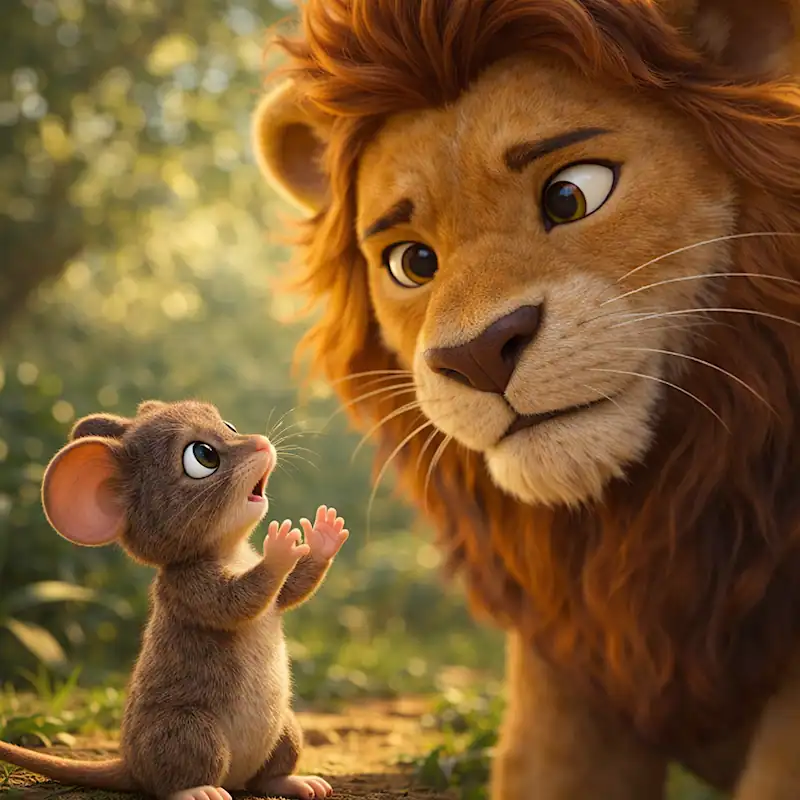
The lion blinked. Then he let out a sound that echoed through the trees.
It was laughter.
“A mouse helping a lion?” he sniggered. “That’s the funniest thing I have heard all week.”
The mouse’s cheeks burned but she did not look away. “It may sound funny,” she said. “Still I mean it.”
The lion stared at her for a long moment. His whiskers twitched. His paw did not move.
Finally he sighed. “Go on then,” he said. “I’m not going to eat you today.”
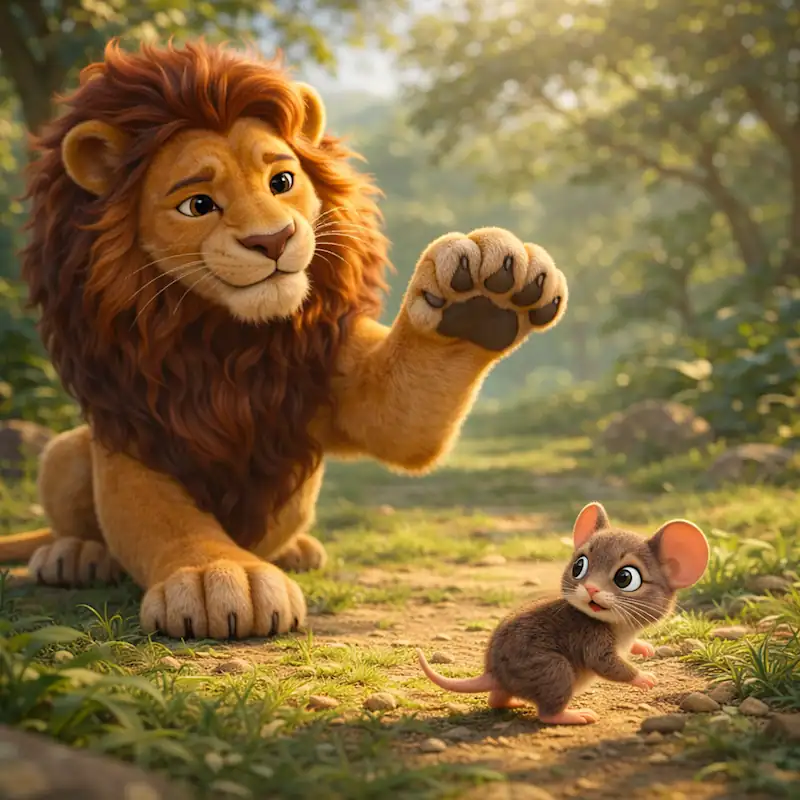
He lifted his paw and the mouse ran off, nearly tripping over her own feet. She stopped at a safe distance and turned back.
“Thank you,” she said softly. “I won’t forget.”
The lion yawned as if the whole thing was already drifting out of his mind. “Run along” he mumbled.
The mouse vanished into the tall grass.
A Promise Carried in a Tiny Heart
The next few days were busy in the jungle. Birds screeched from high in the trees. Monkeys tossed fruit and chattered like they were telling jokes and Ants marched with military precision.
The mouse kept close to home, near the roots and soft stones. Even so, she thought about the lion more than she’d ever have imagined.
She had felt his strength in that paw. She had seen how easy it would be for him to choose a cruel ending. Instead, he had chosen mercy.
So the mouse decided her promise wouldn’t just be empty words that scattered with the wind.
Whenever she heard a loud splash at the river or a crack in the bushes she paused to listen.
If she smelled smoke on the wind she hid. Hunters sometimes came to the jungle and the mouse had learned to watch for their clues.
One afternoon she found a broken vine that looked as if something heavy had ripped it apart. She sniffed the ground and saw tracks pressed deep into the mud.
Large paws,
A lion’s paws.
The mouse’s ears perked up. “I hope he is well,” she whispered.
She hurried after the tracks, stopping often to listen.
Then she heard it.
A Roar!
Not a proud roar that said, “I am the King of the Jungle”. This roar sounded trapped and in Danger.
The Net That Did Not Care Who Was King
The lion had been walking alone through a narrow place between trees. The air carried the scent of animals and the promise of dinner. His belly was empty and he was thinking about food.
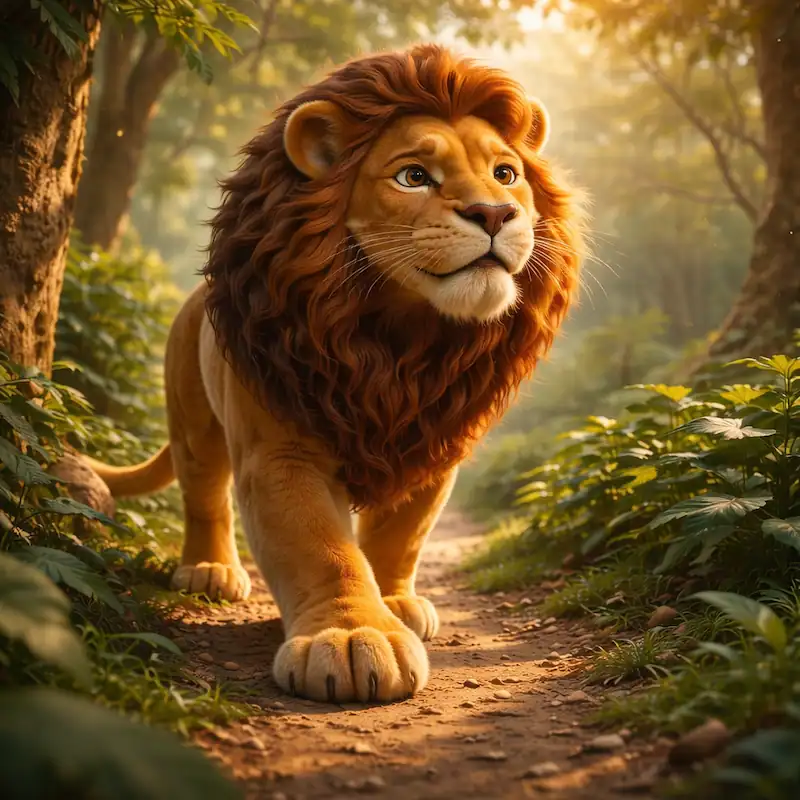
As he stepped forward, the ground beneath him seemed normal. Leaves covered the jungle floor like a blanket.
Then suddenly, A net snapped up all around him. Ropes tightened. The mesh climbed over his shoulders and tangled around his legs. The lion threw his weight against it but the ropes bit back.
He jerked and twisted… He bit at the net but it was strong and held firm. He clawed at the ropes but the knots held tight.
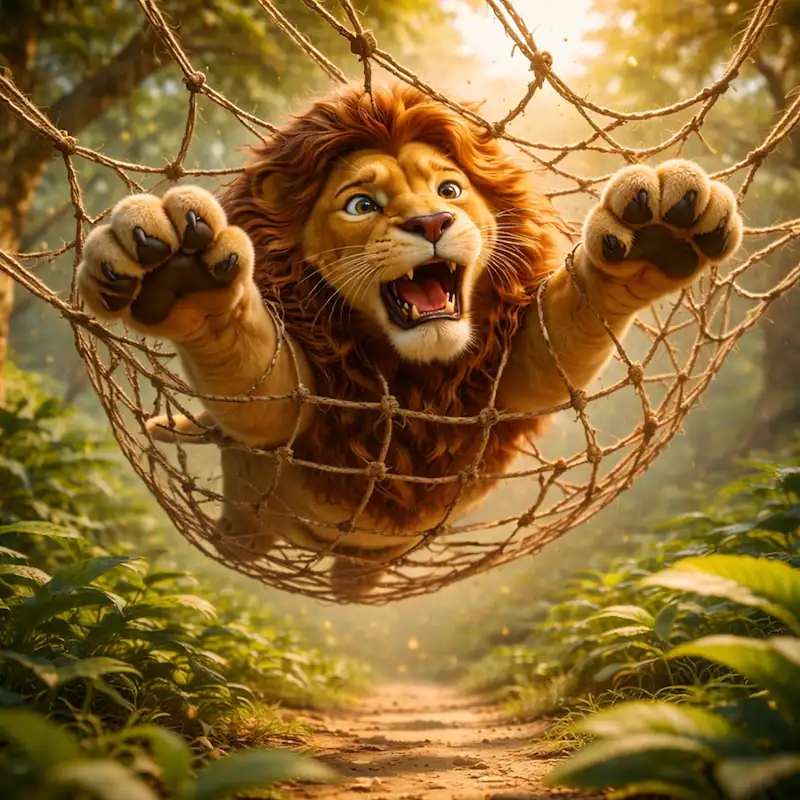
The more he fought the tighter the net held him.
The lion’s eyes burned with anger. He roared so hard the birds burst from the trees.
He was the strongest animal in the jungle. He could knock down a wildebeest with one swipe.
Still the net did not care.
It was made for strength. It was made to hold kings.
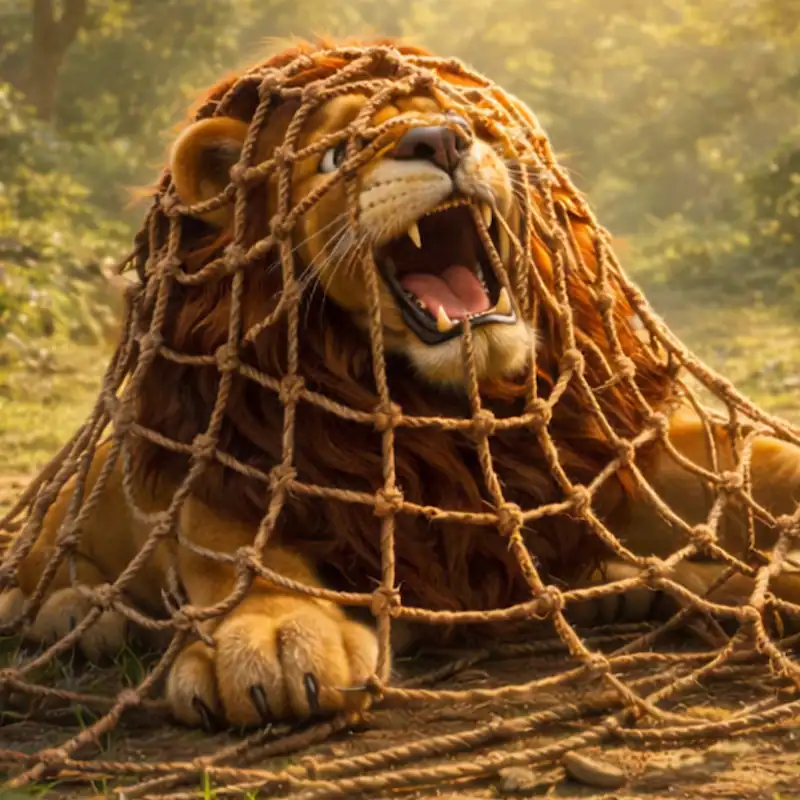
He tried to break free, straining against the ropes but his paw caught in the net and he fell to the floor.
He Roared with Anger!
And somewhere in the grass a mouse heard his pain and ran to help.
Teeth Like Little Scissors
The mouse stopped at the edge of the clearing. Her eyes widened. She had never seen anything like it.
The lion was wrapped in the hunter’s net. The ropes crossed over his chest and around his neck. The mesh trapped his legs so he could not stand properly.
The lion saw the mouse and glared. “Go away!” he snapped. “This is no place for you.”
The mouse took a small breath. “I did not come to laugh,” she said. “I came to help.”
The lion’s ears flattened. “Help?” he said bitterly. “You cannot cut through this net.”
The mouse stepped closer anyway. “Maybe not all at once,” she said. “But I can still try.”
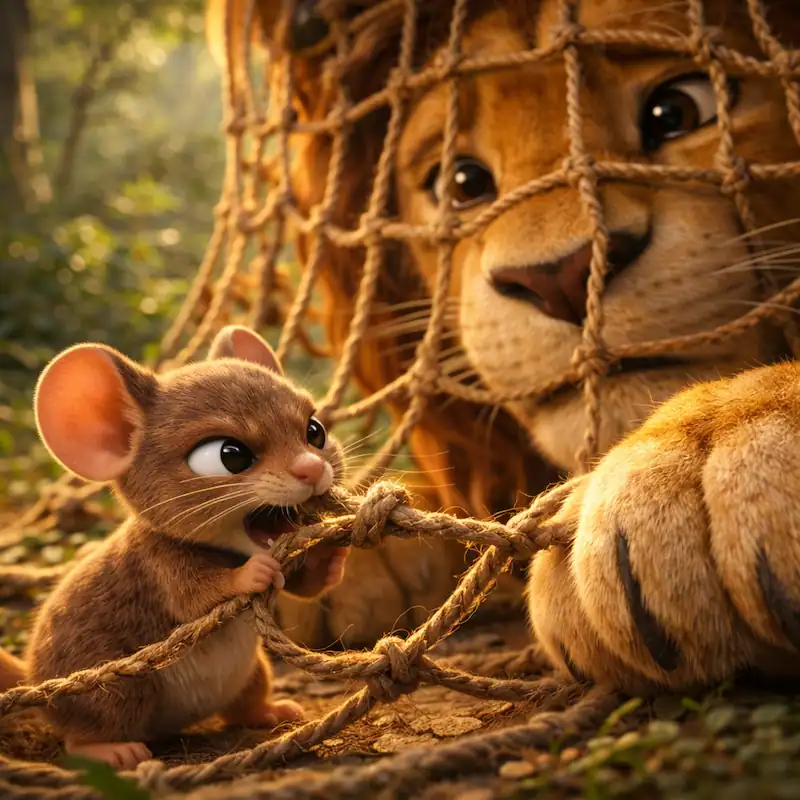
She hopped onto a rope near the lion’s paw. She leaned forward and began to gnaw.
Her teeth were tiny but sharp. They worked like little scissors. She chewed quickly, then shifted her bite and chewed again.
The lion watched, still panting from his struggle.
“Stop,” he said. “You will tire yourself.”
“Not yet,” the mouse replied through a mouthful of fiber.
She chewed and chewed until finally a strand snapped.
Next the mouse moved to the next rope. She chewed there too, steady and determined.
Time passed and the sounds of the jungle seemed to fade. Even the birds grew quiet, as if holding their breath.
The lion stopped fighting and held as still as he could. He did not want to make it any harder for her.
The mouse gradually worked her way along the net. Rope after rope began to weaken and A small gap appeared.
The mouse squeezed through and chewed from the inside. That made the cords easier to break.
At last, one strong rope that held many knots gave way with a sudden PoP.
The net loosened.
The lion shifted carefully. One leg slid free. Then another. He pushed forward, then shook his mane and the net fell away like a dead vine.
The lion stood up breathing hard but he was Free.
The mouse jumped down and backed away, just in case the lion forgot himself.
Instead, the lion looked at her and lowered his head.
A Laugh Turned Into Respect
The lion’s voice was quieter now. “Little mouse,” he said, “you did what I thought could never be done.”
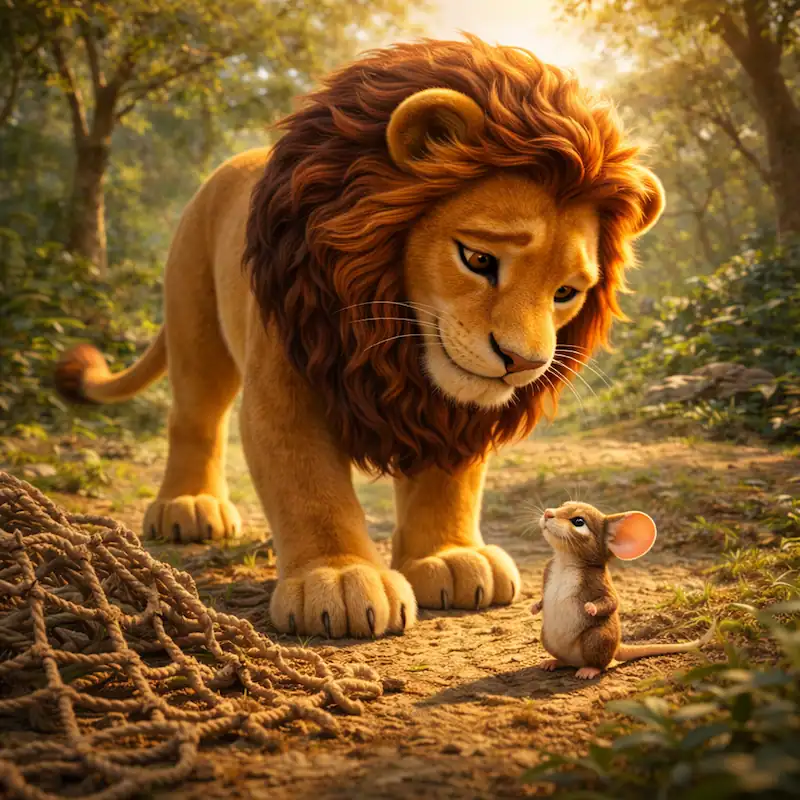
The mouse lifted her chin. “You laughed when I promised to help you,” she said. “Now you see why I made that promise.”
The lion gave a small sigh. “You were right,” he said. “I was foolish”
The lion then looked down at the torn net on the ground. “A hunter will come back for this,” he said.
“Then you should leave,” the mouse said quickly. “Go now while you still can.”
The lion nodded. He stepped toward the trees, then stopped.
“Wait,” he said.
The mouse froze.
The lion bent his head again, not in anger this time but in gratitude. “Thank you,” he said.
“You saved my life.”
The mouse’s heart warmed. “And you spared mine,” she replied. “So we are even.”
The lion’s eyes softened. “No,” he said. “We are not even. We are connected.”
The mouse did not fully understand that word; but she liked how it sounded.
The lion turned and walked back into the jungle, careful and quiet. The mouse watched until the shadows swallowed him.
Then she ran back home, feeling taller than she had ever felt before.
Throughout the jungle, the story Spread. Not about a lion’s strength or about a mouse’s size.
But about a kindness that proved even the tiniest act can make a big difference.
Get Dylan’s First Adventure
Join the dancing fun! Grab your free copy of Dylan’s school debut.
Send My CopyCheck your email (and junk folder).
