
If you are looking for Aboriginal Australian stories for kids, you are probably not just looking for another bedtime story.
You may want a story that feels different from the usual fairy tale. You may want something your child has heard about at school. Or you may simply want a good animal story with something real to talk about afterward.
The Rainbow Serpent, Tiddalik the Very Thirsty Frog and How Kangaroo Got Her Pouch all do that in different ways.
One is about water, land and what everyone depends on.
One is about a very thirsty frog who takes far too much.
One is about helping someone without knowing there will be anything in return.
They are memorable because the ideas are built into the story. Children do not need a lecture on greed, kindness or responsibility. They can meet a giant frog, a powerful serpent or a kind kangaroo, then talk about what happened.
This guide is not here to retell the stories. You can read those separately on Kooky Kids World. Instead, it looks at what parents can talk about with children after reading them, and why these stories still make good conversation starters at home.
Why Aboriginal Australian Stories Matter
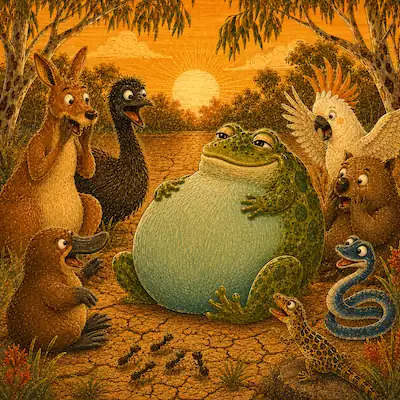
For children, Aboriginal Australian stories can be exciting, funny, strange or beautiful before they are anything else.
That matters. A child is more likely to remember Tiddalik’s enormous belly than a grown-up explanation about selfishness.
But the stories often carry bigger ideas too.
They can help children think about water, animals, Country, sharing, kindness, choices and consequences. The lesson does not have to be pinned on at the end. It is already there in what the characters do.
That is what makes these stories useful for parents.
You can read the story first, enjoy it as a story, and then ask one small question afterward.
Talking About Water and Responsibility: The Rainbow Serpent
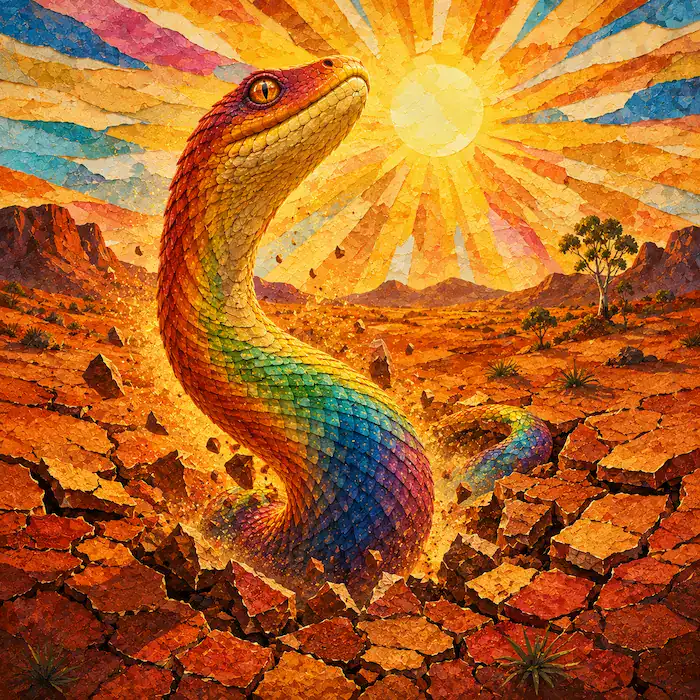
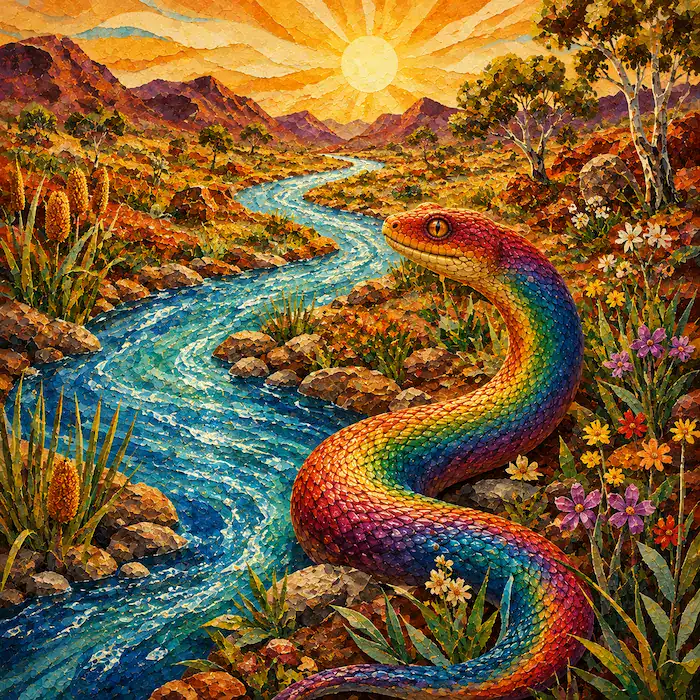
The Rainbow Serpent is one of the best-known Aboriginal Australian stories for children, especially when parents are looking for a story about nature, water and how the world came to be.
In the Kooky Kids World version, the Rainbow Serpent shapes the land and brings water, plants and animals into a dry, silent world. The animals are given something precious, but they also have to look after it.
That is enough for children to understand the heart of the story: water matters, and what one creature does can affect everyone else.
Read The Rainbow Serpent on Kooky Kids World
A parent conversation starter
The obvious lesson is about caring for water and the natural world.
But there is more to it than “do not waste water.”
The animals all depend on the same waterhole. That means one animal’s behavior can create a problem for everyone else.
Children understand that much more easily through a story than through a phrase such as “shared responsibility.”
The story also gives children something useful to think about when things go wrong.
The animals make a mistake. They do not stay stuck there. They recognize the damage and work together to repair it.
That is a much better lesson than pretending good characters always make the right choice first time.
Ideas children may take from the story
It can start conversations about:
- why water matters
- taking only what we need
- looking after shared places
- how our choices affect other people
- repairing something after we have made a mistake
You can bring that back into ordinary life quite easily.
Why do we turn off the tap?
Why should we not leave trash in a park?
What happens if one person takes all of something meant for everyone?
A question to ask
Why does it matter if one character takes more than they need?
Talking About Sharing and Greed: Tiddalik the Very Thirsty Frog
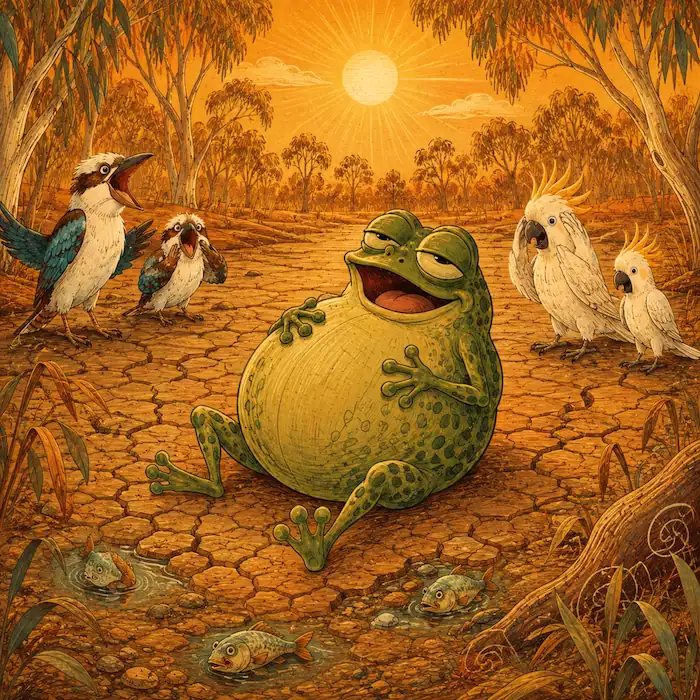
Tiddalik is probably the easiest of the three stories for younger children to grab onto.
A thirsty frog is funny.
A frog who drinks an entire billabong is even better.
In the story, Tiddalik takes all the water for himself. The other animals have to work together to get it back, and the smallest character is the one who finally helps solve the problem.
That gives parents plenty to talk about without turning the story into a lecture.
Read Tiddalik the Very Thirsty Frog on Kooky Kids World
What children often notice first
“Sharing is good” is true, but it is too simple.
Tiddalik does something more specific.
He thinks only about what he needs.
That is what makes the story useful.
Most children are not trying to be cruel when they grab the last cookie, hog a toy or take the biggest turn. They are thinking about what they want at that moment.
Tiddalik gives parents a way to talk about that without pointing straight at the child.
He gets what he wants.
Everyone else gets the consequences.
There is another lesson too. The animals solve the problem together, and the one who finally succeeds is little Snake.
The biggest animals do not fix everything. The smallest one does.
That gives younger children another useful message: being small does not mean being unimportant.
Ideas children may take from the story
The story can help children think about:
- sharing fairly
- greed and consequences
- thinking about what other people need
- working together
- apologizing
- changing behavior after a mistake
- understanding that small contributions matter
It also shows why funny stories can teach serious ideas so well.
A lecture about greed is dull.
A giant frog full of stolen water is not.
A question to ask
What would happen if everybody took more than they needed?
Or, for a more playful answer:
How would you try to make him laugh?
You may also see his name written as Tiddalick. Both spellings are used online and in books.
Talking About Kindness: How Kangaroo Got Her Pouch
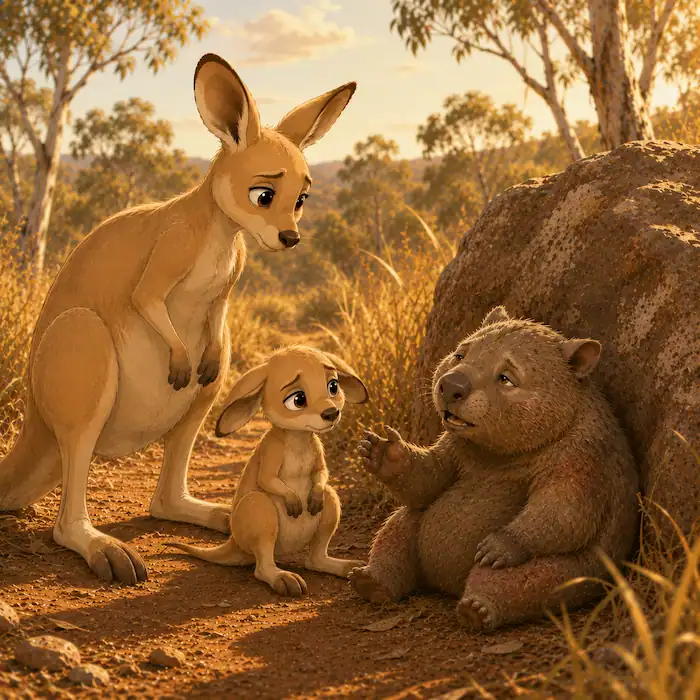
Children are used to rewards.
Tidy up and get a sticker.
Finish this and get a treat.
Do your reading and tick the box.
There is nothing wrong with that, but it does make How Kangaroo Got Her Pouch interesting.
The story is about Kangaroo, her joey and an act of kindness.
Read How Kangaroo Got Her Pouch on Kooky Kids World
A simple kindness question
The main idea is kindness.
More specifically, it is kindness without knowing there will be a reward.
That distinction matters.
If you only help because you know you will get something afterward, you are making a deal.
Kindness is different.
You notice someone needs help and you help because it matters.
The reward, if there is one, comes later.
Or it may not come at all.
The story also gives children a simple way to think about empathy.
Can you notice when somebody else is struggling?
Can you imagine how they might feel?
Can you help even when their problem is not your problem?
Those questions are more useful than simply asking whether Kangaroo was kind.
Ideas children may take from the story
It can help children think about:
- kindness
- empathy
- noticing when somebody needs help
- caring for others
- helping without expecting something back
- looking beyond their own needs
It also works particularly well after Tiddalik.
Tiddalik thinks first about himself.
Kangaroo notices someone else.
Children understand that contrast very quickly.
A question to ask
Would you still help someone if you knew you would get nothing in return?
Dreaming, Dreamtime and Different Versions of Stories
You may see the words Dreaming and Dreamtime used around Aboriginal Australian stories.
Children may hear “Dreamtime” at school or come across it in books and online.
The Dreaming can be connected with creation, Country, ancestors, animals, plants, relationships and cultural knowledge.
It is also important to remember that Aboriginal Australia is not one culture with one set of stories.
Different communities may tell different versions of a story. That is normal in traditional storytelling.
It does not automatically mean one version is right and another is wrong.
For children, you can keep the explanation simple:
Stories can be told differently by different people and in different places.
That is often enough.
Why Animals, Water and the Land Matter So Much
In these stories, the natural world is not just background scenery.
Waterholes, rivers, animals and plants matter to what happens.
That connects with the Aboriginal idea of Country.
Country can include land, waterways, plants, animals, people, ancestors, stories and the relationships between them.
This is one reason water matters so much in both The Rainbow Serpent and Tiddalik.
The Australian Museum explains that First Nations storytelling can pass on knowledge, language and culture, and that Dreaming stories can vary across Australia.
It gives How the Birds Got Their Colors as one example of a story told differently in different places.
That is useful context for parents too. A traditional story does not always have one fixed version. The people, place and storyteller matter.
Why Stories Often Work Better Than Lectures
Parents spend a lot of time explaining things.
Share.
Be kind.
Think about other people.
Do not waste things.
Children hear those phrases constantly.
A story gives the idea somewhere to live.
Sharing becomes a frog with a belly full of water.
Looking after shared resources becomes a waterhole everyone depends on.
Kindness becomes Kangaroo helping when she does not have to.
That is much easier to remember than a rule on its own.
Stories also give children a bit of distance. You can talk about whether Tiddalik behaved fairly without anybody feeling accused.
You can ask whether Kangaroo did the right thing without immediately turning the conversation into something that happened at school yesterday.
Sometimes children will talk much more openly that way.
Which Story Should You Choose First?
Choose The Rainbow Serpent if your child likes nature, rivers, powerful creatures and stories about how the world came to be.
Choose Tiddalik the Very Thirsty Frog if your child enjoys funny animal stories and a story that works especially well read aloud.
Choose How Kangaroo Got Her Pouch if you want something gentler about kindness, helping and noticing other people.
For younger children, Tiddalik is probably the easiest first read.
For children who like asking questions about nature, The Rainbow Serpent may give you more to talk about afterward.
For a quieter story centered on kindness, try How Kangaroo Got Her Pouch.
You can also explore more traditional stories in our Folk Tales for Kids collection, with tales from Australia and around the world.
Questions Parents Can Ask After Reading
You do not need a worksheet.
One good question is plenty.
Try:
- What part did you remember most?
- What did the character forget to think about?
- Who helped in the story?
- What would you have done?
- Did anything in the story remind you of real life?
And if your child only wants to talk about the giant frog or the Rainbow Serpent, that is fine too.
The bigger ideas do not always arrive immediately.
