
Santa’s Space Mail
The Silver Dot
On Christmas Eve, Nia’s apartment windows showed city lights, shuttle lights and stars. A blue moon rose above the towers. A family spaceship drifted past with Christmas lights twinkling along its sides. Grandpa always said the shuttles he rode never had Christmas lights.
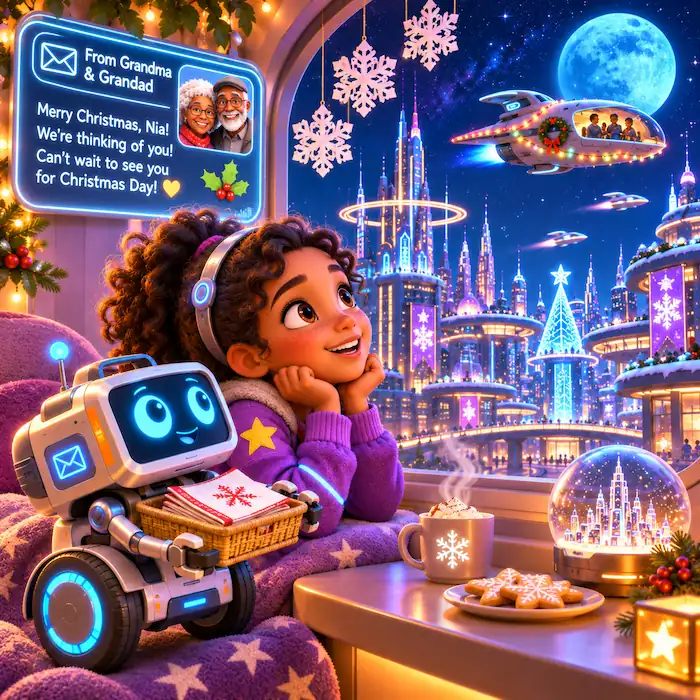
Nia should have been hanging paper snowflakes on the family message screen, but she was watching the orbit map in its corner. Each year, it tracked the Star-Mail Relay, a silver ship that carried Christmas letters away from Earth.
Usually, a blue dot blinked beside SANTA MAIL READY.
Tonight it was silver.
“Mom,” Nia called. “Is silver good?”
Mom was arranging cinnamon rolls on a plate. “Silver is very shiny,” she said. “That sounds promising.”
“It is not shiny. It is waiting.” Nia tapped the screen. A message appeared below the map.
RELAY WAITING FOR RETURN STAR. FINAL COLLECTION IN 12 MINUTES.

Mom came over and read it. “That is unusual.”
At that moment, Pogo rolled out of the kitchen with a basket of napkins balanced on his square little back. Pogo was the building’s helpful delivery robot. He had round blue eyes, thin arms and a voice that sounded as if it had swallowed a kazoo.
“Unusual is my third favorite kind of usual,” Pogo announced.
“What are your first two?” Nia asked.
“Snack time and recharge time.”
Pogo set down the napkins. One slid off his basket and landed on his head. He paused.
“I am now a fancy lamp,” he said.

Nia laughed, but Christmas mail never waited. Her letter had been ready since breakfast. It was folded inside a red envelope with three gold stars.
She had asked Santa for a set of tiny paintbrushes for Grandpa, who made pictures of birds but always lost his smallest brush. For Mom, she had wished for a day when nobody asked her to hurry anywhere.
Please make Christmas bright for everyone in our building, Nia had written. Especially Mr. Ishan on Floor Twelve, because his grandchildren were visiting from Mars and they had never seen snow fall from a city sky.
The city’s winter festival sent safe white bubbles from weather towers on Christmas morning. That afternoon’s test had left a few stray bubbles in the rooftop garden.
“Can we send my letter now?” Nia asked.
Mom glanced at the countdown. 11:06.
“Let’s find out what the return star needs,” she said.
Pogo’s eyes turned green, which meant he was searching his helpfulness files.
“Return star,” he said. “A small solar-powered signal beacon. It charges during the day. At night, it flashes a beam toward the Star-Mail Relay, so the relay knows where to collect letters and where to send replies.”
“I did not put a beacon in my letter,” said Nia.
“Most homes have one built into the mail chute,” Mom said. “Ours is on the roof. It looks like a little silver star.”
Nia knew the one. It stood beside the tomato planters in the rooftop garden. In daytime, its five points gathered sunshine and filled its small power store. At night, it sent its blue signal through the eastern glass panel.
“We should check it,” she said.
Mom looked at the screen. 10:21.
“We can check it now. Coats first.”
Nia was already reaching for hers. Pogo brought the milk to the table, then brought it back again because he had forgotten the cups.
“I was testing whether milk enjoys a walk,” he explained.
“Does it?” Nia asked.
“It was very quiet about its opinion.”
Twelve Minutes
The rooftop garden was quiet beneath its glass roof. Solar lamps glowed along paths between winter herbs, sleeping strawberry plants and a row of empty pots waiting for spring.
Mom unlocked the garden door with her wrist key. Pogo whirred behind them, carrying Nia’s red envelope in his basket.
“I am official mail furniture,” he said.
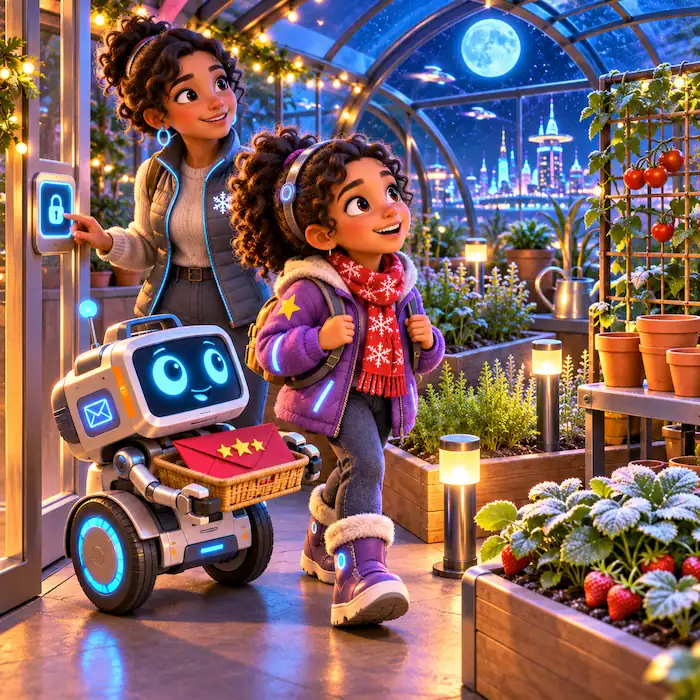
The return star stood beside the parcel chute. It was dinner-plate wide, with silver points and a blue lens in its middle.
Except the lens was covered with a thin sheet of white festival foam.
“Oh,” said Nia. “The beacon cannot see out.”

Mom knelt beside it. “The power store may be full, but its signal needs a clear way through.”
She took a soft garden cloth from the supply box and showed Nia how to wipe the foam away without scratching the lens. Nia cleaned carefully. Pogo held the cloth with both arms.
Then he wiped his own face instead.
“Excellent cleaning,” Pogo said. “My face is nearly a mirror.”

When the lens was clear, a small blue light blinked once.
Nia held her breath.
On Mom’s wrist key, the orbit map chimed. The silver dot turned blue.
Then it flashed silver again.
BEACON SIGNAL BLOCKED. 07:42 REMAINING.
Nia’s shoulders dropped. “We cleaned it.”
“We did,” Mom said. “And we found the first problem.”
Pogo rolled in a slow circle. “I can offer six hallway bulbs, one toaster light and my very enthusiastic eyes.”
“The beacon has power,” Nia said. “Something else is in the way.”
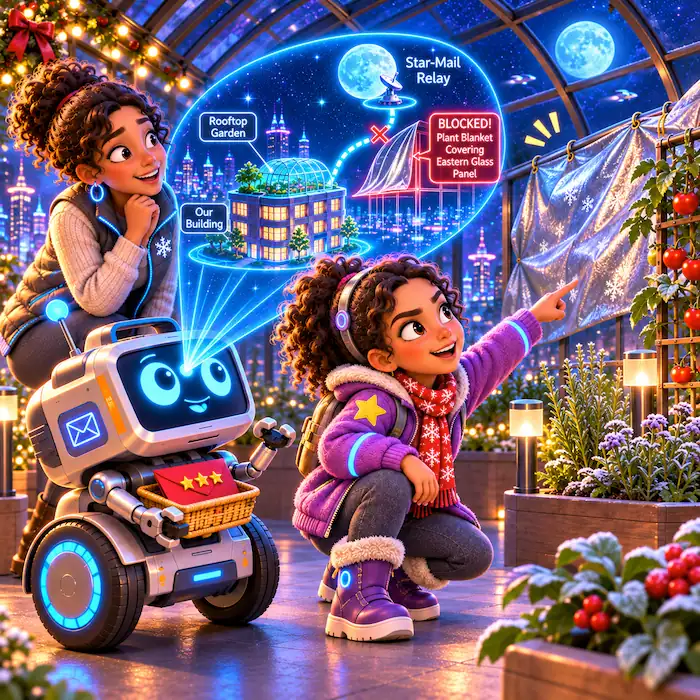
Pogo’s eyes glowed purple. A soft whir came from his middle. Above his head, a small three-dimensional map appeared: their building, the rooftop garden and a bright blue line pointing east toward the Star-Mail Relay.

“Helpful sky picture,” said Pogo. “On this map, the relay is passing the moon now. In seven minutes, its marker will slip behind the city towers.”
The silver marker moved slowly toward the edge of the map.
Nia crouched beside the return star. The blue line did not travel straight up. It went through the east side of the garden roof.
Then she noticed the tall tomato frame behind the beacon. It was wrapped for winter in a shiny silver plant blanket. One loose corner had slipped across the eastern glass panel. It hung directly in front of the blue line.
“There!” Nia pointed. “The blanket is covering the clear eastern panel.”
Mom followed her finger. “Good noticing.”
“Six minutes and fifty-nine seconds,” said Pogo. “I thought you would appreciate an update.”
The blanket was too high for Nia to reach. Mom checked the frame. “It only needs clipping back. Nia, stand by the map and tell us when the blue line is clear. Pogo, can you hold the blanket steady?”
Pogo lifted both arms. “I have a safe step-stool extension. It is for high shelves and very tall biscuits.”
Mom made sure his little wheels were locked, then climbed one short step. Pogo held the edge of the blanket. It flapped once and landed over his head like a shiny cape.
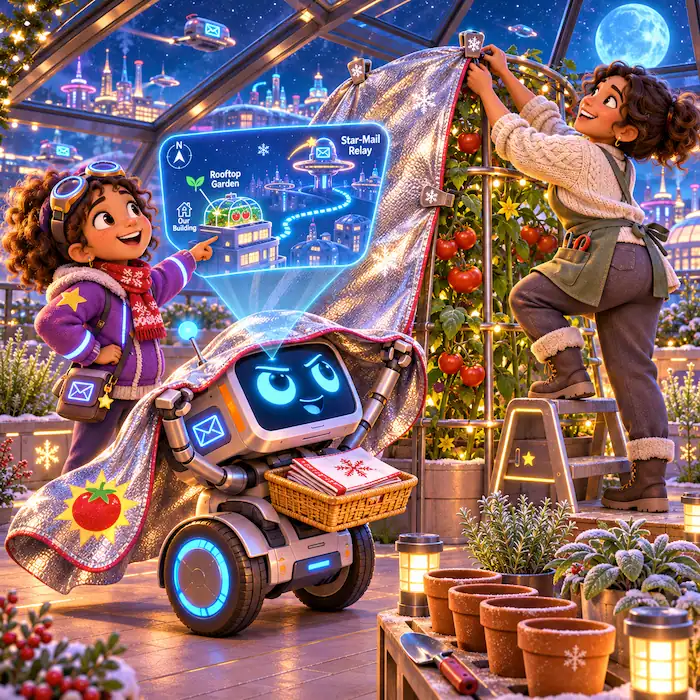
“I have become a heroic tomato,” he said.
Nia looked from the glowing map to the real garden. “A little more left,” she called. “No, the other left. Toward the empty pots.”
Mom laughed. “That is Pogo’s other left.”
Pogo turned around. “I have now found the correct left.”
Mom fastened the blanket to the far side of the frame. The eastern glass panel was clear.
For one long second, nothing happened.
Then the blue lens glowed. A narrow beam flashed across the glass, bright as a blue ribbon. It passed through the clear eastern panel.

On Pogo’s map, the blue line now reached the tiny silver ship.
The orbit map chimed three times.
SANTA MAIL READY. 04:18 REMAINING.
Pogo gave such a happy beep that a sleeping pigeon outside the glass roof fluttered from one ledge to another.
“Mail furniture has become mail delivery!” he cried.
The Extra Line
The parcel chute opened with a soft round hum. It was not wide, only big enough for letters and small packages. Pogo placed Nia’s envelope on its little tray.
Nia stopped him. “Wait.”
“What is wrong?” Mom asked.
Nia looked at her letter. She had written about Grandpa’s paintbrushes and Mom’s quiet day. She had written about snow bubbles for Mr. Ishan’s grandchildren. But now she remembered the thing that had made her happiest that evening.
It was not the cinnamon rolls. It was not the city lights. It was the way Mom had listened when Nia said the clear eastern panel mattered. It was the way Pogo had held the slippery blanket, even when it turned him into a heroic tomato.
Nia opened the envelope.
“Do you need another thing?” Mom asked.
“Yes,” Nia said. “Not a thing to put in a box.”
She found a blank space at the bottom of the page and wrote one more line.
Please help people notice when someone needs a hand, even if they are busy looking at the sky.
Pogo leaned closer. “That request may be larger than my basket.”
“It is not for your basket,” Nia said. “It is for everyone.”
She folded the letter, slipped it back into the envelope and pressed the seal flat. Then she placed it on the chute tray herself.
The tray slid away. For a moment, Nia could see the red envelope through the clear tube, traveling upward past the garden lights. At the roof, a small silver flap opened. The return star flashed blue, blue, blue.
Far above the city, the little silver relay ship blinked back.
The family screen chimed again.
A message appeared in neat green letters.
LETTER RECEIVED. THANK YOU FOR THE EXTRA LINE.
Below it was a picture of a red mitten giving a thumbs-up.
Pogo’s eyes grew wide. “Santa used a mitten symbol. This is a very official reply.”
Nia laughed. Mom put an arm around her shoulders, and together they watched the blue dot travel beyond the moon.
Christmas Morning
On Christmas morning, white festival bubbles floated down between the towers. They looked like little snowflakes as they drifted through the city lights. Mr. Ishan’s grandchildren pressed their faces to their apartment window, watching the first soft bubbles float into the courtyard below.
Nia and Mom were on their way down with cinnamon rolls when Nia saw Mr. Ishan standing beside the courtyard projector. He was trying to hang a bright paper sign that said WELCOME, LITTLE STARS! while holding a box of bubble-catching lanterns under one arm.
Each time he reached for the sign, the lanterns tipped sideways.
“Do you need a hand?” Nia asked.
Mr. Ishan looked surprised, then relieved. “I do, if you have one to spare.”
“I have two,” said Nia.
Pogo rolled out of the lift behind them. “I have thin arms, strong wheels and a very useful basket.”
Nia held the lantern box. Pogo shone his headlight on the sign while Mr. Ishan clipped it into place. Mom tied the last ribbon around the projector. Soon Mrs. Vale from Floor Seven came with extra paper stars. Grandpa brought a little stool. Two neighbours carried cups of warm cocoa into the courtyard.
When the first proper wave of white bubbles came drifting down, Nia held out her mitten and caught one. It melted into a bright drop of water on the wool. Then she showed Mr. Ishan’s grandchildren how to catch the next ones. The projector painted gentle blue constellations onto the wall as they ran beneath the bubbles, laughing and trying to catch the stars of light in their mittens.
Grandpa found a new set of tiny paintbrushes beside his art table. Mom sat down with a cinnamon roll before anyone could ask her to rush anywhere.
Nia looked up at the sky. The Star-Mail Relay was far too small to see now.
Then Pogo gave a quiet beep.
On the courtyard screen, one new message glowed for just one minute.
THANK YOU, NIA. I SAW THE TOMATO CAPE. KEEP LOOKING CLOSELY.
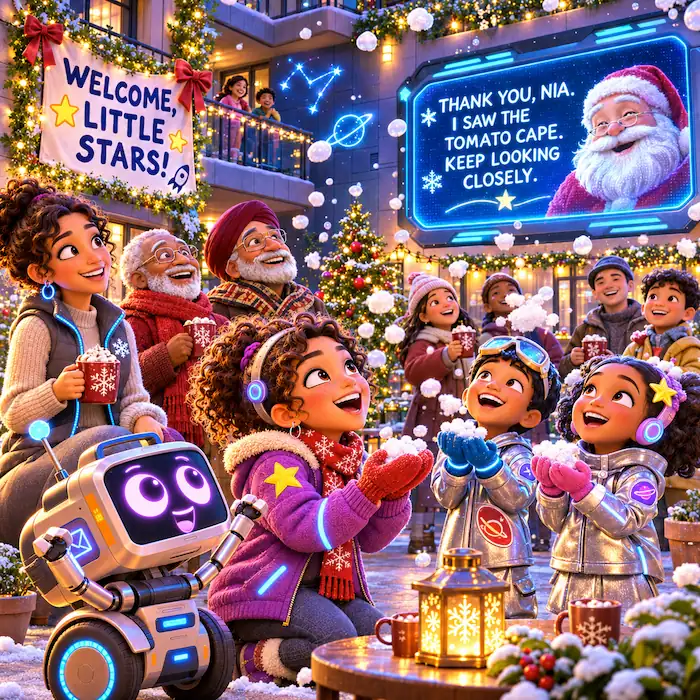
Nia stared at it.
Nobody outside the rooftop garden knew about Pogo’s silver blanket.
Pogo looked at the screen, then at the snowy bubbles drifting above the city.
“Very official,” he whispered.