

The Story of The First Strawberry
The River Valley Home
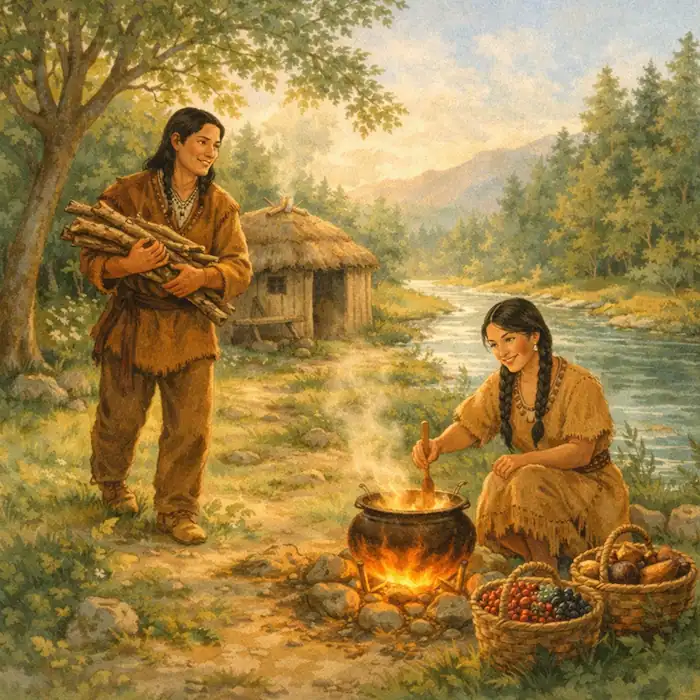
Long ago, when the world was still new, the first man and the first woman made their home beside a great broad river. Water moved slowly over smooth stones. Tall trees lined the banks. Deer passed through the woods, birds called at dawn and dusk, and fish were plentiful in the river. It was a good place to live.

Their home stood in a green valley where the sun reached early and the evenings were cool. Nearby, clear water bubbled from a spring. The forest gave them wood for the fire, the fields gave them berries and roots, and the river gave them fish. When the hunt went well, they had meat. When the trees were heavy with fruit, they had plenty to eat.
Most of all, they had each other.
At first, they worked side by side and laughed often. The first woman sang while she ground corn or cleaned fish by the river. The first man smiled when he heard her voice drifting through the trees. He brought wood to the fire and showed her where the sweetest berries grew. At night they sat by the flames and watched sparks rise into the dark like tiny stars.
“This is a good place,” said the first man one evening, looking out at the moonlit river.
“It is,” said the first woman. “And it feels even better because we share it.”
So the days passed peacefully. They rose with the sun and rested when night came. If rain fell, they listened to it drum on the roof. If wind blew, they pulled their cloaks close and stayed warm by the fire. Life was good then, and their days passed without trouble.
But even in a peaceful home, tempers can rise.
One evening the first man came back tired from walking the woods. He had hoped for a hot meal and an easy evening. Instead, he saw work still waiting to be done. A few things lay out of place. The fire had burned low. He frowned without meaning to.
“Why isn’t the meal ready?” he asked.
The first woman looked up. She was tired too. She had spent the day carrying water, gathering roots and cleaning the house. His words stung her.
“Why didn’t you bring the wood in for the fire?” she answered.
That should have been the end of it. A kind word from either one would have smoothed the trouble away. But neither stopped.
Harsh Words in the Morning
The first man crossed his arms. “I worked all day.”
“So did I,” said the first woman.
He glanced around the room. “Why is this still here?”
She lifted her chin. “Why are you always leaving things behind you?”
The air in the little house changed. It felt sharp now, not warm. Their voices grew louder. The words came faster. Each one hurt more than the last.
“You never listen,” said the first man.
“You never notice what I do,” said the first woman.
A wooden bowl landed on the floor with a clatter. Then a spoon. A plate spun across the room and struck the wall. Neither of them meant to throw anything at first. Still, once anger took hold, it pushed them both farther than they wanted to go.
Outside, the river kept moving and birds called from nearby trees as if nothing had happened. But inside the house, two unhappy hearts beat fast with pride and pain.
At last the first woman turned away.
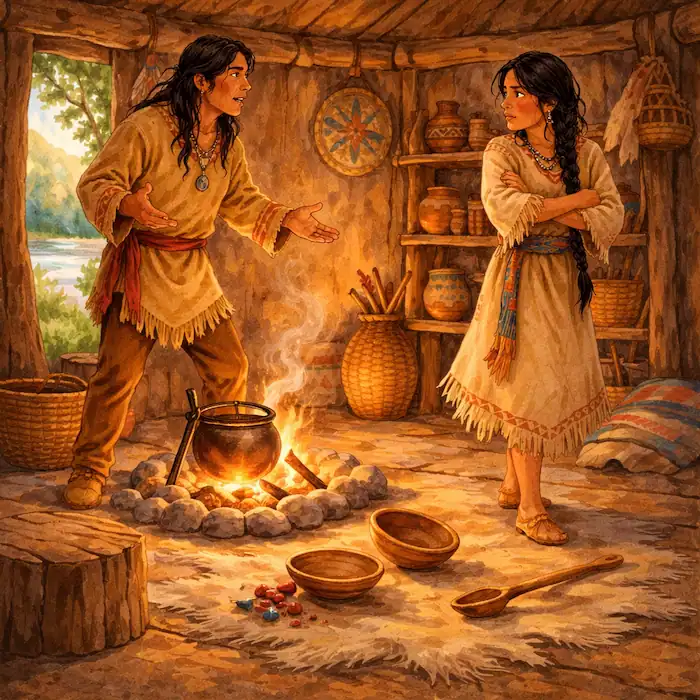
Her cheeks were hot. Her eyes filled with tears, though she would not let them fall in front of him.
“I will not stay here and listen to this,” she said.
The first man opened his mouth to answer, but no gentle words came. He was still too angry and too stubborn.
So the first woman lay down that night without speaking again. The first man lay awake for a while, staring at the fire.
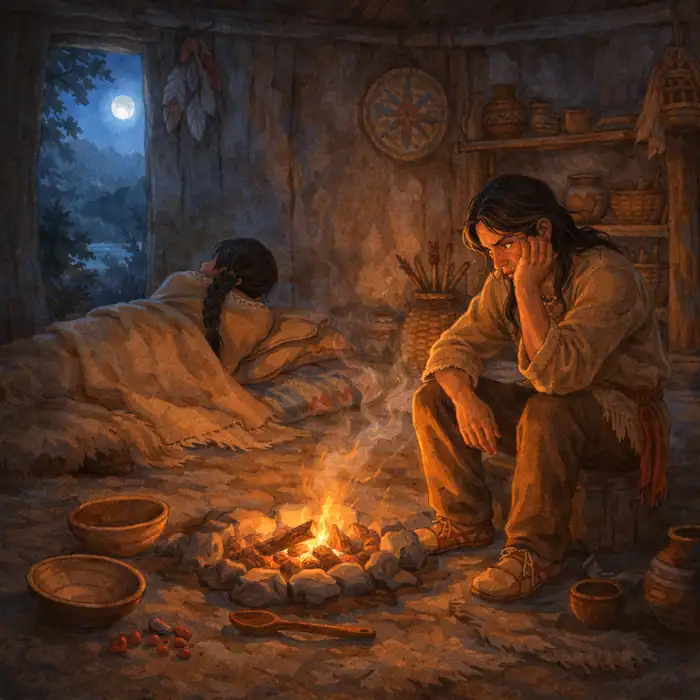
He thought of saying he was sorry. He thought of reaching across the dark. Yet pride held his tongue still. At last he slept.
Walking Towards the Sunrise
Before dawn the first woman rose. She wrapped her cloak around her shoulders. She took nothing but what she could carry. Then she stepped outside into the cool morning and started down the valley toward the rising sun.
She did not look back.
Mist floated over the river. Dew clung to the grass. The first woman kept walking.
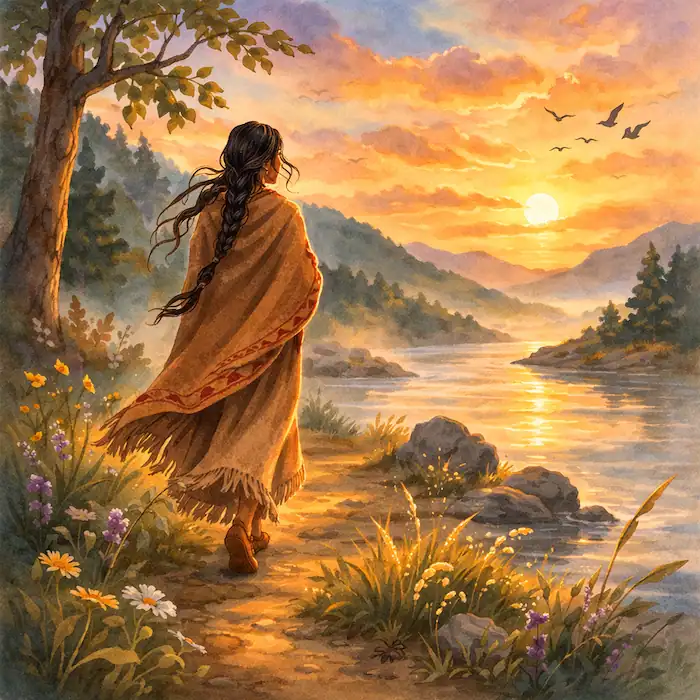
Her feet brushed the path that followed the valley eastward where the sky was slowly turning pink and gold. Every step took her farther from the house, the fire and the man she had once laughed with beside the river.
She was hurt. She was angry. Most of all, she did not trust herself to turn around. If she stopped, she might cry. If she cried, she might forgive too soon. So she fixed her eyes on the path ahead and walked on.
When the first man woke, sunlight already touched the doorway. He reached across the sleeping mat and found it empty. At once he sat up.
“She has gone,” he whispered.
He stepped outside. The valley seemed too still. No song drifted from the spring. No smoke rose from the morning fire. A strange ache opened inside him.
At first he told himself she might return in a moment. Perhaps she had gone for water. Perhaps she needed time alone.
But the moments passed.
Then he saw her footprints in the soft ground, clear in the damp earth, heading down the valley toward the sunrise.
His anger was gone.
“Oh no,” he said.
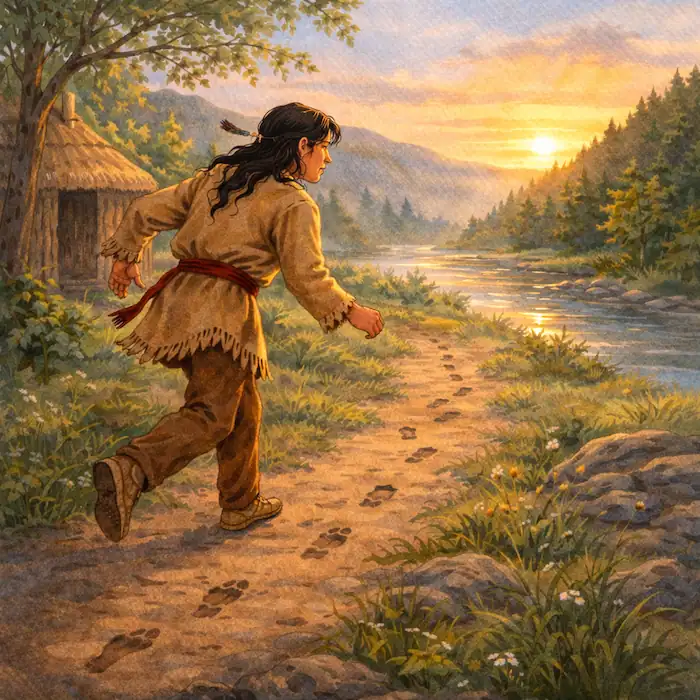
He began to follow. At first he walked quickly. Then he ran. Branches brushed his shoulders. Stones slipped under his feet. Yet she had left early and she had not stopped once so the distance between them stayed wide.
As he hurried along the path, the sun climbed higher into the sky. Its golden light reached across the river, the valley and the hills beyond.
From above, the sun saw many things. It saw birds building nests and foxes slipping through the grass. It saw fish turning in the water and wind rolling through the leaves.
That day it also saw sadness.
It saw the first woman walking alone with her face set hard. It saw the first man chasing after her with worry written all across his face.
The sun looked down with pity.
Its warm light touched the man’s shoulders, and he felt a gentle heat around him, as if the day itself had spoken.
“Are you still angry with your wife?” asked the sun.
The first man stopped and lifted his face. “No,” he said. “My anger is gone.”
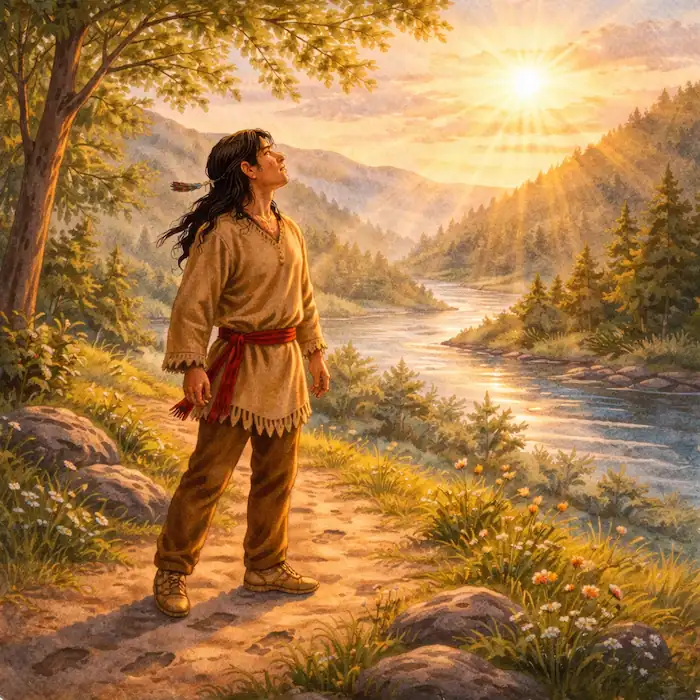
Do you want her to come back?” asked the sun.
The first man swallowed hard. “Yes,” he said. “I do.”
The sun shone brighter for a moment, as though it had heard the truth in his voice.
Then it decided to help.
Gifts Beside the Path
Far ahead, the first woman kept moving along the narrow path. Her steps had slowed a little, but she would not let herself rest. She looked only at the valley ahead, not at the earth beneath her feet and not at the trees around her.
So the sun sent its rays down gently to the ground beside her path.
In that warm bright place, a huckleberry bush sprang up all at once, green and fresh. Little berries gleamed among the leaves. They looked cool and sweet.
The first woman passed by without turning her head.
The sun watched and thought, She is still too troubled.
A little farther on, the sun touched the earth again. This time a clump of blackberry bushes rose beside the path. Their fruit shone purple black in the light. The berries were rich and ripe. Many people would have cried out with delight to see them.
But the first woman walked on.
She did not glance left or right.
She did not slow her steps.
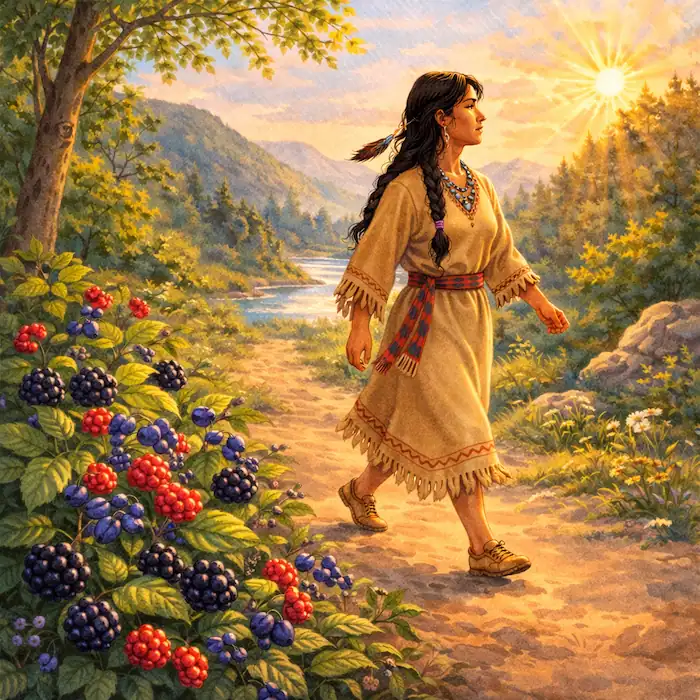
The sun grew thoughtful. It had offered sweet fruit, yet her heart remained heavy. Ordinary berries could not reach her. Something new was needed. Something the world had never seen before. Something bright and sweet enough to break through her hurt and make her pause.
So the sun gathered its warm golden beams and laid them across the earth one more time.
The ground glowed.
Tiny white flowers opened first. Then green leaves spread low across the soil. Beneath them grew little red fruits shaped like drops of water. Their scent rose into the air, soft and sweet. Their skins shone in the sunlight.
The first strawberries had come into the world.
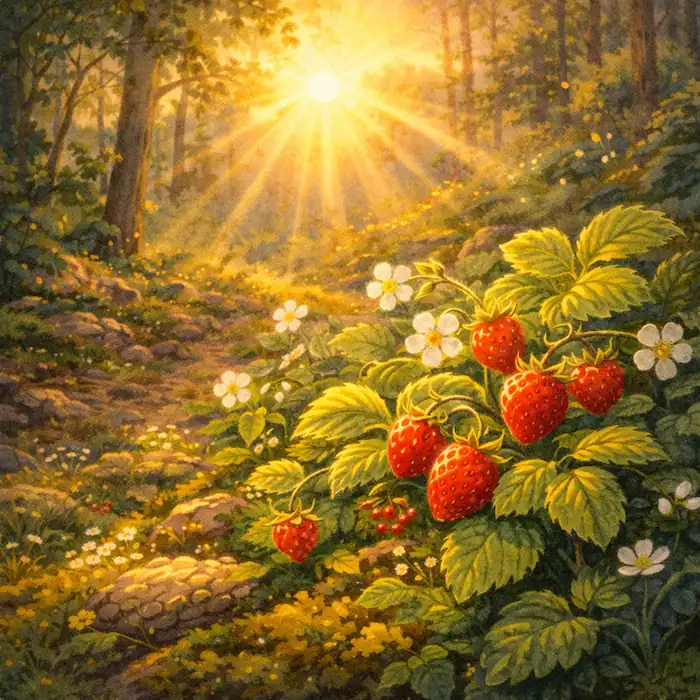
The First Strawberry
At once the first woman smelled something lovely on the breeze.
She slowed.
For the first time since leaving home, her eyes drifted away from the far horizon. She looked down and saw bright red berries peeking out beneath green leaves. Their color was so cheerful that it startled her. The sight of them did not match her angry mood at all.
She knelt beside them.
“What are these?” she whispered.
She had never seen such fruit before. Very carefully, she picked one. Its red skin glowed in her hand.
She took a bite.
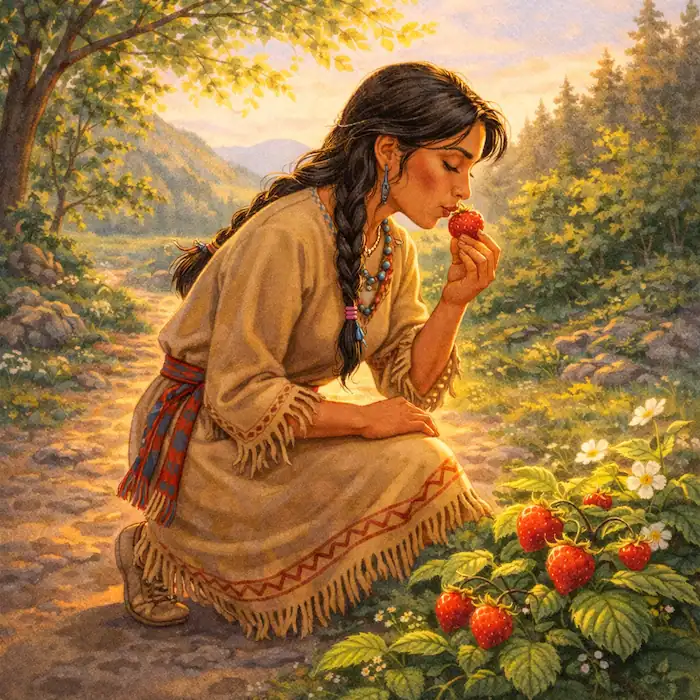
The berry was sweet, with a fresh sharp taste she had never known before.
The first woman closed her eyes.
As she swallowed, the tightness in her chest began to ease. The angry words from the night before no longer sounded so large. She remembered the first man bringing her fresh fish from the river with a grin on his face. She remembered the two of them laughing when rain blew smoke back into the house. She remembered evenings by the fire, quiet and close and gentle.
Then she looked at the half-eaten berry in her hand. Its soft red shape reminded her of a heart, no longer hard with anger.
She sat down in the grass beside the patch of berries. For the first time, she let herself breathe slowly. She felt calmer.
“I was hurt,” she said quietly to herself. “But I was hasty too.”
She picked another berry and ate it more slowly. Then another.
Meanwhile, the first man kept following the path. He was tired now and out of breath. Still, he did not stop. He feared that if he delayed even a little, he might lose her forever.
When he finally came over a rise, he saw her seated in the grass beside a patch of bright red berries. For a moment he simply stood there, amazed and relieved. Then he walked forward slowly, not wanting to frighten her away again.
The first woman turned and saw him.
Neither spoke at once.
The first man sat down beside her, leaving a little space. “I am sorry,” he said at last. “I should not have spoken so sharply.”
The first woman looked down at the berry in her hand. Then she nodded. “I am sorry too. I let my anger lead me.”
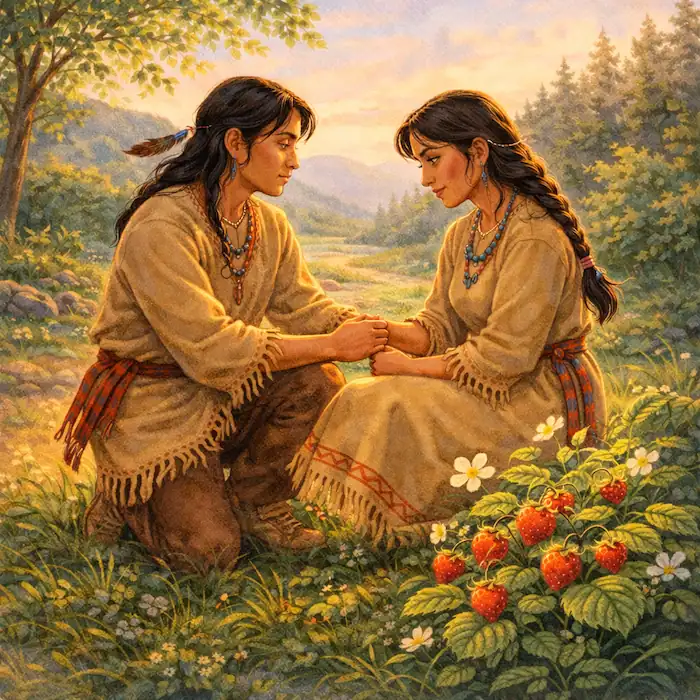
A breeze moved through the leaves above them.
The first man gave a small, hopeful smile. “What are these?”
She held out the berry. “I do not know. But they are sweet.”
He took it gently from her fingers and tasted it. As he ate, the worry in his face eased and he smiled.
“They are very sweet,” he said.
The Walk Back Home
For a little while they sat together in silence, eating strawberries from the patch beside the path. The quiet gave them time to think. They remembered how quickly harsh words can grow and how much difference one kind word can make.
At length the first man said, “Will you come home?”
The first woman looked toward the east where she had been walking. Then she looked back the way she had come, toward the river valley and the house they had built together.
“Yes,” she said. “I will.”
The first man let out a breath he felt he had been holding all day.
Together they rose. Before leaving, the first woman knelt beside the patch and gently loosened a few plants from the earth. The first man helped her lift them carefully, roots and all.
“We should take these with us,” she said.
“So we remember?” he asked.
“So we remember,” she replied.
They walked back through the valley side by side. This time neither hurried ahead.

When the path narrowed, they moved together. When stones made the footing rough, they slowed. Along the way they talked in quiet voices.
“I will try to speak more gently,” said the first man.
“And I will try not to answer too fast in anger,” said the first woman.
“When one of us is weary,” he added, “the other should notice.”
“When one of us is hurt,” she said, “the other should listen.”
The sun watched from above and warmed the valley with golden light.
By the time they reached home, the day was nearly done. The first man brought fresh water. The first woman set the strawberry plants in the ground near the doorway where they would be seen each day. Together they pressed the earth around the roots and gave them water.
Soon the small plants lifted their leaves toward the light.
Seasons passed. The strawberry patch spread. Each year the plants returned, bright and sweet. Whenever the first man and the first woman saw the red berries beneath the leaves, they remembered that hard morning in the valley and the choice they had made.
They still had days when one was tired and the other impatient. They were human, after all. Yet before anger could grow too big, one of them would glance at the strawberry patch and smile. Sometimes the first woman would pick a berry and hand it to the first man.
Sometimes he would do the same for her.
And each time, they remembered to slow down, think carefully and forgive.
That is why, in this old Cherokee folk tale, the first strawberry came into the world: to remind people to forgive and make peace.